Social/Relational Aggression
WHAT’S KNOWN ON THIS SUBJECT: Violence and
social/relational aggression are global problems that become prominent in early adolescence. An extensive literature examines the social contextual and biological influences on violence and antisocial behavior in youth. A potentially important but less well-studied influence is puberty.
WHAT THIS STUDY ADDS: Pubertal stage was associated with higher rates of violent behavior and social/relational aggression, with the latter association seen only at younger ages. Puberty is an important phase at which to implement prevention programs to reduce adolescent violent and antisocial behaviors.
abstract
OBJECTIVE:We examined associations between pubertal stage and violent adolescent behavior and social/relational aggression.
METHODS:The International Youth Development Study comprises statewide representative student samples in grades 5, 7, and 9 (N⫽ 5769) in Washington State and Victoria, Australia, drawn as a 2-stage cluster sample in each state. We used a school-administered, self-report student survey to measure previous-year violent behavior (ie, attacking or beating up another person) and social/relational aggres-sion (excluding peers from the group, threatening to spread lies or rumors), as well as risk and protective factors and pubertal develop-ment. Cross-sectional data were analyzed.
RESULTS:Compared with early puberty, the odds of violent behavior were approximately threefold higher in midpuberty (odds ratio [OR]: 2.87 [95% confidence interval (CI): 1.81– 4.55]) and late puberty (OR: 3.79 [95% CI: 2.25– 6.39]) after adjustment for demographic factors. For social/relational aggression, there were weaker overall associa-tions after adjustment, but these associaassocia-tions included an interaction between pubertal stage and age, and stronger associations with pu-bertal stage at younger age were shown (P⫽.003; midpuberty OR: 1.78 [95% CI: 1.20 –2.63]; late puberty OR: 3.00 [95% CI: 1.95– 4.63]). Associ-ations between pubertal stage and violent behavior and social/rela-tional aggression remained after the inclusion of social contextual mediators in the analyses.
CONCLUSIONS:Pubertal stage was associated with higher rates of violent behavior and social/relational aggression, with the latter asso-ciation seen only at younger ages. Puberty is an important phase at which to implement prevention programs to reduce adolescent violent and antisocial behaviors.Pediatrics2010;126:e298–e305
AUTHORS:Sheryl A. Hemphill, PhD,a,b,cAneta Kotevski,
DPsych,a,bTodd I. Herrenkohl, PhD,dJohn W. Toumbourou,
PhD,a,b,cJohn B. Carlin, PhD,e,fRichard F. Catalano, PhD,d
and George C. Patton, MDa,b
aCentre for Adolescent Health andeClinical Epidemiology and Biostatistics Unit, Murdoch Childrens Research Institute, Royal Children’s Hospital, Melbourne, Australia; Departments of bPaediatrics andfPaediatrics and Population Health, University of Melbourne, Melbourne, Australia;cSchool of Psychology, Deakin University, Victoria, Australia; anddSocial Development Research Group, School of Social Work, University of Washington, Seattle, Washington
KEY WORDS
puberty, adolescent, juvenile delinquency, aggression
ABBREVIATIONS
IYDS—International Youth Development Study PDS—Pubertal Development Scale
OR— odds ratio df— degrees of freedom CI— confidence interval
The content of this article is solely the responsibility of the authors and does not necessarily represent the official views of the National Institute on Drug Abuse.
www.pediatrics.org/cgi/doi/10.1542/peds.2009-0574
doi:10.1542/peds.2009-0574
Accepted for publication May 12, 2010
Address correspondence to Sheryl A. Hemphill, PhD, Centre for Adolescent Health, 2 Gatehouse St, Parkville, Victoria 3052, Australia. E-mail: [email protected]
PEDIATRICS (ISSN Numbers: Print, 0031-4005; Online, 1098-4275).
Copyright © 2010 by the American Academy of Pediatrics
FINANCIAL DISCLOSURE:The authors have indicated they have no financial relationships relevant to this article to disclose.
Adolescent aggression has high costs for individuals and their peers, fami-lies, schools, and communities.1–3
Rates of violence and social/relational aggression (eg, excluding peers from one’s group activities) range between 10% and 20%4,5 and peak in
adoles-cence.6–8There is an extensive
litera-ture examining the social contextual and biological influences on violence and antisocial behavior in youth. A po-tentially important but less well-studied influence is puberty and its role in triggering both the biological and social contextual changes of adolescence.
Puberty begins in late childhood through endocrine changes that lead to sexual maturation and reproductive capability.9 In humans, puberty
coin-cides with physical growth and brain maturational changes and also with emotional, cognitive, and behavioral changes.9 In the 1960s, Marshall and
Tanner developed a system of reliable staging of the external signs of puberty (eg, pubic hair).10,11Pubertal timing is
defined by whether pubertal develop-ment is early, on time, or late com-pared with peers of the same age. The distinction between pubertal stage and pubertal timing is important, be-cause both pubertal stage and timing may have independent effects on risks for the development of behavioral problems in early adolescence.9
There are particular reasons to con-sider associations between puberty and violence and social/relational ag-gression. First, for violent behavior, changes in physical size, particularly for boys, provide opportunities to use physical violence to assert oneself and inflict more damage on others and property than at early stages of devel-opment.7 Second, links between
pu-berty and antisocial behaviors includ-ing violence and social/relational aggression seem stronger for boys with antisocial friends, which suggests
that advancing pubertal stage pro-duces either a change in peer group and/or greater susceptibility to peer influence.9 The growing influence of
peer behaviors on risks for substance use and abuse with advancing puber-tal stage has been demonstrated.12
Third, puberty may also be associated with increases in other risk factors for violence and antisocial behavior, such as conflict with parents and school dis-engagement, and individual-level risk factors such as increased substance use.13,14
In this study we examined associations between pubertal stage and violent be-havior and social/relational aggres-sion in adolescence after controlling for key demographic characteristics, individual-level risk factors, and social contextual mediating factors. We drew on data from the International Youth Development Study (IYDS), comprising 2 statewide representative samples of students in grades 5, 7, and 9 (N ⫽ 5769) in Washington State and Victo-ria, Australia, drawn as a 2-stage clus-ter sample in each state. Our aims were to ascertain whether (1) puber-tal stage is associated with violent be-havior and social/relational aggres-sion independent of age, gender, and state and (2) any associations found with pubertal stage can be explained by controlling for social contextual factors.
METHODS
Participants
A 2-stage cluster-sampling approach was used for school and student re-cruitment in 2002. Schools were ran-domly selected in the first stage, and a target classroom within each school was randomly selected in the second stage. Within each state and grade level, public and private schools con-taining grades 5, 7, or 9 were randomly selected by using a probability propor-tional to grade-level size-sampling
pro-cedure.15 More details about
recruit-ment and participation rates have been described by McMorris et al.4
Procedure
Protocols were approved by the Uni-versity of Washington Human Subjects Review Committee and the Royal Chil-dren’s Hospital Ethics in Human Re-search Committee. To control for sea-sonal effects, surveys in 2002 were administered in February through June in Washington State and in May through November in Victoria by study staff.4 Surveys were
group-administered in classrooms during a 50- to 60-minute period. Students who were absent from school were given the surveys later under the supervi-sion of trained school personnel or, in
⬍3% of cases, over the telephone by study staff. After survey completion, the students in Washington State re-ceived $10; Victorian students rere-ceived a small pocket calculator after return of their consent forms.
Measures
The self-reported measures of violent behavior and social/relational aggres-sion and risk and protective factors were drawn from the Communities That Care survey, which has accept-able psychometric properties.16–18
Antisocial Behavior
Violent behavior was measured by 2 items that asked how often in the pre-vious 12 months students had (1) at-tacked someone with the idea of seri-ously hurting him or her and (2) beaten up someone so badly that he or she required medical treatment. Re-sponse options ranged from never to ⱖ40 times on an 8-point scale (Cron-bach’s␣⫽0.60). A dichotomous mea-sure was created for violent behavior; violent behavior was present (score of 1) if students reported either behavior ⱖ1 time and absent (score of 0) if
Social/relational aggression was as-sessed by 2 items that asked how many times in the previous 12 months students had (1) gotten back at an-other student by not letting him or her be in their group of friends and (2) told lies or started rumors about other stu-dents to make other friends not like them. The items were rated on an 8-point scale that ranged from never to ⱖ40 times (Cronbach’s ␣ ⫽ 0.62). A dichotomous measure for social/ relational aggression was also formed. Social/relational aggression was scored as present (score of 1) if students en-gaged in either behavior ⱖ3 times, and it was scored as absent (0) if stu-dents engaged in either behavior 0 to 2 times.
Pubertal Development
Pubertal stage was assessed with the Carskadon and Acebo self-report ver-sion of the Pubertal Development Scale (PDS).19,20 Adolescents reported their
stage of pubertal development on 5 in-dices of pubertal growth. All partici-pants were asked about growth, body hair, and skin changes. Adolescent boys were asked about changes to their voice and growth of facial hair, and girls were asked about their breast development. Response options were (1) not yet started, (2) barely started, (3) definitely started, and (4) seems complete. Following the criteria of Carskadon and Acebo,19 a 5-level
(I–V) categorical scale comparable to Tanner’s sexual maturation scale stages was calculated. In previous analyses of the IYDS sample, the ma-jority of students reported pubertal stages between II and IV.12Hence,
pu-bertal stages reported in this article were categorized in 3 levels: early (stages I and II), middle (stage III), and late (stages IV and V). In a previous study that used IYDS data, Bond et al21
ner’s sexual maturation scale and the PDS (boys: 89%; girls: 97%). There was lower but moderate agreement (boys: 0.42; girls: 0.57) for individual stage agreement.21 The PDS demonstrated
Cronbach’s ␣values of 0.81 for both male and female participants in this study.
Social Contextual Mediating Factors
Poor family management was
mea-sured with a 9-item scale that resulted in scores that ranged from 1 (definitely no) to 4 (definitely yes) (Cronbach’s ␣⫽.81). Items included whether par-ents would know if the student did not come home on time and whether the family has clear rules about alcohol and drug use.
Having antisocial friends was mea-sured with a 3-item scale that as-sessed how many of the participant’s
best friends (from 0, none of my friends, to 4, 4 of my friends) in the previous 12 months had been sus-pended from school, stolen some-thing worth more than US $5/AUS $10, or attacked someone with the idea of seriously hurting them (Cronbach’s␣⫽68).
School connections were assessed by calculating the mean of 3 scales that reflected commitment to school (eg,
how interesting most of the school subjects were to the student, rated on a 5-point scale; Cronbach’s ␣⫽.77), opportunities for prosocial involve-ment (eg, students have lots of chances to help decide things such as class activities and rules; Cronbach’s ␣⫽.54), and recognition for prosocial involvement (eg, teachers notice when the student does a good job and lets him or her know about it; Cronbach’s ␣ ⫽.71). Response options for both opportunities and recognition for
proso-Individual-Level Risk Factors Depressive symptoms were measured by using the Short Mood and Feelings Questionnaire.22This 13-item scale
cor-relates moderately with the Children’s Depression Inventory23(r ⫽ .67) and
the Diagnostic Interview Schedule
for Children (r ⫽ .65) depression scale.24–26
Lifetime alcohol use and lifetime to-bacco use were assessed by using self-report items derived from the Monitoring the Future surveys.27
Lifetime alcohol use and tobacco use was defined as any use of
alco-hol and tobacco. Response options ranged from no, never (scored as 0) to yes, ⱖ3 in the previous year (scored as 1).
Analysis
Logistic regression models were used to estimate associations (as odds ra-tios [ORs]) between dichotomous out-comes and pubertal stage, with adjust-ment for covariates. All analyses controlled for age, gender, and state. Interaction effects that involved age, gender, location, and pubertal stage were explored. To test mediating fac-tors, analyses first adjusted for individual-level risk factors (depres-sive symptoms and lifetime tobacco and alcohol use) and then focused on exemplars of established social con-textual factors within the peer group
(antisocial friends), family (poor fam-ily management), and school (connec-tion) for which there is evidence of change with pubertal stage.28All
RESULTS
Study Sample
Each age cohort in the sample com-prised the following in each state (VIC indicates Victoria; WA, Washington State): for grade 5, nVIC ⫽ 927 and nWA⫽943; for grade 7,nVIC⫽984 and nWA⫽961; and for grade 9,nVIC⫽973 andnWA⫽981. In each state, the grade 5 cohort was composed almost en-tirely of 10- and 11-year-olds, the grade 7 cohort of 12- and 13-year-olds, and the grade 9 cohort of 14- and 15-year-olds, and boys and girls were equally represented. The mean age of the Washington State boys was 12.7 years (SD: 1.7) and of the girls, 12.6 years (SD: 1.7). In the Victorian sample, the mean age for boys was 12.5 years (SD: 1.7) and for girls, 12.4 years (SD: 1.7).
Table 1 shows the distribution of pu-bertal stages in the sample. In both Washington State and Victoria, the ma-jority of boys reported pubertal stages between I/II and III; 24% and 20% were at stage IV/V in Washington State and Victoria, respectively. Girls reported later pubertal stages, with the major-ity of them in stage IV/V, although the girls in Washington State reported later pubertal stages than Victorian girls.
Violent behavior was more prevalent in Victorian boys compared with Victo-rian girls (P⬍.001), but there was a substantially smaller gender differ-ence among Washington State stu-dents (P⫽.033). In Victoria, more boys than girls engaged in social/relational aggression (P⫽.026), but this gender difference was not seen in the Wash-ington State sample.
Association of Pubertal Stage With Violent Behavior and
Social/Relational Aggression Unadjusted logistic regression models showed that the odds of both violent behavior and social/relational
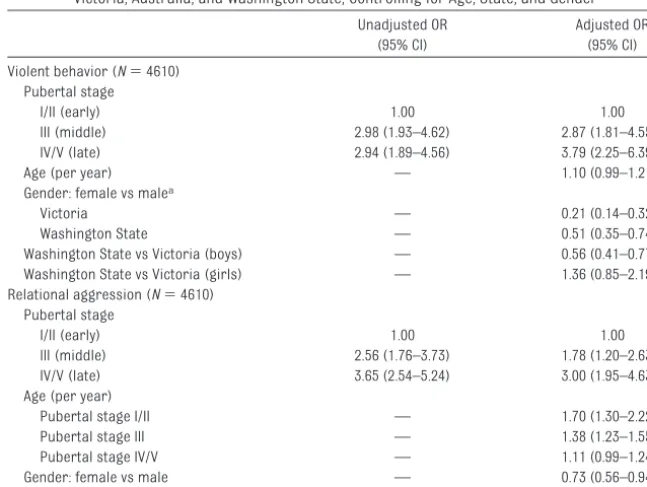
aggres-sion were elevated in pubertal stages III and IV/V (Table 2). Multivariable lo-gistic regression models were fitted to examine whether these associations remained after adjusting for age, gen-der, and state. The model for violent behavior included an interaction be-tween gender and state consistent with the patterns shown in Table 1. For this outcome, there was no evidence
for an interaction between pubertal stage and age (Wald2,P⫽.6, 2
de-grees of freedom [df]). After adjust-ment, compared with early puberty, the odds of violent behavior were
⬃2.5-fold higher in midpuberty and late puberty.
An interaction was found between pu-bertal stage and age in the model for
TABLE 1 Prevalence of the Study Outcomes (Violent Behavior and Social/Relational Aggression) and Pubertal Classification of Secondary Students in Victoria, Australia, and Washington State
Washington State Victoria
Male Female Male Female
Pubertal stage
I/II (early), % 35.2 11.3 34.5 13.3
III (middle), % 41.4 26.6 45.3 32.7
IV/V (late), % 23.5 62.1 20.1 54.0
n 1138 1160 1132 1180
Violent behavior
Not in the previous year, % 93.5 95.5 89.2 96.8
ⱖ1 time in the previous year, % 6.5 4.5 10.8 3.2
n 1138 1160 1132 1180
Social/relational aggression
0 or 1–2 times in previous year, % 93.0 92.9 90.0 92.6 ⱖ3 times in the previous year, % 7.0 7.1 10.0 7.4
n 1138 1160 1132 1180
TABLE 2 Association Between Pubertal Stage and Antisocial Behavior Outcomes for Students in Victoria, Australia, and Washington State, Controlling for Age, State, and Gender
Unadjusted OR (95% CI)
Adjusted OR (95% CI)
Violent behavior (N⫽4610) Pubertal stage
I/II (early) 1.00 1.00
III (middle) 2.98 (1.93–4.62) 2.87 (1.81–4.55)
IV/V (late) 2.94 (1.89–4.56) 3.79 (2.25–6.39)
Age (per year) — 1.10 (0.99–1.21)
Gender: female vs malea
Victoria — 0.21 (0.14–0.32)
Washington State — 0.51 (0.35–0.74)
Washington State vs Victoria (boys) — 0.56 (0.41–0.77) Washington State vs Victoria (girls) — 1.36 (0.85–2.19) Relational aggression (N⫽4610)
Pubertal stage
I/II (early) 1.00 1.00
III (middle) 2.56 (1.76–3.73) 1.78 (1.20–2.63)b
IV/V (late) 3.65 (2.54–5.24) 3.00 (1.95–4.63)b
Age (per year)
Pubertal stage I/II — 1.70 (1.30–2.22)
Pubertal stage III — 1.38 (1.23–1.55)
Pubertal stage IV/V — 1.11 (0.99–1.24)
Gender: female vs male — 0.73 (0.56–0.94)
Washington State vs Victoria — 0.78 (0.62–0.98)
— indicates not applicable.
aInteraction effect, gender by state:P⫽.001.
bAt age 12 (interaction effect, pubertal stage by age:P⫽.003).
social/relational aggression (Wald2,
P⫽.005, 1df), indicating that the odds of social/relational aggression in-creased with age for students in pu-bertal stages I/II but not for those in stages IV/V. An alternative interpreta-tion of these results was obtained by deriving estimated ORs that compare pubertal stages at different ages. For example, the model implies that the OR for stage III versus stages I/II at age 10 was 2.5 (95% confidence interval [CI]: 1.2–5.2), whereas by the age of 13
years this OR was reduced to 1.3 (95% CI: 0.8 –2.1). Comparison with stages IV/V does not make sense until at least the age of 12, when some children reach these advanced stages. The esti-mated OR comparing stage IV/V with stage III at the age of 12 was 1.4 (95% CI: 0.96 –2.0) and reduced to 0.77 (95% CI: 0.53–1.1) by the age of 15.
Testing of Social Mediators
Logistic regression was used to inves-tigate whether social contextual
fac-tors mediate the association between pubertal stage and antisocial behavior outcomes (Tables 3 and 4).
Poor family management, school con-nection, and having antisocial friends had robust independent associations
with violent behavior. However, only the inclusion of having antisocial friends substantially decreased the as-sociation of pubertal stage with violent
behavior, and poor family manage-ment had a smaller effect. After
adjust-Adjusted Analysis: Individual Risk Factors,
OR (95% CI)
Multivariable Models Incorporating Social Mediators, OR (95% CI)
Poor Family Management
School Connection
Antisocial Friends
Full Model
Pubertal stage
I/II (early) 1.00 1.00 1.00 1.00 1.00
III (middle) 2.38 (1.51–3.76) 2.27 (1.43–3.60) 2.39 (1.51–3.80) 2.07 (1.26–3.40) 1.86 (1.13–3.04) IV/V (late) 2.56 (1.50–4.37) 2.29 (1.33–3.95) 2.54 (1.49–4.33) 1.95 (1.09–3.49) 1.60 (0.89–2.87) Individual risk factor
Depressive symptoms 3.09 (2.40–3.97) 2.68 (2.07–3.49) 2.53 (1.95–3.29) 2.32 (1.75–3.08) 1.88 (1.39–2.53) Lifetime tobacco use 2.64 (2.00–3.48) 2.26 (1.71–3.00) 1.47 (1.87–3.26) 1.63 (1.19–2.22) 1.35 (0.97–1.89) Lifetime alcohol use 2.10 (1.48–2.98) 1.88 (1.32–2.68) 1.99 (1.40–2.82) 1.69 (1.18–2.42) 1.33 (0.91–1.95) Social mediator
Poor family management — 2.32 (1.74–3.10) — — 1.41 (1.01–1.97)
School connection — — 0.43(0.31–0.61) — 1.01 (0.69–1.49)
Antisocial friends — — — 2.77 (2.41–3.19) 2.54 (2.19–2.95)
All analyses controlled for gender, state, and state-by-gender interaction. — indicates not applicable.
TABLE 4 Association Between Social/Relational Aggression and Pubertal Stage in 4610 Secondary School Students in Washington State and Victoria After the Inclusion of Individual-Level Risk Factors and Possible Mediating Variables From the Social Context
Adjusted Analysis: Individual Risk Factors,
OR (95% CI)
Multivariable Models Incorporating Social Mediators, OR (95% CI)
Poor Family Management
School Connection
Antisocial Friends
Full Model
Pubertal stage
I/II (early) 1.00 1.00 1.00 1.00 1.00
III (middle) 1.60 (1.08–2.38)a 1.58 (1.06–2.35)a 1.60 (1.07–2.38)a 1.50 (1.00–2.24)a 1.49 (1.00–2.23)a
IV/V (late) 2.25 (1.42–3.55)a 2.18 (1.38–3.44)a 2.24 (1.41–3.54)a 1.98 (1.25–3.16)a 1.97 (1.24–3.13)a
Age (per year)
Pubertal stage I/II 1.60 (1.21–2.11) 1.57 (1.19–2.07) 1.59 (1.20–2.10) 1.59 (1.20–2.11) 1.60 (1.21–2.11) Pubertal stage III 1.28 (1.14–1.44) 1.26 (1.12–1.42) 1.27 (1.13–1.44) 1.28 (1.13–1.44) 1.28 (1.13–1.45) Pubertal stage IV/V 1.05 (0.93–1.19) 1.04 (0.92–1.18) 1.05 (0.92–1.18) 1.05 (0.93–1.19) 1.05 (0.93–1.20) Individual risk factor
Depressive symptoms 2.08 (1.63–2.67) 2.00 (1.56–2.56) 2.03 (1.57–2.61) 1.80 (1.39–2.33) 1.84 (1.41–2.40) Lifetime tobacco use 1.84 (1.42–2.38) 1.76 (1.35–2.29) 1.82 (1.40–2.36) 1.45 (1.11–1.91) 1.45 (1.10–1.91) Lifetime alcohol use 1.49 (1.10–2.00) 1.43 (1.06–1.94) 1.47 (1.09–2.00) 1.35 (1.00–1.83) 1.35 (0.99–1.84) Social mediator
Poor family management — 1.27 (1.01–1.60) — — 1.11 (0.87–1.40)
School connection — — 0.89 (0.65–1.20) — 1.19 (0.86–1.65)
Antisocial friends — — — 1.63 (1.44–1.84) 1.64 (1.44–1.86)
Pvalue for interaction effect pubertal stage according to age
.005 .005 .005 .006 .005
All analyses controlled for gender and state. — indicates not applicable.
ment for all potential mediators, the association with violent aggression was considerably diminished.
The addition of individual risk factors and social mediators had only a small effect on the age-related puberty ef-fects outlined in Table 2.
DISCUSSION
Pubertal stage was associated with both adolescent violence and social/ relational aggression. After consider-ing possible confounders includconsider-ing gender and state, the odds of violence in midpuberty and late puberty were
⬃3 times higher than in early puberty. It is important to note that the puber-tally associated increase in risk of vio-lent behavior occurs independently of increases in age. There was a more complex pattern of association for social/relational aggression. Overall,
there were weaker associations with pubertal stage after adjustment, but these associations included an inter-action between pubertal stage and age, showing stronger associations with pubertal stage at younger ages. This result suggests that the adoles-cent increase in social/relational
ag-gression is related to the timing of pu-berty; differences in pubertal stage are more salient with respect to so-cial/relational aggression at younger ages than they are at older ages. Fur-ther adjustment for individual-level risk factors and the inclusion of social mediating factors such as having
anti-social friends reduced the association between pubertal stage and violent be-havior. On the other hand, the associ-ation between pubertal stage and social/relational aggression generally persisted even after the inclusion of social mediating factors, although
hav-ing antisocial friends reduced the magnitude of the association. The ef-fects seemed to be consistent across the 2 socially distinct contexts of the
northwestern US and southeastern Australia.
The findings from this study are con-sistent with those of previous re-search that showed links between pu-bertal stage and a range of adolescent risk behaviors including antisocial be-havior.9 However, existing literature
has been limited by small and nonrep-resentative sample sizes, not adjusting analyses for individual-level risk fac-tors, and the inclusion of a limited range of social contextual factors, which makes comparisons between studies difficult.30–32A unique aspect of
this study was the inclusion of a large, statewide representative sample from 2 states, adjustment for individual-level risk factors, and the inclusion of modifiable social contextual factors. In addition, compared with other stud-ies that have included general mea-sures of antisocial behavior, our study measured violence and social/ relational aggression, which enables a better understanding of how pu-berty affects these specific adoles-cent antisocial behaviors.
The large sample size and coverage of an age range relevant to puberty al-lowed the examination of separate and joint effects of age and pubertal stage, in effect testing for effects related to pubertal timing. In addition, we used rigorous design and standardized pro-cedures for participant recruitment, survey development and administra-tion, and data management to over-come the common methodologic limitations of many previous cross-national comparisons.4,33 It is one of
only a few high-quality studies of com-munity samples of adolescents and has rich data on social contextual factors.
Some study limitations should be noted. First, pubertal measures were based on self-report, rather than di-rect observation, to minimize intru-sion. Validation studies of the PDS have
supported the use of this self-report measure in large epidemiologic stud-ies in which the use of pictorial mea-sures may be considered inappropri-ate and increase rinappropri-ates of missing data.21,34 Another limitation is, given
the age range of the participants, there were relatively fewer boys in pu-bertal stages IV/V, which may have in-fluenced the results. However, the as-sociations were sufficiently strong to be detected despite this limitation. Third, cross-sectional data were ana-lyzed in this study, which limits inter-pretations about causal processes. Longitudinal analyses of the associa-tions between pubertal stage and vio-lent behavior and social/relational ag-gression are crucial for progressing understanding in this area. In particu-lar, longitudinal analyses will enable a more direct examination of the possi-ble mediating factors of the associa-tion between pubertal stage and vio-lent behavior and social/relational aggression. In addition, statistical ad-justment of the analyses may not re-move all of the contributing influence of the confounders. Finally, the mea-sures of violent behavior and social/ relational aggression are relatively brief, although they include the core components of these constructs.
The patterns of association between pubertal stage and violence differ from those of pubertal stage and so-cial/relational aggression. For vio-lence, the association with pubertal stage was reduced after the inclusion of social mediators including having antisocial friends and poor family management. In contrast, for social/ relational aggression, the inclusion of social mediators yielded smaller re-ductions in associations with pubertal stage. Having antisocial friends and poor family management have consis-tently been associated with violent ad-olescent behavior, which emphasizes the importance of prevention
there may be other social contextual mediators not measured in this study that require further research. Sex hor-mones may also have an important role in the development of violence during puberty, and although it was beyond the scope of this study, further research in this area is warranted.35
CONCLUSIONS
Pubertal change brought substantially higher rates of both violence and so-cial/relational aggression that were independent of age, substance use, and emotional well-being. The
associa-by having antisocial friends and poor family management, which suggests both of these areas as potential tar-gets for preventive intervention at this developmental stage. Although having antisocial friends had some effect on the pubertal association between so-cial/relational aggression and puber-tal stage, this relationship could only, in small part, be explained by the me-diators examined in this study.
ACKNOWLEDGMENTS
We are grateful for the financial sup-port of the National Institute on Drug
ment Theme, Murdoch Childrens Re-search Institute, for funding the analy-ses for this article. Dr Hemphill is supported by funding from Australian
Research Council Discovery Project DPO663371, Dr Patton is supported by a National Health and Medical Re-search Council Fellowship, and Dr Toumbourou is supported by a Victo-rian Health Promotion Foundation Fellowship.
We thank project staff and partici-pants for valuable contribution to the project.
REFERENCES
1. Herrenkohl TI, McMorris BJ, Catalano RF, Abbott RD, Hemphill SA, Toumbourou JW. Risk factors for violence and relational ag-gression in adolescence.J Interpers Vio-lence.2007;22(4):386 – 405
2. Rutherford A, Zwi A, Grove N, Butchart A. Violence: a priority for public health? (part 2).J Epidemiol Community Health. 2007; 61(9):764 –770
3. World Health Organization.World Report on Violence and Health. Geneva, Switzerland: World Health Organization; 2002
4. McMorris BJ, Hemphill SA, Toumbourou JW, Catalano RC, Patton GC. Prevalence of sub-stance use and delinquent behavior in ado-lescents from Victoria, Australia and Wash-ington, USA.Health Educ Behav.2007;34(4): 634 – 650
5. Vassallo S, Smart D, Sanson A, et al. Pat-terns and Precursors of Adolescent Antiso-cial Behaviour: The First Report. Melbourne, Australia: Crime Prevention Victoria; 2002
6. Elliott DS. Serious violent offenders: onset, developmental course, and termination— the American Society of Criminology 1993 presidential address.Criminology. 1994; 32(1):1–21
7. Farrington DP, Loeber R, Elliott DS, et al. Ad-vancing knowledge about the onset of delin-quency and crime. In: Lahey BB, Kazdin AE, eds.Advances in Clinical Child Psychology. New York, NY: Plenum Press; 1990:283–342
8. Marcus RF. Cross-sectional study of vio-lence in emerging adulthood.Aggress Be-hav.2009;35(2):188 –202
9. Patton GC, Viner R. Pubertal transition in health.Lancet.2007;369(9567):1130 –1139
10. Marshall WA, Tanner JM. Variations in pat-tern of pubertal changes in girls.Arch Dis Child.1969;44(235):291–303
11. Marshall WA, Tanner JM. Variations in the pattern of pubertal changes in girls.Arch Dis Child.1970;45(239):13–23
12. Patton GC, McMorris BJ, Toumbourou JW, Hemphill SA, Donath S, Catalano RF. Puberty and the onset of substance use and abuse. Pediatrics.2004;114(3). Available at: www. pediatrics.org/cgi/content/full/114/3/e300
13. Adriani W, Chiarotti F, Laviola G. Elevated novelty seeking and peculiarD-amphetamine sensitization in periadolescent mice com-pared with adult mice.Behav Neurosci. 1998;112(5):1152–1166
14. Primus RJ, Kellogg CK. Pubertal-related changes influence the development of environment-related social interaction in the male rat. Dev Psychobiol.1989;22(6): 633– 643
15. Kish L.Survey Sampling. New York, NY: John Wiley & Sons; 1965
16. Arthur MW, Hawkins JD, Pollard JA, Cata-lano RF, Baglioni AJ. Measuring risk and protective factors for substance use, delin-quency, and other adolescent problem behaviors: the Communities That Care Youth Survey.Eval Rev.2002;26(6):575– 601 17. Glaser RR, Van Horn ML, Arthur MW, Hawkins JD, Catalano RF. Measurement properties of the Communities That Care Youth Survey across demographic groups. J Quant Criminol.2005;21(1):73–102 18. Pollard JA, Hawkins JD, Arthur MW. Risk and
protection: are both necessary to under-stand diverse behavioral outcomes? Soc Work Res.1999;23(3):145–158
19. Carskadon MA, Acebo C. A self-administered rating scale for pubertal development.J Adolesc Health.1993;14(3):190 –195
20. Peterson AC, Crockett L, Richards M, Boxer A. A self-report measure of pubertal status: reliability, validity, and initial norms. J Youth Adolesc.1988;17(2):117–133
21. Bond L, Clements J, Bertalli N, et al. A com-parison of self-reported puberty using the Pubertal Development Scale and the Sexual Maturation Scale in a school-based epide-miologic survey. J Adolesc.2006;29(5): 709 –720
22. Angold A, Costello EJ, Messer SC, Pickles A, Winder F, Silver D. Development of a short questionnaire for use in epidemiological studies of depression in children and ado-lescents.Int J Methods Psychiatr Res.1995; 5(4):237–249
23. Kovacs M. The Children’s Depression Inventory: A Self-rated Depression Scale for School-Aged Youngsters. Pittsburgh, PA: University of Pittsburgh School of Medicine; 1983
24. Costello AJ, Edelbrock C, Kalas R, Kessler MD, Klaric SH.The National Institute of Mental Health Diagnostic Interview Sched-ule for Children (DISC). Rockville, MD: Na-tional Insititute of Mental Health; 1982
25. Costello EJ, Angold A. Scales to assess child and adolescent depression: checklist, screens and nets.J Am Acad Child Adolesc Psychiatry.1988;27(6):726 –737
27. Bachman JG, Johnston LD, O’Malley PM. Monitoring the Future: Questionnaire re-sponses from the nation’s high school se-niors, 1998. Ann Arbor, MI: Institute for Social Research; 2001
28. Patton GC, Olsson C, Bond L, et al. The onset and persistence of female depres-sion across puberty. J Am Acad Child Adolesc Psychiatry. 2008;47(12):1424 – 1432
29. Stata Corp LP. Stata Statistical Software: Re-lease 10.0 [computer program]. College Station, TX: Stata Corp; 2007
30. Caspi A, Lynam DR, Moffitt TE, Silva PA. Un-ravelling girls’ delinquency: Biological, dis-positional, and contextual contributions to adolescent misbehavior.Dev Psychol.1993; 29(1):19 –30
31. Caspi A, Moffitt TE. Individual differences and personal transitions: the sample case of girls at puberty.J Pers Soc Psychol.1991; 61(1):157–168
32. Tremblay L, Frigon JY. Precocious puberty in adolescent girls: a biomarker of later psychosocial adjustment problems. Child Psychiatry Hum Dev.2005;36(1):73–94
33. Pirkis JE, Irwin CE, Brindis C, Patton GC, Saw-yer MG. Adolescent substance use: beware of international comparisons. J Adolesc Health.2003;33(4):279 –286
34. Dorn LD, Susman EJ, Nottelmann ED, Inoff-Germain G, Chrousos GP. Perceptions of puberty: adolescent, parent, and health care personnel.Dev Psychol. 2003;26(2): 322–329
35. Raine A. Biosocial studies of antisocial and violent behavior in children and adults: a review.J Abnorm Child Psychol.2002;30(4): 311–326
DOI: 10.1542/peds.2009-0574 originally published online July 12, 2010;
2010;126;e298
Pediatrics
B. Carlin, Richard F. Catalano and George C. Patton
Services
Updated Information &
http://pediatrics.aappublications.org/content/126/2/e298 including high resolution figures, can be found at:
References
http://pediatrics.aappublications.org/content/126/2/e298#BIBL This article cites 25 articles, 3 of which you can access for free at:
Subspecialty Collections
icine_sub
http://www.aappublications.org/cgi/collection/adolescent_health:med Adolescent Health/Medicine
following collection(s):
This article, along with others on similar topics, appears in the
Permissions & Licensing
http://www.aappublications.org/site/misc/Permissions.xhtml in its entirety can be found online at:
Information about reproducing this article in parts (figures, tables) or
Reprints
DOI: 10.1542/peds.2009-0574 originally published online July 12, 2010;
2010;126;e298
Pediatrics
B. Carlin, Richard F. Catalano and George C. Patton
Sheryl A. Hemphill, Aneta Kotevski, Todd I. Herrenkohl, John W. Toumbourou, John
Pubertal Stage and the Prevalence of Violence and Social/Relational Aggression
http://pediatrics.aappublications.org/content/126/2/e298
located on the World Wide Web at:
The online version of this article, along with updated information and services, is
by the American Academy of Pediatrics. All rights reserved. Print ISSN: 1073-0397.