Security Challenges of Small Cell as a Service
in Virtualized Mobile Edge Computing
Environments
Vassilios Vassilakis1, Emmanouil Panaousis2, and Haralambos Mouratidis2
1 School of Computing and Engineering, University of West London, UK
2 Secure and Dependable Software Systems Research Cluster
School of Computing, Engineering, and Mathematics, University of Brighton, UK {e.panaousis,h.mouratidis}@brighton.ac.uk
Abstract. Research on next-generation 5G wireless networks is cur-rently attracting a lot of attention in both academia and industry. While 5G development and standardization activities are still at their early stage, it is widely acknowledged that 5G systems are going to extensively rely on dense small cell deployments, which would exploit infrastructure and network functions virtualization (NFV), and push the network intel-ligence towards network edges by embracing the concept of mobile edge computing (MEC). As security will be a fundamental enabling factor of small cell as a service (SCaaS) in 5G networks, we present the most prominent threats and vulnerabilities against a broad range of targets. As far as the related work is concerned, to the best of our knowledge, this paper is the rst to investigate security challenges at the intersection of SCaaS, NFV, and MEC. It is also the rst paper that proposes a set of criteria to facilitate a clear and eective taxonomy of security chal-lenges of main elements of 5G networks. Our analysis can serve as a staring point towards the development of appropriate 5G security solu-tions. These will have crucial eect on legal and regulatory frameworks as well as on decisions of businesses, governments, and end-users.
Keywords: Security, small cell as a service, network functions virtual-ization, mobile edge computing, 5G.
1 Introduction
networks aiming to oer high-speed and personalized services to both humans and machines, when and where needed [4].
To support highly dense areas where a vast number of users want to access the network infrastructure, deployment of small cells (SCs) is envisioned. These can co-operate with traditional macro cells, to provide high levels of user experience [5, 6]. SCs will play a signicant role in 5G networks, which are expected to be highly heterogeneous. That is, future 5G networks will comprise a variety of collocated resources, such as indoor and outdoor SCs, macro cell sites, and WiFi access points. Another driving force in 5G will be the advances in hardware virtualization technologies, which can facilitate the realization of the small cell as a service (SCaaS) concept [7].
The primary benet that comes with SCaaS is that independent actors own and lease their cellular infrastructure to multiple mobile network operators (MNOs); therefore SCaaS provides a natural multi-tenant support, by allowing each MNO to be a tenant of the infrastructure and getting a slice of the phys-ical SC infrastructure [8]. This is not the only advantage that SCaaS can oer to 5G. We can leverage SCaaS to provide high-speed, low-latency communica-tions, and to ooad the mobile core network trac and computation to the network edge, giving life to the concept of mobile edge computing (MEC) and fog computing, which has recently attained attention [911].
Finally, another important technology of 5G is network function virtualiza-tion (NFV), which: decouples network funcvirtualiza-tions from their physical locavirtualiza-tion; oers exible function migration; and distributes functions across dierent net-work components [12, 13]. It is worth mentioning that NFV can be further en-hanced with the concept of software-dened networking (SDN) decoupling the control plane from the data plane [14,15].
Although 5G network technologies are still taking shape, and standardiza-tion activities are still ongoing, it is expected that SCaaS, MEC, NFV, and SDN are going to be integral parts of 5G networks. For example, the recently started EU 5G-PPP project SESAME (Small cEllS coordinAtion for Multi-tenancy and Edge services) aims to provide solutions in the eld [16]. Another, EU 5G-PPP project called 5G-ENSURE aims at dening the security architecture and devel-oping security enablers for 5G [17].
1.1 Contribution
1.2 State-of-the-art
The state-of-the-art within the eld of 5G security is in its infancy. Mantas et al. [18] investigated some of the potential threats and attacks against the main components of 5G systems. The authors mainly focus on security issues related to the user equipment, and although they briey go beyond that, they do not present security issues that open up as a result of SCaaS, NFV, and MEC. Apart from this, they lack a clear list of criteria that facilitate the creation of a taxonomy of threats and vulnerabilities. In an even less depth, in terms of threats and vulnerabilities investigation, Fang et al. [19] propose a high level security framework for 5G networks, without paying particular attention in the technologies we consider in our paper, here.
Within the realm of physical layer security for 5G networks, Yang et al. [20] investigate the security challenges that open up when considering the technolo-gies of heterogeneous networks, massive multiple-input multiple-output (MIMO), and millimeter wave, which are likely to be important parts of 5G networks. Fur-thermore, Duan and Wang [21] investigated the security challenges, focusing mainly on authentication handover and privacy protection in 5G. The contribu-tion of these papers is not directly comparable to ours, here, and we only referred to them for completeness.
1.3 Outline
This paper is structured as follows. In Section 2, we describe a generic, high-level architecture for SCaaS. We also present our assumptions regarding the SCaaS security and the adversarial model. Section 3 discusses the security challenges of SCaaS and reveals major security threats that arise due to (i) network re-sources and functions being virtualized, (ii) the adoption of MEC, and (iii) the incorporation of NFV and SDN concepts. We also present a set of criteria to facilitate the taxonomy of security challenges and discuss their mutual depen-dencies. Finally, Section 4 concludes this paper by summarizing its contributions and presenting our plans for future work.
2 Prerequisites
2.1 System Architecture
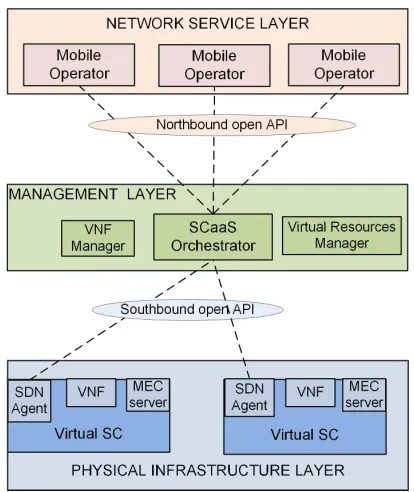
Fig. 1. High-level system architecture for Small Cell as a Service.
(VRM). Each VSC also accommodates a number of virtual network functions (VNFs) and it is managed by the SCaaS Orchestrator via an SDN agent. Above the management layer there is the service layer, in which multiple tenants (i.e., MNOs) are accommodated.
2.2 Security Assumptions
To identify the security challenges of the investigated system architecture, we rst introduce our security assumptions, regarding the baseline security of the system. One of main assumptions is the physical security of SC infrastructure and hardware integrity. More specically, we assume that hardware tampering is prevented by appropriate security controls deployed by the SC infrastructure owner [25], and that the Cloud provider has ensured the physical security of the Cloud infrastructure and of the data centres (e.g., according to the recommen-dations from the Cloud Security Alliance [26]). The existence of physical attacks will be considered in our future works. Note that due to space limitations, in this paper, we do not consider attacks that are initiated from the Cloud side. In-stead, we focus on attacks originated either from user equipment (UE) or from the SC infrastructure itself (e.g., from a malicious tenant or a compromised sys-tem component). Besides, modern literature has investigated Cloud-originated attacks and identied the main Cloud security challenges [27,28]; developed ade-quate security solutions [29]; and proposed methods for Cloud provider selection based on security and privacy requirements [30].
2.3 Adversarial Model
Our analysis adopts the widely-used Dolev-Yao adversarial model [31]. According to this model, the cellular network is represented as a set of abstract entities that exchange messages and the adversary is capable of overhearing, intercepting, and synthesizing any message and they are only limited by the constraints of the deployed cryptographic methods. For example, the adversary neither is able to forge the message authentication code (MAC) nor has the means to obtain the plaintext of encrypted messages.
Apart from the above, we enrich the adversarial model by considering com-promised nodes. The adversary per se could be a legitimate tenant interacting with network entities by using valid credentials and having privileged access to virtualized resources. Yet the adversary might run any management application in their VSC or specify various policies within its virtual domain, which is dened as a cluster of VSCs allocated to the same tenant.
3 Security Challenges
In this section we discuss the security challenges that emerge from the adoption of the SCaaS concept, using as a reference the architecture of Fig. 1. We adopt the widely-used threat taxonomy proposed in [32] and identify the security chal-lenges that arise due to specic architectural characteristics and interaction of various components and layers of SCaaS. The dierent security challenges can be classied according to ve categories.
a particular service running on the victim side, the existence of an open interface is a precondition; another case is when the adversary has some particular access rights.
Vulnerability: What are the vulnerabilities of the system components or the network interfaces, which can be exploited by the adversary? For ex-ample, some components could be implemented in software with aws or non-adequate cryptographic mechanisms could be in place [33].
Target: Which components or interfaces are the potential attack targets? Other considerations include the communication layer the adversary targets and whether he aims to compromise the control or the data plane or both. Method: What are the various attack methods, tools and techniques that
the adversary might use? In the same category we examine whether the adversary follows an active (e.g., replay attack) or passive strategy (e.g., passive reconnaissance).
Eect: What is the impact of a successful attack on the victimized system component or network interface? Impact might be, for instance, unavailabil-ity of some services, nancial costs, and leakage of sensitive data.
Below, we identify specic security challenges for each of the aforementioned ve categories.
3.1 Precondition
Regarding precondition, the following types of requirements might be valid for the adversary.
Specic conguration: In some cases, to launch an attack against a compo-nent, the adversary requires that this component has specic exploitable con-guration or runs a specic software. For example, a precondition for a denial-of-service (DoS) attack [34, 35] can be specic conguration of the VRM with regard to the allocation of resources to tenants. Yet, some aws in the resource allocation algorithm can allow the adversary to prevent a tenant from accessing its portion of virtual resources. Also, other types of DoS attacks may exploit the broadband nature of the wireless medium. For example, malicious interference at the physical layer, even using o-the-shelf hardware, can cause packet collisions at the media access control (MAC) layer [36].
Privileged access: The adversary has privileged access to some parts of the network components or functions. The privileged access can be either at the administrator level or at the user level. For example, the adversary may be a legitimate UE receiving service from its MNO, with the latter being a legiti-mate tenant of the SC network infrastructure. Also, the emerging bring your own device (BYOD) trend in modern enterprises, constitutes many conventional security solutions incapable of protecting the private network [37]. For example, a Trojan horse that infected an employee's device, can bypass the security of the corporate rewall.
3.2 Vulnerabilitiy
SDN controller weaknesses: Some vulnerabilities are caused by aws in software and programming errors. This may lead, for example, to control ow attacks [38] and buer overow attacks [39]. This issue is particularly important in the context of next-generation wireless networks, where the trend is to implement the control plane in software and to virtualize network functions [40,41]
Flaws of NFV platforms: The virtualised environment itself could introduce many potential security problems [42]. In particular, aws of the virtualisation platform in place, may constitute the guest operating system (OS) vulnerable to side-channel attacks. For example, weak isolation between host and guest OSs may lead to a side-channel attack based on cache leakage [43].
Cloud based management: Some vulnerabilities stem from the Cloud based management nature of certain network components. The Cloud based interface used for conguration and updates could be used as a potential attack channel. Weak access control and authentication: Use of weak or default passwords could be easily exploited by an adversary and should be avoided. Also, some components may have hard-coded passwords, which can be exploited by the adversary towards the establishment of backdoor access; stealthy or not.
Weak cryptographic mechanisms: Weaknesses or improper use of crypto-graphic mechanisms may lead to security breaches in authentication processes and data condentiality. Also, the generation of cryptographic keys shouldn't rely on weak random number generators. Other security problems may arise due to communication protocols that use weak cryptographic primitives. Hence, it should be ensured that the cryptographic security controls are in place [44]. This is to say that any adopted public-key scheme that enables the encryption of the communications among SC, UE, and the Cloud, should be suciently secure.
3.3 Target
attacker may try to obtain the secret, by replacing the device with a malicious one [46].
NFV-based management system: Some attacks initiated inside virtualised environments may aim at taking control of the Hypervisor [47]. Also, the SCaaS Orchestrator is an attractive attack target due to being in the 'middle of the system model architecture, as well as other components of the management layer, such as the VNF Manager. Finally, impersonation by the adversary of one of the VNFs or the MEC server when communicating with the management layer could be a potential threat.
VM-hosted operating system: Both host and guest OS may be targeted [48], and to alleviate the impact of such an attack, adequate isolation must be enforced between guest virtual machines (VMs), as well as between the host and guest VMs. The adversary could attempt to break the isolation by exploiting, e.g., some aws of the virtualisation platform in use [49].
Mobility management entity: In some cases, the attack does not target a specic layer in the system architecture, but it rather aims to take control of a specic network entity, either physical or virtual, such as the mobility manage-ment entity (MME). Protecting against such kind of attacks will be even more dicult when a distributed MME is introduced in 5G networks [50].
MEC-based application: A certain application that runs, for instance, on a MEC server is a potential attack target. This does not aect only the SC that hosts the compromised MEC server. Due to clustering of MEC servers into the Light DC, as discussed in Section 2, and their communication with the Cloud, a compromised MEC server can be used as a door to attack other network entities and components. Also, the adversary may attempt to attack the network service isolation. This may result in the violations of limits for virtual resources or unauthorized use of other tenants' resources. We assume that the adversary can attempt to impersonate another tenant or another network entity. Also, it may attempt to decrypt the intercepted messages.
MobileFlow protocol: A usual attack target is the protocol used for com-munication, management or control purposes, such as the MobileFlow proto-col [23]. For example, the southbound and northbound interfaces, shown in Fig. 1, are potential attack targets when attempting to hijack the communication of the SCaaS Orchestrator with VSCs and MNOs. Also, the communication within the SC infrastructure could be targeted; for example, between the management and the physical infrastructure layer. This may enable an adversary to alter the network policies and create attack channels. In particular, possible attack tar-gets are (i) communication of the VNF Manager with VNFs in a SC; and (ii) communication of the VRM with MEC servers. Hence, the adversary may try to alter or disable legitimate policies and cause attacks such as DoS and privilege escalation or to violate the privacy of other tenants data.
3.4 Method
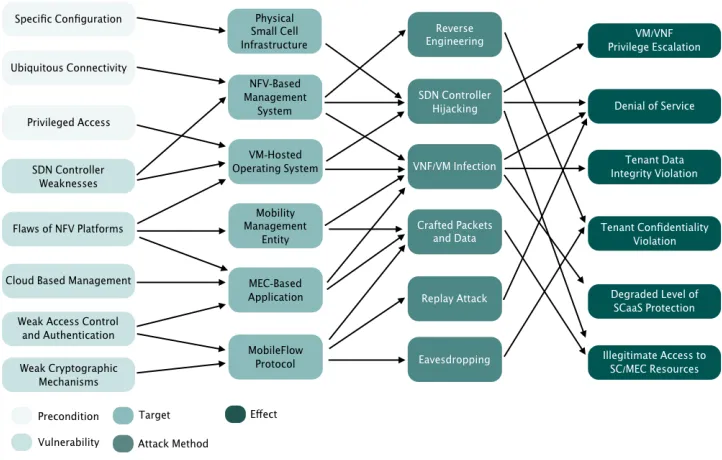
soft-Fig. 2. Dependencies among security challenges of Small Cell as a Service in virtualised MEC environments.
ware to retrieve the source code. This may enable the adversary to identify vulnerabilities in the software or network interfaces. In some cases, the adver-sary may exploit weaknesses in the implemented access control mechanisms and exploit a device through normal usage, i.e., as a legitimate user. Other reverse-engineering techniques may target users' sensitive personal information. For ex-ample, the increasing popularity of mobile crowdsourcing and mobile sensing projects [51] may enable an attacker to exploit various personal data such as the user location, mobility patterns or web browsing habits [52].
SDN controller hijacking: By exploiting the SDN controller implementation weaknesses, the adversary tries to divert the control ows to a controlled device [53]. Then the captured messages can be discarded preventing the data plane entities from proper operation. In a more advanced case, the captured messages may be manipulated with a special purpose code and sent into the network.
iso-lation. This means that a VM is not able to interact with the host and other VMs nor is able to monitor or control them in any way. This isolation is typically enforced by the Hypervisor. However, such virtualised environments may be vul-nerable to the so-called VM escape attack [56], which is a process of breaking out the aforementioned VM isolation. This can be achieved for example by installing malware on the Hypervisor [57].
Crafted packets and data: The adversary can attack communication and con-trol protocols by injecting crafted packets or crafted input data. These actions may exploit, for example, the parsing vulnerabilities of protocol implementa-tions [58].
Replay attack: The adversary captures packets or packet fragments and re-plays them at appropriate times aiming to cause protocol failures or other types of disruption and confusion.
Eavesdropping: The adversary observes messages exchanged between vari-ous network components or functions. In this way, sensitive information can be obtained, especially if this information is weakly protected by cryptographic mechanisms or not protected at all.
3.5 Eect
VM/VNF privilege escalation: The adversary, who has already some level of limited access privilege (e.g., to a VM or a VNF), manages to gain more privilege. This may have very serious negative eects for SDN-based mobile networks [59] as well as for the emerging Internet of things (IoT) technologies [60].
Denial of service: A potential outcome of attacks can be DoS leading to switched o or malfunctioning SC, or unavailable MEC servers. Also, a DoS attack against the SCaaS Orchestrator can cause service disruption and data loss. Yet, in a multi-tenant environment, security implications that may arise due weak isolation between tenants may allow adversaries to compromise more than one tenants upon compromising one of the other tenants. Furthermore, a DoS attack may be launched from within the SC [11].
Tenant data integrity violation: Some data or code, including various con-guration settings and security policies, can be altered. This is a particularly important issue in a virtualised multi-tenant environment. It must be taken into account that some tenants could be malicious. Hence, adequate data isolation for dierent tenants must be ensured. This could be done, for example at the database level or at the hardware level.
Tenant condentiality violation: In some cases sensitive information of a ten-ant may be leaked and made available to the adversary or to a malicious tenten-ant. Degraded level of SCaaS protection: A possible eect can be the degradation of SCaaS infrastructure protection. This can be achieved, for example, by altering the security policies or switching to weaker cryptographic mechanisms.
threat should be considered and appropriate mechanisms must be put in place for preventing service providers form misusing tenants' data.
In Fig. 2, we show, in the form of a directed graph, an example of possible dependencies of these categories. For instance, to cause DoS, the adversary could select VM/VNF infection as an attack method. To achieve that, malware could be injected in the management system (e.g., to the VRM or the VNF Manager in Fig. 1), a VM-hosted OS, or a MEC-based application (i.e., by compromising a MEC server), which constitute the potential attack targets. To target, e.g., the VM-hosted OS, the adversary could possibly exploit the SDN controller weaknesses or aws of NFV platforms, and take advantage of any privileged access rights.
4 Conclusion
In this paper, we have identied the most important security challenges of SCaaS in virtualized environments of 5G networks. We envision that novel technologies, such as NFV, SDN, and MEC will be adopted in the future and will play an important role in the SCaaS realization. We have summarized the main secu-rity challenges that (i) open up with these technologies and (ii) arise due to the interoperability among them, which enables SCaaS. We have highlighted the necessary conditions for the adversary to be able to launch an attack; the vulnerabilities of various system components and network interfaces that can be exploited by the adversary; potential targets of attacks, such as management systems and applications; various methods and techniques that can be used by the adversary; and nally, the impact of the attacks on an SCaaS provider and its tenants. In future work, we intend to study and evaluate prominent security solutions developed for protecting virtualized SC networks and systems per se, focusing on NFV, SDN, and MEC. This security assessment will use this paper, here, as a basis.
Acknowledgements. The present work has been performed in the scope of the SESAME (Small cEllS coordinAtion for Multi-tenancy and Edge services) European Research Project and has been supported by the Commission of the European Communities (5G-PPP/H2020, Grant Agreement No. 671596 ).
References
1. Boccardi, F., Heath, R.W., Lozano, A., Marzetta, T.L., Popovski, P.: Five disrup-tive technology directions for 5G. IEEE Commun. Mag. 52 (2), 74-80 (2014). 2. Andreev, S. et al.: Understanding the IoT connectivity landscape: A contemporary
M2M radio technology roadmap. IEEE Commun. Mag. 53 (9), 32-40 (2015). 3. Vardakas, J.S., Zorba, N., Skianis, C., Verikoukis, C.V.: Performance analysis of
M2M communication networks for QoS-dierentiated smart grid applications. In: IEEE Globecom Workshops (GC Wkshps), 1-6 (2015).
5. Andrews, J.G.: Seven ways that HetNets are a cellular paradigm shift. IEEE Com-mun. Mag. 51 (3), 136-144 (2013).
6. Osseiran, A. et al.: Scenarios for 5G mobile and wireless communications: The vision of the METIS project. IEEE Commun. Mag. 52 (5), 26-35 (2014).
7. Trakas, P., Adelantado, F., Verikoukis, C.: A novel learning mechanism for trac ooading with small cell as a service. In: IEEE Int. Conf. on Commun. (ICC), London, U.K. (2015).
8. Giannoulakis, I. et al.: System architecture and aspects of SESAME: Small cEllS coordinAtion for Multi-tenancy and Edge services. In: 2nd IEEE Conference on Network Softwarization (NetSoft), Workshop on Software Dened 5G Networks (Soft5G), Seoul, Korea (2016).
9. Soldani, D., Manzalini, A.: A 5G infrastructure for anything-as-a-service. J. of Telecommun. Syst. & Manag. 3 (2), 1-10 (2014).
10. Vaquero, L.M., Rodero-Merino, L.: Finding your way in the fog: Towards a compre-hensive denition of fog computing. ACM SIGCOMM Comput. Commun. Review 44 (5), 27-32 (2014).
11. Roman, R., Lopez, J. and Mambo, M.: Mobile edge computing, fog et al.: A survey and analysis of security threats and challenges. arXiv preprint arXiv:1602.00484 (2016).
12. Han, B., Gopalakrishnan, V., Ji, L., Lee, S.: Network function virtualization: Chal-lenges and opportunities for innovations. IEEE Commun. Mag. 53 (2), 90-97 (2015). 13. Yu, R., Xue, G., Kilari, V., Zhang, X.: Network function virtualization in the
multi-tenant cloud. IEEE Netw. 29 (3), 42-47 (2015).
14. Ameigeiras, P.et al.: Link-level access cloud architecture design based on SDN for 5G networks. IEEE Netw. 29 (2), 24-31 (2015).
15. Sun, S., Kadoch, M., Gong, L., Rong, B.: Integrating network function virtualiza-tion with SDR and SDN for 4G/5G networks. IEEE Netw. 29 (3), 54-59 (2015). 16. EC H2020 Small sElls coordinAtion for Multi-tenancy and Edge services
(SESAME) Project, https://5g-ppp.eu/sesame/ [July 2016]. 17. EC H2020 5G-ENSURE, https://5g-ppp.eu/5g-ensure/ [July 2016].
18. Mantas, G. et al.: Security for 5G Communications. Fundamentals of 5G Mobile Netw., John Wiley & Sons, Ltd, 2015.
19. Fang, Q., Weijie, Z., Guojun, W., Hui, F.: Unied security architecture research for 5G wireless system. In: 11th Web Information System and Application Conference, Tianjin, China (2014).
20. Yang, N. et al.: Safeguarding 5G wireless communication networks using physical layer security. IEEE Commun. Mag. 53 (4), 20-27 (2015).
21. Duan, X., Wang, X.: Authentication handover and privacy protection in 5G Het-Nets using software-dened networking. IEEE Commun. Mag. 53 (4), 28-35 (2015). 22. Vassilakis, V.G., Moscholios, I.D., Alzahrani, B.A., Logothetis, M.D.: A software-dened architecture for next-generation cellular networks. In: IEEE Int. Conf. on Commun. (ICC), Kuala Lumpur, Malaysia (2016).
23. Pentikousis, K., Wang, Y., Hu, W.: Mobileow: Toward software-dened mobile networks. IEEE Commun. Mag. 51 (7), 44-53 (2013).
24. Fajardo, J.O. et al.: Introducing mobile edge computing capabilities through dis-tributed 5G cloud enabled small cells. Mobile Networks and Applications, Springer US, 1-11 (2016).
25. Skorobogatov, S.: Physical attacks and tamper resistance. Introduction to Hard-ware Security and Trust, Springer, New York, 143-173 (2012).
27. Subashini, S., Kavitha, V.: A survey on security issues in service delivery models of cloud computing. J. of Netw. and Comput. Applicat. 34 (1), 1-11 (2011). 28. Ryan, M.D.: Cloud computing security: The scientic challenge, and a survey of
solutions. J. of Syst. and Sotw. 86 (9), 2263-2268 (2013).
29. Zissis, D., Lekkas, D.: Addressing cloud computing security issues. Future Gener-ation Comput. Syst. 28 (3), 583-592 (2012).
30. Mouratidis, H., Islam, S., Kalloniatis, C., Gritzalis, S.: A framework to support selection of cloud providers based on security and privacy requirements. J. of Syst. and Softw. 86 (9), 2276-2293 (2013).
31. Dolev, D., Yao, A.C., On the security of public key protocols. IEEE Trans. Inf. Theory 29 (2), 198-208 (1983).
32. Papp, D., Ma, Z., Buttyan, L.: Embedded systems security: Threats, vulnerabili-ties, and attack taxonomy. In: 13th Annu. Conf. on Priv., Secur. and Trust, Izmir, Turkey (2015).
33. Mihaljevic, M.J., Gangopadhyay, S., Paul, G., Imai, H.: Generic cryptographic weakness of k-normal Boolean functions in certain stream ciphers and cryptanalysis of grain-128. Periodica Mathematica Hungarica 65 (2), 205-227 (2012).
34. Gobbo, N., Merlo, A., Migliardi, M.: A denial of service attack to GSM networks via attach procedure. In: International Conference on Availability, Reliability, and Security, 361-376. Springer, Heidelberg (2013).
35. Merlo, A., Migliardi, M., Gobbo, N., Palmieri, F., Castiglione, A.: A denial of service attack to UMTS networks using SIM-less devices. IEEE Transactions on Dependable and Secure Computing, 11(3), 280-291 (2014).
36. Fragkiadakis, A., Askoxylakis, I., Chatziadam, P.: Denial-of-service attacks in wire-less networks using o-the-shelf hardware. In: Distributed, Ambient, and Pervasive Interactions, Springer International Publishing, 427-438 (2014).
37. Armando, A., Costa, G., Merlo, A.: Bring your own device, securely. In: 28th ACM Symp. on Appl. Comp., Coimbra, Portugal (2013).
38. Davi. L. et al.: MoCFI: A framework to mitigate control-ow attacks on smart-phones. In: 19th Annu. Netw. & Distr. Syst. Secur. Symp., San Diego, USA (2012). 39. Wang, L.B., Wei, G.H., Li, Z.: Research of defense scheme against buer overow
attack in embedded system. J. of Comput. Appl 12 (2012).
40. Wang, H., Chen, S., Xu, H., Ai, M., Shi, Y.: SoftNet: A software dened decen-tralized mobile network architecture toward 5G. IEEE Netw. 29 (2), 16-22 (2015). 41. Vassilakis, V.G., Moscholios, I.D., Alzahrani, B.A., Logothetis, M.D.: On the se-curity of software-dened next-generation cellular networks. In: IEICE Inf. and Commun. Tech. Forum (ICTF), Patras, Greece (2016).
42. Kotsovinos, E.: Virtualization: Blessing or curse? Commun. of the ACM 54 (1), 61-65 (2011).
43. Barthe, G., Betarte, G, Campo, J.D., Luna, C.: Cache-leakage resilient OS isolation in an idealized model of virtualization. In: 25th IEEE Comp. Secur. Foundations Symp., Cambridge, USA (2012).
44. Bhargavan, K., Fournet, C., Kohlweiss, M., Pironti, A., Strub, P.: Implementing TLS with veried cryptographic security. In: 34th IEEE Symp. Secur. Privacy, San Francisco, USA (2013).
45. Rostami, M., Koushanfar, F., Rajendran, J., Karri, R.: Hardware security: Threat models and metrics. In: 32nd IEEE/ACM Int. Conf. on Comput.-Aided Design, San Jose, CA (2013).
patterns. In: 14th ACM Int. Conf. on Mobile and Ubiquitous Multimedia, 131-135 (2015).
47. Perez-Botero, D., Szefer, J., Lee, R.B.: Characterizing hypervisor vulnerabilities in cloud computing servers. In: 8th ACM Int. Workshop on Security in Cloud Computing, Hangzhou, China, 3-10 (2013).
48. Suzaki, K., Iijima, K., Yagi, T., Artho, C.: Memory deduplication as a threat to the guest OS. In: 4th ACM Europ. Workshop on System Security, Salzburg, Austria (2011).
49. Hoesing, M.T.: Virtualization security assessment. Inf. Secur. J.: A Global Per-spective 18 (3), 124-130 (2009).
50. Giust, F., Cominardi, L., Bernardos, C.: Distributed mobility management for future 5G networks: Overview and analysis of existing approaches. IEEE Commun. Mag. 53 (1), 142-149 (2015).
51. Chen, P.Y., Cheng, S.M., Ting, P.S., Lien, C.W., Chu, F.J.: When crowdsourcing meets mobile sensing: A social network perspective. IEEE Commun. Mag. 53 (10), 157-163 (2015).
52. Han, Q., Liang, S., Zhang, H.: Mobile cloud sensing, big data, and 5G networks make an intelligent and smart world. IEEE Netw. 29 (2), 40-45 (2015).
53. Goktas, E., Athanasopoulos, E., Bos, H., Portokalidis, G.: Out of control: Over-coming control-ow integrity. In: 35th IEEE Symp. Secur. Privacy, San Jose, CA (2014).
54. Nikaein, N. et al.: Network store: exploring slicing in future 5G networks. In: 10th Int. ACM Workshop on Mobility in the Evolving Internet Architecture, Paris, France (2015).
55. Chin, W.H., Fan, Z., Haines, R.: Emerging technologies and research challenges for 5G wireless networks. IEEE Wireless Commun. 21 (2), 106-112 (2014). 56. Luo, S., Lin, Z., Chen, X., Yang, Z., Chen, J.: Virtualization security for cloud
computing service. In: 4th Int. Conf. on Cloud and Service Computing (CSC), 174-179 (2011).
57. Oyama, Y., Giang, T.T., Chubachi, Y., Shinagawa, T., Kato, K.: Detecting mal-ware signatures in a thin hypervisor. In: 27th Annu. ACM Symp. on Appl. Com-put., Trento, Italy (2012).
58. Hu, C., Li, Z., Ma, J., Guo, T., Shi, Z.: File parsing vulnerability detection with symbolic execution. In: IEEE 6th Int. Symp. on Theoretical Aspects of Softw. Eng., Beijing, China (2012).
59. Chen, M., Qian, Y., Mao, S., Tang, W., Yang, X.: Software-dened mobile networks security. Mobile Networks and Applications, 1-15 (2015).