Computational Fluid Dynamics (CFD) Approach
to Predict an Actual Wind Speed over Complex Terrain
Takanori UCHIDA
Research Institute for Applied Mechanics (RIAM), Kyushu University, 6-1 Kasuga-kouen, Kasuga, Fukuoka, 816-8580, Japan Email: [email protected]
ABSTRACT
This paper proposes a procedure for predicting the actual wind speed for flow over complex terrain with CFD. It converts a time-series of wind speed data acquired from field observations into a time-series of actual scalar wind speed by using non-dimensional wind speed parameters which are determined beforehand with the use of CFD output. The accuracy and reproducibility of the prediction procedure were examined by simulating the flow with CFD with the use of high resolution (5 m) surface elevation data for the Noma Wind Park in Kagoshima Prefecture, Japan. The errors of the predicted average monthly wind speeds relative to the observed values were less than approximately 20%.
Keywords: CFD, LES, complex terrain, actual wind speed
1. Introduction
A significant reduction in CO2 emissions to prevent global warming is currently an urgent issue. For this reason, the
effective use of clean, environmentally-friendly wind energy has received attention. Since the power output of a wind turbine
(WT) is proportional to the cube of the wind speed, it is important to accurately select a site with wind conditions that are
well-suited for WT deployment with a high degree of precision. In Japan, most terrain is complex and few areas are flat, which
is quite different from the terrain in Europe and the U.S.A. Thus, it is very important to take into account the effects of terrain
on the wind flow, such as flow impingement, flow separation, flow reattachment, and reverse flow. Given this background,
micro-siting software which can simulate wind over the complex terrain that is unique to Japan is currently being developed
based on computational fluid dynamics (CFD). This development is being carried out with a vision that the software can also
be applied for micro-siting of WTs over complex terrain in any other part of the world 1-8).
The author’s research group has also been developing such software, specifically, an unsteady, nonlinear wind simulator called RIAM-COMPACT (Research Institute for Applied Mechanics, Kyushu University, COMputational Prediction of
Airflow over Complex Terrain), which is applicable for almost any flat or complex terrain across the world 9-18).
RIAM-COMPACT is based on large eddy simulation (LES), which is a turbulence model, and simulates airflow in small
domains of approximately a few hundreds of meters to a few kilometers. One of the major features of RIAM-COMPACT is
that it can, with high accuracy, predict and visualize, in the form of animation, the effects of terrain on the wind flow such as
flow separation, formation of reverse flow regions which results from flow separation, local flow acceleration, and
reattachment of separated shear layers.
At a planned construction site for a wind power facility, it is a standard practice for an observation pole of 30 m or taller to
be set up to collect time-series data of wind direction, speed, and other meteorological variables over a period of one year. If
these observation data can be loaded into a CFD model and both the observation data and the CFD output can be combined
efficiently, economic assessments of the wind power facility, including assessments of the annual energy production and
capacity factor at an arbitrary location within the facility, can be made with high accuracy.
Accordingly, the present study proposes a procedure to predict the actual wind speed over complex terrain with the use of
time-series data collected from field observations and CFD output. In this procedure, a time-series of wind speed data acquired
from field observations is converted into a time-series of the actual scalar wind speed for the prediction point with the use of
(non-dimensional) wind speed parameters which were determined beforehand with the use of CFD output. The validity of the
proposed procedure is examined for Noma Wind Park, Kagoshima Prefecture, Japan, with the use of observation data collected
with propeller vane anemometers mounted on the nacelles of WTs.
2. Overview of Noma Wind Park, Kagoshima Prefecture
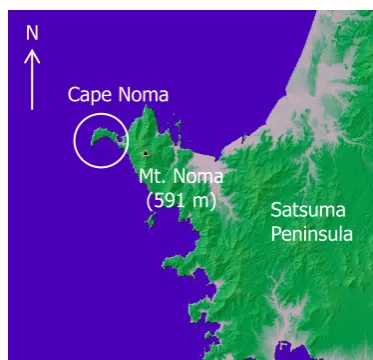
Noma Wind Park is in Kasasa Town in the southwestern part of Kagoshima Prefecture, Japan (marked by the circle in Fig.
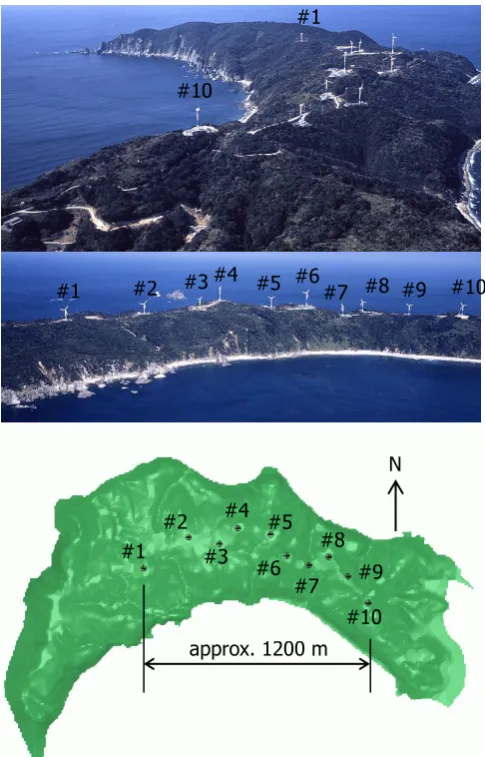
1). The terrain at and in the surrounding area of Noma Wind Park is typical complex terrain (Fig. 2). While the wind park is
surrounded by the ocean, a steep cliff with a slope angle of more than 30 degrees is at the western end of the cape. The
maximum elevation of the terrain surface is 143 m. In Noma Wind Park, ten WTs that are owned by Kyushu Electric Power
Co., Inc. have been deployed, and verification tests have been conducted. The rated output of each WT is 300 kW, thus the
total rated output from the ten WTs combined is 3000 kW. Tables 1 and 2 give an overview of the WTs deployed in Noma
Wind Park.
Table 1 Specifications of WTs at Noma Wind Park
WT #1-5 WT #6-10
Output 300 kW / WT
Generator type Induction Synchronous
Cut-in speed 3.5 m/s 2.5 m/s
Rated wind speed 14.4 m/s 14.0 m/s
Cut-out speed 24.0 m/s 25.0 m/s
Rotor diameter 29 m 30 m
Tower height (WT #430 m :45 m) (WT #630 m :45 m)
Fig. 1 Cape Noma and surrounding topographical features Cape Noma
Mt. Noma
(591 m) Satsuma
Fig. 2 View of Noma Wind Park, the numbers in the figures are those of the WTs
Table 2 WT hub-heights and surface elevations
Hub-height (tower height)
Surface elevation of WT site WT #1
30 m
100 m
WT #2 92 m
WT #3 109 m
WT #4 45 m 122 m
WT #5 30 m 102 m
WT #6 45 m 117 m
WT #7
30 m
88 m
WT #8 95 m
WT #9 92 m
WT #10 109 m
#2 #3
#4 #5 #6
#7 #8
#9 N
#1
#10 approx. 1200 m
#1 #2 #3 #4 #5 #6 #7 #8 #9 #10
#1
Fig. 3 Propeller vane anemometer mounted on a WT nacelle (indicated by A)
0 10 20
30N NNE
NE ENE E ESE SE SSE S SSW SW WSW W WNW NW NNW 0 2 4 6 8
10N NNE
NE ENE E ESE SE SSE S SSW SW WSW W WNW NW NNW
(a) Occurrence frequency (%) (b) Annual average wind speed (m/s)
Fig. 4 Characteristics of wind at Noma Wind Park, WT #4, for the year from June 2002 to May 2003
0 10 20
30N NNE
NE ENE E ESE SE SSE S SSW SW WSW W WNW NW NNW 0 2 4 6 8
10N NNE
NE ENE E ESE SE SSE S SSW SW WSW W WNW NW NNW
(a) Occurrence frequency (%) (b) Monthly average wind speed (m/s)
Fig. 5 Characteristics of wind at Noma Wind Park, WT #4, for the month of February 2003
Propeller vane anemometers are mounted on all of the WTs deployed in Noma Wind Park (indicated by A in Fig. 3). The
present study employs time-series observation data from these propeller vane anemometers. The data were recorded every one
minute. Details of the characteristics of the wind at Noma Wind Park from June 2002 to May 2003 are summarized in Uchida
and Ohya. According to Uchida and Ohya, the prevailing wind direction at this site is northerly, and the monthly average wind
speed is large from November to March (Figs. 4 and 5). The present study validates the proposed procedure for predicting the
actualwind speed (Section 4) with the use of observation data from February 2003, the month during the observation period in
which the least data are missing for all ten WTs and also in which the value of the monthly average wind speed is large. For
February 2003, 40,047 and 273 data values are available for analysis and missing, respectively (percentage of non-missing
data: 99%).
3. Numerical Simulation Technique and Set-up
In order to numerically predict local wind flow over complex terrain with high accuracy while avoiding numerical instability,
the present study employs RIAM-COMPACT. This software simulates wind flow with the use of a collocated grid in a general
curvilinear coordinate system. In this collocated grid, the velocity components and pressure are defined at the grid cell centers,
and variables that result from multiplying the contravariant velocity components by the Jacobian are defined at the cell faces.
For the numerical simulation method, a finite-difference method (FDM) is adopted, and an LES model is used for the
turbulence model. In the LES model, a spatial filter is applied to the flow field to separate eddies of various scales into
grid-scale (GS) components, which are larger than the computational grid cells, and sub-grid scale (SGS) components, which
are smaller than the computational grid cells. Large-scale eddies, i.e., the GS components of turbulence eddies, are directly
numerically simulated without the use of a physically simplified model. In contrast, dissipation of energy, which is the main
effect of small-scale eddies, i.e., the SGS components, is modeled according to a physics-based analysis of the SGS stress. For
the governing equations of the flow, a filtered continuity equation for incompressible fluid (Eq.(1)) and filtered Navier-Stokes
equations (Eq.(2)) are used. Because high wind conditions with mean wind speeds of 6 m/s or higher are considered in the
present study, the effect of vertical thermal stratification, which is generally present in the atmosphere, is neglected. The effects
of the surface roughness have been taken into consideration by reconstructing surface irregularities in high resolution
(horizontal resolution: 5 m).
0 i i u x =
-(1)
2
1 ij
i i i
j
j i j j j
u u p u
u
t x x Re x x x
+ = − + −
-(2)
1
2 3
' ' ' '
ij ij u ui j u uk k ij SGSS
− -(3)
(
)
2SGS C fs s S
= -(4)
(
)
1 22 ij ij /
S = S S -(5)
1 2 j i ij j i u u S x x = + -(6)
(
)
1 25 sf = −exp −z /+ -(7)
(
)
1 3/ x y zh h h
= -(8)
For the computational algorithm, a fractional step (FS) method 19) is used, and a time marching method based on the Euler explicit method is adopted. The Poisson’s equation for pressure is solved by a successive over-relaxation (SOR) method. For discrimination of all the spatial terms in the governing equations except for the convective term in Eq. (2), a second-order
central difference scheme is applied. For the convective term, a third-order upwind difference scheme is used. For the
fourth-order central difference term that constitutes the discretized convective term, the interpolation technique of Kajishima 20),
which is based on a four-point difference scheme and a four-point interpolation scheme, is used. For the weighting of the
numerical diffusion term in the discretized convective term, α = 3.0 is commonly applied in the Kawamura-Kuwahara scheme 21). However, α = 0.5 is used in the present study to minimize the influence of numerical diffusion. For the LES subgrid-scale
modeling, the standard Smagorinsky model 22) (Eqs. (3) - (8)) is adopted with a model coefficient of 0.1 in conjunction with a
4. Procedure for Predicting Actual Wind Speed
The procedure for predicting the actual scalar wind speed time-series data for an arbitrary point over complex terrain is
described below. In this procedure, time-series data that were acquired from field observations and CFD output (time-averaged
wind speed) are utilized.
Step 1. As illustrated in Fig. 6, wind simulations are performed by RIAM-COMPACT for 16 individual wind directions for a
prediction point. After the flow field has sufficiently developed in a simulation run, the simulation is continued, and the
time-averaged flow is calculated.
Fig. 6 Conceptual outline of wind simulations for 16 wind directions for Noma Wind Park
The computational domain is a square with 5 km sides with WT #4 in the center of the domain (Fig. 6). The top of the
computational domain is set to 700 m. Terrain features are reconstructed with the use of high-resolution (5 m spatial
resolution) surface elevation data. The numbers of computational grid points are 51 (streamwise (x)) × 51 (spanwise (y)) × 41 (vertical (z)). Variable grid spacing is used in the x- and y-directions so that the grid density increases toward the center
of the domain. Likewise, variable grid spacing is used in the z-direction so that grid density is highest near the ground surface.
The vertical height of the first layer of grid cells, that is, the minimum vertical grid height, is approximately 2.5 m. A vertical
profile of wind speed based on the 1/7 power law is given for the inflow boundary. The free-slip condition is set for the side
and upper boundaries. The convective outflow condition is applied to the outflow boundary. On the ground, the no-slip
condition is imposed. The non-dimensional parameter, Re, in Eq. (2), defined as Uin h/ν is the Reynolds number and is set to
104. Here, h indicates the difference between the minimum and maximum surface elevations within the computational domain
(h = 143 m). Uin represents the wind speed at the inflow boundary at the height of the maximum surface elevation in the
computational domain, and ν is the coefficient of kinematic viscosity. The representative scales used for the present
simulations, h and Uin, are shown in Fig. 7. The time step in the model is set to ∆t = 2 × 10⁻³ h/Uin.
Fig. 7 Representative scales used in the present study Minimum surface
elevation zmin (m)
Maximum surface elevation zmax (m)
Representative length scale h (m)
(= surface elevation difference = zmax - zmin) Representative wind speed scale Uin (m/s)
z
Simulation runs are performed in sequence
Inflow boundary
WT #4 (Center of computational
domain) 1
2 3
4
5
6
7 8 9 10 11 12 13
14 15
Step 2. For each inflow direction (Fig. 6), the ratio of the simulated hub-height wind speed at a prediction point to the
simulated wind speed at the height of an observation pole, that is, at the reference point, is computed, yielding a set of 16 wind
speed ratios for the prediction point. The value of the wind speed at the reference point is normalized as “1.” In this step, the
wind direction set at the inflow boundary is assumed to match with that at the reference point. In the present study, points
located at WT #4 and WT #6 at the hub-height are used as the reference points. (Hereafter, in the context of reference points,
these reference points will be referred to as WT #4 and WT #6.) Thus, the following wind speed ratios are evaluated: WT #1 /
WT #4, WT #2 / WT #4, WT #3 / WT #4, WT #5 / WT #4, …, WT #10 / WT #4; WT #1 / WT #6, WT #2 / WT #6, WT #3 /
WT #6, WT #4 / WT #6, WT #5 / WT #6, WT #7 / WT #6, …, WT #10 / WT #6. To compute these wind speed ratios, the
scalar wind speed, VEL, is used in both the denominator and numerator and is computed from the time-averaged wind velocity
components in the x- and y-directions as
(
2 2)
VEL= U +V -(9)
Step 3. The observed time seriesof the scalar wind speed at the reference point is converted to a time-series of scalar wind
speed at a prediction point as follows. According to the wind direction at the reference point at a given instance in the observed
time series, the scalar wind speed at the reference point is multiplied by the wind speed ratio which was determined beforehand
for the prediction point for that wind direction in Step 2. By applying this operation to an observed time series of scalar wind
speeds that extends over a period of one year or any period of interest and processing the outcome of the operation statistically,
the monthly and annual average wind speed can be obtained for an arbitrary prediction point.
5. Results and Discussions
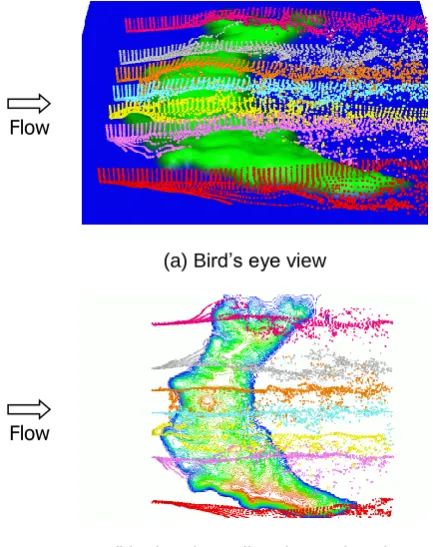
Fig. 8 illustrates instantaneous views of flows that were visualized with the passive particle tracking method. The inflow
wind direction for this case is northerly. This figure indicates that, due to the influence of the terrain irregularities, wind speed
and direction change in complex ways as the wind flows over Cape Noma. In the procedure for predicting the actual wind
speed which is proposed in the present study, simulations are run until fully-developed flows, as the one illustrated in Fig. 8,
are achieved, and the simulations are continued for a period of time. Then, the results of the simulations are used to obtain the
time-averaged flow field.
(a) Bird’s eye view
(b) View from directly overhead
Fig. 8 Examples of flows visualized with the passive particle tracking method, northerly wind
Flow
(a) WT #1 (b) WT #10
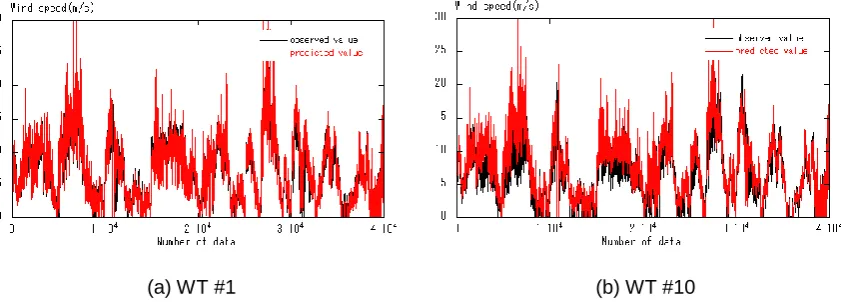
Fig. 9 Time-series data of observed and predicted wind speed, reference point: WT #4
(a) WT #1 (b) WT #10
Fig. 10 Scatter plots of observed and predicted wind speed, reference point: WT #4
(a) WT #1 (b) WT #10
(a) WT #1 (b) WT #10
Fig. 12 Scatter plots of observed and predicted wind speed, reference point: WT #6
Fig. 9 shows comparisons of the observed and predicted time-series of scalar wind speed for the hub-height of WT #1 and
WT #10. To obtain the predicted scalar wind speed in this figure, WT #4 was used as the reference point. Fig. 10 shows scatter
plots of the observed and predicted scalar wind speed from Fig. 9. Fig. 11 also shows comparisons of the observed and
predicted time-series of scalar wind speed for the hub-height of WT #1 and WT #10, however, WT #6 was used as the
reference point for the prediction of the scalar wind speed. Scatter plots for the data in Fig. 11 are shown in Fig. 12. In both the
case of using WT #4 and the case of using WT #6 as the reference points, the proposed procedure for predicting the actual
wind speed yielded predicted values which agrees well with the observed values.
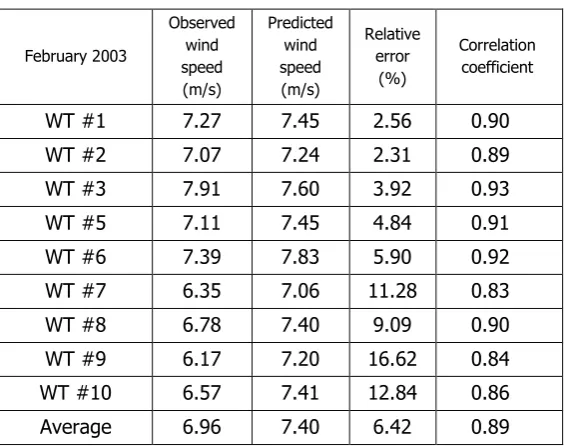
Table 3 summarizes comparisons of observed and predicted values of wind speed for the cases of adopting WT #4 and WT
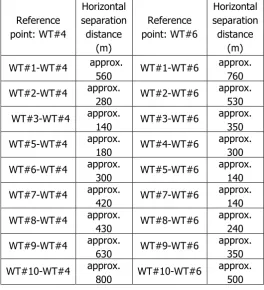
#6 as the reference points. Table 4 gives the horizontal separation distance between a given WT and WT #4 or WT #6, both of
which were used as reference points. Similarly, Table 5 shows the elevation difference between the hub-height of a given WT
and reference point WT #4 or WT #6. Examinations of Tables 3 to 5 reveal that the relative error of the wind speed at a WT
predicted by the proposed actual wind speed prediction procedure is less than approximately 20% if the
Table 3 Comparisons of observed and predicted values of wind speed
(a) Reference point: WT #4
February 2003
Observed wind speed (m/s)
Predicted wind speed (m/s)
Relative error
(%)
Correlation coefficient
WT #1 7.27 7.45 2.56 0.90
WT #2 7.07 7.24 2.31 0.89
WT #3 7.91 7.60 3.92 0.93
WT #5 7.11 7.45 4.84 0.91
WT #6 7.39 7.83 5.90 0.92
WT #7 6.35 7.06 11.28 0.83
WT #8 6.78 7.40 9.09 0.90
WT #9 6.17 7.20 16.62 0.84
WT #10 6.57 7.41 12.84 0.86
(b) Reference point: WT #6 February 2003 Observed wind speed (m/s) Predicted wind speed (m/s) Relative error (%) Correlation coefficient
WT #1 7.27 6.63 8.74 0.90
WT #2 7.07 6.32 10.71 0.87
WT #3 7.91 6.48 18.09 0.92
WT #4 7.11 7.73 6.80 0.92
WT #5 7.39 7.07 0.54 0.92
WT #7 6.35 6.80 7.10 0.92
WT #8 6.78 7.02 3.58 0.96
WT #9 6.17 6.80 10.22 0.92
WT #10 6.57 6.90 5.13 0.93
Average 6.96 6.86 2.73 0.92
horizontal separation distance and elevation difference between a prediction point (the hub-height of a WT) and the reference
point are approximately 800 m or less and 50 m or less, respectively. As expected, the observed wind speed data that are used
in the present study were affected by the blade rotation since they were collected from propeller vane anemometers that were
mounted on the nacelles of the WTs. However, this effect is equally present in the wind speed data that were collected at all the
WTs.
Table 4 Horizontal separation distance between a given WT and the reference point
Reference point: WT#4 Horizontal separation distance (m) Reference point: WT#6 Horizontal separation distance (m)
WT#1-WT#4 approx.
560 WT#1-WT#6
approx. 760
WT#2-WT#4 approx.
280 WT#2-WT#6
approx. 530
WT#3-WT#4 approx.
140 WT#3-WT#6
approx. 350
WT#5-WT#4 approx.
180 WT#4-WT#6
approx. 300
WT#6-WT#4 approx.
300 WT#5-WT#6
approx. 140
WT#7-WT#4 approx.
420 WT#7-WT#6
approx. 140
WT#8-WT#4 approx.
430 WT#8-WT#6
approx. 240
WT#9-WT#4 approx.
630 WT#9-WT#6
approx. 350
WT#10-WT#4 approx.
800 WT#10-WT#6
Table 5 Elevation difference between the hub-height of a given WT (a prediction point) and the reference point
Reference
point: WT#4 Elevation difference (m)
Reference
point WT#6 Elevation difference (m)
WT#1-WT#4 37 WT#1-WT#6 32
WT#2-WT#4 45 WT#2-WT#6 40
WT#3-WT#4 28 WT#3-WT#6 23
WT#5-WT#4 35 WT#4-WT#6 5
WT#6-WT#4 5 WT#5-WT#6 30
WT#7-WT#4 49 WT#7-WT#6 44
WT#8-WT#4 42 WT#8-WT#6 37
WT#9-WT#4 45 WT#9-WT#6 40
WT#10-WT#4 28 WT#10-WT#6 23
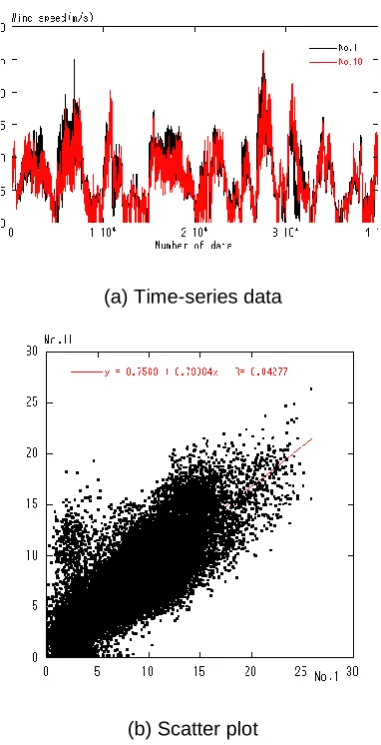
(a) Time-series data
(b) Scatter plot
Fig. 13 Comparison of hub-height wind speed at WT #1 and WT #10, observation data
In regard to the previously discussed range of application for the proposed actual wind speed prediction procedure, the
subsequent analysis examines, based on the observation data, the characteristics of airflow over complex terrain, which serve
as supporting evidence for the range of application for the procedure. Fig. 13 shows a comparison of the time-series of the
observed wind speed from WT #1 and WT #10 and also a scatter plot of the observed wind speed from the two WTs for
February 2003. The horizontal separation distance between the two WTs is as much as approximately 1200 m, and the
separation distance. Even though the horizontal separation distance between WT #1 and WT #10 is more than 1000 m, the
temporal changes of the wind speed over the course of one month at WT #1 and WT #10 are quite similar. The correlation
coefficient between the two data sets plotted in Fig. 13(b) is 0.84.
Of the 40,047 values of the ratio of the wind speed at WT #1 (the prediction point) to the wind speed at WT #4 (the
reference point) for February 2003, data values only from the time of northerly wind are extracted in order to study the
statistical properties of the wind speed ratio. The number of extracted data values is 9,501, which corresponds to approximately 24% of the entire set of data values. In this analysis, an angle of 0° denotes wind which blows from north to
south, and wind which flows from wind directions that are 348.75° or larger and 11.25°or smaller are defined as northerly
wind. Fig. 14 shows the time-series of the wind speed ratio only for times of northerly wind. Fig. 14 also shows the average
value of the observed wind speed ratios for northerly wind and that from the CFD model, revealing that these two average
values agree closely.Fig. 15 shows the frequency distribution of the wind speed ratios plotted in Fig. 14. The frequency is
distributed nearly symmetrically with the average wind speed ratio in the center. Thus, it can be said that time-series data of
scalar wind speed at an arbitrary point can be obtained with the use of observed time-series of wind speed from the reference
point if, with the use of CFD, the effects of terrain irregularities on the wind flow can be simulated accurately and the ratio of
the wind speed at the prediction point to the wind speed at the reference point can be estimated with high accuracy.
Fig. 14 Observed time-series of the ratio of the hub-height wind speed at WT #1 to that at WT #4, only for times of northerly wind, February 2003
Fig. 15 Frequency distribution of the ratio of the hub-height wind speed at WT #1 to that at WT #4, only for times of northerly wind, February 2003
0.89(predicted value)
6. Conclusion
In the present study, a procedure for predicting the actual wind speed over complex terrain was proposed. This procedure
utilizes both time series of observation data and CFD output obtained from the unsteady, nonlinear wind simulator
RIAM-COMPACT, in which a collocated grid in a general curvilinear coordinate system is adopted. In this procedure,
time-series of scalar wind speed obtained from field observations are converted to the actual scalar wind speed with the use of
(non-dimensional) wind speed parameters that were obtained beforehand with the use of the CFD. The proposed prediction
procedure was validated with the use of observation data acquired with propeller vane anemometers mounted on the nacelles
of wind turbines in Noma Wind Park, Kagoshima Prefecture, Japan. As for the result, the following was found for Noma Wind
Park, which was investigated in the present study. If the horizontal separation distance between a prediction point and the
reference point is approximately 800 m or less and the elevation difference between the two locations is 50 m or less, the
relative error of the wind speed predicted by the proposed wind speed prediction procedure is less than approximately 20%.
However, additional validation is necessary in regard to how the reference location is selected and the types of observation
instruments used at the reference point. In addition, validation also needs to be carried out at other sites. These validations will
be topics of future research. Finally, if the proposed procedure is further expanded so that it utilizes output from a
meteorological model instead of observation data, a so-called real-time simulation, which can predict wind flows a few hours
to a few days into the future, will be made possible.
References
1) J. Berg, J. Mann, A. Bechmann, M. S. Courtney, and H. E. Jørgensen, The Bolund experiment, part I: flow over a steep,
three-dimensional hill, Boundary-Layer Meteorology, vol. 141, no. 2, pp. 219–243, 2011
2) A. Bechmann, N. N. Sørensen, J. Berg, J. Mann, and P.-E. Réthoré, The Bolund experiment, part II: blind comparison of microscale flow models, Boundary-Layer Meteorology, vol. 141, no. 2, pp. 245–271, 2011
3) J. M. Prospathopoulos, E. S. Politis, and P. K. Chaviaropoulos, Application of a 3D RANS solver on the complex hill of Bolund and assessment of the wind flow predictions, Journal of Wind Engineering and Industrial Aerodynamics, vol. 107-108, pp. 149–159, 2012
4) M. Diebold, C. Higgins, J. Fang, A. Bechmann, and M. B. Parlange, Flow over hills: a large-eddy simulation of the Bolund case, Boundary-Layer Meteorology, vol. 148, no. 1, pp. 177–194, 2013
5) T. S. Yeow, A. Cuerva, B. Conan, and J. Pérez-Álvarez, Wind tunnel analysis of the detachment bubble on Bolund Island, Journal of Physics: Conference Series, vol. 555, no. 1, Article ID 012021, 2014
6) T. S. Yeow, A. Cuerva-Tejero, and J. Pérez-Álvarez, Reproducing the Bolund experiment in wind tunnel, Wind Energy, vol. 18, no. 1, pp. 153–169, 2015
7) Ashvinkumar Chaudhari, Antti Hellsten,and Jari Hämäläinen, Full-Scale Experimental Validation of Large-Eddy Simulation of Wind Flows over Complex Terrain: The Bolund Hill, Advances in Meteorology, Volume 2016 (2016), Article ID 9232759.
8) B. Conan, A. Chaudhari, S. Aubrun, J. van Beeck, J. Hämäläinen, and A. Hellsten, Experimental and numerical modelling of flow over complex terrain: the Bolund hill, Boundary-Layer Meteorology, vol. 158, no. 2, pp. 183–208, 2016
9) Takanori Uchida and Yuji Ohya, Micro-siting Technique for Wind Turbine Generators by Using Large-Eddy Simulation, Journal of Wind Engineering & Industrial Aerodynamics,Vol.96, pp.2121-2138, 2008
10) Koichi Watanabe, Yuji Ohya, Takanori Uchida, Tomoyuki Nagai, Numerical Prediction and Field Verification Test of Wind-Power Generation Potential in Nearshore Area Using a Moored Floating Platform, Journal of Flow Control, Measurement & Visualization, Vol.5, No.2, 2017, DOI: 10.4236/jfcmv.2017.52002
11) Fumihito Watanabe and Takanori Uchida, Micro-siting of Wind Turbine in Complex Terrain : Simplified Fatigue Life Prediction of Main Bearing in Direct Drive Wind Turbines, WIND ENGINEERING, 39, 4, 21, pp.349-368, 2015
12) Takanori Uchida, Yuji Ohya and Kenichiro Sugitani, Comparisons between the wake of a wind turbine generator operated at optimal tip speed ratio and the wake of a stationary disk, Modelling and Simulation in Engineering, Volume 2011 13) Takanori Uchida, Takashi Maruyama and Yuji Ohya, New Evaluation Technique for WTG Design Wind Speed using a
CFD-model-based Unsteady Flow Simulation with Wind Direction Changes, Modelling and Simulation in Engineering, Volume 2011
RIAM-COMPACT CFD Model-Design Wind Speed Evaluation and Wind Risk (Terrain-Induced Turbulence) Diagnostics in Japan, Energies, Vol.4, pp.458-474, 2011
15) Takanori Uchida and Yuji Ohya, Verification of the Prediction Accuracy of Annual Energy Output at Noma Wind Park by the Non-Stationary and Non-Linear Wind Synopsis Simulator, RIAM-COMPACT, Journal of Fluid Science and Technology, Vol.3, No.3, pp.344-358, 2008
16) Takanori Uchida and Yuji Ohya, Application of LES technique to diagnosis of wind farm by using high resolution elevation data, JSME International Journal 「Environmental Flows」, Series B, Vol.49, No.3, pp.567-575, 2006
17) Takanori Uchida and Yuji Ohya, Large-eddy simulation of turbulent airflow over complex terrain, Journal of Wind Engineering & Industrial Aerodynamics, Vol.91, pp.219-229, 2003
18) Takanori Uchida and Yuji Ohya, Numerical simulation of atmospheric flow over complex terrain, Journal of Wind Engineering & Industrial Aerodynamics, Vol.81, pp.283-293, 1999
19) Kim, J. and Moin, P., Application of a fractional-step method to incompressible Navier-Stokes equations, J. Comput. Phys., Vol.59 (1985), pp.308-323
20) Kajishima, T., Upstream-shifted interpolation method for numerical simulation of incompressible flows, Bull. Japan Soc. Mec. Eng. B, 60-578 (1994), pp.3319-3326, (in Japanese)
21) Kawamura, T., Takami, H. and Kuwahara, K., Computation of high Reynolds number flow around a circular cylinder with surface roughness, Fluid Dyn. Res., Vol.1 (1986), pp.145-162