ARTICLE
Practices and Perceptions of Long-term Follow-up
Among State Newborn Screening Programs
Timothy Hoff, PhD, Adrienne Hoyt, MPH
Department of Health Policy, Management, and Behavior, School of Public Health, University at Albany, State University of New York, Rensselaer, New York
The authors have indicated they have no financial relationships relevant to this article to disclose.
ABSTRACT
OBJECTIVES.The purposes of the study were to describe and to analyze the types of
policies and practices that exist currently among state newborn screening pro-grams in relation to long-term follow-up oversight and activities for newborns with confirmed disorders and to examine the perceptions of newborn screening program leaders regarding long-term follow-up activities.
METHODS.A 23-question survey was administered to state newborn screening
pro-gram coordinators in each of the 50 states, the District of Columbia, Puerto Rico, and the US Virgin Islands in January to February 2005.
RESULTS.Survey findings revealed significant variation in terms of how long-term
follow-up is defined, staffed, and conducted within state newborn screening programs. This variation does not seem to be related to existing state program capacity, in terms of size of newborn screening programs or available resources. In addition, at present many state programs do not conduct long-term follow-up oversight or activities for newborns with diagnosed disorders, and many of those that do seem to lack necessary staffing and quality assurance mechanisms for effective long-term follow-up.
CONCLUSIONS.The results point generally to a need for greater attention in aligning
state newborn screening program capacity with long-term follow-up, increased emphasis on standardization for long-term follow-up activities, and development of stronger quality assurance oversight from state newborn screening programs if effective long-term follow-up oversight is to occur nationally. Given the present expansion of newborn screening in many states, additional research and policy-making with respect to long-term follow-up seem warranted.
www.pediatrics.org/cgi/doi/10.1542/ peds.2005-1830
doi:10.1542/peds.2005-1830
Key Words
follow-up, newborn screening, public health, health policy, newborn screening programs
Abbreviations LTFU—long-term follow-up MS/MS—tandem mass spectrometry NNSGRC—National Newborn Screening and Genetics Resource Center FTE—full-time employee
Accepted for publication Nov 30, 2005 Address correspondence to Timothy Hoff, PhD, Department of Health Policy, Management, and Behavior, School of Public Health, University at Albany, SUNY, 1 University Place, Rensselaer, NY 12144. E-mail: [email protected]
N
EWBORN SCREENING IS an important activity in health care. It is also ideally a system in which testing, diagnosis, treatment, and ongoing evaluation occur in a timely, coordinated manner. In 2001, more than $120 million was spent nationally on newborn screening.1 Newborn screening facilitates the earlyde-tection and prevention of disease among infants and children, reduces morbidity associated with disease, and improves the quality of life and longevity for individuals afflicted with or susceptible to certain disorders.2–4 A
recent report on newborn screening sponsored by the federal government recommended expansion of state testing to a minimum of 29 specific disorders.5Currently,
newborn screening programs exist in all 50 states, the District of Columbia, and some US territories. States screen for 8 to 50 genetic and metabolic disorders, al-though, with the new recommended minimal panel, many states are in the process of expanding screening to ⱖ30 disorders.
Traditionally, the value of newborn screening as a public health activity lay in having valid and reliable tests to identify the presence of treatable disorders.6
However, this traditional view has given way recently to a more-expansive view of newborn screening. The latter view has accompanied technological breakthroughs such as tandem mass spectrometry (MS/MS), which make screening for more disorders cheaper and easier. The use of MS/MS also aids in screening for a larger array of preventable, treatable disorders. The expansive view justifies testing not only to prevent morbidity and death with early intervention but also to identify carriers for specific disorders, to reduce parental stress, and ulti-mately to detect genetic mutations that could lead to adult-onset disease within an individual.7,8
The expansion of state newborn screening programs is an emerging reality, given the technology available, increasing public and political pressure for more testing, and the increasing availability of for-profit, private test-ing laboratories. However, there is debate in the field regarding whether proposed expansions will offer added value from a public health perspective.9–11Some
disor-ders that can be detected with new MS/MS technology are not treatable, prompting debate regarding the ulti-mate benefits of testing for the newborn. Other disorders are treatable but not curable or preventable. In addition, screening for diseases such as cystic fibrosis may create complications and anxiety for patients and their families in the absence of actual disease; for example, the screen-ing process may lead only to carrier identification. These realities make testing potentially more expensive, less reliable, and of less benefit.7,8
For newborns with abnormal screening results, addi-tional concerns arise, related to the ability of each state’s health care delivery system to provide confirmatory di-agnoses for newborns in a timely manner, to provide similar access to treatment services across screened
pop-ulations, and to perform adequate follow-up monitoring and case management over time.11–13 The issue of
fol-low-up services for newborns with abnormal screening results is particularly important because newborn screening is screening and not diagnosis.7 Diagnosis
should begin a longer-term process of monitoring, inter-vention, and treatment. From the state newborn screen-ing program perspective, follow-up services may encom-pass a variety of oversight, care coordination, and direct service activities, including notification of providers of test results, notification of parents, confirmation of di-agnosis and treatment for specific disorders, coordina-tion of services for affected newborns, monitoring of service provision, and evaluation of clinical care for in-dividuals.11,14
Understanding more about the role of state newborn screening programs in follow-up activities requires an appreciation of the general context of newborn screen-ing in the United States. Newborn screenscreen-ing is a state-controlled health care activity.7,15States have complete
discretion to determine how their newborn screening programs should be structured. This discretion produces wide variations in newborn screening programs across states.1,13,14,16,17These variations are a function of a
mix-ture of factors, such as state size, available financial resources, political and interest group pressures, type and authority of advisory groups for newborn screening, and availability of technology.10,11
Less is known about the variations across state pro-grams in long-term follow-up (LTFU) oversight and ac-tivities for newborns with diagnosed disorders. How-ever, LTFU is the second major component of newborn screening that makes it a meaningful public health ac-tivity.7,11 Identifying infants who may have genetic or
METHODS
Survey and Sample
A 23-question survey was prepared and sent to newborn screening programs in all 50 states, the District of Co-lumbia, and the US Virgin Islands. The same survey was administered in both Internet-based and mail formats. The Internet-based version of the survey was sent to the e-mail addresses of both the laboratory and follow-up screening program coordinators listed in the most recent contact list maintained by the National Newborn Screen-ing and Genetics Resource Center (NNSGRC).17 The
printed version of the survey was sent to the mailing addresses of the same program contacts. Respondents were asked to submit only 1 version of the survey, whether they selected the Internet-based or printed sur-vey. Only 2 respondents chose to reply by mail; the rest completed the Internet-based survey. The survey was administered during January and February 2005.
The survey focused on the practices and perceptions of LTFU services in state newborn screening programs. (The complete survey is available from the authors.) Coordinators were also asked to classify what they con-sidered to be part of appropriate, state-level, LTFU over-sight and activities. There is wide variation in the liter-ature regarding what constitutes LTFU, which was another reason to explore how each program sought to define it. Questions in the survey asked respondents about items such as program-specific definitions of fol-low-up, whether or not states engaged in LTFU oversight and activities generally, whether or not states used spe-cific quality assurance tools to conduct LTFU, the pres-ence of formal evaluation activities in relation to LTFU, and current and desired staffing levels for follow-up. It also asked basic descriptive questions related to program budget size, number of disorders screened, positional title of respondent, and number of years working in the current position.
Some of the survey questions were open-ended. The majority had forced choices, in terms of yes/no or Likert-scale responses (eg, strongly agree to strongly disagree). There were also a few questions in which respondents were asked to provide rankings. The survey items were developed through an iterative process that involved discussions with the director of the NNSGRC and review of the literature on newborn screening. The survey was pilot-tested with a group of 12 individuals at the authors’ school of public health and several genetics profession-als. To complete the data set, 1 additional variable was taken from a General Accounting Office 2003 survey of state newborn screening programs, 1 variable was taken from the NNSGRC June 2005 US national screening status report, and the current fees charged by programs were obtained from the NNSGRC. The variable taken from the General Accounting Office survey was the number of live births for each state.1The size of a state,
in terms of number of newborns who need to be screened, may affect follow-up practices, because it raises potential capacity issues related to the number of newborns with abnormal screening results. The number of mandated disorders for each state was obtained from the NNSGRC status report. Finally, program screening fees have been cited as a significant source of revenue used to run newborn screening programs.1
Statistical Analyses
SPSS version 13.0 (SPSS, Chicago, IL) was used for analyses. Analyses were conducted by using a combina-tion of univariate and bivariate statistical operacombina-tions. These included descriptive values such as frequencies, means, and SDs; analysis of variance with independent and paired-samplettests; and cross-tabulations with the 2measure of association. Several key variables, such as whether or not the state conducted any LTFU oversight or activities, were used to stratify the data into subgroups a priori, for comparison analysis. Only 2 variables in the data set had missing data that amounted to⬎5% of total cases; these were the estimated budget for a state new-born screening program and the number of full-time employees (FTEs) necessary to conduct adequate LTFU service. Both variables were included in the analyses because they were deemed important for understanding overall practices and perceptions of LTFU. It was decided that the benefit of having data for these 2 variables for most of the states outweighed the disadvantage of not having data for a few states. Rather than the means for these variables being used in missing cases, the cases themselves were excluded from analysis.
RESULTS
Variation and Capacity Related to LTFU Services
Surveys were completed for 45 of 50 states, the District of Columbia, Puerto Rico, and the US Virgin Islands. This represents a 91% response rate. Nonresponding states included Massachusetts, Kansas, Tennessee, New Mex-ico, and South Dakota. Programs for these states were contacted by telephone, to determine whether the coor-dinators would complete and return the survey. Several could not be reached, and the others stated that they did not wish to complete the survey. We used only 1 com-pleted survey for each state and territory and, in all cases except 5, the completed surveys came from the fol-low-up coordinators within each program. In the other 5 instances, we used laboratory coordinator survey re-sponses, because it was communicated by the particular state programs that those individuals were in the best position to respond to questions about LTFU service.
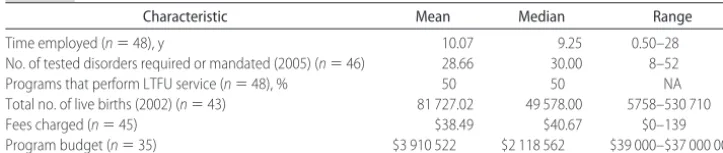
also a great deal of regional variation seen in the number of tested/mandated disorders. (“Tested” disorders were defined as disorders already included in a state’s new-born screening panel and “mandated” as disorders for which testing in a state has been required recently but has not yet been implemented.) Mountain and Southern states tended to have fewer tested/mandated disorders. However, only 5 states had required testing for ⬍10 disorders. There was no association between the size of a state (measured in terms of live births) and the number of disorders tested. On average, programs charged a $38.49 fee for each newborn screened. The median fee charged was $40.67. However, 5 states and territories charged no fee, and 24 charged $40 or more. For pro-grams that performed LTFU activities and oversight, the average fee charged per newborn screened was $36.70. For programs that did not conduct LTFU, the average fee was $41.81. This difference was not statistically signifi-cant. Only 1 program that engaged in LTFU did not charge a fee, compared with 4 states that did not conduct LTFU. Approximately 43% of states engaged in LTFU charged $40 or more in screening fees, compared with 58% of states that did not engage in LTFU. There was no association observed between the fees charged and the size of the state newborn screening program, as mea-sured in terms of numbers of live births or size of total program budget. However, there was a significant asso-ciation between the fees charged and the numbers of tested/mandated conditions within states (r⫽0.372;P
⬍.01).
Variation among state newborn programs was also seen in terms of leader tenure and position title in rela-tion to the follow-up component. The average number of years follow-up coordinators had been employed in their current screening programs was 10. However, one third of all programs had follow-up coordinators who had been employed for⬍4 years, and 25% of coordina-tors had been employed for ⱖ15 years. Job titles for individuals in charge of follow-up activities (both short-term follow-up and LTFU activities) also varied mean-ingfully across state newborn programs (Table 1). At least 15 different titles were reported by respondents. Total budgets and numbers of FTEs for state newborn screening programs also varied greatly. The average an-nual state newborn screening program budget reported
by respondents was $2.9 million, with a range between $39 000 and $37 000 000. However, the distribution of state program budgets was skewed toward lower budget amounts, with 35% of respondents reporting total pro-gram budgets of $1 million or less and 50% reporting budgets of $2.1 million or less. There was a strong pos-itive correlation between state size, measured in number of live births, and program budget size (r⫽0.841;P⬍
.001). No relationship was found between the number of tested/mandated disorders in a state and budget size.
Of programs that conducted LTFU oversight and ac-tivities (n⫽ 24), two thirds stated that they employed ⱕ5 FTEs for all follow-up activities, including both short-term follow-up and LTFU activities. However, when asked to identify the approximate percentage of total FTE follow-up time spent exclusively on LTFU activities, more than one half of these 24 programs stated that ⬍20% of total FTE follow-up time was devoted to activ-ities they considered LTFU. Given a mean of 5 FTEs reported for follow-up staffing in total and the fact that only a few respondents indicated employingⱖ7 individ-uals for follow-up activities in total, we can infer that most state programs that perform LTFU allocate⬃1 or 2 FTEs to this oversight and activity. When all 48 state and territory program respondents were asked how many FTEs they thought were needed in their programs to engage in adequate LTFU for newborns with abnormal screening results in their state, more than one half re-sponded with ⬎2 FTEs and 20% suggested ⱖ9. Given existing staffing levels reported, a meaningful number of respondents thought that what was desirable in terms of staffing for effective LTFU amounted to 2 to 5 times more staff members than are employed presently in their programs. No differences in the desired number of FTEs needed to perform adequate LTFU were seen between state programs that did and did not conduct LTFU.
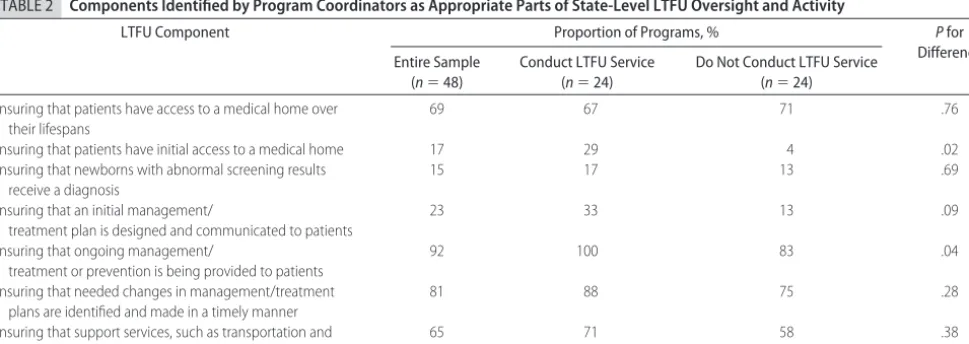
The definitions of what should constitute LTFU over-sight and activity within state newborn screening pro-grams were fairly uniform among survey respondents. Two thirds of responding programs thought that LTFU at the state level consisted of ensuring that patients have access to a medical home during their lifespans and ensuring that support services, such as transportation and information, are available to patients (the definition of “medical home” was provided to respondents in the
TABLE 1 Characteristics of State Newborn Screening Program Sample
Characteristic Mean Median Range
Time employed (n⫽48), y 10.07 9.25 0.50–28
No. of tested disorders required or mandated (2005) (n⫽46) 28.66 30.00 8–52
Programs that perform LTFU service (n⫽48), % 50 50 NA
Total no. of live births (2002) (n⫽43) 81 727.02 49 578.00 5758–530 710
Fees charged (n⫽45) $38.49 $40.67 $0–139
Program budget (n⫽35) $3 910 522 $2 118 562 $39 000–$37 000 000
survey as “a regular and consistent source of care for a patient that is accessible, family-centered, comprehen-sive, and culturally competent”) (Table 2). The greatest agreement among respondents involved the compo-nents of ensuring that ongoing management/treatment is being provided to patients and ensuring that needed changes in management/treatment plans are identified and made in a timely manner. One half of all survey respondents identified these 4 components as appropri-ate parts of LTFU oversight and activity within stappropri-ate newborn screening programs.
Comparison of LTFU Activities, Models, and Quality Assurance Table 2 also compares definitions of LTFU provided by programs that do and do not conduct such activities as a regular course of business. Several differences were found between the 2 groups with respect to how they defined the components constituting LTFU particularly. Respondents from programs that engaged in LTFU seemed to have a more expansive definition of the over-all activity. For example, significantly greater propor-tions of LTFU programs thought that ensuring initial patient access to a medical home and ensuring that ongoing management/treatment is provided to patients were parts of LTFU (P⫽.022 and .043, respectively). In addition, one third of programs engaged in LTFU con-sidered the component of ensuring that an initial man-agement/treatment plan is designed and communicated to patients a legitimate part of LTFU (as opposed to being thought of exclusively as a short-term follow-up activ-ity), compared with 13% of programs not engaged in LTFU. Comparisons were also made for a number of size and capacity characteristics among newborn screening programs that do and do not conduct LTFU for newborns with diagnosed disorders (Table 3). No significant differ-ences were found in any of these characteristics.
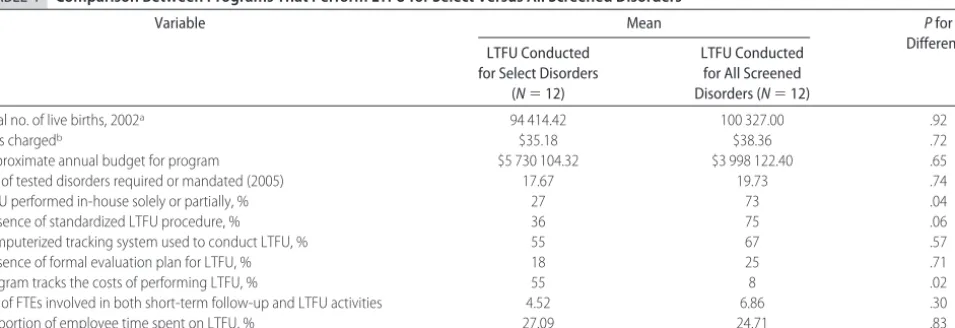
An additional subgroup analysis was performed be-tween state newborn screening programs that engaged
in LTFU oversight and activity for all tested/mandated disorders and those that engaged in LTFU activity only for select disorders (Table 4). These 2 groups were com-pared with respect to a number of size and resource characteristics. They were also compared in terms of the presence or absence of specific quality assurance prac-tices. For example, respondents were asked whether they performed LTFU in-house or contracted out for it, whether they had a standardized LTFU policy or set of procedures in place to guide their oversight and activi-ties, whether they used any sort of computerized track-ing system to conduct follow-up monitortrack-ing over time, whether they had a formal evaluation plan to assess their program’s LTFU oversight and activities, and whether they tracked the LTFU costs for their program. Few differences were found between the 2 LTFU groups (Table 4). The only significant difference was the greater proportion that tracked the costs of LTFU in their program in the group that engaged in LTFU activity only for select disorders, compared with the group that en-gaged in LTFU activity for all tested/mandated disorders (55% vs 8%; P ⫽ .020). A greater proportion of pro-grams that performed LTFU for all disorders in their state had standardized LTFU procedures in place to guide activities (75% vs 36%;P⫽.066). Perhaps more inter-esting than the few differences found between these 2 LTFU groups were the lower percentages found in both groups with respect to having in place or conducting quality assurance and efficiency-focused activities. For example, fewer than one half of the 24 state programs that engaged in LTFU performed any of that service in-house, instead contracting it out to an external entity, thus creating a situation in which they might have less oversight ability.
In addition, only 5 of 24 programs reported having a formal evaluation plan in place to assess the effective-ness of their program’s LTFU activities. Two thirds of the 24 programs performing LTFU indicated that they did
TABLE 2 Components Identified by Program Coordinators as Appropriate Parts of State-Level LTFU Oversight and Activity
LTFU Component Proportion of Programs, % Pfor
Difference Entire Sample
(n⫽48)
Conduct LTFU Service (n⫽24)
Do Not Conduct LTFU Service (n⫽24)
Ensuring that patients have access to a medical home over their lifespans
69 67 71 .76
Ensuring that patients have initial access to a medical home 17 29 4 .02
Ensuring that newborns with abnormal screening results receive a diagnosis
15 17 13 .69
Ensuring that an initial management/
treatment plan is designed and communicated to patients
23 33 13 .09
Ensuring that ongoing management/
treatment or prevention is being provided to patients
92 100 83 .04
Ensuring that needed changes in management/treatment plans are identified and made in a timely manner
81 88 75 .28
Ensuring that support services, such as transportation and information, are available to patients
not track the costs of performing LTFU oversight in their state. Greater proportions indicated that they had both standardized procedures and computerized tracking sys-tems to enhance the quality of LTFU oversight and ac-tivities in their programs. However, 35% to 40% of programs performing LTFU service had neither of those items (Table 4). Not unexpectedly, states that conducted LTFU activities for select disorders had fewer employee resources devoted to LTFU service generally within their state screening programs. For both groups, the amount of allotted FTE time, as indicated earlier, was small.
DISCUSSION
The results of this study raise issues in need of attention, with respect to state newborn screening program capac-ity to engage in LTFU service, standardization of that LTFU service, and improved quality management within state programs that engage in LTFU. First, there is the capacity issue. Most newborn screening programs cur-rently are small, in terms of budgeted resources. There was no observed relationship between the fees charged and whether a state engaged in LTFU. In fact, the screen-ing fee was higher, on average, for states that did not engage in LTFU activities. The lack of association ob-served here between capacity variables and whether a
state engages in any type of LTFU indicates that policy decisions creating increased workload for state newborn screening programs, such as adding new disorders for testing or performing extended follow-up for newborns with confirmed disorders, may not align with the exist-ing capacity of a state newborn screenexist-ing program to absorb that workload. This is an especially important point if there is an expectation, given newborn screening as a system, that state newborn screening programs have a role to play in overseeing and coordinating the man-agement and treatment of newborns with diagnosed disorders.10,11,18
The capacity issue for LTFU in state newborn screen-ing programs is informed by other study results. One half of the states and territories that responded indicated that they currently do not engage in any LTFU oversight or activities. The findings also show that capacity is an issue even for state programs that perform some form of LTFU, with these programs allocating small amounts of resources to their LTFU oversight and activities, in the range of 1 to 2 FTEs. For state programs that screen for up to 50 disorders, these staff resources seem low, re-gardless of which specific tasks constitute the LTFU func-tions in those programs.
If resources (human and financial) to conduct
ade-TABLE 3 Comparison of Size and Capacity Characteristics Between Programs That Do and Do Not Engage in LTFU Oversight and Activities
Variable Mean Pfor
Difference
Conduct LTFU Do Not Conduct
LTFU
Total no. of live births, 2002a 97 102.00 65 620.00 .31
Fees chargedb $36.70 $41.81 .52
Approximate annual budget for program $4 864 113.36 $2 639 066.67 .31
No. of tested disorders required or mandated (2005)c 18.65 20.96 .58
aData from 2003 General Accounting Office report.
bData from the National Newborn Screening and Genetics Resource Center, October 2005. cData from the National Newborn Screening and Genetics Resource Center, June 2005.
TABLE 4 Comparison Between Programs That Perform LTFU for Select Versus All Screened Disorders
Variable Mean Pfor
Difference LTFU Conducted
for Select Disorders (N⫽12)
LTFU Conducted for All Screened Disorders (N⫽12)
Total no. of live births, 2002a 94 414.42 100 327.00 .92
Fees chargedb $35.18 $38.36 .72
Approximate annual budget for program $5 730 104.32 $3 998 122.40 .65
No. of tested disorders required or mandated (2005) 17.67 19.73 .74
LTFU performed in-house solely or partially, % 27 73 .04
Presence of standardized LTFU procedure, % 36 75 .06
Computerized tracking system used to conduct LTFU, % 55 67 .57
Presence of formal evaluation plan for LTFU, % 18 25 .71
Program tracks the costs of performing LTFU, % 55 8 .02
No. of FTEs involved in both short-term follow-up and LTFU activities 4.52 6.86 .30
Proportion of employee time spent on LTFU, % 27.09 24.71 .83
aData from 2003 General Accounting Office report.
quate LTFU activities and oversight in a state newborn screening program are not available, then the activities may fall in part to academic or other specialty centers. As seen in this study, LTFU services could be included as part of contracted services provided by these centers, in some cases. Subspecialty centers may have limited staffs with a variety of clinical priorities, yielding minimal time that can be devoted to LTFU. Subspecialty centers also may tend to care for patients with disorders in specific disease categories, such as metabolic or endocrine disor-ders, rather than caring for patients across multiple dis-ease categories. There may be a variety of subspecialty centers in a given state, geographically distant from each other, that lack the resources for ongoing coordination and communication among themselves.
A second issue raised by the expansion of newborn screening programs is related to the potential for stan-dardization of LTFU program elements within state new-born screening programs. Standardization allows best practices to be identified, shared, and reproduced and helps to establish a national newborn screening system. The recent government-sponsored report on standardiz-ing newborn screenstandardiz-ing panels across states is in the spirit of this idea.5In the present study, several findings point
to either a lack of standardization or potential difficulty in achieving greater standardization regarding the LTFU activities of state newborn screening programs. First, some variation was observed in how LTFU is perceived by state newborn screening programs that do and do not conduct LTFU activities (Table 2). Second, the findings that indicate few linkages between the state’s decision to engage in LTFU and the state newborn screening pro-gram’s capacity to perform LTFU activities mean that some states may be in a less-advantageous position than others in being able to incorporate elements of a stan-dardized approach to LTFU, which might include re-source-intensive systems in areas such as patient track-ing and formal evaluation. Third, almost one half of all state programs that engaged in LTFU oversight and ac-tivities reported that they did not have any type of standardized policies or procedures in place at the present time. This may indicate screening program work cultures that are resistant to standardization or that re-quire some degree of ongoing socialization to embrace standardization in their work.
Ensuring quality assurance for LTFU in the face of newborn screening expansion is a third issue worthy of greater exploration, on the basis of these findings. The quality issue is evident in the percentages of state new-born screening programs that do not have key elements in place as part of an overall quality management approach to LTFU (Table 4). Whether or not they conducted LTFU activities for all or only select tested/mandated disorders, many programs did not have a standardized LTFU protocol in place to guide their activities (as stated above), did not use any sort of computerized tracking system to monitor
care provided to newborns over time, did not have for-mal evaluation plans to gauge the success of their pro-gram’s LTFU oversight and activities, and did not track what they spent on their LTFU activities and compare the costs and benefits of those activities. Interestingly, state size and available funding did not play meaningful roles in increasing the chances that a program would have more quality assurance elements in place. This raises the question of whether it is necessary to consider the federal government mandating (and perhaps helping to fund) minimal quality assurance standards, so that all state screening programs engaging in LTFU have similar abilities and incentives to create and to sustain LTFU quality components. Of course, other programs within a state that perform LTFU activities may possess these quality assurance elements to lesser or greater degrees. However, the question is to what extent state newborn screening programs need these elements when perform-ing their own LTFU activities.
This study suffers from several key limitations. First, the findings are derived from self-reports from newborn screening program leaders. This raises a concern that answers to factual questions such as those on program size and budget might be reported erroneously. How-ever, information from newborn screening programs generally is gathered through self-report at the present time, for example, information sent by programs to the NNSGRC for their annual reports. It was thought that those surveyed were in the best position to comment on both the scope and substance of state program LTFU activities and that the views of these individuals are important in determining how LTFU should be struc-tured within their programs (because they are closest to the everyday program realities). This study did not focus on what state programs actually did in terms of specific LTFU oversight and activities, only whether programs performed LTFU oversight and activities as they defined them. An additional limitation of the study was that it asked only basic questions related to LTFU practices. As a result, additional investigation is needed to clarify the relationships found in the present study, perhaps through qualitative research with a subsample of differ-ent state newborn screening programs. Finally, this study focused only on state newborn screening pro-grams. There may be other entities within a state that conduct LTFU activities for newborns with diagnosed disorders.
CONCLUSIONS
re-mains unclear what role state newborn screening pro-grams should play in it. However, to comply fully with the spirit of recently released guidelines for LTFU,18 it
will be important for state newborn screening programs to be cognizant of the issues related to LTFU and to take a leadership role in finding solutions that lead to more-comprehensive LTFU services. This means that ulti-mately every state NBS program should be involved in LTFU at some level.
ACKNOWLEDGMENTS
This study was supported through funding from the University at Albany, State University of New York, fac-ulty research awards program (to T.H). It was conducted in cooperation with the NNSGRC.
Special thanks go to Brad Therrell, PhD, director of the NNSGRC.
REFERENCES
1. Dodd CJ, DeWine M. Newborn Screening: Characteristics of State Programs. Washington, DC: US General Accounting Office; 2003 2. Saxena A. Issues in newborn screening. Genet Test. 2003;7:
131–134
3. McCabe LL, Therrell BL Jr, McCabe ERB. Newborn screening: rationale for a comprehensive, fully integrated public health system.Mol Genet Metab.2002;77:267–273
4. Waisbren SE, Albers S, Amato S, et al. Effect of expanded newborn screening for biochemical genetic disorders on child outcomes and parental stress.JAMA.2003;290:2564 –2571 5. Maternal and Child Health Bureau. Newborn screening:
to-ward a uniform screening panel and system, 2004. Available at: ftp://ftp.hrsa.gov/mchb/genetics/screeningdraftforcomment. pdf. Accessed April 10, 2005
6. Wright L, Brown A, Davidson-Mundt A. Newborn screening: the miracle and the challenge.J Pediatr Nurs.1992;7:26 – 42 7. Clayton EW. Issues in state newborn screening programs.
Pe-diatrics.1992;90:641– 646
8. Khoury MJ, McCabe LL, McCabe ERB. Population screening in the age of genomic medicine.N Engl J Med.2003;348:50 –58 9. American College of Obstetricians and Gynecologists.Committee
Opinion Number 287: Newborn Screening. Washington, DC: American College of Obstetricians and Gynecologists; 2003 10. Therrell BL Jr. US newborn screening policy dilemmas for the
twenty-first century.Mol Genet Metab.2001;74:64 –74 11. American Academy of Pediatrics, Newborn Screening Task
Force. Serving the family from birth to the medical home: newborn screening: a blueprint for the future.Pediatrics.2000; 106(suppl):383– 427
12. Mandl KD, Feit S, Larson C, Kohane IS. Newborn screening program practices in the United States: notification, research and consent.Pediatrics.2002;109:269 –273
13. Stoddard JJ, Ferrell PM. State-to-state variations in newborn screening policies.Arch Pediatr Adolesc Med.1997;151:561–564 14. Kim S, Lloyd-Puryear MA, Tonniges TF. Examination of the communication practices between state newborn screening programs and the medical home.Pediatrics.2003;111:120 – 126
15. Carreiro-Lewandowski E. Newborn screening: an overview. Clin Lab Sci.2002;15:229 –238
16. National Newborn Screening and Genetics Resource Center. National Newborn Screening Report, 2000: Final Report: February 2003.Austin, TX: National Newborn Screening and Genetics Resource Center; 2003
17. National Newborn Screening and Genetics Resource Center. Newborn Screening Programs in the U.S., February 2005. Austin, TX: National Newborn Screening and Genetics Resource Center; 2005
DOI: 10.1542/peds.2005-1830
2006;117;1922
Pediatrics
Timothy Hoff and Adrienne Hoyt
Screening Programs
Practices and Perceptions of Long-term Follow-up Among State Newborn
Services
Updated Information &
http://pediatrics.aappublications.org/content/117/6/1922
including high resolution figures, can be found at:
References
http://pediatrics.aappublications.org/content/117/6/1922#BIBL
This article cites 12 articles, 2 of which you can access for free at:
Subspecialty Collections
sub
http://www.aappublications.org/cgi/collection/fetus:newborn_infant_ Fetus/Newborn Infant
_management_sub
http://www.aappublications.org/cgi/collection/administration:practice Administration/Practice Management
following collection(s):
This article, along with others on similar topics, appears in the
Permissions & Licensing
http://www.aappublications.org/site/misc/Permissions.xhtml
in its entirety can be found online at:
Information about reproducing this article in parts (figures, tables) or
Reprints
http://www.aappublications.org/site/misc/reprints.xhtml
DOI: 10.1542/peds.2005-1830
2006;117;1922
Pediatrics
Timothy Hoff and Adrienne Hoyt
Screening Programs
Practices and Perceptions of Long-term Follow-up Among State Newborn
http://pediatrics.aappublications.org/content/117/6/1922
located on the World Wide Web at:
The online version of this article, along with updated information and services, is
by the American Academy of Pediatrics. All rights reserved. Print ISSN: 1073-0397.