All-Payer
Claims Database
Establishing a Foundation for Health Care
Transparency and Informed Decision Making
DEVELOPMENT MANUAL
APCDCOUNCIL.ORG WESTHEALTH.ORG
This APCD Manual was created by the APCD Council with assistance and support from the Gary and Mary West Health Policy Center.
About the West Health Policy Center
The Gary and Mary West Health Policy Center is a nonprofit, non-partisan resource in Washington, D.C. providing education, expertise and policy
proposals to transform the American healthcare experience. We’re wholly funded by philanthropists Gary and Mary West as part of West Health, four organizations with a common mission—pioneering new and smarter technologies, policies and practices, to make high-quality healthcare more accessible at a lower cost to all
Americans.
Along with the Policy Center, West Health includes the Gary and Mary West Health Institute, a nonprofit medical research organization working to create new, more effective ways of delivering care; and the for-profit Gary and Mary West Health Investment Fund and West Health Incubator, providing investments and expertise to businesses that share our mission.
FOR MORE INFORMATION, FIND WEST HEALTH AT www.westhealth.org
and follow us @WESTHEALTH
About the APCD Council
The APCD Council is a learning collaborative of government, private, non-profit, and academic organizations focused on improving the development and
deployment of state-based all payer claims databases (APCDs). The APCD Council is convened and coordinated by the Institute for Health Policy and
Practice (IHPP) at the University of New Hampshire (UNH) and the National
Association of Health Data Organizations (NAHDO).
The Council’s work focuses on shared learning amongst APCD stakeholders, early stage technical assistance to states and catalyzing states to achieve mutual
goals.
www.apcdcouncil.org
Acknowledgement
Table of Contents
3 Executive Summary
11 Introduction
11 About the APCD Council 12 About the ACPD Development
Manual
14 Section 1: Engagement
14 Defining the Vision for the APCD Program
16 Stakeholder Engagement
29 Engagement Assessment Checklist
30 Section 2: Governance
30 APCD Legislation 39 Rules and Regulations
40 Governance Assessment Checklist
41 Section 3: Funding
41 Funding Estimates 42 Funding Types
46 Funding Assessment Checklist
47 Section 4: Technical Build
47 Considerations for Building an APCD 56 Standards, Data Elements,
and Format
59 Quality Assurance Testing 60 RFP Development
62 Emerging Interest in Expanding Content of APCD
64 Technical Build Assessment Checklist
65 Section 5: Analysis and Applications Development
65 Analytic Plan
67 The Role of a Technical Advisory Group
71 Section 6: Feedback Loops and Continuous Engagement
71 Continuous Engagement 72 Key Success Factors
76 Feedback Assessment Checklist
77 Appendix: Worksheets
77 Engagement Assessment
Use Cases Worksheet
Stakeholders Worksheet
Data Efforts Worksheet Payer and Market Assessment Worksheet
Legal Barriers Worksheet
82 Governance Assessment
Governance Considerations
Worksheet
Rules and Regulations Considerations Worksheet
Board Compositions Worksheet
85 Funding Assessment
Funding Sources Worksheet
Data Release Pricing Worksheet
87 Technical Build Assessment
Data Submission Guide Worksheet Development Activities/Resources
Worksheet
RFP Development Worksheet
91 Analytic Plan Worksheet
Data Use Agreement Worksheet
Data Release Considerations
94 Feedback Loops and Continuous Engagement Assessment
Work Plan Worksheet
Communication Plan Worksheet
States are discovering that transforming health care requires a series of new regulatory and market approaches. While states vary in these approaches, most states recognize the vital role multi-payer health data and information systems
will play in health care and payment reforms.
To meet these needs, an ever-growing number
of states are implementing All-Payer Claims Databases (APCDs), aggregating claims and administrative data from public and private payers statewide. States are developing APCD reporting systems to fill critical information gaps, promote health care transparency initiatives, and provide actionable information for their
stakeholders.
The APCD Council is a nationwide learning collaborative of government, private, non-profit, and academic organizations focused on improving the development and deployment of state-based all payer claims databases (APCDs). The APCD
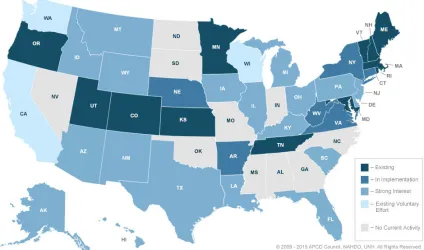
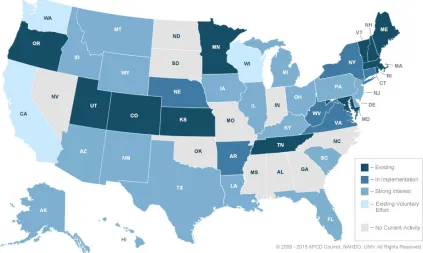
Council maintains a map of state progress on APCD development. As of February 2015, there are 12 states with existing APCDs, 6 in implementation, 3 existing voluntary efforts, and many other states with interest in developing an APCD (Figure 1).
Statewide APCDs:
Databases, typically created by a state mandate, that generally include data derived from medical claims, pharmacy claims, eligibility files, provider (physician and facility) files, and dental claims from private
and public payers.
APCDs are complex data systems, and states seek guidance for recommended
approaches and best practice solutions to common technical issues. This manual
is designed to provide a summary of the many years of collective learning into a single source of information to support APCD development. The APCD Council has created a framework (Figure 2) as an overall
guide to structure state APCD development; this manual provides the details supporting the framework. The framework includes five (5) major aspects to APCD development:
› Engagement › Governance › Funding
› Technical Build
› Analysis & Application Development
In addition, the most successful state APCDs recognize that the work does not stop after the initial implementation, and the arrows on the outside of the figure represent that APCD development is a continuous process (discussed in its own section in the manual).
There are key findings in each of the five areas represented in the APCD development framework.
Engagement
A foundational step in the development of an APCD is articulating and
communicating the purpose of the APCD – the rationale for why the APCD is
needed and what is to be accomplished by creating it. Defining this purpose
should be done through a robust stakeholder engagement process. The
stakeholder group, representing a variety of interests in APCDs, can include:
› Policy makers › Payers
› Health care providers
› Employers and employer coalitions › State agencies
› Consumers › Researchers
› Health Information Exchange (HIE) and Health Insurance Exchange (HIX) systems.
Successful APCD development in an individual state will require comprehensive engagement of these varied partners, resulting in a shared vision. By defining the vision for the APCD system, the key contributors to it (e.g., resources, data, and infrastructure), and the intended use cases for the data, states can cultivate strong community to support APCD development.
Governance
oversight. These components form the foundational structure of the APCD and have bearing on all aspects of the technical build and use of the APCD. The components of a governance structure typically address:
› APCD legislation
› Governing body and oversight › Scope of the data collection effort › Privacy and confidentiality
› General funding considerations › Reporting requirements
› Interagency agreements
While the parameters of governance are similar state-to-state, the specific components of governance vary to meet the needs of the individual state. The final governance parameters (in legislation, rules, and policies) will reflect the state’s intended use of the data, political environment, oversight of the system, and assurances for privacy and data use. Governance policies can drive, or limit, the functionality of a state’s APCD system. For example, Minnesota’s
original legislation restricted access and use of APCD data to the state health
department. Conversely, Colorado’s legislation mandated public reporting of provider-level cost, price, and quality comparative reports for common medical
procedures to enable consumer decisions and choice.
Funding
APCD funding is a key consideration for APCD development, both at the initial development phase and as the system evolves. Costs for APCD planning,
implementation, and maintenance vary by state. Funding considerations involve all aspects of system development and operation and should include:
› Scope: State population (e.g., number of covered lives) and insurance coverage patterns (e.g., the types of health insurance products in place for the population) › Infrastructure needs: Location of the agency where the APCD is to be housed (e.g.,
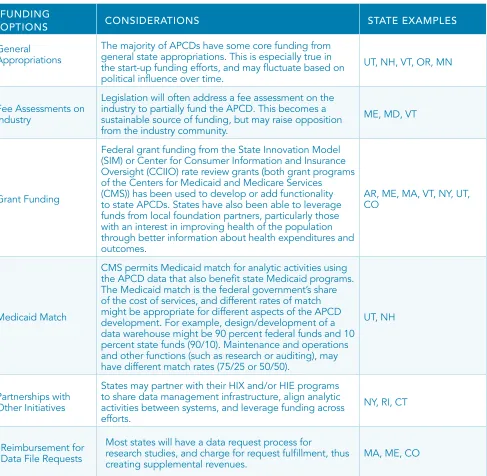
All APCD programs will benefit from diversifying revenue sources as a strategy for sustaining their systems for the long-term (i.e., future development and ongoing maintenance). Thus, APCD initiatives are actively seeking partnerships with other state agencies, such as Medicaid agencies, insurance departments, and health departments to leverage funding and align technical solutions. For example, in Colorado, with a mandate for public reporting and broad user access, the APCD agency is leveraging inter-agency partnerships for funding to
offset the costs of data release. Many state APCD programs are working closely with other state agencies to use APCD data to meet the needs for federal grant
programs, and using those grants to improve APCD data collection and/or
analysis.
Technical Build
The technical build phase of APCD development results in the operational and quality assurance protocols for receiving and processing the data that will be used for analytics and applications. There are several determinants
to understanding the scope of work necessary to support the APCD
technical build, including:
› Analysis and reporting needs › Volume and size of carriers › Types and sizes of files
› Inclusion of public payers › Data submission requirements › Data submission schedule › Data quality requirements
Defining the data elements for the APCD is a key step in the technical build. Because claims data are generated for billing purposes, the data elements are generally available across payer systems. Uniformity of data submission is important, both for reasons of comparability within and across states, and to reduce the payers’ burden to submit data to different states, in different formats.
To address these issues there are initiatives with Standards Development Organizations to standardize data reporting formats. Early efforts in standard-ization have resulted in industry reporting standards that align with both state
There is growing interest in identifying ways to collect new data elements
(e.g., benefit design information) and linking APCDs to other data sets. These innovations in APCD development will likely require new, and often supplemental, approaches to the collection of data in the APCD. New
approaches to data privacy for linkages at the individual record-level may also be
needed.
Collecting and aggregating claims data files across payers is a complex process, with both technical and political challenges. This complexity has led many states
to rely on vendors to build the state APCD operations. The Request for Proposal (RFP) process is an important step in the development of APCDs for many states,
and being deliberate and clear in the RFP is important to ensure that the needs for the APCD system are met.
The construction of state APCDs is complex and resource-intensive, warranting
careful planning with all stakeholders. The technical build planning process starts with strategic consideration of what the desired outcomes are for analyses and
reporting. The existing APCD states can be helpful resources to those states
considering building an APCD.
Analysis and Applications Development
Although states vary in their reporting priorities and APCD approaches, the value and sustainability of any APCD system is closely linked to the information it provides to inform consumer, policy, market, and research decision-making.
The development of an analytic plan can help define both the intended use of the APCD for the state, and also with parameters to release data to allow
for analysis by other stakeholders. The analytic plan guides the data analytics
and release processes, specifically:
Data reporting and data release are complex activities requiring agencies to address numerous political and technical challenges. States may need release processes, Data Use Agreements (DUA), and review protocols to support their analytic plans. APCDs also often establish a technical advisory, data user, or other group of stakeholders specifically focused on appropriate and effective use of
data. These groups assist in the many decisions that must be addressed in order
to produce quality analytics and applications.
A comprehensive analytic plan with a transparent and open process for providing data at various levels of detail for key user types is important to assuring that APCD data are used appropriately and safely. States are proving that it is possible to provide cost-effective, useful information to multiple stakeholders
while protecting the underlying data.
Feedback Loops and Continuous Engagement
Stakeholder engagement is critical in APCD design, construction, and the production of meaningful information. States that have invested in building strong stakeholder processes have forums to deliberate the many challenges faced during each phase of system development and deployment. As APCD programs and systems mature, stakeholders provide input for enhancements that drive the ultimate value of the information produced.
Key factors to maintaining stakeholder engagement over time include:
› Inclusiveness
› Transparency and open processes › Managing expectations
› Clear feedback loops
› Data quality assessment and improvement
Having both a well-defined work plan and communication plan can help guide
Conclusion
This manual is designed to help states develop an APCD by summarizing
the major issues and approaches to address them. It is a compilation of
experiences and lessons learned across multiple statewide APCD initiatives. The development of an APCD system can be a challenging process; however, states have found a number of common issues during development, and
solutions to issues can be consistently applied across states.
States will likely tailor the approach outlined in this manual. The intended uses of the data, the governance structure, the funding sources, and other aspects of the APCD will be developed to meet the needs, capacities, and resources of each state. While there are state-specific differences, there is value in having common attributes of the APCDs, and there are enough similarities between states to be able to share experiences and advice among one another.
The APCD Council would like to thank the Gary and Mary West Health Policy
Statewide APCDs:
Databases, typically created by a state mandate, that generally include data derived from medical claims, pharmacy claims, eligibility files, provider (physi-cian and facility) files, and dental claims from private and public payers.
Introduction
About the APCD Council
In 2007, the Regional All-Payer Healthcare Information Council (RAPHIC) began as a convening organization to bring together several Northeast states that had, or were developing, All-Payer Claims Database (APCD)
systems.
The vision for RAPHIC was to support cross-state data harmonization and
analytic activities. RAPHIC quickly expanded to include participation from states across the country and a broader set of learning network activities. In 2010, RAPHIC changed its name to the APCD Council to reflect the expanded reach.
In the time since the initial meeting in 2007, the APCD Council has helped states across the country with a variety of activities related to APCD development, including:
› Stakeholder meetings › Legislation review › Rule development › Vendor selection › Analytics support
› Linking states to one another to find common solutions
The APCD Council maintains a map of state progress on APCD development. As of February 2015, there are 12 states with existing APCDs, six in implementation, three existing voluntary efforts, and many other states with interest in developing an APCD (Figure 1).
About the ACPD Development Manual
This manual is designed to provide a summary of the many years of collective learning about APCD development into a single source of information. The APCD Council has provided the framework in Figure 2 as an overall guide to state APCD development; this manual
follows that structure. The framework includes
five (5) major aspects to APCD development,
each of which will be discussed in detail in this
› Engagement › Governance › Funding
› Technical Build
› Analysis & Application Development
In addition, the most successful state APCDs recognize that the work does not stop after the initial implementation, and the arrows on the outside of the figure represent that APCD development is a continuous process (discussed in its own section in the manual).
Each section of this manual describes one aspect of the development
framework. The sections include a guide and a checklist. The guide portion
provides key considerations, current state practices, and recommendations or suggestions for APCD development. The checklist portion provides links to tools and worksheets, which are located in the appendices, for states to use for the various steps in the development process outlined in the manual.
Learning Objectives
› What is the purpose of engagement? › Which stakeholders need to be engaged? ›What constitutes effective engagement?
› Why is engagement important?
Engagement
SECTION 1:
A requirement for successful APCD
development is a coordinated engagement
strategy. This includes a number of
foundational aspects of APCD development,
including articulating the goals of the APCD program and identifying the appropriate
stakeholder community. This community needs to be engaged in the
APCD development effort and must remain engaged in the long-term
for the APCD success.
Defining the Vision for the APCD Program
A critical step in developing an APCD is to define the purpose of the program. Carefully defining and articulating the anticipated purpose of the system
and uses of the data is an important step in managing expectations for, and avoiding confusion about, the APCD. Statements of purpose generally define the conceptual need for the APCD system, and the types of issues the data will be used to address. In general, the purposes that states have articulated to date reflect the need for comprehensive, multi-payer data that allows state and other stakeholders to understand the cost, quality, and utilization of health care for their citizens. Increasingly, states are looking to APCDs to meet growing
population health and health reform needs.
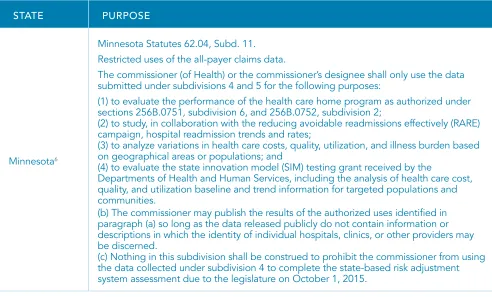
TABLE 1: EXAMPLE APCD STATEMENTS OF PURPOSE
STATE PURPOSE
Maine1
Maine: Title 22, Subtitle 6, Chapter 1683
…create and maintain a useful, objective, reliable and comprehensive health information database that is used to improve the health of Maine citizens and to issue reports
Utah2
Utah: 26-33a-104
…a statewide effort to collect, analyze, and, distribute health care data to facilitate the promotion and accessibility of quality and cost-effective health care and also to facilitate
interaction among those with concern for health care issues
Vermont3
Vermont: Title 18, Section 9410(a)(1)
(A) determining the capacity and distribution of existing resources; (B) identifying health care needs and informing health care policy;
(C) evaluating the effectiveness of intervention programs on improving patient outcomes;
(D) comparing costs between various treatment settings and approaches; (E) providing information to consumers and purchasers of health care; and (F) improving the quality and affordability of patient health care and health care coverage.
Oregon4
Oregon: 442.466
442.466 Health care data reporting by health insurers.
(1) The Administrator of the Office for Oregon Health Policy and Research shall establish and maintain a program that requires reporting entities to report health care data for the following purposes:
(a) Determining the maximum capacity and distribution of existing resources allocated
to health care.
(b) Identifying the demands for health care.
(c) Allowing health care policymakers to make informed choices.
(d) Evaluating the effectiveness of intervention programs in improving health outcomes. (e) Comparing the costs and effectiveness of various treatment settings and approaches. (f) Providing information to consumers and purchasers of health care.
(g) Improving the quality and affordability of health care and health care coverage. (h) Assisting the administrator in furthering the health policies expressed by the Legislative Assembly in ORS 442.025.
(i) Evaluating health disparities, including but not limited to disparities related to race
and ethnicity.
Colorado5
Colorado: 1.200.4 APCD Reports
1.200.4.A. The administrator shall, at a minimum, issue reports from the APCD data at an aggregate level to describe patterns of incidence and variation of targeted medical conditions, state and regional cost patterns and utilization of services.
STATE PURPOSE
Minnesota6
Minnesota Statutes 62.04, Subd. 11. Restricted uses of the all-payer claims data.
The commissioner (of Health) or the commissioner’s designee shall only use the data submitted under subdivisions 4 and 5 for the following purposes:
(1) to evaluate the performance of the health care home program as authorized under sections 256B.0751, subdivision 6, and 256B.0752, subdivision 2;
(2) to study, in collaboration with the reducing avoidable readmissions effectively (RARE) campaign, hospital readmission trends and rates;
(3) to analyze variations in health care costs, quality, utilization, and illness burden based on geographical areas or populations; and
(4) to evaluate the state innovation model (SIM) testing grant received by the
Departments of Health and Human Services, including the analysis of health care cost, quality, and utilization baseline and trend information for targeted populations and
communities.
(b) The commissioner may publish the results of the authorized uses identified in paragraph (a) so long as the data released publicly do not contain information or
descriptions in which the identity of individual hospitals, clinics, or other providers may
be discerned.
(c) Nothing in this subdivision shall be construed to prohibit the commissioner from using the data collected under subdivision 4 to complete the state-based risk adjustment system assessment due to the legislature on October 1, 2015.
Stakeholder Engagement
The APCD development effort typically emerges to support a state initiative, from the interest of a legislative supporter, or as the result of a health
commission that identifies the need for transparency. Stakeholders typically desire comparative information to serve multiple needs, including health care reform and informed state policy. An initial organization often serves as a
champion for the efforts to develop an APCD, and it also identifies and convenes key stakeholders in the state to move the APCD development efforts forward. Many different organizations have historically played the role of the champion, including state insurance departments, state health departments, Governor’s offices, legislators, and non-profit health care cost and quality organizations. In many states, multiple groups have worked together as champions to move the development effort forward.
While the convening entity for state APCD program development can vary from state-to-state, the critical role of stakeholders is common across all states. States have found that the broader the base of stakeholder support, the
greater the chances are for success. A collaborative, transparent, and inclusive process will facilitate active stakeholder input about the scope, challenges, and
approaches for a state APCD. The purpose of the APCD and the constitution of
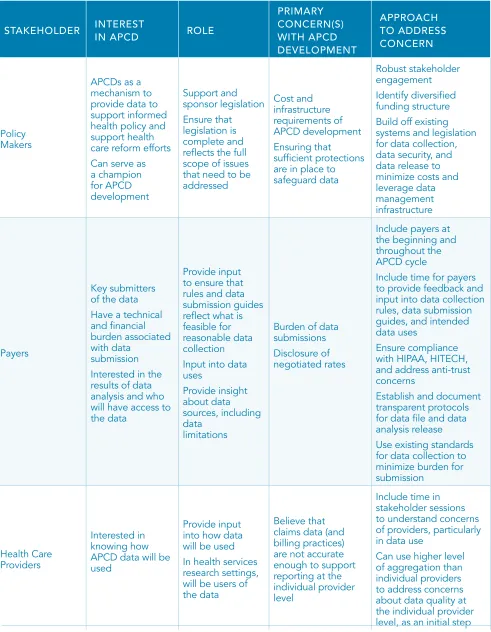
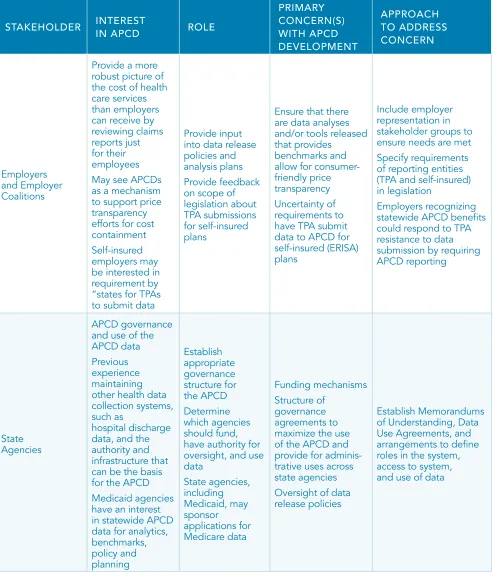
the stakeholder group are inter-related issues, and the stakeholder group should include those organizations that the state believes will be key users of the data. Table 2 summarizes the common key stakeholders and the role or perspective
each group brings.
One of the key, initial functions of the stakeholder group is to develop what are called “use cases.” Use cases define what questions the APCD will answer for which stakeholders. Having input about the intended use cases of the data is key to ensuring that the data system is later developed in a way that ensures
that the use cases can be supported. The APCD Showcase provides much more information about various use cases for APCDs.
While key considerations for the stakeholder groups are described below, later sections of this manual will describe specific issues about APCD development
in more detail. Policy Makers
Policy makers are generally interested in an APCD as a tool that can provide data
to support informed health policy and health care reform efforts. Policy makers
can serve as champions of APCD development, with the instrumental role of sponsoring the enabling legislation to develop the APCD in a state. However, not all policy makers are likely to be aligned with the APCD efforts, and states can expect to need to address concerns of those that are not supportive of the
APCD effort. Policy makers in a state often participate in stakeholder meetings
Policy makers’ initial key concerns about APCD development are often related to the costs and infrastructure requirements associated with developing and maintaining the APCD system. Early on, states benefit from identifying a
diversified funding structure in the APCD development process (see Section 3:
Funding). As the APCD implementation progresses, policy makers may expect an early demonstration of the APCD’s value or return on the initial investment. Staging data reports and release (see Section 5: Analytics and Applications Development) will serve to build value in the data. Maintaining frequent
communication with, and education of, policy makers about the complexities of APCD development will help manage unrealistic expectations (see Section 6: Feedback Loops and Continuous Engagement). In addition, policy makers are interested in ensuring that sufficient protections are in place to safeguard data stored within the system and in data products that are released, and to protect privacy. Addressing these concerns is handled by reviewing best practices in data storage and release (see Section 4: Technical Build) and specifying data security and protection parameters in the system requirement specifications.
Examples of uses of APCD data that can be relevant for policy makers
include Colorado’s Center for Improving Value in Health Care (CIVHC) reports
highlighting variation in regional health care utilization and expenditure on a
population basis by county and other geographic groupings. Among the reports
in the Massachusetts Health System Performance Reports is a spending report
that provides policy makers local expenditure growth trends, with exploration of growth by service category, and assessments of out-of-pocket spending.
Payers
Payers (also referred to as “carriers”, “insurers” or “plans” in different states) are the primary submitters of the data to an APCD. Because of this, there is both a technical and financial burden to the payers associated with data submission. Involving payers early in stakeholder discussions allows a state to discuss a number of key issues related to data submission, including the data submission process, data quality expectations, release schedules, and intended use cases. In addition, payers
A key concern for the payer community is the set of implications related to data submissions. An important reason to include payers in the early
stakeholder discussions--and throughout the APCD development and
continual operations--is to allow for payer input that ensures that rules and data submission guides reflect what is feasible for data collection. That is, states may
be interested in measuring certain things about the health care landscape using
claims data, but the payers’ data systems may not reliably include information to address the issue of interest. For example, states are often interested in analyses using race and ethnicity, and the payer community typically cautions states that any capture of that information may not be reliable, if it is captured at all. States may also reduce the impact to payers by adopting existing standards for data collection, described in more detail in Section 4: Technical Build. This allows payers to reuse technical code and processes to support multiple state APCD efforts.
Addressing these issues is typically handled by the state’s establishment and documentation of transparent protocols for data submission, aggregation, and release. Payers will also require time to provide feedback and input into data collection rules, data submission guides, and intended use of data--all issues addressed by Advisory Groups (see Section 2: Governance).
Payers have routinely expressed concern about the analysis of data that would allow the disclosure of negotiated rates and what implications that might have from an antitrust perspective. Individual states have interpreted the need to restrict the display of analysis by payer and by provider differently. In Colorado, CIVHC has reviewed the issue and shared the guidance it is using for itself, based on a legal review.
Examples of uses of APCD data that can be relevant for payers include the
work that Massachusetts has done across state agencies and with the payer
community to find ways to use the APCD data being submitted to the Center
for Healthcare Information and Analysis (CHIA) to meet the needs for Insurance
Department reporting requirements. In New Hampshire, payers are part of the
Health Care Providers
Health care providers, typically through hospital associations and provider associations, are often interested in knowing how APCD data will be used, especially if there are intentions to analyze and report APCD at the health care system (or provider) levels. Providers have historically felt that claims data (and billing practices) are not accurate enough to support reporting at the individual provider level. Some states have reported data at higher level of aggregation than individual providers (i.e., hospital, clinic, or laboratory) to address concerns about data quality at the individual provider level. Health care providers also have a role in ensuring that the billing data reflect individual provider activity, so that the data accurately reflect (and can be reported at) the provider level. Engaging health care providers in the use case development will often assist in improving the utility of the data.
Examples of uses of APCD data that can be relevant for health care providers
include the New Hampshire Accountable Care Project, which allows health care organizations to see regional level reporting about cost, utilization, and disease characteristics, providing population health information about the geographic areas in which health care organizations provide services. CIVHC is also developing provider level reports, in addition to its release of health care
facility level reporting. In Vermont, the APCD data is being used to evaluate
the Blueprint for Health, the multi-payer advanced primary care medical home
program.
Employers and Employer Coalitions
Employers and employer coalitions often have a keen interest in how APCD data can provide a more robust picture of the cost of health care services than employers can receive by reviewing claims reports just for their employees. In addition, employers may see APCDs as a mechanism to support price
transparency efforts for cost containment. Employer use cases may also drive the development of employer-specific tools that provide benchmarks and allow for consumer-friendly price transparency.
(e.g., Third Party Administrators (TPA), Pharmacy Benefit Managers (PBM), etc.) in their enabling legislation and/or data collection rules. Some data submitters have challenged state laws under the premise that the federal Employee
Retirement Income Security Act (ERISA) pre-empts the state requirement for TPAs to submit data. Cases have been brought before federal courts in Maine
(Patient Advocates, LLC v. Prysunka, No. 03-118-P-H, 2004 WL 114980) and
Vermont (Liberty Mut. Ins. Co. v. Kimbell, 2012 WL 5471225 (D. Vt. Nov. 9, 2012)
and Liberty Mut. Ins. Co. v. Donegan, 746 F.3d 497 (2d Cir. 2014). The results
have depended on different plantiffs, complaints, facts, state laws, and legal strategies. The federal district court in Maine found in favor of the state’s conduct and did not impede the Maine APCD. In Vermont, Liberty Mutual, Inc., a large employer that provides a self-funded ERISA plan to its employees, instructed its third-party administrator not to provide data to the Vermont APCD. In 2012, the federal district court determined that the state law requiring reporting to the Vermont APCD did not interfere with ERISA. By a 2-1 vote, a judicial panel from the Second Circuit Court of Appeals overruled the lower court and held that state laws could not “burden” self-funded ERISA plans with compliance of reporting claims data to an APCD (the third judge agreed with the State
position). In August 2014, Vermont petitioned the U.S. Supreme Court for review of the Second Circuit’s decision and that petition remains pending as of February 2015. To date, the exclusion of plans due to ERISA concerns has not proven to be a challenge preventing state APCD development; notebly, in Vermont, while one data submission has been withheld, the APCD has not been otherwise
disrupted.
Examples of uses of APCD data that can be relevant for employers include the regional health care cost and utilizations reports previously described,
which allow employers to benchmark their own population to regional and
state comparators. In addition, Maine, New Hampshire, Massachusetts, and
Colorado have created tools for understanding the variation in the costs of health care services and procedures, which can promote consumer shopping. This can support the employers’ efforts for cost containment for their employee
State agencies typically provide a critical role in APCD development. Generally,
state health departments and state insurance departments are the state
agencies charged with APCD governance, and they are also typically key users of the APCD data (see Section 2: Governance). State agencies also maintain
other public data sets that could be linked to the APCD in the future. These
agencies have experience maintaining other health data collection systems, such as hospital discharge data, and have the authority (i.e., for data collection and reporting for public health surveillance activities) and infrastructure that can be leveraged for the basis of the APCD. For example, many states use the data infrastructure of the hospital discharge, Medicaid, or other data systems in building the APCD platform. Likewise, the potential to enhance and streamline regulatory reporting across various state agencies not only reduces industry reporting burden but may provide more robust regulatory information.
Given Medicaid expansion efforts and the need to manage growing state budgets, Medicaid programs are increasingly becoming important APCD stakeholders. Medicaid data are almost always included in APCDs, and
Medicaid is often a user of APCD data to design and evaluate health care and payment reform initiatives. When Medicaid data are integrated with other
information, such as commercial carrier claims, the Medicaid program has access to comparative benchmarks for measuring quality and improving outcomes. Several states have successfully leveraged Medicaid matching funds for APCD development and maintenance (see Section 3: Funding). State public health programs are other potential users of APCD information for surveillance of chronic disease, injury, and other population health issues.
To maximize the use of the APCD and provide for cross-agency applications, states structure governance agreements such as Memorandums of
Understanding (MOU), Data Use Agreements (DUA), and other arrangements to allow collaboration across state entities. These agreements document roles, access to, and use of data. For example, the components of the MOU in New Hampshire, between the NH Department of Health and Human Services (NH DHHS) and NH Insurance Department (NHID) include7:
› NHID shall adopt administrative rules relative to the submission of commercial health care claims data and the HEDIS data set;
› NH DHHS and NHID should work collaboratively to develop policies for dissemination of data from the CHIS; and
› In addition to commercial claims and HEDIS data, the CHIS shall also maintain Medicaid claims data for use by the two departments.
Examples of uses of APCD data that can be relevant for state agencies include
population health reports in New Hampshire for use in community health
assessment (typically a public health activity), a Medicaid Quality Indicators
report in New Hampshire, and the Medicaid Costs of Care Comparisons from CIVHC. Massachusetts publishes a Cost Trend Report that is relevant to a
number of state agencies as a tool to track health reform efforts. Multiple states
are developing or expanding existing APCDs to support Rate Review efforts associated with Center for Consumer Information & Insurance Oversight (CCIIO), often in conjunction with State Departments of Insurance.
Consumers
APCD data, if analyzed and published for consumer purposes, can inform a
consumer’s understanding of health care spending and assist in making informed choices about health care services. Comparative provider cost, price, and
quality information for common medical procedures can be especially valuable to people with high deductible health plans and medical savings accounts, who would like to make decisions about the location of care, taking cost into consideration. As an example, multiple states have developed, or plan to develop, consumer portals for price transparency. Consumer stakeholders will need to be assured that privacy and security of confidential data is protected through robust data safeguards for collection, storage, and release of data (see
Section 4: Technical Build).
Examples of uses of APCD data relevant to consumers include price transparency
tools in Massachusetts, Maine, New Hampshire, and Colorado. These tools
Researchers
Researchers, particularly in health care services research, utilize APCD data for
multiple purposes. The research community in a state will be concerned with
limits or restrictions on data access, so their participation in the stakeholder conversations are beneficial to determining how data release policies will be structured. Additionally, early stakeholder engagement of the local research community can provide input into how data will be used.
As states have developed research release protocols, many states have noted that data requests from the academic community have increased. As an example, The Dartmouth Institute (TDI) published a “Dartmouth Atlas of
Children’s Health Care of Northern New England” (Goodman, et. al, December 2013), including analysis from multiple states’ APCD data8.
Health Information Exchanges (HIE) and Health Insurance Exchanges (HIX) The collection of clinical data through an HIE may be supplemented in important
ways with APCD administrative data. Combining clinical data with APCD fiscal data can enhance clinical outcomes and effectiveness research studies. Also, APCD data can be useful to states electing to operate a state-based Health Insurance Exchange (HIX) as these states can use the data for their risk adjustment models. Additionally, the collection of benefit design information through an HIX may be combined with administrative claims information to provide information on how benefit design impacts health spending trends. Despite the potential benefits, many states face technical and legal barriers to the linkage between HIEs, HIXs, and APCDs. Therefore, involving stakeholders from a state HIX and HIE in APCD conversations, ideally at the earliest stages of APCD development, can provide input into the structure of the ACPD to facilitate cross-system linkage.
STAKEHOLDER INTEREST IN APCD ROLE PRIMARY CONCERN(S) WITH APCD DEVELOPMENT APPROACH TO ADDRESS CONCERN Policy Makers
APCDs as a mechanism to
provide data to
support informed health policy and support health care reform efforts
Can serve as
a champion for APCD development Support and sponsor legislation Ensure that legislation is complete and
reflects the full
scope of issues that need to be addressed Cost and infrastructure requirements of APCD development Ensuring that sufficient protections
are in place to safeguard data
Robust stakeholder engagement
Identify diversified
funding structure
Build off existing
systems and legislation
for data collection, data security, and
data release to
minimize costs and leverage data
management infrastructure
Payers
Key submitters of the data
Have a technical and financial
burden associated with data
submission Interested in the results of data analysis and who
will have access to
the data
Provide input
to ensure that rules and data submission guides
reflect what is
feasible for reasonable data collection Input into data uses Provide insight about data sources, including data limitations
Burden of data
submissions Disclosure of negotiated rates
Include payers at the beginning and throughout the APCD cycle
Include time for payers
to provide feedback and
input into data collection
rules, data submission guides, and intended
data uses
Ensure compliance
with HIPAA, HITECH, and address anti-trust
concerns
Establish and document transparent protocols
for data file and data
analysis release
Use existing standards
for data collection to
minimize burden for
submission
Health Care
Providers
Interested in knowing how APCD data will be used
Provide input
into how data will be used
In health services research settings,
will be users of the data
Believe that claims data (and billing practices)
are not accurate enough to support reporting at the
individual provider level
Include time in stakeholder sessions to understand concerns
of providers, particularly
in data use
Can use higher level
of aggregation than
individual providers
to address concerns
about data quality at the individual provider level, as an initial step
STAKEHOLDER INTEREST IN APCD ROLE PRIMARY CONCERN(S) WITH APCD DEVELOPMENT APPROACH TO ADDRESS CONCERN Employers and Employer Coalitions
Provide a more
robust picture of the cost of health
care services
than employers
can receive by reviewing claims
reports just for their employees May see APCDs as a mechanism to support price transparency efforts for cost containment
Self-insured
employers may be interested in
requirement by
“states for TPAs to submit data
Provide input
into data release policies and analysis plans
Provide feedback
on scope of legislation about TPA submissions
for self-insured
plans
Ensure that there are data analyses
and/or tools released that provides
benchmarks and
allow for
consumer-friendly price transparency Uncertainty of
requirements to have TPA submit
data to APCD for
self-insured (ERISA)
plans
Include employer representation in stakeholder groups to ensure needs are met
Specify requirements
of reporting entities
(TPA and self-insured)
in legislation
Employers recognizing statewide APCD benefits
could respond to TPA resistance to data
submission by requiring
APCD reporting
State
Agencies
APCD governance
and use of the APCD data
Previous experience
maintaining other health data
collection systems,
such as
hospital discharge
data, and the
authority and infrastructure that can be the basis for the APCD Medicaid agencies
have an interest
in statewide APCD
data for analytics, benchmarks, policy and planning Establish appropriate governance structure for the APCD Determine which agencies should fund, have authority for oversight, and use
data State agencies, including Medicaid, may sponsor applications for Medicare data Funding mechanisms Structure of governance agreements to
maximize the use
of the APCD and
provide for adminis-trative uses across
state agencies
Oversight of data
release policies
Establish Memorandums
of Understanding, Data Use Agreements, and arrangements to define roles in the system, access to system,
and use of data
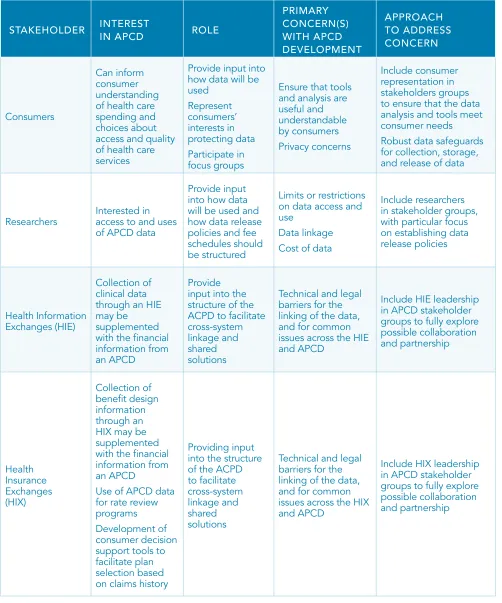
STAKEHOLDER INTEREST IN APCD ROLE PRIMARY CONCERN(S) WITH APCD DEVELOPMENT APPROACH TO ADDRESS CONCERN Consumers Can inform consumer understanding of health care spending and choices about
access and quality
of health care
services
Provide input into
how data will be used Represent consumers’ interests in protecting data Participate in focus groups
Ensure that tools and analysis are useful and understandable by consumers Privacy concerns Include consumer representation in stakeholders groups to ensure that the data analysis and tools meet consumer needs
Robust data safeguards
for collection, storage,
and release of data
Researchers Interested in access to and uses of APCD data
Provide input
into how data will be used and how data release policies and fee schedules should be structured
Limits or restrictions
on data access and use
Data linkage Cost of data
Include researchers
in stakeholder groups,
with particular focus on establishing data release policies
Health Information
Exchanges (HIE)
Collection of clinical data through an HIE may be supplemented
with the financial
information from an APCD
Provide
input into the structure of the ACPD to facilitate
cross-system
linkage and shared solutions
Technical and legal barriers for the
linking of the data,
and for common issues across the HIE and APCD
Include HIE leadership in APCD stakeholder
groups to fully explore
possible collaboration and partnership Health Insurance Exchanges (HIX) Collection of benefit design information through an
HIX may be
supplemented
with the financial
information from an APCD
Use of APCD data
for rate review
programs
Development of
consumer decision support tools to facilitate plan selection based on claims history
Providing input
into the structure of the ACPD to facilitate
cross-system
linkage and shared solutions
Technical and legal barriers for the
linking of the data,
and for common
issues across the HIX
and APCD
Include HIX leadership
in APCD stakeholder
groups to fully explore
possible collaboration and partnership
Once the stakeholders for a state are identified, states should develop an outreach plan to formalize stakeholder connections. States often do this via a series of meetings with the stakeholder groups, often around a common table, to discuss issues in an open and transparent way. The level of involvement for each stakeholder group will vary from state to state. Some states might find that their employer community, for example, wants to be very engaged in the development discussions, while others will find that there is a lack of interest among that group. As time passes, the stakeholder group may evolve into a more structured group such as a formal steering or advisory committee.
Section 2: Governance describes the establishment and role of the formal
steering committee (or advisory group) in more detail. Finally, while engagement is considered a key first step in APCD development, the stakeholder group can be an ongoing body to provide input and oversight, as described in
Section 6: Demonstrating the Feedback Loop and Continual Processes.
Conclusion
Engagement for APCD development includes a range of stakeholders representing different perspectives and areas of interest. Successful APCD development in an individual state will require comprehensive engagement of these varied partners, resulting in a share vision. By defining the vision for the system, the key contributors to it (e.g., resources, data, and infrastructure), and the intended use cases for the data, states can develop the list of key stakeholders to involve in the engagement process. While the overall mix and level of engagement for various parties may vary state-to-state, one very consistent experience across states is that good payer relationships are key
ENGAGEMENT ASSESSMENT CHECKLIST
STEP WORKSHEET/TOOL COMPLETE
List the anticipated use cases
for the data Engagement Assessment - Use Cases Worksheet
List the stakeholders and their
positions Engagement Assessment - Stakeholders Worksheet
List other data efforts in the state
that may be connected to the APCD
Engagement Assessment
- Data Efforts Worksheet
List the carriers and their market share, including public payers
and plans for data inclusion
Engagement Assessment -
Payer and Market Assessment Worksheet
List the approaches to handling
the legal barriers that may be
relevant in that state
Engagement Assessment
Learning Objectives:
›How is governance defined?
›Why are governance issues important for APCD development?
›What is the purpose of governance?
› What issues and practices should be considered to ensure competent
governance?
Governance
SECTION 2:
Governance covers a broad array of aspects of the APCD, including authorizing legislation, data collection and release rules, oversight entity for the APCD (i.e., governmental or designated non-profit), and the composition of a board for governance. These components
form the foundational structure of the APCD
and have bearing on all aspects of the technical
build and use of the APCD. Governance considerations, like all aspects of APCD development, need to be reviewed periodically to ensure that the APCD adapts to meet evolving needs.
APCD Legislation
The majority of APCDs established in the last 10 years were created via legislative statute as mandatory reporting initiatives, which require payers to comply with data collection and reporting. Additionally, several states have created voluntary reporting initiatives, which rely on non-mandatory submission
of data by carriers to the state.
For a state-mandated APCD, broad governance parameters are typically defined by the legislation that authorizes the APCD. At the most basic level, legislation to create an APCD needs to include two things:
› Specific legal authority to define data submitters, including the specification
of PBMs and TPAs as data submitters
More specific elements of the system and developmental procedures may be included in the legislation; however, the details of how the system will be operationalized are typically articulated via rule-making procedures and data submission specifications. This allows for the ability to make changes to future APCD requirements without requiring legislative action.
Some states have been able to modify existing legislation to facilitate the development of the APCD. For example, New York modified the existing authority for collection of hospital discharge data. Similarly, Connecticut has created legislation that integrates their claims data collection with their HIX.
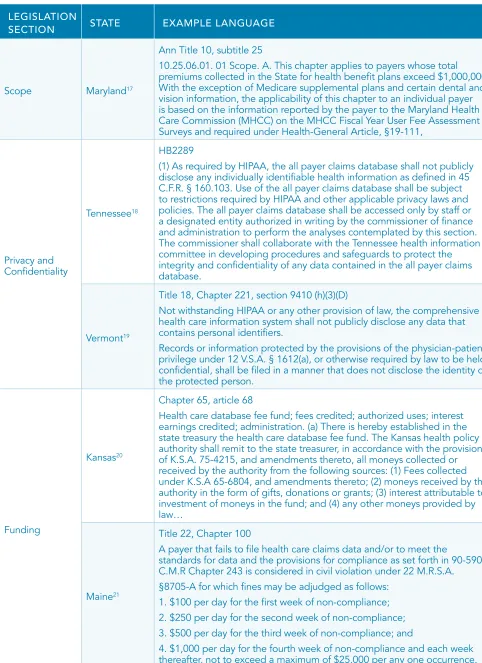
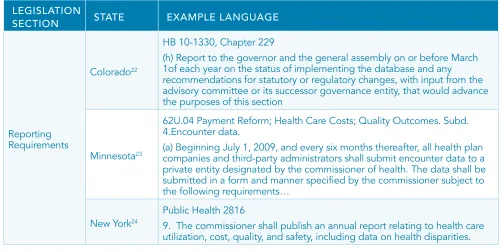
In general, APCD legislation addresses six (6) critical elements. Each of these is described in more detail, with example state language of the sections in Table 3:
› Purpose
› Governing Body and Oversight › Scope
› Privacy and Confidentiality
› Funding
› Reporting Requirements
Purpose
Though the inherent purpose of legislation is to authorize the creation of an APCD system, the purpose section of APCD legislation typically outlines the goals, expectations, and limits of the APCD. APCDs serve different purposes for each state, and it is crucial that these purposes be clarified within the legislation. APCDs can have extremely narrow focuses and uses, such as in Minnesota’s initial APCD legislation, (which limited to use to specific reports and allowed access to the health department only), or be quite broad, such as in Maine (used to “improve the health of Maine citizens”). The purpose will match the state intent for use of the system, and states with broad purpose statements have found that they have had the flexibility to use the APCD data to address issues that have evolved over time (e.g., the need to evaluate medical home initiatives associated with the Affordable Care Act implementation). Clarity around purpose (e.g., utilization, cost, quality, health reform support, population health) will allow
the role of sub-groups, such as data release committees, easier once the APCD is implemented. Declaring which stakeholders (e.g., consumers, employers, providers, and government agencies) will be able to have access to the data will reduce problems after data collection is complete, and data are ready for public
release.
Governing Body and Oversight
The governing entity responsible for APCD oversight varies by state and is typically identified in the legislation. One of the primary oversight functions of the governing entity is to ensure that the infrastructure to collect, maintain, and disseminate the data are in place. Additionally, the governing entity is charged with ensuring collection of the data, including the administration of any penalties for non-compliance of data submissions. The governing entity is also typically responsible for the financial and staffing resources required to manage the APCD. Existing oversight models include:
› Department of Health (Utah, Minnesota) › Independent state agency (Maine, Vermont)
› Health and insurance departments with overlapping responsibilities (New Hampshire) › Independent, non-partisan, non-profit organization (Colorado, Virginia)
Many states create steering committees that are responsible for the
development of the APCD as well as its ongoing maintenance (see Table 3 for examples of the constitution of oversight boards in Colorado and Maine). The committees are often extensions of the stakeholder groups created in the planning phase of the APCD. In a similar vein, once data are available for release, states create data release committees to review the requests and ensure they are meeting the state’s legislative and rules requirements. Two examples
of such groups are the Massachusetts’ APCD User Workgroup and Colorado’s Data Release Review Committee. The Vermont Green Mountain Care Board
model selected should be the one that best leverages infrastructure capacity, resources, and funding opportunities for an individual state.
Scope
Items typically discussed in the legislation that address and define the scope of an APCD are:
› File types to be collected (medical, pharmacy, dental, eligibility, provider)
› Lines of business included/excluded (fully insured plans, self-funded coverage, accident, disability)
› Entities reporting (carriers, TPAs, PBMs)
› Thresholds for data submission by payers, typically defined by the number
of people covered by the › Schedule for data submissions
› Language around authority to enforce provisions, such as penalties for payers that do not report or for misuse of the data
As discussed in Section 4: Technical Build, states will vary in the scope of which reporting entities are included in the APCD, based on a number of factors: need for/interest in certain types of data (e.g., does the state intend to include dental data); the state interest in collecting data from all payers, or only those over certain thresholds; the state’s assessment of the authority to mandate collection for self-insured plans; and state’s assessment of its resources to accept files at certain frequencies.
Privacy and Confidentiality
A core decision for any APCD is how to protect patient identifying information. Protections are essential for building public trust in the system while creating
Data Collection
States vary in their approach to collecting patient data fields. About half of the states currently only allow de-identified patient information to be collected, typically encrypting sensitive data fields. Ideally, the encryption methodology is consistent across each data submitter, such that individuals can be statistically
tracked across payers. There is a recent trend in states to collect direct and
indirect patient identifiers (names, dates of birth, addresses) which are typically
encrypted after collection during the data aggregation process. The ability
to collect patient identifiers requires discussion and debate as to how the
information will be used, whom will have access, and under what circumstances. The collection of patient fields will enable future data linkages to public health, clinical, and other datasets. It should also be noted that data linkage is a
difficult and resource-intensive undertaking, even with robust patient identifiers. Collection and linkage policies are nascent in their development, and will require diligence and cooperation amongst stakeholders. Despite the challenges, it should be recognized that APCD systems without these fields will not be able to conduct cross-system linkages and analytics in the future. One state, Rhode Island, has legislation9 allowing for a patient to opt-out of the dataset via the
carrier; however, operationalizing policies such as this are challenging.
Data Release
There is significant variation in data release policies and practices across states, reflecting differing viewpoints about the balance between making the data available for use and controlling release to address concerns about patient privacy. Regulations that specify data access and release policies vary according to state legal and political environments (e.g., Minnesota does not release
data to external organizations because of privacy concerns; Maine restricts the identification of provider discount arrangements). In some states, de-identified and research files are made available for qualified users and uses. Other states limit data access to state government only. A few states prohibit the provision of individual data to multi-state or national databases. Providers and payers have additional concerns about data release, particularly around disclosure of payment information vis-a-vis potential antitrust concerns. Some states are
Many states refer to HIPAA for guidance in defining release policies. The Privacy Rule specifically does not preempt contrary state public health laws that provide for the reporting of disease or injury, child abuse, birth or death, or for the conduct of public health surveillance, investigation, or intervention [45 CFR § 160.202]10. Preemption of a contrary state law will not occur if the US
Department of Health and Human Services (DHHS) determines that the state law 1) is necessary to prevent fraud and abuse related to the provision of or payment for health care; 2) is necessary to ensure appropriate state regulation of insurance and health plans to the extent expressly authorized by statute or regulation; 3) is necessary for state reporting on health care delivery or costs; or 4) is necessary to serve a compelling public health, safety, or welfare need. States without a state mandate that collect APCD data voluntarily from covered entities (health plans) may collect data from payers under the Treatment, Payment, Operations provisions of HIPAA. The use and release of the data should be governed through an agreement that governs the disclosure and defines the protections.
Of particular note, states often have specific data release provisions for claims
related to substance abuse treatment. These policies typically restrict any
release of claims related to substance abuse treatment, in response to the Act to Remedy Alcohol and Drug Abuse (Pub. L. 98-24), codified under 42 U.S.C. § 290. Under the law, there are specific provisions regarding the confidentiality of patient records and claims. Pursuant to the Act, US DHHS interpreted the statute and outlined provisions for the permitted disclosure of patient records under 42 CFR part 2. The Substance Abuse and Mental Health Services Administration (SAMHSA) has provided a number of guidance documents regarding these
provisions11. In general, states have been cautious in their implementation of this
guidance and restrict the release of substance abuse claims.
For all of these discussions, it is important to recognize that many agencies maintaining APCDs have decades of experience collecting and disseminating hospital data without privacy breaches and use similar statistical and
management controls for their APCD practices. Funding
funding, and they often are required to use multiple sources (e.g., general funds, Medicaid match, other) for both short and long-term program sustain-ability (Section 3: Funding addresses this in more detail). While penalties for non-compliance of data submitters is often addressed in legislation, states do not consider penalties as a part of the funding mechanism. Such penalties are
designed to ensure that all submitters are sending in their data regularly to
promote the integrity of the overall database.
Progress Reporting Requirements
As states develop their accountability structures, one option is to define progress reporting requirements. This may include an annual report to the Governor’s office, the Legislature, or a legislative committee. They may also be milestone-based (rather than at a specified time interval), such as when funds have been
raised or systems implemented.
TABLE 3: EXAMPLE TEXT FOR APCD LEGISLATION SECTIONS
LEGISLATION
SECTION STATE EXAMPLE LANGUAGE
Purpose
Maine12
Title 22, Chapter 1683
The purposes of the organization are to create and maintain a useful, objective, reliable and comprehensive health information database that is used to improve the health of Maine citizens and to issue reports, as provided in section 8712. This database must be publicly accessible while protecting patient confidentiality and respecting providers of care. The organization shall collect, process, analyze and report clinical, financial, quality and restructuring data as defined in this chapter.
Utah13
26-33a-104
(1) The purpose of the committee is to direct a statewide effort to collect, analyze, and distribute health care data to facilitate the promotion and accessibility of quality and cost-effective health care and also to facilitate
interaction among those with concern for health care issues.
(2) The committee shall:
(a) develop and adopt by rule, following public hearing and comment, a health data plan that shall among its elements:
(i) identify the key health care issues, questions, and problems amenable to resolution or improvement through better data, more extensive or careful analysis, or improved dissemination of health data;
(ii) document existing health data activities in the state to collect, organize, or make available types of data pertinent to the needs identified in Subsection (2)(a)(i);
LEGISLATION
SECTION STATE EXAMPLE LANGUAGE
Purpose New Hampshire14
420-G:11-a
The department and the department of health and human services shall
enter into a memorandum of understanding for collaboration in the
development of a comprehensive health care information system…To the extent allowed by HIPAA, the data shall be available as a resource for insurers, employers, providers, purchasers of health care, and state agencies to continuously review health care utilization, expenditures,
and performance in New Hampshire and to enhance the ability of New
Hampshire consumers and employers to make informed and cost-effective
health care choices.
Oversight
Maine15
Title 22, Chapter 8703
2. Board of directors. The organization operates under the supervision of a board of directors, which consists of 20 voting members and one nonvoting
member.
A. The Governor shall appoint 18 board members in accordance with the following requirements. Appointments by the Governor are not subject to review or confirmation.
(1) Four members must represent consumers. For the purposes of this section, “consumer” means a person who is not affiliated with or employed by a 3rd-party payor, a provider or an association representing those providers or those 3rd-party payors.
(2) Three members must represent employers. One member must be chosen from a list provided by a health management coalition in this State. One member must be chosen from a list provided by a statewide chamber
of commerce.
(3) Two members must represent 3rd-party payors chosen from a list provided by a statewide organization representing 3rd-party payors. (4) Nine members must represent providers. Two provider members must represent hospitals chosen from a list provided by the Maine Hospital Association. Two provider members must be physicians or representatives of physicians, one chosen from a list provided by the Maine Medical Association and one chosen from a list provided by the Maine Osteopathic Association. One provider member must be a doctor of chiropractic chosen from a list provided by a statewide chiropractic association. One provider member must be a representative, chosen from a list provided by the Maine Primary Care Association, of a federally qualified health center. One provider member must be a pharmacist chosen from a list provided by the Maine Pharmacy Association. One provider member must be a mental health provider chosen from a list provided by the Maine Association of Mental Health Services. One provider member must represent a home
health care company.
Colorado16
HB 10-1330
25.5-1-204. Advisory committee to establish an all-payer health claims database…the executive director shall appoint an advisory committee
to make recommendations regarding the creation of the framework and
implementation plan for a Colorado all-payer claims database …the executive director shall appoint an administrator of the database. (b) the executive director shall appoint the members of the Advisory committee, consisting of the following members:
(i) a member of academia with experience in health care data and cost efficiency research;
(ii) a representative of a statewide association of hospitals;