High Mortality Rates for Very Low Birth Weight Infants
in Developing Countries Despite Training
WHAT’S KNOWN ON THIS SUBJECT: Perinatal and/or neonatal mortality rates for infants born in community settings in developing countries can be decreased with implementation of a package of neonatal health care interventions. VLBW infants born in these settings have high mortality risk.
WHAT THIS STUDY ADDS: A neonatal health care intervention package that was effective in reducing perinatal and/or early neonatal mortality rates did not improve outcomes for VLBW infants born in community settings in developing countries.
abstract
OBJECTIVE:The goal was to determine the effect of training in new-born care and resuscitation on 7-day (early) neonatal mortality rates for very low birth weight (VLBW) infants. The study was designed to test the hypothesis that these training programs would reduce neonatal mortality rates for VLBW infants.
METHODS:Local instructors trained birth attendants from 96 rural communities in 6 developing countries in protocol and data collection, the World Health Organization Essential Newborn Care (ENC) course, and a modified version of the American Academy of Pediatrics Neonatal Resuscitation Program (NRP), by using a train-the-trainer model. To test the impact of ENC training, data on infants of 500 to 1499 g were collected by using a before/after, active baseline, controlled study de-sign. A cluster-randomized, controlled trial design was used to test the impact of the NRP.
RESULTS:A total of 1096 VLBW (500 –1499 g) infants were enrolled, and 98.5% of live-born infants were monitored to 7 days. All-cause, 7-day neonatal mortality, stillbirth, and perinatal mortality rates were not affected by ENC or NRP training.
CONCLUSIONS:Neither ENC nor NRP training of birth attendants de-creased 7-day neonatal, stillbirth, or perinatal mortality rates for VLBW infants born at home or at first-level facilities. Encouragement of deliv-ery in a facility where a higher level of care is available may be prefer-able when delivery of a VLBW infant is expected.Pediatrics2010;126: e1072–e1080
AUTHORS:Waldemar A. Carlo, MD,a,bShivaprasad S. Goudar, MD, MHPE,cImtiaz Jehan, FCPS, MSc,dElwyn Chomba, MD,b,eAntoinette Tshefu, MD, PhD,fAna Garces, MD,gSailajanandan Parida, MD,hFernando Althabe, MD,i Elizabeth M. McClure, MEd,jRichard J. Derman, MD, MPH,k Robert L. Goldenberg, MD,lCarl Bose, MD,mMichael Hambidge, MD,nPinaki Panigrahi, MD, PhD,oPierre Buekens, MD, PhD,pHrishikesh Chakraborty, DrPH,jTyler D. Hartwell, PhD,jJanet Moore, MS,jand Linda L. Wright, MD,qfor the First Breath Study Group
aDivision of Neonatology, Department of Pediatrics, School of
Medicine, University of Alabama at Birmingham, Birmingham, Alabama;bCentre for Infectious Disease Research in Zambia,
Lusaka, Zambia;cDepartment of Pediatrics, Jawaharlal Nehru
Medical College, Belgaum, India;dDepartment of Pediatrics,
School of Medicine, Aga Khan University, Karachi, Pakistan;
eDepartment of Pediatrics and Child Health, University Teaching
Hospital, Lusaka, Zambia;fDepartment of Public Health,
Kinshasa School of Public Health, Kinshasa, Democratic Republic of Congo;gDepartment of Pediatrics, School of Medicine, San
Carlos University, Guatemala City, Guatemala;hDepartment of
Pediatrics, Sriramchandra Bhanja Medical College, Cuttack, India;iInstitute for Clinical Effectiveness and Health Policy,
Buenos Aires, Argentina;jDepartment of Statistics and
Epidemiology, RTI International, Durham, North Carolina;
kDepartment of Pediatrics, School of Medicine, University of
Missouri, Kansas City, Missouri;lDepartment of Pediatrics,
College of Medicine, Drexel University, Philadelphia, Pennsylvania;mDepartment of Pediatrics, School of Medicine,
University of North Carolina at Chapel Hill, Chapel Hill, North Carolina;nDepartment of Pediatrics, University of Colorado
Health Sciences Center, Denver, Colorado;oDepartment of
Pediatrics, School of Medicine, University of Maryland, Baltimore, Maryland;pDepartment of Epidemiology, School of
Public Health and Tropical Medicine, Tulane University, New Orleans, Louisiana; andqCenter for Research for Mothers and
Children, Eunice Kennedy Shriver National Institute of Child Health and Human Development, Bethesda, Maryland
KEY WORDS
neonatal mortality, perinatal mortality, stillbirth, developing countries, health care systems, very low birth weight, prematurity
ABBREVIATIONS
ENC—Essential Newborn Care NRP—Neonatal Resuscitation Program VLBW—very low birth weight RR—relative risk
CI—confidence interval
This trial has been registered at www.clinicaltrials.gov (identifier NCT00136708).
Approximately 50% of the 6 million perinatal deaths throughout the world each year are early neonatal deaths (occurring in the first 7 days after birth).1Early neonatal deaths account
for ⬃75% of all deaths that occur within the first 28 days after birth.1,2A
major decrease in early neonatal deaths is needed to achieve United Na-tions Millennium Declaration Develop-ment Goal 4, which is to reduce the 1990 child (⬍5 years of age) mortality rate by two-thirds.3 Stillbirths are
prevalent but sometimes are difficult to distinguish from early neonatal deaths. Therefore, examining both stillbirths and early neonatal deaths is important when evaluating programs that may affect perinatal mortality rates.4
Birth asphyxia, low birth weight/pre-maturity, and infection are major causes of perinatal deaths. Low-cost interventions, including neonatal re-suscitation training5 and other
inter-ventions introduced as a package of neonatal care,6,7have been tested, but
data are limited. Studies showed that training in the World Health Organiza-tion Essential Newborn Care (ENC) course8,9 improved midwives’ skills
and knowledge10 and reduced early
neonatal mortality rates among low-risk women who delivered in Zambian clinics.11Perinatal mortality rates may
be decreased through training of com-munity birth attendants.12
We showed recently that, forⱖ1500 g infants born in rural communities, training in the ENC course decreased perinatal mortality rates for births conducted by birth attendants and de-creased overall stillbirth rates inde-pendent of the presence of a birth at-tendant.13By design, infants of⬍1500
g (very low birth weight [VLBW]) were not included in that study, because the study goals were to evaluate the effect of the limited interventions included in the ENC course on infants of⬎1500 g.
VLBW infants are at high risk of death, and a package of simple neonatal care interventions provided mostly at home may not improve the outcomes of VLBW infants in the absence of advanced medical care. The current study was designed to test the hypothesis that training of birth attendants in the World Health Organization ENC course, followed by training in a modified ver-sion of the American Academy of Pediatrics Neonatal Resuscitation Pro-gram (NRP), would each reduce all-cause, 7-day (early) neonatal mortality rates for VLBW infants (⬍1500 g) in rural communities in developing countries.
METHODS
Population
This study was part of the First Breath Trial, a trial of training birth atten-dants in the provision of neonatal care.13 Infants of ⬍1500 g were not
part of the main trial because ad-vanced medical care for⬍1500 g in-fants was generally not available in the communities. However, the personnel who participated in the trial provided care for and collected data on⬍1500 g infants in a manner identical to that used forⱖ1500 g infants, because they were not aware that these infants were not included in the First Breath Trial outcomes. Informed consent was obtained from the mothers. The con-sent rate was⬎99% in the 4 study sub-groups. A waiver of the requirement for consent was approved in 1 country.
Study Sites
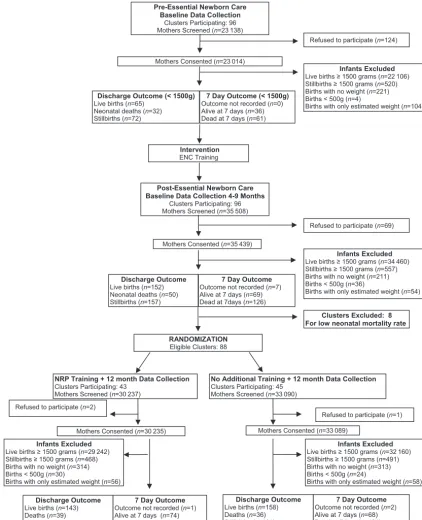
The effect of ENC training was as-sessed in a before/after study con-ducted in 96 rural communities in 7 sites of the Global Network for Wom-en’s and ChildrWom-en’s Health Research (in Argentina, Democratic Republic of Congo, Guatemala, India [2 sites], Paki-stan, and Zambia) between March 2005 and February 2007 (Fig 1). An
ac-tive baseline design was used to mini-mize biases attributable to historical or otherwise inadequate baseline data.14The active baseline design
re-quires the full protocol, except for the intervention, to be initiated before baseline data collection is started. The cluster-randomized trial of NRP train-ing was conducted in 88 communities (in all locations except Argentina) be-tween July 2006 and August 2008. The sample size for this VLBW infant study was determined by the period of data collection for the First Breath Trial.13
Most communities had poor health systems, with high rates of home births assisted by traditional birth at-tendants. Because of the intent-to-treat design, all births in the geo-graphic area, including deliveries at all clinics, hospitals, and homes within these communities, regardless of a birth attendant’s presence, were in-cluded. Maternal and neonatal data were collected for all births, including stillbirths. The study was reviewed and approved by the institutional review boards of participating sites in the de-veloping countries and in the United States.
Procedures and Interventions The procedures and interventions were the same as those used for the First Breath Trial.13 Briefly, during 3
separate 3-day training periods, a train-the-trainer educational program was used to train all birth attendants in the communities in the study proce-dures and in the 2 courses. These courses were tested in a clinic-based study in Zambia11and were modified
for the First Breath Trial for
community-based birth attendants, specifically with training material and data collection forms for illiterate birth attendants.13
proce-dures, including explanation of the protocol, data collection, differentia-tion between stillbirth and early neo-natal death (use of stethoscopes to de-tect heart rate and Apgar scoring), clinical assessments (fetal heart rate monitoring, signs of life at delivery,
and Apgar scoring), and adult educa-tion/training techniques. The master trainers subsequently trainedⱖ1 re-search staff member (either a physi-cian or nurse) as a community coor-dinator in each community. The community coordinators, in turn,
trained the birth attendants (includ-ing traditional birth attendants, nurses, midwives, and physicians) in
each community and distributed
weight scales (UNICEF spring Salter
Scales [UNICEF model 145555],
Copenhagen, Denmark, from the
Infants Excluded Live births ≥ 1500 grams (n=22 106) Stillbirths ≥ 1500 grams (n=520) Births with no weight (n=221) Births < 500g (n=4)
Births with only estimated weight (n=104) Pre-Essential Newborn Care
Baseline Data Collection Clusters Participating: 96 Mothers Screened (n=23 138)
Intervention ENC Training
Post-Essential Newborn Care Baseline Data Collection 4-9 Months
Clusters Participating: 96 Mothers Screened (n=35 508)
Infants Excluded Live births ≥ 1500 grams (n=34 460) Stillbirths ≥ 1500 grams (n=557) Births with no weight (n=211) Births < 500g (n=36)
Births with only estimated weight (n=54)
RANDOMIZATION Eligible Clusters: 88 Mothers Consented (n=23 014)
Discharge Outcome (< 1500g) Live births (n=65)
Neonatal deaths (n=32) Stillbirths (n=72)
7 Day Outcome (< 1500g) Outcome not recorded (n=0) Alive at 7 days (n=36) Dead at 7 days (n=61)
Mothers Consented (n=35 439)
Clusters Excluded: 8 For low neonatal mortality rate
NRP Training + 12 month Data Collection Clusters Participating: 43
Mothers Screened (n=30 237)
7 Day Outcome Outcome not recorded (n=1) Alive at 7 days (n=74) Dead at 7days (n=107) Discharge Outcome
Live births (n=143) Deaths (n=39) Stillbirths (n=91)
Mothers Consented (n=30 235)
No Additional Training + 12 month Data Collection Clusters Participating: 45
Mothers Screened (n=33 090)
Mothers Consented (n=33 089)
7 Day Outcome Outcome not recorded (n=2) Alive at 7 days (n=68) Dead at 7days (n=124) Discharge Outcome
Live births (n=158) Deaths (n=36) Stillbirths (n=101) Infants Excluded
Live births ≥ 1500 grams (n=29 242) Stillbirths ≥ 1500 grams (n=468) Births with no weight (n=314) Births < 500g (n=30)
Births with only estimated weight (n=56)
Infants Excluded Live births ≥ 1500 grams (n=32 160) Stillbirths ≥ 1500 grams (n=491) Births with no weight (n=313) Births < 500g (n=24)
Births with only estimated weight (n=58) Refused to participate (n=124)
Refused to participate (n=1) Discharge Outcome
Live births (n=152) Neonatal deaths (n=50) Stillbirths (n=157)
7 Day Outcome Outcome not recorded (n=7) Alive at 7 days (n=69) Dead at 7days (n=126)
Refused to participate (n=2)
Refused to participate (n=69)
FIGURE 1
United Nations Children’s Fund), stethoscopes, and delivery kits.
After the baseline data collection period, an experienced World Health Organiza-tion trainer (Ornella Lincetto, MD) taught master trainers, who subsequently trained community coordinators and birth attendants, in the ENC course (2004 edition), by using the same train-the-trainer model. The contents of this course included routine neonatal care, initiation of breathing and resuscitation (including bag-mask ventilation), ther-moregulation, early and exclusive breastfeeding, kangaroo (skin-to-skin) care, small infant care, danger signs, and recognition and initial management of complications. Self-inflating bags and masks were given to all birth attendants. After the post–ENC training data collection period, the same training cascade was used, for communities assigned randomly to the intervention, by an experienced trainer (Susan Niermeyer, MD) to teach the NRP (2000 edition), including in-depth, hands-on training in basic knowledge and skills regarding initial resuscitation steps and bag-mask ventilation.
The birth attendants taught mothers how to implement the ENC practices. Birth attendants and/or community coordinators obtained consent and collected all data on standardized data forms. The community coordinators performed neurologic examinations, as described by Ellis et al,15at 7 days,
for surviving neonates who had re-ceived bag-mask resuscitation. Data were reviewed by the community coor-dinators during weekly visits and be-fore local data entry and transmission to the data center. The First Breath Trial design did not provide resources for referral, transport, or other com-ponents of perinatal care.
Study Outcomes
The primary outcome for both inter-ventions was all-cause, 7-day neonatal mortality rates. The secondary
hypoth-esis was that training in the ENC course and subsequently in the NRP would decrease rates of 7-day deaths attributable to birth asphyxia (defined as failure to initiate and/or to sustain normal breathing at birth),16
still-births, fresh stillbirths (defined on the basis of the absence of maceration), perinatal deaths, and deaths accord-ing to birth weight categories, loca-tions, and birth attendants. Secondary outcomes included Apgar scores, use of resuscitation techniques, and neu-rologic outcomes at 7 days.15All
out-comes were prespecified.
Data Management and Statistical Analyses
Data edits, including consistency checks, were performed as described previous-ly.13 Multivariate logistic and
propor-tional odds regression models with gen-eralized estimating equations adjusting for cluster were used to determine dif-ferences in maternal and neonatal char-acteristics between the pre–ENC train-ing and post–ENC traintrain-ing data and between the NRP intervention and con-trol data by using SAS 9.1.3 (SAS Institute, Cary, NC).17Logistic models were used
for binary data, proportional odds mod-els with cumulative logit were used for ordered multinomial variables, and pro-portional odds models with generalized logit were used for nonordered multino-mial variables. Adjusted relative risks (RRs) and 95% confidence intervals (CIs) from multivariate logistic regression models with generalized estimating equations adjusting for clustering are reported for the post–ENC training ver-sus pre–ENC training periods, for com-parison of the effects of ENC training, and for the NRP intervention versus control groups.
RESULTS
Study Group
A total of 1096 infants had birth weights between 500 and 1499 g (Table
1). Complete 7-day follow-up data were available for 98.5% of live births. In-fants of 500 to 1499 g birth weight ac-counted for 0.9% of the infants en-rolled in the First Breath Trial. Infants without exact birth weight data (N⫽
272) and infants with birth weights of
⬍500 g (N⫽94) were excluded from the study. If infants who did not have exact birth weight data but were esti-mated to weigh 500 to 1499 g were in-cluded, then this weight group would constitute 1.2% of the infants enrolled in the First Breath Trial. Additional analyses, including analysis of the out-comes of these infants, did not change the conclusions of the analyses (data not shown). The proportions of infants with exact birth weight data increased from the pre–ENC training period to the post–ENC training period and re-mained large during the NRP period.
Pre–ENC Training/Post–ENC Training Study
NRP Randomized Trial
There was no difference in the demo-graphic characteristics between the
randomly assigned groups.
All-cause, 7-day neonatal mortality, still-birth, and perinatal mortality rates did not decrease for the infants born
in clusters assigned to receive
train-ing in the NRP, compared with
con-trol clusters (Tables 2, 3, and 4). Of the stillbirths, the proportions of fresh
stillbirths averaged 71% and did not differ between intervention and con-trol clusters.
Resuscitation
Overall, 15.3% of VLBW infants (168 of 1096 VLBW infants) received bag-mask ventilation; the majority of infants who did not receive bag-mask ventilation were stillborn. Of the infants who re-ceived bag-mask ventilation, 10.7%
TABLE 1 Demographic Characteristics of Infants Before and After Implementation of ENC Course and in Intervention and Control Groups in NRP Trial
n(%) P n(%) P
Before ENC Training (N⫽169)
After ENC Training (N⫽359)
Control (N⫽295)
After NRP, Intervention (N⫽273)
Birth attendanta .024 .13
Physician 33 (19.6) 46 (12.8) 29 (9.8) 13 (4.8)
Nurse/midwife 55 (32.7) 86 (24.0) 88 (29.8) 122 (44.7)
Traditional birth attendants
63 (37.5) 159 (44.3) 144 (48.8) 96 (35.2)
Family/unattended/other 17 (10.1) 68 (18.9) 34 (11.5) 42 (15.4)
Location of birthb .008 .99
Hospital 56 (33.3) 72 (20.1) 47 (15.9) 51 (18.7)
Clinic 23 (13.7) 59 (16.4) 58 (19.7) 53 (19.4)
Home with birth attendant 15 (8.9) 56 (15.6) 34 (11.5) 24 (8.8)
Home 73 (43.5) 171 (47.6) 155 (52.5) 144 (52.7)
Other 1 (0.6) 1 (0.3) 1 (0.3) 1 (0.4)
Multiple birth 26 (15.4) 58 (16.2) .88 50 (16.9) 48 (17.6) .90
Male 89 (53.0) 174 (48.5) .35 155 (52.5) 136 (49.8) .47
Apgar score of⬍4 at 1 min 95 (57.6) 179 (51.3) .26 132 (45.2) 123 (45.9) .93
Apgar of⬍4 at 5 min 86 (51.5) 168 (48.1) .54 112 (38.4) 111 (41.4) .76
Apnea at birth 104 (62.3) 200 (55.9) .19 185 (62.7) 146 (53.5) .15
Bag-mask ventilation 11 (6.5) 23 (6.4) .96 75 (25.4) 59 (21.6) .50
Birth weight .30 .09
500–999 g 38 (22.5) 93 (25.9) 40 (13.6) 50 (18.3)
1000–1249 g 63 (37.3) 139 (38.7) 97 (32.9) 124 (45.4)
1250–1499 g 68 (40.2) 127 (35.4) 158 (53.6) 99 (36.3)
Data on some characteristics of 1 infant in the pre–ENC training group are missing.
aP⫽.024 for pre–ENC training versus post–ENC training andP⬍.001 for NRP control versus intervention for birth attendant distribution. bP⫽.008 for pre–ENC training versus post–ENC training for location of birth distribution.
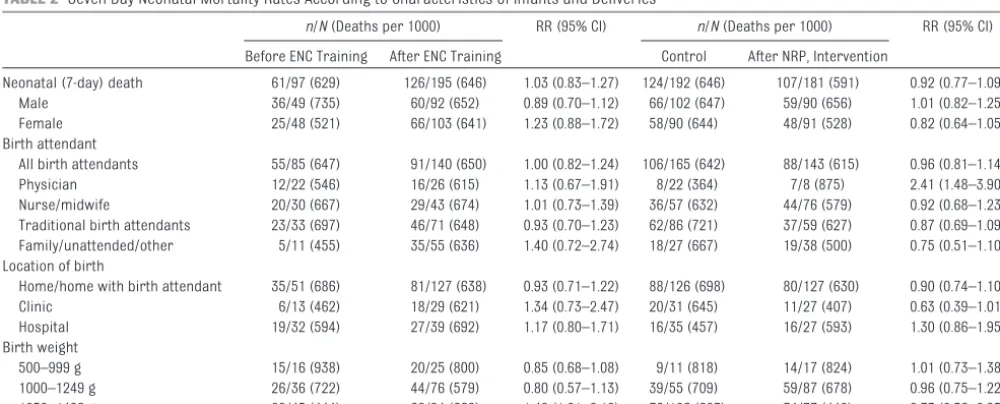
TABLE 2 Seven-Day Neonatal Mortality Rates According to Characteristics of Infants and Deliveries
n/N(Deaths per 1000) RR (95% CI) n/N(Deaths per 1000) RR (95% CI)
Before ENC Training After ENC Training Control After NRP, Intervention
Neonatal (7-day) death 61/97 (629) 126/195 (646) 1.03 (0.83–1.27) 124/192 (646) 107/181 (591) 0.92 (0.77–1.09)
Male 36/49 (735) 60/92 (652) 0.89 (0.70–1.12) 66/102 (647) 59/90 (656) 1.01 (0.82–1.25)
Female 25/48 (521) 66/103 (641) 1.23 (0.88–1.72) 58/90 (644) 48/91 (528) 0.82 (0.64–1.05) Birth attendant
All birth attendants 55/85 (647) 91/140 (650) 1.00 (0.82–1.24) 106/165 (642) 88/143 (615) 0.96 (0.81–1.14) Physician 12/22 (546) 16/26 (615) 1.13 (0.67–1.91) 8/22 (364) 7/8 (875) 2.41 (1.48–3.90) Nurse/midwife 20/30 (667) 29/43 (674) 1.01 (0.73–1.39) 36/57 (632) 44/76 (579) 0.92 (0.68–1.23) Traditional birth attendants 23/33 (697) 46/71 (648) 0.93 (0.70–1.23) 62/86 (721) 37/59 (627) 0.87 (0.69–1.09) Family/unattended/other 5/11 (455) 35/55 (636) 1.40 (0.72–2.74) 18/27 (667) 19/38 (500) 0.75 (0.51–1.10) Location of birth
Home/home with birth attendant 35/51 (686) 81/127 (638) 0.93 (0.71–1.22) 88/126 (698) 80/127 (630) 0.90 (0.74–1.10)
Clinic 6/13 (462) 18/29 (621) 1.34 (0.73–2.47) 20/31 (645) 11/27 (407) 0.63 (0.39–1.01)
Hospital 19/32 (594) 27/39 (692) 1.17 (0.80–1.71) 16/35 (457) 16/27 (593) 1.30 (0.86–1.95) Birth weight
500–999 g 15/16 (938) 20/25 (800) 0.85 (0.68–1.08) 9/11 (818) 14/17 (824) 1.01 (0.73–1.38) 1000–1249 g 26/36 (722) 44/76 (579) 0.80 (0.57–1.13) 39/55 (709) 59/87 (678) 0.96 (0.75–1.22) 1250–1499 g 20/45 (444) 62/94 (660) 1.48 (1.01–2.18) 76/126 (603) 34/77 (442) 0.73 (0.56–0.95)
were stillborn. Of the live-born infants, 22% received bag-mask ventilation. Of the live-born infants, 25% survived to day 7. These results did not differ sig-nificantly according to study phase. Of the live-born infants who did not re-ceive bag-mask ventilation, 40% sur-vived to day 7.
Causes of Death
Overall, the primary causes of deaths were VLBW (76%), birth asphyxia
(16%), and infections (6%). After ENC training, there was a decrease in the rate of deaths attributable to birth as-phyxia (from 16.5 deaths per 1000 live births to 2.6 deaths per 1000 live births;P⬍.001) among VLBW infants. Neurologic Examination Results Neurologic examination results were available for only 59 of the 7-day VLBW survivors. Twenty (34%) of the 59 infants who were seen at 7 days
had examination results consistent with moderate/severe encephalopa-thy. These results did not change sig-nificantly according to study phase.
DISCUSSION
This multicenter study conducted in rural communities in developing coun-tries demonstrated that neither ENC training nor NRP training reduced mortality rates for VLBW infants. This result is in contrast to the reductions
TABLE 3 Stillbirth Rates According to Characteristics of Infants and Deliveries
n/N(Deaths per 1000) RR (95% CI) n/N(Deaths per 1000) RR (95% CI)
Before ENC Training After ENC Training Control After NRP, Intervention
Stillbirth 72/169 (426) 157/359 (437) 1.03 (0.80–1.31) 101/295 (342) 91/273 (333) 0.97 (0.57–1.67) Fresh stillbirth 39/169 (231) 117/359 (326) 1.41 (0.97–2.07) 71/295 (241) 65/273 (238) 0.99 (0.54–1.81) Macerated stillbirth 33/169 (195) 40/359 (111) 0.57 (0.38–0.85) 30/295 (102) 26/273 (95) 0.94 (0.39–2.24) Male 40/89 (449) 77/174 (443) 0.98 (0.73–1.33) 52/155 (336) 46/136 (338) 1.01 (0.57–1.79) Female 31/79 (392) 80/185 (432) 1.10 (0.81–1.49) 49/140 (350) 45/137 (329) 0.94 (0.50–1.76) Birth attendant
All birth attendants 66/151 (437) 146/291 (502) 1.15 (0.91–1.45) 94/261 (360) 87/231 (377) 1.05 (0.62–1.77) Physician 11/33 (333) 16/46 (348) 1.04 (0.61–1.78) 5/29 (172) 5/13 (385) 2.23 (0.89–5.58) Nurse/midwife 25/55 (455) 42/86 (488) 1.07 (0.74–1.56) 31/88 (352) 46/122 (377) 1.07 (0.56–2.03) Traditional birth attendants 30/63 (476) 88/159 (554) 1.16 (0.79–1.71) 58/144 (403) 36/96 (375) 0.93 (0.50–1.74) Family/unattended/other 6/17 (353) 11/68 (162) 0.46 (0.14–1.49) 7/34 (206) 4/42 (95) 0.46 (0.12–1.86) Location of birth
Home/home with birth attendant 38/89 (427) 99/228 (434) 1.02 (0.72–1.45) 64/190 (337) 41/169 (243) 0.72 (0.36–1.44) Clinic 10/23 (435) 30/59 (509) 1.17 (0.61–2.24) 27/58 (466) 26/53 (491) 1.05 (0.64–1.73) Hospital 24/56 (429) 28/72 (389) 0.91 (0.63–1.30) 10/47 (213) 24/51 (471) 2.21 (1.10–4.44) Birth weight
500–999 g 22/38 (579) 68/93 (731) 1.26 (0.91–1.76) 29/40 (725) 33/50 (660) 0.91 (0.65–1.28) 1000–1249 g 27/63 (429) 63/139 (453) 1.06 (0.80–1.40) 42/97 (433) 36/124 (290) 0.67 (0.41–1.09) 1250–1499 g 23/68 (338) 26/127 (205) 0.61 (0.37–0.98) 30/158 (190) 22/99 (222) 1.17 (0.50–2.76)
Data may reflect missing values.
TABLE 4 Perinatal Mortality Rates According to Characteristics of Infants and Deliveries
n/N(Deaths per 1000) RR (95% CI) n/N(Deaths per 1000) RR (95% CI)
Before ENC Training After ENC Training Control After NRP, Intervention
Perinatal death 133/169 (787) 283/352 (804) 1.02 (0.91–1.14) 225/293 (768) 198/272 (728) 0.95 (0.84–1.07) Male 76/89 (854) 137/169 (811) 0.95 (0.84–1.07) 118/154 (766) 105/136 (772) 1.01 (0.87–1.16) Female 56/79 (709) 146/183 (798) 1.13 (0.94–1.35) 107/139 (770) 93/136 (684) 0.89 (0.75–1.05) Birth attendant
All birth attendants 121/151 (801) 237/286 (829) 1.03 (0.93–1.15) 200/259 (772) 175/230 (761) 0.99 (0.88–1.10) Physician 23/33 (697) 32/42 (762) 1.09 (0.80–1.50) 13/27 (482) 12/13 (923) 1.92 (1.39–2.65) Nurse/midwife 45/55 (818) 71/85 (835) 1.02 (0.87–1.20) 67/88 (761) 90/122 (738) 0.97 (0.84–1.12) Traditional birth attendants 53/63 (841) 134/159 (843) 1.00 (0.87–1.15) 120/144 (833) 73/95 (768) 0.92 (0.80–1.06) Family/unattended/other 11/17 (647) 46/66 (697) 1.08 (0.65–1.79) 25/34 (735) 23/42 (548) 0.74 (0.53–1.05) Location of birth
Home/home with birth attendant 73/89 (820) 180/226 (797) 0.97 (0.83–1.13) 152/190 (800) 121/168 (720) 0.90 (0.77–1.06) Clinic 16/23 (696) 48/59 (814) 1.17 (0.83–1.64) 47/58 (810) 37/53 (698) 0.86 (0.71–1.04) Hospital 43/56 (768) 55/67 (821) 1.07 (0.88–1.30) 26/45 (578) 40/51 (784) 1.36 (1.04–1.77) Birth weight
500–999 g 37/38 (974) 88/93 (946) 0.97 (0.91–1.04) 38/40 (950) 47/50 (940) 0.99 (0.90–1.09) 1000–1249 g 53/63 (841) 107/139 (770) 0.92 (0.77–1.09) 81/97 (835) 95/123 (772) 0.92 (0.80–1.07) 1250–1499 g 43/68 (632) 88/120 (733) 1.16 (0.93–1.45) 106/156 (680) 56/99 (566) 0.83 (0.68–1.02)
in stillbirth and perinatal mortality rates for infants with birth weights of
⬎1500 g that were observed after training of the same birth attendants with the ENC course13and the
reduc-tions in neonatal mortality rates in a facility-based study of the same inter-vention.11The majority of the deliveries
occurred at home and were attended by traditional birth attendants or fam-ily members. Maternal and neonatal transportation and advanced neonatal care generally were unavailable or were limited in the study communities, which may explain in part the lack of impact on mortality rates in this high-risk population.
The study strengths are the
population-based design, the rigorous training using master instructors, the exclusive use of local trainers to train birth attendants, the use of preg-nancy/birth registries to capture all births, the inclusion of all birth atten-dants, the relatively large sample size, and the high consent and 7-day follow-up rates. Importantly, whereas most low-income countries register live births but not stillbirths,4 birth
attendants were trained to report outcomes of all pregnancies, which allowed ascertainment of the contribu-tions of stillbirths and very early neo-natal deaths to perineo-natal mortality rates. In addition, many studies of perinatal interventions at the com-munity level did not train birth atten-dants in the differentiation between stillbirths and neonatal deaths, as was performed in the current study. To our knowledge, this is the largest study of VLBW infants born in rural communities in low- and middle-income countries.
One weakness of this study was the before/after design to evaluate the impact of the ENC course. To mini-mize this weakness, all training, ex-cept for ENC training, was conducted before the initiation of data
collec-tion. This active baseline design min-imizes biases and decreases the likelihood that other concurrent changes in practice influenced the outcomes.14With high-quality design
and data collection, before/after analyses can provide meaningful re-sults and supplement studies using random allocation.18 However, the
possibility that differences between the pre–ENC training and post–ENC training periods might confound and mask potential differences between the periods cannot be excluded. An-other weakness is that some infants considered VLBW were not weighed at birth and therefore, were not in-cluded in the study. However, analy-ses including infants with estimated birth weights did not change the study conclusions. Because infants thought to be most immature might have been excluded, smaller VLBW in-fants are likely to be underrepre-sented in the reported cohort, as suggested by the birth weight distri-butions. Another important limita-tion is that many VLBW infants did not receive bag-mask ventilation and might not have received other care because of anticipated low chances for survival. However, the use of bag-mask ventilation increased almost fourfold during the study periods. Despite the increased use of bag-mask ventilation, mortality rates were not decreased.
This study focused on VLBW infants, who, because of their high risk of death, were not included in the First Breath Trial results. Birth weight is a predictor of neonatal death,19,20causes
of neonatal death,21and birth
asphyx-ia20,22in less-developed countries.
Ges-tational age also is a strong predictor of neonatal death.19A combination of
birth weight and gestational age was almost as effective in predicting neo-natal death as a more-complex model that was dependent on variables that
rarely are available at first-level facili-ties or through retrospective data col-lection in the developing world.19
Therefore, focusing on the effects of interventions that affect birth weight and gestational age is important.
Improved survival rates for VLBW in-fants are likely to require advanced care. Survival rates for VLBW infants
increase as care practices, including use of prenatal steroid treatment, cesarean section, exogenous surfac-tant administration, ventilation, and continuous positive airway pressure
therapy, are introduced in NICUs.23
However, these advanced care prac-tices frequently are not available for pregnant women at high risk or their infants at first-level facilities or in
home deliveries in developing coun-tries. Perinatal and neonatal care in these circumstances would require maternal referral to more-advanced
facilities or stabilization and prompt transportation soon after birth. There is some evidence that neonatal care intervention packages6,7,11–13,18
and newborn resuscitation5,24–27 can
be effective in reducing mortality rates in a general population of neonates. However, those studies did not include VLBW infants or reported on only a small population of VLBW infants,
with-out specific analyses of the effects of the interventions on those infants. The current study is particularly important because a training package of
neona-tal interventions and resuscitation was tested among VLBW infants born at the community level. However, the current data cannot be used to deter-mine whether these interventions
would be effective if maternal and/or neonatal referral and advanced care practices were available. In a large, population-based study in a developed
CONCLUSIONS
Training of birth attendants in ENC and in NRP did not decrease early neonatal mortality, stillbirth, or perinatal mor-tality rates for VLBW infants born at a first-level facility or at home. In view of the advanced practices found to be ef-fective for these high-risk infants, transportation of pregnant women to facilities with high levels of care should be considered when delivery of a VLBW infant or an infant at ⬍30 weeks of gestation is expected. How-ever, VLBW infants constitute only
⬃1% of births, and ENC training should continue to be advocated for all births, because it can reduce markedly the rates of stillbirths,13 neonatal
deaths,11and perinatal deaths.13
ACKNOWLEDGMENTS
This work was funded by the Eunice Kennedy Shriver National Institute of Child Health and Human Development Global Network for Women’s and Children’s Health Research (grants
U01 HD040477, U01 HD043475, U01 HD043464, U01 HD040657, U01 HD042372, U01 HD040607, U01 HD040636, and U01 HD040574) and the Bill and Melinda Gates Foundation. Eunice Kennedy Shriver National Institute of Child Health and Human Development staff members participated in the study de-sign, study conduct, data interpreta-tion, and manuscript editing. Neither funding agency limited the ability to complete the research as planned. The authors had full control of the primary data.
The First Breath Study Group of the Global Network for Women’s and Chil-dren’s Health Research included the following: Argentina: Fernando Al-thabe, Jose M. Belizan, and Edgardo Szyld (Institute for Clinical Effective-ness and Health Policy); Democratic Republic of Congo: John Ditekemena and Antoinette Tshefu (Kinshasa School of Public Health); Guatemala: Ana Garces (San Carlos University); In-dia: Arjit Mohapatra and Sailajanan-dan Parida (Sriramchandra Bhanja
Medical College) and Shivaprasad S. Goudar and Bhalchandra S. Kodkany (Jawaharlal Nehru Medical College); Pakistan: Imtiaz Jehan, Syed Rafat Jafri, and Omrana Pasha (Aga Khan University); Zambia: Margaret Mbel-enga (Centre for Infectious Disease Re-search) and Elwyn Chomba (University of Zambia); United States: Waldemar A. Carlo (University of Alabama at Bir-mingham), Nancy Krebs and Michael Hambidge (University of Colorado), Robert L. Goldenberg (Drexel Univer-sity), Pinaki Panigrahi (University of Maryland, Baltimore), Richard J. Der-man (University of Missouri, Kansas City), Carl Bose (University of North Carolina at Chapel Hill), Pierre Buek-ens (Tulane School of Public Health and Tropical Medicine), Linda L. Wright, Macaya Douoguih, and Anne Willoughby (Eunice Kennedy Shriver National Institute of Child Health and Human Development), and Hillary Har-ris, Elizabeth M. McClure, Hrishikesh Chakraborty, Janet Moore, and Ty Hart-well (RTI International).
REFERENCES
1. World Health Organization.Neonatal and Perinatal Mortality: Country, Regional and Global Estimates. Geneva, Switzerland: World Health Organization; 2006. Available at: www.who.int/making_pregnancy_ safer/publications/en/index.html. Ac-cessed February 11, 2010
2. Lawn JE, Cousens S, Zupan J; Lancet Neona-tal Survival Steering Team. 4 million neona-tal deaths: when? where? why?Lancet. 2005;365(9462):891–900
3. Murray CJ, Laakso T, Shibuya K, Hill K, Lopez AD. Can we achieve Millennium Develop-ment Goal 4? New analysis of country trends and forecasts of under-5 mortality to 2015.Lancet. 2007;370(9592):1040 –1054
4. Lawn J, Shibuya K, Stein C. No cry at birth: global estimates of intrapartum stillbirths and intrapartum-related neonatal deaths. Bull World Health Organ. 2005;83(6): 409 – 417
5. Deorari AK, Paul VK, Singh M, Vidyasagar D; Medical Colleges Network. Impact of educa-tion and training on neonatal resuscitaeduca-tion practices in 14 teaching hospitals in India. Ann Trop Paediatr. 2001;21(1):29 –33
6. Darmstadt GL, Bhutta ZA, Cousens S, et al. Evidence-based, cost-effective interventions:
how many newborn babies can we save? Lan-cet. 2005;365(9463):977–988
7. Haws RA, Thomas AL, Bhutta ZA, Darmstadt
GL. Impact of packaged interventions on neonatal health: a review of the evidence.
Health Policy Plan. 2007;22(4):193–215
8. World Health Organization. Pregnancy, Childbirth, Postpartum and Newborn
Care: A Guide for Essential Practice. 2nd ed. Geneva, Switzerland: World Health Organization; 2006
9. Lang S.Essential Newborn Care Course. Ge-neva, Switzerland: World Health Organization;
2004
10. McClure EM, Carlo WA, Wright LL, et al. Evaluation of the educational impact of
the WHO Essential Newborn Care course in Zambia. Acta Paediatr. 2007;96(8): 1135–1138
11. Wright LL, Garces A, Carlo WA, McClure EM; First Breath Study Group. Effect of Essential Newborn Care (ENC) training by birth
atten-dant type: a global network study.
Pre-sented at the annual meeting of the Pediat-ric Academic Societies; May 2–5, 2009;
Baltimore, MD
12. Bhutta ZA, Darmstadt GL, Hasan BS, Haws RA. Community-based interventions for
im-proving perinatal and neonatal health out-comes in developing countries: a review of
the evidence.Pediatrics. 2005;115(2 suppl): 519 – 617
13. Carlo WA, Goudar SS, Jehan I, et al.
Newborn-care training and perinatal mor-tality in developing countries.N Engl J Med. 2010;362(7):614 – 623
14. Spilker B. Guide to Clinical Trials. 1st ed. Philadelphia, PA: Lippincott Williams &
Wilkins; 1991:75
15. Ellis M, Manandhar DS, Manandhar N, Wyatt J, Bolam AJ, Costello AM. Stillbirths and
neo-natal encephalopathy in Kathmandu, Nepal: an estimate of the contribution of birth as-phyxia to perinatal mortality in low-income
urban population. Paediatr Perinat Epide-miol. 2000;14(1):39 –52
16. World Health Organization.Basic Newborn
Switzerland: World Health Organization; 1997:32
17. Stokes ME, Davis CS, Koch GG. Categorical Data Analysis Using the SAS System. 2nd ed. Cary, NC: SAS Institute; 2009
18. Bhutta ZA, Memon ZA, Soofi S, Salat MS, Cousens S, Martines J. Implementing community-based perinatal care: results from a pilot study in rural Pakistan.Bull World Health Organ. 2008;86(6):452– 459
19. Rosenberg RE, Ahmed S, Saha SK, et al. Sim-plified age-weight mortality risk classifica-tion for very low birth weight infants in low-resource settings.J Pediatr. 2008;153(4): 519 –524
20. Adhikari M, Gouws E, Desai PK. Periventricu-lar hemorrhage in a developing world: is drug intervention appropriate?Brain Dev. 1995;17(3):164 –168
21. Hotrakitya S, Tejavej A, Siripoonya P. Early neonatal mortality and causes of death in Ramathibodi Hospital: 1981–1990.J Med As-soc Thai. 1993;76(suppl 2):119 –129
22. Kolatat T, Aunganon K, Yosthiem P. Airway complications in neonates who received mechanical ventilation.J Med Assoc Thai. 2002;85(suppl 2):S455–S462
23. Ho JJ, Chang AS. Changes in the process of care and outcome over a 10-year period in a neonatal nursery in a developing country.J Trop Pediatr. 2007;53(4):232–237
24. Cowles W. Abstracts from India’s Second In-ternational Emergency Medicine and Disas-ter Preparedness Conference.Acad Emerg Med. 2007;14(5):e109 – e113
25. Zhu XY, Fang HQ, Zeng SP, Li YM, Lin HL, Shi SZ. The impact of the neonatal resuscita-tion program guidelines (NRPG) on the
neonatal mortality in a hospital in Zhuhai, China. Singapore Med J. 1997;38(11): 485– 487
26. O’Hare BA, Nakakeeto M, Southall DP. A pilot study to determine if nurses trained in basic neonatal resuscitation would im-pact the outcome of neonates delivered in Kampala, Uganda.J Trop Pediatr. 2006; 52(5):376 –379
27. Opiyo N, Were F, Govedi F, Fegan G, Wasunna A, English M. Effect of newborn resuscita-tion training on health worker practices in Pumwani Hospital, Kenya.PLoS One. 2008; 3(2):e1599
28. Cifuentes J, Bronstein J, Phibbs CS, Phibbs RH, Schmitt SK, Carlo WA. Mortality in low birth weight infants according to level of neonatal care at hospital of birth. Pediat-rics. 2002;109(5):745–751
(Continued from first page)
www.pediatrics.org/cgi/doi/10.1542/peds.2010-1183
doi:10.1542/peds.2010-1183
Accepted for publication Jul 23, 2010
Address correspondence to Waldemar A. Carlo, MD, University of Alabama at Birmingham, School of Medicine, Department of Pediatrics, 176F Suite 9380, 619 S. 19th St, Birmingham, AL 35249-7335. E-mail: [email protected]
PEDIATRICS (ISSN Numbers: Print, 0031-4005; Online, 1098-4275).
Copyright © 2010 by the American Academy of Pediatrics
DOI: 10.1542/peds.2010-1183 originally published online October 11, 2010;
2010;126;e1072
Pediatrics
Linda L. Wright and for the First Breath Study Group
Panigrahi, Pierre Buekens, Hrishikesh Chakraborty, Tyler D. Hartwell, Janet Moore,
Richard J. Derman, Robert L. Goldenberg, Carl Bose, Michael Hambidge, Pinaki
Tshefu, Ana Garces, Sailajanandan Parida, Fernando Althabe, Elizabeth M. McClure,
Waldemar A. Carlo, Shivaprasad S. Goudar, Imtiaz Jehan, Elwyn Chomba, Antoinette
Services
Updated Information &
http://pediatrics.aappublications.org/content/126/5/e1072
including high resolution figures, can be found at:
References
http://pediatrics.aappublications.org/content/126/5/e1072#BIBL
This article cites 21 articles, 1 of which you can access for free at:
Subspecialty Collections
sub
http://www.aappublications.org/cgi/collection/fetus:newborn_infant_
Fetus/Newborn Infant following collection(s):
This article, along with others on similar topics, appears in the
Permissions & Licensing
http://www.aappublications.org/site/misc/Permissions.xhtml
in its entirety can be found online at:
Information about reproducing this article in parts (figures, tables) or
Reprints
http://www.aappublications.org/site/misc/reprints.xhtml
DOI: 10.1542/peds.2010-1183 originally published online October 11, 2010;
2010;126;e1072
Pediatrics
Linda L. Wright and for the First Breath Study Group
Panigrahi, Pierre Buekens, Hrishikesh Chakraborty, Tyler D. Hartwell, Janet Moore,
Richard J. Derman, Robert L. Goldenberg, Carl Bose, Michael Hambidge, Pinaki
Tshefu, Ana Garces, Sailajanandan Parida, Fernando Althabe, Elizabeth M. McClure,
Waldemar A. Carlo, Shivaprasad S. Goudar, Imtiaz Jehan, Elwyn Chomba, Antoinette
Countries Despite Training
High Mortality Rates for Very Low Birth Weight Infants in Developing
http://pediatrics.aappublications.org/content/126/5/e1072
located on the World Wide Web at:
The online version of this article, along with updated information and services, is
by the American Academy of Pediatrics. All rights reserved. Print ISSN: 1073-0397.