Timing of Return to Work and
Breastfeeding in Australia
Ning Xiang, PhD, MSc, MEd, Maria Zadoroznyj, PhD, MSc, Wojtek Tomaszewski, PhD, MSc, MA, Bill Martin, PhD, MA
abstract
OBJECTIVE: To examine the effects of timing of return to work, number of hours worked, and their interaction, on the likelihood of breastfeeding at 6 months and predominant breastfeeding at 16 weeks.
METHODS: A nationally representative sample of Australian mothers in paid employment in
the 13 months before giving birth (n = 2300) were surveyed by telephone. Four multivariate
logistic regression models were used to analyze the effects of timing of return to work and work hours, independently and in interaction, on any breastfeeding at 6 months and on predominant breastfeeding at 16 weeks, controlling for maternal sociodemographics, employment patterns, and health measures.
RESULTS: Mothers who returned to work within 6 months and who worked for ≥20 hours per week were significantly less likely than mothers who had not returned to work to
be breastfeeding at 6 months. However, returning to work for ≤19 hours per week had
no significant impact on the likelihood of breastfeeding regardless of when mothers returned to work. Older maternal age, higher educational attainment, better physical or mental health, managerial or professional maternal occupation, and being self-employed all significantly contributed to the increased likelihood of any breastfeeding at 6 months. Similar patterns exist for predominant breastfeeding at 16 weeks.
CONCLUSIONS: The effects of timing of return to work are secondary to the hours of
employment. Working ≤19 hours per week is associated with higher likelihood of
maintaining breastfeeding, regardless of timing of return to work.
Institute for Social Science Research, University of Queensland, Queensland, Australia
Dr Xiang carried out the initial analyses and drafted several sections of the initial manuscript; Dr Zadoroznyj conceptualized and drafted the initial manuscript, and reviewed and revised the manuscript; Dr Tomaszewski substantially contributed to the data analyses, and critically reviewed the manuscript; Dr Martin designed the data collection instruments, coordinated and supervised data collection, and critically reviewed the manuscript; and all authors approved the fi nal manuscript as submitted.
DOI: 10.1542/peds.2015-3883 Accepted for publication Mar 7, 2016
Address correspondence to Ning Xiang, PhD, Institute for Social Science Research, The University of Queensland, Long Pocket Precinct, 80 Meiers Rd, Building C (Cycad 1018), Indooroopilly, QLD 4068, Australia. E-mail: [email protected]
PEDIATRICS (ISSN Numbers: Print, 0031-4005; Online, 1098-4275). Copyright © 2016 by the American Academy of Pediatrics
FINANCIAL DISCLOSURE: The authors have indicated they have no fi nancial relationships relevant
to this article to disclose. To cite: Xiang N, Zadoroznyj M, Tomaszewski W, et al.
Timing of Return to Work and Breastfeeding in Australia.
Pediatrics. 2016;137(6):e20153883
WHAT’S KNOWN ON THIS SUBJECT: Whereas both the timing of return to work and hours of employment are known to affect breastfeeding, little is known about the relative importance of their independent and combined effects on breastfeeding outcomes.
Despite consistent evidence of the benefits of breastfeeding for both mothers and infants, 1 breastfeeding
initiation, duration, and exclusivity remain lower than recommended by health and medical authorities2, 3
in Europe4 and the United States.5, 6
In Australia, breastfeeding initiation rates have been increasing for more than a decade and reached 96% in 2010.7 However, breastfeeding rates
decline rapidly in the first 6 months, such that 60% of Australian infants were still receiving some breast milk at 6 months, and only 15% were exclusively breastfed to 5 months.7
Maternal employment, particularly in the first 6 months after the birth of an infant, has been identified in a number of studies as an important barrier to the continuation of breastfeeding to 6 months.6, 8–14
Previous research indicates that high working hours coupled with early return to work function as barriers to mothers’ ability to breastfeed.8, 11–13, 15, 16 However, there
has been little attempt to separate the effects of timing of return to work and hours worked, nor to investigate how the 2 factors might interact.
In this article, we examine the independent and combined effects of timing of return to work and hours worked on the rate of breastfeeding at 6 months and on the likelihood of predominantly breastfeeding at 16 weeks. We conduct multivariate logistic regression analysis and include a range of maternal and infant covariates known to be associated with breastfeeding outcomes.17–21
METHODS
Sample
Data used here are from the Baseline Mothers Survey, a random sample survey of working Australian mothers taken ∼12 months after they gave birth to a child. The survey was undertaken to gather baseline
data for an evaluation of the national Paid Parental Leave scheme that commenced in January 2011.22
Mothers were randomly chosen from a sampling frame of applicants for the Baby Bonus for infants born in October and November 2009. It is estimated that, at this time, ∼95% of Australian mothers applied for the Baby Bonus after a birth. Mothers were included if they had worked an average of at least 1 day per week during 10 of the 13 months before the birth, part of the eligibility criteria for the parental leave scheme. Telephone interviews were conducted with 2587 mothers between late November 2010 and late February 2011. An approach letter was sent to participants before they were called and an informed consent was obtained orally before the interview proceeded. The survey had an 84% response rate. Ethics approval for the study was obtained from the Behavioral and Social Sciences Ethical Review Committee of the University of Queensland (No. 2010001298). Mothers who had never initiated breastfeeding or did not provide key data were excluded from analyses, which resulted in a final sample of 2300 participants. Table 1 presents the characteristics of the study sample compared with relevant Australian data.
Data Collection and Variables
The duration of breastfeeding was measured by mothers’ response to the question “How old was the baby when you completely stopped
breastfeeding?” The extent of breastfeeding was measured through the question “How old was the baby when he/she was first given infant formula (bottle) or solids?” Because the intake of water was not included in this question, we use the term “predominant” rather than “exclusive” to describe the extent of breastfeeding. We analyze the extent of breastfeeding at the 16-week time point, because so few infants are predominantly breastfed by 6 months. The 2 main independent variables were measured in the questions “How old was the baby when you first worked in a paid job after the birth?” and “How many hours a week do you work in that job (your first job)?”
Based on previous literature, we include covariates relating to maternal sociodemographic characteristics (age, education, relationship status, country of birth, and household income), maternal work-related characteristics
(occupation and employment sector), infant’s characteristics (birth weight, gestational age), and parity. Maternal physical and mental health were measured by the Medical Outcomes Study Short-Form version 2.24 SF-12
version 2 is a subset scale of the SF-36 health-related quality-of-life measure.25 This scale includes 12
items measuring 8 dimensions of health, which are then converted to 2 component scores indicating physical and mental health condition. The component physical and mental scores are included in the model as
TABLE 1 Characteristics of Study Sample Compared With Relevant Australian Data.
BaMS Sample Australian Comparison
Median maternal age at birth, y 33 31a
University education, % 51.8 41.2b
Parity, primiparous, % 50.9c 41.0
Breastfeeding initiation, % 94.0, n = 2587 95.9b
Any breastfeeding at 6 mo, % 58.0, n = 2300 60.1b
Predominant breastfeeding <4 mo, % 48.5, n = 2300 47.1b
Source: Baseline Mothers Survey (BaMS), data weighted by state.
a Australian Bureau of Statistics. Births, Australia, 2013.23 b 2010 Australian National Infant Feeding Survey.7
c Those who said “No” to the question “Whether any other children live in the household” were regarded as fi rst-time
continuous variables with a range of 1 to 100.
Analysis
To clarify the impact of timing of return to work and working hours, we built 4 multivariate logistic regression models. In the first model, we assessed the impact of timing of return to work on breastfeeding likelihood while controlling for all the covariates. Next, we examined the impact of working hours on breastfeeding likelihood, controlling for the same set of covariates. Third, we put both of the 2 key predictors in 1 model. And finally, in the fourth model, we included the interaction of timing of return to work and working hours.
In our return to work variables, mothers who had not returned to work are treated as the reference category. As a result, the same mothers are in the reference category for our 2 key independent variables. Because of this, models 3 and 4 estimate a full range of effects for the number of hours worked (contrasting them with the mothers who had not returned to work), and also include a direct contrast between those who return to work sooner and later after the birth (ie, within 3 and 6 months for any breastfeeding at 6 months,
and 8 and 16 weeks for exclusive breastfeeding at 16 weeks). By proceeding in this way, we are able to test directly whether there is a statistically significant difference in breastfeeding odds that is associated with timing of return to work, given that the mother had returned to work and is working for a certain number of hours. We are also able to directly test whether including both key independent variables in a single model (model 3), and adding interactions between them (model 4), offers statistical improvement over more parsimonious models.
RESULTS
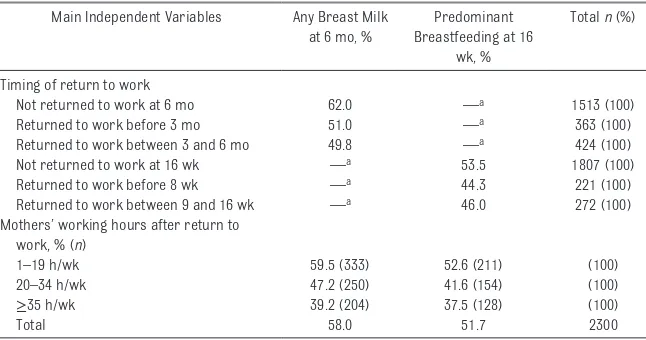
The percentages of mothers who still breastfed at 6 months and predominantly breastfed at 16 weeks across key independent variables are presented in Table 2. A greater percentage of mothers who had not returned to work were breastfeeding at 6 months (62%) and predominantly breastfeeding at 16 weeks (53%). Looking at timing of return to work, although there is a substantial drop in the breastfeeding rates for all mothers who returned, breastfeeding rates at 6 months are very similar among those who returned to work within 3 months
postpartum (51%) and those who returned between 3 and 6 months (49%). A similar pattern occurs for predominant breastfeeding rates at 16 weeks. In contrast, breastfeeding rates by the number of hours that mothers worked after they returned show a more linear pattern, with a steady decrease in rates as mothers work more hours. This occurs for both predominant breastfeeding at 16 weeks and any breastfeeding at 6 months.
The Effect of Timing of Return to Work and Working Hours on Breastfeeding
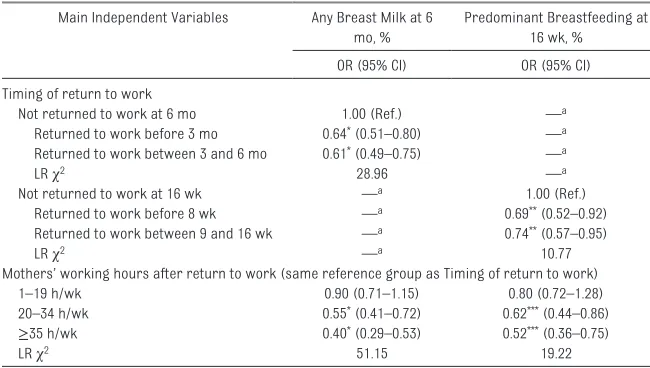
Unadjusted odds ratios (ORs) from logistic regressions for each of the 2 main predictors with outcome variables of any breast milk at 6 months and predominant breastfeeding at 16 weeks are presented in Table 3.
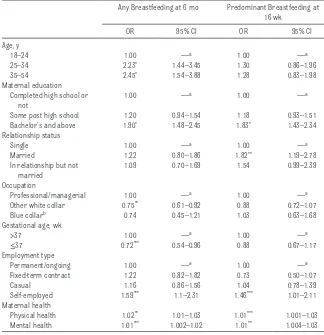
Adjusted ORs from multiple logistic regressions with outcome variables of any breast milk at 6 months and predominant breastfeeding at 16 weeks are presented in Table 4 and Table 5, respectively. In both tables, model 1 shows the effect of timing of return to work, model 2 shows the effect of working hours, model 3 combines the 2 key independent variables, and model 4 also included the interaction effects between the 2. All models are adjusted for the same range of control variables as described earlier. The effects of those control variables are suppressed in Tables 4 and 5 to aid clarity but are presented separately in Table 6.
Model 1 analyzes the likelihood of any breastfeeding at 6 months (Table 4). It shows that, compared with mothers who did not return to work at 6 months, those who returned to work within 3 months (adjusted OR 0.56, 95% confidence interval [CI] 0.43–0.73) and from 3 to 6 months (adjusted OR 0.60, 95% CI 0.48–0.75) had a lower odds of breastfeeding their infants at 6 months of age. Model 2 shows the main effect
TABLE 2 Mothers’ Employment and Breastfeeding at 6 Months and Predominant Breastfeeding at 16 Weeks
Main Independent Variables Any Breast Milk at 6 mo, %
Predominant Breastfeeding at 16
wk, %
Total n (%)
Timing of return to work
Not returned to work at 6 mo 62.0 —a 1513 (100)
Returned to work before 3 mo 51.0 —a 363 (100)
Returned to work between 3 and 6 mo 49.8 —a 424 (100)
Not returned to work at 16 wk —a 53.5 1807 (100)
Returned to work before 8 wk —a 44.3 221 (100)
Returned to work between 9 and 16 wk —a 46.0 272 (100)
Mothers’ working hours after return to work, % (n)
1–19 h/wk 59.5 (333) 52.6 (211) (100)
20–34 h/wk 47.2 (250) 41.6 (154) (100)
≥35 h/wk 39.2 (204) 37.5 (128) (100)
Total 58.0 51.7 2300
Source: Baseline Mothers Survey (BaMS).
a Note: The empty cell means no observations due to the categorization of dependent variables. For example, we only look
of working hours: mothers who worked full-time (≥35 hours per week) (adjusted OR 0.36, 95% CI 0.27–0.50) and between 20 and 34 hours per week (adjusted OR 0.50, 95% CI 0.38–0.66) had a lower odds of breastfeeding at 6 months than mothers who had not returned to work. This is not the case, however, for mothers who worked 1 to 19 hours per week (adjusted OR 0.88, 95% CI 0.68–1.14).
The addition of timing of return to work and working hours together, as shown in model 3, removes the statistical significance of timing of return to work, yet the main effect of working hours remains. This suggests that once we control for the number of hours mothers work, there is no statistically significant difference in the odds of breastfeeding among the mothers who do not return to work, those who return to work in the first 3 months, and those who return between 3 and 6 months postpartum.
In the final step of analysis, shown in model 4, the interaction effects between the categories of the 2 main predictors were added, none of which were statistically significant (output
suppressed but available from authors on request).
The results from models 3 and 4 suggest that once the number of hours worked has been accounted for, including the timing of return to work might not be necessary. To test this more directly, we performed the likelihood ratio (LR) test by comparing the goodness of fit of consecutive models. In model 2, Likelihood Ratio (LR) χ2 (24) =
215.68, whereas in model 3, LR χ2
(25) = 215.76, and model 4, LR χ2
(29) = 216.84. The results of the LR tests show that neither adding timing of return to work (model 3 – model 2: LR χ2 (1) = 0.08, P =
.77) nor the interactions (model 4 – model 2: LR χ2 (5) = 1.16, P =
.95) offer statistically significant improvements in model fit over the more parsimonious model 2.
The results for predominant breastfeeding at 16 weeks (Table 5) are similar to those for any breastfeeding at 6 months. We observe a significant drop in predominant breastfeeding rates for those mothers who return to working
≥20 hours per week. However,
there is no significant difference in predominant breastfeeding likelihood between those mothers who work 1 to 19 hours and those who stay at home (model 2). These findings hold, regardless of when the mothers return to work (within 8 weeks or between 8 and 16 weeks) (models 3 and 4). As before, the results of the LR tests show that neither adding timing of return to work (model 3 – model 2: LR χ2 (1) =
1.24, P = .27) nor the interactions (model 4 – model 2: LR χ2 (5) =
4.28, P = .51) significantly improves model fit as compared with the more parsimonious model 2.
Taken together, the findings
demonstrate that, although returning to work has, on average, a significant impact on mothers’ likelihood of breastfeeding (both at 6 months and predominant breastfeeding at 16 weeks), this depends entirely on the number of hours worked. In particular, working ≤19 hours removes the negative effect of return to work on the continuation of breastfeeding. By contrast, the timing of return to work does not appear to make further difference, once the number of hours worked is accounted for.
Other Factors Associated With Breastfeeding
As with other studies, older, more educated mothers, and those in managerial or professional occupations, or self-employed are more likely to breastfeed for longer, as measured by some breastfeeding at 6 months (see Table 6). Those mothers who reported better physical (adjusted OR 1.02, 95% CI 1.01–1.03) and mental health (adjusted OR 1.01, 95% CI 1.002–1.02) also had a higher odds of breastfeeding at 6 months. Premature infants (≤37 weeks) had a lower odds of being breastfed at 6 months than full-term infants (>37 weeks) (adjusted OR 0.72, 95% CI 0.54–0.96).
TABLE 3 Unadjusted ORs for Any Breastfeeding at 6 Months and Predominant Breastfeeding at 16 Weeks
Main Independent Variables Any Breast Milk at 6 mo, %
Predominant Breastfeeding at 16 wk, %
OR (95% CI) OR (95% CI)
Timing of return to work
Not returned to work at 6 mo 1.00 (Ref.) —a
Returned to work before 3 mo 0.64* (0.51–0.80) —a Returned to work between 3 and 6 mo 0.61* (0.49–0.75) —a
LR χ2 28.96 —a
Not returned to work at 16 wk —a 1.00 (Ref.)
Returned to work before 8 wk —a 0.69** (0.52–0.92)
Returned to work between 9 and 16 wk —a 0.74** (0.57–0.95)
LR χ2 —a 10.77
Mothers’ working hours after return to work (same reference group as Timing of return to work)
1–19 h/wk 0.90 (0.71–1.15) 0.80 (0.72–1.28)
20–34 h/wk 0.55* (0.41–0.72) 0.62*** (0.44–0.86)
≥35 h/wk 0.40* (0.29–0.53) 0.52*** (0.36–0.75)
LR χ2 51.15 19.22
Source: Baseline Mothers Survey (BaMS).
a Note: The empty cell means no observations due to the categorisation of dependent variables. For example, we only look
at predominant breastfeeding at 16 weeks, as such no observation at 6 months.
Consistent with the pattern for any breastfeeding at 6 months, maternal education, being self-employed, and maternal health remain as significant predictors of the odds of predominant breastfeeding at 16 weeks. Interestingly, however, the effect of maternal age, occupation, and infant’s gestational age were not significant, whereas relationship status emerged as a significant predictor. Specifically, married mothers (adjusted OR 1.82, 95% CI 1.19–2.78) had higher odds of predominantly breastfeeding at 16 weeks than single mothers.
DISCUSSION
Although a number of previous studies have demonstrated that the longer the delay before returning to paid employment, the longer the breastfeeding duration, 8, 11, 13, 16, 20, 27
the relationship between working hours and the duration of
breastfeeding has been the focus of fewer studies, 6 and their findings are
somewhat more equivocal.8, 9
One of the reasons may be that most previous studies have used a relatively high number of hours (30–40) to simply distinguish between “part-time” and “full-time” employment.6, 8, 13 The findings
reported in this article extend previous research by testing the effects of both timing of return to work and working hours, where the latter are categorized in more detail.
For the sample of Australian women analyzed in this article, the main effect of timing of return to work on the duration and extent of breastfeeding was not significant when working hours were controlled. Furthermore, there are no interactions between the timing of return to work and working hours. Returning to work anytime within the first 6 months could significantly impair the likelihood of predominant breastfeeding at 16 weeks, and any breastfeeding at 6 months, regardless
TABLE 4
Adjusted ORs for Any Breastfeeding at 6 Months (
n
= 2300)
Model 1: Timing of Return to Work
Model 2: Working Hours
Model 3: Timing of Return to Work and
Working Hours
Model 4: Timing of Return to Work, Working Hours, and Their Interaction
OR 95% CI OR 95% CI OR 95% CI OR 95% CI
Timing of return to work Not returned to work at 6 mo
1.00 — a — a — a — a — a — a — a
Returned to work before 3 mo
0.56 *** 0.43–0.73 — a — a 0.96 0.70–1.30 0.76 0.42–1.37
Returned to work between 3 and 6 mo
0.60 *** 0.48–0.75 — a — a 1.00 — a 1.00 — a
Working hours Not returned to work
— a — a 1.00 — a 1.00 — a 1.00 — a 1–19 h/week — a — a 0.88 0.68–1.14 0.90 0.67–1.19 0.89 0.64–1.23 20–34 h/week — a — a 0.50 *** 0.38–0.66 0.51 *** 0.37–0.70 0.47 *** 0.33–0.69 ≥ 35 h/week — a — a 0.36 *** 0.27–0.50 0.37 *** 0.26–0.52 0.41 *** 0.27–0.63 Interactions — a — a — a — a — a — a — a
All interactions are not signifi
cant (0.62–3.20) LR χ 2 191.90 215.68 215.76 216.84
Source: Baseline Mothers Sur
vey (BaMS).
a Note: The empty cells mean that the independent variable has not been included in the model or same reference category was use
d.
*
** P
of how soon they returned. However, as long as mothers who returned to work keep their working hours within 19 hours per week, they appear as likely as stay-at-home mothers to maintain predominant breastfeeding at 16 weeks and any breastfeeding at 6 months.
Given the time-consuming nature of breastfeeding and the documented difficulties of expressing milk in workplaces, 28, 29 an important
factor that should be taken into consideration is the lactation support in workplaces and access to working arrangements that facilitate breastfeeding for those mothers who returned to work. In workplaces that provide facilities to help mothers continue breastfeeding (eg, employer allows working from home, or provides on-site child care), working hours might be less important than otherwise.
Despite efforts to promote breastfeeding-friendly workplaces in Australia, 30 evidence suggests
that breastfeeding support among Australian employers is relatively low.31, 32 Similarly low support from
employers also has been found in the United States13 and Hong Kong, 33 which suggests the findings
reported in this article may be relevant to comparable contexts. In the absence of breastfeeding support from employers, mothers may need to restrict their working hours to maintain breastfeeding, particularly when they have to return to work within 6 months postpartum. Restricting working hours to a certain level (eg, ≤19 hours, as the findings in this article suggest) can provide mothers with more opportunities to be with their infants physically, to enable them to maintain breastfeeding after they return to work.
Consistent with previous findings, older, better-educated mothers in professional or managerial occupations or self-employment are more likely to be breastfeeding at 6 months.
TABLE 5
Adjusted ORs for Predominant Breastfeeding at 16 Weeks (
n
= 2300)
Model 1: Timing of Return to Work
Model 2: Working Hours
Model 3: Timing of Return to Work and
Working Hours
Model 4: Timing of Return to Work, Working Hours, and Their Interaction
OR 95% CI OR 95% CI OR 95% CI OR 95% CI
Timing of return to work Not returned to work at 16 wk
1.00 — a — a — a — a — a — a — a
Returned to work before 8 wk
0.57 * 0.41–0.78 — a — a 0.80 0.55–1.18 0.88 0.41–1.87
Returned to work between 9 and 16 wk
0.71 ** 0.54–0.92 — a — a 1.00 — a 1.00 — a
Working hours Not returned to work
— a — a 1.00 — a 1.00 — a 1.00 — a 1–19 h/week — a — a 0.91 0.67–1.23 0.99 0.71–1.39 1.06 0.72–1.57 20–34 h/week — a — a 0.54 ** 0.38–0.76 0.59 ** 0.40–0.86 0.55 *** 0.35–0.86 ≥ 35 h/week — a — a 0.46 * 0.31–0.68 0.50 ** 0.33–0.76 0.49 ** 0.29–0.80 Interaction — a — a — a — a — a — a — a
All interactions are not signifi
cant (0.40–2.94) LR χ 2 101.50 110.47 111.71 114.75
Source: Baseline Mothers Sur
vey (BaMS).
a Note: The empty cells mean that the independent variable has not been included in the model or same reference category was use
Slightly different sociodemographic factors are implicated in predominant breastfeeding at 16 weeks, where marital status (being married) rather than maternal age and occupation, is an important predictor. Maternal physical and mental health is positively related to the likelihood of predominant breastfeeding at 16 weeks and any breastfeeding at 6 months.
There are 2 main limitations of our study. First, the mothers recruited to this study were a nationally representative sample of women whose employment levels were sufficient to meet the eligibility criteria for Australia’s national Paid Parental Leave scheme.22 As such,
they are not representative of all Australian mothers. The sample is, as shown in Table 1, somewhat more highly educated, and more likely to be primiparous. It is not surprising that first-time mothers are overrepresented, as they are more likely than women who are already mothers, to be employed before the birth. Second, data on duration and predominance of breastfeeding are based on retrospective information from mothers at ∼12 months postpartum. There might be a chance of recall bias associated with the retrospective collection of data at ≥12 months. Although a review of existing studies suggests that maternal recall is a valid and reliable estimate of breastfeeding initiation and duration when it is collected within 3 years postpartum, 34 it also indicates that
the timing when solid food was introduced might be less reliable. As such, in common with other surveys of this kind, this potential limitation should be acknowledged.
CONCLUSIONS
This study disentangles the effects of timing of return to work and working hours on the likelihood of predominant breastfeeding at 16 weeks and any breastfeeding at 6 months. It shows that return
to paid employment is a barrier to maintaining predominant and any breastfeeding, but that the effects of return to work are removed when mothers work ≤19 hours per week. Regardless of when they return to work, this relatively low level of part-time employment enabled mothers in this sample to retain the same likelihood of breastfeeding as mothers who did not return to work within the first 6 months of their child’s life.
The implication of our findings is that practitioners should recommend reduced working hours for those
mothers who decide to return to work within the first 6 months postpartum. Specifically, working
≤19 hours per week should be recommended to maintain any breastfeeding at least up to 6 months. Policy makers should provide incentives for employers to improve lactation support to mothers in workplaces.
ABBREVIATIONS
CI: confidence interval LR: likelihood ratio OR: odds ratio SF: short-form
TABLE 6 Adjusted ORs of Signifi cant Covariates in Interaction Models for Any Breastfeeding at 6 Months and Predominant Breastfeeding at 16 Weeks (n = 2300)
Any Breastfeeding at 6 mo Predominant Breastfeeding at 16 wk
OR 95% CI OR 95% CI
Age, y
18–24 1.00 —a 1.00 —a
25–34 2.23* 1.44–3.45 1.30 0.86–1.96
35–54 2.45* 1.54–3.88 1.28 0.83–1.98
Maternal education Completed high school or
not
1.00 —a 1.00 —a
Some post high school 1.20 0.94–1.54 1.18 0.93–1.51
Bachelor’s and above 1.90* 1.48–2.45 1.83* 1.43–2.34
Relationship status
Single 1.00 —a 1.00 —a
Married 1.22 0.80–1.86 1.82** 1.19–2.78
In relationship but not married
1.09 0.70–1.69 1.54 0.99–2.39
Occupation
Professional/managerial 1.00 —a 1.00 —a
Other white collar 0.75** 0.61–0.92 0.88 0.72–1.07
Blue collarb 0.74 0.45–1.21 1.03 0.63–1.68
Gestational age, wk
>37 1.00 —a 1.00 —a
≤37 0.72*** 0.54–0.96 0.88 0.67–1.17
Employment type
Permanent/ongoing 1.00 —a 1.00 —a
Fixed-term contract 1.22 0.82–1.82 0.73 0.50–1.07
Casual 1.16 0.86–1.56 1.04 0.78–1.39
Self-employed 1.59*** 1.1–2.31 1.46*** 1.01–2.11
Maternal health
Physical health 1.02** 1.01–1.03 1.01*** 1.001–1.03
Mental health 1.01*** 1.002–1.02 1.01** 1.004–1.03
Source: Baseline Mothers Survey (BaMS).
a Note: The empty cells mean that no CI was reported for the reference category.
b Blue collar is defi ned as per Australian and New Zealand Standard Classifi cation of Occupations, 26 comprising laborers,
such as machine operators, automobile drivers, and product assemblers. All other jobs are considered white collar. It should be noticed that the nonsignifi cant difference between Professional/managerial and Blue collar might be due to small case number in the latter category (n = 81).
REFERENCES
1. Ip S, Chung M, Raman G, et al. Breastfeeding and Maternal and Infant Health Outcomes in Developed Countries. Boston, MA: Tufts-New England Medical Center Evidence-based Practice Center. Prepared for: Agency for Healthcare Research and Quality, U.S. Department of Health and Human Services; 2007
2. World Health Organization. Global Strategy for Infant and Young Child Feeding. Geneva, Switzerland: World Health Organization; 2003
3. Section on Breastfeeding.
Breastfeeding and the use of human milk. Pediatrics. 2012;129(3). Available at: www. pediatrics. org/ cgi/ content/ full/ 129/ 3/: e827
4. Cattaneo A, Burmaz T, Arendt M, et al; ‘Promotion of Breastfeeding in Europe: Pilot Testing the Blueprint for Action’ Project. Protection, promotion and support of breast-feeding in Europe: progress from 2002 to 2007. Public Health Nutr. 2010;13(6): 751–759
5. Johnston ML, Esposito N. Barriers and facilitators for breastfeeding among working women in the United States. J Obstet Gynecol Neonatal Nurs. 2007;36(1):9–20
6. Ogbuanu C, Glover S, Probst J, Hussey J, Liu J. Balancing work and family: effect of employment characteristics on breastfeeding. J Hum Lact. 2011;27(3):225–238, quiz 293–295
7. Australian Institute of Health and Welfare. 2010 Australian National Infant Feeding Survey: Indicator results. Canberra, Australia: Australian Institute of Health and Welfare; 2011
8. Mirkovic KR, Perrine CG, Scanlon KS, Grummer-Strawn LM. Maternity leave duration and full-time/part-time work status are associated with US mothers’ ability to meet breastfeeding intentions. J Hum Lact. 2014;30(4):416–419
9. Cooklin AR, Donath SM, Amir LH. Maternal employment and breastfeeding: results from the longitudinal study of Australian children. Acta Paediatr. 2008;97(5):620–623
10. Fein SB, Mandal B, Roe BE. Success of strategies for combining employment and breastfeeding. Pediatrics. 2008;122(suppl 2):S56–S62
11. Huang R, Yang M. Paid maternity leave and breastfeeding practice before and after California’s implementation of the nation’s fi rst paid family leave program. Econ Hum Biol. 2015;16:45–59
12. Mandal B, Roe BE, Fein SB. The differential effects of full-time and part-time work status on breastfeeding. Health Policy. 2010;97(1):79–86
13. Bai YK, Gaits SI, Wunderlich SM. Workplace lactation support by New Jersey employers following US Reasonable Break Time for Nursing Mothers law. J Hum Lact. 2015;31(1):76–80
14. Gielen AC, Faden RR, O’Campo P, Brown CH, Paige DM. Maternal employment during the early postpartum period: effects on initiation and continuation of breast-feeding. Pediatrics. 1991;87(3):298–305
15. Ogbuanu C, Glover S, Probst J, Liu J, Hussey J. The effect of maternity leave length and time of return to work on breastfeeding. Pediatrics. 2011;127(6). Available at: www. pediatrics. org/ cgi/ content/ full/ 127/ 6/ e1414
16. Scott JA, Binns CW, Oddy WH, Graham KI. Predictors of breastfeeding duration: evidence from a cohort study. Pediatrics. 2006;117(4). Available at: www. pediatrics. org/ cgi/ content/ full/ 117/ 4/ e646
17. Forster DA, McLachlan HL, Lumley J. Factors associated with breastfeeding at six months postpartum in a group of Australian women. Int Breastfeed J. 2006;1(18):18
18. Scott JA, Binns CW, Graham KI, Oddy WH. Temporal changes in the determinants of breastfeeding initiation. Birth. 2006;33(1):37–45
19. Lande B, Andersen LF, Baerug A, et al. Infant feeding practices and associated factors in the fi rst six months of life: the Norwegian infant nutrition survey. Acta Paediatr. 2003;92(2):152–161
20. Guendelman S, Kosa JL, Pearl M, Graham S, Goodman J, Kharrazi M. Juggling work and breastfeeding: effects of maternity leave and occupational characteristics. Pediatrics. 2009;123(1). Available at: www. pediatrics. org/ cgi/ content/ full/ 123/ 1/ e38
21. Li R, Darling N, Maurice E, Barker L, Grummer-Strawn LM. Breastfeeding rates in the United States by
characteristics of the child, mother, or family: the 2002 National Immunization Survey. Pediatrics. 2005;115(1). Available at: www. pediatrics. org/ cgi/ content/ full/ 115/ 1/ e31
22. Martin B, Hewitt B, Baird M, et al. Paid Parental Leave Evaluation: Phase 1. Canberra, Australia: Department of Families, Housing, Community Services and Indigenous Affairs; 2012
23. Australian Bureau of Statistics. Births, Australia, 2013. Canberra, Australia: Australian Bureau of Statistics; 2014
24. Ware JE Jr, Kosinski M, Turner-Bowker D, Gandek B. SF12v2: How to Score Version 2 of the SF-12 Health Survey. Lincoln, RI: Quality Metric Incorporated; 2002
25. Ware JE Jr, Sherbourne CD. The MOS 36-item short-form health survey (SF-36). I. Conceptual framework and item selection. Med Care. 1992;30(6):473–483
26. Australian Bureau of Statistics. Australian and New Zealand Standard Classifi cation of Occupations (ANZSCO). Canberra, Australia: Australian Bureau of Statistics; 2006
FUNDING: The data presented in this article were collected as part of an evaluation of the Australian Government's Paid Parental Leave Scheme, funded by the Department of Social Services.
27. Skafi da V. Juggling work and motherhood: the impact of employment and maternity leave on breastfeeding duration: a survival analysis on Growing Up in Scotland data. Matern Child Health J. 2012;16(2):519–527
28. Avishai O. At the pump. Journal of the Motherhood Initiative for Research and Community Involvement. 2004;6(2):138–149
29. Boswell-Penc M, Boyer K. Expressing anxiety? Breast pump usage in
American wage workplaces. Gend Place Cult. 2007;14(5): 551–567
30. Eldridge S, Croker A. Breastfeeding friendly workplace accreditation. Creating supportive workplaces for breastfeeding women. Breastfeed Rev. 2005;13(2):17–22
31. Clifford J, McIntyre E. Who supports breastfeeding? Breastfeed Rev. 2008;16(2):9–19
32. Weber D, Janson A, Nolan M, Wen LM, Rissel C. Female employees’
perceptions of organisational support for breastfeeding at work: fi ndings from an Australian health service workplace. Int Breastfeed J. 2011;6(19):19
33. Dodgson JE, Chee Y-O, Yap TS. Workplace breastfeeding support for hospital employees. J Adv Nurs. 2004;47(1):91–100
DOI: 10.1542/peds.2015-3883 originally published online May 16, 2016;
2016;137;
Pediatrics
Ning Xiang, Maria Zadoroznyj, Wojtek Tomaszewski and Bill Martin
Timing of Return to Work and Breastfeeding in Australia
Services
Updated Information &
http://pediatrics.aappublications.org/content/137/6/e20153883
including high resolution figures, can be found at:
References
http://pediatrics.aappublications.org/content/137/6/e20153883#BIBL
This article cites 27 articles, 7 of which you can access for free at:
Subspecialty Collections
http://www.aappublications.org/cgi/collection/breastfeeding_sub
Breastfeeding
http://www.aappublications.org/cgi/collection/nutrition_sub
Nutrition
following collection(s):
This article, along with others on similar topics, appears in the
Permissions & Licensing
http://www.aappublications.org/site/misc/Permissions.xhtml
in its entirety can be found online at:
Information about reproducing this article in parts (figures, tables) or
Reprints
http://www.aappublications.org/site/misc/reprints.xhtml
DOI: 10.1542/peds.2015-3883 originally published online May 16, 2016;
2016;137;
Pediatrics
Ning Xiang, Maria Zadoroznyj, Wojtek Tomaszewski and Bill Martin
Timing of Return to Work and Breastfeeding in Australia
http://pediatrics.aappublications.org/content/137/6/e20153883
located on the World Wide Web at:
The online version of this article, along with updated information and services, is
by the American Academy of Pediatrics. All rights reserved. Print ISSN: 1073-0397.