296 | P a g e
Computerization in construction management using radio
frequency detection (RFD)
Dr. P. Subramanian
1, Arul Kumar
2.S, Rishi.S
3,
Pugalenthi.K
4, Kumaravel.R.
5Department of Civil, Sengunthar Engineering College (India)
Abstract:
Resources are very important for the construction projects. Some of the most important resources aretime, cost, men, machineries, materials, etc.., ICT applications in the construction industry are now common
place for facilitating procurement, collaboration and knowledge management. There is not much use of modern
ICT tools (e.g. wireless communications, bar-coding and RFID) to facilitate resource management processes in
tracking materials quickly, accurately, and easily.RFID and wireless communications are expected to grow in
usage to support resource management practices. the economy and feasibility of this proposal of the RFID
technology in construction projects for the management of resources is to be evaluated. From the proposal of
the RFID technology the savings in the resources like time and labour in terms of cost economics is to be
evaluated.
Keywords:
Radio Frequency Identification, Information and Communication Technology, Bar-coding
and Wireless Communication.
Introduction:
Some of the most important resources are time, cost, men, machineries, materials, etc.., Resource management is a vital function for improving productivity in construction projects. There are various advantages in the implementation of ICT in resource management, as ICT has the potential to significantly improve the management of resource on site. A range of opportunities for construction organizations to invest in advanced information and telecommunication system. ICT applications in the construction industry are now common place for facilitating procurement, collaboration and knowledge management. There is not much use of modern ICT tools (e.g. wireless communications, bar-coding and RFID) to facilitate resource management processes in tracking materials quickly, accurately, and easily.
RFID in resource management:
297 | P a g e
Management of materials:
In a typical material supply chain, construction materials ordered were shipped or transported by trucks from factory to material distributors, and then on-site warehouse. Material information such as manufacturer, quantity, specifications, etc. should be readily available to decision makers such as buyers in the head office, project managers on site, and truck drivers on the road. The RFID technology can improve productivity by reading all the information in a go, and updating it automatically. It is also easier for construction workers to find the right materials by tracing the information attached on materials.
Management of men:
Construction sites have specific needs for access control; an effective access control system can keep the site, staff, and assets secure; if combined with an attendance checking system, it can provide time and attendance record as a basis for further uses such as allocating works, calculating wage, and so on. It is suggested to put RFID tags in safety gears including safety helmet, fluorescent jacket, safety boots, and belt. A system is to detect whether they have worn the gears properly, for example, by detecting their relative positions in line with strengths of signals. Nonetheless, the algorithm for this is yet to be developed.
Management of machinery
:
Tracking of machinery and tools will also be done. Construction machinery ranges from large-scale machines such as cranes and excavators to smaller tools such as pneumatic breakers, welding machines, and wrenches. Managing machines and tools efficiently is not only to manage them as assets but also to ensure the smoothness of scheduled construction works. A machine operation permission system can be developed using RFID technology. . All maintenance records such as time of inspection, the personnel who conducts the checking, conditions of the machines, and repair work done, can be read. After the inspection and maintenance are finished, the information can be saved into the tags immediately and updated in the central system for further use.
Need for the study:
Resource management is not successful in many projects due to the lack of proper ICT (Information Communication and Technology). There are various advantages in the implementation of ICT in resource management, as ICT has the potential to significantly improve the management of resource on site. Only if the resource (men, materials and machineries) are managed there will be savings in cost and also in time. Implementation of RFID technology for the construction project will improve ICT (information Communication Technology) for the effective management or resources in savings in resource in terms of time and cost economics.
Objective:
298 | P a g e
To analyze the feasibility RFID technology for the resource management(men, materials, machineries) in the construction project.
To evaluate and estimate the savings from the resource management in terms of time and cost economics.
Methodology:
The aim of this study is for effective management of resources(men, materials and machineries) to make the savings in terms of time and cost economics. Since 3M’s are used in large quantities for any of the construction projects. Using RFID tool will be one of the solutions for increasing the ICT for the management of resources.
Working of RFID technology:
There are two primary components of an RFID system as shown in Figure 1. The whole RFID system requires the tags and the reader including an antenna to be operated. The RFID tags or transponder are normally located on the object or people to be identified. The RFID reader or interrogator provides, read and write/read facility through a fixed or mobile reader to communicate data to and from the tags. The components of the RFID system are the tags, readers and antenna.
RFID tags can be classified into two types: passive and active. Passive RFID tags have no internal power source (they are only active when a reader is nearby to power them). Generally, passive tags have shorter read ranges of a few inches to 30 feet, but have a long life than active tags. The passive RFID tags consist of a microchip attached to an antenna and can be packaged in a different way such as mounted on a substrate to create a tag, sandwiched between an adhesive layer and a paper label to create a printable RFID label (or smart label), embedded in a plastic card, a key fob, the wall of a plastic container, and special packaging.
RFID readers or the interrogator typically contains a radio frequency module (transmitter and receiver), a control unit and a coupling element to the transponder. According to, the RFID readers may be fixed or mobile and capable of communicating data to and from the tags to share data with the larger information system they support. The data is exchanged between tags and readers using radio waves. The mobile RFID readers can be integrated (fitted) into PCs, handheld computers (such as PDAs, notebook PCs, tablet PCs), or stationed and positioned at strategic points such as a facility entrance or on an assembly line.
An RFID antenna is the conductive element that enables the tag to send and receive data. The antenna attached to a reader functions to transmit an electromagnetic field that activates a passive and active tag when it is within reading range. The linearly polarized antennas are more suitable for selective data collection and restriction of read zones.
Table 1;the cost details of RFID Cost of equipments Rs.40000-60000 Cost for installation by the experts Rs.10000
299 | P a g e
Figure 1: working of RFIDImplementation of RFID in site:
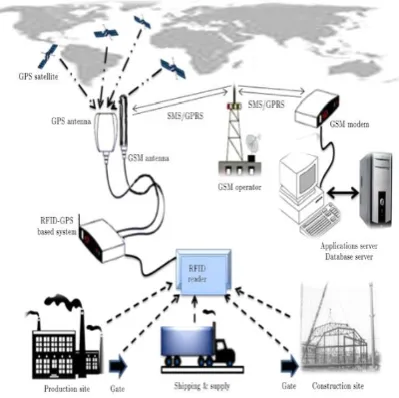
RFID technology will be implemented in the site for the management of resources (3M’s) as shown in figure 2. Necessary management for the resources will be done by the managing authorities. Evaluation of the data collected from the site using RFID. Evaluation of savings in terms of cost and time economics will be done.
Figure 2: Implementation of RFID in construction site
The resource management techniques are much important in the construction since these resources like men, materials and machineries are utilized in more quantities when compared to other resources. It is found that paper based resource management by human is not most accurate and they are error-prone. This will cause risk to many of the construction project. So increase in ICT in construction projects will be used for the effective management of resource when compared to manual method of data collection.
300 | P a g e
instantaneously. The use of RFID technology can provide intangible and comprehensive benefits in communication and labour utilization, and it can also facilitate extremely low-cost, infrastructure-free solutions to form the backbone of a construction resource management system.
Analyzing the feasibility RFID technology for the resource management (men, materials, machineries) in the construction Project. Savings in terms of cost and time economics can also be estimated. Implementing of RFID in construction will increase the effectiveness in resource management by providing most accurate results and human error-free management of resources, minimize the labour quantities and loss of time. RFID can be used for effective management of resources.
Conclusion:
The resource management techniques are much important in the construction since these resources like men, materials and machineries are utilized in more quantities when compared to other resources. It is found that paper based resource management by human is not most accurate and they are error-prone. This will cause risk to many of the construction project. So increase in ICT in construction projects will be used for the effective management of resource when compared to manual method of data collection.
The combination of RFID, GPS, and GSM technologies, as a powerful portable data collection tool, enables the collection, storage, sharing, and reuse of field data accurately, completely, and almost instantaneously. The use of RFID technology can provide intangible and comprehensive benefits in communication and labour utilization, and it can also facilitate extremely low-cost, infrastructure-free solutions to form the backbone of a construction resource management system.
301 | P a g e
References:
[1]. Changyoon Kim, Yeonjong Ju, Hyoungkwan Kim and Jung-Hoon Kim(2009) “Resource Management in
Civil Construction Using RFID Technologies”
[2.] Fadi A. Karaa1 and Anas Y. Nasr “Resource management in construction” Constr. Eng. Manage. 1986.112:346-357.
[3]. Javad Majrouhi Sardroud (22 February 2012) “Influence of RFID technology on automated management of construction materials and components”
[4]. Jeong Hwa Song, Kun Soo Oh Ning Gu(21 December 2012) “Information lifecycle management with RFID for material control on construction sites”.
[5]. Jouni Ikonen, Antti Knutas (april 2013) “Use of embeded RFID tags in concrete element supply chains, journals of information technology in construction.” Journal of Information Technology in Construction - ISSN 1874-4753
[6]. Ju Hyun Lee, Jeong Hwa Song, Kun Soo Oh, Ning Gu (2011) “Information lifecycle management with RFID for material control on construction sites.” Advanced engineering infromatics 108-119
[7]. N. B. Kasim, Peniel Ang Soon Ern(2010) ”The Awareness Of ICT Implementation For Materials Management In Construction Projects”. Int. J. of Computer and Communication Technology, Vol. 2, No. 1, 2010
[8]. Kristian Birch Sørensen, Per Christiansson, Kjeld Svidt , Kim Jacobsen and Thomas Simoni, (2008) ”Radio Frequency Identification in Construction Operation and Maintenance – Contextual Analysis of User Needs.”
[9]. Narimah Kasim, Aryani Ahmad Latiffi, Mohamad Syazli Fathi(2013) “RFID Technology for Materials
Management in Construction Projects”