Challenges of Construction Industries in Developing
Countries: Lessons from Various Countries
Dr.P. Subramanian
1, Eshwaran.K
2, Niresh.B
3, Arjun.S
4, Ajith. T
5Department of Civil Engineering, Sengunthar Engineering College, (India)
Abstract
The construction industry everywhere faces problems and challenges. However, in the developing
countries, these difficulties and challenges are present alongside a general situation of socio-economic stress,
chronic resource shortages, institutional weaknesses and a general inability to deal with the key issues. There is
also evidence that the problems have become greater in extent and severity in recent years.
This paper considers some of the challenges facing the construction industries in developing countries.
The main issues addressed are: construction industry development; globalization; culture; and the environment.
In each case, the issue is analyzed from the perspective of the developing countries, and the main implications
and present challenges highlighted. Lessons are then drawn mainly from the recent experience of other
countries al all levels of development, especially Singapore, to highlight possible ways by which progress can
be made in the developing countries. A research agenda is presented and the important role of researchers in the
drive to improve the performance of the construction industries of the developing countries in the light of their
resource constraints and administrative weaknesses is outlined.
Keywords
: construction industry development; globalization; culture; the environment; research
agenda
INTRODUCTION
Many topical issues which have implications for the construction industry have, so far, only been discussed to a significant extent in the context of the industrialized countries. It is often considered that these matters do not (or not yet) concern the developing countries. This paper addresses some of these issues and analyses them from the perspective of the developing countries. It starts with construction industry development which, ironically, is often seen as a need for only developing countries, although it is also relevant to industrialized countries. It then proceeds to discuss globalization, culture and the environment. In each case, the relevance of the topic is highlighted; and examples of good initiatives and practices in other countries are discussed. In the penultimate section, the further discussion of each of the issues ends with a consideration of issues to be studied further by researchers.
KEY CHALLENGES AND THEIR IMPLICATIONS
Construction industry development
At the first meeting of this Task Group, it was agreed that construction industry development is a
(a) Increased value for money to industry clients as well as environmental responsibility in the delivery process; and
(b) The viability and competitiveness of domestic construction enterprises.
The construction industry, by nature, has many special problems and requirements (see Hillebrandt, 2000 for a discussion of the key features of the industry). The importance of taking measures to improve the performance of the construction industry has now been recognized in several countries at various levels of socio-economic development. Dedicated agencies have been formed in many countries to administer the continuous improvement of the industry, although they have different objectives, responsibilities and levels of authority. In the UK, the Construction Industry Board is an industry initiative, whereas its counterpart institutions in developing countries are government agencies. They include the Construction Industry Development Board of Malaysia, the Institute of Construction Training and Development of Sri Lanka and the National Construction Council of Tanzania (Miles and Neale, 1991). Singapore’s Building and Construction Authority is also a government agency.
The recent formation of construction industry development agencies in the Southern African countries, with a regional initiative to co-ordinate efforts and pool resources where necessary, is encouraging. It is heartening that many of the institutions are industry inspired, or involve the industry’s active participation. Such initiatives potentially have greater sustainability and chances of success because the main stakeholder and beneficiary is directly included in the planning and implementation processes.
Considering the nature of the industry’s needs and problems, and in many developing countries, the resource constraints, formation of an agency does not guarantee the success of construction industry development. An important point worth stressing is that construction industry development is a continuous process. A number of countries at different levels of development have recently formulated long-term plans for improving their construction industries. These include: Australia (Australian Procurement and Construction Council, 1997), Hong Kong, Singapore (Construction 21 Steering Committee) and the UK (Latham, 1994; Egan, 1998). The reviews have been given impetus by both internal and external trends which indicate a challenging future for each of these construction industries. The trends include the needs of an increasingly sophisticated economy, client demands, technological and social change, and globalisation leading to competitive pressures. The initiative in Singapore, which has a successful construction industry development agency (formed in 1984 originally as the Construction Industry and Development Board, which became the Building and Construction Authority in 1999) is a good example of such efforts.
the targets and move the construction industry and workforce towards the intended vision.
The C21 Steering Committee formulated a vision for Singapore’s construction industry for the 21st
century: “To Be a World Class Builder in the Knowledge Age”. Under the vision, C21 proposes to transform Singapore’s construction industry from “the 3Ds” to “the 3Ps”, i.e., from an industry which is “dirty, dangerous and demanding” to one which is “professional, productive and progressive”. The report highlighted the following desired outcomes for the Singapore construction industry:
(i) a professional, productive and progressive industry; (ii) a knowledge workforce;
(iii) superior capabilities through synergistic partnerships; (iv) integrated process for high build ability;
(v) contributor to wealth through cost competitiveness; and (vi) Construction expertise as an export industry.
Under the vision, six strategic thrusts were identified: 1. Enhancing the Professionalism of the Industry 2. Raising the Skills Level
3. Improving Industry Practices and Techniques 4. Adopting an Integrated Approach to Construction 5. Developing an External Wing
6. A Collective Championing Effort for the Construction Industry.
Thirty-nine recommendations are presented in the C21 report, specific targets are set and responsible organizations indicated. The Building and Construction Authority is identified as the “champion agency” and the Construction Industry Joint Council is also assigned some responsibilities. The implementation period is 2000-2010.
Globalization
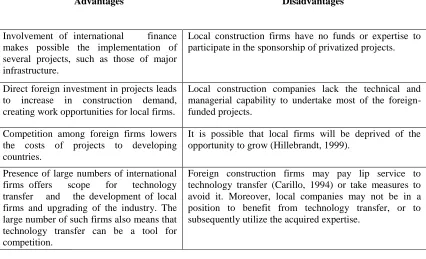
Table 1: Advantages and Disadvantages of Globalization Considering Construction Industries in
Developing Countries
Advantages Disadvantages
Involvement of international finance makes possible the implementation of several projects, such as those of major infrastructure.
Local construction firms have no funds or expertise to participate in the sponsorship of privatized projects.
Direct foreign investment in projects leads to increase in construction demand, creating work opportunities for local firms.
Local construction companies lack the technical and managerial capability to undertake most of the foreign-funded projects.
Competition among foreign firms lowers the costs of projects to developing countries.
It is possible that local firms will be deprived of the opportunity to grow (Hillebrandt, 1999).
Presence of large numbers of international firms offers scope for technology transfer and the development of local firms and upgrading of the industry. The large number of such firms also means that technology transfer can be a tool for competition.
Foreign construction firms may pay lip service to technology transfer (Carillo, 1994) or take measures to avoid it. Moreover, local companies may not be in a position to benefit from technology transfer, or to subsequently utilize the acquired expertise.
The study of international contractors and their role in developing countries is not new. Turin (1973) identified in his matrix of construction industries in developing countries, “international-large” projects which are large and complex, and can only be undertaken by foreign contractors. Edmonds and Miles (1984) and the World Bank (1984) are among authors who have observed that “international” or “foreign” contractors are prominent among large construction firms in developing countries. Turin (1973), Drewer (1980) and other authors advised developing nations to use their construction work to support the growth and development of their indigenous contractors so that they can replace the foreign firms. On the other hand, Moavenzadeh (1978) saw no end to the dominant position of the foreign companies and urged developing countries to use foreign firms on a long-term basis to undertake the large and complex projects.
effectively transfer their technology since they believe that it means they would be nurturing their future competitors. Ofori (1996) noted that both local and foreign firms benefit if systematic efforts are made by the latter to develop the former.
Rashid (1993) draws lessons for developing-country contractors from the international operations of foreign firms. Ofori (1996) and Ofori and Chan (2000) show that both local and foreign contractors in Singapore have benefited from the latter’s operations.
CULTURE
The project procurement and administrative arrangements currently in use in developing countries have been inherited from Western countries which have a different history, culture, collective experience and breadth of construction expertise. These arrangements determine the documentation, procedures and practices in the industry, and specify the roles of the participants and the relationships among them, and hence the networks of power and authority. They stress formality and the following of set channels of communication. Ironically, the countries of origin of these procurement arrangements have changed their approaches. For example, after a comprehensive review of the UK construction industry, Latham (1994) advocated the building of trust and a spirit of partnering in an industry characterized by mistrust, rivalries and adversarialism. Moreover, the “traditional” procurement approach, which is still predominant in the in the Commonwealth countries, is now only one of many possible ones. Furthermore, the influences on the UK construction have come from other industrialized countries, mainly the US. Rwelamila et al (2000) showed that the failure to consider and incorporate cultural traits in the procurement systems of construction project adopted in Southern Africa is a major contributor to the generally poor performance on projects. Studies in other countries might reach similar conclusions.
Culture has become an important area of study in business organizations (see, for example, Hofstede, 1980). It has been found that every organization has a culture which is determined by its history, size, corporate goals and objectives, technology of production, market, and operating environment (Handy, 1985). In construction, where several organizations temporarily interact on each project, cultural issues are constantly to the fore (Barthorpeetal., 1999). The ability to manage cultural issues, especially in multi-cultural situations as are encountered on large construction projects, is a determinant of project and corporate success.
In construction, the studies relating to culture have concerned:
The impact of the nation’s culture on construction activity (Rwelamilaetal, 2000) The culture of the construction project (Rowlinson and Root, 1997)
The culture of the construction firm (Liu and Fellows, 1999) The culture of the construction site (Applebaum, 1991).
THE ENVIRONMENT
The issue of the environment has been topical since the eighties, and has been a major subject of research and international attention since the mid-eighties. There is a belief that countries do, or should, only pay attention to the environment and Endeavour to protect it when they attain a high level of socio-economic development. However, the issue of preserving the environment should be of even greater interest to developing countries since they face severe environment-related problems (UNCHS, 1996). Most of these countries have fragile environments, and are faced with high levels of land degradation (erosion, aridity, desertification, drought, flooding, alkalinisation and Stalinization). Many of them also experience acute shortages of fresh water, a situation which is expected to worsen, and possibly lead to conflict among nations. The developing countries are also losing their forests at a very fast rate. The countries also face rapid urbanization with its associated problems of air pollution and pressure on existing infrastructure such as waste management systems. Another important issue in the context of developing countries is the volume of physical resources which will be required to meet the backlog of infrastructural and building needs which they must fulfill if they are to develop, as well as to raise the standard of living of their peoples. For example, the UNCHS (1996) notes that more than 600 million people in the urban areas of the world are homeless or live in life- and health-threatening situations. Meeting these key requirements of the economies and basic needs of the peoples will put severe pressure on the resources of the countries as well as the globe. These trends underline the critical importance of the sustainable management of resources in developing countries.
The environmental problems of the developing countries exist side-by-side with a lack of the managerial experience, financial resources, and legal and administrative systems necessary to deal with the issue through public and formal education, formulation and enforcement of “command and control” measures (legislation and regulations), as well as the devising and implementation of “economic instruments” (incentives – grants, subsidies – and taxes).
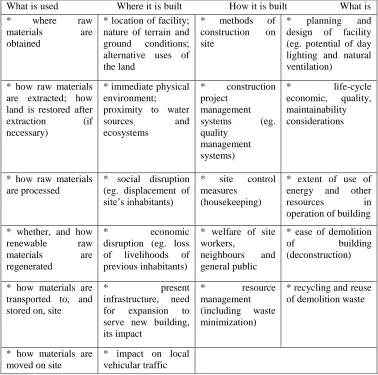
Table 2: Environmental Impact and Considerations of Construction Activity
What is used Where it is built How it is built What is built
* where raw
materials are obtained
* location of facility; nature of terrain and ground conditions; alternative uses of the land
* methods of construction on site
* planning and design of facility (eg. potential of day lighting and natural ventilation)
* how raw materials are extracted; how land is restored after extraction (if necessary)
* immediate physical environment; proximity to water
sources and
ecosystems
* construction project
management systems (eg. quality
management systems)
* life-cycle
economic, quality, maintainability considerations
* how raw materials are processed
* social disruption (eg. displacement of site’s inhabitants)
* site control measures
(housekeeping)
* extent of use of energy and other
resources in
operation of building * whether, and how
renewable raw materials are regenerated
* economic
disruption (eg. loss of livelihoods of previous inhabitants)
* welfare of site workers,
neighbours and general public
* ease of demolition
of building
(deconstruction)
* how materials are transported to, and stored on, site
* present
infrastructure, need for expansion to serve new building, its impact
* resource
management (including waste minimization)
* recycling and reuse of demolition waste
* how materials are moved on site
* impact on local vehicular traffic
Source: Adapted from Ofori (1999)
Many countries, mainly industrialized ones, have taken action to ensure that their construction industries adopt materials, techniques and practices which result in operations and products which have a lower environmental impact. The developing countries can derive useful lessons from these measures. They include the following:
government action – legislation and regulations on environmental performance; requirement for licenses and approvals; subsidies, tax incentives and grants; certification and labeling of products market forces – clients’ insistence on better environmental performance; other construction firms adopting or benefiting from, good environmental practices
institutional initiatives – professional bodies offering advice and support services to members Operational environment – action of pressure groups and informed users.
Discussion
Other authors have proposed topics for further studies in this area. For example, after reviewing the state of the art of research in construction industry development, Ofori (1993) proposed that there should be “appropriate research” which should seek to recognize the circumstances of the developing countries, and to adapt and use the available analytical techniques to help solve the difficulties facing their construction industries” (p. 182). The topics for research suggested included: conceptualization of the construction industry and development of a common framework for its analysis; development of conceptual models of stages through which a construction industry passes as it progresses to maturity; how construction can help nations out of long-term economic problems and how the industry can be improved in such circumstances; appropriate construction materials and techniques; design of educational programmes for producing essential technical personnel. It was also suggested that such research works be co-ordinated and their results better disseminated.
Construction industry development
The economies of many developing countries are currently confronted by severe difficulties owing to a combination of lower commodity prices, higher energy costs, falling exchange rates and rising inflation. At the same time, the countries face immense social problems (including a rising urban population and unemployment) which are putting pressure on the nation’s resources and capabilities. The construction industry in a typical developing country is facing reduced levels of demand as a result of adjustment programmes which invariably involve cuts in governments’ capital investment. The challenge, as Ofori (1993) suggests, is that the construction industry should do well despite the severe constraints in its operating environment. Moreover, the construction industry must help the national economies to recover, and also contribute to the easing of the social problems.
Ways must be found to take advantage of the special features of construction which offer unique opportunities. First, the construction industry should effectively play its role in the economy by realising its potential to create jobs in all parts of the country as well as stimulating business activities in other sectors of the economy. New strategies are necessary to make this possible. Second, construction activities should lay the infrastructure for development. With public funds under severe strain and chronically short, ways must be found to structure funding strategies which are suitable for the developing countries. Investment approaches which broaden the base of ownership among the population and give the immediate community a stake in major development projects could be formulated
formulating and implementing its plans. Finally, the agency should be continuously relevant. This implies that its plans, policies, initiatives, procedures and communication channels should be continually reviewed and fine-tuned or radically restructured where necessary.
Corporate development is of crucial importance. Construction industries need companies which take a long-term view, and are prepared to invest in human resource, equipment and research and development in order to improve their performance. However, the construction enterprises in developing countries are known for their lack of knowledge, short-term orientation and lack of focus on construction (Ofori, 1991). They are also unable to employ qualified personnel, and/or unwilling to appoint them to positions of responsibility. Management development should be a key concern in the construction firms of the developing countries.
Globalization
There is a perception that globalization is a one-way flow of exports from the industrialized countries to developing ones. However, two points should be made. First, the firms from industrialized countries are also active in each other’s markets, i.e., the “international construction market” does not only lie within the developing countries. Second, it must be remembered that in globalization, some of the exporting construction enterprises are from developing countries. A study of the top 30 international construction firms during 1990-1999 revealed that 58 contractors were listed at least once among the top 30 Engineering News Record (ENR) contractors during the period (ENR, 1990 to 1999). US contractors had the highest number listed: (14, or 24%) followed by Japan (9, or 16%), France (8, or 14%) UK (6, or 10%) and Germany (5, or 9%). Thirteen of the contractors were from Asian countries (Japan, Korea and China), while the others were all from Europe and America.
A study of the performance of construction firms from Asia on the world market during 1990-99 revealed many significant players (ENR, 1990 to 1999). Four Singapore contractors were listed among the top 225 ENR contractors in 1990-99. The highest ranking was 93, in 1993. However, none of the Singapore contractors was able to remain on the ENR list throughout the 10 years. Only one Malaysian firm was listed for three years, attaining its highest ranking of 180th in 1994. Four Taiwanese contractors were listed at least once among the top 225 international contractors, with the highest ranking being 97 in 1990, by a contractor which was on the ENR list throughout the ten-year period. One Hong Kong contractor was listed on the list continuously after 1995, and its ranking rose steadily from 183 to 63 in 1999. Some 19 Korean contractors were listed at least once in the ENR top 225 during 1990-1999. The highest ranking was 12th by Hyundai Engineering & Construction Co. in 1998. As many as 35 Chinese contractors were listed at least once in the ENR top 225 through 1990-1999. The highest ranking was 24, by China State Construction and Engineering Corporation in 1999. Three contractors have remained on the list steadily throughout the 10 years. Two Philippine contractors were listed at least once in the ENR top 225 firms with the highest ranking of 139th, in 1993. Finally, 3 Indian contractors were listed at least once in the ENR top 225 firms, with the highest ranked at 147th, in 1995. One firm was listed for 7 years.
study. First, the costs and benefits to national construction industries should be studied. These may differ from those for the national economy. Second, work is required on how the benefits of globalization can be maximized and the adverse effects minimized for the benefit of both the developing-country firms and their foreign counterparts. Third, actions which the industry itself can take also requires to be studied. The final issue needing further investigation is intra-industry diffusion of technologies and knowledge. The subject here would be how the larger local contractors can use the relevant know-how acquired from their foreign counterparts or other sources, to lead the industry to upgrade.
Several authors predict that construction firms from developing countries will play an increasingly greater role in the global market in future (see, for example, Hassan et al., 1998). The way in which these companies can actively help to upgrade their national construction industries should also be studied. Another issue is the possibility of cross-border strategic alliances among construction firms from developing countries, which will enable them to collaborate in modern construction business and technology development. For example, Ofori (2000) notes that China has several international contractors but foreign firms are active on its sophisticated-project market. India has large numbers of skilled personnel, and foreign enterprises have set up skills-intensive operations such as design and information-technology offices. However, few Indian construction firms are successful overseas. Strategic collaboration among companies from these nations for projects within their own countries and beyond would be beneficial.
Culture
The subject of culture has rightly come to the fore in construction research. So far, the work has focused on industrialized countries. It is necessary to reconsider the arrangements and procedures of the construction industries of developing countries, especially since the countries from which they are borrowed have already taken measures to review or replace them. Effort is required to reflect the cultural attributes and values of individual developing countries in their construction practices and procedures. The existing ones are not only currently obsolete, but they are also inappropriate.
Studies on the culture of construction and construction-related firms, projects and workers in the developing countries would, among other things:
help managers to understand how to communicate with, and motivate, their workers
enable clients to appreciate how to offer incentives to, and steer construction firms to innovate offer insights into the most effective way to transfer technology to local construction firms help project managers to integrate the contributions of the project participants most effectively The environment
construction client would be paramount. Construction companies and practitioners should be encouraged to continuously search for inputs and ways of working which will minimize the negative impact of construction activity on the environment. Detailed case studies of good practice would also be useful. The possibility of preparing good-practice manuals suitable for use in various contexts could be explored.
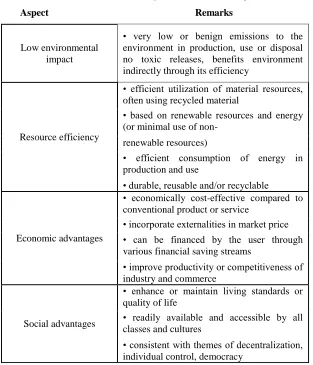
Table 3 presents a useful framework for analyzing the technologies, materials, and so on, which can be used to evaluate inputs in the construction industries of developing countries. These countries’ local materials tend to be less energy-intensive, and some also possess some positive environmental features. Table 4 shows the environmental policies and practices of the first construction contractor in Singapore to attain certification to the ISO 14001 environmental management system. The company is a successful design-and-build contractor which is one of the most innovative firms in Singapore, having won awards for excellence as an enterprise. The table shows several initiatives which indicate the potential commercial merits of environmentally-responsible corporate behaviour, in addition to its long-term benefits of conserving and protecting the environment.
Table 3: Characteristics of sustainable technologies
Aspect Remarks
Low environmental impact
• very low or benign emissions to the environment in production, use or disposal no toxic releases, benefits environment indirectly through its efficiency
Resource efficiency
• efficient utilization of material resources, often using recycled material
• based on renewable resources and energy (or minimal use of non-
renewable resources)
• efficient consumption of energy in production and use
• durable, reusable and/or recyclable
Economic advantages
• economically cost-effective compared to conventional product or service
• incorporate externalities in market price • can be financed by the user through various financial saving streams
• improve productivity or competitiveness of industry and commerce
Social advantages
• enhance or maintain living standards or quality of life
• readily available and accessible by all classes and cultures
• consistent with themes of decentralization, individual control, democracy
New techniques
As discussed above, the C21 initiative in Singapore was part of a series of major reviews of national construction industries which have been undertaken in a number of developed countries in recent years. These studies have been completed under the broad theme of performance improvement, benchmarking; identification, adaptation and application of best practices. Also prominent among the influencing factors are developments in techniques and tools from other sectors, such as manufacturing. These developments are also relevant to the construction industries of developing countries. These industries would benefit from the application of techniques such as quality, waste and safety management; just-in-time; client focus; supply chain management; and above all, and linking all these, the strategic application of information technology. In short, the construction enterprises and practitioners in developing countries should be encouraged and assisted to become
excellent.
CONCLUSION
REFERENCES
[1] Abbott, P G (1985) Technology Transfer in the Construction Industry. The Economist Intelligence Unit, London.
[2] Applebaum, H A (1981) Royal blue: The culture of construction workers. In Spindler, G. and Spindler, L (Eds.), Case Studies in Cultural Anthropology, Stanford University, Holt, Rinehart and Winston International.
[3] Australian Procurement and Construction Council (1997) Construct Australia. Canberra.
[4] Barthorpe, S, Duncan, R and Miller, C (1999) A literature review on studies in culture: A pluralistic concept. In Ogunlana, S.O. (Ed.) Profitable Partnering in Construction Procurement. Spon, London, pp. 533-542.
[5] Carillo, P. (1994) Technology transfer: A survey of international construction companies. Construction
Management and Economics, 12, 45-51.
[6] CIB (1999) Managing Construction Industry Development in Developing Countries: Report on the
First Meeting of the CIB Task Group 29. Arusha, Tanzania, 21-23 September. Rotterdam.
[7] Cockburn, C (1970) Construction in Overseas Development: A search for appropriate aid and trade measures for the 1970's. Overseas Development Institute, London.
[8] Construction 21 Steering Committee (1999) Re-Inventing Construction. Ministry of Manpower and Ministry of National Development, Singapore.
[9] Drewer, S. (1980) Construction and development: A new perspective. Habitat International, Vol. 5, 3/4, pp. 395-428.
[10] Egan, J (1998) Rethinking Construction. Department of the Environment, Transport and the Regions, http://www.construction.detr.gov.uk.
[11] Hill, R C and Bowen, P (1997) Sustainable construction: Principles and a framework for attainment.
Construction Management and Economics, 15, 223-239.
[12] Hassan, T, Mitrovic, D, Gayoso, A and Hunter, I (1998) The Future LSE Industry, Work Package 2 of Report on the ELSEWISE Project. European Construction Institute, Lough borough.
[13] Hillebrandt, P M (1999) Problems of larger local contractors: Causes and possible remedies. Paper presented at Second Meeting of CIB TG29, Kampala, Uganda, 25-26 June.
[14] Hillebrandt, P M (2000) Economic Theory and the Construction Industry. Macmillan, London.
[15] Hofstede, G (1980) Culture’s Consequences: International differences in work related values. Sage, Beverly Hills.