Research Design, Organization, and Sample Characteristics of the
Maternal PKU Collaborative Study
Richard Koch, MD*; Colleen Azen, MS*; Eva Friedman, MS*; William Hanley, MD‡; Harvey Levy, MD§; Reuben Matalon, MD, PhD储; Bobbye Rouse, MD储; Friedrich Trefz, MD¶; Jiaping Ning, MS*; and
Felix de la Cruz, MD, MPH#
ABSTRACT. Objective. The Maternal PKU Collabora-tive Study (MPKUCS) was initiated in 1984 by the National Institute of Child Health and Human Development (NICHD). The purpose was to assess the efficacy of dietary restriction of phenylalanine in reducing morbidity in off-spring of women with hyperphenylalaninemia (HPA). A contract was awarded to Childrens Hospital Los Angeles as the Coordinating Center to provide implementation of the research protocol, data collection, and analysis.
Methods. The Study included four regional contrib-uting centers: Childrens Hospital Los Angeles (Western Region), Boston Children’s Hospital (Northeast Region), University of Illinois (Midwest Region), and University of Texas Medical Branch, Galveston (Southeast Region). Within each region, many participating clinics were re-sponsible for obstetric care, treatment, and monitoring protocols. In 1985, Canada joined the MPKUCS, and in 1992, Germany entered. They were selected because they provided dietary supplies and strong professional ser-vices. Acquisition began in 1984 and ended in October 1995. The study included 574 pregnancies in women with HPA and 100 control subjects matched on age, race, par-ity, and weeks of gestation. The sample included women with blood phenylalanine values>240 mol/L, 66% of whom had classical PKU, 22% had atypical PKU, and 12% had mild HPA. Informed consents were obtained on all participants. The women ranged in age from 15 to 36 years of age, with a mean age at conception of 23 years. Teenage pregnancies accounted for 19%. Seventy-five percent graduated from high school. Offspring included 416 newborns, 317 of whom were evaluated at 4 years of age and 289 at 6 to 7 years. Follow-up involved medical, nutritional, psychosocial, and psychological assessments.
Conclusion. Women with PKU treated before concep-tion and in control of their blood phenylalanine levels between 120 and 360mol/L (2– 6 mg) exhibited normal pregnancies and neonatal outcome. Surprisingly, women who achieved control in the recommended range by 8 weeks of pregnancy also had a normal fetal outcome.
Pediatrics2003;112:1519 –1522;Maternal PKU
Collabora-tive Study, phenylalanine, phenylalanine-restricted diet, hyperphenylalaninemic.
ABBREVIATIONS. PKU, phenylketonuria; NIH, National Insti-tutes of Health; NICHD, National Institute of Child Health and Development; Phe, phenylalanine; HPA, hyperphenylalaninemia; MPKUCS, Maternal PKU Collaborative Study; WISC-R, Wechsler Intelligence Scale for Children–Revised.
T
his study had its beginning in 1980 when Lenke and Levy published their epic article concerning the poor outcome of⬎500 pregnan-cies of women with untreated phenylketonuria (PKU). As a result of that publication, Eva Friedman, Malcolm Williamson, and Richard Koch prepared an application to the National Institutes of Health (NIH) to fund a study of pregnancy outcome in women with treated PKU. The application was not ap-proved. The primary critique was that the study was too large and that a smaller pilot study should be done in preparation for a subsequent larger study. Therefore, in 1982, we submitted a smaller proposal, which also was rejected. Early in 1983, because the National Institute of Child Health and Development (NICHD) had funded a previous collaborative study of children who were treated for PKU, I expressed my frustration to Ted Tjossem, PhD, whom I had known for a number of years and was then the chief of the Mental Retardation and Developmental Dis-ability Branch of NICHD. Shortly thereafter, I re-ceived a call from Dr Felix de la Cruz. He stated that NICHD was considering what research questions were important to solve for maternal PKU and how a study should be organized if they were to respond to the need for more research on the topic. Subse-quently, NICHD offered a request for proposals to develop a coordinating center for data collection and 4 regional centers to locate and enroll potential women who had PKU and were already pregnant or were planning a pregnancy. The initial research questions were as follows:1. Does the phenylalanine (Phe)-restricted diet re-duce the frequency of mental retardation, sponta-neous abortion, low birth weight, congenital malformation, and neurologic and behavioral im-pairment reported in pregnancies of mothers who had hyperphenylalaninemia (HPA) and were on unrestricted Phe intake during pregnancy? From the *Childrens Hospital Los Angeles, Division of Medical Genetics,
Department of Pediatrics, Keck School of Medicine, University of Southern California, Los Angeles, California; ‡Clinical and Biochemical Genetics, Hospital for Sick Children, Toronto, Ontario, Canada; §Children’s Hospital Boston, Boston, Massachusetts;㛳University of Texas Medical Branch, De-partment of Pediatrics/Genetics, Galveston, Texas; ¶Childrens Hospital Reutlingen, Universita¨t of Tubingen, Reutlingen, Germany; #National In-stitute of Child Health and Human Development, Bethesda, Maryland. Reprint requests to (R.K.) Maternal PKU Collaborative Study, Childrens Hospital Los Angeles, PKU Program #73, 4650 Sunset Blvd, Los Angeles, CA 90027. E-mail: [email protected]
2. Is pregnancy outcome in women who have HPA and restricted Phe intake during pregnancy com-parable to that of women without HPA?
3. Is pregnancy outcome in women with HPA re-lated to maternal Phe levels during pregnancy? 4. Is gestational age at the onset of intervention
pre-dictive of fetal outcome?
5. Are there beneficial effects of starting the diet before conception?
6. What are the levels of tyrosine and trace metals during pregnancy, and what are the effects on pregnancy outcome of supplementation if levels are found to be reduced?
Subsequently, an NICHD contract was awarded, which called for a 7-year study period, during which 200 mother–infant pairs were to be studied. de la Cruz was designated as the NIH Project Officer, and Harvey Shifrin was the NIH Contracting Officer. Their primary role was to guide the project develop-ment for NICHD. A Coordinating Center and a Western Contributing Center were located at Child-rens Hospital Los Angeles. Three other contributing centers were located at Boston Children’s Hospital, the University of Illinois at Chicago, and the Univer-sity of Texas Medical Branch in Galveston. Each Con-tributing center was to relate to a specific geograph-ical region of the United States.
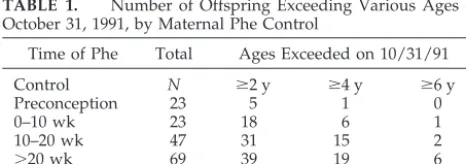
It had been anticipated that the goal of studying 200 pregnancies would be easily met during the ini-tial 7-year period of the research project, but locating and enrolling pregnant women with PKU proved to be more difficult than we had anticipated. There were 2 major reasons for this. The most important one was related to the clinical impression that fetal outcome was so poor that pregnancy was actively discouraged in these women, and some of them had already been sterilized and advised to adopt chil-dren. The second reason related to the intelligence of the women who were born before newborn screen-ing, diagnosed late, and thus were mentally limited. Newborn screening for PKU began early in 1963 in a few states such as Massachusetts, but other states lagged behind and did not start until 1970. Thus, the identification of women with normal intelligence did not become available for study until the mid-1980s. Canada was invited to join the study in 1985. The number of offspring born to enrolled PKU women as of October 1991 was 185, only 23 of whom women were in control before pregnancy (Table 1). Further-more the mean IQ of this initial cohort was only 83⫾ 12.
In 1992, the NICHD planned a site visit with a group of outstanding individuals, who reviewed the project carefully and recommended a 4-year exten-sion. Two members of the site review team became part of the Steering Committee, whose meetings were held biannually. For improving the number of pregnancies treated before conception, Germany was invited to join the study in 1992. Subsequently, Can-ada enrolled 47 pregnancies, and Germany enrolled 48. These pregnancies had higher percentages on diet before conception (43% and 62%, respectively) than those enrolled in the United States (24%).
The Site Committee added 2 new research ques-tions to the original 6 quesques-tions:
7. Does maternal genotype, as determined by DNA mutational analysis, correlate with offspring phe-notype?
8. Does detailed long-term neuropsychological eval-uation of offspring correlate with efficacy of ma-ternal dietary treatment?
For answering research question 7, Flemming Gu¨t-tler of Denmark was contracted to perform mutation studies on the phenylalanine hydroxylase gene on the mothers and offspring in the Maternal PKU Col-laborative Study (MPKUCS). For addressing re-search question 8, an extensive offspring follow-up battery of psychological tests was introduced and the follow-up period was extended to age 8 and beyond.1
For improving the quantity and quality of the psy-chological data, a network of local psychologists was developed by Susan Waisbren, to assist in testing, as needed, and a procedure for double scoring all tests in Boston was implemented. The additional 4 years of sample acquisition greatly increased the total number of offspring, as well as the number old enough for psychological testing beyond the Bayley at 2 years of age.
Although the sample of maternal PKU/HPA preg-nancies increased the numbers in key study groups who were old enough for psychological testing, the sample was still too small to provide adequate sta-tistical power for meaningful hypothesis testing in-volving endpoints beyond birth. Psychological data collection rates improved to ⬎80%, when enough time was allowed to arrange for testing and data acquisition in the 75% of children who were followed by the participating clinics, rather than at 1 of the 6 contributing centers. Evaluation of psychological data continued to show a strong relationship to ma-ternal Phe levels during pregnancy, even after con-trolling for environmental variables, and that off-spring of women who established control between 10 and 20 weeks were scoring higher than expected on developmental tests, although the number was still small.
A second extension of the contract was awarded in 1996 to allow all study offspring to reach 4 years of age and undergo intelligence testing with the Mc-Carthy Scales of Children’s Abilities2(see Waisbren
and Azen1 in this supplement for details). The
re-search questions were extended to focus on those
TABLE 1. Number of Offspring Exceeding Various Ages on October 31, 1991, by Maternal Phe Control
Time of Phe Total Ages Exceeded on 10/31/91
Control N ⱖ2 y ⱖ4 y ⱖ6 y
Preconception 23 5 1 0
0–10 wk 23 18 6 1
10–20 wk 47 31 15 2
⬎20 wk 69 39 19 6
Untreated MHP 21 14 3 0
Total 185 107 44 9
aspects of the original and revised questions that still could not be answered with certainty. Additional research questions included the following:
9. Are offspring of treated PKU/HPA women with Phe levels 120 to 360mol/L from early in preg-nancy different from those of women with Phe between 360 and 600 mol/L on variables as-sessing medical status, physical growth, and psy-chological development at 4 and 6 years of age? 10. Are offspring of treated PKU/HPA women with Phe levels 120 to 360 mol/L different from those with levels 120 to 600 mol/L? If there is no difference in these 2 groups, then are there differences in those who started dietary treat-ment before conception from those who estab-lished the same degree of control by 10 weeks’ gestation on outcome variables assessing medi-cal status, physimedi-cal growth, and psychologimedi-cal development at 4 and 6 years of age?
11. Are offspring of treated PKU/HPA women with “optimal” Phe control, by degree of timing, dif-ferent from control offspring on variables assess-ing medical status, physical growth, and psycho-social development at 4 and 6 years of age? 12. What is the developmental outlook for offspring
of women who established control between 10 and 20 weeks’ gestation?
13. Are offspring of treated PKU/HPA women with “optimal” Phe control, by degree and timing, different from those of untreated mild HPA with Phe in the same range on an unrestricted diet, on outcome variables assessing medical status, physical growth, and psychological develop-ment at 4 and 6 years of age?
SUBJECTS
The MPKUCS attempted to enroll and follow all pregnancies that occurred in women with HPA dur-ing the recruitment period. Eligibility criteria in-cluded having an off-diet blood Phe level of 240 mol/L or higher, living in the community, and having sufficient intellectual capacity to follow treat-ment recommendations and sign an informed con-sent. A control sample of pregnancies in normal women matched as closely as possible to the HPA sample of age, race, parity, and weeks’ gestation at enrollment was also enrolled and followed prospec-tively.
TREATMENT
The treatment plan consisted of 4 components:
1. Provision of adequate nutrition during preg-nancy.
2. Offering dietary restriction of Phe to women with HPA with blood Phe concentrations ⱖ600 mol/L.
3. Maintaining blood Phe levels between 120 and 600 mol/L (later reduced to 120 –360 mol/L) and obtaining phenylalanine hydroxylase mutation data on mother and child.
4. Supplementation with tyrosine and trace elements as indicated.
Ideally, pregnancies would be planned and dietary therapy would be initiated before conception. Ade-quacy of and compliance with the treatment plan were monitored by obtaining weekly blood Phe lev-els and monthly 3-day diet records, plasma amino acids, trace metals, and other laboratory assessments.
DATA COLLECTION
Data collected on the mothers at enrollment in-cluded details of her PKU diagnosis and treatment history, family pedigree, socioeconomic informa-tion (Hollingshead Scale) and intellectual status (Wechsler Adult Intelligence Scale–Revised), preg-nancy history, and a baseline medical and obstetric evaluation. Data collected during pregnancy, in ad-dition to blood Phe, dietary, and laboratory informa-tion, included monthly obstetric evaluation (weight, blood pressure, complications) and ultrasound at 8, 20, and 28 to 34 weeks.
The research questions were to be evaluated using a variety of outcome variables, measured during pregnancy, at birth and during early childhood. Spe-cifically, offspring outcome was assessed at birth (gestational age, birth length, weight, and head cir-cumference; and overall assessment by a neonatolo-gist; and echocardiogram if indicated); at 6, 12, and 24 months with the Bayley Scales of Infant Develop-ment; at 3, 4, to 5 years with the McCarthy; and at 6 to 7 years with the WISC-R, and additional evalua-tions of behavior, perception (Vineland, PPVT, etc). Annual medical and physical assessments, including measurements of height, weight, and head circum-ference, and a dysmorphology evaluation during the first year of life were also specified.
STUDY EXTENSION AND MODIFICATIONS TO THE RESEARCH DESIGN
In April 1992, a 4-year extension of the contract was awarded, with certain modifications recom-mended by a site visit committee, to address the problems encountered in the first 7-year phase of the MPKUCS. The 2 research questions added to the original 6 were designed to assess the relationship of maternal genotype to offspring phenotype and to provide a more extensive developmental profile of the offspring.
although the sample size was inadequate do draw firm conclusions.
A second extension to the contract was awarded in 1996 to allow all study offspring to reach 4 years of age and a maximum number to undergo IQ testing with the WISC-R at age 6. For this phase, the research questions were reworded to focus on those aspects of the original and revised questions that still could not be answered with certainty: is there a “safe” level of maternal Phe during pregnancy, and, if so, is it nec-essary to establish this level of control before concep-tion? What happens when control is not achieved until later in pregnancy? Do women with mild HPA need to be treated?
When data collection ended on October 31, 2001, all but 12 offspring were old enough for a WISC-R IQ evaluation. During the course of the study, 9 off-spring died, 6 from congenital heart disease. Another 7 withdrew when their families refused further par-ticipation. The overall data collection rate for key offspring follow-up variables approached 80%, a re-markable achievement, considering the duration of the project and the organizational complexity of the study.
As a result of the contract extensions provided, we have been able to collect psychological data on 6- to 7-year-old offspring of women with PKU. In the future, women with PKU can thank Drs Duane Al-exander and Felix de la Cruz for their foresight in
discerning the need for factual information that will guide health professionals and women with PKU in making informed decisions about pregnancy.
The sample consisted of 95% white, 2% black, 2% Native American, and 1% Asian-Pacific Islander. Ed-ucational attainment of the sample revealed that 43% graduated from high school and another 32% at-tended college. The group that did not graduate from high school primarily had mental disabilities. Social class revealed that 74% were represented by the 2 lowest classes and only 8% were in the highest classes, whereas the middle class represented 15%.
By the end of the study, significant changes in the enrolled population had occurred. In the beginning, there were few pregnancies in women who were treated before conception and were in control with blood Phe levels of 120 to 360mol/L, but during the last years, more were in this category. In addi-tion, the mean IQ of the mothers enrolled in the study had also risen to 88⫾14.
ACKNOWLEDGMENTS
This study was supported by National Institutes of Health contract no. N01-HD-2-3148 from the National Institute of Child Health and Human Development, Bethesda, MD.
REFERENCES
1. Waisbren SE, Azen C. Cognitive and behavioral development in ma-ternal phenylketonuria offspring.Pediatrics.2003;112:1544 –1547 2. McCarthy D.Manual for the McCarthy Scales of Children’s Abilities.New
York, NY: The Psychological Corporation; 1972
2003;112;1519
Pediatrics
Matalon, Bobbye Rouse, Friedrich Trefz, Jiaping Ning and Felix de la Cruz
Richard Koch, Colleen Azen, Eva Friedman, William Hanley, Harvey Levy, Reuben
PKU Collaborative Study
Research Design, Organization, and Sample Characteristics of the Maternal
Services
Updated Information &
http://pediatrics.aappublications.org/content/112/Supplement_4/1519 including high resolution figures, can be found at:
References
#BIBL
http://pediatrics.aappublications.org/content/112/Supplement_4/1519 This article cites 1 articles, 0 of which you can access for free at:
Subspecialty Collections
http://www.aappublications.org/cgi/collection/genetics_sub Genetics
following collection(s):
This article, along with others on similar topics, appears in the
Permissions & Licensing
http://www.aappublications.org/site/misc/Permissions.xhtml in its entirety can be found online at:
Information about reproducing this article in parts (figures, tables) or
Reprints
2003;112;1519
Pediatrics
Matalon, Bobbye Rouse, Friedrich Trefz, Jiaping Ning and Felix de la Cruz
Richard Koch, Colleen Azen, Eva Friedman, William Hanley, Harvey Levy, Reuben
PKU Collaborative Study
Research Design, Organization, and Sample Characteristics of the Maternal
http://pediatrics.aappublications.org/content/112/Supplement_4/1519
located on the World Wide Web at:
The online version of this article, along with updated information and services, is
by the American Academy of Pediatrics. All rights reserved. Print ISSN: 1073-0397.
the American Academy of Pediatrics, 345 Park Avenue, Itasca, Illinois, 60143. Copyright © 2003 has been published continuously since 1948. Pediatrics is owned, published, and trademarked by Pediatrics is the official journal of the American Academy of Pediatrics. A monthly publication, it
at Viet Nam:AAP Sponsored on August 30, 2020
www.aappublications.org/news