Comparison of Continuous Subcutaneous Insulin Infusion and Multiple
Daily Injection Regimens in Children With Type 1 Diabetes:
A Randomized Open Crossover Trial
Naomi Weintrob, MD‡; Hadassa Benzaquen, CDE*; Avinoam Galatzer, MA*; Shlomit Shalitin, MD‡; Liora Lazar, MD‡; Gila Fayman, BSc, RD*; Pearl Lilos, BSc*; Zvi Dickerman, MD‡; and
Moshe Phillip, MD‡
ABSTRACT. Objective. To compare the efficacy and feasibility of continuous subcutaneous insulin infusion (CSII) with multiple daily insulin injections (MDI) in children with type 1 diabetes.
Methods. The study sample included 23 children (10 males) aged 9.4 to 13.9 years with type 1 diabetes. An open randomized crossover design was used to compare 3.5 months of CSII to 3.5 months of MDI therapy for the following variables: diabetic control, incidence of ad-verse events, daily insulin requirement, body mass index standard deviation scores, treatment satisfaction, and quality of life.
Results. The changes in HbA1c and fructoseamine
values were similar in the 2 arms over time. At the end of the study, mean HbA1c level measured 8.05 ⴞ 0.78%.
There were no differences between the treatment modes in frequency of symptomatic hypoglycemic or hypergly-cemic events. There was 1 event of severe hypoglycemia during pump therapy and 3 during MDI, yielding a rate of 0.26 events per patient-year. There were no episodes of diabetic ketoacidosis. Body mass index standard devia-tion scores decreased during CSII and increased during MDI, as did mean insulin dose. Patients expressed a higher treatment satisfaction from CSII than MDI, al-though there was no difference in quality of life between the 2 modes.
Conclusions. Intensive insulin therapy by either in-sulin pump or MDI is safe in children and young ado-lescents with type 1 diabetes, with similar diabetes con-trol and a very low rate of adverse events. We suggest that both modes be available to the diabetic team to better tailor therapy.Pediatrics 2003;112:559 –564; pump, continuous subcutaneous insulin infusion, multiple daily insulin injections, type 1 diabetes, intensive therapy, chil-dren.
ABBREVIATIONS. DCCT, Diabetes Control and Complication Trial; CSII, continuous subcutaneous insulin infusion; MDI, mul-tiple daily insulin injection; SBGM, self-blood glucose monitoring; NPH, neutral protamine hagedorn; DKA, diabetic ketoacidosis; BMI, body mass index; SDS, standard deviation score; DTSQ,
Diabetes Treatment Satisfaction Questionnaire; DQOLY, Diabetes Quality of Life Questionnaire for Youth.
T
he Diabetes Control and Complication Trial (DCCT)1 demonstrated that in patients withtype 1 diabetes, tight metabolic control achieved with intensive insulin therapy is superior to conventional treatment in reducing the risk of long-term microvascular complications. Evidence is accu-mulating that the prepubertal and pubertal years have an impact on microvascular complications in diabetes.2,3Therefore, tight metabolic control may be
an important determinant during these years. How-ever, young patients, especially adolescents, may find it difficult to comply with regular insulin injec-tions, frequent blood glucose monitoring, and regu-lar meals.4Indeed, the adolescent group in the DCCT
had higher HbA1c levels than the adults, and a higher rate of severe hypoglycemic events.5Episodes
of severe hypoglycemia carry a low risk of mortality, neurologic morbidity, and permanent cognitive dys-function; they also exaggerate the fear of hypoglyce-mia with a consequent deterioration in metabolic control.6At the same time, strict metabolic control is
itself associated with an increased risk of severe hy-poglycemic episodes1,5 and significant weight
gain1,5,7— both limitations with particular
signifi-cance in children and adolescents who tend to have erratic eating behaviors5,8 and worry about their
body image.9Therefore, there is a clear need for an
intensive insulin regimen that will appeal to these age groups and enable strict metabolic control with-out the increased risk of severe hypoglycemic events. Several studies have suggested that intensive ther-apy with continuous subcutaneous insulin infusion (CSII) could provide better glycemic control,7,10 –12
with a lower risk of severe hypoglycemia and a lesser weight gain7 than multiple daily insulin injections
(MDIs). However, only a few of these studies were randomized,11,12 and most were done in adults. The
present study was prompted by the scarcity of ran-domized crossover studies comparing the 2 modes of therapy in children with type 1 diabetes. We evalu-ated CSII and MDI for glycemic control, incidence of hypoglycemia and hyperglycemia, dose require-ments, weight gain, quality of life, and satisfaction.
From the *Institute for Endocrinology and Diabetes, National Center of Childhood Diabetes, Schneider Children’s Medical Center of Israel, Petah Tikva, Israel; and ‡Sackler School of Medicine, Tel Aviv University, Tel Aviv, Israel.
Received for publication Aug 2, 2002; accepted Dec 4, 2002.
Address correspondence to Naomi Weintrob, MD, Institute for Endocrinol-ogy and Diabetes, Schneider Children’s Medical Center of Israel, 14 Kaplan St, Petah Tikva 49202, Israel. E-mail: [email protected]
METHODS
The study protocol was approved by the Ethics Committee of Rabin Medical Center, and all the patients and their parents gave written informed consent.
Patients
All patients were followed at the National Institute for Child-hood Diabetes of Schneider Children’s Medical Center of Israel, which serves 1200 children and youth with type 1 diabetes. Inclu-sion criteria were as follows: type 1 diabetes treated by insulin for at least 2 years; aged 8 to 14 years; deficient C-peptide secretion (fasting level⬍200 pmol/L); and ability to cope, together with the parents, with the treatment procedures, as judged by the diabetic team. Participation in the study was offered on a consecutive basis; of the 258 patients aged 9 to 14 years in our institute who were eligible for the study, the first 24 who expressed a desire to be included were enrolled. One girl was excluded because of endogenous insulin secretions (fasting C-peptide 370 pmol/L). The mean duration of diabetes in the study group was 2.8 to 11.9 years (median 5.5), and mean prestudy HbA1c, 8.9⫾ 1.0%. At
enrollment, all the children were being treated with multiple (ⱖ3) daily injections of either Insulatard and Actrapid (NovoNordisk, Bagsvaerd, Denmark) or Humulin N and Humulin R (Eli Lilli, Indianapolis, IN). They performed self-blood glucose monitoring (SBGM) 1 to 4 times per day using home glucose meters, and visited the clinic every 2 to 3 months. None of the patients had used CSII before the study. None had clinical evidence of micro-vascular complications, hypoglycemia unawareness, concomitant disorders, mental retardation, or a psychiatric disorder, and none had participated in another study in the past 3 months.
Study Design and Protocol
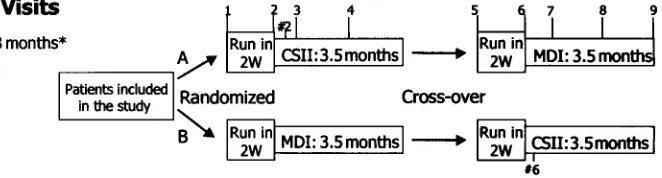
A randomized crossover design was used. The MDI protocol consisted of combined neutral protamine hagedorn (NPH) and regular insulin before breakfast, regular insulin before lunch and supper, and NPH at bedtime; CSII was delivered with a program-mable external pump (MiniMed 508; MiniMed, Sylmar, CA) using lispro (Humalog; Eli Lilli). The regular insulin was given 20 to 30 minutes before meals, and the lispro, immediately before meals. The 23 children were randomly assigned to start with either CSII (group A) or MDI with their prestudy insulin (group B) for 3.5 months, after which they were switched to the other mode of therapy for another 3.5 months, with a 2-week washout period (Fig 1).
Three months before onset of the study, an educational session was conducted with the children and their families to motivate them to practice strict SBGM and insulin dose adjustment to prevent diabetic ketoacidosis (DKA) during pump therapy. The patients were taught carbohydrate counting and insulin bolus dosing based on the insulto-carbohydrate ratio, using 1 U in-sulin per 10 to 20 g carbohydrate. According to the post-meal SBGM and food diary, additional insulin was added to the regi-men, to cover for proteins and lipids, as necessary. The children were asked to perform SBGM 7 times per day (before meals, after meals, and weekly at 3am). The target range for glycemia was 4.4 to 8.3 mmol/L before meals and at midnight, and 6.6 to 10 mmol/L at 2 hours after meals.13
The insulin dosage was determined by decreasing the average total insulin dosage per day over the preceding 2 weeks by 20%; 50% was given as a basal rate. and 50% as premeal boluses. In both regimens, blood glucose levels above 8.3 mmol/L were corrected with additional insulin given before meals and snacks, using 1 U for every 2.8 to 5.5 mmol/L above 8.3 mmol/L. During pump therapy, the participants were asked to change the infusion site
every 3 days and also under the following conditions: when blood glucose was⬎16.6 mmol/L with positive urinary ketones or when blood glucose was⬎16.6 mmol/L and failed to respond to cor-rective insulin dose, and at any sign of insertion site infection.
At onset of the study, visits were scheduled at 2 weeks, 2 days (CSII arm only), 1 and 3 weeks, and then twice every 5 to 6 weeks (Fig 1). The patients and their parents were asked to record all adverse events in a daily diary. Hypoglycemia was defined as symptoms relieved by the ingestion of glucose or food and/or a capillary blood glucose level of⬍3.8 mmol/L. Severe hypoglyce-mia was defined as any hypoglycemic event requiring assistance from another person or resulting in seizure or coma. Hyperglyce-mia was defined as symptoms of polyuria, polydipsia, or nocturia and/or a capillary blood glucose level of⬎22.2 mmol/L with or without urinary ketones. DKA was defined as a ketotic event requiring hospital admission with venous blood pH of⬍7.30.
At each office visit, weight and height were measured by a wall-mounted stadiometer, injection or cannula insertion sites were checked, the diary was reviewed, and insulin dose adjust-ments were made. Weight and height measureadjust-ments were used to calculate body mass index (BMI) in kilograms per squared meter; the BMI standard deviation score (SDS) was calculated as previ-ously described.14
Patients and families were instructed and followed by the same physician, diabetic educational nurse, and dietitian. As part of the routine clinic procedure, the team was available 24 hours a day for patient calls and faxes.
Capillary HbA1clevels were determined 3 months before the
study (at the educational session), at onset of the study, and in the middle and at the end of each study arm. We used a DCA 2000 analyzer (Bayer Diagnostics, Tarrytown, NY) with a nondiabetic range of 4.3% to 6.3%. The DCA 2000 analyzer standards were run 6 times annually and were always in the accepted ranges. The correlation between the capillary method and our laboratory (tur-bidimetric inhibition immunoassay using the Hitachi 911 [normal range: 4.3%–5.8%]) was 0.93 (P⬍.001). Fructoseamine levels were measured with the colorimetric assay using the Hitachi 917 (Roche Diagnostics, Mannheim, Germany [normal range: 205–285mol/ L]).
All patients completed the Diabetes Treatment Satisfaction Questionnaire (DTSQ)15and the Diabetes Quality of Life
Ques-tionnaire for Youth (DQOLY),16at the beginning of the study and
at the end of each treatment arm.
Statistical Analysis
The data were analyzed with the BMDP program.17Data are
presented as mean⫾standard deviation or median (range), as appropriate. Analysis of variance was used to compare baseline variables between the 2 randomized groups, and analysis of vari-ance with repeated measures was applied to compare the changes in the variables over time between the 2 study arms. Discrete variables were compared with McNemar’s test for matched pairs. All reported results are 2-tailed; significance level was set atP⫽ .05.
RESULTS
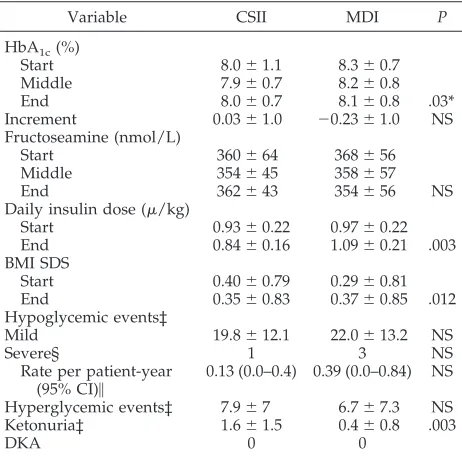
All 23 children who started the study completed the 2 study arms. The clinical data on entry to the study are shown in Table 1; there were no significant differences between the 2 groups. Seven children were prepubertal, 13 were in Tanner stages 2 to 4 and 3 were fully pubertal. Comparison of the parameters between the 2 modes is shown in Table 2.
Glycemic Control
The capillary HbA1clevels at the start of the study
were significantly lower than the levels measured 3 months before the study, at the first educational ses-sion (8.9 ⫾ 1.0% vs 8.3 ⫾ 1.1%, P ⫽ .003). This reduction was maintained throughout the study in both groups, and the difference in levels between 3 months before the study and at the end of the study was statistically significant (8.9⫾1.0% vs 8.0⫾0.8%,
P⬍ .001). The values for each group separately are shown in Fig 2A. HbA1c values were lower during CSII than MDI on repeated measures (P⫽.03; Table 2), secondary to the differences at the start of the
treatment arm. However, there was no significant interaction of the study arms and the change in HbA1clevels over time (Fig 2B). Fructoseamine levels were similar throughout the study.
Insulin Dose and BMI
The total daily insulin dose (units/kg/d) was sim-ilar for the 2 regimens at initiation of the study. There was a significant interaction between the therapy regimen and the change in insulin dose over time, decreasing during pump therapy and increasing during MDI (P ⫽ .003). Baseline BMI SDS was also similar at study onset, but it decreased during CSII and increased during MDI (P ⫽ .012). At baseline, and to the end of the study, 1 boy and 1 girl (8.7% of the study population) were overweight, defined as BMI ⬎2 standard deviations for age.14 Both had
fa-milial obesity.
Adverse Events
The frequency of mild diurnal and nocturnal hy-poglycemic and hyperglycemic episodes reported by the patients was similar in the 2 study arms, al-though the number of ketotic events per patient was higher during CSII than MDI (P⫽.003). There were
Fig 2. A, Glycemic control over time for the whole study sample, by group. Group A started with CSII and group B with MDI. *Educational session conducted 3 months before randomization. For the whole study group,P⫽.003 for HbA1cat randomization
versus 3 months before andP⬍.001 for HbA1cat the end of the
study versus 3 months before. Analysis of variance with repeated measures by group showed no significant difference between groups A and B (P ⫽.13), a highly significant change in mean HbA1clevels overtime (P ⬍.001) and no significant interaction
between group and the change in HbA1covertime. B, Glycemic
control with CSII versus MDI (mean⫾standard deviation).
TABLE 1. Baseline Characteristics of the Children by Ran-domization Group
Variable Group A (Started With CSII)
Group B (Started With MDI)
Total
N (female) 11 (7) 12 (6) 23 (13) Age (y) 11.9⫾1.4 11.6⫾1.5 11.8⫾1.4 Duration (y) 5.3⫾1.9 6.3⫾2.6 5.8⫾2.3 BMI SDS* 0.3⫾1.0 0.3⫾0.4 0.3⫾0.8 HbA1c
3 mo 8.6⫾0.8 9.2⫾1.0 8.9⫾1.0 At randomization 7.9⫾1.3 8.6⫾0.8 8.3⫾1.1‡ Daily insulin dose (/kg) 0.93⫾0.22 0.97⫾0.22 0.95⫾0.22 Data are presented as mean⫾standard deviation unless other-wise indicated.
No significant difference was noted for any of the variables be-tween the 2 groups.
* BMI SDS calculated according to the 2000 growth charts of the Center for Disease Control, National Center for Health Statistics, USA.14
‡ P⫽.003 for HbA1cat randomization versus 3 months before.
TABLE 2. Glycemic Control, Insulin Dose, BMI SDS, and Ad-verse Events by Study Regimen
Variable CSII MDI P
HbA1c(%)
Start 8.0⫾1.1 8.3⫾0.7 Middle 7.9⫾0.7 8.2⫾0.8 End 8.0⫾0.7 8.1⫾0.8 .03* Increment 0.03⫾1.0 ⫺0.23⫾1.0 NS Fructoseamine (nmol/L)
Start 360⫾64 368⫾56
Middle 354⫾45 358⫾57
End 362⫾43 354⫾56 NS
Daily insulin dose (/kg)
Start 0.93⫾0.22 0.97⫾0.22 End 0.84⫾0.16 1.09⫾0.21 .003 BMI SDS
Start 0.40⫾0.79 0.29⫾0.81 End 0.35⫾0.83 0.37⫾0.85 .012 Hypoglycemic events‡
Mild 19.8⫾12.1 22.0⫾13.2 NS
Severe§ 1 3 NS
Rate per patient-year
(95% CI)㛳 0.13 (0.0–0.4) 0.39 (0.0–0.84) NS
Hyperglycemic events‡ 7.9⫾7 6.7⫾7.3 NS Ketonuria‡ 1.6⫾1.5 0.4⫾0.8 .003
DKA 0 0
NS indicates not significant.
Data are presented as mean⫾standard deviation, unless other-wise indicated.
* On repeated measures. ‡ Mean events/patient/arm.
§ Total number of events of severe hypoglycemia.
no cases of DKA; all ketotic episodes that were sec-ondary to infusion set problems were treated at home. There was 1 event of severe nocturnal hypo-glycemia without coma during CSII and 3 (2 noctur-nal) during MDI, yielding an overall rate of 0.26 events per patient-year (95% CI: 0.01– 0.51). During pump therapy, there were 12 minor infusion-set site infections (treated by local antibiotic cream), 16 blockages, and 42 dislodgements. There were 3 hos-pital admissions for intercurrent infection, 2 during pump therapy and 1 during MDI therapy.
Treatment Satisfaction and Quality of Life
There was a significant difference between treat-ment groups in treattreat-ment satisfaction, expressed by the DTSQ total score. The total score, which can range from 6 to 36, was 21.4⫾3.3 at the beginning of the study, 21.9⫾3.8 at the end of the MDI arm, and 30.6⫾3.7 at the end of the CSII arm (P⬍.001). There was no statistically significant difference between treatment groups for any of the DQOLY subscales, using either a univariate model with treatment group included or a multivariate model that in-cluded sex as a covariate. (satisfaction scale: 71.9⫾ 14.5 at the beginning of the study, 73.5⫾14.0 at the end of the MDI arm, and 74.8⫾13.5 at the end of the CSII arm; impact scale: 68.8⫾10.6, 73.5⫾9.7, 73.2⫾ 9.6; worry scale: 77.0⫾13.5, 79.8⫾12.8, 81.6⫾12.4). At termination of the study, the patients were asked which regimen they preferred for continuation of therapy. Sixteen (6 males) of the 23 children chose CSII because it provided them greater flexibility with meal times, avoided the pain of injections, and con-ferred a sense of smoother blood glucose profiles and/or better glycemic control. Among the 7 chil-dren (4 males) who preferred to continue with MDI therapy, 5 had started with CSII and then switched to MDI. Their reasons for unwillingness to resume CSII therapy were as follows: deteriorating glycemic con-trol and fear of overeating and weight gain in 2 boys; scars at infusion-set site in 1 girl; fear of infusion-set insertion in 1 girl; desire to keep the diabetes a secret and shame at wearing the pump in 1 boy; pain in catheter-insertion site in 1 girl; and bothersome, fre-quent self-measurements of blood glucose in 1 boy.
DISCUSSION
To the best of our knowledge, this is the first randomized crossover trial comparing the outcome of CSII and MDI in children with type 1 diabetes. Our study shows that patients treated intensively with CSII and MDI achieve a similar metabolic con-trol and have the same rate of adverse events. The use of CSII led to a lower insulin requirement and higher satisfaction rate, with no change in BMI. Both modes of therapy were associated with fair glycemic control, comparable to that achieved by the inten-sive-therapy adolescent group in the DCCT.5 The
lower HbA1c values during CSII on repeated
mea-sures (P ⫽ .03) were accounted for solely by the lower HbA1cvalue at the start of the treatment arm
but there was no significant difference between modes of therapy in the change over time.
Studies comparing glycemic control and the
fre-quency of adverse events in patients using CSII and MDI have shown conflicting results. Those reporting slightly better glycemic control with CSII than MDI, such as the DCCT10and others,7,18were not
random-ized with regard to mode of therapy, so the results may have been at least partly subject to patient or physician bias. Our findings are in line with 2 pre-vious randomized trials in young patients19,26 and
adults20 with type 1 diabetes, but disagree with 2
other studies using a similar design,11,12 which
re-ported a slight but statistically significant improve-ment in glycemic control during CSII. In the latter studies, either the sample was older (adults) with previous experience with pump use11 or the pump
was used only at night and the sample was young-er,12when care is supervised by the parents.21Most
of our patients were early pubertal and pubertal, when compliance with therapy is more difficult to achieve4,5and inconsistent meals and boluses might
counterbalance the advantage of the better basal in-sulin replacement offered by CSII. In addition, CSII was a new modality for the patients and parents. Whether a longer period of CSII therapy would im-prove glycemic control with a decreased rate of hy-poglycemia has yet to be determined.
We used regular insulin in the MDI arm of ther-apy. The choice was based on the observation that for optimal pre-meal and bedtime glycemic control dur-ing MDI therapy, a small amount of NPH needs to be added to each pre-meal lispro injection.22 As the
children preferred to use insulin pens for pre-meal shots, we decided to continue with the regular insu-lin during MDI. In view of the recent study compar-ing insulin analog to regular insulin in children treated with MDI,23 wherein glycemic control and
rate of hypoglycemia were found to be similar in the 2 groups, we assume the difference in insulin types did not have a major effect on the results.
The frequency of severe hypoglycemia during CSII was slightly, and not significantly, lower than during MDI. This small difference might be secondary not only to the different modes of therapy but also to the different short-acting insulins used in the 2 treatment modalities. A meta-analysis of randomized studies comparing rates of severe hypoglycemia between lispro and regular insulin during MDI showed that although findings in the individual studies were not significant, there was a significant overall difference favoring lispro.24
Another concern of patients who achieve im-proved glycemic control with intensive therapy is weight gain.1,5,7In our group, there was a significant
interaction between mode of therapy and change in BMI SDS, with no change during CSII and a signifi-cant, albeit slight, increase during MDI, despite a similar level of glycemic control. This finding might be attributable to the significantly lower insulin re-quirements in our series, and in others,11 and the
decreased need for snacks during CSII therapy. Should this difference be sustained for a longer pe-riod of time, it would confer a distinct advantage on pump therapy.
secondary to pump or infusion-set failure.10,25 To
reduce this risk, we conducted an educational ses-sion 3 months before initiating the study to motivate the patients and their parents to practice strict, rou-tine self-monitoring of blood glucose and urinary ketones and to teach them how to correct hypergly-cemia and ketosis. The results showed that despite the higher rate of ketonuria during CSII, there were no episodes of DKA during the study. This finding might be different in a routine clinic follow-up set-ting or during longer periods of CSII therapy.25
Fur-ther studies are needed to determine if regular, re-peated educational sessions can prevent DKA on a long-term basis.
Interestingly, a significant reduction (⬃0.6%) in HbA1clevels was noted at randomization, 3 months after the prestudy educational session, during which patients and parents were asked to perform 6 to 7 SBGMs and to report the results to the diabetic team for insulin dose adjustment. That is, it was the first 3 months before baseline (educational session) that ac-counted for the change in HbA1c. This initial im-provement in metabolic control occurred within a support setting, without a change in the diabetes treatment regimen. This finding agrees with other studies.19,26 It also illustrates the benefits of
educa-tion alone in this populaeduca-tion and suggests that for improvement of diabetic control, patient, parent, and team motivation, involvement, and adherence might be more important than the type of insulin regimen. The HbA1cfurther decreased by 0.3% to 8%
through-out the study, for an overall reduction of 0.9%. This change is clinically significant, as the DCCT reported a 21% to 49% decreased risk of microvascular com-plications with every 1% decrease in HbA1c.27
Our study appears to be among the few random-ized crossover studies to evaluate patient satisfac-tion. The patients seemed to be more satisfied with pump therapy than MDI therapy, as expressed by their response on the DSQT scale and their reported preference to continue with this mode. No such dif-ference was found in the DQOLY. This discrepancy might be explained by the nature of the satisfaction score of the DQOLY, which is composed of items relating satisfaction with the treatment mode to sat-isfaction with life in general, and this may have masked the independent impact of the treatment mode. Be that as it may, satisfaction with pump therapy needs to be evaluated for longer periods, when the novelty of the pump is no longer a factor. In addition, the better satisfaction during CSII might be partly attributable to the different types of insulin used, with regular insulin given 20 to 30 minutes before meals during MDI and lispro given with meals during CSII.
Our study shows that intensive insulin therapy with either CSII or MDI is feasible, safe, and well accepted by children with type 1 diabetes and their families. With both modes of therapy, fair and ac-ceptable glycemic control for this age group was maintained. The main improvement in metabolic control in our sample was achieved in the period before the study, simply by intensifying patient ed-ucation. Our results suggest, therefore, that both
modes be made available to the diabetic team and the patients to better tailor therapy, and that enroll-ing patients in a research study is an effective tool to improve diabetic control.
ACKNOWLEDGMENTS
This study was supported by Minimed/Agentek (1987) Ltd. We are grateful for the editorial and secretarial help of Gloria Ginzach and Melanie Kawe, and Michal Kasher and Alon Klein for their help with the figures.
REFERENCES
1. Diabetes Control and Complications Trial Research Group. The effect of intensive treatment of diabetes on the development and progression of long-term complications in insulin dependent diabetes mellitus.N Engl J Med.1993;329:977–986
2. Kostraba JN, Dorman JS, Orchard TJ, et al. Contribution of diabetes duration before puberty to development of microvascular complica-tions in IDDM subjects.Diabetes Care. 1989;12:686 – 693
3. Shalitin S, Josefsberg Z, Lilos P, De-Vries L, Phillip M, Weintrob N. Bedside scoring procedure for the diagnosis of diabetic peripheral neuropathy in young patients with type 1 diabetes.J Pediatr Endocrinol Metab. 2002;15:613– 620
4. Weissberg-Benchall J, Glasgow AM, Tynan WD, Wirtz P, Turck J, Ward J. Adolescent diabetes management and mismanagement.Diabetes Care. 1995;18:77– 83
5. Diabetes Control and Complications Trial Research Group. Effect of intensive diabetes treatment on the development and progression of long-term complications in adolescents with insulin-dependent diabe-tes mellitus: Diabediabe-tes Control and Complications Trial.J Pediatr.1994; 125:177–188
6. Becker DJ, Ryan CM. Hypoglycemia. A complication of diabetes ther-apy in children.Trends Endocrinol Metab. 2000;11:198 –202
7. Boland EA, Grey M, Oesterle A, Fredrickson L, Tamborlane WV. Con-tinuous subcutaneous insulin infusion: a new way to lower risk of severe hypoglycemia, improve metabolic control, and enhance coping in adolescents with type 1 diabetes.Diabetes Care. 1999;22:1779 –1784 8. Johnson SB, Silverstein J, Rosenbloom A, Carter R, Cunningham W.
Assessing daily management of childhood diabetes. Health Psychol. 1986;5:545–564
9. Wing RR, Nowalk MP, Marcus MD, Koeske R, Finegold D. Subclinical eating disorders and glycemic control in adolescents with type 1 dia-betes.Diabetes Care. 1986;9:162–167
10. Diabetes Control and Complications Trial Research Group. Implemen-tation of treatment protocols in the Diabetes Control and Complications Trial.Diabetes Care.1995;18:361–376
11. Hanaire-Broutin H, Melki V, Bessieres-Lacombe S, Tauber JP, The Study Group for the Development of Pump Therapy in Diabetes. Comparison of continuous subcutaneous insulin infusion and multiple daily injec-tion regimens using insulin lispro in type 1 diabetic patients on inten-sified treatment.Diabetes Care.2000;23:1232–1235
12. Kaufman FR, Halvorson M, Kim C, Pitukcheewanont P. Use of insulin pump therapy at nighttime only for children 7–10 years of age with type 1 diabetes.Diabetes Care. 2000;23:579 –582
13. Rohlfing CL, Wiedmeyer H-M, Little RR, England JD, Tennill A, Gold-stein DE. Defining the relationship between plasma glucose and HbA1c.
Analysis of glucose profiles and HbA1cin the diabetes control and
complications trial.Diabetes Care. 2002;25:275–278
14. Kuczmarski RJ, Ogden CL, Grummer-Strawn LM.CDC Growth Charts: United States Advance Data From Vital and Health Statistics.No. 314. Hyattsville, MD: National Center for Health Statistics; 2000
15. Bradley C. Diabetes Treatment Satisfaction Questionnaire (DTSQ). In: Bradley C, ed. Handbook of Psychology and Diabetes. Reading, United Kingdom: Gordon & Breach; 1994:111–132
16. Ingersoll GM, Marrero DG. A modified quality of life measure for youths: psychometric properties.Diabetes Educ. 1991;17:114 –118 17. Dixon WJ, ed.BMDP Statistical Software. Los Angeles, CA: University of
California Press; 1993
18. Maniatis AK, Klingensmith GJ, Slover RH, Mowry CJ, Chase HP. Con-tinuous subcutaneous insulin infusion therapy for children and adolescents: an option for routine diabetes care.Pediatrics. 2001;107: 351–356
19. Schiffrin A, Belmonte MM. Comparison between continuous subcuta-neous insulin infusion and multiple injections of insulin; a one-year prospective study.Diabetes. 1982;31:255–264
insulin lispro; a randomized trial of continuous subcutaneous insulin infusion versus multiple daily insulin injection.Diabetes Care. 2001;24: 1722–1727
21. Scottish Study Group for the Care of the Young Diabetic. Factors influencing glycemic control in young people with type 1 diabetes in Scotland: a population-based study (DIABAUD2).Diabetes Care.2001; 24:239 –244
22. Lalli C, Ciofetta M, Del Sindaco P, et al. Long-term intensive treatment of type I diabetes with the short-acting insulin analog lispro in variable combination with NPH insulin at mealtime.Diabetes Care. 1991;22:468–477 23. Deeb LC, Holcombe JH, Brunelle R, et al. Insulin lispro lowers post-prandial glucose in prepubertal children with diabetes.Pediatrics. 2001; 108:1175–1179
24. Brunelle RL, Llewellyn J, Anderson Jr JH, Gale EAM, Koivisto VA. Meta-analysis of the effect of insulin lispro on severe hypoglycemia in patients with type 1 diabetes.Diabetes Care. 1998;21:1726 –1731 25. Wang PH, Lau J, Chalmers TC. Meta-analysis of effects of intensive
blood-glucose control on late complications of type 1 diabetes.Lancet. 1993;341:1306 –1309
26. Couper JJ, Taylor J, Fotheringham MJ, Sawyer M. Failure to maintain the benefits of home-based intervention in adolescents with poorly controlled type 1 diabetes.Diabetes Care. 1999;22:1933–1937
27. Diabetes Control and Complications Trial Research Group. The absence of a glycemic threshold for the development of long-term complications: the perspective of the diabetes control and complications trial.Diabetes.1996;45:1289 –1298
EFFICACY OF ALBUMIN IN CRITICALLY ILL PATIENTS
“In 1998, theBritish Medical Journalpublished a meta-analysis that compared the effects of fluids containing albumin and crystalloids on death rates in critically ill patients. The analysis included 24 studies involving 1419 patients. The report concluded that there was no evidence that albumin reduced mortality and a strong implication that it might increase the risk of death. . . [A recent] meta-analysis included 55 trials involving 3504 patients—more than twice the numbers included in the original Cochrane review. Overall, this analysis detected no difference in mortality between patients treated with albumin and patients treated with other fluids. . . The only issue on which everyone seems agreed on is or more large, high quality, randomized controlled trials of albumin in critically ill patients are need-ed. . . The Australian and New Zealand Intensive Society, the Institute for Inter-national Health of the University of Sydney, and the Australian Red Cross Blood Service, have initiated a large double blind randomized controlled trial of albumin versus saline. . . They plan to recruit 7000 adult patients!”
Finfer S.BMJ. 2003:326:559 –560
Editor’s Note:Randomized trials all too often seem to result in a call for more and
larger randomized trials. Are we doomed to forever calling for more and larger RCTs?
DOI: 10.1542/peds.112.3.559
2003;112;559
Pediatrics
Gila Fayman, Pearl Lilos, Zvi Dickerman and Moshe Phillip
Naomi Weintrob, Hadassa Benzaquen, Avinoam Galatzer, Shlomit Shalitin, Liora Lazar,
Crossover Trial
Injection Regimens in Children With Type 1 Diabetes: A Randomized Open
Comparison of Continuous Subcutaneous Insulin Infusion and Multiple Daily
Services
Updated Information &
http://pediatrics.aappublications.org/content/112/3/559
including high resolution figures, can be found at:
References
http://pediatrics.aappublications.org/content/112/3/559#BIBL
This article cites 24 articles, 16 of which you can access for free at:
Subspecialty Collections
http://www.aappublications.org/cgi/collection/endocrinology_sub Endocrinology
collection(s):
This article, along with others on similar topics, appears in the following
Permissions & Licensing
http://www.aappublications.org/site/misc/Permissions.xhtml
its entirety can be found online at:
Information about reproducing this article in parts (figures, tables) or in
Reprints
http://www.aappublications.org/site/misc/reprints.xhtml
DOI: 10.1542/peds.112.3.559
2003;112;559
Pediatrics
Gila Fayman, Pearl Lilos, Zvi Dickerman and Moshe Phillip
Naomi Weintrob, Hadassa Benzaquen, Avinoam Galatzer, Shlomit Shalitin, Liora Lazar,
Crossover Trial
Injection Regimens in Children With Type 1 Diabetes: A Randomized Open
Comparison of Continuous Subcutaneous Insulin Infusion and Multiple Daily
http://pediatrics.aappublications.org/content/112/3/559
on the World Wide Web at:
The online version of this article, along with updated information and services, is located
American Academy of Pediatrics. All rights reserved. Print ISSN: 1073-0397.