EFFECT OF VARIATION OF LASER PARAMETERS
ON FREQUENCY SHIFT IN TRANSPARENT BULK
MEDIA
Supriya Rai
Department of Physics, Lovely Professional University, Jalandhar, Punjab, (India)
ABSTRACT
The paper contains derivation of equations governing the propagation dynamics and parameters affecting the
wide band dielectric in the interaction zone. Theoretical investigation of the variation of laser parameters
during laser induced breakdown of wide band dielectrics is carried out in the paper. When the dielectric sample
is irradiated with ultrashort laser pulses, the interaction results in transfer of pulse energy to electrons, and
they get excited to conduction band through multiphoton ionization. Then the electron density increases beyond
breakdown limit leading to formation of plasma. The change in refractive index triggers self phase modulation
which upshifts laser frequency. The mathematical model illustrates dependence of beam width parameter and
normalized laser frequency on propagation distance. This model also efficiently depicts shift in laser frequency,
which is valid for higher intensities of the order 1017/cm2.
Keywords: Dielectrics, Frequency Upshift, Laser Induced Breakdown, WKB Approximation
I. INTRODUCTION
The advents of femtosecond lasers have paced up the experimental as well as theoretical research in widening
the scope of lasers in micromachining to keratoplasty. The study of physics of nonlinear optical processes of the
irradiating a dielectric sample with laser pulses of few 1015s can reveal the latent potentials of this interaction.
This regime of laser matter interaction has seen extensive experimental advancement in past decades, but lacks
theoretical background to explain the observed results.
The conduction band population increases as the laser pulses initiate the photo-excitation of electron from
valence band via multiphoton ionization [5]. The electrons produced in conduction band absorb energy from
laser pulse and collide with neighboring electron to transfer energy to other electrons, thus helping the electrons
to overcome the ionization potential [9]. The electron-electron collision in addition to tunneling increases the
electron density beyond the threshold value. This causes evolution of plasma and refractive index decreases
causing the modulation of phase, ultimately leading to frequency broadening [11]. Theoretical investigation of
the variation of laser parameters during laser induced breakdown of wide band dielectrics is carried out in the
II. THEORETICAL ANALYSIS
2.1 Density Evolution
Consider a large band gap dielectric with energy band gap Eg occupying half space z > 0.An ultra-short laser
pulse is incident normally on a z = 0 surface from free space. The laser field inside the dielectric is given by the
equation below
2
2
ˆ
oexp
exp
exp
o
r
E
xE t
i t
i
t kz
r
(1)where 𝑟0 is the spot size of the laser at z = 0. 𝐸0 is related to the incident laser amplitude Eoi(t) as Eo(t) = [2/(1 +
n)] Eoi , where n is the refractive index of the dielectric and k = (ω/c)n. For z > 0, we have
ˆ
iE
xAe
whereϕ (z, t) = ωt − kz is the fast phase of the wave and A( z, r, t) is a slowly varying complex amplitude of the wave.(ω = ∂ϕ/∂t and k = −∂ϕ/∂z)
Li et al. (2000) have concluded from their experimental results that the net electron density evolution equation
can be written as
e e e
n
t W
n
n
(2)where α0(Te)I distinguishes the rate of the collisional e-h production and I(t) is the laser intensity of the laser
pulse.
5 2 3 2
2
2 9
g g/
Aexp
A/ 2
W
E
mE
E E
E
E
and EA is the strength of the atomicfield. At enormously high laser intensities (>> 1017W/cm2), when the electric field of laser
E
exceeds thecoulomb field of the atom
E
A, the electron orbiting around tunnels out(rendered as free electron) and is themajor contributor to the plasma formation. The evolution of plasma frequency
p (
p2
4
me n
2 o, whereo
n
is the density) varies with time [4] as given below
2 2 2 p pm pz
(3)III. LASER FREQUENCY UPSHIFT
Considering Gildenburg et al. (2002), the wave equation governing the laser pulse inside the dielectric, in the
limit of 𝜈𝑒2≪𝜔2 ( assuming ∇𝐸 ≈ 0 is valid when 𝜔𝑝2≪𝜔2) is given by
2
2 2
2 2 2
1
p
L
E
i
E
E
c
t
c
(4)The dispersion relation for a semiconductor of dielectric constant
L is found by using equations (2) and (4) inDifferentiating the above equation with respect to t (using 𝜕𝑘/𝜕𝑡 = −𝜕𝜔/𝜕𝑧) and taking group velocity of the
form
1 2
2 2
g L L po
v
c
for under-dense plasma
p2<<
2, we get(6)
Now as per the analysis introduced by Liu and Tripathi (2000), for an initially Gaussian beam, results in the
beam width parameter [7]
2 2
2 2
2 3 2 2
1
1
1
pL L L
f
f
f
f
(7)Introducing dimensionless quantities for paraxial ray approximation [11]
z c
oro2,
z R
d,whereR
dis defined as the Rayleigh length (Rd kro2),
ot
,
is the normalized propagation distance given byo o
r c
, pm
pm
0, p2
p2
0, and
0where
o
2
1 2I
o
1
g
2and the value of g is given by
g
E
AE
oo.Applying transformation rules on the equations we finally get the equations governing the laser frequency
2 2
2 2
1 2 pm po
L
(8)
2 2 2 po pm poV
(9)
2
2 2 2 2
2 p
p pm po
o
V
(10)where
V
1
f
2
exp
gf
,
2 1 2
2
I
oE E
Aexp
E
AE
.Then the equations(7),(8),(9), and (10) are solved numerically as well as plotted using MATLAB 2013a and ORIGIN 9.0.
2 2 2
1
po g Lv
t
z
t
IV. FIGURES
Figure 1: Variation of beam width parameter (f) with normalized propagation distance (ξ) for different values of normalized spot size (η) of laser beam. The other parameters are Ωpm
2 =
0.005 and
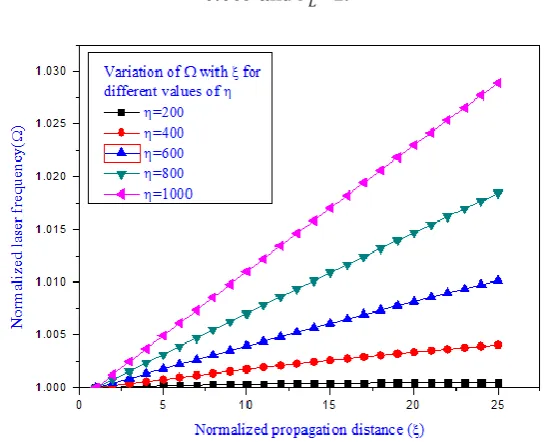
L=1.Figure 2: Variation of normalized laser frequency (Ω) with normalized propagation distance (ξ) for different values of normalized spot size (η) of laser beam. The other parameters are Ωpm
2 =
Figure 3: Variation of beam width parameter (f) with normalized propagation distance (ξ) for
different values of Ωpm
2. The other parameters are normalized spot size (η) = 600 and
L
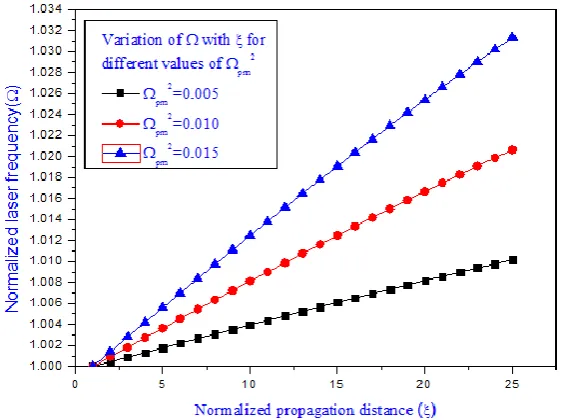
=1.Figure 4: Variation of normalized laser frequency (Ω) with normalized propagation distance (ξ)
for different values of Ωpm
2. The other parameters are normalized spot size (η) = 600 and
L
Figure 5: Variation of beam width parameter (f) with normalized propagation distance (ξ) for
different values of dielectric constant (
L) of laser beam. The other parameters are Ωpm 2= 0.005
and η=600.
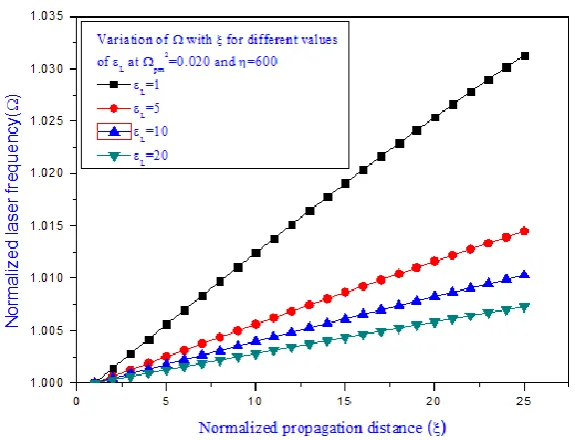
Figure 6: Variation of normalized laser frequency (Ω) with normalized propagation distance (ξ)
for different values of dielectric constant (
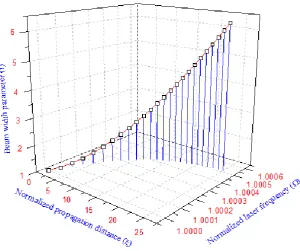
L) of laser beam. The other parameters are Ωpm2 =Figure 7: Laser frequency shift with propagation distance
V. RESULTS AND DISCUSSIONS
The material chosen for numerical appreciation is a dielectric sample of fused silica. The Ti: Sapphire laser
system is used whose standard output in 25 fs is 0.5 mJ at a repetition rate of 1 KHz. The laser had an intensity
of 5×10¹⁷W/cm2, Io=9 eV at ωo=2×10¹⁵rad/s which emits red and near-infrared light in the range from 650 nm to
1100 nm. Figure 1elicits the frequency shift with respect to distance (ξ) and dielectric constant
L. Figure 2represents the monotonic increase in the beam width parameter with respect to normalized distance at different
normalized spot sizes and reveals that the rate of divergence due to diffraction for higher laser spot sizes vary
smoothly. Figure 3 illustrates that the rate of frequency increase with propagation distance for beams with larger
spot sizes is large in comparison to others. The atoms or ions in the influence of electric field of the fast moving
electrons and slow moving ions causing perturbation to energy level is proportional to electric field resulting in
shift in frequency, hence pronouncing a strong dependence on laser spot size. As the dielectric constant
increases the laser beam has to face more resistance in propagation (Figure 4) where the curves of beam width
parameter versus normalized distance slopes down for higher value of dielectric constant. Light traverses in a
region in which the refractive index varies in time, but not spatially, the wavelength remains constant. However,
the phase velocity of the propagating wave does change; it increases if the index is decreasing. When the
wavelength remains constant while the speed increases an observer at a fixed location will therefore see more
peaks per second, measurement then results in a higher frequency. Even if the wave moves out of the spatial
region in which the index was time-varying, the frequency upshift persists in picture as a spatial change in
refractive index does not affect the frequency. In the case of a time-decreasing index, the medium has done
work on the photon and made it more energetic. Ionization of a transparent material causes a time-decreasing
change in refractive index induces self phase modulation and ultimately frequency broadening. It is evident
from the Figure 5, where the dimensionless frequency downshifts with distance and its rate of downshift has
strong correlation with relative permittivity. Figure 6 shows the nonlinear dependence of beam width parameter
with propagation distance for different values of
pm2. The density varies with the increase in the value of freecharge carrier density
pm2, there is a modulation in refractive index of the dielectric, causing self phase modulation and ultimately frequency upshift. The frequency shift saturates with propagation distance, which isshown in Figure 7.
VI. CONCLUSIONS
Frequency shift plays a significant role in influencing the variation of parameters of the incident laser beam due
to the interaction between plasma formed in focal volume of sample and ultra-short intense laser beam. Our
model is applicable and most suitable for modeling the femtosecond laser induced breakdown in large band gap
dielectrics at higher intensities. Normalized frequency up-shifts with the normalized propagation distance, for
increasing normalized spot sizes of laser. While with increase in the value of dielectric constant, the normalized
frequency shows a downshift and beam width parameter rises with normalized propagation distance. It proves to
be potential area of research (theoretical as well as experimental) as applications range from enhancing
possibilities in micromachining to multiphoton mediated subpico-processing of human chromosomes. The
study of variation of laser parameters will help us to exploit the potential unleashed in the interaction between
ultrashort lasers and dielectric.
VII. ACKNOWLEDGEMENTS
The author is thankful to Dr. Niti Kant, LPU, for his initial motivation. However, the conclusions expressed in
this material are those of author and does not necessarily reflect his opinion.
REFERENCES
[1] Alio J.L. (2013) “Femtosecond Laser-Assisted Keratoplasty”, Jaypee brothers medical publications,
9Bakunov M.I.,
[2] Bystrov A.M., and Gildenburg V.B. (2002) “Frequency self upshifting of intense microwave radiation producing ionization in a thin gaseous layer”, American Institute of Physics, Phys. Plasmas, 9, 2803. [3] Dias J.M., Stenz C., Lopes N., Badiche X., Blasco F., Dos Santos A., Oliveira e Silva L., Mysyrowicz A.,
Antonetti A., and Mendonça J.T. (1997) “Experimental Evidence of Photon Acceleration of Ultrashort Laser Pulses in Relativistic Ionization Fronts”, Phys. Rev. Lett., 78, 4773.
[6] Li Ming, Menon Saipriya, Nibarger John P., and Gibson George N. (1999) “Ultrafast Electron Dynamics in Femtosecond Optical Breakdown of Dielectrics”, Phys. Rev. Lett., 82, 2394.
[7] Liu C.S. and Tripathi V.K. (2000) “Laser frequency upshift, self-defocusing, and ring formation in tunnel ionizing gases and plasmas”, Phys. Plasmas, 7, 4360.
[8] Quéré F., Guizard S. and Martin P. (2001) “Time-resolved study of laser-induced breakdown in dielectrics”, Europhys. Lett. , 56, 136.
[9] Rethfeld B. (2006) “Free-electron generation in laser-irradiated dielectrics” PHYSICAL REVIEW B, 73, 035101
[10] Stuart B. C, Feit M. D, Rubenchik A. M, Shore B. W, and Perry M. D (1996) “Nanosecond to picosecond laser induced breakdown in dielectrics” Phys. Rev. B, 53,1761.