3219
Implementation Of The Nash Model In The
Interaction Of Enterprises
Tetiana Galetska, Natalia Topishko, Ivan Topishko, Natalia Danyliuk, Tetiana Kmytiuk
Abstract: Establishing effective interaction between the manufacturer and the retailer as participants of supply chain implies the construction of an effective mechanism for the implementation of the main strategies of their business behavior, in particular price strategies, as well as strategies for generating costs for joint promotion of the product. This provides the manufacturer and the retailer with the ability to make independent management decisions regarding the selection of the most appropriate business game scenarios that maximize their profits in the short and long term, and is therefore a topical question in the practice of operating distribution networks. The purpose of the study is to determine the optimal values of the parameters of the advertising cost response function, under which the maximization of manufacturer and the retailer profits can be achieved in the process of their independent decision-making on determining pricing strategies, as well as strategies for generating joint costs for product promotion. The paper presents a numerical experiment on the possible values of the parameters of the advertising cost response function, calculated on the basis of effectively selected range and step change. Nash game solution is mathematically substantiated and defined as a variant of interaction between participants of the supply chain, in which neither of them can maximize their own profit without affecting the profit of the other. A numerical experiment was carried out on the possibilities of maximizing the profit functions of the manufacturer, the retailer and the channel from the standpoint of pricing strategies, as well as joint costs strategies of both channel members for product advertising. The results obtained can be the initial information base for providing recommendations on the possibilities of using non-cooperative game in comparison with other types of game-theoretic models of enterprises’ interactions in supply chains, in particular in the study of activities of enterprises – participants of oligopoly (duopoly).
Index Terms: advertising cost response function, business strategy, consumer demand function, joint advertising costs, Nash equilibrium, profit, retail price, transfer price.
—————————— ——————————
1
I
NTRODUCTION IN the process of comprehensive research of the effectiveness of conducting any type of business activity, which includes the promotion of the product to end consumers, the features determining of the institutional entities functioning play an important role, which are called supply chains. Since any business entity being the participant of the supply chain aims to achieve positive financial results in the short and long term, it is objectively necessary and relevant to assess the peculiarities of generating profits of manufacturers and retailers as members of distribution channels. In this context, it should be noted, that in the process of distribution policy, enterprises are guided by the strategies of the supply chains in which they operate, as well as the number of participants in the channel. Determining the impact of pricing strategies and generating costs on joint product promotion in the distribution channel on the final financial results of manufacturers andretailers are key aspects of evaluating the ability to find ways of maximizing enterprises’ profits. In this context, priority is given to the range and nature of the interaction between the participants of the supply chain, which implies the formation of a short one-level channel in which there is one retailer between the manufacturer and the consumers. Considering this moment, the study examines the interaction between relatively independent enterprises – manufacturer and retailer, who are equal in their decision-making regarding the implementation of business behavior strategies in the process of promoting product to end consumers. Such interaction is formed on a contractual basis, or on terms of cooperation, which suggests the simultaneous and independent decision-making by both the manufacturer and the retailer on the implementation of the main business game strategies, which are pricing strategies, as well as strategies for generating joint costs for product advertising. Thus, the study focuses on finding a solution of non-cooperative game, which proposes Nash equilibrium formation, as a fairly simple scenario of a business game, in which each player (manufacturer and retailer) can not affect the business behavior of the other without changing their own. An important aspect of Nash equilibrium is the consideration of such a feature of the manufacturer’s and the retailer’s cost-formation strategies as the manufacturer’s ability to participate in the retailer’s costs of promoting the product in the supply chain. Therefore, in addition to determining the optimal Nash equilibrium pricing strategies, namely the ratio of the manufacturer’s transfer price and the retailer’s retail price, the study actualizes the possibility of finding optimal strategies for generating joint costs for advertising by the manufacturer and the retailer in the process of promoting the product to end consumers. At the same time, the strategies of costs’ formation for joint promotion are implemented in the form of shares of the respective costs for the manufacturer and the retailer, which allows to further find their optimal ratio from the point of view of maximizing the profits of the participants of the distribution channel.
————————————————
Tetiana Galetska is Candidate of Economics (Ph. D), Associate Professor of the Department of Economic Theory, Management and Marketing, Faculty of Economics, The National University of Ostroh Academy, Ostroh, Ukraine. E-mail: [email protected] Natalia Topishko is Candidate of Economics (Ph. D), Associate
Professor of the Department of Economic Theory, Management and Marketing, Faculty of Economics, The National University of Ostroh Academy, Ostroh, Ukraine. Email: [email protected] Ivan Topishko is Candidate of Economics (Ph. D), Associate Professor
of the Department of Economic Theory, Management and Marketing, Faculty of Economics, The National University of Ostroh Academy, Ostroh, Ukraine. Email: [email protected]
Natalia Danyliuk is Post-graduate student of the Advanced Mathematics Department, Faculty of Marketing, Kyiv National Economic University named after Vadym Hetman, Kyiv, Ukraine. E-mail: [email protected]
3220
2
T
HEORETICALB
ASISThe influence of key factors on the profits formation of the participants of the supply chain is determined on the basis of consumer demand functions, which reflect the profit models of the manufacturer, the retailer and the channel as a whole. Appropriate consumer demand functions take into account the joint interaction of channel participants, which is seen as an effective mechanism for avoiding conflicts in the channel. Particular attention should be paid to such a component of consumer demand function and, at the same time, joint product promotion strategies, as the costs of joint advertising. Defining these costs as co-operative advertising costs, foreign scientists in [1], [4], [5], [8], [11] indicate the positive impact of co-promotion costs on both the manufacturer’s and the retailer’s activities, as they allow for the first player to focus on the long-term development perspective and for the second one to increase competitiveness. To build profit models for the participants of supply chain, which are used in a numerical experiment of Nash equilibrium formation, it is taken into account the multiplicative consumer demand function, that was offered in [10], which is mathematically represented as follows: ) , ( ) ( ) , ,
(wv p f p F w v
D r r , (1)
where
w
- the share of the retailer’s costs for joint product promotion;v
- the share of the manufacturer’s costs for jointproduct promotion;
p
r - retail price per unit of product.The first component of the multiplicative function
f
(
p
r)
reflects the linear relationship between the retail price per unit of product and the volume of its sale; at the same time, the second component of the function F(w,v) depends on two variables and needs a more detailed explanation of its nature. For this purpose, we will use proposed in [5] mathematical notation of the advertising cost response function, namely:
v w B A v w F ) , (
; A,B,w,v0, ,(0;1), (2) where
A
- the scattered asymptote of product sales;B
- estimation parameter;
,
- quasi-advertising elasticity respectively for the retailer and the manufacturer.Given the mathematical notation
F
(
w
,
v
)
, presented in (2), and the necessity to include the strategies of business behavior of the manufacturer and the retailer in the profit model, we present the consumer demand function (1) in a non-dimensional form:for the manufacturer
k w vv w B A p p
Пm t r
1 ) ( 1 1 1 (3)
for the retailer
k wv w B A p p p
Пr r t r
) 1 ( 1 ) ( 1 ) ( 1
1
(4)
for the channel
v
w
v
w
B
A
p
p
П
ch r r
1
)
(
)
1
(
11 , (5)
where
p
t - transfer price per unit of product;k
- the rate of the manufacturer’s participation in the cost of the retailer’s product advertising. In order to adapt the profit models, obtained in (3)-(5), to the finding of the optimal ratios of their components, under which Nash equilibrium is formed, it is necessary to define the main aspects of Nash equilibrium itself as a result of the business interaction between the manufacturer and the retailer in the channel. Based on the claims of scientists in [3], [6], [9], Nash equilibrium occurs in the interaction between rational players, each of which takes into account the position of the other in the decision-making process for the implementation of business behavior strategies. In order to mathematically express Nash equilibrium, we will find the solution of the problem of maximizing the profit functions (3) and (4) for both participants of the supply chain in the following form: for the manufacturer
k w vv w B A p p
Пm t r
k v pt 1 ) ( 1 max 1 1 , , (6)
and for the retailer
k wv w B A p p p
Пr r t r w pr ) 1 ( 1 ) ( 1 ) ( max 1 1 , (7)
Let the profits of the manufacturer and the retailer be formed provided that,
k
0
,p
r
p
t, moreoverp
r
1
. Since bothchannel members simultaneously make decisions to maximize their own profits, it can be assumed that they expect to receive equivalent profits. Given the results of the study [7], we can assume that:
t r
t t
r
p
p
p
p
p
2
(8)To solve the problem of profit maximizing for the retailer, we need to check the necessary and the sufficient conditions for the existence of an extremum of function (4). The necessary condition for the existence of an extremum of the profit function for the retailer is:
0
)
(
,
0
)
(
' ' r r p r r w rp
П
П
w
П
П
r (9)After the transformations, system (9) can be written as follows:
0 ) ( , 3 2 , 3 1 , 1 9 1 1 ) 1 ( v w B A p p v w r t (10) As determinant
0
)
)
((
)
(
)
(
''
''
'' 2
r r
rp r wp
p r ww
r
П
П
П
,(11)
3221 manufacturer, the necessary and the sufficient conditions for
the existence of an extremum of its profit function (3) are verified. The necessary condition for the existence of an extremum of function (3) have the following form:
0
)
(
,
0
)
(
' '
t m p m
m v m
p
П
П
v
П
П
t
(12)
Having solved the first equation of system (12), we conclude that
1 8 1
w v (13)
and the necessary condition for the existence of an extremum of the manufacturer profit function is fulfilled.
As a determinant
0
)
)
((
)
(
)
(
''
''
'' 2
t t
tp m vp
p m vv
m
П
П
П
,(14)
the sufficient condition for the existence of an extremum of the manufacturer profit function (3) is not satisfied. Since Nash equilibrium implies independent decision making regarding the implementation of business game strategies, it does not, however, exclude the possibility of interaction between the manufacturer and the retailer in the process of implementation of these strategies. Therefore, the following equation system should be solved:
0
)
(
,
0
)
(
' '
v
П
П
w
П
П
m v m
r w r
(15) provided that
3
2
,
3
1
rt
p
p
(16)
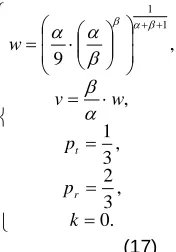
The solutions of system (15) form Nash equilibrium, which is mathematically written as the following system:
. 0
, 3 2 , 3 1
, , 9
1 1
k p p
w v w
r t
(17)
In order to perform the numerical experiment, some assumptions are made regarding the components
A
,
B
of the advertising cost response functionF
(
w
,
v
)
, based on practical guidelines for the functioning of the supply chains. Referring to [2], suppose that an ad campaign extensioncannot exceed product sales by more than twice, i.e.
А
2
; at the same time, a manufacturer’s enhanced advertising cannot increase its sales by more than 50%,therefore
B
0
,
5
w
v
. In this regard, the component functions can be written as follows:b
a
A
2
2
,w
v
b
a
B
2
5
,
0
(18)
To calculate the ratio (a2b) it is necessary to investigate the nature of the dependence of the demand volume on the price per unit of the product, taking into account the specifics of the
formation of the retail price
p
r. The study, conducted on the basis of 36 observations on the values of the average monthly price per unit of the product and the average monthly volume of its sales made it possible to form a selective set and on this basis to construct a linear pair regression equation of the following form:9034795
2216602
,
0
X
Y
(19)
The main numerical characteristics of equation (19) are given in table 1:
TABLE 1
The Main Numerical Characteristics of the Model of Linear Regression
Y
a
b
X
As can be seen from the mathematical record of the system of equations (17) and (18), the magnitude of the costs of the manufacturer and the retailer for the joint promotion of the product in the channel
(
v
;
w
)
, as well as the componentsB
A,
of profit models (3)-(5) depend on the values of parameters
,
, that change under the study condition in the range (0;1) with a step change l0,1.3 R
ESULTSIn order to determine the optimum ratio of parameter values
,
, that maximize the profits of the manufacturer, the retailer and the channel, two cases of change of values should be considered in the chosen business strategies of the channel participants
,
. In the first case, for each
from the set of values
0
,
1
;
0
,
2
;
0
,
3
;
0
,
4
;
0
,
5
;
0
,
6
;
0
,
7
;
0
,
8
;
0
,
9
parameter
satisfies the condition
(
0
;
1
)
; in the second case, for each
from the set of values
0
,
1
;
0
,
2
;
0
,
3
;
0
,
4
;
0
,
5
;
0
,
6
;
0
,
7
;
0
,
8
;
0
,
9
parameter
satisfies3222 retail
p
r prices.In the case when parameter
(
0
;
1
)
for each value)
1
;
0
(
, which changes with step l0,1, a preliminary analysis of the profit values of the manufacturer (П
m), theretailer (
П
r) and the channel (П
ch) showed that profits reachthe highest values when
0,9, that is, they increase with increasing parameter
values. Therefore, in order to provide recommendations on the possibility of using Nash game for channel members, it is necessary to analyze the peculiarities of changing parameter
, which can be made on the basis of the data, given in table 2.TABLE 2
Summary Data on Nash Equilibrium at
k
0
,
0
,
9
,)
1
;
0
(
With a Step Changel
0
,
1
As can be seen from the data in table II, the profits of the manufacturer (
П
m), the retailer (П
r) and the channel (П
ch)increase with increasing parameter
and reach maximum values at
0,9. However, based on system (13), thevalues of transfer
p
t and retailp
r prices remain unchangedfor each pair of values
,
, moreoverp
r
p
t, and this is due to the desire of the retailer to provide the minimum necessary level of possible profit in the channel. At the same time, as parameter
increases, the share of the costs of the manufacturer (v
) and the retailor (w
) for joint promotion of the product also increase, moreoverw
v
for all pairs of values
,
, except
0
,
9
.In the case when parameter
(
0
;
1
)
for each value) 1 ; 0 (
, changes with step l0,1, a preliminary analysis of the profit values of the channel participants and the channel as a whole also showed that the largest values of the profitsm
П
,П
r andП
ch acquire at
0
,
9
, at which
(
0
;
1
)
. In order to provide further recommendations on the possibilities of using Nash equilibrium in the channel under given initial conditions, it is necessary to analyze the data, given in table 3.TABLE 3
Summary Data on Nash Equilibrium Formation at
k
0
,9
,
0
,
(
0
;
1
)
With a Step Changel
0
,
1
Data from table 3 allows us to argue that the profits of the manufacturer, the retailer and the channel increase with increasing parameter
and reach maximum values at9
,
0
. As in the previous case, provided that9
,
0
, the magnitudes of profitsП
m andП
r are equivalent, indicating that one of the conditions of Nash game was fulfilled. In addition, the cost share of the manufacturer (v
) and the retailer (w
) for joint product advertising in the channel is equivalent, which along withp
r
p
t also satisfies the condition of the game. It is worth noting that, in contrast to the previous case, for each pair of values
,
, except the case
0
,
9
, the inequality holdsv
w
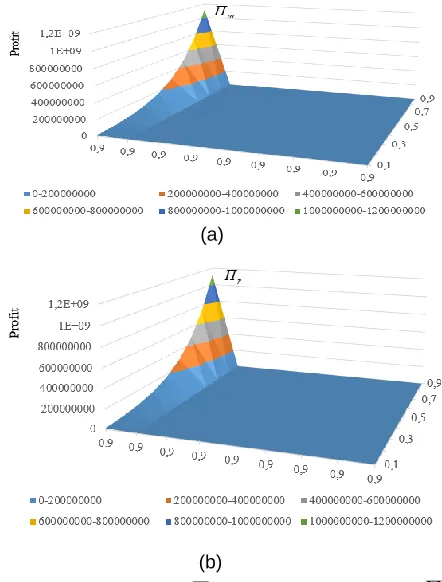
.Graphically, the models of profit maximization of the manufacturer and the retailer, which forms under Nash equilibrium, are represented as surfaces in Fig. 1:
(a)
(b)
3223 Thus, provided that
0
,
9
, business conditions aresatisfied and Nash equilibrium is reached, because both the manufacturer and the retailer have incentives to maintain interaction, indicating the maximum value of their profits in each scenario for the implementation of pricing strategies, as well as shared cost strategies (cost share are equal) for product advertising.
4
C
ONCLUSIONBased on the analysis of the results of numerical simulation, it can be confirm that there is a possible one case of implementation of Nash game, which is favorable in terms of maximizing the profits of both channel participants and is achieved when
0,9. It should be noted, that in the first case of changing parameter values
,
the implementation of Nash game model is more favorable for the manufacturer, because for each pair of values
,
, except9
,
0
, the manufacturer’s profits slightly, but exceed the corresponding profits of the retailer, and the manufacturer’s costs do not exceed the costs of the retailer. In the second case of changing parameter values
,
the situation is opposite, and Nash game gives more favorable opportunities for maximizing the retailer’s profit. Thus, provided that the participation rate of the manufacturer is zero, therefore the manufacturer does not in any way assists the retailer in reducing the retailer’s costs for product advertising, the numerical confirmation of Nash game solution indicates that there is an effective interaction between both channel participants. At the same time, the mechanism of this interaction is realized by balancing the values of expected profits due to the interdependentsimultaneous decision making regarding the
implementation of pricing strategies and strategies for generating joint costs for product advertising. The results of the numerical experiment make information base for further studies of the effectiveness of interaction between two participants in the supply chain, which helps to avoid conflicts in the channel and allows calculations of parameters
,
other than in the proposed study.R
EFERENCES[1] Bergen, M. & John, G. (1997). Understanding cooperative advertising participation rates in conventional channels. Journal of Marketing Research, Vol. 34(2), pp. 357-369. [2] Bludova, T., Danylyuk, N., Dyma, O., Kachan, O.,
Horokhova, O. (2019). Implementation of Manufacturer and Reseller Interaction Models, Taking Into Account Advertising Costs. International Journal of Recent Technology and Engineering, Vol. 8(4), pp. 4727-4736. [3] Gibbons, R. (1992). A Primer in Game Theory. Harvester
Wheatsheaf. New York.
[4] He, X., Krishnamoorthy, A., Prasad, A., Sethi, S.P. (2011). Retail competition and cooperative advertising. Operations Research Letters, Vol. 39, pp. 11-16. DOI: 10.1016/j.orl.2010.10.006
[5] Huang, Z., Li, S.X. (2001). Co-op advertising models in manufacturer-retailor supply chains: A game theory approach. European Journal of Operational Research, Vol. 135(3), pp. 527-544.
[6] Jorgensen, S., Sigué, S.-P., Zaccour, G. (2001). Stackelberg Leadership in a Marketing Channel. International Game Theory Review, Vol. 3(1), pp. 13-26. [7] Jorgensen, S., Zaccour, G. (1999). Equilibrium Pricing
and Advertising Strategies in a Marketing Channel. Journal of Optimization Theory and Applications, Vol. 102(1), pp. 111-125.
[8] Li, S.X., Huang, Z., Zhu, J. & Chau, Patrick Y.K. (2002). Cooperative advertising, game theory and manufacturer-retailer supply chains. The International Journal of Management Science, Vol. 30, pp. 347-357.
[9] Tsou, Ch.-S., Fang, H.-H., Lo, H.-Ch., Huang, Ch.-H. (2009). A Study of Cooperative Advertising in a Manufacturer-Retailer Supply Chain. International Journal of Information and Management Sciences, Vol. 20, pp. 15-26.
[10]Xie, J., Neyret, A. (2009). Co-op advertising and pricing models in manufacturer-retailer supply chains. Computers and Industrial Engineering, Vol. 56(4), pp. 1375-1385. DOІ: 10.1016/j.cie.2008.08.017