Page | 545
A MODIFIED AND IMPROVED METHOD FOR
ISOLATION OF METAGENOMIC DNA FROM HILLY
AND DENSE FOREST SOIL SAMPLES
Reena Singh
1, Vishnu Gupta, Vijeshwar Verma
2and Shafaq Rasool
3*1,2,3
School of Biotechnology, Shri Mata Vaishno Devi University, Katra, 182320
Jammu and Kashmir, (India)
ABSTRACT
A modified and efficient method has been developed for extracting high molecular weight (HMW) DNA free of inhibitors (humic substances) from hilly and dense forest soil samples. The method exhibited good yield and significantly improved the quality of DNA with efficient removal of humic substances. DNA extracted from different samples could be purified in one hour with 2% CaCl2 treatment resulting in DNA pure enough to be
used for gene cloning techniques. This paper presents in detail the method which can be used in overcoming the limitation of most of the reported protocols for soil DNA extraction and purification
Keywords
--
CaCl
2,HMW, Humic substances, Metagenome, PCR, PEG 8000
I.INTRODUCTION
Microbes are the most ubiquitous organisms on earth, represented in all habitats and have a long history as
resources for novel enzymes, biocatalysts and biologically active compounds [1].The concept of microbial diversity has dramatically expanded within the past decade. According to Amann [2] and colleagues only a minority of the micro-organisms living in any given habitat are cultivable. Amann reported that 0.001%-0.1% of
the micro-organisms in
seawater, 0.25% in freshwater, 0.25% in sediments and only 0.3% of soil micro-organisms were found to be
cultivable [1, 3]. Soil is the most diverse of all the naturally occurring microbial habitats with thousands of
different microbial species in a few grams. There is a great opportunity for discovering new groups of
micro-organisms that would be important for industrial and pharmaceutical research. It is not possible to recreate all of
the specific requirements that all soil micro-organisms need, that is why, in addition to standard microbiological
techniques, innovative molecular genetics methodologies are being designed and employed [4, 5,6,7].By
applying these techniques to a given environment, one can obtain large quantities of genetic material and study a
vast part of a given microbial community. Hence, soil is, and will continue to be an important source of useful
micro-organisms awaiting discovery. Extraction of DNA from soil has enabled the biotechnologists to
circumvent the need of culturing indigenous microbiota for metagenomic library construction. In metagenomic
analysis the initial step is the isolation of intact, highly pure and high molecular weight (HMW) DNA
Page | 546
with downstream processing [9].Numerous methods have been recommended to remove humic substances from
soil DNA including Cesium chloride density centrifugation [10], Cetyl-trimethyl-ammonium bromide (CTAB)[11], Polyvinylpolypyrrolidone (PVPP) [ 9], gel electrophoresis [9] and the Sephadex G- 200 column [12]. However, most of these methods are expensive and some result in reduced DNA recovery [13,15].
In the present study we describe (i) a modified method for soil DNA extraction and (ii) recommend a new
method for removal of humic substances. The objectives of the study were to compare the efficiency of our
method with other widely used DNA extraction and purification protocols.
II. MATERIALS AND METHODS
2.1 Collection of Soil Samples
Different environmental samples, encoded S1 and S2 were collected from Patnitop and Nathatop (Longitude
74.85 90’’N, Latitude 32.731’’E) at an altitude of 1500M and 2740M, and BGS3, SMVDUS4 from Bhairov
Ghati and Shri Mata Vaishno Devi University (Longitude 32º 56 29’’N, Latitude 74º 57 14’’E) at an altitude of
1700M respectively of Jammu and Kashmir region in North Western Himalayas, India. The sample collection
sites are exposed to wide range of temperatures in different seasons varying between 8 to 30ºC in summer &
-10 to -10º C in winter. Approximately 1kg of soil was taken from the top (20cm) using a sterilized and
autoclaved stainless steel knife. Samples were placed in sterilized polyethylene bags, placed in ice for transport
and stored at 4ºC for further analysis.
2.2 Characteristics of the Soil
Soil moisture contents were determined by drying at 103ºC for 30minutes and then calculating the percentage
moisture content of the soil [14]. Soil pH was determined by diluting the soil sample up to (10-5× dilution) in
water and the pH of the sample was determined using pH metre.
2.3 Optimized Protocol for Soil DNA Extraction and Purification
5gm of soil was mixed with 13.5 mL of DNA extraction buffer [100 mM Tris-HCl (pH 8.0), 100 mM EDTA
(pH8.0), 100 mM sodium phosphate (pH 8.0), 1.5 M NaCl, 1% CTAB] and 100µL of proteinase K (10
mg/mL)} into a sterile 50mL centrifuge tube. The tubes were incubated at 37ºC for 30 minutes with horizontal
shaking. 1.5mL of 20% SDS (w/v) was added, and the samples were incubated at 65ºC for two hours with gentle
inversions every 20 minutes. The tubes were centrifuged at 6,000g for 10 minutes at room temperature and the supernatant was transferred to fresh 50mL centrifuge tubes. The DNA was further extracted (II & III
extractions) by adding 4.5 mL of extraction buffer and 0.5 mL of 20% SDS (w/v) followed by incubation at
65ºC for 15 min.The tubes were centrifuged at 6,000g for 10 min.The supernatants were mixed with an equal
volume of Chloroform: Isoamyl alcohol (24:1).The aqueous phase was recovered by centrifugation at 15,000g
for 10 minutes. The crude DNA was precipitated with 0.5 volumes of 50% PEG and 0.1 volume of 1M NaCl at -
20ºC for one hour. The tubes were centrifuged at maximum speed and the DNA pellet was washed with 70%
ethanol, dried and dissolved in TE (pH 8.0).
2.4 Removal of Humic Acid
Page | 547
The samples were pelleted by centrifugation at 15,000g for 15 minutes to remove the co- extracted humic
compounds. The supernant was collected and the DNA was precipitated with 1/10 volume of 7.5M ammonium
acetate and two volumes of ethanol.The DNA was harvested at 16,000g for 20 minutes at room temperature.
The pellet was air dried and resuspended in sterile 1X TE buffer (pH 8.0). The integrity of the DNA was
checked on 0.8% (w/v) agarose gel. The estimations obtained from the gel were then correlated to the readings
made by spectrophotometric analysis (UV 3000+, Labindia Analytical Instruments Pvt. Ltd. New Delhi, India).
Alternatively, DNA was also extracted by using different commercially available kits ( Ultraclean TM [Mo Bio
Laboratories Inc., Carlsbad, CA, USA], and HiperTM Soil DNA kit[Himedia Laboratories Pvt Ltd., Mumbai,
India]) and various recommended protocols with slight modifications in our laboratory, a summary of which is
shown in Table 1 along with references.
2.5 DNA quantification
After the purification, DNA was quantified by spectrophotometry with a UV/VIS spectrophotometer (Labindia
Analytical Instruments Pvt. Ltd. New Delhi, India). The spectrophotometer was calibrated with lambda
DNA,non methylated (Bangalore Genei, India).DNA concentration was determined at a wavelength of
260nm.The absorbance ratio A260/A230 (DNA/humic acids) and A260/A280 nm (DNA/protein) was used to
evaluate the purity of extracted soil DNA [19].Considering the persistent co-extraction of humic acids from
environmental samples we chose 1.5 as the minimum A260/A230 nm ratio for a sample to be called, significantly
purified.
2.6 PCR amplification
To further validate the purity of extracted soil DNA by the optimized protocol, PCR amplification was
conducted for all the samples using16S rDNA primers 16Sf [5’-GAATT TGATCCTGGCTCAG-3’] and 16Sr [5’-GGCTACCTTGTTACGACTT-3’] [16] using Archael primers Arch-1F: 5’-TTC CGG TTG ATC CYG
CCG GA-3’ and Arch-1R: 5’-YCC GGC GTT GAM TCC AAT T- 3’,including a control. PCR was performed
in a total reaction volume of 20µL containing 1X Taq buffer (Bangalore Genei, India), 0.2mM of each dNTP,
template DNA (1:10) diluted, and 1.5U Taq DNA polymerase (Bangalore Genei, India). PCR amplification was
performed in a thermo cycler (Bio-Rad, Hercules, CA, USA) The optimized PCR condition was: Initial
denaturation at 94ºC for 3 mins, 30 cycles of 94ºC for 30s, 55ºC for 1 min, 72ºC for 2 min and a final extension
of 72ºC for 5 mins.The PCR products were subjected to electrophoresis on a 1% agarose gel containing 1kb
DNA ladder (Fermentas Life Sciences,Carlsbad,CA,USA)
2.7 ITS Amplification
PCR amplification using ITS primers was performed with the environmental samples in order to determine the
community of microbes present in the samples. The optimized PCR condition was: Initial denaturation at 94ºC
for 2 mins, 30 cycles of 94ºC for 30s, 50ºC for 1 min, 72ºC for 1 min 30 seconds and a final extension of 72ºC
for 10 mins.The PCR products were subjected to electrophoresis in a 1% agarose gel containing 1kb DNA
Page | 548
2.8 Restriction enzyme digestion
Partial restriction digestion of the purified soil DNA samples was performed. DNA was digested with 0.5U of
Sau3AI (Merck Specialities Pvt.Ltd., Mumbai, India) in an appropriate buffered 20ul reaction for 15, 20, 30, 45 and 1 hour at 37ºC.The enzyme was then heat inactivated at 65ºC for 5 min and the digested DNA was resolved
in a 1% agarose gel with EcoRI and Hind III digested lambda DNA ladder (Fermentas Life Sciences, Carlsbad,
CA,USA).
2.9 Construction of Metagenomic Library
2-6 kb fragments of partially digested metagenomic DNA were ligated into BamH1 digested and dephosphorylated pUC 18 vector.The ligated products were then transformed into chemically competent E.coli
DH5α cells. The transformation mixture was plated onto LB ampicillin plates containing X-gal (40ug/ml) and
IPTG (50ug/ml) and the recombinants (white colonies) obtained were grown on LB plates containing 1.5%
starch and ampicillin (100ug/ml).
III. RESULTS
The physico-chemical characteristics of the different soil samples collected from Patnitop, Nathatop, Bhairov
Ghati and Shri Mata Vaishno Devi University regions of Jammu and Kashmir used in DNA extraction study
have been listed in (Table 1).Soils were classified as sandy loam, loam, clay and loamy clay. The percentage of
the moisture content was determined between 32.67% and 44.4%. The pH of the soil ranged from 7.1 to 7.7.
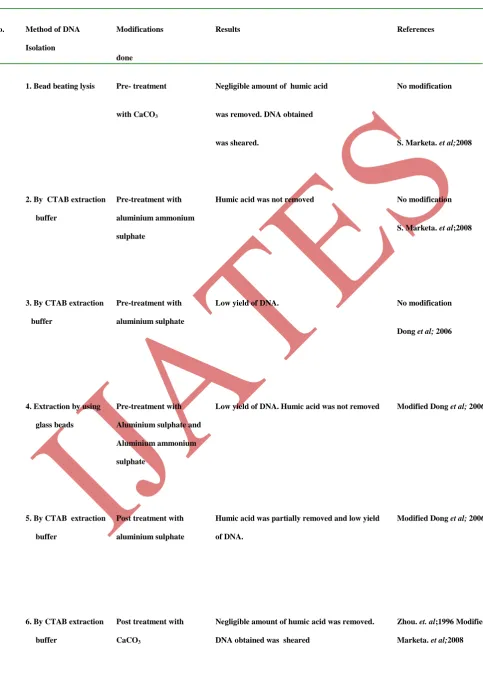
The quality and yield of DNA extracted from 5g of soil samples by different extraction and purification
procedures was compared with the optimized protocol (Table 1). Pretreatment with calcium chloride and
aluminium ammonium sulphate failed to remove humic substances. Pre-treatment with aluminium ammonium
sulphate and ammonium sulphate was not suitable for efficient humic acids removal, however the post treatment
with aluminium sulphate enabled partial removal of humic substances, but the DNA yield was low. DNA
extracted by CTAB extraction buffer method lead to insignificant removal of humic acids along with persistent
degradation of DNA. DNA extracted by CTAB extraction buffer method [9] with 10%
polyvinylpolypyrrolidone treatment resulted in no removal of humic content of the samples. In yet another
modification of DNA extraction by Zhou et al; protocol DNA extracted was incubated with 2% CaCl2 overnight
however, partial removal of humic acid was seen The highest yield and the most efficient removal of humic
acids was observed using CTAB extraction buffer method coupled with PEG/ NaCl precipitation and CaCl2
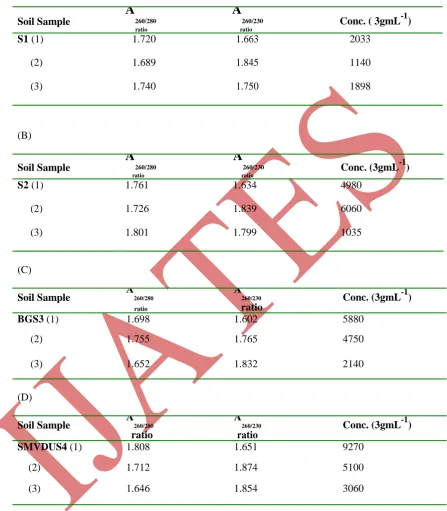
purification (Fig 1). To evaluate DNA purity for enzyme digestion and PCR amplification spectrophotometric
analysis was performed, and, A260/A230 and A260/A280 nm ratios were determined (Table 2). The results indicated
that the modified method yielded DNA free of inhibitory humic compounds. In addition, the extraction of soil
DNA by other methods and commercially available kits (Table 1) resulted in low concentration of DNA and
inefficient removal of humic acids from the soil samples.
Qualitative estimation for checking the purity of extracted DNA was analyzed by PCR as well as restriction
Page | 549
of microbes in these different samples. The metagenomic DNA isolated from different soil samples was
digested with restriction endonucleases without giving any problems (Fig 3 and 4). The aim was to isolate the
pure DNA from the soil samples which could be used for the construction of metagenomic libraries in E.coli.A library of approximately 15,000 colonies was constructed in E.coli using the isolated DNA in pUC18 vector.The
library was screened for amylase activity using functional screening assay. Two clones were found positive
among the 15,000 colonies screened so far (Figure 5). The clones are being further characterized in order to
exploit their biotechnology potential.
IV. DISCUSSION
Theoretically, the microbial DNA, isolated from a soil sample represents the collective DNA of all the
indigenous soil microorganisms [17,18]. In a broad range the DNA strategies are separation of cells and direct
lysis [7].The main problem when isolating DNA from soil is co-precipitation of contaminating substances
(humic compounds & phenolics) that interfere with downstream processes [19]. Although there are many
methods published worldwide for the extraction of soil DNA and many commercial kits are available as well,
the problem mentioned above is usually encountered in these protocols as physico-chemical properties of soil
vary from location to location.
One of the most accepted methods i.e., CTAB extraction buffer method was followed [9]. The method used the
detergents like CTAB and SDS for the direct cell lysis. This method could extract the DNA somewhat
efficiently but could not remove the humic acid content. The high content of humic acid could interfere with
other processes like PCR amplification and restriction digestion. To remove the humic acids different pre and
post treatments with aluminium sulphate, aluminium ammonium sulphate, calcium carbonate and PVPP were
given in conjunction with CTAB extraction buffer but humic acid was not efficiently removed..One more
method of mechanical lysis by bead beating [8] was also used but the method showed negligible removal of
humic acids . Most promising method seemed to be extraction by modified CTAB extraction buffer method
complemented with 0.5 volumes of 50% PEG and 0.1 vol of 1M NaCl precipitation and purification by one step
post treatment with 2% CaCl2 .The role of Cacl2 in purification of the extracted soil DNA is that it prevents the
humic substances, to undergo oxidation forming quinones, which covalently bind to the DNA, thus hampering
the DNA and Taq polymerase interaction. The gel analysis as well as spectrophotometric analysis showed high
concentration of DNA and efficient removal of humic substances .
Inhibition of PCR is often sourced to DNA contaminated with humic acids co-extracted from the soil [3, 20, 21].
The efficacy of the method described in this paper to remove humic acids was verified by 16S rDNA PCR
amplification and to demonstrate that the isolated soil DNA represents community of micro-organisms PCR
amplification was performed with ITS primers The purified DNA samples were then successfully partially
digested using restriction endonuclease Sau3A1. The restriction digestion was optimised in order to yield 2-6kb fragments. The protocol optimized in the laboratory worked efficiently on all the tested soil types and
Page | 550
V. CONCLUSION
Hence, the soil DNA extraction and purification method described here, is a simple and efficient method for
most of the soil samples. DNA extracted from different samples could be purified in one hour with 2% CaCl2
treatment, resulting in DNA pure enough to be used for restriction digestion and PCR, as compared to the
commercially available kits in the market and other reported methods which resulted in lower concentration of
DNA along with only 60-70% success rate in PCR amplification of the extracted soil DNA. Thus, the optimized
laboratory method yielded higher concentration of DNA free of humic substances enabling us to construct
metagenomic library meant for selecting clones that exhibit amyloytic activity.
VI. ACKNOWLEDGEMENT
The work was financially supported by Council of Scientific and Industrial Research (CSIR), New Delhi,
Government of India; Project No. 37(1545)/12/EMR-II entitled “Exploring Microbial Diversity and Mining
Novel Hydrolases from Brackish Water Lakes of Ladakh Region by Metagenomic Approach”. *Miss Reena
Singh is thankful to Council of Scientific and Industrial Research (CSIR), Government of India for the award of
Senior Research Fellowship.
VII. REFERENCES
[1] P. Lorenz , and J. Eck , Metagenomics and industrial applications, Nat Rev Mic robiol, 3, 2005, 510–516.
[2] R.I. Amann, W. Ludwig and K.H. Schleifer KH, Phylogenetic identification and in situ detection of individual microbial cells without cultivation. Microbiol Rev, 59, 1995, 143– 169.
[3] P.R. Robe, C. Nalin, T.M. Capellano and V.P.Simonet, Extraction of DNA from soil. Eur J Soil Biology, 39, 2003, 183-190.
[4] I.G. Wilson, Inhibition and facilitation of nucleic acid amplification. Appl Environ Microbiol, 6, 1997, 3741– 3751.
[5] H.A. Iqbal, F. Zhiyang, and F.B. Sean, Biocatalysts and small molecule products from metagenomic studies.
Current Opinion in Chemical Biology, 16, 2012, 109-116.
[6] M.I.More, J.B.Herrick, M.C.Silva, W.C. Ghiorse, and E.L.Madsen, Quantitative cell lysis of indigenous
microorganisms and rapid extraction of microbial DNA from sediment. Appl Environ Microbiol, 60, 1994, 1572– 1580.
[7] C.L. Roose Amsaleg, S.E. Garnier, and M. Harry, Extraction and purification of microbial DNA from soil
and sediment samples. Appl Soil Ecol, 18, 2001, 47-60.
[8] D.Dong, A.Yan , H.Liu, X. Zhang and Y.Xu, Removal of humic substances from soil DNA using aluminium
sulphate. J Microbiol Methods, 66, 2006, 217-222.
[9] J. Zhou, M.A. Bruns, and J.M. Tiedie, DNA recovery from soils of diverse composition. Appl Environ Microbiol, 62, 1996, 316-322.
Page | 551
[11] J. Cho, D. Lee, Y. Cho, J. Cho, and S. Kim, Direct extraction of DNA from soil for amplification of16S rDNA gene sequences by polymerase chain reaction. J Microbiol, 34, 1996, 229–235.
[12] D.N.Miller, J.E. Bryant, E.L. Madsen and W.C. Ghiorse, (1999) Evaluation and optimization of DNA extraction and purification procedures for soil and sediment samples. Appl Environ Microbiol, 65, 1999, 4715–4724.
[13] M.I. More, J.B. Herrick, M.C. Silva, W.C. Ghiorse, and E.L. Madsen, Quantitative cell lysis of indigenous microorganisms and rapid extraction of microbial DNA from sediment. Appl Environ Microbiol, 60, 1994, 1572– 1580.
[14] A. Janessen, C. Sperl, W. Bouten , and J.M. Verstraten, Soil water content measurement at different scales:
accuracy of time domain reflectometry and ground penetrating radar. Journal of Hydrology, 245, 2001, 48-58.
[15] C.R. Kusk, K.L. Banton, D.L. Adorada, P.C.Stark, and P.J. Jackson, Small-scale DNA sample preparation method for field PCR detection of microbial cells and spores in soil. Appl Environ Microbiol 64, 1998, 2463–2472.
[16] A. Matsuda, S. Tazumi, T. Kagawa, O. Sekizuka, J.E. Murayama, B.C.Moore, and Millar, Homogeneity of the 16S rDNA sequence among geographically disparate isolates of Taylorella equigenitalis. BMC Veterinary Research 2, 2006, 1.
[17] J. Handelsman, M.R. Rondon, S.F. Brady, J. Clardy, and R.M. Goodman, Molecular biological access to
the chemistry of unknown soil microbes: a new frontier for natural products. Chem Biol 5, 1998, R245– R249.
[18] M.R. Rondon, R.M.Goodman, and J. Handelsman, The earth’s bounty: accessing soil microbial diversity.
TIBTECH 17, 1999, 403–409.
[19] Y.Tsai, and B.H. Olson, Rapid method for separation of bacterial DNA from humic substances in
sediments for polymerase chain reaction. Appl Environ Microbiol 58, 1992, 2292-5.
[20] J.E.Stach, S. Bathe,J.P. Clapp and R.G. Burns, PCR-SSCP comparison of 16S rDNA
sequence diversity in soil DNA obtained using different isolation and purification methods. FEMS Microbiol ECOL 36, 2001, 139- 151.
[21] C.C.Tebbe, and W. Vahjen , Interference of humic acids and DNA extracted directly from soil in detection
Page | 552
FIGURE LEGENDS:
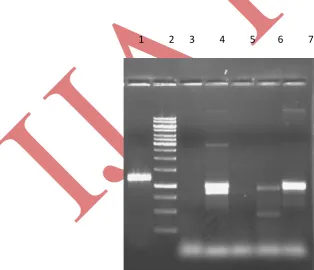
Fig 2(a): 1% Agarose gel showing 16S rDNA amplification products of extractions of PTS1, NTS2, BGS3 and SMVDUS4 DNA with PEG precipitation+ CaCl2 treatment. Lanes. 1. 1kb DNA ladder; 2.
Page | 553
Fig 2(b): 1% Agarose gel showing amplification products of extractions of PTS1, NTS2, BGS3 and SMVDUS4 DNA with ITS primers. Lanes. 1. 1kb DNA ladder; 2. PTS1 soil DNA; 3. NTS2 soil DNA; 4. BGS3 soil DNA; 5. SMVDUS4 soil DNA
1 2 3 4 5
1 2 3 4 5 6 7
Page | 554
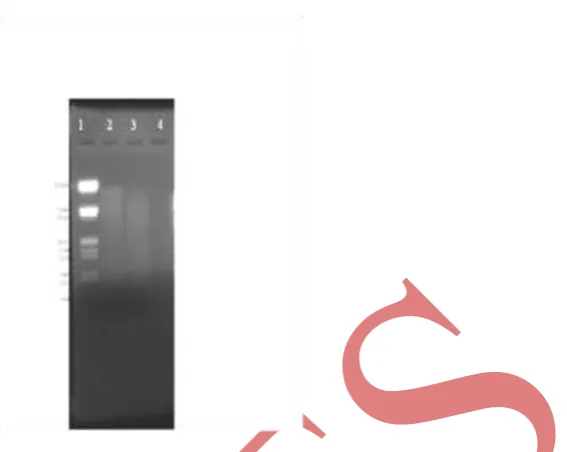
Fig 3: 1% Agarose gel showing partial restriction digestion of PTS1 and NTS2 DNA. Lanes. 1. λ DNA cut with Eco RI/HindIII; 2. Sau3AI digested PTS1 DNA (45 mins); 3. Sau3AI digested
NTS2 DNA (1Hr).
Fig 4: 1% Agarose gel showing partial restriction digestion of PTS1 and NTS2 DNA. Lanes. 1. λ DNA cut with Eco RI/HindIII; 2. Sau3AI digested BGS3 DNA (30 mins); 3. Sau3AI digested SMVDUS4 DNA (1Hr).
Page | 555
TABLE 1: Comparison of various soil DNA extraction and purification methods
S.No. Method of DNA
Isolation
Modifications
done
Results References
1. Bead beating lysis Pre- treatment
with CaCO3
Negligible amount of humic acid
was removed. DNA obtained
was sheared.
No modification
S. Marketa. et al;2008
2. By CTAB extraction
buffer
Pre-treatment with
aluminium ammonium
sulphate
Humic acid was not removed No modification
S. Marketa. et al;2008
3. By CTAB extraction
buffer
Pre-treatment with
aluminium sulphate
Low yield of DNA. No modification
Dong et al; 2006
4. Extraction by using
glass beads
Pre-treatment with
Aluminium sulphate and
Aluminium ammonium
sulphate
Low yield of DNA. Humic acid was not removed Modified Dong et al; 2006
5. By CTAB extraction
buffer
Post treatment with
aluminium sulphate
Humic acid was partially removed and low yield
of DNA.
Modified Dong et al; 2006
6. By CTAB extraction
buffer
Post treatment with
CaCO3
Negligible amount of humic acid was removed.
DNA obtained was sheared
Zhou. et. al;1996 Modified S.
Page | 556
10. Mo Bio Kit, CA, USA --- Low concentration of DNA ---
11. Hiper Soil DNA Kit, --- Inefficient removal of humic acids ---
Himedia,India
12. DNA extraction by using Treatment with Low yield of DNA. D.Verma. et.al;201 1
activated charcoal. activated charcoal &
modified extraction buffer
13. DNA extraction by using
glass beads Treatment with sodium phosphate Humic acid not removed A.Ogram et. al ; 1987
buffer & sodium dodecyl sulphate.
14. *By CTAB extraction buffer with 2% CaCl2 post
50% PEG and 1M NaCl treatment with 1 hour Humic acid was efficiently removed This work
(for soil samples) incubation and high yield of DNA.
*Work presented in this paper
7. By CTAB extraction
buffer
8. By CTAB extraction
buffer
9. By CTAB extraction
buffer
Post treatment with 10%
PVPP
Post treatment with
aluminium ammonium
sulphate
Overnight Post treatment
with 2% CaCl2.
Humic acid was not removed
Humic acid was not removed
Humic acid was not completely removed.
Zhou. et. al;1996
Modified Krsek. et. al;1999
Nalin et. al 1999.
No modification
Zhou. et. al;1996
Braid.et. al; 2003
Modified Zhou. et. al;1996
Page | 557
TABLE 2: Spectrophotometric analysis of extracted DNA from different soil samples
(A)
Soil Sample
A
260/280A
260/230 Conc. ( 3gmL-1)
ratio ratio
S1 (1) 1.720 1.663 2033
(2) 1.689 1.845 1140
(3) 1.740 1.750 1898
(B)
Soil Sample
A
260/280A
260/230 Conc. (3gmL-1)
ratio ratio
S2 (1) 1.761 1.634 4980
(2) 1.726 1.839 6060
(3) 1.801 1.799 1035
(C)
Soil Sample A260/280
A
260/230 Conc. (3gmL-1)
ratio ratio
BGS3 (1) 1.698 1.602 5880
(2) 1.755 1.765 4750
(3) 1.652 1.832 2140
(D)
Soil Sample A260/280
A
260/230 Conc. (3gmL-1)
ratio ratio
SMVDUS4 (1) 1.808 1.651 9270
(2) 1.712 1.874 5100
(3) 1.646 1.854 3060