Facial Expression Recognition Through Machine
Learning
Nazia Perveen, Nazir Ahmad, M. Abdul Qadoos Bilal Khan, Rizwan Khalid, Salman Qadri
Abstract: Facial expressions communicate non-verbal cues, which play an important role in interpersonal relations. Automatic recognition of facial ex-pressions can be an important element of normal human-machine interfaces; it might likewise be utilized as a part of behavioral science and in clinical practice. In spite of the fact that people perceive facial expressions for all intents and purposes immediately, solid expression recognition by machine is still a challenge. From the point of view of automatic recognition, a facial expression can be considered to comprise of disfigurements of the facial parts and their spatial relations, or changes in the face's pigmentation. Research into automatic recognition of the facial expressions addresses the issues encompassing the representation and arrangement of static or dynamic qualities of these distortions or face pigmentation. We get results by utilizing the CVIPtools. We have taken train data set of six facial expressions of three persons and for train data set purpose we have total border mask sample 90 and 30% border mask sample for test data set purpose and we use RST- Invariant features and texture features for feature analysis and then classified them by using k- Nearest Neighbor classification algorithm. The maximum accuracy is 90%.
Keywords CVIPtools, RST- Invariant, KNN, Human-Machine Interfaces
————————————————————
1. INTRODUCTION
Facial expression is the most effective form of non verbal communication and it provides intimation about emotional state, mindset and intention. Facial expressions not only can change the flow of conversation but also provides the listeners a way to communicate a wealth of information to the speaker without even uttering a single word. When the facial expression does not match with the spoken words, then the information pass on by the face gets more power in interpreting the information.
From the perspective of automatic recognition, a facial ex-pression can be considered to consist of deformations of facial components and their spatial relations, or changes in the pig-mentation of the face. Facial expressions represent the changes of facial appearance in reaction to a person’s inside emotional states, social communications or intentions. To communicate the emotions and express the intentions the Fa-cial expression is the most powerful, natural, non verbal and instant way for humans. It is faster to communicate the emo-tions through facial expressions than through verbalization. The requirement for proficient communication channels be-tween machines and humans becomes progressively impera-tive in light of the fact that machines and individuals start to share a variety of tasks. Systems to form these communication channels are known as human machine interaction (HMI) systems. Progresses in technology make it possible the de-velopment of more useful HMI systems which no more depend on regular devices for example keyboard, mouse and displays but take commands directly from user’s voice and mimics. Such systems intend to simulate human-human interaction by only utilizing communication channels utilized between hu-mans and not requiring artificial equipment. Human-machine interaction should be enhanced to more nearly simulate human to human interaction before machines take more places in our _____________________________
Nazia Perveen, GCUF Layyah Campus, Pakistan,
PH-03451652331. E-mail: [email protected]
Nazir Ahmad, The Islamia University Bahawalpur,
Paki-stan, PH-03457937789. E-mail: [email protected]
M. Abdul Qadoos Bilal Khan, GCUF Layyah Campus,
Pakistan, PH - 03217033258. E-mail:
Rizwan Khalid, GCUF Layyah Campus, Pakistan,
PH-03336201747. E-mail: [email protected]
Salman Qadri, The Islamia University of Bahawalpur,
lives. As change of expressions on human face is an intense method for passing emotions, facial expression recognition (FER) will be one of the best steps for improving HMI systems. An automatic facial expression recognition system generally comprises of three main parts: face detection, facial feature points extraction and facial expression classification. In the first step, system obtains input image and performs some image processing techniques on it in order to locate the face region. In static images it is called face localization whereas in videos it is called face tracking. After the face has been located in the image or video frame, it can be evaluated in terms of facial action happening. A feature is a point of interest or a piece of information. There are two types of features that are generally used to represent facial expression: geometric features and appearance features. Geometric features evaluate the dis-placements of certain parts of the face for instance brows or mouth corners, whereas appearance features represent the change in texture of face when particular action is performed. The task of geometric feature measurement is typically asso-ciated with face region analysis, particularly finding and track-ing key points in the face region. Potential problems that take place in face decomposition task could be occlusions and oc-currences of facial hair or glasses. Moreover, defining the fea-ture set is difficult, because feafea-tures should be descriptive and possibly not correlated. The last part of the Facial Expressions Recognition system is based on machine learning theory; spe-cifically it is the classification task. A set of features which were retrieved from face region in the previous stage is the input to the classifier. The set of features is created to explain the facial expression. Classification needs supervised training, so the training set should consist of labeled data. Once the classifier is trained, it can recognize input images by assigning them a specific class label. The most frequently used facial expres-sions classification is done both in terms of Action Units, pro-posed in Facial Action Coding System and in terms of universal emotions: happiness, sadness, anger, surprise, disgust and fear. There are several different machine learning techniques for classification task for instance K-Nearest Neighbors, Artifi-cial Neural Networks, Support Vector Machines, Hidden Mar-kov Models, Expert Systems with rule based classifier, Bayes-ian Networks or Boosting Techniques. Three main issues in classification task are: choosing good feature set, competent machine learning technique and different database for training. Feature set should be composed of features that are
discrimi-native and characteristic for specific expression. Machine learning technique is selected usually by the type of a feature set. The database used as a training set should be big enough and include a variety of data. In facial expression recognition Region of Interests represent the eye pair, nostrils, and the mouth area. Region of Interest is related to define a large re-gion which contains the point that we want to detect. In Facial Expression Recognition Systems, only particular regions of the face are used for discrimination. The areas of the eyes, eye-brows, mouth, and nose are the main features in any Facial Expression Recognition System. Some facial recognition algo-rithms perceive facial components by extracting landmarks, or elements, from a picture of the subject's face. For instance, an algorithm may assess the relative position, size, and state of the eyes, nose, cheekbones, and jaw. These features are then used to search for other images with identical features. The majority of the facial expression recognition methods reported yet are focused on recognition of six primary expression cate-gories such as: happiness, sadness, fear, anger, disgust and grief.
2. RELATED WORK:
extracted from the sequences of facial expression images. The landmark initialization and tracking is based on the Elastic Bunch Graph Multi-resolution method. Multi class AdaBoost with dynamic time warping similarity distance between the feature vector of input facial expression and prototypical facial expression, is used as a weak classifier to select the subset of discriminative feature vectors. The recognition rate of 95.17% using feature selective multi class AdaBoost, and 97.35% us-ing SVM on boosted features, is achieved on the Extended Cohn-Kanade (CK+) facial expression database. Abidin and Harjoko (2012) focused on static images of single person for facial expression recognition. They used integral projection method for localization and segmentation of face portion from the images. The features have been extracted by using fish-erface method. To recognize the facial expression the neural network was used as a classifier. The Japanese Female Facial Expression (JAFFE) database has been used for experiments. The recognition rate of proposed system was 86.85%. Zavaschi et al., (2013) introduced SVM ensemble classifier based on the combination of Gabor filters and LBP feature vector. Multi Objective Genetic Algorithm is used for searching the best combination of SVM classifiers for facial expression recognition. Experimental results on JAFFE and Cohn-Kanade databases have shown the effectiveness of the proposed ap-proach in finding powerful ensembles, which improves the recognition rates between 5% and 10% over usual approaches that utilize single feature sets and single classifiers. Sarawagi and Arya (2013) designed a competent system for recognition of facial expression in an image sequences. They emphasized on the color normalization and facial feature extraction. They used Local Binary Pattern for feature detection. To discover facial landmarks automatic landmark detection technique is introduced which used Local Binary Pattern. On the Indian database the accuracy of 94.7% is observed. Hablani et al., (2013) extracted features based on Local Binary Pattern. They have chosen some important facial parts like sub parts of eyes, nose and mouth as facial features. They used the templates of extracted facial features as template matching to classify the expression. Their proposed approach is better than ap-proaches that use the whole face image. The proposed meth-od integrates person identity to perform better than usual ex-pression systems. The proposed person dependent approach attains higher recognition rates. For classification Chi square distance is used as measure of similarity. They used Support
variations among face images. To detect the face in an image they proposed the Hue Saturation Value (HSV) color model. For reducing the high dimensionality of the eigenspace Prin-cipal Component Analysis (PCA) has been used. By calculat-ing the Euclidean distance between the input test image and the mean of the eigenfaces of the training dataset the various emotions are recognized. Chao et al., (2015) enhanced the performance of the popular LBP feature. They applied the techniques of expression specific extension and symmetric extension and proposed the es-LBP feature. That captures the better local information of faces on important fiducial points. Furthermore, the LPQ feature, which was initially used for texture classification, is also integrated in the proposed facial expression recognition system. They proposed the class-regularized locality preserving projection (cr-LPP) method for dimensionality reduction to better separate different expressions and match the usage of classifiers. The recogni-tion rate of the proposed method is 96.19%. Yu and Liu (2015) combined the appearance descriptors and geometric features of the image for facial expression recognition. To represent facial appearance the covariance descriptors containing dif-ferent textural features are computed. Then to present a gen-eral facial movement description of the facial expression the geometric features are detected. To form a vector representa-tion of the facial expression the appearance and geometric features are combined. The proposed method shows encour-aging performance on the CK+ database. Zhang and Tjondronegoro (2011) proposed a facial expression recognition system using features extracted from facial movements. The features are obtained by extracting patch-based 3D Gabor features, selecting the salient patches, and performing patch matching operations. To recognize the six basic emotions the resultant distance features are fed into a multiclass support vector machine (SVM). The experimental results also display significant performance improvements because of the consid-eration of facial movement features and promising perfor-mance under face registration errors.
3. METHODOLOGY:
We use these approaches: Support Vector Machine, Artificial Neural Network and K Nearest Neighbours (KNN). In pattern recognition, the k-Nearest Neighbors algorithm (or k-NN for short) is a non-parametric method used for classifica-tion and regression. In both cases, the input consists of
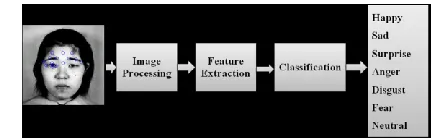
the k closest training examples in the feature space. In Pre-processing we take the image and preprocessed with using these techniques then after this features extraction. In features extraction technique some predefined positions as facial fea-tures. In next step feature selection and then classified them.
Figure 1. Overview of Facial Expression Recognition System
3.1. Image Acquisition
Images used for facial expression recognition are static images. To take the images of expressions of people we use a Pana-sonic camera (Model DMC- LS5) with focal length of 5mm is used. The format of images is 24 bit color JPEG with resolution of 4320x 3240 pixels. The distance between the camera and person was four feet and images of six basic expressions of each person were taken.
3.2. Image Preprocessing
The image preprocessing procedure comes as a very im-portant step in the facial expression recognition task. The ob-jective of the preprocessing phase is to take images which have normalized intensity, uniform size and shape, and repre-sent only a face expressing certain emotion. The prepro-cessing procedure should also reduce the effects of illumina-tion and lighting. Expression representaillumina-tion can be delicate to translation, scaling, and rotation of the head in a picture. To battle the effect of these pointless changes, the facial image may be geometrically institutionalized before classification.
3.3. Feature Extraction
to keep up essential data having high segregation force and high security.
3.4. Feature Selection
Feature selection is concerned with choosing of a subset of features perfectly necessary to perform the classification task from a larger set of candidate features. The feature selection step has an effect on both the computational complexity and the quality of the classification results. It is essential that the information contained in the selected features is adequate to correctly verify the input class. Too many features may un-necessarily raise the complexity of the training and classifica-tion tasks, while a poor, inadequate selecclassifica-tion of features may have a detrimental effect on the classification results. The process of selecting a sub set of features improves the effi-ciency of classifier and reduces execution time.
3.5. Classification
The last step of Facial Expressions Recognition systems is to recognize facial expression based on the extracted features. Classification refers to an algorithmic approach for recognizing a given expression as one of a given number of expressions. We use K- Nearest Neighbor classifier for classification. The K- Nearest Neighbor algorithm is a non parametric method used for classification and regression. The input comprises of K closest training examples in the feature space. The output is class participation. By a majority vote of its neighbors an object is classified, with the object being allotted to the class most common among its k nearest neighbors.
3.6. Physically Data Set
4. RESULTS
We get results by using the CVIPtools.
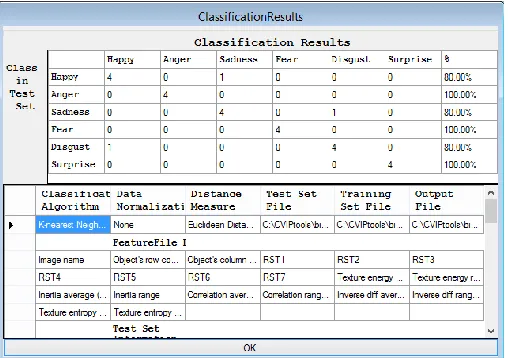
Table 1. Confusion Table for Person
The above table is a confusion table of six facial expressions of person A. We take train data set. We have ratio of 30, 70 test data set for classification. The feature analysis is performed by using RST- Invariant features and texture features. The texture difference is 2. After that pattern classification is performed. The data normalization is no normalization. The distance measure is Euclidean Distance. The classification algorithm is k- Nearest Neighbor and k= 2. The algorithm testing is Train-ing/Test. The accuracy of Happy is 100%, Anger is 80%, Sad-ness is 80%, Fear is 100%, disgust is 80% and surprise is 100%. The total accuracy rate is 90%.
Figure 2. Classification Result for Facial Expressions of
Per-son A
Table 2. Confusion Table for Person B
The above table is a confusion table of six facial expressions of person B. We take train data set. We have ratio of 30, 70 test data set for classification. The feature analysis is performed by using RST- Invariant features and texture features. The texture difference is 2. After that pattern classification is performed. The data normalization is no normalization. The distance measure is Euclidean Distance. The classification algorithm is k- Nearest Neighbor and k= 2. The algorithm testing is Train-ing/Test. The accuracy of Happy is 80%, Anger is 80%, Sad-ness is 80%, Fear is 100%, disgust is 66.67% and surprise is 100%. The total accuracy rate is 84%.
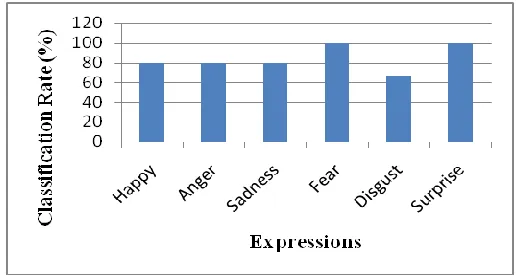
Figure 3. Classification Result for Facial Expressions of
Per-son B
The above graph shows the classification results of six facial expressions of person B. The accuracy of Happy is 80%, An-ger is 80%, Sadness is 80%, Fear is 100%, disgust is 66.67% and surprise is 100%.
Table 3. Confusion Table for Person C
The above table is a confusion table of six facial expressions of person C. We take train data set. We have ratio of 30, 70 test data set for classification. The feature analysis is performed by using RST- Invariant features and texture features. The texture difference is 2. After that pattern classification is performed. The data normalization is no normalization. The distance measure is Euclidean Distance. The classification algorithm is k- Nearest Neighbor and k= 2. The algorithm testing is Train-ing/Test. The accuracy of Happy is 80%, Anger is 80%, Sad-ness is 66.67%, Fear is 80%, disgust is 80% and surprise is 100%. The total accuracy rate is 81%.
Figure 4. Classification Result for Facial Expressions of
Per-son C
5. CONCLUSION
All Confusion tables have shown different classification results of six facial expressions. Confusion table 4.1 has shown maximum accuracy of 90% at k= 2, where k is k- Nearest Neighbor algorithm. It is shown from all the confusion tables that Surprise expression has better results of 100% accuracy than other expressions. We have taken train data set of six facial expressions of three persons and we have total border mask sample 90 for train data set purpose and 30% border mask sample for test data set purpose and then classified them with better result. For better result we use RST- Invariant fea-tures and texture feafea-tures.
REFERENCES
[1] Giorgana, G., and Ploeger, P. G., 2012, Facial expression recognition for domestic service robots, In Robo Cup 2011: Robot Soccer World Cup XV, pp. 353-364.
[2] Wang, Z. and Xiao, N., 2013, Using MD-Adaboost to En-hance Classifier of Facial Expression Recognition, Journal of Computational Information Systems, 9(3), 923- 932.
[3] Ghimire, D., and Lee, J., 2013, Geometric feature-based facial expression recognition in image sequences using multi-class Adaboost and support vector ma-chines, Sensors, 13(6), 7714-7734.
[4] Abidin, Z., and Harjoko, A., 2012, A neural network based facial expression recognition using fisherface, International Journal of Computer Applications, 59(3), 30-34.
[5] Zavaschi, T. H., Britto, A. S., Oliveira, L. E., and Koerich, A. L., 2013, Fusion of feature sets and classifiers for facial expression recognition, Expert Systems with Applica-tions, 40(2), 646-655.
[6] Sarawagi, V., and Arya, K. V., 2013, Automatic facial ex-pression recognition for image sequences,
In Contemporary Computing (IC3), Sixth International Conference on, 278-282.
[7] Hablani, R., Chaudhari, N., and Tanwani, S., 2013, Recognition of Facial Expressions using Local Binary Patterns of Important Facial Parts, International Journal of
Image Processing (IJIP), 7(2), 163- 170.
[8] Lingareddy, M. and D, Haritha., 2013, An Optimal Face Recognition Tool, International Journal of Research in En-gineering and Technology, 2(3), 351-357.
[9] Zhang, H., Luo, S., and Yoshie, O., 2013, Facial expres-sion recognition by analyzing features of conceptual re-gions, In Computer and Information Science, 529-534.
[10]Das, D., 2014, Human’s Facial Parts Extraction to Rec-ognize Facial Expression, International journal on infor-mation theory, 3(3), 65-72.
[11]Hai, T. S., Thai, L. H. and Thuy, N. T., 2015, Facial Ex-pression Classification Using Artificial Neural Network and K-Nearest Neighbor, International Journal of Information Technology and Computer Science (IJITCS), 7(3), 27- 32.
[12]De, A., Saha, A., and Pal, M. C., 2015, A Human Facial Expression Recognition Model Based on Eigen Face Ap-proach, Procedia Computer Science, 45, 282-289.
[13]Chao, W. L., Ding, J. J., and Liu, J. Z., 2015, Facial ex-pression recognition based on improved local binary pat-tern and class-regularized locality preserving projec-tion, Signal Processing, 4(7), 1-39.
[14]Yu, H., and Liu, H., 2015), Combining appearance and geometric features for facial expression recognition, In Sixth International Conference on Graphic and Image Processing , 944308-944308.