364 | P a g e
WATERMARKING TECHNIQUE FOR SECURITY
Mr.J. K. Ravan
1, Dr.T.C.Thanuja
21
Assistant Professor,Dhananjay Mahadik Group Of Institutions, Kolhapur, Maharashtra(India)
2
Professor,Visvesvaraya Technical University, Belagavi, Karnataka (India)
Abstract:
The term "digital watermark" was first coined in 1992 by Andrew Tirkel and Charles Osborne. A digital
watermark is a kind of marker covertly embedded in a noise-tolerant signal such as an audio, video or image
data. It is typically used to identify ownership of the copyright of such signal. "Watermarking" is the process of
hiding digital information in a carrier signal; the hidden information should, but does not need to, contain a
relation to the carrier signal. Digital watermarks may be used to verify the authenticity or integrity of the
carrier signal or to show the identity of its owners. It is prominently used for tracing copyright infringements.
Keywords:
Watermarking, SINR, Discrete Wavelet transform, DFT, FFT, and DCT.
I. INTRODUCTION
Digital watermarking technology started as early as 1282 in Italy, where paper watermarks were used to
indicate the paper brand and the mill that produced it. After this invention, the method quickly spread over
Italy and then over Europe. Although originally intended for paper brand and mill identification, the technique
was later enhanced to include paper format, quality and strength. They were also used to date and authenticate
paper.[10]
During 18th century, this technique was first used for installing anti-counterfeiting measures on money
and other documents(http://www.ncd.matf.bg.ac.yu/casopis/05/Vuckovic/ Vuckovic.pdf). They are still widely
used as security features in currency today. The first watermark, that is the base of today’s technology, is
the patent filed in 1954 by Emil Hembrooke for identifying musical works.
It was only after 1995, interest in digital watermarking increased and several organizations began
including watermarking technology in different standards. The Secure Digital Music Initiative (SDMI, 1999)
adopted watermarking as a central component to its music protection system. The Copy Protection Technical
Working Group (CPTWG) (Bell, 1999) considered watermarking technology for video content protection
on DVDs. The International Organization for Standardization (ISO) showed an interest in watermarking
for designing MPEG standards (Cox et al., 2008). VIVA (Depovere et al., 1999) and Talisman (Hartung
and Kutter, 1999), both sponsored by European Union, employed the technology for broadcast
monitoring.
Digital watermarking is the embedding or hiding of information within a digital file without noticeably altering
the file itself. Now digital image watermarking is increasing attention due to the fast developing in the internet
traffic. Digital watermarking achieved is popularity due to its significance in content authentication and
copyright protection for digital multimedia data. It is inserted invisible in host image so that it can be extracted
365 | P a g e
for copyright protection of multimedia data from being misused [2, 3]. Watermarking is the process ofembedding data into a multimedia element such as an image, audio or video file for the purpose of
authentication. This embedded data can be later extracted or detected the multimedia data for security purposes.
A watermark is information about origin, ownership and copy control. This information is embedded in
multimedia content with take care of imperceptibility and robustness. According to the embedding domain of
the host image, digital image watermarking techniques can be categorized into one of the two domains via
spatial and transform. The simplest technique in the spatial domain methods is to insert the watermark image
pixels in the least significant bits (LSB) of the host image pixels [4]. In capacity of data hiding is high in these
methods but hardly robust. Watermarking in transform domain is more secure and robust to various attacks. In
Frequency domain, watermark is not added to the image intensities or pixels, but to the values of its transform
coefficients. Then to get the watermarked image, one should perform the transform inversely. It includes DCT
(Digital Cosine Transform), DFT (Digital Fourier Transform), and DWT (Digital Wavelet Transform).
II. DIGITAL WATERMARKING SCHEMES
Watermarking schemes can be classified as follows:
1) Spatial Domain: The watermarking system directly alters the main data elements (like pixels in an image) to
hide the watermark data.
2) Transformed Domain: The watermarking system alters the frequency transforms of data elements to hide the
watermark data. This has proved to be more robust than the spatial domain watermarking.
III. LITERATURE SURVEY
The term “digital watermarking” came into existence only after 1988 and was coined by Komatsu and
Tominaga (1988). Since then, there has been a huge interest in the field of digital watermarking and
several different techniques have been proposed. Even though watermarks can be included with any digital
content, this research focuses on image watermarking and the following sections review only those
implementations that are related to this field.[6]
Shaikh Shoaib, Mahajan R. C. [5] propose implementation of 3-Level DWT algorithms and to have more
secure data a secret key is used. The secret key is given to watermark image during embedding
process and while extracting the watermark image the same secret key is used. To check effectiveness of the
watermark video MSE and PSNR parameters are used. In a typical authentication watermark technique an
authentication signature (AS) is computed from the whole image data and inserted into the image itself.
in cryptography, AS is called message authentication code (using secret-key) or digital signature (using
public/private-key). Secret key contains information about the image that may be checked to verify its integrity.
However, inserting the AS into the image alters the image itself, hence modifying its AS and invalidating
the watermark AWT for binary images that has good visual quality when applied to a generic binary image.
It is used in conjunction with secret-key or public/private key.
Kazuto Ogawa and Go Ohtake [2] propose a watermarking method for HEVC/H.265 video streams that embeds
information while encoding the video. HEVC/H.265 uses a kind of arithmetic coding (CABAC) and it is not
366 | P a g e
embeds information into HEVC streams. In our method, each receiver selects some packets according to theiridentifiers, and therefore, it is necessary to force the receiver to select correct packets by using encryption
schemes. According to [8] it is possible to embed information into a compressed stream using this method
without degrading the content and with an appropriate robustness that meets the requirements of the users.
Somayyeh Mohammadi [3] proposes a novel video watermarking algorithm based on wavelet transform and
chaotic maps. Researcher apply the two dimensional wavelet transform on I-frames and then insert the chaotic
watermark into part of the sub-band coefficients. Since chaotic maps are sensitive to initial values, initial values
of the chaotic maps and their chaotic parameters are exploited as secret keys in our algorithm. Our
watermarking system operates on video compressed using the MPEG-2 compression standard. The watermark is
embedded in the selected wavelet coefficients of the luminance Y of I-frames of the video stream. For
watermark embedding procedure, I-frames are preferred because of two chief reasons. Firstly, their existence in
a video sequence is necessary. Secondly, the two frames P and B are extremely compressed by motion
compensation
.
Vladimír bánoci, Martin Broda, Gabriel Bugár, Dušan Levický [4] propose two dimensional spread spectrum
watermarking framework based on Direct Spread Spectrum theory using PN sequences. The presenting schema
allows acquiring a high level of robustness with desired imperceptibility. The aim of this paper was to present
robust and adaptive watermarking system for multimedia protection, where hidden watermark provides a
desired requisition against copyright infringement. Media content delivery system incorporated by
cryptographic public-key was proposed in the paper as part of. The framework concept was applied to digital
video content to simulate 2D-level spreading technique of hidden watermark data. Several watermarks can be
superimposed using this technique if different pseudo-noise sequences are used for modulation. This requires
application of PN sequences with very low cross-correlation properties, where different pseudo-noise sequences
are in general orthogonal and they can be retrieved in arbitrary order and independently from each other. Thus,
the pseudo-noise signal is the secret key for embedding and retrieval of watermark, and for security reason, PN
sequences should be used that are not easy to guess.
Tianrui Zong, Yong Xiang, and Iynkaran Natgunanathan [5] propose a histogram-based image watermarking
method to tackle with both cropping attack and RBAs. In this method first the gray levels are divided into
groups. Secondly the groups for watermark embedding are selected according to the number of pixels in them,
which makes this method fully based on the histogram shape of the original image and adaptive to different
images. Then the watermark bits are embedded by modifying the histogram of the selected groups. Since
histogram shape is insensitive to cropping and independent from pixel positions, the proposed method is robust
to cropping attack and RBAs. Besides, it also has high robustness against other common attacks. The histogram
of an image is naturally insensitive to cropping and independent from pixel positions, so it is ideal to be
exploited in image watermarking to tackle with cropping attack and RBAs. Compared to the traditional
histogram-based method, the superior performance of proposed method is demonstrated by simulation examples
by authors in the research article.
Ming Li, Ngwe Thawdar, Dimitris A. Pados, Stella N. Batalama, Michael J. Medley [6], investigate the problem
of embedding data in raw video sequences with minimum video mean-square distortion for any required data
367 | P a g e
interest, we find the optimal carrier and scalar parameterized linear operator on the video data that maximize theoutput signal-to-interference-plus-noise ratio (SINR) of the maximum-SINR data receiver filter or, equivalently,
minimize the average embedding distortion for any target message extraction error rate. The procedure is
extended from single-carrier to multi-carrier (multiple messages) embedding. As a practical consideration, a
sub-optimal computationally efficient embedding algorithm is also proposed. Extensive experimental results
demonstrate that sub-optimal embedding as described has video distortion versus data extraction error rate
performance comparable to optimal embedding. Our studies also demonstrate the robustness of the optimal (and
sub-optimal) embedding schemes to H.264 compliant encoding. This paper considered the problem of
single-carrier and multi-single-carrier (multiple sessions) data embedding in linearly modified (transform) domains of raw
video sequences with minimum video mean-square distortion for any required data recovery error rate.
Sub-optimal, single-frame-only designed embedding was also considered.
The issues with all described approaches arises when we consider the resistance against decryption attacks of
the algorithms. The spatial additive watermarks can directly be detected and subtracted to find unsecure original
image. The approach of transform algorithms such as 2 dimensional DFT, FFT, DWT, and DCT also has
limitations as they are non-robust against component analysis approaches such as advanced modified PCA or
ICA. The static temporal watermarks are also susceptive against forced iterative detection algorithms.
The text or symbolic watermarks can also be broken as they have a limited combinations. For example a
numeric key generated of length 8 characters will have 108 (10,00,00,000) combinations, for which a forced
key-detection algorithm can be written with intelligent and advanced programming skills.
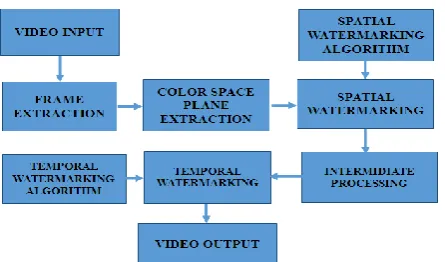
IV. PROPOSED METHOD
Figure. A general block diagram of proposed methodology
VI. PROPOSED METHODOLOGY
The proposed methodology will consider implementation of both spatial and temporal watermarking algorithm.
1. The spatial watermarking algorithm will introduce a static opaque or completely invisible spatial watermark
in each color frame. In Spacial domain the watermark is inserted into the intensity values. It embed the
watermark by modify the pixel value of the host image. Low computational complexity and simplicity are
368 | P a g e
2. The temporal watermarking algorithm will introduce a temporally dynamic watermark which will beslightly different for each frame.
The multiple watermarking algorithms varying spatially as well as temporally will ensure a great robustness
against variability and decryption attacks.
VII. CONCLUSION
Our approach is to generate an ideal digital watermark having improved properties which help to implement it
for security and copyright protection. By using a hybrid spatial and temporal watermarking we can implement
an advanced frequency domain technique, which is mostly invisible to naked eyes.
REFERENCES
[1] Shaikh Shoaib, Prof. R. C. Mahajan “Authenticating Using Secret Key in Digital Video Watermarking
Using 3-Level DWT” 2015 International Conference on Communication, Information & Computing
Technology (ICCICT), Jan. 16-17, Mumbai, India
[2] Kazuto Ogawa and Go Ohtake “Watermarking for HEVC/H.265 Stream” 2015 IEEE International
Conference on Consumer Electronics (ICCE).
[3] Somayyeh Mohammadi “A Novel Video Watermarking Algorithm based on Chaotic Maps in the
Transform Domain”, 2015 international symposium on AISP.
[4] Vladimír bánoci, Martin Broda, Gabriel Bugár, Dušan Levický “2D - Spread Spectrum Watermark
Framework for Multimedia Copyright Protection” 2014 IEEE
[5] Tianrui Zong, Yong Xiang, and Iynkaran Natgunanathan “Histogram Shape-Based Robust Image
Watermarking Method” IEEE ICC 2014, Communication and Information Systems Security Symposium
[6] Ming Li, Ngwe Thawdar, Dimitris A. Pados, Stella N. Batalama, Michael J. Medley “Minimum-Distortion
Data Embedding in Video Streams” IEEE ICC 2014 SP for CS.
[7] D.MATHIVADHANI ,“Multiple Watermarking Approaches Using Enhanced Image Processing
Techniques And Visual Cryptography” , A phd thesis submitted in 2012 at Avinashilingam Institute for
Home science and Higher Education for Women, Coimbatore, 2012.
[8] Jianchao Yang, ,John Wright, Thomas Huang ,Yi Ma, “Image Super-Resolution via Sparse
Representation”, IEEE, 2004
[9] Matt L. Miller, “WATERMARKING WITH DIRTY-PAPER CODES” , 2001 IEEE.
[10] Chun-Shien Lu, Hong-Yuan Mark Liao, “Multipurpose Watermarking for Image Authentication and
Protection”, IEEE TRANSACTIONS ON IMAGE PROCESSING, VOL. 10, NO. 10, OCTOBER 2001
[11] Frank hartung and Bernd Girod ”Watermarking of Uncompressed and compressed video” vol no 3 may
1998
[12] Tae-Yun Chung, Min-Suk Hong, Young-Nam Oh, Dong-Ho Shin and Sang-Hui Park, “DIGITAL
WATERMARKING FOR COPYRIGHT PROTECTION OF MPEGP COMPRESSED VIDEO” , IEEE,