A S tu d y o f V a ria b ility in th e
U ltr a v io le t S p ec tr a o f G a la ctic
W olf-R ayet S ta rs
by
N icole S t-L o u is
A Thesis S ubm itted to TH E UNIVERSITY O F LONDON
for the Degree of D O CTO R OF PH ILO SO PH Y
ProQuest Number: 10609967
All rights reserved
INFORMATION TO ALL USERS
The qu ality of this repro d u ctio n is d e p e n d e n t upon the q u ality of the copy subm itted.
In the unlikely e v e n t that the a u th o r did not send a c o m p le te m anuscript and there are missing pages, these will be note d . Also, if m aterial had to be rem oved,
a n o te will in d ica te the deletion.
uest
ProQuest 10609967
Published by ProQuest LLC(2017). C op yrig ht of the Dissertation is held by the Author.
All rights reserved.
This work is protected against unauthorized copying under Title 17, United States C o d e M icroform Edition © ProQuest LLC.
ProQuest LLC.
789 East Eisenhower Parkway P.O. Box 1346
A b str a ct
The results of an archival search for ultraviolet spectroscopic variability of all galactic, single-lined Wolf-Rayet (W R) stars observed m ore th a n once w ith IUE are presented. At least 35 % of stars are found to be variable; a large proportion considering th a t, in m any cases, the available datasets are not ideally suited for this type of study. For each star, spectra have been co-added to form a mean spectrum w ith an im proved signal-to-noise. The resulting sp ectra are presented as and atlas of high resolution IUE spectra for 28 galactic W R stars.
A detailed study of the ultraviolet spectroscopic variability for the W R stars HD 192163 (W R 136) and HD 50896 (W R 6) has been conducted, using
high resolution IUE spectra. For HD 192163, significant variability is found in the C IV A1550, H e ll A1640 and N IV A1718 P Cygni profiles, over a pe riod of ~ 1 day. Enhanced absorption is observed a t velocities exceeding the
usual m axim um wind outflow velocity. Weak variability is also detected in the emission com ponents of the P Cygni profiles on a sim ilar timescale as the variability found in the absorption com ponents. In the case of HD 50896, varia tions are observed in the absorption and emission com ponents of the N V A1240, C IV A1550, H e ll A1640 and N IV A1718 P Cygni profiles as well as for a se ries of FeV and FeV I lines. As for HD 192163, th e changes in the absorption com ponents occur at velocities in excess of the term inal velocity of the wind. As a result of the excellent tim e resolution of the d ataset for this star, it has been established th a t the absorption com ponent variability takes place on a timescale of ~ 1 day and has a sim ilar recurrence tim escale. The variations
wind instabilities are found to, at least qualitatively, account for the variations observed at the highest outflow velocities.
T he line of sight towards HD 192163 and other stars in Cygnus has been in vestigated. High-velocity com ponents have been detected in H i-type and highly- ionised species towards 10 out of 13 stars in the sam ple and are in terp reted as arising in an expanding supershell enveloping the Cyg O B I association.
A study of the phase-dependent ultraviolet variability observed in high 'i
resblution Copernicus and IU E spectra of the well-known W R + O spectroscopic
binary 7 Velorum is presented. Changes in the P Cygni profiles of resonance
and low-excitation transitions are confirmed as being p artly caused by selective eclipses of the O star continuum light by the W R wind. T he appearance of a high velocity wing in the absorption com ponent of N V A1240, Si IV A1396 and C IV A1550, at phases when the O s ta r com panion is in front of the W R star, is a ttrib u te d to the form ation of a region of shocked gas, following the collision betw een the two stellar winds. A b ro ad absorption in the eclipse spectrum
betw een ~ 1410—1910 A is found to be due to a large num ber of F elV transitions
T able o f C o n ten ts
A b s tr a c t ... 3
L ist o f T a b les ... 9
L ist o f F ig u r e s ... 12
A c k n o w le d g m e n ts ... 18
P r e fa c e ... 19
C h a p te r 1 V a r ia b ility o f W o lf-R a y et S ta rs 21 1 . 1 Observed Intrinsic Variability ... 2 1 1.1 . 1 O ptical Photom etry ... 2 1 1.1 . 2 F lux Changes at O ther W avelengths ... 24
1.1.3 O ptical Spectroscopy ... 24
1.1.4 U ltraviolet Spectroscopy ... 26
1.1.5 Linear Polarization ... 28
1.2 T heory of Intrinsic Variability ... 30
1.2 . 1 Radiatively Driven Blobs ... 30
1.2 . 2 R adiative Instabilities in Line-driven Flows ... 31
1.2.3 R adial and Nonradial Pulsations ... 33
1.3 B inary Related Changes ... 35
1.3.1 O ptical Photom etry ... 35
1.3.2 Phase-dependent Photom etric Changes at O th er W avelengths .. 36
1.3.3 U ltraviolet Spectroscopy ... 38
1.3.4 Polarim etric Variations ... 40
C h a p ter 2
A n I U E A rch iv a l S u rv ey o f V a ria b ility in W o lf-R a y e t S ta rs 45
2 . 1 Intro d u ctio n ... 45
2 . 2 O bservational D ata ... 48
2.3 Results ... 51
2.4 Discussion and Conclusion ... 6 6 C h a p ter 3 IU E O b se r v a tio n s o f V a ria b ility in th e W N 6 sta r H D 1 9 2 1 6 3 69 3.1 In troduction ... 69
3.2 O bservations ... 72
3.3 C om parison of th e IUE Spectra ... 74
3.3.1 T h e SW P S pectra ... 75
3.3.2 T h e LWP S pectra ... 89
3.4 A Com pact Com panion ... 91
3.4.1 T he Binary O rbit ... 91
3.4.2 T he Expected X -ray Luminosity of HD 192163 93 3.4.3 T he H atch ett and M cCray Effect ... 97
3.5 Intrinsic Stellar W ind Variations ... 1 0 1 3.6 New IU E O bservations of HD 192163 106 3.7 T he In terstellar M edium in the Line of Sight Towards W R 136 and O ther S tars in Cygnus ... 113
3.7.1 In tro d u ctio n ... 113
3.7.2 O bservations ... 115
3.7.2.1 N a l and C a ll Observations ... 115
3.7.3 Results ... 119
3.7.3.1 Velocity D istribution of N a l and C a ll ... 119
3.7.3. 2 The UV Interstellar Spectrum of W R 136 124 3.7.3.3 Stars in Cygnus ... 132
3.7.4 Discussion and Conclusions ... 143
3.7.4.1 Low Velocity Gas ... 143
3.7.4.2 High Velocity Components ... 148
3.7.4.2.1 Interm ediate Velocity Gas ... 148
3.7.4.2.2 High Velocity Gas ... 149
C h a p ter 4 N e w R e su lts o n th e U ltr a v io le t V a r ia b ility o f H D 5 0 8 9 6 155 4.1 Introduction ... 155
4.2 Observations ... 157
4.3 Results and Discussion ... 160
4.3.1 Variations in the Absorption Com ponents of th e M ajor P Cygni Profiles ... 160
4.3.2 Variations in the Emission Com ponents of th e M ajor P Cygni Profiles ... 168
4.3.3 V ariations in Subordinate Transitions ... 174
4.4 Conclusion ... 180
C h a p ter 5 U V O b serv a tio n s o f S e le c tiv e W in d E c lip se s in 7 V e lo r u m 183 5.1 Introduction ... 183
5.3 Results and Discussion ... 190
5.3.1 U ltraviolet Spectral Variations ... 190
5.3.2 Detailed D escription of the V ariations ... 195
5.3.2.1 T he CIIIA2297 T ransition and O ther Lines of Similar Behaviour ... 195
5.3.2.2 T he Si IV A1396 Doublet and O ther Lines of Similar Behaviour ... 203
5.3.2.3 T he F elV C ontinuum -like A bsorption and the C III A1909] Transition ... 211
5.4 Related Variations in V444 Cygni and CV Serpentis ... 215
5.4.1 V444 Cygni ... 215
5.4.2 CV Serpentis ... 216
5.5 Conclusions ... 2 2 0 S u m m a ry and F u tu re W ork ... 223
R e fe r e n c e s ... 228
A p p e n d ix : An Atlas of High Resolution IUE S pectra of 28 Galactic W R Stars ... 238
E rra ta
Page 59 : In Figure 2.3, the Si IV A1402.770 component is plotted in th e top p art of the graph and the Si IV A1393.755 component is p lo tted in the bottom p art of the graph. Therefore, the labels need to be interchanged.
Page 203 : In Section 5.3.2.2, LWR 1359 should be changed for SW P 1359.
Page 204 : In the figure caption, LWR 1359 should be changed for SW P 1359.
List o f T ab les
C h a p te r 2
A n IU E A rch iv a l S u r v e y o f V a r ia b ility in W o lf-R a y e t S ta r s
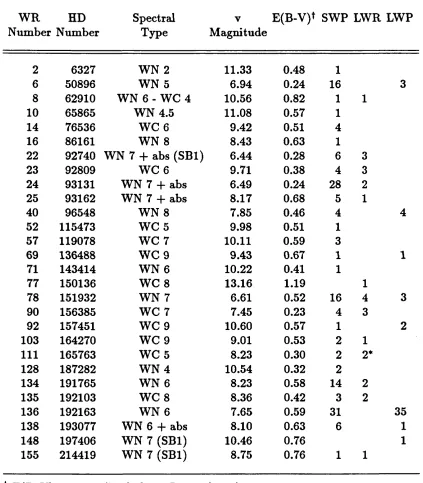
T a b le 2 . 1 : IU E Archival Spectra of G alactic Wolf-Rayet S ta rs... 49
T a b le 2.2 : IU E High Resolution S pectra of W R 78... 58
T a b le 2 .3 : IU E SW P High Resolution Spectra of W R 134... 64
T a b le 2 .4 : Wolf-Rayet Stars with IU E High Resolution S p ectra... 6 8
C h a p te r 3
IU E O b se r v a tio n s o f V a ria b ility in t h e W N 6 sta r H D 1 9 2 1 6 3
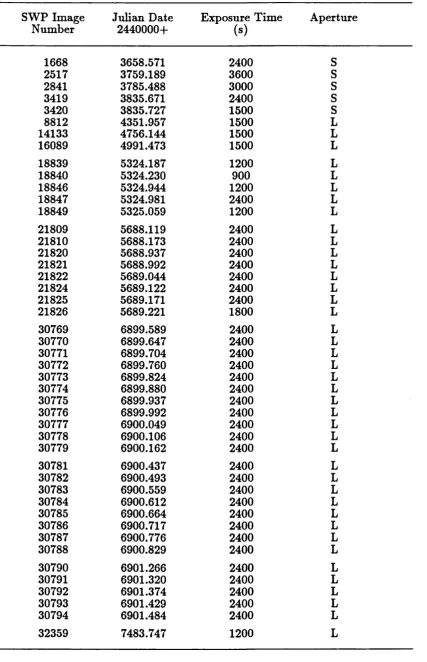
T a b le 3 .1 : SW P High Resolution Images of HD 192163... 73
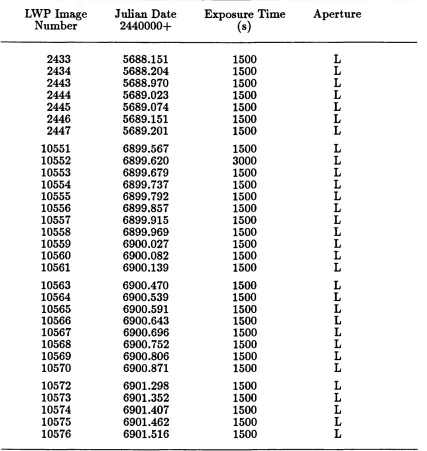
T a b le 3 .2 : LWP High Resolution Images of HD 192163... 74
T a b le 3 .3 : Equivalent W idth M easurem ents (A) of the A bsorption Excesses and Emission Deficits in th e 1987 Spectra
for HD 192163... 87
T a b le 3 .4 : SW P High Resolution Images of HD 192163... 92
T a b le 3 .5 : Equivalent W idth M easurem ents of th e N IV A1718
P Cygni A bsorption C om ponent... 1 0 0
T a b le 3 .6 : New IUE SW P High Resolution Images of HD 192163. .. 107
T a b le 3 .7 : Equivalent W idth M easurem ents of th e N IV A1718 P Cygni A bsorption Com ponent for th e New 1989
Observations... I l l
T able 3 .9 : Velocities (km s 1) and Equivalent W idths (mA) for
N a I and Ca II D oublets... 121
T able 3 .1 0 : Profile F it P aram eters for N a I an d C a II D oublets 123
T ab le 3 .1 1 : Observed interstellar lines in the m ean spectrum
of W R 136... 125
T ab le 3 .1 2 : Colum n Densities (N) and D epletion Values (£) for
th e H i-ty p e Species tow ards W R 136... 130
T ab le 3 .1 3 : LSR Velocities of Com ponents in H i-ty p e Species... 134
T ab le 3 .1 4 : LSR Velocities and Equivalent W idths of Com ponents
in Highly Ionised Species... 135
T able 3 .1 5 : Colum n Densities (LogV ), Velocity Dispersions (b)
and M ean Velocities (V) of C om ponents in
H l-type Species... 144
T ab le 3 .1 6 : Colum n Densities (log N , cm - 2 ), Velocity Dispersions (6, km s- 1 ) and Velocities (V, km s - 1 ) of Com ponents
in Highly Ionised Species... 145
C h a p te r 4
N e w R e s u lts o n th e U ltr a v io le t V a r ia b ility o f H D 5 0 8 9 6
T able 4 .1 : IU E SW P High Resolution Images of HD 50896... 158
T ab le 4 .2 : Equivalent W idths of A bsorption C om ponents... 163
T able 4 .3 : Equivalent W idths of Emission C om ponents... 169
T able 4 .4 : Equivalent W idths M easurem ents for Subordinate
C h a p ter 5
U V O b s e r v a tio n s o f S e le c tiv e W in d E c lip s e s in 7 V e lo r u m
T a b le 5.1 : IU E SW P High Resolution Images of 7 Vel... 187
T a b le 5.2 : IU E LWR High Resolution Images of 7 Vel... 188
T a b le 5.3 : Copernicus Observations of 7 Vel... 189
T a b le 5 .4 : M ajor Observed Eclipse Transitions for 7 Vel... 194
T a b le 5.5 : R ange of velocities for which wind absorption is d etected in th e CIIIA2297 tran sitio n ... 199
L ist o f F ig u res
C h a p t e r 2
A n I U E A rc h iv a l S u r v e y o f V a r ia b ility in W o lf -R a y e t S t a r s
F ig u r e 2.1 : Archival Spectra SW P 1591 and SW P 15132 com pared to the m ean for the C IV A1550 P Cygni profile
of W R 24... 53
F ig u r e 2 . 2 : Variations in the C IV A1550 resonance doublet between
SW P 6609 and the m ean for W R 25... 55
F ig u r e 2.3 : P Cygni profiles in velocity space of th e Si IV resonance
doublet for SW P 4334 and the 1988 m ean of W R 78. . . . 59
F ig u r e 2.4 : C III A1247 P Cygni profiles for SW P 2518 SW P 2872
of W R 1 1 1... 62
C h a p t e r 3
I U E O b s e rv a tio n s o f V a r ia b ility in t h e W N6 s t a r H D 1 9 2 1 6 3
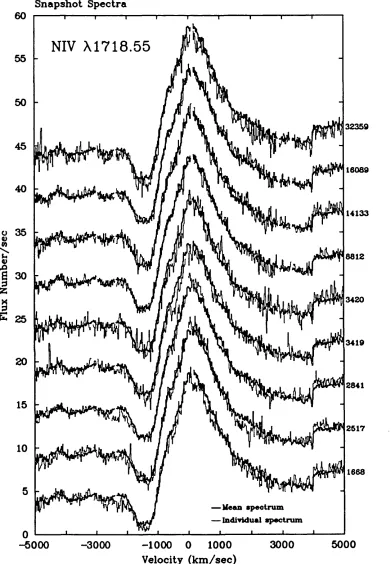
F ig u r e 3.1 : T he nine “snapshot” spectra taken betw een 1978 and 1987 com pared w ith the m ean spectrum for th e N IV A1718
P Cygni profile... 76
F ig u r e 3.2 : The five spectra taken over 2 1 hours in 1982 com pared
w ith the m ean spectrum for the N IV A1718 P Cygni
profile... 77
F ig u r e 3 .3 : The eight spectra taken over 27 hours in 1983 com pared w ith the m ean spectrum for the N IV A1718 P Cygni
F i g u r e 3 .4 a : F irst half of the 24 spectra com prising the extensive 1987 dataset which covers a to ta l of 48 hours com pared w ith the m ean spectrum for the N IV A1718 P Cygni
profile... 79
F i g u r e 3 .4 b : Second half of the 24 spectra comprising the extensive 1987 dataset which covers a to tal of 48 hours com pared w ith the m ean spectrum for th e N IV A1718 P Cygni
profile... 80
F ig u r e 3 .5 a : F irst half of the 24 spectra com prising the extensive 1987 dataset which covers a to tal of 48 hours com pared w ith the m ean spectrum for the H e ll A1640 P Cygni
profile... 81
F i g u r e 3 .5 b : Second half of the 24 spectra com prising the extensive 1987 dataset which covers a to tal of 48 hours com pared w ith the m ean spectrum for the H e ll A1640 P Cygni
profile... 82
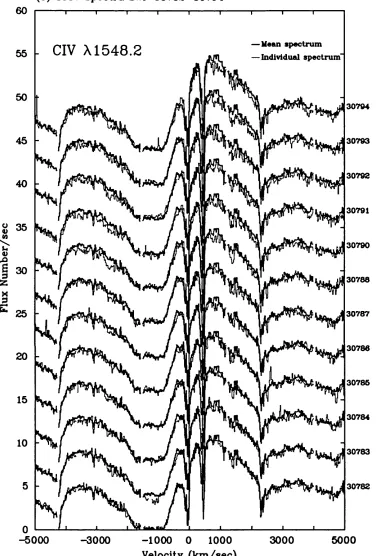
F ig u r e 3 .6 a : F irst half of the 24 spectra com prising th e extensive 1987 dataset which covers a to tal of 48 hours com pared w ith the m ean spectrum for th e C IV A1550 P Cygni
profile... 83
F i g u r e 3 .6 b : Second half of the 24 spectra comprising th e extensive 1987 dataset which covers a to tal of 48 hours com pared w ith the m ean spectrum for th e C IV A1550 P Cygni
profile... 84
F ig u r e 3 .7 : T he equivalent widths of the absorption excesses for N IV , H e ll and C IV plotted against Ju lian D ate for the 24 SW P spectra obtained over 48 hours in 1987... 8 8
F ig u r e 3 .8 : T he equivalent widths of the absorption excess for N IV and emission deficits for He II and C IV p lo tted against Julian D ate for the 24 SW P spectra obtained over 48
F ig u r e 3 .9 : The calculated orbital variation of th e absorbing column
in HD 192163 for a variety of o rb ital inclinations... 94
F ig u r e 3 .1 0 : The calculated orbital variation of th e intrinsic X-ray accretion luminosity of th e p o stu lated n eutron star
com panion... 95
F ig u r e 3 .1 1 : The calculated orbital variation of th e observed X-ray lum inosity in the Uhuru w aveband (2.0-6 . 0 keV) and
the Einstein waveband (0.2-4.0 keV )... 96 F ig u r e 3 .1 2 : Contours of constant ( , th e ionization param eter at
(a) phase $ = 0.0 and (b) phase $ = 0.5... 98
F ig u r e 3 .1 3 : T he equivalent w idths of the N IV A1718 P Cygni for all absorption com ponent p lo tted as a function of
phase for all the SW P sp ec tra... 1 0 1
F ig u r e 3 .1 4 a : F irst half of the 15 new spectra of HD 192163 compared w ith th e m ean spectrum for th e NIVA1718 P Cygni profile... 109
F i g u r e 3 .1 4 b : Second half of the 15 new sp ectra of HD 192163 com pared w ith the m ean spectrum for th e NIVA1718 P Cygni profile... 1 1 0
F i g u r e 3 .1 5 : T he equivalent widths of the N IV A1718 P Cygni
absorption com ponent p lo tted as a function of phase for all the SW P spectra... 112
F ig u r e 3 .1 6 : R eproduction from the red P alo m ar sky survey showing
the positions of the stars w ithin th e Cygnus region. .. 117
F i g u r e 3 .1 7 : O ptical interstellar absorption lines of N a l for twelve of the stars in the sam ple... 1 2 0
F ig u r e 3 .1 8 : Em pirical and theoretical curve of grow th for the low
velocity H i-ty p e species observed tow ards W R 136. .. 129
F ig u re 3 .2 0 a : Rectified ultraviolet C IV profiles for the W R stars
in the sam ple... 137
F ig u r e 3 .2 0 b : Rectified ultraviolet C IV profiles for the O stars in
the sam ple... 138
F ig u re 3 .2 1 : Positions of th e O and W R Cygnus stars included in this work. The m ean velocity of the H I-type species and the fitted velocity of C IV are identified for th e high velocity com ponents observed towards th e stars in th e sample. . 151
C h a p ter 4
N e w R e s u lts o n th e U ltr a v io le t V a r ia b ility o f H D 5 0 8 9 6
F ig u re 4.1 : IU E spectra SWP34917 and SW P34936 illu stratin g the variations in the absorption com ponents of th e NFV A1718, C IV A1550 and He II A1640 P Cygni profiles... 161
F ig u r e 4 .2 : Equivalent w idths of the absorption com ponents of N IV , C IV and He II P Cygni profiles of W R 6 as a function of
Ju lian D ate... 165
F ig u re 4 .3 : (a) Equivalent w idth m easurem ents of the absorption com ponent of N IV A1718 and (b) corresponding power spectrum for W R 6. For com parison, (c) set of random
num bers w ith an identical sam pling and (d) corresponding power spectrum ... 167
F ig u re 4 .4 : Equivalent w idths (A) of the em ission com ponents of N IV , C IV and H e ll as a function of Ju lia n D ate... 172
F ig u re 4 .5 : Form ation regions for the emission com ponents of the C IV
A1550, HeIIAl640 and N IV A1718P Cygni profiles 175
F ig u re 4 .6 : IU E spectra SWP34968 and SWP35011 illu stratin g the
F ig u r e 4 .7 : Equivalent w idth m easurem ents for the spectral ranges
AA1248 - 1330 A (Fe VI) and AA1330 - 1515 A (FeV ). 177
C h a p ter 5
U V O b s e rv a tio n s o f S e le c tiv e W in d E c lip s e s in 7 V e lo r u m
F ig u r e 5.1 : SiIIIAl206 line of 7 Vel near phases 0 . 0 and 0.5 obtained
w ith IUE at two different epochs... 191
F ig u re 5.2 : Eclipse spectrum of 7 Velorum... 192
F ig u re 5.3 : Variations in the CIIIA2297 profile w ith o rbital phase. 196
F ig u re 5.4 : Simplified sketch illustrating the geom etrical setting of
wind eclipses... 2 0 0
F ig u re 5.5 : Observed and predicted velocity range upper lim its for the absorption of the O sta r light by the W R wind as a function of orbital phase for various values of the
inclination... 2 0 1
F ig u re 5.6 : Variations in the SiIVAl396 doublet w ith o rbital phase. 204
F ig u re 5.7 : 7 Vel IUE SW P spectra at phases 0.008 and 0.534 in the
C III A1247.38 and N V A1238.81 velocity spaces... 208
F ig u re 5.8 : Shock surfaces evaluated by calculating th e position of
equal ram pressures for a selection of o rbital phases. .. 2 1 0
F ig u re 5.9 : F elV Em pirical model com pared to the ratio of SW P
spectra at phases 0.0 and 0.5... 213
F ig u re 5.1 0 : Variations in the C IIIJA1908.73 doublet w ith orbital
phase... 214
F ig u re 5.11 : Difference of the m ean spectra at phases 0 . 0 and 0.5 for
F i g u r e 5.12 : FeV + Fe VI em pirical m odel com pared to the ratio of the
SW P m ean spectra a t phases 0.0 an d 0.5 for V444 Cygni. 218
F ig u r e 5.1 3 : Em pirical F elV m odel com pared to th e ratio of phase
A ck n o w led g em en ts
F irst, I wish to th an k my supervisor, Allan W illis, for his support and encour agem ent during th e course of my Ph.D . studies and for providing me w ith the o p p o rtu n ity to work on such an interesting area of astronomy. It is also a great pleasure to t h a n k Linda Smith; her guidance, patience and expertise are largely responsible for m aking this project a very gratifying experience.
I have benefited from m any rew arding conversations w ith Ian H owarth and R am an P rinja. I also thank them for useful comments on p arts of this thesis.
M any thanks to P aul Crow ther for calculating line form ation regions in the w ind of HD 50896 and to Ian Stevens for providing me w ith a program to calculate the shape of the shock surface for colliding winds and for evaluating the expected X -ray flux for HD 192163. I also th an k them for reading p arts of this thesis.
I am especially grateful to Rene Doyon for his constant support and for m any fruitful discussions.
P refa ce
Since their discovery by C .J.E . Wolf and G. Rayet in 1867, our understanding of Wolf-Rayet (W R) stars has considerably im proved. Q uantities such as absolute visual m agnitudes, chemical composition and mass-loss rates are now relatively well-known, although th e trem endous com plexity of th e physical phenom ena taking place in these stars renders the determ ination of oth er quantities such as effective tem peratures or lum inosities more controversial (for a recent review of Wolf-Rayet stars, see A bbott and Conti 1987). As o u r general knowledge of W R stars increased, m ore detailed aspects began to b e explored. For instance, the advent of a new generation of scientific instrum ents capable of providing d ata w ith im proved signal-to-noise and resolution revealed th a t a large proportion of W R stars showed variability, at varying degrees, in their continuum light and emission-line fluxes. Not all these variations can be a ttrib u te d to effects in binary systems and therefore alternative in terp retatio n s have to be sought.
This work is concerned w ith various aspects of th e variability observed in the ultraviolet spectra of galactic W R stars. As an introduction, C hapter
1 presents a brief review of the photom etric, spectroscopic and polarim etric
variability observed and predicted theoretically for W R stars. Most of the d a ta employed in this work have been acquired w ith th e International Ultraviolet Explorer (IUE) satellite. Over the past ten years, a large num ber of observations have been secured w ith this telescope which are m ade widely available to the international astronom ical com m unity through an extensive archive. In C hapter
2, the results of an archival search for spectroscopic variability for all galactic
W R stars observed m ore th a n once w ith IUE are described. T he aims are to provide a general description of the d a ta already available in the archive at the tim e this work began and to try to assess the ub iq u ity of th e phenom enon of ultraviolet spectroscopic variability of W R stars. T h e th ird and fourth chapters of this thesis consist of a study of ultraviolet variability in th e spectra of the
Wolf-Rayet stars W R 136 (HD 192163) and W R 6 (HD 50896), respectively.
These stars have been suggested as candidates for W R + com pact com panion (neutron sta r or black hole) binaries. Such system s are expected to exhibit very distinctive phase-dependent changes in their ultraviolet P Cygni profiles. For both stars, an extensive set of IUE observations has been acquired w ith the
ill order to determ ine if they can be ascribed to a com pact com panion and thus provide support for the binary hypothesis or alternatively if the changes are intrinsic to the W R sta r itself. In the la tte r context, the n a tu re and timescale of the variability can help determ ine the mechanisms responsible and provide further insight into the basic physical properties of the hot and dense stellar wind. In the final p a rt of this thesis, a different kind of variability is investigated. The behaviour, as a function of orbital phase, of th e ultraviolet spectrum of the
well-known W R + O binary, 7 Velorum, is analysed. T he m echanisms generating
C h a p ter 1
V ariab ility o f W olf-R a yet S tars
1.1 O bserved In trin sic "Variability
In this section, I will present a brief s u m m a r y of the variations observed in the light and spectra of Wolf-Rayet (W R) stars which are thought to be intrinsic to the s ta r rath er th an caused by the effects of a com panion in a binary system. Two reviews have previously been published on this subject, the first by Vreux (1987) and the other by Moffat and R obert (1991).
1 .1 .1 OPTICAL PHOTOMETRY
It is well known th a t some apparently single Wolf-Rayet stars show small scale (A m ~ 0.0 1-0.1) light variations a t optical wavelengths. In the p ast, this has
often been explained in term s of the presence of a com pact com panion. The occurrence of W R +com pact binary systems has been theoretically proposed to represent one stage in the evolution of massive close binaries (see the review by van den Heuvel 1976) which can be illustrated schem atically as follows:
O +O — ►W R + O — > compact+O — ►com pact+W R — ►compact+ compact
Moffat (1982) has suggested a list of 1 1 candidate W R + c system s w ith periods
optical light and spectral variations; have an unusually large z-distance a n d /o r runaw ay velocity; and are associated w ith ring nebulae (ejected during a phase of rap id mass transfer from the O sta r to its com pact companion). However, to d ate, none of these candidates have been reliably confirmed. Vreux (1985) has suggested th a t all the published periods, which are of the order of a few days, can easily be related to each oth er and th u s could perhaps be a ttrib u te d to non-radial pulsations. However, M atthew s an d Beech (1987) dem onstrated th a t the periods are consistent w ith a random distribution and therefore, no observational evidence is currently available for non-radial pulsations occurring in Wolf-Rayet stars. The am plitude of th e light curves and spectroscopic orbits of these candidates are often very low; the scatte r around the curves cannot, in m ost cases, be accounted for by in strum ental uncertainties and therefore, in any case, smother process has to be invoked. M ore im portantly, in most cases th e periods suggested cannot be reproduced in subsequent datasets.
In recent years, it has been questioned w hether th e photom etric variations observed in apparently single Wolf-Rayet stars can be attrib u te d to effects in com pact binary systems. In order to try to shed some light on the origin of these changes, several authors have carried out extensive photom etric m onitoring of groups or samples of Wolf-Rayet stars. Such studies have th e p o ten tial of revealing general trends and p attern s in the observed changes and thus provide new clues as to how they originate. Moffat and S hara (1986) have observed a com plete m agnitude-lim ited sample of 2 0 n o rth e rn W olf-Rayet stars including 6
well-established spectroscopic binaries. They find th a t a t least half of th e stars observed (in the B band) show continuum light variability w ith a am plitude of > 0 . 0 2 m agnitudes. Excluding the predictable changes associated w ith the
well known binary systems, they were not able to identify th e source of the variations. However, they do rem ark th a t th e W N 8 stars in their sample
show th e highest level of random noise. A sim ilar result was found one year later by Lam ontagne and Moffat (1987) who observed, in broadbands V an d I, a
group of 8 southern Wolf-Rayet stars th a t are known or suspected to show large
photom etric variations. These results suggest a singular characteristic of W N 8
and Moffat (1987) also reach broader conclusions. They find th a t in general the W N stars have a larger variation am plitude th a n the W C stars and th a t for both classes the am plitude increases towards la ter subtypes.
In a very high precision W alraven VBLUW photom etric m onitoring pro gram of 7 Wolf-Rayet stars, van Genderen, van der Hucht and Steemers (1987) not only found light variations b ut also colour variations. They conclude th a t when the am plitude of the light variations is low ( < 0.03 m agnitude), the colour changes are difficult to detect but when the am plitude is higher, B-L,B-U and U-W colour variations are easily detectable w ith am plitudes between 5-10 times smaller th a n th e light am plitudes. The B-L and B-U colours for m any stars vary in phase w ith each other as a function of brightness (becoming bluer w ith in creasing brightness) while U-W seems to show th e opposite behaviour. The fact th a t the correlation between colour and brightness changes is so similar for stars of different spectral type, together w ith th e fact th a t although the L and U bandpasses have the smallest content in emission lines, they show the largest variations, led the authors to conclude th a t th e changes were continuum , not emission line variations. The authors suggest th a t they can probably be a ttrib u te d to tem perature effects such as hot blobs in the wind or eddies in a turbulent envelope allowing us to see deeper in to th e h o tte r layers.
Balona, Egan and M arang (1989) secured an extensive set of Johnson- B filter photom etry of 17 of the brightest southern Wolf-Rayet stars over a period of three years. Only 5 stars in the sam ple were found to be constant. The authors found 3 cases of semi-periodic variations, or periods th a t are only tem porarily present in the light curve. T heir d ataset was also appropriate for searching for very short timescale changes. Not a single case was found of such variations which could have been a ttrib u te d to pulsations. However, short timescale changes have recently been detected by M onderen etal. (1988) and
van Genderen, van der Hucht and Larsen (1990) for W R 46, W R 50 and W R 8 6.
strictly periodic, semi-periodic or completely irregular, which makes it difficult to suggest an origin or causes for th e variability.
1.1.2 FLUX CHANGES AT OTHER WAVELENGTHS
Short timescale variability has been reported in th e Einstein IP C X -ray flux of the WN 5 star W R 6 by W hite and Long (1986). However, form al statistical
tests by Pollock (1989) on the d a ta obtained in th e h ard energy band (0.8-4.5 kev), taking into account Poissonian statistics, have shown th a t the statistical significance of the variability is low. It is necessary to use Poissonian as opposed to G aussian statistics in this case due to the low count ra te of the sources. Pollock (1989) has also applied these tests to IP C observations of 8 other W R
stars and found little evidence for variability on tim escales from 2 0 0 seconds to a
few thousand seconds. T here was, however, one exception in a 1979 observation of W R 25 where a steady decrease in the intensity was observed on a timescale of ~ 5000 seconds. T he variations reported by Moffat etal. (1982) for W R 6
on a timescale of 3.8 days also tu rn ed out to be statistically significant at the few percent level. These variations are consistent w ith the period of 3.766 days often associated w ith this star, although the phase coverage in only ~ 3 %.
Hogg (1989) has m onitored the radio flux a t 4885 MHz of five therm ally em itting W R stars using the VLA betw een 1980 and 1987 w ith the aim of searching for variability. Also included in his stu d y are th e observations of A bbott etal. (1986) and Dickel, Habing and Isaacm an (1980). For all five sources, the observations are found to be constant w ithin 2 0 % of the m ean
value. For the four stars W R 6, W R 79, W R 134 an d W R 136 no consistent
p attern of change was found and therefore the sources are considered to be constant w ith variability greater th a n 20 % ruled o ut. For th e WN7 sta r W R
78, however, a steady increase in the flux of 1 0 % p er year was detected between
1981 and 1985, although th e author does stress th a t this conclusion is tentative and th a t more observations are required to confirm th e variability of this star at 4885 MHz.
1.1.3 OPTICAL SPECTROSCOPY
Reports of intrinsic w ind variability observed in the strong optical emission lines of Wolf-Rayet stars have only recently begun to appear. This is mainly because of their very small am plitudes ( ~ 1 % of th e to ta l equivalent width)
et al. (1988) have monitored two bright Cygnus W R stars, W R 134 (HD 191765) and W R 136 (HD 192163), during one night in Ju ly 1986 over th e spectral re gion covering the H e ll A5411.524 transition. A lthough W R 136 showed little change during th a t night, several bum ps were found superposed on the broad emission line for W R 134. These features have a w idth of F W H M «2 - 1 0 A and
a height < 1 0 % of the continuum and move across the profile w ith a timescale
of < 8 hours. One im p o rtan t characteristic of these changes is th a t bum ps
th a t are initially redshifted w ith respect to the rest wavelength of the tran si tion become even more redshifted w ith tim e whereas those th a t axe initially blueshifted become even more blueshifted. Moffat et al. in terp ret the variations in term s of condensations of m aterial or ‘blobs’ being accelerated outw ards in th e W R wind, w ith the timescale reflecting the tim e th a t w ind m aterial takes to flow through the H e ll em itting region. M cCandliss (1988) in a more extensive stu d y of W R 134 has obtained 152 spectra over a much larger spectral range (3940-6610 A) and tim e period ( 1 2 nights). All th e m ajor lines in this spectral
range were found to be variable. This includes the H e ll Pickering series, H e ll A4200,4686, H e l A4471,5876, N IV A4058, N V A4945 and the blend of H e ll an d N III at 4100 A. The He II A4686 line was found to vary the m ost an d the variability in the Pickering lines increased w ith increasing wavelength. Hillier
(1987) showed, in a model of the WN5 sta r W R 6, th a t the lower m em bers of
the Pickering series formed at progressively larger radii and th a t H e ll A4686 line was formed even further out. By extending this to W R 134, M cCandliss concluded th a t the outer regions of the wind were more variable th a n th e in ner regions and therefore predicted th a t the H e ll Pickering line at 10124 A,
which Hillier showed is formed approxim ately in th e same region as He II A4686 line, should show a particularly high level of variability. In addition to the narrow features moving across the broad emission line, M cCandliss concluded th a t there were also non-periodic global line flux and line position variations. Finally, Underhill eial. (1990) have also found variations in th e peak of the H e ll A5411 and C IV A5805 emission lines of W R 134, although they claim th a t they cannot detect any of the system atic changes found by Moffat etal.
For W R 134, Moffat and R obert (1991) have com pared the observed vari ation of the velocity of the narrow features as a function of tim e w ith m odel pre dictions. These were evaluated by assum ing th a t the ‘blob’ ejection is radial and th a t the inhomogeneities follow a velocity law of the form vw = V o o ( l - R m/r)P
where Vq© is the term inal velocity of the wind an d R mis the radius of the W R core. A blob ejected at an angle 0 w ith respect to the direction tow ards the observer would therefore be detected at a velocity of v = vwcos0. Com paring th e predicted and observed values can in principle yield the ejection angle and
j.3if one assumes values for Vqo and R*. They conclude th a t, as expected, the blobs seem to be em itted at random angles b u t th a t their progression cannot be described by a velocity law w ith /? « 1, as generally expected for winds of
h ot stars. They speculate th a t this is either because the regions of th e wind probed by the blobs have larger f) values or th a t the blobs are simply moving m ore slowly th an the wind.
1 .1 .4 ULTRAVIOLET SPECTROSCOPY
As m entioned in Section 1.1.1, the in terp retatio n of radial velocity an d pho
been secured for two W R + c candidates, W R 6 (HD 50896) and W R 40 (HD
96548) to search for variability akin to the H atch ett and M cCray effect.
W R 40 is a W N8 star which was suggested as a W R + c candidate by Moffat
and Isserstedt (1980). From an extensive narrow -band photoelectric photom etry and optical photographic spectroscopy d ataset, they proposed an orbital period of 4.762 days w ith a semi am plitude of 0.02 m agnitude in the light curve and of 8 - 1 0 km s- 1 in the radial velocity curve. Sm ith, Lloyd and Walker (1985)
presented a study of 14 archival IUE high resolution spectra obtained between 1979-1982. The spectra contain m any emission lines and P Cygni profiles from ions ranging from F e ll to N V . Variability was found in all the emission lines although the largest changes were observed in the absorption components of the C IV A1550 and SiIV A1396 resonance doublets. T he variations were, however, inconsistent w ith the proposed orbital period although m ore d a ta were required to confirm this assertion. Additional observations were obtained in 1983, 1985 and 1986 and a prelim inary analysis of the d a ta was presented by Sm ith et al.
(1986). In contrast w ith the earlier archival spectra, only the Si IV A1396 and N IV A1718 lines were found to show significant variability. This strongly sug gests th a t the changes in the ultraviolet spectra are epoch dependent. The n atu re of the changes were also quite revealing. T h e blue absorption edge of the Si IV P Cygni profile was found to gradually decrease by 400 km s- 1 over a
five day period in 1985. This corroborated the earlier claim th a t the variations do not have the required phase-dependence to be caused by the H atchett and M cCray effect. Instead, the authors suggest th a t th e changes are more likely caused by intrinsic variations w ithin the W R stellar wind.
W R 6 (HD 50896) is presently th e best candidate for a W R + c system
m ainly because of the well-established 3.766 day period often associated w ith it. This periodicity was first announced by F irm ani et al. (1980) in a set of pho tom etric and spectroscopic observations and McLean (1980) using polarim etry, bu t was later refined by Lamontagne, Moffat an d Lam arre (1986) using five years of optical photom etry. W R 6 has been very extensively observed at high
C IV A1550, H e ll A1640 and N IV A1718 P Cygni profiles as well as in num er ous other lines which are thought to be blends of F elV and FeV transitions. One feature th a t im m ediately became clear was th a t th e ultraviolet variations were epoch-dependent. W hile spectra obtained a t ran d o m epochs showed large scale differences, the extensive 1983 dataset appeared to reflect a relatively quiescent period. T he changes th a t were found are m ainly confined to the P Cygni absorption com ponents, in particular to th e soft blue edge. Willis et al.
(1989) suggested a (poorly-determ ined) ultraviolet variability timescale of ~ 1 day, w ith some evidence for time-delay effects in different ions, possibly result ing from stratification effects. No significant phase-dependence was found and therefore the changes could not be ascribed to th e H atch ett and M cCray effect. As for W R 40, the ultraviolet variability is th o ught to be intrinsic to th e W R wind, probably caused by changes in the wind, density or ionisation structure.
1.1.5 LINEAR POLARIZATION
larger am plitudes th an WC stars and in a given subclass the la te r spectral types (W N8 and W C9) axe found to present the largest variations. T he changes were
interpreted as ejection of mass-conserving blobs of m aterial a t random angles in the wind. Following the work of Owocki, C astor and Rybicki (1988), R obert
etal. (1989) have attem pted to u n d erstan d the changes in term s of radiative in stabilities th a t would create a blob-like structure. T he polarization dispersion was assum ed to be proportional to ek^v^Vth^ w ith v the velocity of the w ind at th e radius where r = l , vth is the therm al velocity and k is a constant. This is sim ilar to th a t which Owocki, C astor and Rybicki (1988) derived for a velocity am plitude growth. U nfortunately, uncertainties in param eters such as th e mass loss rate, the stellar radius and the therm al and term inal velocities hindered a definite conclusion on the validity of this model. They have also tried another model based on the assum ption th a t the growth ra te of th e p ertu rb a tio n is pro portional to the m agnitude of the pertu rb atio n . They find th a t this works well b u t th a t uncertainties in W R sta r param eters are still a lim iting factor. Finally, it is w orth m entioning th a t these polarization m easurem ents are not capable of distinguishing between mass-conserving blobs or disturbances in the velocity or ionisation structure of the wind and therefore this la tte r in terp retatio n should also be taken into account.
1.2 T h eo ry o f In trin sic V ariab ility
In this section, I will present a short outline of the current sta te of the theory for th e three m ain processes capable of generating the intrinsic variability of W olf-Ray et stars.
1.2.1 RADIATIVELY DRIVEN BLOBS
T he propagation or ejection of mass-conserving inhomogeneities or blobs of wind m aterial has been suggested by some authors as the origin of intrinsic wind variability. A model for the wind of hot stars including such a population of blobs was proposed by Lucy and W hite (1980). Initially, this m odel was developed to explain the X-ray emission from th e wind of hot O and B stars as well as the presence of relatively high ionisation stages such as O V I and N V. T he basis of the model is th e unstable n a tu re of line-driven flows which axe th o ught to be the dom inant process for driving the O, B and W R stellar winds. This unstable n ature is a consequence of the sensitive dependence of the line-force on velocity. In such a case, a small increase in the radial velocity of an elem ent of gas w ith respect to th e surrounding m edium shifts the local line frequency out of the absorption shadow of intervening m aterial an d there fore increases the line force. This will increase the velocity of the element even fu rth er leading to an instability. Lucy and W hite suggested th a t as a conse quence of the instability, the final sta te of the stellar wind could be described as a num ber of radiatively driven blobs moving through the am bient gas which is not itself radiatively driven because it is shadowed by the blob population. This com ponent nevertheless flows away from the s ta r because of the drag force betw een th e blobs and the ambient gas. T he shocks preceeding these blobs em it the required X-rays in their cooling zones.
Finally, it is worthwhile m entioning th a t ejection of mass-conserving in homogeneities was not found to be a suitable in terp retatio n for the narrow absorption com ponents seen moving across the Si IV resonance profile of the O star 6 8 Cygni [07.5 III((f))] by P rin ja and H ow arth (1988). In a study of three
well-monitored consecutive sequences of progressive opacity enhancem ents, they found th a t the propagation of the blob would follow a very slow velocity law and predict th a t substantial absorption features should be detected at veloc ities m uch sm aller th a n are actually observed. Therefore, they conclude th a t blob ejection is inadequate to explain their observations. Instead, they suggest th a t wind m aterial is passing through p ertu rb atio n s in the flow. Although the variations found for O star winds are not exactly th e same as those observed for W R stars, it is judicious to bear in m ind the results of studies of intrinsic variability in the winds of O stars. As they axe th e progenitors of W R stars and b o th types of stars probably have the same wind driving mechanism, it is not unreasonable to expect similar processes generating the changes.
1.2.2 RADIATIVE INSTABILITIES IN LINE-DRIVEN FLOWS
is stable. Owocki and Rybicki (1984) solved this ap p aren t discrepancy by pre senting a linear stability analysis in which they m ade no assum ptions about the behaviour of the p ertu rb ed force, although they still neglected th e effect of the diffuse radiation field. They found th a t the p e rtu rb ed force could be expressed as :
tic &9ab» = ' 7J~$V
X b + l k
where Qf, is th e instability growth rate, k is th e w avenum ber and \ b 1 —L/ 2
w ith L being the Sobolev length. Therefore, for long-wavelengths (k <C Xb) this equation is equivalent to A b b o tt’s expression using th e Sobolev approxim ation and thus the flow is stable while for short-wavelengths (k \b ) the expression is equivalent to m aking the optically thin approxim ation and th u s the flow is unstable. The grow th rate of these instabilities was found to be so large (cum u lative effect of 1 0 0 e-folds through the wind) th a t any small linear p ertu rb atio n
in the wind would rapidly become nonlinear.
The possible dynam ical effect of the diffuse rad iatio n field was first inves tigated by Lucy (1984). He concluded th a t in co n trast to w hat occurs in the m ean flow in which the diffuse radiation has a roughly fore-aft sym m etry and therefore exerts no net force on the flow, the diffuse rad iatio n field exerted a net drag force on th e perturbations. Owocki and Rybicki (1985) have studied the m agnitude of this effect by considering a diffuse field w ith com plete redistribu tion and a Doppler profile. They found th a t at th e base of the w ind, where the flow can be considered as plane parallel, the in stab ility grow th ra te is greatly reduced b u t th a t as the flow moves outw ards, th e effect decreases rapidly. At 1 R*, the grow th rate is 50 % of its value in th e case of p u re absorption and at large radii it can reach almost 80 % of its approxim ate value. A nother con clusion which they have reached in this study is th a t th e diffuse radiation field tends to dam pen horizontal velocity pertu rb atio n s. Therefore, in general, the instability problem can be reduced to one dim ension (radial direction) which greatly simplifies the calculations.
flow can be characterised by high velocity m aterial a t high density and high tem perature. One appealing feature of this model is th a t it n atu rally explains th e satu rated or ‘black’ P Cygni absorption com ponents observed in the spectra of hot stars. In uniform line-driven flows, the absorption com ponent is partially filled in by forward scattered radiation received from the w ind’s approaching side. Lucy (1982) found th a t a wind w ith the assum ed stru ctu re preferentially
backscatters photospheric radiation. Therefore the forward scattered radiation is greatly reduced and the absorption com ponents are not filled in. This model has, however, the disadvantage of not being set on a solid physical base, as the stru ctu re of the wind is hypothetical. Owocki, C astor and Rybicki (1988) have developed a numerical, radiation-hydrodynam ics code th a t sim ulates the evolution of instabilities in line-driven flows and therefore determ ines th e likely stru ctu re of the resulting wind. In contrast w ith Lucy’s m odel, they found th a t the strongest shocks axe reverse shocks which decelerate high-speed, rarefied gas as it im pacts onto slower m aterial which has been compressed into denser shells. Therefore, in this model, the high speed m aterial has a very low density which is the opposite of w hat is found in Lucy’s model.
In their wind model, Owocki, C astor and Rybicki (1988) introduced an explicit p ertu rb atio n at th e base of th e wind and exam ined its evolution as a function of time. However, Owocki, Poe and C astor (1990) an d Poe, Owocki and C astor (1990) have shown th a t line-driven flows can be intrinsically variable. This property was found to depend on the ratio of the therm al speed to the sound speed (v<^/a). For Vth/a <1/2, there exists a well defined steady solution
which allows a tim e-dependent model to relax to the associated sta te and thus to become stable. For v t h / a ~ 1/2, a whole series of solutions exists and therefore
the wind never settles down. Instead, it oscillates continuously am ong the degenerate family of possible steady solutions. T he tim escale for this oscillation is ~ 1 / 2 day which is m uch longer th a t the grow th tim e for individual sm all scale
instabilities ( ~ 1 hour). This, however, compares well w ith the propagation
timescale for narrow absorption components observed in the sa tu rate d P Cygni absorption com ponents of O stars.
1.2.3 RADIAL AND NONRADIAL PULSATIONS
variations. This, together w ith the suggestion th a t pulsations m ight contribute to the driving of the W R wind, led to a series of theoretical investigations into the vibrational instability of W R stars in various phases of evolution.
M aeder (1985) presented a stu d y of the vibrational stability to radial pulsations of very massive stars (85 M® and 120 M®) through various evolu tionary stages, using observed mass-loss rates. For W R stars, he found th a t the nuclear energizing of the pulsations in th e central He-burning core largely dom in ated the radiative damping in the envelope and therefore th a t W R stars are vibrationally unstable to radial modes. This unstable phase begins when the hydrogen to helium ratio at the surface is H /H e= 0 .3 and rem ains throughout the subsequent W R evolutionary stages. Processes such as overshooting, tu r bulent diffusion or mixing by nonradial oscillations would enhance even further the vibrational instability. However, the periods predicted by M aeder’s models were relatively short (15—60 m inutes) and did not correspond to the timescales of th e observed variability. Noels and Scuflaire (1986) suggested th a t one way to reduce the discrepancy was to consider g+ m odes of nonradial pulsations. They investigated this type of instability for a 1 0 0 M® sta r in the adiabatic
case and showed th a t there existed a vibrational instability tow ards nonradial pulsations startin g after the exhaustion of H in th e centre b u t when H -burning still rem ained in a shell, distant from the centre. A lthough the predicted pe riods of several hours were generally in agreem ent w ith some of the observed timescales, th e duration of the unstable phase was so short ( ~ 6000 years) th a t it was doubtful th a t it could be responsible for the observed variability. Recently, Cox and Cahn (1988) have m ade m ore accurate nonadiabatic calculations for a series of representative radial and nonradial pulsational modes of 5 W R star models. Although M aeder’s conclusions rem ained correct for radial oscillation m odes, Cox and Cahn found no unstable nonradial m odes, in contrast w ith Noels and Scuflaire’s work. They suggest th a t this is probably a result of the quasiadiabatic approxim ation in the hydrogen shell burning region which is not valid during pulsations.
th a t radial modes are possible for W R stars, it is not clear how th e extended non-static wind will respond to the inner oscillations. Perhaps this type of variability will be very difficult to observe. Only w ith very high tim e resolution d atasets will we be able to ascertain if pulsations are a significant contributor to the intrinsic variability of W R stars.
1.3 B in a ry R ela ted C hanges
In this section, b o th observational and theoretical aspects of the variations of W R stars caused by the presence of a com panion will be discussed. This is not intended as a complete review of the subject, which is very broad, b u t rath er as a brief overview of the most im p o rtan t topics.
1.3.1 OPTICAL PHOTOMETRY
For any type of binary system with a sufficiently large orbital inclination, there will be eclipses of the continuum em itting cores of the two stars. For W R + O binaries, the O sta r light can also be eclipsed by th e dense W R envelope. Kopal and Shapley (1946) were the first to a ttem p t to stu d y the n a tu re and structure of absorption processes in the extended W R winds, using phase-dependent vari ations in optical photom etry. For th e well-known W R + O binary V444 Cygni, they found th a t the opacity causing the continuum variations increased towards the centre of the W R star b u t they were not able to detect a sharp core larger th an 1 1 R©. Consequently, they concluded th a t the opacity was caused by a
large envelope and they went on to suggest th a t th e dom inant effect was scat tering by free electrons. This led them to predict th a t the prim ary eclipse would be wavelength independent which was later confirmed by H iltner (1949).
free electrons in the W R wind. As the 0 sta r orbits to th e far side of the W R wind, the line of sight crosses an increasingly large colum n density of electrons and thus the opacity increases. The optical d ep th in this case is given by a relatively simple expression:
d r = cren e(r)dz
where <reis the Thom son electron scattering coefficient and n e(r) is the electron density. By using the equation of mass conservation Kl — 4irr2p(r)v(r) and a param etric velocity law of the form v(r) = v<x>(l — R * /r)^ , th e optical depth integrated over th e line of sight is given by
T =
r
__________ - _______&J z = z 0 47rrripVoo r 2 ( 1 - R * / r)0
where a is the num ber of electrons per baryon m ass an d z q = —(a sini)cos27V (j), w ith (f> being the orbital phase. Therefore, th e shape and am plitude of the m inim um yields estim ates of Jl2f and i.
Lam ontagne etal. (1991) have presented fitted light curves for all non core-eclipsing W R binaries for which optical pho to m etry is available and with orbital periods < 30 days. The mass-loss rates determ ined from these fitted curves show a general tren d with spectral type, in th e sense th a t more luminous stars have higher mass-loss rates, in agreem ent w ith previous results (A bbott
etal. 1986, St-Louis etal. 1988).
1.3.2 PHASE-DEPENDENT PHOTOMETRIC CHANGES AT OTHER WAVELENGTHS
The great m ajority of W R + O binary systems have been discovered by the detection of periodic variability in photom etric or spectroscopic observations at optical wavelengths. One rem arkable exception has been th e Wolf-Rayet system W R 140 (HD 193793). It was known as early as 1947 th a t absorption lines are present in the spectrum of this sta r and th a t th ey show a significant range in radial velocities, although no periodicity could be established (McDonald 1947). Lam ontagne, Moffat and Seggewiss (1984) presented an optical radial velocity orbit w ith a period of ~ 3 years b u t th is was not reproduced in the dataset of Conti etal. (1984) and thus was considered to be spurious. Williams
and Sm ith 1985) which lead W illiams etal. (1987) to suggest th a t these events were cyclic w ith a period of ~ 7.9 years and th a t they were m ost likely a consequence of orbital m otion. Moffat etal. (1987) re-analysed all th e optical radial velocity observations and confirmed th a t W R 140 was a W R + O binary w ith an extremely high eccentricity (e = 0 . 7 — 0.8).
Williams et al. (1990a) presented a sum m ary of m ost infrared, X-ray, radio and optical observations previously published together w ith new observations a t infrared, X-ray and radio wavelengths. An analysis of th e now extensive d ataset of infrared photom etry yielded a period of P = 2 9 0 0 ± 1 0 days which they th en used to re-analyse all the optical radial velocities an d provide improved estim ates of the orbital elements of this system. W R 140 is the strongest X-ray em itting W R star, w ith a flux two orders of m agnitude higher th a n usually observed from norm al emission in hot sta r winds. This strongly suggests the presence of a X -ray producing shocked region betw een th e two stellar winds. T he variability in the X -ray flux is consistent w ith varying free-free extinction as a consequence of the changes in ion and electron column densities along the line of sight as the O sta r orbits through the dense W R wind. T he authors used this varying circum stellar extinction together w ith th e o rb ital param eters to determ ine a fractional carbon abundance in the w ind of n c ~0.06. T h e radio flux was found to consist of two components, th e norm al free-free emission from the W R wind and a non therm al source which, as th e X -ray flux, suffers varying am ounts of atten u atio n w ith orbital phase. However, they were not able to reconcile the observations w ith an isotropic W R w ind and suggest th at th e discrepancy is caused by the presence of a low density cone in the shadow of the O star in which the extinction is much sm aller th a n in the undisturbed W R wind.
this type of binary system, W R 48a and W R 137, have been suggested b u t more system atic observing is required to establish their exact nature.
1.3.3 ULTRAVIOLET SPECTROSCOPY
Phase-dependent variations in the intensity of spectral features in th e ultraviolet have been detected for 3 W C + O and 5 W N + O b inary systems. T he changes are observed in a large num ber of transitions and are typically described as a gradual strengthening of the absorption com ponents of P Cygni profiles accom panied by a weakening of emission features when the bright O -type com panion orbits to th e far side of the dense W R wind. T he m ost widespread in terp retatio n for these changes is th a t the W R wind absorbs or scatters the O star light a t wavelengths corresponding to transitions in which the lower level is sufficiently populated. T he effect becomes stronger as the O sta r moves to the back of th e W R wind because the light beam encounters an increasingly larger column density of m aterial. A lternative interpretations have also been p u t forward. K uhi (1968) explained changes in the optical emission lines of V444 Cygni by suggesting th a t the distribution of em itting atom s in the W R envelope was asym m etric,
i.e. th a t the p a rt facing the O s ta r was considerably brighter as a consequence of gas flowing through the Lagrangian points of th e gravitational equipotentials. A nother interesting suggestion is th a t of Shore an d Brown (1988) an d Brandi, Ferrer and Sahade (1989) in which wind m aterial being accelerated to high velocities along a shock front caused by the interaction between the two stellar winds is invoked to explain some aspects of the variability.
T he detailed study of such phase-dependent spectral line variations has the potential of yielding valuable inform ation on th e stru ctu re and composition of Wolf-Rayet winds. T he ultraviolet wavelength range includes a great wealth of spectral features which is a definite advantage in this type of study. Reso nance lines such as CIVA1550 and SiIVAl396, th a t can originate in relatively low density gas, provide inform ation on the outer regions of the w ind while excited transitions such as H eIIA l640 and NIVA1718 probe higher density re gions closer to the core. The presence or absence of variations in these various spectral lines provides inform ation on th e actual location of the changes w ithin the envelope.
The three W C + O systems for which ultraviolet phase-dependent varia
Willis etal. 1979), CV Serpentis (WC8+-08-09IV, H ow arth, Willis and Stick- land 1982 and E aton, Cherepashchuk and K haliullin 1985a) and HD 97152 (W C 7 + 0 7 V , Auer, Colome and Koenigsberger 1988). Most of these studies are based on low resolution IUE spectra w ith th e exception of the earlier work of Willis and W ilson (1976) in which sp ectra from th e S2/68 experim ent were used. Changes were detected in a large num ber of isolated transitions from a wide variety of ions including He II, C I I — IV and Si I I — IV. In addition to these well identified individual lines, E aton, Cherepashchuk and Khaliullin (1985a) reported a broad depression in the eclipse spectrum of CV Serpentis around
1200—1470 A which they interpreted as being caused by a large num ber of
F elV transitions between the d4As and d44p levels. They proposed th a t the lower level m ay be populated by ultraviolet rad iatio n near 500 A which would provide evidence for the existence of rad iatio n below th e Lym an lim it. A sim ilar broad absorption was also detected for HD 97152 by Auer, Colome and Koenigsberger (1988).
Koenigsberger and Auer (1985) (see also A uer and Koenigsberger 1982) were th e first to report phase-dependent ultraviolet spectroscopic variations for WN binaries. Using an extensive set of low resolution IUE spectra, they find changes for the 5 W N +O systems V444 Cygni, HD 90657, HD 94546, HD 186943 and HD 211853. The authors detect variations in all m ajor P Cygni profiles which are of sim ilar n ature and am plitude for all system s, which include W R stars of spectral types ranging from W N 4 to W N 6. This strongly suggests
a common origin for the changes observed in th e five systems. Using the flux m easured in the NIVA1718 line at various orb ital phases, they derived an optical depth distribution of the form r oc r_ 1 for r > 14 R®. Koenigsberger and Auer
wind when th e O sta r is in front of the W R sta r. Note th a t there was no m ention in this study of the form ation of a shock front. It would be surprising if this did not occur in view of the high density of the two stellar winds as well as their relative velocities. The study of K oenigsberger and Auer (1985), although including 5 stars, was m ainly concentrated on th e NIVA1718 line. Eaton, Cherepashchuk and Khaliullin (1985a) sim ultaneously examined one of these 5 binaries, V444 Cygni, b ut included all spectral lines. They concluded th a t the m aterial generating the opacity in the W R wind was distributed in shells w ith the central hole being caused by the fact th a t the upper levels of the transitions are being populated which increases stim ulated emission and reduces the optical depth. This requires tem peratures of ~ 1 0 5 K which would
be sufficient to drive the dense stellar wind.
T he discovery of Fe as a source of opacity in th e winds of galactic W R stars led to the study of W R binaries in the Small Magellanic Cloud (SMC). As radiation pressure depends on heavy elem ent abundances, an analysis of W R winds in different m etallicity environments m ay provide inform ation on the role radiation pressure plays in driving these winds. Koenigsberger, Moffat and Auer (1987) obtained low resolution IUE sp ectra of the SMC binary HD 5980 (W N 4 + 0 7 I:). They find selective atm ospheric eclipses in transitions of N IV — V, He II and C IV of similar am plitude as in galactic WN binaries but they do not detect any changes < 1500 A. This is m ost likely the result of the lower heavy element abundances in the SMC. Sim ilar results were found for the WO binary Sk 188 (W 0 4 + 0 4 V ) by Koenigsberger, Moffat and Auer (1988) and Moffat, Koenigsberger and Auer (1989).
Clearly, a large am ount of valuable inform ation on th e composition, struc ture and n atu re of W R stellar winds can be deduced from the detailed study of phase-dependent changes in the ultraviolet. M uch m ore observational and theoretical work is necessary for development of this relatively young field.
1.3.4 POLARIMETRIC VARIATIONS