Educational Alternatives
ISSN 1314-7277, Volume 14, 2016
Journal of International Scientific Publications www.scientific-publications.net
Page 220
VECTOR OF CHANGES OF THE RUSSIAN SYSTEM OF PROFESSIONAL EDUCATION AND MEANS OF FORMING OF GRADUATES’ COMPETENCES
Irina I. Kharchenko
Institute of Economics and Industrial Engineering, Siberian Branch of the Russian Academy of Sciences (IEIE SB RAS), 17, Ac. Lavrentiev Prospect, Novosibirsk, 630090, Russia
Abstract
The paper discusses the occurring changes in the Russian system of education, first as reforms within a state policy, secondly as objective social process. The goal of our research is to analyze changes that took place in the Russian system of professional education (higher - universities and secondary- colleges) in the last decade and evaluate some results of its functioning. Processes of modernization of the national education system and the results of reforming are estimated as very contradictive in respect of understanding of their necessity by scientific and educational community, experts and the population. Among the goals was analyzing of educational behavior of senior students and their attitudes about obtained competencies and quality of training. Some explanatory features are revealed in secondary education especially in the intentions of school-leavers towards their further professional education. The empirical base of the paper consists of the data of several monitoring sociological surveys of senior school pupils and undergraduate university and college students in Novosibirsk region conducted by IEIE SB RAS.
Key words: profession education, secondary education, modernization, students, survey, competence
1. INTRODUCTION
The education system has become one of the most often reformed society spheres in the transition period of market reforms in Russia, all new tasks are assigned to it. In recent years the Russian education system came to a new stage of modernization which is implemented by:1) On the one hand, as the state reform which is characterized by the adoption of a number of legislative initiatives as the Federal Law №273 "On Education in the Russian Federation" (entered into force on 01.09.2013) ( The Federal Law n.d.); the Federal target program of education development for 2011-2015 (The Federal target program n.d.) and its continuer for 2016-2020 (Concept of the Federal target program 2014); the action plan (“Road Map”) approved by the Government of RF for improving the effectiveness of education and science (The order of the Government n.d.); Federal state educational standards of the new generation for all education spheres, and others; 2) On the other hand, as an objective social process full of contradictions.
More general contradictions in the system of relations "society – the population – the education system (education market) – the state – business – labor market" are noticed on this background. Some of them are:
preferences of the population which are not corresponding to conditions of the labor market: people’s preferences are given to "investments" into higher education; growth of the educational and labor motivations corresponding with high salary, career, prestige (so called “liberal-market” motivations); imbalances in the structure of specialties in higher education institutions and colleges with the predominance of economic, administrative, social and humanities were formed since the end of the 1990th years;
demographic processes: the going-down trend in the number of cohorts of youth in senior school and student age; occurred changes in quantitative ratios of different subsystems of the education system; widening relative "capacity" of enrollment in universities and colleges gives the chance for different interacting parties to realize their interests in these conditions;
Page 221
modernization that is going in format “reforming from above”; the "optimization" realized as a reduction of number of educational institutions in the systems of general and professional education create prerequisites and ground for conflict of interests;
unwillingness of business to invest in preparation and retraining of personnel and their employment consolidation after graduation of educational institutions slows down public-private partnership development.
The goal of our research is to analyze changes that took place in the Russian system of professional education (higher - universities and secondary- colleges) in the last decade and evaluate some results of its functioning, to study educational behavior of senior students and their attitudes about obtained competency and quality of training. Among the tasks was analyzing the background of student’s educational behavior using the information about school-leavers’ educational behavior (intentions towards further professional education). The empirical base of the paper consists of the data of monitoring sociological surveys in Novosibirsk region - of undergraduate university and college students (2015/16, N=4670) and of senior school pupils (2014/15, N=1247) conducted by research group of IEIE SB RAS. Comparisons with the data of previous surveys are used.
Methods of research include questionnaire of pupils and students, semi-formalized interviews with experts – education institutions representatives, collecting of objective information and analyzing of web-sites of schools, colleges and universities of our samples. Methodological devices of human capital, human development, social inclusion and exclusion, transitions from school to work, other theories are used in the research.
2. REQUESTS TO THE EDUCATION SYSTEM
We analyzed a social situation and conditions of the educational sphere in terms of their "contribution" to solving the tasks of human development. The revealed problems on the example of one of the regions of Siberia - Novosibirsk region (“Novisibirskaya oblast” - NSO) were formulated as social calls (requests demanding reaction) facing the Russian education system and some corresponding spheres of society at the present stage.
Request 1. Modernization of society demands modernization of education. In the system of higher education is observed a transition focused on inquiries of post-industrial (information) society. In Russia these features are: "massification" of higher education; a change in the structure of professional education system as a whole from traditional on modern; functional changes taking place in the educational environment and in education as a social institution; the inevitability of modernization of secondary and primary vocational training subsystems. The accounting of inquiries of the innovative economy having a special needs for personnel becomes reality (Chubik, Chuchalin et al. 2013).
Request 2. The educational behavior of secondary school leavers is characterized by mass orientation to continue education in universities (that is supported and in many respects formed by their parents). The Russian population had modern view of expenses for education (in a broad sense as monetary, temporary, intellectual, etc.) as the investments which are expected to return in one form or another (this is especially evident in relation to higher education). The decreased quality of education stands in contradiction to this purpose (Donskikh 2013). Mass orientations of school leavers to higher education corresponds with a growth in liberal-market motivation (salary, career, prestige) in their plans to continue education and to choose a profession and its combination with the desire of self-realization. Therefore, the question arises: "To what extent society is ready to meet the ambitious plans of such young people?".
Educational Alternatives
ISSN 1314-7277, Volume 14, 2016
Journal of International Scientific Publications www.scientific-publications.net
Page 222
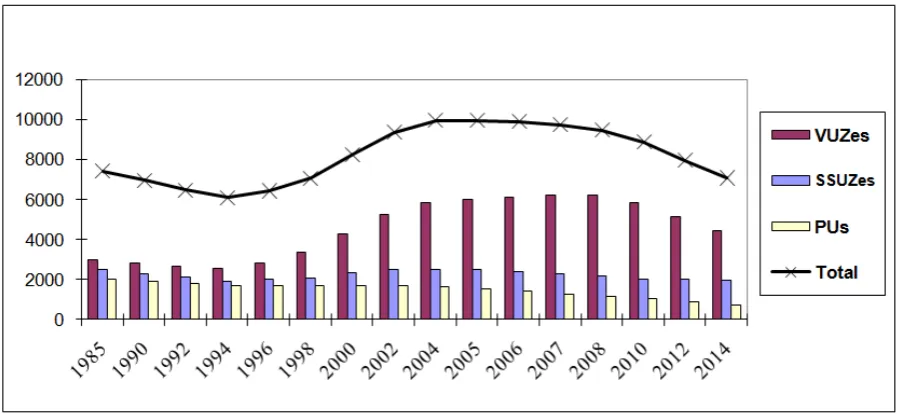
and their subsidiaries recognized as inefficient, reduction of free educational places on a number of specialties, etc. Such administrative actions are reaction to demographic processes in many respects: – decrease in cohorts of graduates of secondary schools and youth of student's age (after 2004-2005 reduction of number of the studying youth is noticed) (fig.1, fig.2); - migratory processes in the country are not in favor of human development.
Request 4. Work of the education system in terms of the new law "On education ..." and in conditions of gradual implementation of the new federal state educational standards at all levels opens up possibilities for a new organization of educational processes and a new understanding of results. However, the realization of this possibilities are prevented by the amplified formalism and bureaucratic "pressure" of administrative and controlling structures upon secondary schools and institutions of professional education.
Request 5. "Signals" from the labor market. Vectors of development of professional education system and a sphere of employment for a long time had different directions. The current structure of training disperses from modern needs of the sphere of employment and perspective projects of economic development (quantitatively and qualitatively). On the one hand, preferences of the population go in line with the formation of modern structure of professional education with a prevalence of the higher one. On the other hand, these preferences create imbalances in the structure of specialties in universities and colleges, increase disparities between the educational services market and the labor market. Falling of quality of education, quality of training and its results is reflected also in a dissatisfaction of employers with professional competences of young certified specialists. Results of reforming of the system of professional education often do not find understanding among employers (for example, transition of higher education institutions to training of bachelors instead of specialists; elimination of primary professional education as separate stage for training of workers, and others).
Fig. 1. The number of students of state institutions of professional education (thousands of people, 1985-2014, the Russian Federation)
Page 223
Fig. 2 The number of students of state institutions of professional education (thousands of people, 1985-2014, Novosibirsk region)
Source: Regions of Russia 2015
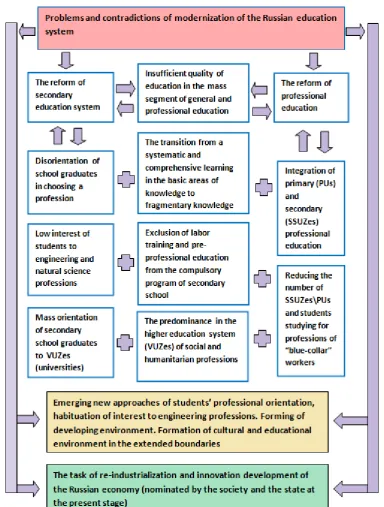
Request 6. Changes occurred in the course of modernization of the education system generate a complex of social problems demanding the account. Among such tasks: ensuring comprehensive concept of the secondary education; correction of the effects of elimination of system of primary professional education; to give an opportunity to teenagers from all social groups of society to realize their post-secondary education trajectory. Partly mutual influence of the happening changes is presented in fig. 3.
Educational Alternatives
ISSN 1314-7277, Volume 14, 2016
Journal of International Scientific Publications www.scientific-publications.net
Page 224
Fig. 3. Problems and contradictions of modernization of the Russian system of education in the last decades and emerging new approaches of its improvement under the tasks of re-industrialization and
innovation development of the national economy.
3. THE SYSTEM OF EDUCATION IN NEW CONDITIONS OF REFORMING
Page 225
However other subsystems of professional education (secondary and primary) in that period underwent great difficulties in absolutely every respect. The most basic changes during that period were inclusion of profile studies at senior grades of secondary school and introduction of compulsory exams - USE (unified state exam) at complete high school and SFT (state final testing) – in incomplete. All participants of educational process needed to adapt to this testing (pupils, parents, schools, teachers, higher education institutions which were forced to accept entrants by results of USE "blindly"). Tensions over the exam does not subside until now [Pishnyak & Khalina 2015]. The next period of reforming (which began approximately since 2010 - 2011) coincided, and in many respects was caused by the influence of the demographic factor - reduction in the number of cohorts of youth in school and student's age. (fig.4, fig.5).
The influence of demographic factor leads to reducing of total number of students and of total entrance figures after mid-2000-ies. Although young people still have an expanded choice of higher educational institutions (including paid education in state and non-state universities). So almost all graduates from complete secondary school could continue their education in higher educational institutions in one of the possible form of learning in Novosibirsk region (full-time, part-time or correspondence courses, night courses) – of course if we abstract from their plans and all limitations of real life. In this respect in Novosibirsk region the situation continues to be more favorable than in the Russian Federation in the whole. The similar trend can be observed in recent years of the national scope (fig.4, 5).
Fig. 4. Entrance of students in higher educational institutions of all forms of ownership and graduation from complete secondary schools in the Russian Federation (in thousands).
Educational Alternatives
ISSN 1314-7277, Volume 14, 2016
Journal of International Scientific Publications www.scientific-publications.net
Page 226
Fig. 5. Entrance of students in higher educational institutions of all forms of ownership and graduation from complete secondary schools in Novosibirsk region (in thousands)
Source: Regions of Russia 2015
Secondary professional education after the reforming (under the new law "On Education in the Russian Federation") consists of 2 stages - training of specialists of mid-level (that in the past engaged in secondary special educational institution - SSUZes) and the training of workers and employees (that earlier engaged in vocational schools - PUs). It took a big restructuring, which resulted in elimination of part of the vocational schools, and the part underwent association. The system of secondary and primary professional education during the period since the end of 2000th in large quantities moved
from the federal level of submission and financing to a regional level. Though several technical schools could enter into structures of higher education institutions. The regional authorities reasonably set the task of "optimization" of expenses on this system, changing of structure of vocational training of students according to the demands of the regional labor market. (Fig. 6).
There is no doubt that the most successful project of modernization was computerization at all levels of the education system. However, it was succeeded not only to computerize professional educational institutions due to the concentration of financial resources in these conditions, but also to update equipment for studies, other devices and educational literature, to buy expensive simulators.
As a result of “optimization” the part of the professional schools was eliminated, especially that located in rural areas. From old once there were existed new educational institutions which received, as a rule, the name "college" (and sometimes – ‘technical school’ or ‘training center’). In many of these colleges after reorganization the structure of specialties ceased to be universal as before, recently became focused on one or two branches (the industry, transport, construction, agriculture, services, etc.). Especially such changes have affected the opportunities of rural youth to receive a working profession close to home (more it concerned the girls who were left without "female" professions). As the positive effect of these reform has become more close interaction of the system of secondary professional education with employers, improvement of material base of colleges, the emergence of new forms of association of resources (for example resource centers).
Page 227
The common features among these directions of reforms, in opinion of Pasi Sahlberg, - who called them Global Educational Reform Movement (GERM), - are standardization, the accountability and fixed result. On the contrary, in economic environment for increase of competitiveness of national economy are important flexibility, creativity and risk-taking (Sahlberg 2006). However, during information era in which a world universities community turned out today a tradition to use only of the old forms of education is a way to lag (Balatsky 2015).
The following processes and measures took place at all levels of the Russian education system during the considered period: implementation of the federal state educational standards, various systems of measurement of educational results of pupils and students, measurements of productivity of teachers’ work, introduction of the normative ‘per-person’ financing, gradual introduction of effective contracts for teachers. Problem is in unstable financing of educational reforms. Initially strange problem was solved: to raise a salary of teachers without increase in financing at these purposes. Decision was chosen as a rule unpopular and was carried out due to reduction of number of lecturers and increase in labor load of those who remained. (Balatsky 2015, p. 91).
The best years of the system of higher education (2000th) were changed to the intense period of new adaptation. The state continued to change "rules of the game". Only higher education institutions that activity was approved by governing bodies and corresponded to the criteria of efficiency developed by them could realize the advantages. The number of higher education institutions and especially of their subsidiaries were reduced. So the number of state universities in the Russian Federation decreased from 655 to 548 units from 2005 to 2014, while the number of their subsidiaries accordingly from 1100 to 843. In Novosibirsk region this process almost did not affect head universities (reduction from 16 to 14 units), but touched their subsidiaries which number in the reporting period was reduced from 11 to 7 units (Regions of Russia 2015). However, the part of higher education institutions had new opportunities of expansion of the infrastructure due to accession of colleges. Gradually the structure of the budgetary (free) educational places was changed with the purpose to raise a number of students on engineering specialties and to reduce – on humanitarian.
Fig. 6. Dynamics of number of students in the state SSUZes (colleges) of Novosibirsk region by integrated groups of professions (all forms of study, thousand people) (2005-2014)
Educational Alternatives
ISSN 1314-7277, Volume 14, 2016
Journal of International Scientific Publications www.scientific-publications.net
Page 228
Fig. 7. Dynamics of the number of students in state VUZes (universities) in Novosibirsk region by integrated groups of professions (all forms of study, thousand people) (2005 - 2014)
Source: Higher educational institutions 2015
The model of management of higher education was changed. The administration of universities began to depend more and more on the authorities and control bodies, and ordinary professors and teachers – on administration of their institutions. The researchers incline to opinion that there was a transition from «university-centered» to a «client-centered» system within the processes in the New public management, in particular all these changers need to ensure for actors greater transparency, accountability and orientation on demand (Kapoguzov 2015).
During this period there were realization in the system of higher education first, ideas of a variety - federal universities and national research universities appeared. The task included improvement of the competitiveness of national higher education system and achievement of a high world rating by several leading universities of Russia. This global trend is described in the paper (Teichler 2015). Secondly, the idea was to bring Russian university closer to the image of western university (to encourage teachers to write scientific articles, to transfer them to effective contracts, to attract foreign students and professors, and others.). In this regard, the understanding between reformers and "toilers" from education did not turn out so far. According to some authors the conflicts ripen here. Reorganization of the salary system significantly changed the status of teachers for the worse by the administrative-bureaucratic methods (Kurbatova 2013; Tambovtsev 2015).
The interaction of universities and colleges with employers are continuing in different forms by the initiative of universities and regional community. As the necessary measure it was announced the set of professional standards need to work out in collaboration. There were organized educational clusters for the purpose of long-term trajectories of training for a more effective cooperation; the concept of inclusion of higher education in the task of development of real production sector in the region appeared.
Page 229
With regard to secondary professional education measures were effective and, as can be seen, the relative structure has changed. However, the absolute growth of number of students on technical specialties of colleges did not happen (Fig. 6). With regard to higher education noticeable change is not observed, the youth, who did not get free places on humanitarian and economic specialties, ready to study for a fee (Fig.7).
The process of "optimization" of the education system at the regional level, accompanied by a decrease in the territorial accessibility of secondary education for children: in the countryside of Novosibirsk region from 1999/2000 to 2014/2015 acad. years 515 municipal schools were closed (Education in Novosibirsk region 2015), and for compensation a system of delivery of pupils by school buses was created. “Optimization" of primary and secondary professional education institutions reduced availability of this type of education to youth (usually of low-income families) that was not compensated by anything more (Fig.8). As a result, entrance to ‘new’ colleges is carried out by a competition. Experts in colleges which we interviewed were proud of the fact that for their studies appeared a competition. They felt that this would enhance the prestige of the institution in the eyes of young people. The carried-out reorganization of vocational education system allowed to start its modernization. However, the appeared progress comes against the availability of vocational education for children from rural areas, and also from families of low social status.
The conducted reforming aggravated by demographic factor can’t improve the existing problem of a mismatch, on the one hand, mass orientations of school leavers to higher education and prestigious professions of market infrastructure and service sphere and, on the other hand, labor market demand for skills of workers, engineers and technicians for the industrial segment of economy even more. Imbalances in the labor market will increase as there are pent in demand for those professions which were trained by professional schools. This can be confirmed with data of the Ministry of Labour of Novosibirsk region. Thus, the declared need for employees was in 2013 year 172.8 thousand vacancies of which 129.2 thousand (74.7%) was for blue-collar workers. These indicators grew in 2014 and made 192.6 thousand vacancies among which was 148.6 thousand (77,1%) for blue-collar workers. The same trend noticed in the Siberian Federal District (uniting regions of the Western and Eastern Siberia).
Fig. 8. The number (units) of educational institutions of primary professional education (PUs) – vocational schools for training qualified workers in Novosibirsk region and students in them (thousands of people) at the end of the year. Comment: For 2013 and 2014 there is shown the number
of institutions of secondary professional educational realizing the programs of qualified workers training.
Educational Alternatives
ISSN 1314-7277, Volume 14, 2016
Journal of International Scientific Publications www.scientific-publications.net
Page 230
4. CHANGES IN CONDITIONS OF SECONDARY EDUCATION AND TRENDS IN SCHOOL GRADUATES’ INTENTIONS
In this chapter the data of school leavers monitoring survey are used. The last was conducted in 2014/15 academic year (1247 questionnaires of senior grades pupils and materials of 26 interviews with experts – schools’ representatives and others were gathered). The obtained data are compared in analysis with previous researches conducted in 1990, 1996, 2000 and 2006. All comparisons were made between weighed data arrays.
The obtained results allowed to record remaining and new tendencies in comparison with our sociological surveys of the period mid-1990s and early 2000s. So, the share of senior pupils who did not choose a profession that they would like to study remains high (reaching up to half).
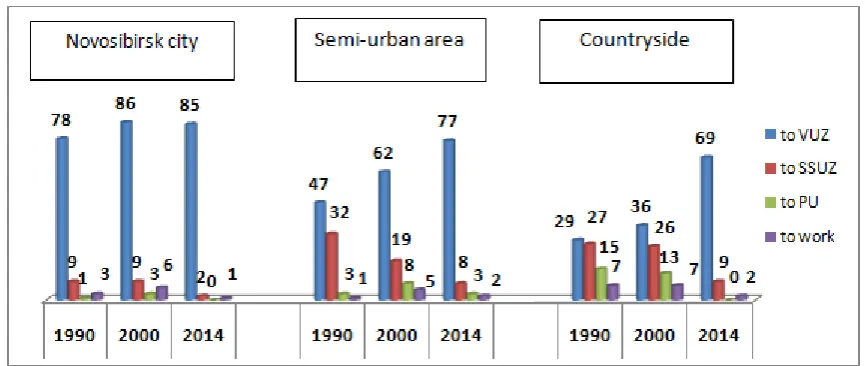
Thus, the introduction of profile studies at schools did not break a tendency of rather massive postponed professional choice until "the last moment". The orientation to higher education institutions keeps popularity: it especially high in the regional center – up to 85% among graduates of complete secondary school, and growth was observed in the small towns and semi-urban settlements (to 77%) and in the countryside (to 69%). The growth of orientation of 11th grade pupils to enter a higher
education institution corresponds to plans of 9th grade pupils to remain in high school, that is to realize
the "academic" educational trajectory increasing chances in further to enter university. Noteworthy is the fact that in the countryside and semi-urban areas were revealed more students that prefer to leave school after 9th grade and go to college, that is to implement the "non-academic" educational trajectory (fig.9, 10). The action of social factors influencing such choice is shown in a number of studies, for example Bessudnov & Malik (2016), Boudon (1974).
At the choice of education and a profession, as well as in our surveys of previous years, prevailing combination of ‘liberal-market’ motivation (income, prestige, career – from 48 to 61% respondents) with significance of self-realization (up to 69%) remains.
According to answers to an open question "If you have already decided what profession (specialty) you would like to receive, then specify it, please ..." it was revealed that engineering professions still do not enjoy popularity (as in the previous surveys of 1996, 2000 and 2006 years). Nevertheless, school-leavers began to be guided by professions of health care and the sphere of information technologies rather more than earlier. These preferences somewhat reduced the share of group of popular professions of financial and economic sphere, business, legal, management, a number of social and humanitarian. However, this decrease may be misleading, since every second high school student was not defined with a profession yet (Fig.11, 12).
Fig 9. Dynamics of intentions of complete secondary school graduates (students of 11th grades), %
Page 231
Fig 10. Dynamics of intentions of incomplete secondary school graduates (students of 9th grades), %
Source: The data of sociological surveys, IEIE SB RAS, Novosibirsk region.
Concerning professional self-determination, the mass orientation of schools’ leavers to the higher education has become a modern trend. The system of higher education faces a problem of unreasonable choice of profession by schools graduates and of their low motivation to acquire knowledge on the background of high claims to a salary, opportunities of career development, prestige of profession and opportunities of realization of their abilities and interests. Respectively the labor market faces consequences of this phenomenon (Arsentyeva, Kharchenko 2016).
Fig. 11. Professions aggregated by branch-oriented specialization aspired by graduates of incomplete secondary school (students of 9th grades), %
Educational Alternatives
ISSN 1314-7277, Volume 14, 2016
Journal of International Scientific Publications www.scientific-publications.net
Page 232
Fig. 12. Professions aggregated by branch-oriented specialization aspired by graduates of complete secondary school (students of 11th grades), %
Source: The data of sociological surveys, IEIE SB RAS, Novosibirsk region.
5. EDUCATIONAL BEHAVIOUR AND COMPETENCES OF GRADUATE STUDENTS OF PROFESSIONAL EDUCATIONAL INSTITUTIONS
The research objective of this part of the paper consists of 2 topics: - to study interest of students towards forming their professional potential and ability to be competitive in modern labor market; - to estimate opportunities of higher and secondary professional education system to create necessary conditions for this (on the case of Novosibirsk region).
As the empirical base are used the data of 3-waved periodical sociological observations carried out in the subsystems of higher, secondary and primary professional education in Novosibirsk region, which includes: 1) the survey of students conducted in 2015/16 academic year at 38 institutions of higher and secondary professional education (4670 questionnaires of students at full-time departments of graduate and undergraduate courses were collected). Also materials of 31 semi-formalized interviews with experts (professional education institutions representatives and others) were gathered. Students of higher educational institutions (VUZes) represents specialists’ and bachelors’ programs; students of secondary special or secondary professional education institutions (SSUZes) - training programs for mid-technicians and for qualified blue-collar workers; 2) the arrays of questionnaires performed on students at full-time departments of graduate and undergraduate courses in universities and their subsidiaries (1947 people, 2007/08 academic year), secondary special and professional schools (1748 people, 2008/09 academic year); 3) the materials of “basic” observation with the comparable methodology and sampling (2470 students of universities, secondary special and professional schools were interrogated in 2001); 4) the materials of semi-formalized interviews with experts being the representatives of institutions included into surveys.
Page 233
agriculture; 11) geodesy and land management; 12) transportation; 13) communication service; 14) service sector and trade 15) production of food and consumer goods engineering.
All considered groups of students became more satisfied with their educational choice during the first period of our monitoring survey. But in the second period only students of secondary professional institutions wined of ongoing reforming in education - they were satisfied more when study at the chosen profession (answer «yes» gave 59% of respondents in comparison of 51 % in previous period) (table 1).
Table 1. Change in estimations of choice made by students (in % to answered respondents) *
Share of those who said that**:
Higher institutions (VUZes)
Secondary special*** institutions (SSUZes)
Professional schools (PUs)***
2001 2007/08 2015/16 2001 2008/09 2015/16 2001 2008/09 2015/16
- choice of university/ college/ prof.
school was correct (answer «yes») 47 52 47 51 57 53 68 68 55
- choice of university/ college/ prof. school was not correct (answer «no» +
“rather no, than yes”) 15 12 13 15 11 14 13 9 16
- I like to study at the chosen
profession now (answer «yes») 38 48 47 46 51 59 66 67 56
- I don’t like to study at the chosen
profession now (answer «no») 3 2 5 2 3 4 2 2 5
- choice of profession in whole was
correct (answer «yes») 41 46 39 50 53 52 67 71 51
- choice of profession in whole was incorrect («no» + “rather no, than yes”)
16 14 19 16 12 15 12 10 19
- I’m going to work according to
obtained specialty (answer «yes») 46 49 49 37 44 44 48 45 41
- I’m not going to work according to
obtained specialty (answer «no») 6 6 6 8 8 7 5 8 9
*) We don’t give statistics to such positions as: “do not know”, “rather yes, than no”, “as happens” **) Hereinafter all comparisons were made between weighted data arrays.
***) Hereinafter, for purposes of convenience and comparison of data in dynamics we divided our colleges’ respondents of 2015/16 into mid-level technicians (former SSUZes) and workers (former PUs).
Educational Alternatives
ISSN 1314-7277, Volume 14, 2016
Journal of International Scientific Publications www.scientific-publications.net
Page 234
Table 2. Dynamic of students’ appraisals of different elements of educational process (average on 5-grade scale, where 1 is the lowest grade, 5 – the highest one) *
Higher institutions (VUZes)
Secondary special institutions (SSUZes)
Professional schools (PUs)
2001 2007/08 2015/16 2001 2008/09 2015/16 2001 2008/09 2015/16
Professors’ professional level 4,2 (0,8) 4,25 (0,76) 4,16 (0,87) 4,49 (0,74) 4,47 (0,78) 4,44 (0,84) 4,36 (0,93) 4,38 (0,98) 4,30 (0,99)
Lectures level 3,7 (0,8) 3,82 (0,85) 3,69 (0,97) 4,06 (0,88) 4,15 (0,86) 4,18 (0,92) 3,98 (1,09) 3,97 (1,12) 4,07 (1,09)
Practical classes level 3,6 (0,9) 3,81 (0,87) 3,89 (0,93) 4,01 (0,97) 4,14 (0,98) 4,15 (1,03) 3,90 (1,08) 3,99 (1.19) 3,98 (1,14)
Practical work organization 2,8 (1,2) 3,33 (1,27) 3,41 (1,26) 4,08 (1,12) 4,06 (1,11) 4,07 (1,15) 4,11 (1,07) 4,17 (1,11) 4,18 (1,18)
Material supply of education process 2,5 (1,1) 3,33 (1,16) 3,46 (1,19) 3,09 (1,21) 3,63 (1,09) 3,75 (1,17) 3,43 (1,28) 3,83 (1,14) 3,95 (1,16)
Provision with educational literature 2,7 (1,2) 3,54 (1,16) 3,89 (1,14) 2,94 (1,14) 3,67 (1,12) 4,05 (1.10) 3,14 (1,36) 3,78 (1,28) 4,09 (1,10)
Provision with scientific literature, reference books, periodicals
2,8 (1,2) 3,49 (1,14) 3,81 (1,14) 2,96 (1,13) 3,58 (1,14) 3,95 (1,13) 3,08 (1,32) 3,65 (1,35) 3,95 (1,13)
Conveniences (repair of rooms, food
point, security, cloak-room, etc.) n/d n/d
3,4
(1,29) n/d n/d
3,46
(1,36) n/d n/d
3,71 (1,28)
General correspondence of education
to demands of job and life 3,2 (1,0) 3,55 (0,99) 3,58 (1,07) 3,67 (1,02) 3,92 (0,95) 3,81 (1,10) 3,77 (1,13) 4,01 (1,09) 3,98 (1,08)
*) In brackets standard deviation is given **) n/d - no data available
For the purpose of monitoring we observe estimations done by students of necessary changes in their education institutions. In the opinion of majority, the quality of education need to be enhanced. University students were very much anxious about educational programs of courses and disciplines taught. They suggest to change them for more correspondence of the labour market demand and employers’ requests to university graduates. Changes in organization and content of practical work still remain important for them too. Students in the secondary special/professional education became less excited about their practical training than we revealed in first-wave survey.
Also students of university were less satisfied with the teaching quality than their mates in colleges. Their need of widening of active methods of education were still high. University students in comparison with their college mates more often need optimization of curriculum. Increase in provision of educational process with material and technical resources, with educational literature became less actual for all 3 considered groups of students. As a very dramatic point for university students is seen insufficient attitude of their class-mates to learning that need improvement in the opinion of 44% of our respondents (table 3).
Page 235
Table 3. Estimation by students the necessary changes to enhance quality of education (percent of respondents who gave an answer to the question) *
Higher institutions (VUZes)
Secondary special institutions (SSUZes)
Professional schools (PUs)
2001 2007/08 2015/16 2001 2008/09 2015/16 2001 2008/09 2015/16
Professional growth of lectures &
professors 25 22 21 15 15 17 21 18 23
Improvement of teaching quality n/d 33 33 n/d 15 17 n/d 15 13
Change in educational program, review
of courses and disciplines taught 47 40 48 23 19 22 12 8 11
Increase of active methods of education
share 38 42 39 21 19 18 7 4 11
Increase of amount of practical work 30 24 32 36 22 23 32 17 18
Change in organization and content of
practical work n/d 43 41 n/d 24 23 n/d 9 15
Increase of educational process provision with material & technical
resources 70 44 33 62 39 24 47 22 21
Provision with educational literature 58 33 15 47 27 14 20 8 6
Provision with scientific literature,
periodicals 45 30 n/d 32 22 n/d 16 6 n/d
Optimization of curriculum n/d 34 44 n/d 21 25 n/d 7 11
Improvement of students’ attitude to
education n/d 44 44 n/d 42 35 n/d 23 21
Nothing must be changed n/d 2 5 n/d 9 17 n/d 22 21
n/d – no data available; *) Same variants of answers with small meanings are not shown in the table
Apparently, progress of students of higher education considerably drops, and on the contrary among students of SSUZes and PUs becomes higher. With regard to the first we explain it with difficulties of adaptation of the yesterday's school pupil to the university level of requirements. With regard to the second we deal with more successful perception of practical knowledge and skills than theoretical one (the latter just dominate at secondary school).
Table 4. School progress (answers on a retrospective self-assessment) and progress in professional education institution (answers on self-assessment) among students
Students’ progress: Higher institutions (VUZes) Secondary special institutions (SSUZes) Professional schools (PUs)
School progress:
“Perfectly” + “Perfectly and good” + “good”
82,5 51,0 23,7
“good and satisfactory” +
“satisfactory” 17,5 49,0 76.3
Professional education progress:
“Perfectly” + “Perfectly and good” + “good”
64,6 59,5 45,7
“good and satisfactory” +
Educational Alternatives
ISSN 1314-7277, Volume 14, 2016
Journal of International Scientific Publications www.scientific-publications.net
Page 236
Currently, the share of those who do not know for what sake they are learning in higher education was 13%, in secondary professional - 18% and in professional schools - 27% of respondents. It is typical that this share has increased in the last period of observation. Also part of the students does not learn in order to achieve any results, but to avoid problems due to poor academic performance. Most of such students are in higher education - 29% (for comparison: in SSUZes- 11%, in PUs - 4%).
Change in students’ attitude towards education does not ensue from satisfaction by conditions of education. Incentives to education have not changed significantly. From one tenth to one fourth of interrogated young people still don’t have any special purposes for education. Each third (36 %) of all respondents consider that they could easily study better. Significant part of students (up to 44 % in VUZes) believe that quality of education would significantly increase if students change attitude to education.
The idea of what skills, abilities, features the students have got by the time of graduation is shown in table 5. There is quite a long distance between knowledge and skills gained during studies and their practical implementation (even if it is a theoretical one). As we see most of students believe that they will have a set of competences necessary to fulfill a demand to basic competences of a specialist today (qualitative professional education, wide mental outlook, sufficient for mastering in different kinds of activities, for life-long and independent learning, analytical skills, teamwork ability, communication skills, managerial skills, tolerance, free use of computer and IT). Over a half (59 %) of students believe that they are competent in an “out-of-the-box” skill (that is ability of creative thinking). At the same time from one fifth to more than one third of graduates (by self-esteem) have doubts as they can get competences necessary for a specialist with higher or other level of professional education: from 21 to 42% of graduate students gave a low assessment of their grounding in this “standard” set of competences.
Table 5. The share of responses who answered “Will obtain (have already obtained)” to the question in table form “What skills, abilities, features will you obtain by the time of graduation?”, 2007/08
(% of respondents who gave an answer in every row) *)
Will obtain (have already obtained):
Higher institutions
(VUZes) Secondary special institutions (SSUZes) Professional schools (PUs)
2007/08 2015/16 2008/09 2015/16 2008/09 2015/16
Qualitative professional education that is in accord
with contemporary demands 71 69 84 80 82 81
Education sufficient for mastering in different kinds of activities, for life-long and independent learning **)
73** 81 81 79 68 67
Fluent speaking a foreign language 14 18 12 19 13 16
Non-standard and creative thinking 58 59 61 61 49 56
Perfect skill of computer use and IT 58 55 57 64 43 51
Knowledge of modern techniques, methods of
solving production tasks n/d 54 49 61 41 49
The ability to apply knowledge and skills to solve
production tasks n/d 71 n/d 80 n/d 74
Teamwork ability 71 75 84 81 82 76
Communication skills 76 75 89 81 85 76
Managerial skills 60 58 71 64 54 52
Practical experience, skills of working n/d 58 n/d 78 n/d 75
Page 237
*) We don’t give statistics to such positions as “Doubtfully will get but would like to” and “Don’t have such a goal” **) In 2007/08 survey this position was given as “Wide mental outlook, education sufficient for mastering in different kinds of activities, for life-long and independent learning”
The problem of a lack of the general and professional competences is most actual for students of universities as requirements of employers to their level are highest. In particular, 29 % of students of VUZes have noted that they could not receive the sufficient computer competence (16 % even do not feel the need in it). Alarming factor is knowledge of foreign languages. Only 18 % of respondents consider that they can fluently speak a foreign language.
All answers to this question (table 5) show that students have a significant request for obtaining competencies that are necessary for a specialist with higher or other professional education in informational era. We should note that responses give a self-esteem that reflects, on one hand, quality of obtained education (as compulsory as additional), on the other hand – level of individual request to this quality (the lower this level is the easier is to satisfy it). It became clear that these data show mainly possession of educational competences ("what they learn" and "what they had taught"), but they are not fully show that a student is able to do in a real practical (working) situation.
One more important competence of specialists with higher education is research competence. The possibilities of students to participate in scientific research (except for only one national research university NSU in Novosibirsk region) remain inadequate, despite on the fact that for university education the connection of learning with science is an important characteristic of its quality. Our monitoring has not recorded any positive changes in this direction yet (Table 6).
Table 6. Dynamics of university students’ participation in scientific researches in total and separately in Novosibirsk State University (2007/08 and 2015/16 ac.y.)
(% of answered respondents, only VUZes)
Forms of participation 2007/08 2015/16
Total NSU Total NSU
1. Lead an independent scientific research 12 30 10 14
2. Participate in scientific research of university (at a chair, department or in a lab etc.) 8 17 14 18
3. Participate in scientific research of their scientific advisor or a professor 13 41 17 43
4. Participate in scientific research at a place of their practical (tentative) work *) 4 10
7 23 5. Participate in scientific research at a place of their part-time job 4 12
6. Other (mostly answers like “while writing students’ or qualification papers”) 2 3 1 2
7. Do not participate but would like to 32 11 30 19
8. Do not participate since they have lack of time, no wish or no interest 34 12 34 17
*) in the questionnaire 2015/16 answer variants 4 and 5 were combined into one
We used the following approach in order to smooth over the factor of different requests. The idea was to reveal what requirements are imposed by employers and to what of them students can correspond. We compare students’ answers to 2 questions: 1) “What requirements, in your opinion, often imposed by employers to graduates of education institution on your specialty?”; 2) “And which of these requirements you for certain will be able to correspond?”
Educational Alternatives
ISSN 1314-7277, Volume 14, 2016
Journal of International Scientific Publications www.scientific-publications.net
Page 238
– 59% compared to “I can match” – 28%; students of college respectively – 41% against 28%; students of professional school respectively – 30% against 23%. But the opposite situation revealed when the concerned item was continuing education. For the competence “Ability and readiness for training, self-education, if necessary – to retraining” students of university gave the answers “imposed” – 49% compared to “I can match” – 58%; students of college respectively – 25% against 31%; students of professional school respectively – 12% against 15%.
Survey of students revealed a problem which is quite realistically estimated by future employees. So, about 60% of the interrogated graduate students consider that having gained the diploma they could get to work in their specialty at once if such a work occurs. Still approximately every fifth will need additional training of a particular type (supplementary professional courses, training with the mentor, etc.). Among university students it was each forth. The rest have other plans, including continuing education in formal institutions and job search not in their specialty (Table 7).
Table 7. Distribution of students’ answers on the question “Whether you will be able after graduation from this educational institution to start work on a specialty without additional training?”
(% in groups of specialties, 2015/16)
Whether you will be able after graduation to start work on a specialty without additional training?
Higher institutions (VUZes)
Secondary special institutions (SSUZes)
Professional schools (PUs)
Yes, most likely, I will be able (if necessary I will go
in for self-education) 56 57 58
At once I can’t – will require advanced training
course 8 8 7
At once I can’t - will require other types of
additional training 17 10 6
At once I plan to study further to obtain diploma of a higher level
12 10 5
I’m not sure yet whether I will work in the specialty 12 12 17
Don’t know 7 7 10
Page 239
Table 8. The share of respondents who were planning to continue their studies in the nearest 1–2 years after completing the given stage of education and receiving a diploma (% to sample) *
Higher institutions (VUZes)
Secondary special schools (SSUZes)
Professional schools (PUs)
2001 2007/08 2015/16 2001 2008/09 2015/16 2001 2008/09 2015/16
No, I am not planning yet 41 38 34 27 23 36 46 50 61
On refresher courses in my specialty 12 13 9 10 5 10 15 11 9
On professional courses, retraining
courses in another specialty 11 11 5 6 3 6 9 6 6
At a professional school 0,3 – - 1 1
2 2 5 3
At secondary special institutions 0,2 – - 1 1 9 8
At a higher institution 27 36 11 60 67 46 24 19 19
Taking a master’s course*
20 9 39 – – - – – -
Taking a post graduate course 10 6 – – - – – -
Other (on my own, internship, etc.) 8 6 3 2 2 5 4 4 7
* In 2007/08 survey in the sample prevailed specialists and in the sample of 2015/16 – bachelors.
In all waves of our monitoring continuing education is quite highly demanded among young people even during period of their study in the institutions of formal education (universities, colleges, professional schools). Students of secondary special schools comprise a bigger part of those oriented to continue their studies in a formal system of education. In recent years students of higher institutions also became oriented towards the formal one due to significant need of masters’ degree (39%). Continuing education is considered by the majority of young specialists as an important factor for their professional qualifications and successful career. Its courses/programs are required by students as the essential component of a modern workplace.
* * *
By results of the research conclusion is drawn that the system of professional education (the higher and secondary stage) began to be guided more, first by tasks of internal development, secondly, by ensuring result on prepared specialists and workers demanded by national economy. However, reforming of secondary professional education subsystem was followed by closing of many professional schools and, respectively, decreasing in social availability of this type of education to youth of rural territories. The material conditions of training for students in general were improved and communications with employers were strengthen during the reorganization of a subsystem of secondary professional education. The last, in turn, was reflected to better conditions of practical training for students and of their further employment. However, efficiency of the made expenses and reformatory efforts decreases because of a number of factors among which there are students’ ones. Some of them are the following: - weak school preparation in basic subjects; - a considerable share of casual or poorly thought out professional choice at the school period; - the unstable motivation to work by the received profession; - narrow bounds of educational competences and of necessary professional competences need to future specialists (limited basic set of competences reduces readiness of students to work in their specialty without passing additional training courses on practical skills of work); low participation of students of universities in scientific researches in the years of study does not promote their interest in innovative economy and work in highly technological sector of economy. Therefore, change in real quality of education was often less significant. As a perspective feature of graduates was revealed their high adaptation readiness to conditions of labor market and in general to living conditions.
Educational Alternatives
ISSN 1314-7277, Volume 14, 2016
Journal of International Scientific Publications www.scientific-publications.net
Page 240
teachers, students, public representatives, using their potential. It is necessary that one of the tools of educational policy become strategy of a support on competitive advantages (Kuzminov, et al. 2013, page 155-156).
ACKNOWLEDGEMENT
The paper was prepared with support by the «Russian Foundation for Humanities» (RFH) in alliance with the Government of Novosibirskaya oblast, project №15-13-54001 "Models for human development of youth in the region: the necessary conditions and incentives" (headed by I. I. Kharchenko).
REFERENCES
Arsentyeva, NM, Kharchenko, I I 2016, ‘The contradictions of human development in a region within the modernization of the Russian professional education system (in Russian), Region: Economics and Sociology, All-Russian Scientific Journal, no. 1 (89), pp. 159-181.
Balatsky, EV 2015, ‘New trends in the development of the university sector’ (in Russian). Universe of Russia. Sociology. Ethnology, vol. 24, no. 4, pp. 72-98.
Bessudnov, A & Malik, V 2016, ‘Socio-economic and gender inequalities in educational trajectories upon completion of lower secondary education in Russia’ (in Russian), Educational Studies, Moscow, no. 1, pp.135-167.
Boudon, R 1974, Education, opportunity and social inequality, Wiley, New York.
Chubik, PS, Chuchalin, AI, Soloviev, MA & Zamyatina, OM 2013, 'Training of high-class technicians and technologists' (in Russian), Education issues, vol. 2, no. 2, pp. 188-208.
Concept of the Federal target program of education development for 2016-2020 years (in Russian) 2014, The order of the Government of the Russian Federation of December 29, 2014, No.2765-r, Moscow, viewed 31 July 2016, <http://metodist.lbz.ru/content/files/29-12-14.pdf>.
Donskikh, OA 2013, Degradation. Thoughts on education and its place in our culture (in Russian), Moscow.
Education in Novosibirsk region (in Russian) 2015, Statistical handbook, Novosibirskstat –Territorial office of the Federal State Statistics Service of the Novosibirsk region, Novosibirsk.
Higher educational institutions of Novosibirsk region (in Russian) 2015, Statistical handbook, Novosibirskstat – Territorial office of the Federal State Statistics Service of Novosibirsk region, Novosibirsk.
Holmwood, J 2013, ‘The neo-liberal knowledge regime, public higher education and the future of the social sciences’, Report to the 11th Conference of the European Sociological Association “Crisis, Critique and Change”, Torino, Italy, August, 28-31th, 2013.
Kapoguzov, EA 2015, ‘Transformation of the role of higher education stakeholders in the context of the Russian reform’ (in Russian), Herald of Omsk University, Series “Economics”, no. 2, pp. 4-9. Kharchenko, I I 2010 ‘Modernization of the Russian System of Higher Education’, International Scientific Publications: educational alternatives, vol. 8, pt. 1, pp. 95-115, viewed 31 July 2016, <http://www.science-journals.eu/erd/ISP-ERD-Vol8-Part1.swf >.
Kurbatova, MV 2013, ‘Not only wages: professors of universities on the way to become a cog in the education machine (in Russian), EKO, no. 10, pp. 110-122.
Page 241
Development, Higher School of Economics. Proceedings 2011-2012 [Text], Moscow, 2013, pp. 146-203.
Pishnyak, A & Khalina, N 2015, ‘Perception of a successful passing of State Final Testing (SFT) and United State Exam (USE) by parents of Moscow school students: opportunities and drawbacks’, Educational Studies, Moscow, no 3, pp. 144-170.
Regions of Russia. Social and Economic indicators (in Russian) 2015, Statistical handbook, Rosstat, Moskow, viewed 31 July 2016, <http://www.gks.ru/bgd/regl/b15_14p/Main.htm>.
Sahlberg, P 2006, ‘Education reform for raising economic competitiveness’, Journal of Educational Change, vol. 7, no. 4, pp. 259–287.
Secondary special educational institutions of Novosibirsk region (in Russian) 2015, Statistical handbook, Novosibirskstat – Territorial office of the Federal State Statistics Service of Novosibirsk region, Novosibirsk.
Statistical Yearbook of Russia (in Russian), 2015, Statistical handbook, Rosstat, Moskow, viewed 31 July 2016, <http://www.gks.ru/>.
Tambovtsev, VL 2015, ‘The scientific basis for the higher education reforms’ (in Russian), Herald of Omsk University. Series “Economics”, no. 2, pp. 66-70.
Teichler, U 2015, ‘Diversity and diversification of higher education: trends, challenges and policies’ (in Russian), Educational Studies, Moscow, no. 1, pp.14-38.
The Federal Law ‘On Education in the Russian Federation’ (in Russian) n.d., The order of the Government of the Russian Federation of December 29, 2012, № 273-FZ, viewed 31 July 2016, <http://base.garant.ru/70291362/1/#block_ 10229#ixzz3SHliqKh6>.
The Federal target program of education development for 2011-2015 (in Russian) n.d., viewed 31 July 2016, <http://fip.kpmo.ru/fip/info/13430.html>.
The order of the Government of the Russian Federation of December 30, 2012 No.2620-r “On approval of the action plan (Road Map) “Changes in the social sphere aimed at improving the effectiveness of education and science”” (in Russian) 2013, viewed 31 July 2016, <http://www.garant.ru/products/ipo/prime/doc/70191846/>.
The program of re-industrialization of economy of the Novosibirsk region until 2025, 2016, Approved by Resolution of the Government of the Novosibirsk region at 01.04.2016, №89-p, Novosibirsk (in Russian), viewed 31 July 2016, <https://www.nso.ru/sites/test.new.nso.ru/ wodby_files/files/wiki/2015/02/programma_reindustrializacii.pdf>.