NEW VS. TRADITIONAL INSTITUTIONAL ORDER IN EDUCATIONAL INSTITUTIONS: THE CASE OF ESTABLISHING THE FIRST URBANISM STUDY PROGRAMME IN
SERBIA
Marija Maruna, Danijela Milojkić
Faculty of Architecture, University of Belgrade, Bulevar Kralja Aleksandra 73/2, 11000 Belgrade, Serbia
Abstract
Rapid and externally imposed institutional changes cause conflict and stagnation within educational organisations. The tension arises from conflicts between the newly introduced institutional framework, which imposes change, and the old one, which takes the form of an informal framework and resists changes that disturb the institutional order established with much effort. The informal framework creates difficulties for operating within the new framework and the state of collision between two competing institutional frameworks prevents institutions from continuing to develop. However, the formality of the newly-introduced framework can override the informal framework, because it opens the possibility for individuals to act within the institutional order, provided that they consolidate and follow a new set of formal rules and procedures. Working within the conflict state and analysing it can help identify weak points in the procedure that could not be identified during the establishment of the new institutional framework.
Key words: institutional change, educational organisations, formal and informal institutional frameworks, weak points in the procedure
1. INTRODUCTION: CONSEQUENCES OF IMPOSED INSTITUTIONAL CHANGE
The pace, at which the modern world moves, calls for fast adaptation of educational organisations. Yet this speed is wholly at odds with the natural – gradual and slow – mode of transformation of institutional frameworks. Where formal change to an existing institutional framework is introduced or imposed from the outside, difficulties arise in effecting real change in how the organisation in question is structured and operates, since traditional forms of behaviour and other relics of the old institutional system tend to cling to existence and are retained. This is the informal institutional framework — it is made up of extensions, elaborations and qualifications of formal rules that have a tenacious survival ability because they have become part of habitual behaviour. Routines, customs, traditions and conventions are the words we use to note the persistence of informal constraints, together with the way they are enforced. (North 1990; Campbell 2004; Meyer & Rowan 1977) The disturbance of an existing order, inherent preference of the informal framework for establishing a formal framework gradually and slowly, and the insensitivity of change imposed from the outside for such a system, are the primary causes of issues that arise when changes are imposed externally. Change imposed from the outside alters the formal framework independently and quickly, leaving the informal framework in a state of, initially, shock, and then of resistance to the new framework. This state of paralysis prevents the organisation from developing, and the situation as a whole can last for some time (Campbell 2004).
Although informal (traditionally established) institutional frameworks are deeply rooted in the very foundations of a system, it would be wrong to consider them resistant to change for this reason. They too are subject to change over time. To ensure their own survival and growth, organisations must solve a whole set of problems that arise as the system evolves (Schotter 1981). Institutional change is thus the constant and natural state of an institution, although such change is most often gradual and slow. Empirical research suggests that organisational order can be the consequence of both bottom-up and top-down processes, as well as of a combination of both (Scott 1994). However, if we view an organization as a system guided by broad collective intentionality (especially in widely democratic
educational organizations), objects or people can be said to perform functions only by virtue of formal or informal collective acceptance by the community. Only community can assign a status to object or person which carries with it functions that cannot be performed without collective acceptance, regardless of whether change has been gradual or imposed from the outside (North 1990; Searle 2005).
We must differentiate between changes within institutional, normative frameworks and the frameworks themselves (March & Olsen 2006). Changes to the framework may be fast or slow, exogenous or endogenous, and include rules and formal limitations binding on all agents within an organisation. However, institutional change is a complex process, since essential, real change cannot take place through modifications to rules or formal limitations, or the efficacy of their implementation (as brought about by external change). True change happens only with changes to informal limitations, those built into the fabric of society. Although formal rules can change overnight due to political or legal decisions, informal limitations, found in customs, traditions, and codes of conduct, are much more resilient to such change (North 1990).
However, external pressures and attendant changes are a main trait of the network society, which equalises standards. One such case is the process of introducing a higher education system bureaucratically aligned with the principles of the Bologna Declaration in transitional Serbia. Although principles of the Bologna Declaration support making room for student mobility and the creation of varied study programmes associated with it, the introduction of such new programmes was made more difficult due to the resistance of the informal institutional framework. This case of the establishment of the first urbanism study programme at the Faculty of Architecture in Serbia shows an environment where the institutional framework had been formally amended, but where traditional forms of behaviour persisted. As is often the case with change imposed from the outside, an established formal framework for development was not supported by an appropriate procedural framework and bodies that could promote such development. The description of the process of establishing the new study programme shows how activities were undertaken within the complex organisational structure of the Belgrade Faculty of Architecture. Emphasis is placed on presenting bottom-up actions taken by the Department of Urban Planning, which was tasked with establishing the new study programme. The case study explains the reasons why the process was carried out the way it was, and identifies the primary problems faced by heads of the study programme within the institution. The study devotes particular attention to the weak points in procedures created due to the sudden introduction of changes into the formal framework after the Bologna reform: these, in the view of the authors, hold answers to the question of how to act more effectively and efficiently within the new formal institutional framework.
2. CASE STUDY: INTRODUCTION OF A NEW MASTER’S-LEVEL URBAN PLANNING PROGRAMME AT THE BELGRADE FACULTY OF ARCHITECTURE
2.1. Faculty of Architecture and urban planning in post-socialist/transition Serbia
Serbia belongs to the ‘other’ half of the world’s countries that offer no urban planning study programmes at all (UN Habitat 2009, Chapter 10). Urbanism is primarily studied at the Faculty of Architecture as a technical science, while this field is traditionally oriented towards engineering skills and knowledge. Engineers, trained less thoroughly in the social sciences than planners, have less understanding of the ‘soft side’ of planning, which differentiates it from engineering, provides a rationale for its intellectual autonomy (Sanyal 2007), and is key for solving the complex problems faced by modern urban planning in a democratic society.
The lack of specialised urban planners is a particularly severe problem in a transition country such as Serbia. Since the 1990s, and particularly after the changes that ushered in democracy in 2000, Serbia has been undergoing a period of transition with no clear vision, but with high expectations (Zec 2009; 2011). The disorganised nature of the system is clearly reflected in the key segments of city management (land use policy, urban planning, utilities, public finance policy, etc.), which are also rather underdeveloped and pose major obstacles to continuing economic development of society. Urbanism has also had to struggle with inadequate instruments used to guide local spatial development
policies and missing institutions and parts of the system able to implement them (Lazarević Bajec 2011). In these circumstances, urban design and urban planning appear as the principal instruments for establishing spatial order, and, consequently, the role of the urban planner becomes far more significant, and the skills he or she needs much broader and complex.
In spite of the crushing pressure of accumulated problems of space production and maintenance, as well as the great responsibility and important role played by urban planners, there is no social recognition of specialised education extended to these professionals. When Serbia’s transition from socialism to democracy induced a reform of higher education in line with the Bologna Declaration (Bologna Declaration1999; Law on Higher Education 2005), the Faculty of Architecture was among the first to adopt new courses of study leading to the degrees of Bachelor and Master.1 This new model made room for the addition of specialised courses into master studies of architecture; however, during the first year of reform of the curriculum, the general course in architecture was retained, with very slight hints of specialisation in other fields – architecture, architectural technology, and urbanism. The option to apply Bologna principles that promote the diversity of study programmes was not exercised due to insistence on traditional education for architects. The low degree of specialisation introduced at the Faculty of Architecture did not allow for the training of urban planners able to respond to the complex challenges posed by practice in a transition country. The new teaching load for urbanism subjects has created more room for training urban planners, yet this reform completely failed to make a clear distinction between individual curricula leading to specific professional licences.
2.2. Room for action within the new institutional framework
Unhappy with the results of the first curriculum reform, members of the Faculty of Architecture’s Urban Planning Department saw the Bologna model as an opportunity to develop new master programmes and achieve the high degree of specialisation of knowledge at the Faculty necessary for training Serbian urban planners. According to Bologna principles and based on the set of standards prescribed by a National Council for Higher Education (Rules on Standards and Procedure of Accreditation of Higher Education Institutions and Study Programmes 2006; Rules and Standards of Self-Evaluation for Higher Education Institutions 2006; Rules and Standards of External Quality Control in Higher Education Institutions 2006), binding documents were enacted for higher education institutions, laying down the organisational structure of the faculty and defining the duties of its organisational units, the departments. This provided formal grounds and legitimacy for launching the initiative and for starting the development of a new study programme. The idea was timely, triggered by escalating problems of space production in transitional Serbia, that surpass the knowledge of the architect-urbanist (unprincipled co-operation with individuals from the private sector, manipulations with titles to land, illegal change of land use and development standards, corruption in construction permitting, etc.). It was supposed to be the first urbanism study programme of this type in Serbia.
The idea of developing an independent master’s programme to train urban planners gained currency as open criticism of the outcomes of the Bologna reform mounted. There seemed to be no room for a broader discussion on how overall teaching at the Faculty of Architecture could better respond to society’s needs. Aware of the emerging problems, the management of the Faculty of Architecture announced the review of the teaching process as part of the next study programme accreditation cycle, planned to take place within two years. This was a signal for members of the Urban Planning Department to take a proactive stance toward the announced reforms.
2.3. Spontaneous bottom-up approach, obstacles and conflicts
The Urban Planning Department’s independent initiative to establish a new study programme at the Faculty of Architecture generated numerous conflicts and encountered many obstacles, in spite of University regulations that encourage the modernisation of teaching and the development of new programmes at the various Faculties,2 as well as the formal requirement for the Department to develop
1 The reform of teaching was carried out within the EU TEMPUS programme managed by professors of European universities, with the support of their colleagues from the Faculty of Architecture.
2
According to the Charter of the University of Belgrade, academic freedom is deemed to be freedom to choose the study programme, courses and methods of teaching (AF 2006 Article 8). According to the Faculty of Architecture’s Charter, proposing study programmes falls
study programmes within its remit (in accordance with the principles of the Bologna declaration). The obstacles to establishing the study programme helped uncover weaknesses in the newly-introduced procedures – those areas where procedures did not assume the resistance of informal patterns of behaviour persisting after the reform.
The initiative to establish a new master’s study programme was formally launched at a meeting of the Urban Planning Department. The rational for the initiative cited European higher education directives3 that require the current system to be modernised and new qualifications to be developed. It was emphasised that the proposed study programme should not be seen as competition to existing study programmes at either the Faculty or the University, but rather as a socially warranted programme with its own audience. The development of this study programme, it was argued, could proceed independently of the planned reform of overall teaching at the Faculty of Architecture.
The initiative was preceded by informal discussions between several members of the Department. These deliberations focused on experiences from similar situations seen in the past as to the extent of effort required to be undertaken, readiness of the team to take part in the forthcoming operational activities, as well as any possible conflicts. Previous experience showed that efforts of this kind had had to secure the support of the most distinguished members of the Urban Planning Department. The Department unanimously established a working group, made up of full professors and the head of the Department, to be tasked with drafting the possible structure of the planned study programme. Conceptualising the future study programme took two months of intensive effort; nonetheless, some members of the Department opted not to attend the meetings, and therefore, in effect did not take part in decision-making (absence from a meeting need not be justified and is not sanctioned, while poor attendance is often due to members’ disinterest in the issues being discussed or constitutes a non-verbal expression of disagreement with initiatives launched). This made them dissatisfied and generated resistance to the process of developing the new study programme.
The full professors’ working group developed the concept for the future study programme and a plan of activities to implement it. It was proposed to adopt the existing two-year master’s programme model, in line with available capacities and prescribed standards. The results of the working group were presented at the first subsequent meeting of the Department. One of the first steps taken was to send a formal letter to the Dean and Vice-Dean of Teaching to let them know that the Department had resolved to establish a new master’s-level study programme. As justification for its decision, the Department cited its obligations stemming from the core documents of the Faculty of Architecture and Belgrade University, the Law on Higher Education, Accreditation Standards issued by the National Council for Higher Education, European directives dealing with higher education, and experiences of renowned European schools in the domain of urbanism4 (Law on Higher Education 2005; University of Belgrade 2006; 2007a; 2007b; 2007c; Faculty of Architecture 2006; 2008a; 2008b; 2008c; EC 1999). Particular emphasis was placed on the social need for establishing new study programmes in line with the development of the discipline in question and the needs of the labour market (Department of Urban Planning 2010). After sending this formal letter, the professors’ working group, including the head of the Department, arranged a meeting with the Dean of the Faculty to present in person the Department’s initiative to establish a new study programme and build consensus around the Department’s future activities. The letter and the meeting were the first steps towards a bottom-up initiative that ran counter to traditional top-down decision-making behaviour.
The proposed concept of the new study programme drafted by the professors’ working group was then forwarded to the junior members of the Department who were invited to develop it further. This group was made up of all junior assistant professors and teaching assistants with the Department. Although participation was voluntary, the response was overwhelming. The working group developed the study
within each department’s remit (AF 2006, Article 47), while the Rules on Assurance and Improvement of Quality also place under a department’s remit the creation of new study programmes in accordance with the development of the discipline in question and the needs of the labour market (Rules on Assurance and Improvement of Quality 2008, Article 9).
3 Directive 2005/36/EC of the European Parliament and of the Council of 7 September 2005 on the recognition of professional qualifications. 4 Faculty of Architecture – Delft University of Technology (http://www.tudelft.nl); School of Architecture, Building and Urban Planning – Polytechnic University of Catalonia, Barcelona (http://www.upc.edu); and the Faculty of Urban and Regional Planning – Iuav University of Venice (http://www.iuav.it).
Page 11
programme in detail (curriculum; titles and content of subjects; number of hours taught; form of instruction, etc.). After the third workshop, a meeting of the Department was held at which the conclusions of the working group were presented to other members of the Department, who gave their consent for this effort to be finalised. Although no true conflicts materialised, there were instances of miscommunication among the junior teachers and teaching assistants. The team’s task was clear, to conceptualise the study programme, but it first needed to develop the workflow to do this. There was never a single formal body made up of all junior members of the Department, and thus there was no previous experience to guide them, nor were there any horizontal linkages between the junior members (except for informal co-operation and collaboration between individuals). In addition, there was great mistrust of the purpose of the whole endeavour of developing the new study programme.
The full professors’ group worked in parallel with that of junior members. The full professors were charged with moulding the initiative to establish the new study programme into a shape appropriate for presentation to the Dean’s Board, a body made up of all members of the Faculty management (the Dean and the four Vice-Deans) and heads of departments.5 Following intensive efforts, the prepared material was presented at a meeting of the Dean’s Board. The first official conflict emerged at this meeting, which was riddled with doubts about the justifiability of the initiative, and where arguments were made for an end to the process. The approval of the Dean’s Board was of the utmost importance since its members deliberate issues relevant for and in the interest of the Faculty, and its findings must be presented to the Council of Professors, the main decision-making body (comprising all tenured professors and in charge of initiating procedures to establish study programmes) (Faculty of Architecture 2006). The Dean’s Board discussed the key issues and expressed strong reservations, but nevertheless approved further work on the proposed study programme and preparation of materials for the meeting of the Council of Professors. Having obtained the approval of the Dean’s Board, both working groups of the Urban Planning Department went on to finalise the materials to be presented at the meeting of the Council.
After four months of intensive work, the necessary materials were ready for presentation to the Council of Professors (which must approve the introduction of any new study programme). Although the faculty had been able to gain indirect information about what the Urban Planning Department was doing through the heads of departments who attended meetings of the Dean’s Board, the sitting of the Council of Professors was actually the first time all faculty members officially encountered this issue and had the chance to discuss it and express their opinions. The head of the Urban Planning Department officially presented the proposed study programme at the Council meeting, with additional clarifications provided by members of the full professors’ working group. Since there was no agreement among the management (Dean’s Board) as to whether to support the proposal, this view also spread to some faculty members as well. Many doubts as to the justification for the initiative were expressed at the meeting, while arguments were made for an end to the process. Nevertheless, after the discussion the proposal was put to the vote and the motion carried by a majority of votes of Council members: the proposal thus officially entered further procedure outside the Faculty.6
Although further activities were carried out in line with the prescribed procedure for approving study programmes (first at the university level and subsequently with the Accreditation Committee), the proposal lacked the backing of formal authorities of the Faculty who were in a position to influence the efficiency/effectiveness of the process. The lack of official support by the Faculty’s officers at higher levels of decision-making generated problems within the Faculty structure responsible for further administrative activities. Uncertainty about the outcomes of the process continued throughout the procedure.
5 The Dean’s Board is an advisory body to the Dean that discusses and advises the Dean on current operational issues (Faculty of Architecture 2006, Article 29).
6 Further procedure entailed obtaining approval for the proposed programme by bodies of the University, and, after this was granted, the development of the entire set of courses in line with standards issued by the National Council for Higher Education (Accreditation Committee 2010) and its submission to the Accreditation Committee for accreditation and quality control. This procedure was lengthy and required many activities that fall beyond the scope of this paper.
2.4. Weak points in the procedure
It was obvious that the initiative of the Urban Planning Department disturbed the traditional hierarchy at the Faculty of Architecture. The long-standing pattern of behaviour had included the launching of proposals and the identification of priorities by Faculty management, through top-down initiatives, and the subsequent delegation of tasks to the Departments. Although a number of documents governing the structure of higher education institutions (the faculty and university) are in favour of the autonomy of departments, the organisational units of these institutions tasked with specific fields (Law on Higher Education 2005; University of Belgrade 2006; Faculty of Architecture 2006; University of Belgrade 2007c; Faculty of Architecture 2008a; Faculty of Architecture 2008c), the inherited hierarchy of decision-making and delegation of tasks is firmly rooted at the level of each institution. The new bottom-up disturbance of this institutionalised mode of operation troubled faculty management and individuals who were not initially aware of the initiative.
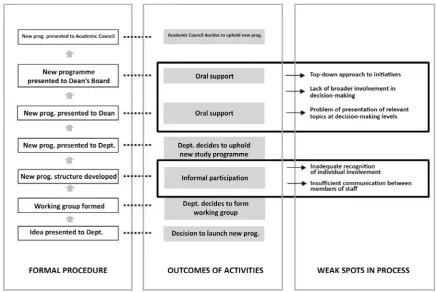
Based on the account and analysis of the process of establishing a new study programme, we may summarise the most pronounced institutionalised practices within the institution that generated problems (Figure 1):
- Lack of broader involvement in decision-making – The Dean’s Board is traditionally the first body to launch initiatives. The Board rules on what is important for the Faculty and what should be presented to the official decision-makers. It was up to the Board and the Dean to decide whether the Urban Planning Department’s initiative would find its way onto the decision-making agenda of the Academic Council, which informally but crucially makes a select few people responsible for setting the Faculty’s development strategy.
- Top-down approach to initiatives – The Dean and the Dean’s Board exert substantial influence on the Faculty’s other bodies and administration. The Academic Council is too cumbersome to debate the details or overall strategy for the Faculty’s development, and relies on the choices made by the Dean and the Board in making decisions in these matters. The Council discusses only issues that are, primarily, mandatory from a procedural standpoint, or are chosen and placed on the agenda by the Dean’s Board as important and of interest for the Faculty. Further, administrative staff are not used to working with actors other than the Dean or members of the Dean’s Board in matters of major importance for the Faculty’s development and constantly seek reinforcement from higher instances, which informally adds legitimacy to their work but also slows the whole process down. Any dilemmas among members of the management induce instability among the Faculty staff and affect the outcomes of voting.
- Problems with presenting relevant topics at decision-making levels – Members of the Urban Planning Department ignored the inherited informal institutional frameworks and traditional patterns of behaviour to launch an initiative on their own and present it to their colleagues for the first time at the moment a decision is required. Although the Department’s decision was perfectly legal and fully justified, since a faculty department is completely responsible for developing curricula, the failure to include other members of the Dean’s Board in these activities made the process non-transparent to them and so provoked their mistrust and resistance.
- Inadequate recognition for individual work in programme and professional development – Unclear and inadequately recognised obligations of individual department members in developing study programmes discourage their participation in joint improvement initiatives and make it more difficult to agree on responsibilities and duties.
- Insufficient communication between members of staff – Unclear horizontal and vertical co-ordination procedures at the Department disrupts communication between junior members. The structure of the Faculty recognises only departments (cathedrae or courses of study) as organisational units. There are no other formal bodies to serve as forums for groups of professors or teaching assistants in the form of organisational units. Hence, department meetings represent the only formal venue for joint discussion. However, the sheer size of departments means that
department meetings are not places for discussion, but rather only venues for endorsing arrangements previously agreed upon.
Figure 1: Establishment of a new study programme and the weak spots in this process
Weak spots are due to the remains of the old system that have not been supplanted by new procedures. The new system envisages bottom-up initiatives, but fails to take into account possible situations where those placed higher up block such initiatives, or cases where lower-ranked individuals are disinterested in them. As Bologna reforms were carried out with great speed, no attention was paid to the operation of administrative and management structures called upon to put new models into practice and gradually improve them. The newly-introduced procedures do not provide clear guidance across all possible trouble spots that new programmes may encounter in their establishment due to the persistence of traditional patterns of behaviour. However, although the new procedures do not allow for more efficient and effective work in this area, they do confer legitimacy on activities aimed at establishing new study programmes.
2.4.1. Ad hoc strategies to overcome obstacles
To neutralise the impact of the surviving institutional framework, in its effort to set up the new study programme the Urban Planning Department relied on and referenced as much as possible the newly-established procedures and rules of the formal institutional framework that allowed it to achieve its goal. The Department faced obstacles on a step-by-step basis and applied limited-scope strategies that eliminated threats to the desired outcome:
- Process legitimacy: The legitimacy of establishing the new study programme was guaranteed by the formal framework within which the activities were implemented. All activities were implemented in accordance with formal standards, rules, and procedures laid down by national higher-education institutions.
- Consensus-building: The strength of the Department lay in the consensus of all its members; this was created through joint discussions at Department meetings and in the essential informal gatherings of department members. Informal meetings offered the prospect of broader talks, more direct communication and agreement on certain matters particularly with those members of the Department who did not take part in the initial design of the new study programme.
- Delegation of responsibilities: Genuine participation in the development of the new study programme increased the interest of the members involved in the outcome of the process, as well as the degree of their commitment. The interest in and responsibility for the outcome of the process of development of the new study programme thus spread to the majority of Department members, which helped step up the formal adoption process and overcome the potential lack of understanding for the final version of the study programme at the Department meeting.
- Respect for power: Consent of the members of the Dean’s Board to further activities and continuation of the process was won through respect for the existing hierarchy of power at the Faculty. A series of informal talks were conducted with heads of the other two departments. - Support from authority figures: The votes of members of the Council of Professors who had no
prior opinion on the topic concerned were won through explanations provided by members of the Department regarded as the greatest authority figures by other members of staff at the Faculty. Support for the initiative by the most prominent members of the Department was of crucial importance for those members of the Council of Professors who had had no previous knowledge of the subject matter and on whose support the outcome of the voting depended.
- Promoting inner institutional values: Strict observance of institutional procedures and practices in the process of establishing the new study programme showed that the Department respected institutional values and, by extension, the effort put in by all members of the administration staff, which secured their support.
Following lengthy procedures, the new study programme was accredited and the first generation of students is set to graduate from the new master’s programme in 2014 (University of Belgrade 2011). Interestingly, an initiative has been launched by the new management of the Faculty of Architecture to develop more study programmes in the near future to allow architecture students to specialise in all areas the Faculty deals in – architectural design, building technologies, and urbanism.
3. DISCUSSION
Changes to formal rules imposed from the outside, and the implementation of these new norms, lead to disturbances in the existing equilibrium, since a stable framework for action within an organisation consists of a harmonised package of formal and informal institutional limitations and ways of their application. Following changes to formal rules, the new informal equilibrium can develop only gradually. Yet, the road leading to this type of change is uncertain and difficult, since these activities come up against naturally, endogenously, and traditionally established informal patterns of action. The uncertainty and slowness that accompany change are wholly at odds with the speed required by modern society education.
The case of the Faculty of Architecture shows that change imposed from the outside did enjoy the formal support of the management, but also bears out the fact that informal institutional frameworks are deeply ingrained in the value systems of both individuals and bodies that are part of an organisation. As various problems arose, and as it encountered opposition, the Urban Planning Department sought ad hoc solutions in an effort to achieve its goal. The Department gradually built up support, backing the informal institutional framework and legitimating individuals, groups, or informal procedures by giving them all roles in the development of the new programmes at one time or another. One of the greatest problems was caused by a mistake on the part of the Department, which had at the start of the initiative overlooked the need for giving legitimacy to existing informal values that required decisions to be made in a top-to-bottom fashion. On the other hand, the Department had every right to develop a new study programme and initiate its establishment, as the decision to do so was
grounded in faculty, university, and national-level documents. References to these documents and clear adherence to all necessary procedures conferred legitimacy on the initiative and gave the Department a robust foundation from which to defend its plan.
Even though the Urban Planning Department’s actions and strategies achieved the desired aim, the institutional obstacles have merely been circumvented, and remain in place. In view of the current positive developments at the Faculty of Architecture and the creation of new study programmes, the resistance encountered can be seen to have been the consequence of deeply institutionalised and entrenched values, as well as of a tendency to maintain the status quo, rather than an expression of a rationally and consciously negative stance towards the initiative. This opinion corresponds to the findings of institutionalist sociologists, who emphasise the passivity of institutions over their activity, and posit that unconscious acceptance, rather than political manipulation, is the response to outside pressures and expectations. However, one must rightfully insist on the significance of considering all possible reactions by organisations to institutional pressures, or variations in terms of resistance, consciousness, proactivity, influences, and interests, as held by economic institutionalism (Scott, 1994). In view of the likelihood of additional resistance, and regardless of whether current developments turn out to be positive (in the case of the Faculty of Architecture), the lengthy process of creating change needs to be followed by consideration of whether there is room for amending the frameworks that made the entire procedure more difficult.
The identification of weak points in initiatives to change structures or statuses within institutional frameworks prone to conflict lays the groundwork for improvement. Enhanced procedures able to supplement the formally changed institutional framework and facilitate future desired changes would help overcome the traditional behavioural patterns that essentially obstruct development activities. Since institutional changes usually consist of gradual adjustment to a set of rules, norms, and ways to implement them (North 1990), the authors take the view that adding to an existing set of procedures and fine-tuning and consistently monitoring them could overcome the issues that arise from the conflict of two frameworks after change is imposed from the outside. Yet, such fine-tuning or extensions of procedures are not gradual or spontaneous processes in these circumstances; conversely, they most often come about due to the engagement and investment of entrepreneurial energy by individuals who collect elements to improve the framework within an existing institutional landscape. This is a specific activity likely to encounter new obstacles that can be overcome only by quick thinking; it is also bound to generate material for new case studies.
For the Faculty of Architecture, the subject around which the hypotheses presented in this paper were created and tested, these could be small steps towards laying foundations for change. Broader involvement in decision-making could be substituted for by the establishment of a group of full professors to serve as a management body tasked with drafting the Faculty’s strategy and developing study programmes; their views could be scrutinised by broader-based bodies, such as departments (the case study showed that the credibility of the most distinguished names of the Faculty was recognised by all staff members, and that their decisions were trusted). This creates room for public debate on issues of importance for the development of the Faculty, while the top-down approach to initiatives is balanced with a bottom-up approach. The establishment of an operational body responsible for implementing new strategies would strengthen bonds between all levels of management, administration, and other staff. The problem of presenting relevant topics at decision-making levels could also be obviated by the introduction of a system whereby future Faculty strategy would be developed jointly, in which not even bottom-up initiatives would be possible without broader consensus and a strategic framework that the whole school agrees is a favourable direction for development. All decisions should receive broad publicity at the early stages, accompanied by reasoned explanations of why they are justified. Such an approach would avoid decision-making at the same meeting at which the first information about the proposal is communicated, which in itself generates problems. Decision-making would generally be preceded by a debate, where responses would be offered to questions raised and the important aspects of the subject would be given thorough consideration. To ensure future debates are well-informed, a solution should also be found to the problem of insufficient horizontal communication between members of staff within the departments
themselves. This issue could be overcome through the introduction of sub-departments, cathedrae, established as separate bodies within departments and serving as venues for horizontal communication and co-ordination. The Faculty’s Charter envisages the possibility of formalising such cathedrae or courses of study, made up of professors and their students, and focusing predominantly on one or multiple related narrow scientific fields (Faculty of Architecture 2006). The current arrangement is that agreements reached among professors travel vertically to teaching assistants, while understandings on important matters among teaching assistants again travel vertically to the professors. These relations represent a kind of channel for passing information on, exchanging opinions, and forging agreement. New structures at lower levels would also facilitate the appropriate engagement of individuals in the development of teaching materials, professional skills, and study programmes, since each sub-department would strive to engage all of its members in the defence of its own interests. It would be easier to detect the results of each individual’s activity at the level of each sub-department rather than of the department, which would make it possible to measure them with greater precision and accord them the recognition they need.
4. CONCLUSION
The paper gives a systematic overview of the process of initiating a new study programme in a formally changed institutional framework, but against the backdrop of retained traditional forms of behaviour. The case presented confirms that sudden institutional change imposed from the outside results in conflict between the formal and informal institutional frameworks that hinders action, which is the key issue. Nonetheless, the authors can observe that the difficulties of establishing initiatives in these circumstances do make it possible to identify weak spots in procedures that could not be foreseen, or were simply not taken into consideration, at the time the new formal framework was introduced. In the case presented, a number of ad hoc strategies limited in scope were used to overcome the obstacles posed by the procedural weak spots: this approach should probably be replicated in other cases, in either the format presented here or a modified one, to avoid conflict and misunderstanding. However, real change, which would facilitate action in spite of opposition and with no uncertainty, entails the elimination of procedural weak spots, extension/augmentation of procedures, and their fine-tuning and consistent monitoring. Although the sole use of procedures to solve the problem of interference with action within the new framework may seem rigid, clear procedures ensure the certainty of outcomes and may be defined so as to enable openness, democratic and bottom-up participation, discussion of key issues, etc. Clear procedures thus help to prevent situations where outcomes of initiatives depend on the results of individual conflicts or diplomatic skills of particular people, an environment unacceptable for educational institutions.
REFERENCES
Accreditation Committee 2010, Accreditation in Higher Education (Belgrade, Ministry of Education and Sport of the Republic of Serbia).
Alexander, ER 2005, ‘Institutional transformation and Planning: From Institutionalization Theory to Institutional Design’, Planning Theory, vol. 4, no. 3, pp. 209-223.
Campbell, JL 2004, Institutional change and globalization, Princeton University Press, New Jersey.
Department of Urban Planning 2010 Official Letter of the Urban Planning Department to the Dean of the Faculty of Architecture of 12 April 2010.
Geppert, A & Cotella, G (eds) 2010, Quality Issues in a changing European Higher Education Area, AESOP.
Gospodini, A & Skayannis P 2005, ‘Towards an ‘integration model’ of planning education
programmes in a European and international context: The contribution of recent Greek experience’ Planning Theory and Practice, vol. 6 no.3, pp. 355-382.
The European Higher Education Area. Joint Declaration of the European Ministers of Education. [Bologna Declaration.] Convened in Bologna on the 19th of June 1999.
Faculty of Architecture 2006, Statute of the Faculty of Architecture in Belgrade, Službeni bilten Arhitektonskog fakulteta, 77/08.
Faculty of Architecture 2008a, Rules on Quality Assurance and Improvement, Službeni bilten Arhitektonskog fakulteta, 81/08.
Faculty of Architecture 2008b, ‘Quality Improvement and Assurance Policy’, Politika, section: Advertisements, 27 February, p.26
Faculty of Architecture 2008c, Quality Assurance and Improvement Strategy, Službeni bilten Arhitektonskog fakulteta, 78/08.
Lazarević Bajec, N 2011, ‘Prostorni plan Republike Srbije 2010. godine’ [Spatial Plan of the Republic of Serbia, 2010], Fokus, no.7 (CLDS, Beograd).
Law on Higher Education 2005, Službeni glasnik RS, 76/05, 97/08, 44/10.
March, JG & Olsen, JP 2006, Elaborating the new institutionalism, in RAW Rhodes, SA Binder & BA Rockman (eds), The Oxford handbook of political institutions, Oxford University Press, Oxford.
Meyer, J.W. And Rowan, B. (1977) ‘Institutionalised Organisations: Formal Structure as Myth and Ceremony’, The American Journal of Sociology, no. 2, pp.340-363.
North, DC 1990, Institutions, institutional change and economic performance, Cambridge University Press, Cambridge.
Rules and Standards of Self-Evaluation for Higher Education Institutions 2006, Službeni glasnik RS, 106/06-19.
Rules and Standards of External Quality Control in Higher Education Institutions 2006, Službeni glasnik RS, 106/06-24.
Rules on the Standards and Procedure of Accreditation of Higher Education Institutions and Study Programmes 2006, Službeni glasnik RS, 106/06-27, 112/08-45.
Sanyal, B 2007, ‘Planning a Planning School: Reflections from MIT’, Planning Theory and Practice, vol. 8, no. 2, pp.251-275.
Schotter, A 1981, The economic theory of social institutions, Cambridge University Press, Cambridge
Scott, WR 1994, Institutions and organizations: toward a theoretical synthesis, in WR Scott & JW Mayer (eds), Institutional environments and organizations: structural complexity and individualism, Sage, London.
Searle, JR 2005, ‘What is an institution?’ Journal of institutional Economics no. 1, pp.1-22.
UN HABITAT 2009, Planning Sustainable Cities: Global Report on Human Settlements (Earthscan, London).
University of Belgrade 2006, Statute of the University of Belgrade, University of Belgrade Gazette, no.131/06.
University of Belgrade 2007a, Rules on Adoption of Study Programmes, University of Belgrade Gazette, no. 139/07.
University of Belgrade 2007b, Quality Assurance Rules. University of Belgrade Gazette, no. 135/07.
University of Belgrade 2007c, Quality Assurance Strategy. University of Belgrade Gazette, no. 135/07.
University of Belgrade 2011, Decision of the Senate of the University on Establishing the Master Study Programme “Integral Urbanism” of 26 January 2011.
Zec, M 2009, Za kim zvona zvone? [For Whom the Bell Tolls]. Poslovni Magazin, 19/V
Zec, M 2011, U Srbiji mora da se radi [One Has to Work in Serbia]. Slobodni student, no.7, June/July.