https://doi.org/10.26637/MJM0703/0008
A study on recruitment and selection process with
reference to current scenario in organizations
Anju Khandelwal
1* and Avanish Kumar
2Abstract
The success of organizations in this modern business environment depends on the performance / strength / caliber of the manpower that steers the day to day affairs of the organizations. The process of recruiting and selecting all categories of employees into both private and public organization has been a matter of concern to many and needs attention. It is the wish of every organization to attract the best human resource in order to fulfill organization needs and got excellent performance by appropriate candidate. There are various methods available regarding the recruitment of candidates in the field. The objective of this paper is to understand the relationship between recruitment and selection process of an organization and also its link to the organization growth and effectiveness. For this purpose we assume that there is a strong impact of recruitment on selection of right candidate with desired set of skills, knowledge and ability leading to cost effectiveness. Also, for evaluation researcher take measure for evaluation as (i) Competency (ii) Recruitment Process (iii) Organizational Climate.
Keywords
Recruitment Process, Selection Process, Competency, Employees, Organization Climate, Ethical Values.
AMS Subject Classification
91A90, 62-20, 62-07.
1Department of Mathematics, Shri Ram Murti Smarak College of Engg. & Tech., Bareilly, India.
2Commission for Scientific & Technical Terminology, Dept. of Higher Education, MHRD, New Delhi, India. *Corresponding author:1[email protected];2[email protected]
Article History: Received12February2019; Accepted09May2019 c2019 MJM.
Contents
1 Introduction. . . 412
2 Objective. . . 413
3 Review of Literature. . . 413
4 Methodology. . . 414
5 Interpretation & Suggestions. . . 416
6 Findings & Conclusion. . . 417
References. . . 417
1. Introduction
a. Need for the Study
Any organization requires assets, counting back, crude materials, gear and man control/ faculty, for fruitful working. Analysts accept that the quality of staff may be a key arrangement since it influences the organization productivity, e.g., client fulfillment, developments, benefit and competitiveness of the organization.Within the worldwide competitive environment, the greater portion of victory of
well-known organizations is due to their competence and personnel ability. Competence incorporates the desired traits, especially information, aptitudes, individual and behavioral factors essential for people to perform their part within the organization. In case the individual don’t have these qualities, it’ll be incomprehensible to carry out the job and create compelling and qualified administrations and items. For the organization, staff choice is the method of selecting the finest one or ones among the people who meet the fundamental prerequisites for a position or a depicted work. With the globalization of the world and increment on the competition, selecting the proper staff plays a critical part on the victory of companies or organization.
b. Recruitment
• It makes a difference in expanding the victory rate of determination prepares by diminishing the number of unmistakably beneath or over qualified work application.
• It makes a difference in distinguishing potential candidate and gives authentication.
• It decreases the plausibility that the work candidate once selected and chosen will take off the organization soon.
c. Selection
TheSelectionis the process of choosing the most suitable candidate for the vacant position in the organization. In other words, selection means weeding out unsuitable applicants and selecting those individuals with prerequisite qualifications and capabilities to fill the jobs in the organization. On the other hand the way toward talking and assessing contender for a particular occupation and choosing a person for business in light of specific criteria.
2. Objective
The focal point of this investigation is primarily to analyze the adequacy of the fair recruitment and selection methods within the open division/ public sector. The basic objective of this investigation is to explore and analyze the effectiveness of recruitment and selection in open division keeping in view of procedural decency, straightforwardness, sex issues, Line Manager Role, HR Competency and organizational & state legislative issues impact.
3. Review of Literature
Recruitmentmeans to estimate the available vacancies and to make suitable arrangements for their selection and appointment. Recruitment is understood as the process of searching for and obtaining applicants for the jobs, from among whom the right people can be selected. A formal definition states, “It is the process of finding and attracting capable applicants for the employment. The process begins when new recruits are sought and ends when their applicants are submitted. The result is a pool of applicants from which new employees are selected”.
Maintenanceis one of the most crucial issues in today’s competitive manufacturing environment. Now days, productive methods are used in manufacturing plants to improve operations capabilities, which alternatively change business environmental factors leading to a competitive market. Based on the fuzzy analytical network process (FANP) method, which composes criteria and options, a new approach to selecting optimal maintenance strategy is proposed by Naimeh Borjalilu et al. [1].
Personnel evaluation and selectionis a very important activity for the enterprises. Different job needs different ability and the requirement of criteria which can measure ability is different. Analytic Hierarchy Process (AHP) is one of Multi Criteria decision making methods derived from paired comparisons. Ali Reza Afshari et al. [2] tries to
analyze the Analytic Hierarchy Process in order to make the recruitment process more reasonable, based on the fuzzy multiple criteria decision making model to achieve the goal of personnel selection.
The methods of recruitment in various fields of activity were analyzed, and a trend towards methods of assessing the quality of candidates based on the application of hybrid technologies was identified. Mikhail Leizerovich Krichevsky et al. [3] described the action of a neuro-fuzzy hybrid system like the adaptive network-based fuzzy inference system (ANFIS), which combines the principles of fuzzy logic and artificial neural networks. Assessment of faculty performance is a significant element in enhancing the excellence of the work and improves their incentive to execute well. It also presents a basis for promotion and enhancing of an educational organization. G. Vasanti [4] presents a case study of a performance appraisal system, which deals the faculty‘s qualitative actions in fuzzy parameters to evaluate their performance in an Institute.The methods available for evaluation of teacher in educational institute are based on crisp data in the form of rigid boundaries. In ranking the quality of teacher’s performance, T. A. Thakre et al. [5] proposed fuzzy expert system on the basis of multi inputs as required by the institution. The proposed method introduces fuzzification of crisp data which depends on the extreme value that exists in the data. Khushboo Dilip Lad [6] proposes a new approach for the evaluation of the candidates on the basis of their suitability for job. Overall competency of the working personnel is often observed to ultimately affect the productivity of an organization. Anant V. Khandekar et al. [7] proposed a method based on fuzzy axiomatic design principles for solving the personnel selection problems. The recruitment process in any departments or organizations is usually decided by traditional criteria. In today’s scenario, every organization wants to have best employees for their work. A. Khandelwal et al. [8] proposing a method of recruitment by the use of fuzzy triangular number and genetic algorithm with Hungarian method. After performing the first stage (written test) of recruitment with fuzzy triangular number and Hungarian method, the later stages are accomplished with linguistic variables and final recruitment is performed by the use of genetic algorithm. Because of the fact that today human resources has been accepted as one of the most important source of competitive advantage of an organization, finding the right person for the job has become as a vital human resource management function. Mustafa Tinkir et al. [9] presents mamdani and sugeno type fuzzy inference system modeling techniques being used while group decision making in the fuzzy environment and displays the methods process with an empirical application.
to improve the recruitment and selection process. In their paper they focus on understanding recruitment and selection process and help to manage a manpower budget for the recruitment and selection process. Also Pelin Vardarher et al. [11] study, conceptual model of the process has been formed by making use of Axiomatic Design principles in order to provide guidance for the businesses to be able to carry out recruitment procedures effectively and the provided model has aimed to contribute the businesses which has newly used the current approaches on human resources to be able to carry out these activities systematically.
Personnel selection determines the input quality of personnel, therefore, plays a decisive role in human resource management. Ali Reza Afshari et al. [13] presents a comprehensive literature review of applying Fuzzy decision making techniques in personnel selection problem. Recruitment and selection, often termed as talent acquisition in many companies is the heart to business success and growth. Poona Khanna [14] concludes that extreme steps should be taken to implement befitting recruitment and selection policies, majorly access desired competencies for surpassed performance results. Sudhamsetti Naveen et al. [16] discusses the same with the objective to identify general practices that organizations use to recruit and select employees. The study focus its attention to determine how the recruitment and selection practices affect the organizational outcomes.
4. Methodology
For the proposed objective, we designed the questionnaire having 24 questions through which we analyze and understand the relationship between recruitment and selection process of an organization and also its link to the organization growth and effectiveness. During this data collection process we have received 183 responses out of which 150 samples were used for this study. Since we assume that there is a strong impact of recruitment on selection of right candidate with desired set of skills, knowledge and ability leading to cost effectiveness, so that for evaluation,we have taken measures such as, (i) Competency (ii) Recruitment Process (iii) Organizational Climate as key factor.
a. Impact of recruitment on selection of right candidate with the factor of desired set of skills
H0: There is no impact of recruitment on selection of right
candidate with desired set of skills, knowledge and ability leading to cost effectiveness.
H1: There is a strong impact of recruitment on selection of
right candidate with desired set of skills, knowledge and ability leading to cost effectiveness.
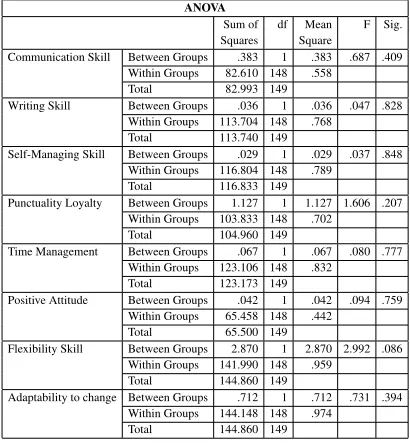
Table 1.ANOVA Analysis for Desired Set of Skills
ANOVA
Sum of df Mean F Sig. Squares Square
Communication Skill Between Groups .383 1 .383 .687 .409 Within Groups 82.610 148 .558
Total 82.993 149
Writing Skill Between Groups .036 1 .036 .047 .828 Within Groups 113.704 148 .768
Total 113.740 149
Self-Managing Skill Between Groups .029 1 .029 .037 .848 Within Groups 116.804 148 .789
Total 116.833 149
Punctuality Loyalty Between Groups 1.127 1 1.127 1.606 .207 Within Groups 103.833 148 .702
Total 104.960 149
Time Management Between Groups .067 1 .067 .080 .777 Within Groups 123.106 148 .832
Total 123.173 149
Positive Attitude Between Groups .042 1 .042 .094 .759 Within Groups 65.458 148 .442
Total 65.500 149
Flexibility Skill Between Groups 2.870 1 2.870 2.992 .086 Within Groups 141.990 148 .959
Total 144.860 149
Adaptability to change Between Groups .712 1 .712 .731 .394 Within Groups 144.148 148 .974
Total 144.860 149
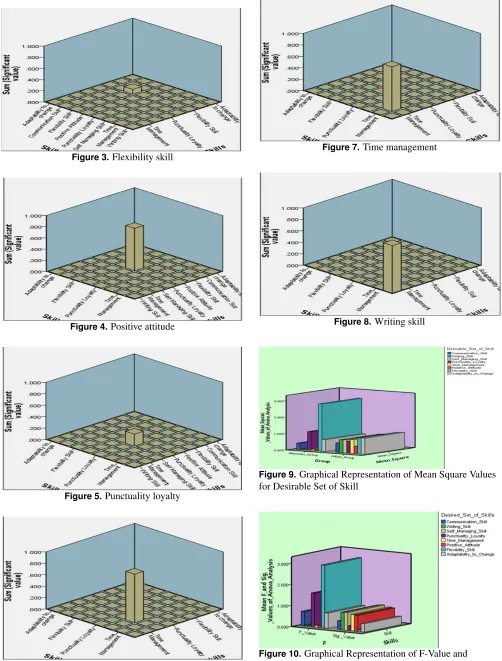
Different Skills representing Significant Values are shown in Figures1–8.
Figure 1.Adaptability to change
Figure 3.Flexibility skill
Figure 4.Positive attitude
Figure 5.Punctuality loyalty
Figure 6.Self Managing skill
Figure 7.Time management
Figure 8.Writing skill
Figure 9.Graphical Representation of Mean Square Values for Desirable Set of Skill
b. Impact of recruitment on selection of right candidate with the factor of Competency that adds to the growth of the organization
H0: There is no impact of recruitment on selection of right
candidate with the Competency.
H1: There is a strong impact of recruitment on selection of
right candidate with the Competency.
Table 2.ANOVA Analysis for Competent Employee Growth on the basis of Experiences
ANOVA
Competent Emp Growth
Sum of Squares df Mean Square F Sig.
Between Groups 1.341 4 .335 .651 .627
Within Groups 74.659 145 .515
Total 76.000 149
Figure 11.Graphical Representation of ANOVA Analysis for Competent Employee Growth on basis of Experience
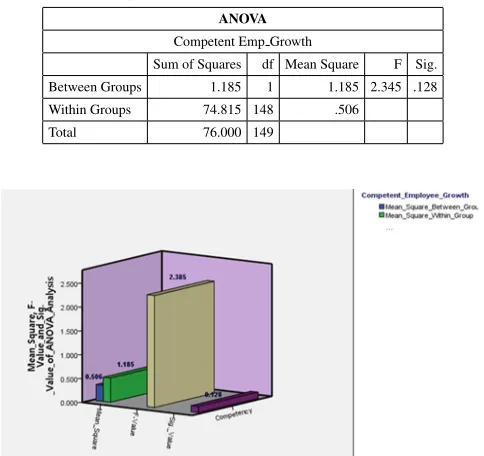
Table 3.ANOVA Analysis for Competent Employee Growth on the basis of Gender
ANOVA
Competent Emp Growth
Sum of Squares df Mean Square F Sig.
Between Groups 1.185 1 1.185 2.345 .128
Within Groups 74.815 148 .506
Total 76.000 149
Figure 12.Graphical Representation of ANOVA Analysis for Competent Employee Growth on the basis of Gender
c. Impact of recruitment on selection of right candidate with the factor of Organizational Climate that defines the attrition rate of organization
H0: There is no impact of recruitment on selection of right
candidate with Organizational Climate.
H1: There is a strong impact of recruitment on selection of
right candidate with Organizational Climate.
Table 4.ANOVA Analysis for Attrition Rate
ANOVA
Attrition Rate
Sum of Squares df Mean Square F Sig.
Between Groups 14.197 3 4.732 1.872 .137
Within Groups 369.136 146 2.528
Total 383.333 149
Figure 13.Graphical Representation ANOVA analysis for Attrition Rate
5. Interpretation & Suggestions
The research tool used for data collection was based on questionnaire. The questionnaire that defines to cover all the necessary information needed for this study. The developed questionnaire were distributed to and retrieved from the respondents in person. This process of distribution and retrieving of the questionnaire in person was taken for two reasons, first, to make sure that the questionnaire get to the intended recipients and secondly, to help improve the response rate. After the responses were collected, every type of data relating to the questions were separated and collected to answer for different research objectives. The information received were classified into answer categories and expressed the non-parametric responses into parametric. The research methodology that was used is quantitative. Statistical Package for the Social Sciences (SPSS) version 22 was then used for the analysis.
observed that the dependent variables have shown values above 0.05 in question (a) which indicates that null hypothesis is rejected and it can be observed that skill set mapping is not being practiced during recruitment process. Also highest significant value (0.848) for self managing skill indicate that this is the most important issue on which any organization need to put highly focused approach and lowest significant value for flexibility skill (0.086) indicate that there is no need to put much emphasis on candidate flexibility.
• In question (b), it has been observed that the dependent variables have shown values above 0.05 which indicates that null hypothesis is rejected and a clear significance of impact of competency on selection of right candidate that adds to the growth of the organization is visible. Also it represents that competency is not based on experience and also doesn’t have gender effect.
• In question (c) it has been observed that the dependent variables have shown values above 0.05 which indicates that null hypothesis is rejected and a clear significant of impact of organizational climate on selection of right candidate that defines the attrition rate of organization is visible.
6. Findings & Conclusion
The researcher has taken three hypotheses. The entire null hypothesis has been rejected showing that recruitment and selection process does not have impact on (i) Competency (ii) Recruitment Process (iii) Organizational Climate. This can be due to negligence or unawareness of correct way of recruitment and selection process among the practitioner. Hence it can be concluded that as organizations are not practicing right process of recruitment and selection, in long term there may be over cost problems due to high attrition rate (misfit either job misfit or organization misfit) and repetition of the whole recruitment and selection process. Organizations adopting the shortcuts in recruitment and selection process usually have to compromise in achieving the target and objectives of organizations along with that it may lead to damaging the image of the organization.
Finally, the conclusion is drawn from the study regarding the recruitment and selection that any company growth and successes depends on efficient working of its employees and hence make it significantly important for the organizations to choose the experienced and qualified candidates. The process of recruitment and selection requires a rigorous and thoughtful planning so that a lot of care needs to be taken while recruiting the man power for any organization.
References
[1] N. Borjalilu and M. Ghambari, Optimal maintenance
strategy selection based on a fuzzy analytical network process: A case study on a 5-MW
powerhouse, International Journal of Engineering Business Management 10 (2018), 1-10, DOI: 10.1177/1847979018776172.
[2] A. R. Afshari, M. Nikolic and Z. Akbari, Personnel
selection using group fuzzy AHP and SAW methods, Journal of Engineering Management and Competitiveness7(1) (2017), 3-10.
[3] M. L. Krichevsky, J. A. Martunova and V. B. Sirotkin,
Neuro-fuzzy recruitment system,Journal of Sistema de Reclutamiento Neuro-Difuso38(62) (2017), 15.
[4] G. Vasanti, Teacher’s performance appraisal system
using fuzzy logic- A case study,International Journal on Recent and Innovation Trends in Computing and Communication5(7) (2017), 273-278.
[5] T. A. Thakre, O. K. Chaudhari and Nita Dhawade, A
fuzzy logic multi criteria approach for evaluation of teachers performance,Advances in Fuzzy Mathematics
12(1) (2017), 129-145.
[6] K. D. Lad and A. Joglekar, Selection of a candidate
using fuzzy approach, International Journal of Trend in Research and Development3(3) (2106), 22-25.
[7] A. V. Khandekar and S. Chakraborty, Personnel
selection using fuzzy axiomatic design principles,Verslas: Teorijairpraktika / Business: Theory and Practice17(3) (2016), 251-260, DOI: 10.3846/btp.2016.660.
[8] A. Khandelwal and A. Agarwal, An amalgamated
approach of fuzzy logic and genetic algorithm for better recruitment process,TNC Transactions of Network and Communications3(3) (2015), 23-31.
[9] M. Tinkir, B. Doganalp and S. Doganalp, Human
resource selection process by using various fuzzy logic techniques, Proceedings of the Workshop on Foundations of Informatics, FOI-2015, August 24-29, Chisinau, Republic of Moldova, 403-421, 2015.
[10] G. Karthiga, R. Karthi and P. Balaishwarya, Recruitment
and selection process,International Journal of Scientific and Research Publications5(4) (2015), 1-4.
[11] P. Vardarher, Yalcm and S. Birgun, Modelling
of the strategic recruitment process by axiomatic design principles, Procedia of Social and Behavioral Sciences 150 (2014), 374-383, DOI: 10.1016/j.sbspro.2014.09.031.
[12] S. D. Bhoganadam and D. S. Rao, A study on recruitment
and selection process of Sai Global Yarntex (India) Private Limited,International Journal of Management Research & Review4(10) (2014), Article No. 5, 996-1006.
[13] A. R. Afshari, M. Nikolic and D. Cockalo, Applications
of fuzzy decision making for personnel selection problem - a review, Journal of Engineering Management and
Competitiveness4(2) (2014), 68-77.
[14] P. Khanna, Recruitment and selection: a need of the
[15] G. Nabi and S. Wei et al., Effective recruitment and
selection procedures: an analytical study based on public sector universities of Pakistan,Public Policy and Administration Research4(10) (2014), 12-21.
[16] S. Naveen and D. N. M. Raju, A study on recruitment
& selection process with reference to three industries, cement industry, electronics industry, sugar industry in Krishna DtAp, India, IOSR Journal of Business and Management15 (5) (2014), 60-67.
? ? ? ? ? ? ? ? ?
ISSN(P):2319−3786 Malaya Journal of Matematik
ISSN(O):2321−5666