(UDC: 621.822.5)
A study on the performance of a magnetic fluid based hydrodynamic short
porous journal bearing
N.S.Patel1, D.P.Vakharia2, G.M.Deheri3
1*. Mechanical Engineering Department, Faculty of Technology, Dharmsinh Desai University, Nadiad-387001, Gujarat, India.
E-mail- [email protected]
2. Mechanical Engineering Department, Sardar Vallabhbhai National Institute of Technology, Surat-395007, Gujarat, India.
E-mail- [email protected]
3. Mathematics Department, Sardar Patel University, Vallabh Vidyanagar, Anand- 388120, Gujarat, India.
E-mail- [email protected]
*Corresponding Author: [email protected]
Keywords: Magnetic fluid, Hydrodynamic , Porous journal bearing, Pressure, Friction.
Abstract:
An endeavour has been made to investigate the performance of a hydrodynamic short porous journal bearing under the presence of a magnetic fluid lubricant. The associated Reynolds equation for the fluid pressure is solved with appropriate boundary conditions. To get the fluid film pressure leading to the calculation of the load carrying capacity .Further, friction is computed. Results presented in graphical form indicate that the magnetic fluid turns in a better performance of the bearing system compared to the case of the conventional lubricant. It is clearly seen that the load carrying capacity increases nominally while the co-efficient of friction decreases significantly. Besides, it is seen that the bearing can support a load even in the absence of flow. This study may offer an additional degree of freedom from design point of view in terms of the forms of the magnitude of the magnetic field.
1. Introduction:
Porous oil bearings find extensive use in the industry because of their low cost and little oil requirement. Theoretical research on these bearings was first initiated by [Morgan and Cameron 1957].
[Bujurke and Naduvinamani 1991] presented a study on the performance characteristics of a narrow porous journal bearing lubricated with couple stress fluid. It was established that the journal bearing with couple stress as lubricant provided significant load capacity and ensured considerable reduction in the coefficient of friction as compared with viscous lubricants.
[Baka 1999] calculated the hydrodynamic load carrying capacity of porous journal bearings. The calculated load carrying capacity showed that the short bearing assumption gave more simplified solution than the infinite long bearing assumption.
[Elsharkawy and Guedour 2001] obtained a numerical solution for the hydrodynamic lubrication of finite porous journal bearings using a modified Brinkman-extended Darcy model. It was shown that the dimensionless permeability parameter had a significant effect on the performance parameters of finite porous journal bearings especially, at higher eccentricity ratios. Further, it was concluded that the load carrying capacity and friction factor decreased with the increase in the permeability parameter, however, the attitude angle increased.
[Durak 2003] experimentally investigated the behavior of porous bearing under different lubricants and lubricating conditions. The experimental results obtained in this study indicated that the correct selection of the lubricant and suitable running conditions were very important on the tribological characteristics of porous bearings. Further, it was clear from the experimental results that the change in friction coefficient was more stable and in smaller magnitude under stable loading than that of periodic loading.
[Grabovski 2005] solved the problem of an infinite journal bearing having an isothermal compressible lubricant and a porous bush ensuring the optimum load carrying capacity.
Recently, [Patel et al.2012] analyzed the performance of a hydrodynamic short journal bearing under the presence of a magnetic fluid lubricant. The results presented in graphical form suggested that the bearing system registered an improved performance due to the magnetic fluid lubricant as compared to the conventional lubricant. In addition, it was observed that the coefficient of friction decreased significantly.
2. Analysis:
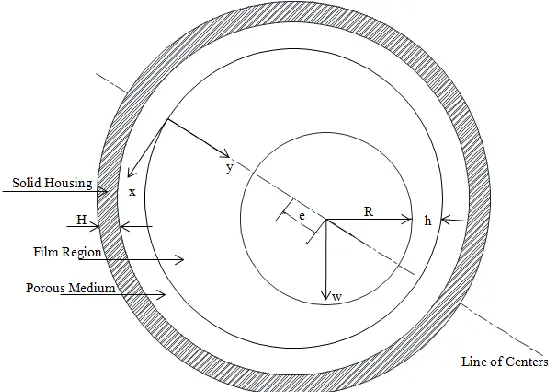
The configuration of the bearing which is infinitely short in Z-direction is presented in Figure 1.The journal having radius Rj rotates inside a bearing and the space between the journal and the bearing is filled with a magnetic fluid. If the journal is infinitely short, the pressure gradient
z
p
is much larger than the pressure gradient
x
p
, as a result of which the later can be
neglected. The magnetic field is oblique to the stator as in [Agrawal 1986] and its magnitude is given by
2
H =
2
2
B
z
B
z
k
Fig. 1. Configuration of the problem
In 1964 Neuringer and Rosensweig developed a simple model to study the steady flow of magnetic fluids in the presence of slowly changing external magnetic fields. The model consisted of the following equations:
H M q p q
q. ) o( . )
( 2
(1)
0
.
q
(2)
0
H (3)
H M
(4)
0 )
.(
H M
(5)
where ρ is the fluid density,
q
=(u,v,w) is the fluid velocity in film region, p is the filmpressure,
is the fluid viscosity,
ois the permeability of free space,M
is the magnetizationvector,
H
is the external magnetic field and
is the magnetic susceptibility of the magneticparticles.
Using equation (3) and (4), equation (1) becomes
q H
p q
q 2
2 0
2 )
.
(
(6)
This shows that an extra pressure term 2
2 0H
is introduced into the Navier-Stokes equation
magnetohydrodynamic short journal bearing under the usual assumptions [Bhat and Deheri 1991], [Bhat 1978] and [Agrawal 1986] turns out to be
d dh R h u H p dz d o . 6 2 3 2 2 2 (7)
Introduction of the slip and porosity parameters in the equation (7) leads to
) 1 ( 2 . 12 1 4 62 3 *
2 2 2 sh sh h d d R H sh sh h u H p dz d o
The associated boundary conditions are
0
p at z = +B/2 and -B/2,
0
dz
dp
at z = 0.
Introduction of the dimensionless quantities
B
z
Z
, Ssh
,
p
u
R
P
, 3* h , u R kB o * 2
paves the way for expression of the pressure distribution in dimensionless form as
2 _ _ _ 3 2 4 1 ) 2 ( 12 ) 2 ( 2 cos 1 sin 3 2 * Z s s s C B P (8)The load carrying capacity in x direction is given by
2 0 0 cos 2 BX p Rd dz
w
(9)
Thus, the dimensionless load carrying capacity in x direction is obtained from
x x
w
B
u
c
W
3 2
) 1 ( 12 ) 4 ( 21 _ _
_ 2 2 2 s s s (10)
The load carrying capacity in z direction is given by
2 0 0 sin 2 BZ p Rd dz
w
(11)
z z
w
B
u
c
W
3 2
) 1 ( 12 ) 4 ( 2 1 4 16 _ _
_ 2 3 2 * s s s
(12)
Therefore, the resultant load carrying capacity is given by
1 2 _ 2 * 2 22 3 2
2 2 _ _ 2 1 1 6 4 1 1 4 1
1 12 1
x z
s
W W W
s s (13)
The friction force is determined by
LRd
h
u
f
2
0
which renders the non dimensional friction force as
ULB
C
f
F
122
1
2
(14)Lastly, the coefficient of friction is given by
W
F
2 1 2 3 2 * 2 2 2 _ _ _ 2 12
4
1
1
6
1
1
1
12
1
4
1
2
1
2
s
s
s
(15)3. Results and discussion:
Settingµ* to be equal to zero this investigation reduces to the performance of a porous journal
conventional lubricant. However, the results are presented graphically to study and analyze the performance characteristics.
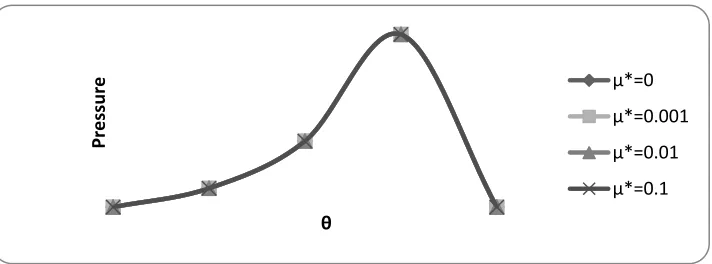
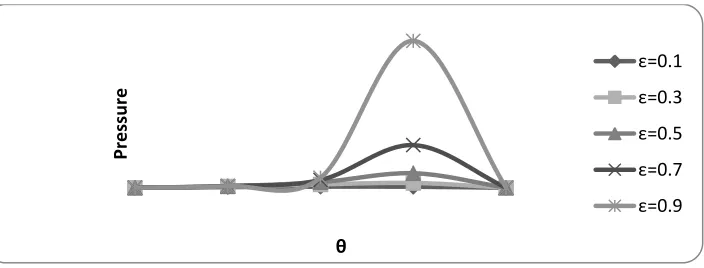
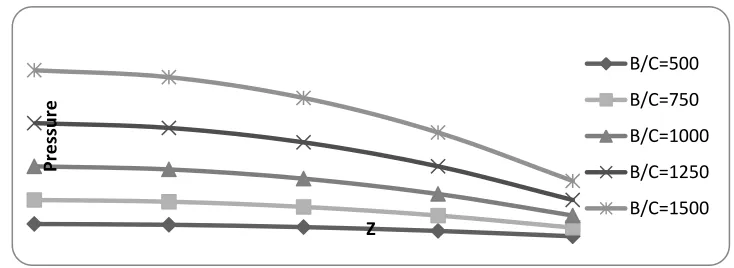
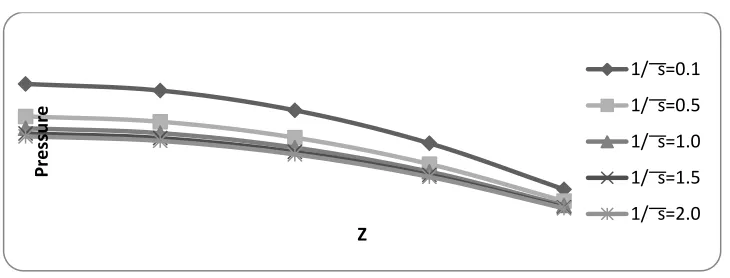
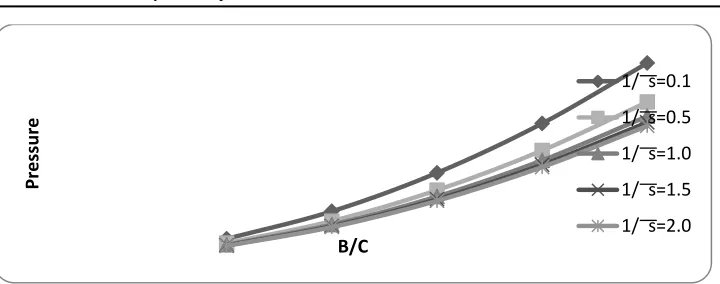
Fig: 2 dealing with the pressure profile with respect to angle θ, indicates that the pressure increases marginally with respect to the magnetization parameter. This is due to the fact that the magnetic pressure adds to the one generated by the magnetic force developed due to the magnetic particles suspended in the lubricant. Fig: 3, 4, 5 indicate that the pressure increases substantially with respect to Z, B/C and eccentricity ratio respectively. If B/C is less than more fluid passes through the gap between journal and bearing and therefore more pressure develops. Increase in eccentricity ratio increase the convergent region of fluid film between the bearing and the journal which again increases the pressure. Also, Fig: 6, shows that the effect of slip parameter on the pressure profile is almost negligible. Fig: 7 indicate that the pressure decreases
with increasing values of ψ. Fig: 8-17 are another way of representations of the pressure
distribution with respect to z, B/C and ε.
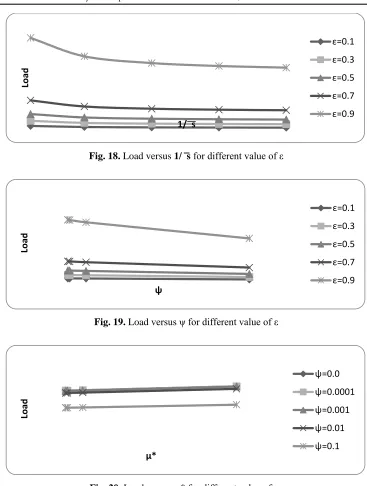
Fig: 18, indicates that the load carrying capacity decreases significantly due to the slip when lower value of eccentricity ratio is taken in to consideration. It is also seen from this Figure that the effect of slip is almost negligible for higher range of slip parameter. It is observed from Fig: 19 that porosity tends to decrease, the load carrying capacity significantly for higher values of eccentricity ratio, however, this decreasing effect reduces for lower values
of eccentricity. It is manifest in Fig: 20that magnetization increases the load carrying capacity
marginally for the lower values of porosity. Fig: 21-22 show that the effect of magnetization is negligible on the load carrying capacity with respect to the eccentricity while load carrying
capacity increases as usual with increasing values of eccentricity.
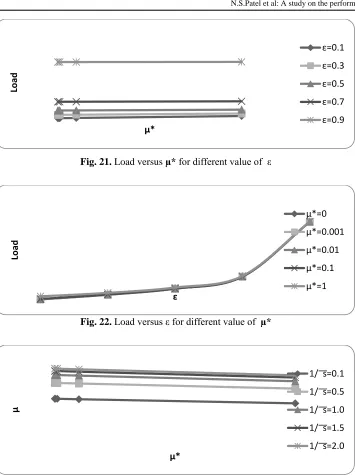
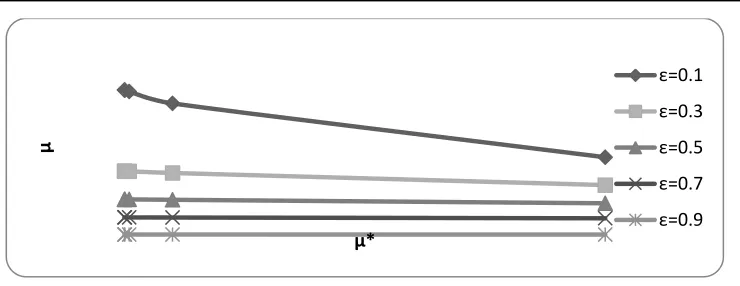
Fig: 23, shows that the magnetization decreases the friction considerably while the friction decreases with the decreasing value of the slip parameter. Thus, for a better performance due to magnetization this slip should be kept minimum. From Fig: 24 it is clear that the coefficient of friction decreases considerably for lower values of eccentricity ratio. Further, it is observed that even lower to moderate values of eccentricity ratio cause reduced coefficient of friction. Finally, it is clearly visible from Fig: 25 that the porosity effect on the friction profile with respect to magnetization is negligible for lower values of porosity. But, it is interesting to note that the friction decreases considerably due to the magnetization. In addition, coefficient of friction is relatively less for moderate values of porosity.
Fig. 2. Non-dimensional pressure distribution P versus θ for different values of magnetic parameter µ*
Press
ure
θ
µ*=0
µ*=0.001
µ*=0.01
Fig. 3. Non-dimensional pressure distribution P versus θ for different values of Z
Fig. 4. Non-dimensional pressure distribution P versus θ for different values B/C
Fig. 5. Non-dimensional pressure distribution P versus θ for different values of ε
Press
ure
θ
z=0
z=0.1
z=0.2
z=0.3
z=0.4
Press
ure
θ
B/C=500
B/C=750
B/C=1000
B/C=1250
B/C=1500
Press
ure
θ
ε=0.1
ε=0.3
ε=0.5
ε=0.7
Fig. 6. Non-dimensional pressure distribution P versus θ for different values of 1/ s
Fig. 7. Non-dimensional pressure distribution P versus Z for different values of ψ
Fig. 8. Non-dimensional pressure distribution P versus Z for different values of B/C
press
su
re
θ
1/ ͞s=0.1
1/ ͞s=0.5
1/ ͞s=1.0
1/ ͞s=1.5
1/ ͞s=2.0
Press
ure
Z
ψ=0.0
ψ=0.0001
ψ=0.001
ψ=0.01
ψ=0.1
Press
ure
Z
B/C=500
B/C=750
B/C=1000
B/C=1250
Fig. 9. Non-dimensional pressure distribution P versus Z for different values of 1/ s
Fig. 10. Non-dimensional pressure distribution P versus Z for different values of ε
Fig. 11. Non-dimensional pressure distribution P versus Z for different values of θ
Press
ure
Z
1/ ͞s=0.1
1/ ͞s=0.5
1/ ͞s=1.0
1/ ͞s=1.5
1/ ͞s=2.0
Press
ure
z
ε=0.1
ε=0.3
ε=0.5
ε=0.7
ε=0.9
Press
ure
Z
θ=0
θ=45
θ=90
θ=135
Fig. 12. Non-dimensional pressure distribution P versus B/C for different values of 1/ s
Fig. 13. Non-dimensional pressure distribution P versus B/C for different values of ψ
Fig. 14. Non-dimensional pressure distribution p versus B/C for different values of ε
Press
ure
B/C
1/ ͞s=0.1
1/ ͞s=0.5
1/ ͞s=1.0
1/ ͞s=1.5
1/ ͞s=2.0
Press
ure
B/C
ψ=0.0
ψ=0.0001
ψ=0.001
ψ=0.01
ψ=0.1
Press
ure
B/C
ε=0.1
ε=0.3
ε=0.5
ε=0.7
Fig. 15. Non-dimensional pressure distribution P versus ε for different value of B/C
Fig. 16. Non-dimensional pressure distribution P versus ε for different values of ψ
Fig. 17. Non-dimensional pressure distribution P versus ε for different values of 1/ s
Press
ure
B/C=500
B/C=750
B/C=1000
B/C=1250
B/C=1500
Press
ure
ψ=0.0
ψ=0.0001
ψ=0.001
ψ=0.01
ψ=0.1
Press
ure
1/ ͞s=0.1
1/ ͞s=0.5
1/ ͞s=1.0
1/ ͞s=1.5
Fig. 18. Load versus 1/ sfor different value of ε
Fig. 19. Load versus ψfor different value of ε
Fig. 20. Load versus µ* for different value of ψ
Lo
ad
1/ ͞s
ε=0.1
ε=0.3
ε=0.5
ε=0.7
ε=0.9
Lo
ad
ψ
ε=0.1
ε=0.3
ε=0.5
ε=0.7
ε=0.9
Lo
ad
µ*
ψ=0.0
ψ=0.0001
ψ=0.001
ψ=0.01
Fig. 21. Load versus µ* for different value of ε
Fig. 22. Load versus ε for different value of µ*
Fig. 23. Coefficient of friction versus μ∗ for different value of 1/ s
Lo
ad
µ*
ε=0.1
ε=0.3
ε=0.5
ε=0.7
ε=0.9
Lo
ad
ε
µ*=0
µ*=0.001
µ*=0.01
µ*=0.1
µ*=1
µ
µ*
1/ ͞s=0.1
1/ ͞s=0.5
1/ ͞s=1.0
1/ ͞s=1.5
Fig. 24. Coefficient of friction versusµ* for different value of ε
Fig. 25. Coefficient of friction versusµ* for different value of ψ
4. Conclusions:
This investigation tends to suggest that the performance of the bearing system can be improved significantly with a proper choice of eccentricity ratio by considering a suitable magnetic strength. This article offers some measures for minimizing the adverse effect of porosity and slip by the positive effect of magnetization. Of course here the slip deserves to be kept at minimum.
Nomenclature:
B Breadth of bearing (mm)
2
H Strength of magnetic field (A2 m-2)
p
Lubricant pressure (N/m2)P
Dimensionless pressurew
Load carrying capacity (N)F Dimensionless friction force
Co-efficient of frictionW
Dimensionless load carrying capacity0
Permeability of free space (kg m s-2A-2)
µ
µ*
ε=0.1
ε=0.3
ε=0.5
ε=0.7
ε=0.9
µ
µ*
ψ=0.0
ψ=0.0001
ψ=0.001
ψ=0.01
magnetic susceptibility *
Dimensionless magnetization parameter
Lubricant viscosity (N.S/m2)R Journal radius (m)
e Eccentricity (m)
c Radial clearance(m)
ε Eccentricity ratio(=e/c)
ψ Permeability parameter
Permeability(m2)
H Porous layer thickness (m)
h Film thickness(m)
s slip parameter =α/
α slip coefficient
s
Извод
Студија о перформансама хидродинамичког кратког порозног
цилиндричног лежаја са магнетним флуидом
N.S.Patel1, D.P.Vakharia2, G.M.Deheri3
1*. Mechanical Engineering Department, Faculty of Technology, Dharmsinh Desai University, Nadiad-387001, Gujarat, India.
E-mail- [email protected]
2. Mechanical Engineering Department, Sardar Vallabhbhai National Institute of Technology, Surat-395007, Gujarat, India.
E-mail- [email protected]
3. Mathematics Department, Sardar Patel University, Vallabh Vidyanagar, Anand- 388120, Gujarat, India.
E-mail- [email protected]
*Corresponding Author: [email protected]
Резиме
Уложен је труд да би се испитале перформансе хидродинамичког кратког порозног цилиндричног лежаја под присуством магнетног флуида подмазивача. Одговарајућа Рејнолдсова једначина за притисак флуида је решена са граничним условима да би испитао притисак флуида филма у односу на рачунање носивости. Даље је анализирано и рачунање трења. Резултати који су представљени графички указују на то да магнетни флуид показује боље перформансе код лежајних система у поређењу са уобичајеним подмазивачем. Јасно се види да се носивост повећава док се коефицијент трења значајно смањује. Осим тога, види се и да лежај може да поднесе оптерећење чак и у одсуству протока. Ова студија може да пружи додатни поглед са дизајнерске тачке гледишта у виду јачине магнетног поља.
Књучне речи: Магнетни флуид, хидродинамички, порозни цилиндрични лежај, притисак, трење.
References:
Agrawal V (1986). Magnetic fluid based porous inclined slider bearing, WEAR, 107,133-139. Baka Ern o (1999). Calculation of the hydrodynamic load carrying capacity of porous journal
bearings, periodica polytechnica ser. Mech. Eng., 46, NO. 1, 3–14. Bhat M (2003). Lubrication with a magnetic fluid, Team Spirit (India) Pvt. Ltd.
Bhat M (1978). Hydrodynamic lubrication of a porous composite slider bearing. Japanese Journal of AppliedPhysics, 17, 479-481.
Bhat M, Deheri G (1991). Squeeze film behavior in porous annular discs lubricated with magnetic fluid, Wear, 151, 123-128.
Chattopadhyay A, Majumdar B (1984). Steady state solution of finite hydrostatic porous oil journal bearings with tangential velocity slip. Tribology international, 317-323.
DURAK Ertugrul (2003). Experimental Investigation of Porous Bearings Under Different Lubricant and Lubricating Conditions. KSME International Journal, 17(9), 1276- 1286. Elsharkawy A, Guedouar L (2001). Hydrodynamic lubrication of porous journal bearings using
a modified Brinkman-extended Darcy model, Tribology International, 34,767–777.
Grabovskii V I (2005). Optimum porous journal bearing ensuring maximum load capacity, Fluid Dynamics, 41(1), 29–36.
Morgan V, Cameron A (1957). Mechanism of lubrication in porous metal bearings, Proc. Conf. Lubrication and Wear. Institution of Mechanic M Engineers, London, 151--157.
Neuringer J, Rosensweig R (1964). Phys Fluids, 7, 19-27.