Tufail et al. World Journal of Pharmaceutical and Medical Research
EFFECT OF GUM CHEWING ON BOWEL FUNCTION AFTER CAESAREAN SECTION
1*Dr. Nazia Tufail, 2Dr. Namra Khalid and 3Dr. Tayyaba Iftikhar
1
PMDC # 45964-P. 2PMDC # 70618-P.
3PMDC # 73350-P.
Article Received on 13/01/2019 Article Revised on 03/02/2019 Article Accepted on 23/02/2019
INTRODUCTION
According to 2015 World Health Organization (WHO) data, the rates of cesarean delivery are 33% in the United States, 38% in Italy, 56% in Brazil, 46% in Mexico, 33% in Switzerland, and 32% in Germany.[1] In the Pakistani, the Ministry of Health states the rate of cesarean deliveries is 53.1% in state hospitals. There is no data for private hospitals.[2] Small intestine activity after abdominal operations returns to normal function within a few hours, gastric activity returns to normal within 24-48 hours, and colon activity returns to normal within 48-72 hours.[3,4] Due to the delayed motility of the gastrointestinal system in the postoperative period, gas and secretions accumulate in the stomach and small and large intestines, which causes abdominal distension, nausea, vomiting, and pain, all of which negatively affect the comfort level of the patients.[5] Chewing gum activates the cephalic vagal reflex and can be used to stimulate bowel function in the postoperative period. Chewing gum stimulates the digestive cephalic phase by imitating eating and is considered a virtual diet.[6-9]
Early initiation of intestinal motility after abdominal surgery is highlighted in the “Enhanced Recovery After Surgery” (ERAS) protocol, also known as the multidisciplinary approach.[10] In this protocol, it was noted that for the prevention of postoperative ileus development, having the patient chew gum has moderate evidence. Approaches suggested in the ERAS protocol can also be applied after cesarean section, which speeds
up the recovery process in the postoperative period.[11] Late onset of bowel movements after cesarean section with spinal anesthesia causes the mother to feel uncomfortable and to suffer difficulties in breast feeding due to pain and distension. It also causes problems such as late discharge, hospital infections, and high costs for the hospitals and families.
In the literature, there are studies in which gum chewing accelerates the healing process and shortens the length of stay in the hospital by increasing intestinal motility after abdominal surgery.[6-9]
In a study on patients after cesarean section surgery showed that chewing gum shortened the time first intestinal movements started.[12] In Ledari study, on 100 women candidates for cesarean section with local anesthesia (spinal), in gum-chewing group, the first bowel sounds in post operative period after C. Section was significantly shorter compared to the control group (p=0.016).[13] This study aim was to determine the effect of sugar-free gum chewing on bowel function postoperatively in women following cesarean delivery under spinal anesthesia.
METHODS
This semi-experimental study was conducted at Allama Iqbal Memorial Hospital, Sialkot with 45 women in both the experimental and control groups, between October
ISSN 2455-3301
WJPMR
WORLD JOURNAL OF PHARMACEUTICAL
AND MEDICAL RESEARCH
www.wjpmr.com
*Corresponding Author: Dr. Nazia Tufail
PMDC # 45964-P.
ABSTRACT
2016 and June 2017. The sample consisted of patients with elective or emergency cesarean section on a volunteer basis. The women were over 18 years old, received spinal anesthesia, did not have any systemic or chronic disease, and had not undergone tooth or jaw surgery or have a history of dental disease. In the study, the conclusions of Harma et al.[12] and Ledari et al.[13] were utilized to calculate the sample size. G*Power software (Version 3.1.7) was used for calculations.
Power analysis was calculated to be 90% and the error rate to be 5%. The number of samples according to this calculation was experimental (n: 45) and control (n: 45).
Women in the experimental group were asked to chew commercially available soft, unsweetened, easily chewable gum, containing no aspartame, sorbitol, or xylitol from the second hour of the postoperative period until oral feeding. In the postoperative period, the patient chewed gum at least three times for a minimum of 15 minutes and maximum of 30 minutes during the 2nd, 4th, and 6th hours and they did not eat anything other than gum for the first six hours. In the control group, no application other than standard post-operative care was carried out. The women included in the study were informed about the study and their written consent was obtained. Ethical approval was obtained from the institution where the study was carried out.
1. Socio-Demographic Information: This form consisted of seven questions regarding age, educational status, profession, and working status and five questions regarding obstetric history. The researcher completed the sociodemographic information from using faceto-face interviews with the pregnant women before surgery.
2. Bowel Function Evaluation Form: In the bowel function evaluation form prepared for the experimental group, there were four questions regarding the time the patient left surgery, gum chewing times and durations, intestinal sounds, and flatulation time. In the bowel function evaluation form prepared for the control group, there were three questions regarding the time the patient left surgery, intestinal sounds, and flatulation time.
Research Hypotheses
H1: There is a difference between the time of first flatulation for the patients in the experimental and control groups.
H2: There is a difference between the time of first bowel sounds for the patients in the experimental and control groups.
H3: There is a difference between the patient discharge times in the experimental and control groups.
Analysis: Arithmetic mean, standard deviation, median, and minimum-maximum values were determined as
descriptive statistics for quantitative data. Descriptive statistics for qualitative variables were shown as numbers and percentages. For continuous data, the Mann-Whitney U test was applied for comparisons between the two independent groups. The Kruskal-Wallis test was applied to compare continuous data among multiple groups. For hypothesis tests related to categorical variables, Pearson’s Chi Square and Fisher’s exact Chi Square tests were applied. Statistical power was 90% and the error rate was 5%. The significance level for all studies was accepted as 0.05. Post-hoc study conclusion statistical power analysis revealed 98.99% for hypothesis H1, 100% for hypothesis H2, and 59.08% for hypothesis H3. Statistical evaluation of the data was performed using SPSS (Version 17.0) software.
RESULTS
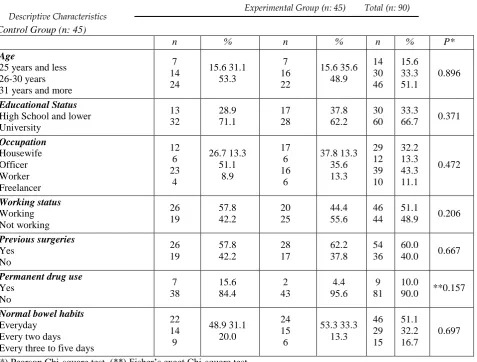
The experimental and control groups were statistically homogeneous in terms of age, educational status, occupation, working status, previous surgery, continuous drug use, and normal bowel habits (Table-I).
Table I: Distribution of women in experimental and control groups by socio-demographic characteristics.
Control Group (n: 45)
n % n % n % P*
Age
25 years and less 26-30 years 31 years and more
7 14 24 15.6 31.1 53.3 7 16 22 15.6 35.6 48.9 14 30 46 15.6 33.3 51.1 0.896 Educational Status High School and lower University 13 32 28.9 71.1 17 28 37.8 62.2 30 60 33.3
66.7 0.371
Occupation Housewife Officer Worker Freelancer 12 6 23 4 26.7 13.3 51.1 8.9 17 6 16 6 37.8 13.3 35.6 13.3 29 12 39 10 32.2 13.3 43.3 11.1 0.472 Working status Working Not working 26 19 57.8 42.2 20 25 44.4 55.6 46 44 51.1
48.9 0.206
Previous surgeries Yes No 26 19 57.8 42.2 28 17 62.2 37.8 54 36 60.0
40.0 0.667
Permanent drug use Yes No 7 38 15.6 84.4 2 43 4.4 95.6 9 81 10.0
90.0 **0.157
Normal bowel habits Everyday
Every two days Every three to five days
22 14 9 48.9 31.1 20.0 24 15 6 53.3 33.3 13.3 46 29 15 51.1 32.2 16.7 0.697
(*) Pearson Chi-square test, (**) Fisher’s exact Chi-square test.
Table II: Distribution of women in the experimental and control groups according to intestinal functions after cesarean section.
Control Group (n: 45) Experimental Group (n: 45)
p Avg.+SD Median (MinMax) Avg.+SD Median (MinMax)
Time to hear intestinal sounds (h) 16.35±5.20 18.00 (4.0024.00) 12.62±7.73 15.00 (2.0027.00) 0.001 Time to first flatus (h) 26.33±7.54 26.00 (10.0046.00) 13.44±6.56 18.00 (4.0024.00) 0.001 Time to discharge (h) 49.11±1.62 48.00 (48.0054.00) 47.17±1.51 48.00 (44.0048.00) 0.036
Ozlem Akalpler et al. and 12.62 ± 7.73 hours in the experimental group. The time of hearing the bowel movements in the experimental group was statistically significant (p<0.001) (Table-II).
According to the findings obtained in this study, gum chewing shortened the duration of the intestinal movements in the post-operative period, the time of first flatulation, and discharge. These results support the hypotheses H1, H2, and H3.
DISCUSSION
Problems such as constipation, postoperative ileus, and abdominal distension may be seen in the gastrointestinal system due to the effect of anesthesia after abdominal
surgery.[5] For early return of bowel movements after caesarean section surgeries, applications such as oral hydration, early feeding[14], and gum chewing[9,13,15-21] are recommended in the postoperative period.
The mean time for bowel sounds in women following cesarean delivery with spinal anesthesia included in this study was 12.62 ± 7.73 hours in the experimental group and 16.35 ± 5.20 hours in the control group. The fact that bowel sounds started four hours earlier in the experimental group was significant. A four hour difference for a woman who has delivered via caesarean section is a positive result in terms of comfort and prevention of complications.
The study of Abd-El Maeboud et al.[22] with 200 women after cesarean delivery under general anesthesia in Egypt revealed that the group that chewed gum experienced bowel sounds 10.9 hours after surgery and the control group 15.6 hours after surgery. Shang et al.[23] conducted a study in China (n:388) to determine the effect of chewing gum on postoperative bowel function in spinal anesthesia patients who delivered via cesarean section and they revealed that bowel sounds started 18.2 hours after surgery in the experimental group and 23.2 hours after surgery in the control group. In the randomized controlled study of Ledari et al.[13] with 100 women, the first bowel sounds after cesarean section were 21.9 hours in the gum chewing group and 26.1 hours in the control group. The fivehour difference between the groups is important for patient comfort and discharge. In this study, the bowel sounds started four hours earlier in the experimental group, similar to the above studies (Table-II). Kafali et al.[24] conducted a study with 150 women in order to evaluate the effect of chewing gum after cesarean section on postoperative bowel activity and bowel sounds were significantly shorter in the study group (mean 5.9 hours) than in the control group (mean 6.7 hours) (p<0.01). The results obtained are similar to the results of this study. This similarity suggests that chewing gum in the postoperative period accelerates intestinal motility, early bowel sounds, patient comfort, early discharge, and cost-effectiveness.
In this study, women in the gum-chewing group flatulated after an average of 13.44 ± 6.56 hours and those in the control group after 26.33 ± 7.54 hours (Table-II). In the study of Kafali et al.[24] with women who delivered by caesarean section (n:150), women in the experimental group flatulated 22.4 hours after surgery and women in the control group flatulated 31 hours after surgery. In the experimental study of Shang et al.[23], the mean flatulation time for the women in the gum chewing group was 5.3 hours earlier than in the control group. This study achieved similar results. The average 13 hour difference in flatulation time between the experimental group and the control group ensured that the patients in the experimental group felt better. Chewing gum stimulates intestinal motility by mimicking eating. It is thought that the earlier flatulation for the gum chewing group after surgery is due to this effect. This result is a positive finding of gum chewing on bowel motility. Several meta-analysis studies have reported that chewing gum enhances bowel movements after gastrointestinal surgery.[25,26] The results obtained from this study can contribute to future metaanalysis studies. Some studies in the literature state that chewing gum increases intestinal motility after abdominal surgery, accelerates the healing process, and shortens the time to discharge from the hospital.[12,17,23,24] In this study, the women who chewed gum had shorter discharge times (47.17 ± 1.51 hours) than those in the control group (49.11 ± 1.62 hours). In the study of Abd-El-Maeboud et al.[22], the women in the experimental group were discharged after 40.8 hours and the women
in the control group after 50.5 hours (p<0.05). According to the results obtained from our study, the time of discharge after surgery in the chewing gum group was two hours earlier. Although this finding was not statistically significant, it is clinically important for maternal and infant health.
CONCLUSION
The current study was performed to investigate the effect of gum chewing on the return of intestinal function in women with cesarean section under the spinal anesthesia, so that a positive step can be taken toward diminishing their problems in fields of timely and early prevention of ileus. According to the findings obtained in this study, gum chewing shortened the duration of the intestinal movements, first flatus, time to hear intestinal sounds and time to discharge in patients undergoing cesarean section under the spinal anesthesia in the postoperative period. It can be added to post-caesarean care without any concern on early post-operation feeding as a low-cost, safe and tolerable treatment in early intestinal stimulation to reduce ileus associated complications.
REFERENCES
1. World Health Statistics Web site [homepage on the Internet]. [cited 2016 December 16]. Available from: http://www. who.int/gho/publications/world_health_statistics/20 15/ en/ 2015.9
2. Ministry of Health the Pakistani Republic of Northern Cyprus. Health Statistics. Web site [homepage on the Internet]. [cited 2016 December 10]. Available from: http:// www.saglik.gov.ct.tr/2013.
3. Sanfilippo F, Spoletini G. Perspectives on the importance of postoperative ileus. Curr Med Res Opin., 2015; 31(4): 675–676. doi: 10.1185/03007995.2015.1027184.
4. Nimarta Singh NV, Gupta R. Effectiveness of chewing gum on bowel motility among the patients who have undergone Abdominal Surgery. Nurs Midwifery Res J., 2013; 9(3): 108-117.
5. Taşdemir N, Şenol-Çelik S. Experiences of patients toward abdominal distension after surgical intervention. Ege Üniversitesi Hemşirelik Yüksek Okulu Dergisi., 2010; 26(3): 23-31.
6. Ledari FM, Barat S, Delavar MA, Banihosini SZ, Khafri S. Chewing Sugar-Free Gum Reduces Ileus After Cesarean Section in Nulliparous Women: A Randomized Clinical Trial. Iran Red Crescent Med J., 2013; 15(4): 330–334. doi: 10.5812/ircmj.6458 7. Jakkaew B, Charoenkwan K. Effects of gum
chewing on recovery of bowel function following cesarean section: A randomized controlled trial. Arch Gynecol Obstet., 2013; 288: 255-260. doi: 10.1007/s00404-013-2727
and meta-analysis of randomised controlled trials. BJOG., 2014; 121: 793–800. doi: 10.1111/1471-0528.12696
9. Zhu Y-P, Wang W-J, Zhang S-L, Dai B, Ye D-W. Effects of gum chewing on postoperative bowel motility after cesarean section: a meta-analysis of randomised controlled trials. BJOG., 2014; 121: 787–792. doi: 10.1111/1471-0528.12662
10. Kehlet H, Wilmore DW. Evidence-Based Surgical Care and the Evolution of Fast-Track Surgery. Ann Surg., 2008; 248(2): 189198 doi: 10.1097/SLA.0b013e31817f2c1a.
11. Gustafsson UO, Scott MJ, Schwenk W, Demartines N, Roulin D, Francis N, et al. Guidelines for Perioperative Care in Elective Colonic Surgery: Enhanced Recovery After Surgery (ERAS) Society Recommendations. World J Surg., 2013; 37: 259–284. doi:10.1007/s00268-012-1772-0
12. Harma MG, Barut A, Arikan G, Harma M. Gum-chewing Speeds Return of First Bowel Sounds but not First Defecation after Cesarean Section. Anatolian J Obstet Gynecol, 2009; 1: 1-3.
13. Ledari FM, Barat S, Delavar MA. Chewing gums has stimulatory effects on bowel function in patients undergoing cesarean section: A randomized controlled trial. Bosn J Basic Med Sci., 2012; 12(4): 265-268. doi:10.17305/bjbms.2012.2452
14. Jalilian N, Ghadami MR. Randomized clinical trial comparing postoperative outcomes of early versus late oral feeding after cesarean section. J Obstet Gynaecol Res., 2014; 40(6): 1649-1652. doi: 10.1111/jog.12246
15. Huang HP, He M. Usefulness of chewing gum for recovering intestinal function after cesarean delivery: A systematic review and meta-analysis of randomized controlled trials. Taiwanese J Obstet Gynecol, 2015; 54: 116-121. doi:10.1016/j. tjog.2014.10.004
16. Pandeeswari BB, Bhasani D, Dhumale S. Effect of chewing gum on the postoperative recovery of gastrointestinal function after gynaecological laparoscopic surgery. Int J Reprod Contraception Obstet Gynecol, 2018; 7(2): 644-647. doi: 10.18203/2320-1770.ijrcog20180187
17. Çevik SA, Başer M. Effect of bed exercises and gum chewing on abdominal sounds, flatulence and early discharge in the early period after cesarean section. J Clin Nurs., 2016; 25(9-10): 1416-1425. doi: 10.1111/jocn.13245
18. Göymen A, Şimşek Y, Özkaplan ŞE, Özdurak Hİ, Akpak YK, Semiz A, et al. Effect of Gum Chewing and Coffee Consumption on Intestinal Motility in Cesarean Sections. J Clin Anal Med., 2017; 1-5. doi: 10.4328/JCAM.4901
19. Wajid R, Huma G, Mobusher I. Role of chewing gum on early recovery of females after cesarean section. Ann King Edward Med Uni., 2015; 21(4): 280-284. doi:10.21649. akemu.v21i4.772
20. Şahin E, Terzioğlu F. The Effect of Gum Chewing, Early Oral Hydration, and Early Mobilization on
Intestinal Motility After Cesarean Birth. Worldviews Evid Based Nurs., 2015; 12(6): 380-388. doi: 10.1111/wvn.12125
21. Deshpande H, Madkar C, Kale N, Sable U, Bobe A. The Study Of Effect Of Sugar Free Chewing Gum On Peristalsis Activity In Postcesarean Patients. Indian J Res., 2017; 6(3): 4-6.
22. Abd-El-Maeboud KHI, Ibrahim MI, Shalaby DAA, Fikry MF. Gum chewing stimulates early return of bowel motility after caesarean section. BJOG., 2009; 116: 1334–1339. doi: 10.1111/j.1471-0528.2009.02225.x
23. Shang H, Yang Y, Tong X, Zhang I, Fang A, Hong L. Gum chewing slightly enhances early recovery from postoperative ileus after cesarean section: results of a prospective randomized controlled trial. Am J Perinatal, 2010; 27: 387-391. doi: 10.1055/s-0029-1243313.
24. Kafali H, İltemir-Duvan C, Gözdemir E, Simavli S, Onaran T, Keskin E. Influence of Gum Chewing on Postoperative Bowel Activity after Cesarean Section. Gynecol Obstet Invest, 2010; 69: 84–87. doi: 10.1159/000260048.
25. Mei B, Wang W, Cui F, Wen Z, Shen M. Chewing Gum for Intestinal Function Recovery after Colorectal Cancer Surgery: A Systematic Review and Meta-Analysis. Gastroenterol Res Pract., 2017; 2017: 3087904. doi: 10.1155/2017/3087904. 26. Wen Z, Shen M, Wu C, Ding J, Mei B. Chewing