Nancy Rottle, MLA, RLA, ASLA, Assistant Professor, Department of Landscape Architecture, Adjunct Assistant Professor, Department of Architecture, College of Architecture
and Urban Planning, Box 355734, University of Washington, Seattle, WA 98195-5734, United States of
America. Telephone: +206-543-7897 Fax: +206-685-4486 Email: [email protected]
KEY WORDS Engaged scholarship Community design studio Integration Universal in local
Universal
in
the Local: Practising the Scholarship
of Engagement
NANCY ROTTLE
The 'Scholarship of Engagement' is a burgeoning genre of scholarship exemplified by community-based pedagogic models used in schools of landscape architecture. This form of scholarship employs engagement with the multi-faceted particulars of local places and people, through which it can inform globally relevant principles and strategies. The paper describes attributes of the Scholarship of Engagement, which supports integrated teaching, research and service in landscape architecture and provides an example of the 'universal in the local'. It suggests that a framework for scholarship assessment developed by the Carnegie Foundation for Advancement of Teaching is effective in promoting scholarship in the design studio, incorporating the components: clear goals and problem definition; preparation through literature and research; methods including community participation, place analyses, case-study research and analysis, and solution testing through design; assessment of results; effective presentation of the results; and reflective critique by the students, community and faculty. This model frames the structure and description of community design-studio work undertaken to help a small Alaskan town confront the impending influx and impacts oflarge chain stores, a problem communities are increasingly facing. In such an engaged-scholarship approach, the hierarchical values of cosmopolitan versus local are realigned, and faculty and students collaborate with community partners - whether global or local - to solve pressing issues. Can this integrated model of public scholarship be legitimised, supported and extended?
THE SCHOLARSHIP OF ENGAGEMENT
T
HE SCHOLARSHIP OF ENGAGEMENT currently promoted by the American Association of Higher Education represents an epistemological shift in the definition of scholarship. This paper presents a case for engaged scholarship in landscape architecture integrating teaching, research and service, and employs a framework of criteria developed to assess engaged scholarship to describe and evaluate a research-based community design studio in the small town of Homer, Alaska.knowledge are realigned to emphasise the local; and faculty and students partner with community to solve pressing issues. It moves theory closer to the point of use, while following a universal framework for excellence in scholarship (Huber, 2000).
The hallmark of the Scholarship of Engagement is integration of teaching, research and community service, whether communities are local, national or global.
The Scholarship of Engagement is particularly relevant to teaching and advancing knowledge in landscape architecture, which aims, fundamentally, at action upon the physical and social world. This scholarship "assumes a ... kind of alignment ... where theory and practice stand on a level playing field and interact in ways that are mutually beneficial - each building on the other", consisting of "engaged pedagogy", "community-based research" and "collaborative practice" (Rice, 2003). The movement values interdisciplinary approaches that are inherent in landscape architecture. While academic disciplines such as history, chemistry and mathematics embrace this new scholarship (Diamond and Adam, 1995, as cited in Huber, 2000), landscape architecture may, by contrast, be moving towards traditional, positivist research models of scholarship. A Landscape Research article calls for research to have national or international significance to be academically meritorious and states: "If the practising academic is offering ... public service ... then such 'extension services' ... are just that and are not research or even research-equivalent" (Benson, 1998).
UNIVERSAL IN THE LOCAL
Through engaged scholarship, landscape architects can practise the 'universal in the local', wherein authentic personal, actual and specific experiences reveal larger truths. This idea is embraced in art, literature, poetry and philosophy. Author and literary scholar Harold Simonson writes: "Literature that is universal requires specificity, a real and concrete locality" (1980). For design and planning disciplines, each design problem's natural and cultural contexts are unique - termed a "situation" by Merleau-Ponty" I - yet a heuristic framework can provide a process and general
principles (Rowe, 1987) that can be universally applied. Kapper and Chenoweth
(2000) acknowledge that while "social-science research is analytical, generating data pertaining to general cases ... the designer needs to create a synthesis for each individual case (p 154). Moreover, the notion that good design builds upon particular qualities of each place, town or region is widely accepted.
INTEGRATING TEACHING AND RESEARCH IN THE
COMMUNITY DESIGN STUDIO
identify forces that drive community form-making; and practise "reflection-in-action" (Schoen, 1983) using the design process. This intentional integration of research, teaching and service in community design studios provides a model of "civically engaged scholarship".3 Indeed, participation in planning and design for real communities enables participants to delve deeply enough to confront the multi-faceted, consequential, and ambiguous aspects of real, contemporary problems, rather than deal only with necessarily simplified abstractions that may characterise positivist approaches to research.
FRAMEWORKS FOR THE SCHOLARSHIP OF ENGAGEMENT
Scholarship Assessed: Evaluation of the Professoriate (Glassick et ai, 1997), a sequel to Scholarship Reconsidered, advanced criteria for evaluating excellence in the scholarships of discovery, integration, application and teaching. Co-author Mary Taylor Huber argues that the same criteria can be used to evaluate outreach and public service (Huber, 2000). These standards are applicable not only to engaged scholarship, but also suggest a framework for leading community design studios, and for disseminating results:
1 clear goals
2 adequate preparation
3 appropriate methods 4 significant results 5 effective presentation 6 reflective critique.
Following this process, faculty expertise develops not only around the content of research and results of 'design testing', but also in the realms of community-participation processes, studio teaching and research guidance.
CASE STUDY: APPLYING THE FRAMEWORK TO A COMMUNITY
DESIGN STUDIO IN ALASKA
The influx of large-store retail - "big-box" stores - in small towns is causing rapid change in downtown cores across America and affecting community economies, environments and identities. The citizens of Homer, Alaska, faced with the prospect of a big-box store in a prime, town centre location, asked the Department of Landscape Architecture, University of Washington for assistance. Specifically, they sought research on outcomes in similar towns to inform their decisions on store size limitations, and design solutions that envisioned a new town centre applying various store-size caps. The graduate studio process followed Glassick et aI's scholarship framework (1997):
Goals and questions
1 Conduct case-study research on how similar towns controlled large stores, and learn the outcomes of applied planning mechanisms.
Preparation
intheory and existing scholarship
Students reviewed and shared literature on big-box stores in town centres and on small town planning and design.
Appropriate methods
The class travelled to Alaska to conduct site analyses, met with town leaders and citizens, and facilitated a community workshop. It then conducted case-study research on similar towns, analysed common outcome patterns, and synthesised a set of planning mechanisms. Finally, students developed alternative designs to test impacts of 20k-, 40k- and 66k-sized stores.
Results
1 Community: Our presence and products effected significant community discourse and action. Size caps were implemented, but, more importantly, citizens became aware of tools available to them and the City expanded the small planning staff into a full department. A project proponent summarised our influence: "Not a City meeting goes by where a 'term' [from the student work] isn't used, a 'vision' isn't referenced, or the action of one of the towns from the 'case studies' isn't discussed". Citizens formed a Town Centre planning committee, basing their work on student designs.
2 Teaching: Student learning was significant. Course survey responses, taken immediately and again after six months, consistently cited the following valuable learning experiences: interaction with a real community on an ongoing project; exposure to community processes; case studies; diverse community perspectives and design evaluations; and planning tools acquired in the research process. 3 Research: Studio participants learned the issues associated with locating large
chain stores in small towns, the conditions needed to mitigate impacts, and the combination of planning mechanisms necessary to control, or benefit from, large-store retail. Design research indicated that buildings over 40k were problematic in small town centres, but smaller buildings could be integrated through spatial planning and design.
Effective presentation
Work was submitted in five formats:
1 report with 12 case studies and concluding analyses 2 case-study poster summary
3 posters displaying alternative designs
4 full-colour booklet describing designs with implementation strategies 5 Power Point presentations to the community of the case studies and designs. The project was published in the College's quarterly publication (CAUP, 2003), the university's weekly newspaper (Goldsmith, 2003), on our course website (<http:// courses.washington.edu/larch503/» and in local newspaper articles Games, 2003).
Reflective critique
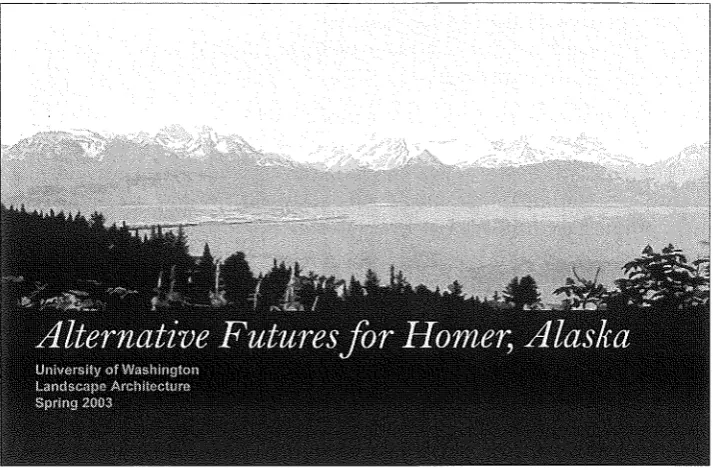
Figure 1: Booklet cover, Alternative
Futures for Homer, Alaska. Six
alternatives that tested different maximum store sizes in town centre designs are documented in an 11" x 17" colour booklet, with recommended design and
implementation guidelines.
While all course-survey respondents rated the studio highly, the disadvantages cited included schedule discrepancies, a truncated time frame and insufficient design time; work load and level of professionalism expected; and internal pressure from caring deeply about the project. One student commented: "There was a real need for the work and that made it all the more challenging and educational".
The instructor's dual role as project manager and professor is highly demanding, especially when one is balancing learning and service objectives, and when the community is distant and unknown. The instructor's role would be facilitated by having funding for project scoping, travel, and documentation, extreme clarity about community expectations, and a research seminar accompanying the design studio. A committed community partner is essential.
CONCLUSION AND QUESTIONS
While the process of engaged community design demands efforts and funds beyond those typically available for studios, the work can be highly valued by students and communities and can extend faculty scholarship. This rapidly developing form of scholarship is beginning to achieve academic recognition. Yet, whether the discipline of landscape architecture sanctions the scholarly aspects of such integrated work remains an open question. Can we acknowledge that specific cases can provide design solutions, processes and inclusive models that may be replicated globally? Given the rigour of a recognised framework, will this integrated model of scholarship be legitimised, supported and extended in landscape architecture?
BIBLIOGRAPHY
Benson, JF (1998) On Research, Scholarship and Design in Landscape Architecture, Landscape
Boyer, EL (1990) Scholarship Reconsidered: Priorities of the Professoriate, Princeton, NJ: The Carnegie
Foundation for the Advancement of Teaching.
Boyer, EL (1997) Selected Speeches, 1979-1995, Menlo Park, CA: The Carnegie Foundation for the
Advancement of Teaching.
Caup, University of Washington College of Architecture and Urban Planning (2003) Community
Heart: Students Plan a New Town Center in Alaska, CAUP News, Summer, p 7.
Diamond, RM and Adam, BE (eds) (1995) The Disciplines Speak: Rewarding the Scholarly, Professional, and Creative Work of Faculty, Washington, DC: American Association for Higher Education.
Driscoll, A and Lynton, EA (1999) Making Outreach Visible: A Guide to Documenting Professional
Service and Outreach, Washington, DC: American Association for Higher Education.
Glassick, CE; Huber, MT and Maeroff, GI (1997) Scholarship Assessed: Evaluation of the Professoriate,
San Francisco: Jossey-Bass.
Goldsmith, SL (2003) Students Help Town Control Destiny, University Week, 6 November, p 6.
Huber, MT (2000). Evaluating Outreach: Scholarship Assessed's Approach [online]. Pennsylvania: Penn
State University <http://www.outreach.psu.edu/News/Pubs/Monograph/ eval.html> (last accessed January 2004).
James, C (2003) Grad Students Study Homer Planning, Homer News, 17 April. Also available online
http://www.homernews.com/stories/041703/new_041703new002.shtml (last accessed 20 May, 2003).
James, C (2003) 'Visions' Forum Held Today, Homer News, 22 May. Also available online http://
www.homernews.com/stories/052203/new_052203new402001.shtml> (last accessed 29 May 2003).
James, C (2003) Students Present Community with Planning Ideas, Homer News, 29 May. Also
available on-line: <www.homernews.com/stories/052903/new_052903newOOlOOl.shtml> (last accessed 29 May, 2003).
Kapper, T and Chenoweth, R (2000) Landscape Architecture and Societal Values: Evidence from
the Literature, LandscapeJoumal, Vol 19, Nos 1 and 2, pp 149-155.
Mallin, SB (1979) Merleau-Ponty's Philosophy, New Haven: Yale University Press.
Rice, RE (2003) Rethinking Scholarship and New Practice: A Central AAHE Priority [online]. Washington, DC: American Association for Higher Education. Available from: <http://www.aahe.
org/specialreports/part4/htm> (last accessed August 2003).
Rowe, PG (1987) Design Thinking, Cambridge, MA: The MIT Press.
Schoen, DA (1983) The Reflective Practitioner: How Professionals Think in Action, San Francisco:
Jossey-Bass.
Simonson, HP (1980) Pacific Northwest Literature - Its Coming of Age, Pacific Northwest Quarterly,
October, p 147.
NOTES
1 Phenomenologist Merleau-Ponty defined "situation" as "involvement in circumstances", or "active
concern with sets of natural, cultural, or human problems" (Mallin, 1979: 7; Rowe, 1987: 76).
2 Driscoll and Lynton cite collaborations and teamwork and a heavy focus on process as "one of the most salient accomplishments of significant community engagement" (Huber, 2000; Driscoll and Lynton, 1999).
3 Lowell Bennion Service Center at the University of Utah uses this term, defined as "a dynamic