R E S E A R C H
Open Access
On origin of genetic code and tRNA before
translation
Andrei S Rodin
1,2, Eörs Szathmáry
2,3,4, Sergei N Rodin
2,5*Abstract
Background:Synthesis of proteins is based on the genetic code - a nearly universal assignment of codons to amino acids (aas). A major challenge to the understanding of the origins of this assignment is the archetypal“ key-lock vs. frozen accident” dilemma. Here we re-examine this dilemma in light of 1) the fundamental veto on
“foresight evolution”, 2) modular structures of tRNAs and aminoacyl-tRNA synthetases, and 3) the updated library of aa-binding sites in RNA aptamers successfully selectedin vitrofor eight amino acids.
Results:The aa-binding sites of arginine, isoleucine and tyrosine contain both their cognate triplets, anticodons and codons. We have noticed that these cases might be associated with palindrome-dinucleotides. For example, one-base shift to the left brings arginine codons CGN, with CG at 1-2 positions, to the respective anticodons NCG, with CG at 2-3 positions. Formally, the concomitant presence of codons and anticodons is also expected in the reverse situation, with codons containing palindrome-dinucleotides at their 2-3 positions, and anticodons exhibiting them at 1-2 positions. A closer analysis reveals that, surprisingly, RNA binding sites for Arg, Ile and Tyr
“prefer” (exactly as in the actual genetic code) the anticodon(2-3)/codon(1-2) tetramers to their anticodon(1-2)/ codon(2-3) counterparts, despite the seemingly perfect symmetry of the latter. However, sincein vitroselection of aa-specific RNA aptamers apparently had nothing to do with translation, this striking preference provides a new strong support to the notion of the genetic code emerging before translation, in response to catalytic (and possibly other) needs of ancient RNA life. Consistently with the pre-translation origin of the code, we propose here a new model of tRNA origin by the gradual, Fibonacci process-like, elongation of a tRNA molecule from a
primordial coding triplet and 5’DCCA3’ quadruplet (D is a base-determinator) to the eventual 76 base-long cloverleaf-shaped molecule.
Conclusion:Taken together, our findings necessarily imply that primordial tRNAs, tRNA aminoacylating ribozymes, and (later) the translation machinery in general have been co-evolving to‘’fit’’the (likely already defined) genetic code, rather than the opposite way around. Coding triplets in this primal pre-translational code were likely similar to the anticodons, with second and third nucleotides being more important than the less specific first one. Later, when the code was expanding in co-evolution with the translation apparatus, the importance of 2-3 nucleotides of coding triplets“transferred” to the 1-2 nucleotides of their complements, thus distinguishing anticodons from codons. This evolutionary primacy of anticodons in genetic coding makes the hypothesis of primal stereo-chemical affinity between amino acids and cognate triplets, the hypothesis of coding coenzyme handles for amino acids, the hypothesis of tRNA-like genomic 3’tags suggesting that tRNAs originated in replication, and the hypothesis of ancient ribozymes-mediated operational code of tRNA aminoacylation not mutually contradicting but rather co-existing in harmony.
Reviewers:This article was reviewed by Eugene V. Koonin, Wentao Ma (nominated by Juergen Brosius) and Anthony Poole.
* Correspondence: [email protected] 2
Collegium Budapest (Institute for Advanced Study), Szentháromság u. 2, H-1014 Budapest, Hungary
Full list of author information is available at the end of the article
Background
Genetic Code refers to a nearly universal assignment of triplets (codons) of nucleotides (nts) to amino acids (aas), linking hereditary entities to the functional blocks of life (Figure 1A). In practice, this codon-to-aa assign-ment is realized through the agencies of 1) the code adaptor molecules of transfer RNAs (tRNAs) with a codon’s complementary replica (anticodon) and the cor-responding aa attached to the 3’end, and 2) aminoacyl tRNA synthetases (aaRSs), the enzymes that actually recognize and connect proper aa and tRNAs (Figure 1B and 1C).
Unraveling the origin of the genetic code and transla-tion machinery is an inherently difficult problem [1]. On one hand, the system that unifies the nt and aa lan-guages must necessarily be highly optimized. On the other hand, the events shaping the genetic code took place long time ago, and due to the relative compactness of the extant genetic code, many alternative scenarios for its origin are conceivable (and have been put forward).
Furthermore, the very existence of the two languages (with the code being a translational intermediary) implies an evolutionary motivation. This is a great chal-lenge to evolutionists, even at the most abstract concep-tual level of reasoning. When seeking, for example, the arguments for perhaps the most fateful transition in life history - from ribozymes to enzymes [2] - we cannot simply fall back on the truism that proteins are more efficient and versatile catalysts than RNAs. Indeed, pro-teins constitute a final product in the long chain of reac-tions performed by the very complex coding and translation machinery. The very complexity of the trans-lation system inevitably suggests it has been shaped gra-dually ([3] see also [4-7]). However, the natural selection works strictly “in the present moment”, right here and right now, just like a first-aid ambulance [8] - lacking the foresight of potential future advantages [2,7]. By contrast, any advantage of proteins over ribozymes could have materialized only in the very end of the ribo-zymes-mediated multi-step coding and translation pro-cesses. Therefore, just as with any case of step-by-step evolution towards a more complex system, there should be an evolutionary rationale behind each intermediate step. As far as the coding and translation system is con-cerned, it would seem logical to start with separating the two “origins” - origin of the code, and origin of translation [9-11]. Moreover, because life never evolves with foresight, we inevitably arrive to the hypothesis that the code emerged before translation - in response to the needs of the RNA world (ibid).
The detailed treatment of the pre-translational origin of the genetic code is a whole separate topic that will be reviewed elsewhere (Szathmáry and Rodin, in preparation).
In this report, we consolidate our arguments for the“ pre-translational”codeviaa closer analysis of:
1. The fundamental veto on“foresight evolution” 2. The recently updated library of direct RNA-aa binding sites — possibly pointing at the earliest
“(stereo chemical) era”in the history of the genetic code [12], and
3. Some features of the genetic codeper se (Figure 1A), as well as its adaptors (tRNAs) and implemen-ters (aaRSs).
Results and discussion
Origin of the genetic code: the major question
Even before the final deciphering of the genetic code, the two general ideas were already aboard with respect to the code’s possible origin(s). The two are radically different when it comes to the veto on“foresight evolu-tion”. The first ("key-lock”) idea assumes some sort of direct stereochemical affinity between amino acids and oligonucleotides that are similar to, or just contain, anticodons (or codons) [13-16]. Apparently, such an affi-nity does not depend on translation itself, and so life might have used it for pre-translational coding regard-less of potential foresight adaptations. This observation leaves open the question of the immediate use of coding without translation, however (see below for candidate explanations).
This is clearly not the case with the other ("adaptor”) idea, stipulating existence of intermediate molecular agents capable of recognizing both an amino acid and a corresponding codon in mRNAs simultaneously [17]. The logical difficulty with this idea is that it does not really address the issue of the code origin—it simply“passes the buck”to the aforementioned adaptors. Now we know that these adaptors are not in the least hypothetical— they do exist, they are tRNAs (Figure 1C), and it is these molecules in which one usually looks for the clues towards elucidation of the code origin.
1 2 3
U C A G
U UUU Phe UCU Ser UAU Tyr UGU Cys U U UUC Phe UCC Ser UAC Tyr UGC Cys C U UUA Leu UCA Ser UAA stop UGA stop A U UUG Leu UCG Ser UAG stop UGG Trp G C CUU Leu CCU Pro CAU His CGU Arg U C CUC Leu CCC Pro CAC His CGC Arg C C CUA Leu CCA Pro CAA Gln CGA Arg A C CUG Leu CCG Pro CAG Gln CGG Arg G A AUU Ile ACU Thr AAU Asn AGU Ser U A AUC Ile ACC Thr AAC Asn AGC Ser C A AUA Ile ACA Thr AAA Lys AGA Ser/Gly A A AUG Met ACG Thr AAG Lys AGG Ser/Gly G G GUU Val GCU Ala GAU Asp GGU Gly U G GUC Val GCC Ala GAC Asp GGC Gly C G GUA Val GCA Ala GAA Glu GGA Gly A G GUG Val GCG Ala GAG Glu GGG Gly G
1 2 3 1 2 3 1 2 3 1 2 3 Y U N ɂ A R Y G ɂ N C R
R U N ɂ A Y R G ɂ N C Y
5’ A C C A 3’ G -- C
G -- C
G -- U G -- C C -- G U -- A
A -- U G G N U C G C C A G A A | | | | | G
C C U C G A G C G G C
G | | | | C T P
G G A G C U G A G G A C –- G U –- A U –- A G –- C C –- G A U U A
G G C
A
B
C AlaRS
minor groove major groove
Figure 1The genetic code (adopted from[19,24,36,40]). A. The code table. Yellow and blue colors indicate the two modes of tRNA recognition by aaRSs - from the minor and major groove sides of the acceptor stem, respectively [21,22]. The minor groove side of recognition represents mostly the class I aaRSs, the major groove side, class II aaRSs. Stop codons are shown in yellow because the known cases of their
amino acid, and it would seem logical to position the recognition site as close as possible to the tRNA 3’end (in the r-aaRS-tRNA complexes). And so, the central problem remains: a tRNA, in its turn,“passes the buck”to the cod-ing-prone sites of aa-RNA interactions in r-aaRSs. Furthermore, the r-aaRSs, in order to aminoacylate cog-nate tRNAs, would have required the catalysts of their own, i.e.,“meta-r-aaRSs”, which situation, in turn, would inherit the same problem and require the catalysts of their own, etc...ad infinitum[18-20].
Two important discoveries further exacerbate the pro-blem. First, the p-aaRSs appear to be divided in two dis-tinct classes, their structures having nothing in common (on all, 1D, 2D and 3D, levels). However, they show sterically mirror modes of tRNA recognition: from minor and major groove sides of the acceptor stem [21,22] (Figure 1A). Most likely, this complementarity in tRNA recognition of class I and class II p-aaRSs reflects structural complementarity of their genes — the com-plementarity that becomes obvious in the anti-parallel (head-to-tail) alignment and, in turn, might point to their sense-antisense (SAS) origin from complementary strands of one and the same gene-ancestor [23,24].
Second, in parallel with these presumably ancient SAS-basedinter-generelationships, both main agents of the code, adaptors (tRNA) and “implementers”(p-aaRS) demonstrate the apparent intra-genemodularity. More specifically, for at least ten amino acids, tRNAs trun-cated to a small piece of the acceptor arm with the CCA3’end have been still able to be charged with a cor-rect aa by cognate p-aaRS [25-27]. Inversely, complete deletion of the anticodon-binding domain in p-aaRSs did not deprive them of the ability to link tRNAs with the anticodon-specific aa (ibid). This amazing antico-don-independent (but still correct) aminoacylation was interpreted as evidence of there being a second (RNA operational) code [26,28] embodied mainly in the first three-four base pairs of the acceptor stem and the unpaired base-determinator.
This operational code of tRNA aminoacylation might have been older than the anticodon-mediated ability to read codons in mRNAs [26], and it is certainly older than the partition of aaRSs in two classes since ten
“anticodon-independent” amino acids are evenly repre-sented between them: Val, Ile, Met, Tyr, Cys - class I and Gly, Ala, Ser, Asp, His - class II. In fact, this neces-sarily implies that the operational code has been initially implemented by the ribozymic precursors of aaRSs. This, in turn, indirectly supports the hypothesis that the classic genetic code (associated in tRNAs with the antic-odon) might be a “frozen accident” [29]. At any rate, all of the above does not eradicate the thesis that“at some early stage in the evolution of life the direct association of amino acids with polynucleotides, which was later to
evolve into the genetic code, must have begun” [15]. Consistently, in aminoacylation of tRNAs, p-aaRSs first recognize and select a particular amino acid, and only after that the aa-specific tRNAs. Most likely, p-aaRSs inherited this order of recognitions from r-aaRSs, along with many other features [19,30].
The aa-binding sites of r-aaRSs might reflect this pri-mary code. The fundamental question is: Does this putative pre-translational code have anything in com-mon with the actual genetic code used in translation? This question, again,“passes the buck”back to the main logical dilemma: whether the codon-to-aa assignment (Figure 1A) evolved from the aa-binding sites of r-aaRSs, or if it was, indeed, a frozen accident. The
in vitro selected aa-binding RNAs [12,31] might just provide an answer.
RNA-amino acid binding sites: Asymmetry in frequency of anticodons and codons suggests pre-translational origin of the genetic code
By now, aa-binding RNA aptamers have been success-fully“selexed”for eight amino acids. According to [12], their aa-binding sites are of the three types:
- Sites in which cognate codon and anticodon are both significantly over-represented, this group including arginine, isoleucine and (borderline signifi-cant) tyrosine.
- Sites in which only cognate anticodons are found in significant excess, this group including histidine, phenylalanine and tryptophan.
- Sites in which neither anticodons nor codons sig-nificantly dominate, this group including glutamine and presumably leucine.
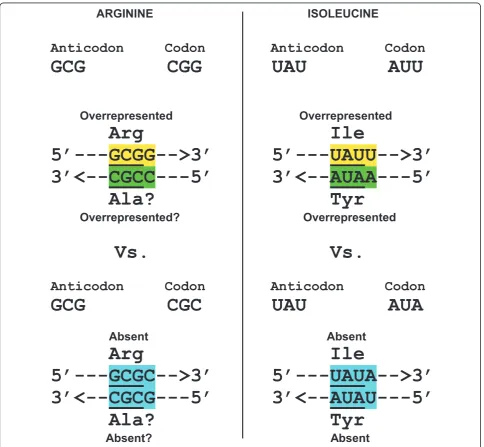
Initially, it was thought that codons were overrepre-sented in such RNA aptamers, although inspection of the sequences revealed that when there were codons, antico-dons were also there almost invariably [10]. The updated compilation [12] totals 337 RNA aptamers and yet, remarkably, the group of “codons-only” sites remains unpopulated. Looking for possible explanation, we have noticed that in the first (codon + anticodon) group, codons for Arg, Ile, and Tyr have a self-complementary palindromic dinucleotide at 1-2 positions, namely:CGN for Arg (N is U,C,A,G),AUU,AUC, andAUA for Ile, and
UAU andUAC for Tyr. Accordingly, the anticodons have exactly the same dinucleotides, but at 2-3 positions, namely: NCGfor Arg (N are A,G,U,C), AAU, GAU, and UAUfor Ile, and AUAand GUAfor Tyr. Therefore it is hardly surprising that, for example, inside the Arg-binding site one base-left shift to its codonCGN would necessarily bring us to its anticodon NCG. And, the opposite way
finding aCGN codon one-base shifted to the right (Figure 2). Thus, in this group of aa-binding sites, codons might simply accompany anticodons, orvice versa.
To find out which of the two, anticodon or codon, was actually involved in selection of independent aa-binding RNAs, we first noticed that, formally speaking, the concomitant presence of codons and anticodons is also expected in the reverse situation, when codons con-tain a palindrome-dinucleotide at their 2-3 positions, whereas anticodons exhibit them at 1-2 positions, i.e. as if the codons and anticodons switched their places. Fig-ure 2 shows an example: His codon CAUand anticodon
AUG.
Before we move further, we will denote these two cases of palindromic dinucleotide-containing coding motifs as codon(1-2)/anticodon(2-3) and codon(2-3)/anticodon(1-2), or, for simplicity, (1-2)/(2-3) and (2-3)/(1-2), respectively. Combination of both of these cases is also possible (see, for example, CGCG tetraplet in Figure 2).
In the complete code (Figure 1A), a number of codons with any such palindrome at 1-2 positions is equal to that with the same palindrome at 2-3 positions. One would then think that these two perfectly symmetrical cases, (1-2)/(2-3) and (2-3)/(1-2), should have equal chance to be found in aa-binding sites of selexed RNA aptamers. Indeed, there are no reasons whatsoever for thea prioribelief that the procedure of RNA aptamers selectionper se— the selection focused on stereo-speci-fic binding of amino acids to particular RNA sequences
— has anything to do with translation (hence, by the
way, the wobbling interface between codon and antico-don at their 3rd and 1st nts, charging tRNAs with cog-nate amino acids by p-aaRSs, etc.)
However, Table 1 in [12] unambiguously shows that the codon(1-2)/anticodon(2-3) cases, but not their codon(2-3)/anticodon(1-2) “counterparts”, are over-represented at significant level in Arg-, Ile- and (with borderline significance) Tyr-binding sites. A closer inspection of aa-binding RNA aptamer sequences for these amino acids uncovered a number of fascinating details. As the control data, we used His- and Leu-bind-ing RNAs, because their codons contain (just at (2-3) positions), the AU and UA palindromes: CAU(His) and UUA, CUA(Leu).
Arginine
In the set of 34 Arg-binding sites, NCG anticodons pre-dominate, often together with overlapping CGN codons; the most frequent motifs being 5’-UCGA-3’, 5’-UCGC-3’ and 5’-GCGG-3’. Importantly,these three are all of the codon(1-2)/anticodon(2-3) type.
The motif 5’-CGCG-3’is of a special interest (Figure 2), because one can see it in two ways: CGC is a codon(1-2) for CG palindrome and, simultaneously, it is also a codon (2-3) for GC palindrome. The overlapping GCG antico-don, in its turn, can be considered as the (2-3) or (1-2) one for CG and GC, respectively. This ambiguity is fraught with confusion for coding. Very telling, therefore, is the fact that Arg-binding sites do not contain the 5’-CGCG-3’motif at all, in contrast to the above three motifs of the codon(1-2)/anticodon(2-3) type.This fact
anticodon codon codon
123 123 123
5’-NCGN-3’ 5’-CGCG-3’ 5’-CAUG-3’
123 123 123
codon anticodon anticodon
(N = U,C,A,G)
Arg
Arg
His
becomes even more telling if we take in account presence of 5’-CGCG-3’beyond aa-binding sites ([12]: see, in the Arg list, cases 17, F2e, F2f, and F2U).
Overall, anticodon UCG significantly outnumbers CGN codons, suggesting that codons might simply follow anticodons (like hitch hikers) rather thanvice versa. The only exception is codon AGG (see [12]). However, among the 34 sites, there is not a single one in which AGG appears as itself, without concomitant NCG and/or CGN cognate triplets. Moreover, in the latest compila-tion set of 127 newly isolated smallest Arg-binding sites [31], the only significantly over-represented triplet is the AGG’s complement, arginine’s anticodon CCU. Thus,
when for the same amino acid, arginine, we find in its RNA-binding sites a cognate,but not-CG-containing, triplet, it appears to be the anticodon, not codon.
Isoleucine
The available set of Ile-binding RNA aptamers is the most populous one: 185 sequences. Ile’s three codons have a palindrome, AU, at 1-2 positions, and one of these three, AUA, also has another palindrome, UA, at 2-3 positions.
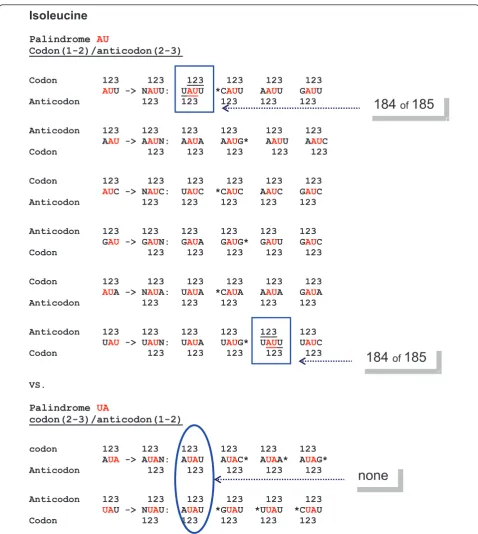
Figure 3 shows the tetraplets which are supposed to occur in Ile-binding sites if one of its coding triplets, either AUU, AUC, AUA (codons) or AAU, GAU, UAU (anticodons) is already there. Out of this extensive repertoire, only one (5’-UAUU-3’) tetraplet does occur (and in obvious excess) in numerous independently selected Ile-binding sites. Note that this motif belongs to the (1-2)/(2-3) group. The symmetry of (2-3)/(1-3) motifs suggests competitive presence of the 5’-AUAU-3’ tetraplet, in which AUAcan be considered as the Ile’s codon(2-3), and the overlappingUAU as the Ile’s antic-odon(1-2), respectively. However, the whole set of 185 Ile-binding RNA sites (2508 nts in total) does not con-tain even a single 5’-AUAU-3’. In contrast, beyond the sites (9915 nts), we can see 28 such tetraplets, one per 354 nts, on average. Proportionally, by chance alone, one would expect to find seven tetraplets 5’-AUAU-3’in Ile-binding sites. Its complete absence may hint at the selection acting against it. A strong independent evi-dence for such selection comes from Tyr-binding sites.
Tyrosine
One of tyrosine’s codons, UAU, is a (precise) comple-mentary partner of isoleucine’s AUA. Only three Tyr-binding RNA aptamers are available [12]. However, these three display exactly the same pattern, as do much more representative Arg- and Ile-binding ones: the sig-nificant excess of 5’-AUAC-3’ tetraplet, which consists
of tyrosine anticodon AUA overlapping with codon
UAC. This is, again, a motif of the codon(1-2)/antico-don(2-3) type. The seemingly equivalent 5’-UAUA-3’of the codon(2-3)/anticodon(1-2) type is not to be found in Tyr-binding aptamers.
It should be emphasized that the 5’-AUAC-3’, and its closest homolog 5’-AUAU-3’, are the very motifs that belong to the codon(2-3)/anticodon(1-2) group for iso-leucine. However, neither is located in the Ile-binding sites (see Figure 3). Instead (and this is highly unlikely to be just a coincidence), we find the 5’-AUAC-3’ pre-cisely where the codon(1-2)/anticodon(2-3) “rule” pre-dicts: in binding sites of the Ile’s complementarily
encoded partner — Tyr. It would be hard to find a
more convincing argument for the preference of (1-2)/ (2-3) tetraplets over seemingly symmetric (2-3)/(1-2) in aa-binding sites of selexed RNAs.
Histidine
This amino acid shows an excess of its GUG (highly signif-icant) and AUG (borderline signifsignif-icant) anticodons in aa-binding sites of selexed RNA aptamers [12]. What makes histidine important for our analysis is the fact that one of its codons, CAU, happens to be of the (2-3) type, the anticodonAUG being, complementarily, of the (1-2) type. Therefore, were the (1-2)/(2-3) and (2-3)/(1-2) motifs had had equal chances to be selected in aa-specific RNA apta-mers, the His’s (2-3)/(1-2) motif 5’-CAUG-3’would be found in significant excess within the His-specific binding sites. However, among such sites (54 independently selexed RNAs) we do not see even a single 5’-CAUG-3’ — the absence being all the more telling if one takes into account the fact that this tetraplet is quite common
outsideof the His-binding sites.
Leucine
According to Yarus et al. [12], concentration of cognate triplets in the aa-binding sites of the independently recovered (15 times) Leu-specific RNA is not significant. Yet, it is the Leu’s CUA codon(2-3), which is repre-sented by itsUAG anticodon(1-2) (with borderline sig-nificance); and again, exactly as with His’s CAUcodon (see above), one observes the corresponding (2-3)/(1-2) tetraplet 5’-CUAG-3’outside, but not within, the Leu-binding site (ibid).
In summary, we point out that:
1) Anticodons, not codons, are more often signifi-cantly over-represented in aa-binding sites of the RNA aptamers.
2) For amino acids encoded by dinucleotide-palin-drome-containing triplets, their binding sites in RNA aptamers “prefer” the codon(1-2)/anticodon(2-3) motifs over the codon(2-3)/anticodon(1-2) ones in spite of their seemingly perfect symmetry.
Isoleucine
Palindrome AU
Codon(1-2)/anticodon(2-3)
Codon 123 123 123 123 123 123
AUU -> NAUU: UAUU *CAUU AAUU GAUU
Anticodon 123 123 123 123 123
Anticodon 123 123 123 123 123 123
AAU -> AAUN: AAUA AAUG* AAUU AAUC
Codon 123 123 123 123 123
Codon 123 123 123 123 123 123
AUC -> NAUC: UAUC *CAUC AAUC GAUC
Anticodon 123 123 123 123 123
Anticodon 123 123 123 123 123 123
GAU -> GAUN: GAUA GAUG* GAUU GAUC
Codon 123 123 123 123 123
Codon 123 123 123 123 123 123
AUA -> NAUA: UAUA *CAUA AAUA GAUA
Anticodon 123 123 123 123 123
Anticodon 123 123 123 123 123 123
UAU -> UAUN: UAUA UAUG* UAUU UAUC
Codon 123 123 123 123 123
VS.
Palindrome UA
codon(2-3)/anticodon(1-2)
codon 123 123 123 123 123 123
AUA -> AUAN: AUAU AUAC* AUAA* AUAG*
Anticodon 123 123 123 123 123
Anticodon 123 123 123 123 123 123
UAU -> NUAU: AUAU *GUAU *UUAU *CUAU
Codon 123 123 123 123 123
184
of185
none
184
of185
nothing to do with translation, it would be more correct to say that in the interface between interacting aas and cognate triplets, the 2-3 nucleotides contribute more to the specificity of interaction, thus determining their future usage as ananticodon. Furthermore, selection of aa-specific RNA aptamers had nothing to do with the translation machinery (in contrast to primary coding). If so, the revealed strong bias towards anticodon’s 2-3 (and, complementarily, codon’s 1-2) palindromes has been established very early, before translation, i.e., before the codon-anticodon interaction in tRNA-mRNA com-plexes. Consequently, not only the translation machinery itself, but its coding toolkit, the code-adapting molecules (tRNA) and aaRSs (initially, advanced ribozymes, then minimalist primitive enzymes) have been evolving to
‘’fit’’the probably already basically outlined genetic code (as opposed to the code co-evolving with tRNAs and aaRSs to “fit” translation by minimizing translation errors).
Does this translation-independent preference of (1-2)/ (2-3) over (2-3)/(1-2) triplets suggest some fundamental left-right, chirality-like, asymmetry, and if it does, could this asymmetry determine the salient features of coding and translation? Our (guarded) answer is Yes. However, the code’s primordial adaptors (tRNAs) and implemen-ters (r-aaRSs) could have simply used the preexisting aa-triplets’ affinities in the way that minimized errors of aminoacylation. That is, the original aa-triplet prefer-ences within the aa-binding sites of RNA catalysts deter-mined the primal pre-translational genetic code with more important 2nd and 3rd nts, whereas 1st nt was much less specific. Later, when the code was expanding in co-evolution with the translation apparatus, the importance of 2-3 nts of coding triplets“passed” on 1-2 nts of their complements thus distinguishing anticodons from codons. The fact that codon’s 3rd nt is more degenerated than the anticodon’s 1st nt actually serves as an indirect evidence of in support of this order of events.
Imprints of the pre-translational code in tRNAs: One ancestor for two codes
If the code did have a pre-translational origin, one would look for its imprints in the code adaptors, tRNAs. The very structure of tRNAs is quite interesting in this regard. Indeed, anticodons are directly involved in“reading”
mRNAsviarecognition of complementary codons, but
the anticodon-to-aa association (the codeper se) is indir-ect, provided solely by the physical linkage of the aminoa-cylation and codon-reading sites within a tRNA molecule. This is a crucial point on which, among other things, the idea of frozen accident [29] hinges upon, and the anticodon-free charging of many tRNAs with cognate aas, i.e. the operational code of tRNA aminoacylation,
might still reflect this ancient fortuity [26]. At the same time, new data on riboswitches in general [32], recent discovery that in the ribosome the anticodons are selec-tively enriched just in proximity to their amino acids [33], an excess of the aa-respective anticodons just in the aa-binding sites of in vitro“selexed”RNA aptamers [12], and our own study of these sites (see above) revealing the striking bias of triplets with dinucleotide palindromes at 2-3 positions towards the real anticodon-to aa assign-ment - all these facts suggest that the hypothetical ancient pre-translational code and the real pro-transla-tional code are in fact one and the same code.
Furthermore, the pre-translational stereo-chemical hypothesis for the code origin [12,16] and the hypoth-esis of the ancient operational code preceding the cano-nical one [26] do not contradict but might, in fact, strengthen each other if the acceptor arm is older than the anticodon arm, but both have a common ancestor.
It seems reasonable to suppose that hypothetical r-aaRSs recognized proto-tRNAs by complementary base pairing. This means that they looked like tRNA complements additionally endowed with the aa-specific aminoacylating activity [34]. Accordingly, not just
tRNAs but rather pairs of tRNAs with complementary
anticodons could still retain the imprints of the code’s earliest (pre-translation) history. Our three previous findings support this statement:
1) Pairs of tRNAs with complementary anticodons turn out to be complementary at the 2ndbase of the acceptor stem as well [20,35]. To the best of our knowledge, this concerted dual complementarity remains the only evidence (however indirect) for the anticodon and first three bases of the acceptor stem possibly having a common ancestor.
2) Two sterically mirror modes of tRNA aminoacyla-tion might have prevented ancestral tRNAs with complementary anticodons from (otherwise highly probable) confusion [19,36]. The“rules”that deter-mine which pairs of complementary anticodon loops should be recognized from the same, and which ones from the opposite, sides in order to avoid their confusion (Figure 1B) seem to have been implemen-ted very early, most likely by ribozymic precursors of the two enzymes (ibid).
arms, not anticodons, the acceptor’s second base pair playing the crucial role in this (ibid).
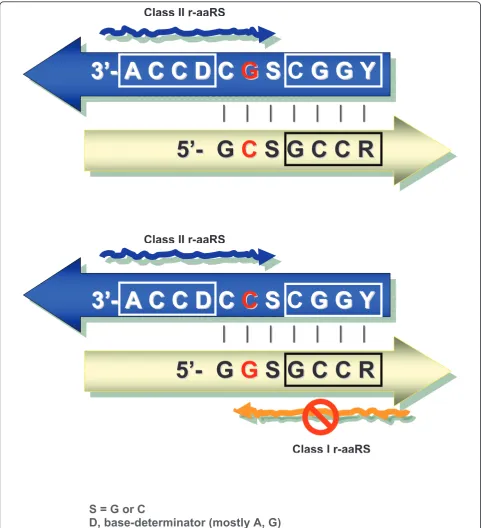
Figure 4 reveals a possible reason. It shows a common ancestor of acceptor arms, reconstructed from the phylo-genetic trees of Bacteria, Archaea and Eukarya. The acceptor’s 5’strand consists of a triplet that might repre-sent, according to the dual complementarity, a proto-anticodon and a quadruplet GCCR that is homologous to the universal DCCA 3’tail. Consequently, the 3’strand of the acceptor emerges as a short palindrome (11 nts) with a codon-like triplet in the middle. It is easy to see that in order to avoid confusion between two acceptor stems with complementary second bases (as it is in the case of Gly and Ala), the aminoacylating ribozymes must use the same groove side; otherwise, they would actually encoun-ter identical targets of recognition. Of two such variants, the 3’× 3’(blue × blue) looks more advantageous than the 5’× 5’(yellow × yellow) due to the unpaired DCCA-3’tail. And it is this variant which has been really chosen despite the fact that within the anticodon loop three other variants (5’× 5’, 5’× 3’and 3’× 5’) were equally error-proof (see [20] for detail).
Worthy of note, alanine is one of five amino acid encoded by the palindromic dinucleotide-containing tri-plets at 1-2 positions, GCN. It would be quite interest-ing, therefore, to test ala-binding sites of RNA aptamers on the (1-2)/(2-3) over (2-3)/(1-2) preference. However, alanine, as well as its complementary partner glycine and all other blue × blue pairs of “Miller’s”amino acids (Pro, Thr, Ser), are absent in the library of aa-binding RNA aptamers [12]. Insensitivity of their tRNA recogni-tion modes to anticodon loops and, on the contrary, a strong association of the confusion risk with the accep-tor arm (Figure 4) may turn out to be very meaningful in this connection.
Origin of tRNA: From a proto-anticodon and a 5’-DCCA-3’ to a cloverleaf
Pre-translational origin of aa-specific anticodons is con-sistent with our model of tRNA growth (Figure 5). We have noticed that the two coding units, a triplet (pre-sumable proto-anticodon) and DCCA (pre(pre-sumable tag of replication with a coding base-determinator D) would eventually generate the 76 nt-long cloverleaf if we will use them as building bricks in the Fibonacci-like itera-tive process. Literally: 3 + 4 = 7, 4 + 7 = 11, 7 + 11 = 18, 11 + 18 = 29, 18 + 29 = 47, and finally 29 + 47 = 76! This algorithm produces the cloverleaf with periodically repeated ACCR and YGGU motifs and many of the con-servative and largely concon-servative bases, such as 5’-URG-3’ at 8-10 positions, the anticodon flanking 3’-U and R-5’ bases, the 3’-C of the V-loop which is homologous to the nearly invariant 3’-C at the 72ndposition (see also: [20,35]).
Importantly, in order to arrive at a final“perfect” clo-verleaf, one should, in each step “i” of the elongation process (i = 1, 2,...,6), add to the (i-1)th member not just the preceding (i-2)th one, but its complementary image. This actually implies that during the code development the repertoire of aa-specific triplets has been increasing not one by one but rather by complementary pairs, in
accord with numerous independent arguments
[18-20,23,24,34-43]. This also implies a self-priming and self-templating, mechanism of elongation (Figure 5). As a consequence, the 76-nt long cloverleaf would have internal sequence periodicity — the hallmark of tRNAs reported long ago ([44], see also [35]).
The 11 nt-long precursor is a palindrome, which may serve a template for its perfectly symmetric partner with a complementary triplet in the center (Figure 5; step 2). Two other structures, the 29 nt-long hairpin (step 4), and the eventual cloverleaf (step 6), also show such complementary symmetry (although less perfect) with the anticodon mapped right in the middle. (By the way, the final cloverleaf and its 47 nt-long precursor can be both represented as a long hairpin, with a few small bulges, as well (not shown).) Indirectly, this symmetry also supports the hypothesis that new amino acids entered translation by complementarily encoded pairs ([37], see also [20,35,38,39]).
The following aspects of the model are worthy of spe-cial comments:
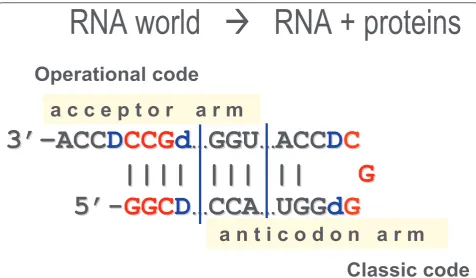
First, tRNAs could participate in translation before they have “reached” the complete cloverleaf. The 29 nt-long hairpin with overlapping acceptor and antico-don domains is an obvious candidate to be such a pre-cursor for code adaptors. tRNA is perhaps the most important molecule of life, bridging RNA and (RNA + Proteins) worlds. As Figure 6 symbolically shows, the two worlds are literally as close as it possibly gets in this hairpin: the late RNA world with the operational code actually joins the early (RNA + Proteins) world with the classic code. In principle, the 18-nt long acceptor arm also assumes two alternative versions of combining the 11- and 7-nt long precursors usable in translation (Figure 7B) or even earlier - in replication (Figure 7C) with the ribosome functioning as an RNA replisome and tRNAs loaded with trinucleotides (not amino acids) and donating them to growing comple-mentary RNA molecules ([45], see [4,5,46,47] for more comprehensive treatment).
Fibonacci-like elongation is quite specific in this regard: starting from the 5’DCCA3’ quadruplet and different (including complementary) coding triplets, it brings them all to the universal 76 nt-long cloverleaf. Of course, any elongation that took place with a single
proto-tRNA could then be spread across the whole repertoire of already existing code adaptors by a variety of mechanisms (see [49] for review), but the Fibonacci-like elongation obviously makes such“coincidental coe-volution” [50] much easier.
3
3
’
’
-
-
A
A
C
C
C
C
D
D
C
C
C
C
S C
S
G
G
G
G
Y
Y
5
5
’
’
-
-
G
G
G
G
S
S
G
G
C
C
C
C
R
R
|
|
|
|
|
|
|
|
|
|
|
|
|
|
3
3
’
’
-
-
A
A
C
C
C
C
D
D
C
C
G
G
S C
S
G
G
G
G
Y
Y
5
5
’
’
-
-
G
G
C
C
S
S
G
G
C
C
C
C
R
R
|
|
|
|
|
|
|
|
|
|
|
|
|
|
S = G or C
D, base-determinator (mostly A, G)
Class II r-aaRS
Class II r-aaRS
Class I r-aaRS
Figure 4Ancestral acceptor arms of tRNAs with complementary second base pairs (shown in red) and putative r-aaRSs of two types shown as wavy arrows. The 3’× 3’(blue × blue) variant of recognition of acceptors is much less confusion-prone in comparison with the
Third, our model (Figure 5) may seem incompatible with the Di Giulio model (Figure 8A), in which tRNAs originated from a hairpin with a proto-anticodon in the 3’strand preceding the unpaired DCCA tail. Two such hairpins make a cloverleaf if one is shifted along the other with formation of the unpaired anticodon loop
(and, as a consequence, V loop) as shown in Figure 8A [51,52]. In this simple and generally elegant model, the anticodon precursor is positioned in the same place as in our model— adjacently to the 5’DCCA3’. However, in the Di Giulio model, the anticodon and its putative
acceptor’s precursor are supposed to be identical
%XLOGLQJXQLWV
&RGLQJWULSOHWV¶*&&¶ DQG¶**&¶ )ODQNLQJWHWUDSOHWV¶'&&$¶ DQG¶G**8¶ (ORQJDWLRQE\VHOISULPLQJDQGVHOIWHPSODWLQJ
VWVWHS
¶$&&'¶¶&&*¶ ! ¶$&&'&&*
QGVWHS
¶$&&'&&*¶¶G**8¶ÆÆÆÆ ¶$&&'&&*G**8
UGVWHS
¶**&'&&$¶ ¶$&&'&&*G**8«
¶$&&'&&*G**8¶ ! ¶$&&'&&*G**8«$&&'&**¶ !_______ ¶**&'&&$«
WKVWHS ¶8**G**&'&&$
¶$&&'&&*G**8¶««$&&'&**¶!¶$&&'&&*G**8«$&&'&**G**8«$&&'&**¶ &' ¶$&&'&&*G**8¶±$ & &'& & *G* * 8 $ &&
_______¶$&&'&**G**8¶ ! _ _ _ _ _ _ _ _ _*
¶**&'&&$ ¶* * &'& & $ 8 * *
*G
¶$&&'&&*G**8
Ľ
¶8**G**&'&&$
¶$&&'&&*G**8
Ľ
Ľ ¶8**G**&'&&$
WKVWHS
¶±$&&'&&*G**8«$&&'&¶$&&'&&*G**8¶ _________*_______ ¶**&'&&$«8**G* ¶8**G**&
¶8**G**&'&&$
¶$&&'&&*G**8«««««$&&'&**G**8«$&&'&**
p p p p
¶8**G*&&
¶$&&'&&*G**8«$&&'&**G**8«««$&&'&**G**8«$&&'&**
p p p p
¶$&&'&&*G**8«$&&'&&*G**8&&*G**8«$&&'&**G**8«$&&'&**
**
G 8
*& *&
& *
'G
& * & * $± 8&'
¶±$&&'&&*G**8« $&&
_________*
¶**&'&&$« 8**
*G
WKVWHS
¶8**G*&&'&&$«8**G*&&
¶$&&'&&*G**8«$&&'&&*G**8&&*G**8««««««$&&'&**G**8«$&&'&**
p p p p
¶8**G**&'&&$
¶$&&'&&*G**8«$&&'&&*G**8&&*G**8«&&*G**8«««««««$&&'&&*G**8«$&&'&**G**8«$&&'&**
p p p p
¶$&&'&&*G**8«$&&'&&*G**8«&&*G**8«&&*G**8«$&&'&**G**8«$&&'&&*G**8«$&&'&**G**8«$&&'&**¶ **
G 8
*&
*& **
& *G 8
'±G*&*&
&
&±±***&*&
&
&**&&**
$± 8 & ' 'G
¶±$ & &'& & *G* * 8« «$ & &&± * _ _ _ _ _ _ __ _*& *
¶* * &'& & $« « 8 **$± 8& *& '
* G¶$ & &'&&&&**G* * 8&& G* * 8 $ &&&
_ _ _ _ _ _ __ _ _ _ _**
¶****&&'& & $±8 * '& & $ 8 ***
*±& * G & 'G" &
¶±& & *G* * 8 $ &&**
_ _ _ _ _ _ _ _ **"G
¶ 8**G* & &'& & $ 8 **&*
* G'*
& 8 &$
PLQLKHOL[
GXPEEHOO
whereas in our model they are complementary to each other. Note that in consensus and ancestral tRNAs, at the purine/pyrimidine (R/Y) resolution, second bases of anticodon and its presumable precursor in the acceptor are much more often complementary rather than identi-cal [20,35]. Moreover, for the amino acids which (in the majority of origin scenarios) are supposed to be the very first ones recruited by emerging code and translation, i.e. Gly, Ala, Asp, Val, Glu, their tRNAs all have comple-mentary second bases in the anticodon and 3’strand of the acceptor stem. The same is the case for two tetrads, [Ala (GGC), Gly (GCC), Val (GAC), Asp (GUC)] and [Ala (CGC), Arg (GCG), Val(CAC), His (GUG)], which might have formed the complementary core of the genetic code (see [18,19,40] for details). And, in convin-cing contrast, the tRNAs which are consistent with the
“dimerization”model (Figure 8A), all represent relatively
“late”amino acids: Leu, Gln, Trp, Phe and Cys.
Yet, a closer analysis of the“dimerization”model (Fig-ure 8A) reveals its similarity with the model proposed here (Figure 5). Indeed, Figure 8B clearly shows how shifting of the 3’half of one hairpin forms the anticodon loop and, consequently, V-loop, but necessarily implies preexistence of the anticodon duplicate (plus UG-3’) intended to complement the codon triplet (plus 5’-CA) on the 5’ half of the opposite hairpin. Symmetrically, this anticodon duplicate in turn suggests preexistence of
the codon duplicate in the original hairpin, etc., - in all, we get eight coding triplets, four anticodons and four codons, each with adjacent UG or CA dinucleotide, respectively - precisely as in our model (Figure 5). It thus turns out that “simple”dimerization of two identi-cal hairpins with anticodon/codon-like pair at the basis generates the tRNA cloverleaf with the unpaired antico-don in the center if and only if the hairpin itself origi-nated by complementary duplications of shorter precursors. Actually, it is the self priming and self tem-plating model of tRNA growth [44] that is at work here, and our model (Figure 5) is its Fibonacci process-based version (see also the close variant in [20]). Among other similar versions (not shown), we would like to mention here the simple series of six duplications of the original palindrome (of alternate complementarity) producing the final 73 nt-long cloverleaf (11 × 7 less the 5’ term-inal dGGU tetraplet) and the model of three duplica-tions of the acceptor arm with the additional base “d” on the 5’strand, which is complementary to the base-determinator“D” on the 3’strand. In this (19 × 4 = 76) model, the intermediate (19 × 2 = 38) state is in fact equivalent to the primordial tRNA hairpin in the Di Giulio’s model (Figure 8A). The (19 × 4 = 76) model suggests also that ancestral tRNAs might have had in the acceptor arm a complementary intron preceding the
“d” and, indeed, the majority of tRNAs of histidine do
RNA world
Æ
RNA + proteins
3
3
’
’
–
–
ACC
ACC
D
D
CCG
CCG
d
d
…
…
GGU
GGU
…
…
ACC
ACC
D
D
C
C
|||| ||| ||
|||| ||| ||
G
G
5
5
’
’
-
-
GGC
GGC
D
D
…
…
CCA
CCA
…
…
UGG
UGG
d
d
G
G
Operational code
Classic code
a c c e p t o r a r m
a n t i c o d o n a r m
contain such complementary base-determinator. (Inter-estingly, His is the amino acid of highest catalytic propensity [11].)
Fourth, in addition to the typical 37/38-positioned intron in tRNA genes [53-56], the recentin silico gen-ome-wide search for tRNAs in some archaebacteria and eukaryotes unexpectedly discovered the great diversity of disrupted tRNA genes (reviewed in [57]). The collec-tion of encoded-in-pieces tRNAs with an intron at 37/38 site is enriched by the genes with a single intron at non-canonical positions [58,59], the genes with multi-ple introns [60], the split genes that separately encode the 5’and 3’halves of tRNAs [61-63], the tri-split tRNA
gene precedents [64,65], and permuted tRNA genes, in which the sequence coding for 3’half precedes that for the 5’half [66,67].
This impressive diversity is precisely what any model of gradual tRNA elongation predicts (e.g. Figure 5) because the anticodon-flanking bases come actually from the primordial palindrome (Figure 4) as homologs of the base-determinator“D” and its complement“d”. It does not mean, of course, that the entirety of the tRNA splitting diversity that we observe today directly des-cends from the corresponding intermediate stages of tRNA growth; certain present-day disrupted tRNA
var-iants might well be the “analogs” rather than the
Building units
:
Coding triplets:
5’-
GGC
-3’
and
5’-
GCC
-3’
Flanking tetraplets:
5’-
D
CCA
-3’
and
5’-
UGG
d
-3’
proto-tRNA?
A: aminoacylation
3’–ACC
D
CCG
d
GGU-5’
|||||||
5’-
GGC
D
CCA-3’
B: translation?
3’–ACC
D
CCG
ACC
D
C
C
|||
G
5’-UGG
d
G
C: replication?
3’-ACC
D
C
C
|||
G
G
5’-
GCC
D
CCAUGG
d
G
homologs of the putative tRNA precursors - analogs that readily emerge simply due to the revealed multiple modularity of a tRNA molecule. The“homology vs. ana-logy” uncertainty here is similar to that encountered with the origin of deviant codes (see [68] for review);
while the phylogeny tells us that they must be late deviations, we do know that there must have been such codon-to-aa variations during the origin of the universal genetic code as well. And yet, it has not escaped our attention that, most frequently, D is A, d is U, and it is
Original hairpin
3’-ACCD ANT
||||||||||| 5’-
Dimerization
3’-ACCD ANT -5’
||||||||||||| ||||||||||| |||
5’- ANT DCCA-3’
…implies:
3’-ACCD - -ACCD ||| ||||| ||||||| ||| || 5’- - -UG??
…implies that in the original hairpin:
3’-ACCD -5 ’ ||||||||||||| ||||||||||||| |||
5’- UG?? DCCA-3’
…implies:
3’-ACCD ??GU AC-- -5’ ||| ||||||| |||| ||||||||| |||||||
5’- --CA UG?? DCCA-3’
cloverleaf
Acceptor Vloop
A N T
A
B
again the invariant A (sometimes G) and U that flank the anticodon from the 3’and 5’sides, respectively.
There is a certain rationale behind the fact that the major site of introns, splits on minigenes and processing
in permuted tRNA genes is located between the 37th
and 38th nts. It is this position that is consistent with the sub-code for two modes of tRNA aminoacylation (from major and minor groove sides) - the sub-code that minimizes the risk of confusion for pairs of tRNAs with complementary anticodons [19,36], especially if we put the putative aminoacylating ribozymes in introns, in proximity to the 37th base [9,10,69]. Furthermore, the sub-code might have already worked in shorter precur-sors such as the 29-nt long proto-tRNAs with the pre-sumable site of intron also mapped right in the middle (between 15thand 16thnts), or even 11-mer precursors, right after the base-determinator D.
According to Di Giulio [48,52,70], the most frequent intron position right in the middle (37/38) of a tRNA molecule reflects its origin by hairpin dimerization (Fig-ure 8A). In contrast, as far as other flexible sites of tRNA disruption are concerned, Di Giulio [71] explains away all such cases after Randau & Söll [61-63,72] - due to gained protection against integrative mobile elements. However, the “main” and“peripheral”introns are pro-cessed uniformly, and they are undistinguishable in everything but location. Therefore, like Randau and Söll [73], we do not find these two explanations readily com-patible. At the same time, the purely “protectionist” hypothesis of Randau and Söll does not appear to be entirely convincing, either (see [71]).
There is, however, no need for anyad hocexplanations of the sort if we accept the models of multi-step self-primed and self-templated elongation of tRNAs. For example, in our model (Figure 5), the 37thbase has a series of precursors starting from the base-determinator D in the original heptamer and 11-mer palindrome. Remarkably, the additional sites of tRNA disruptions are often mapped right next to, or one-two bases shifted from, the“D”and its complementary“d”bases, following or preceding them, respectively. Thus, our model (Figure 5) uniformly com-pletes the evolutionary interpretation of all tRNAs-in-pieces: not only the 37/38-positioned hot spot of tRNA splits but also the majority of “warm”and “cold”spots might reflect the deep evolutionary past of tRNAs marking crucial steps in their development from a coding triplet and DCCA up to a final cloverleaf. In our model, the 37/ 38 position of intact tRNAs is identical to similar positions of shorter precursors (like the 15/16 position in the 29-base long proto-tRNA) as if it“inherited” all previous stages of tRNAs elongation thus, accordingly, becoming the major site of possible disruptions.
However, in our opinion, neither the interpretation limited to the 37/38 site, nor its extension to all other
disruption sites in our model are incompatible with the Randau’s and Söll’s“anti-parasitic”explanation. After all, consistently with the“homology vs. analogy”proviso, we do not see why the preferable targets of intron (or mobile element) insertions could not coincide with the junction sites in the stepbystep growing tRNAs -rather, this is where one would expect to find them, right at the“critical points of growth”.
Conclusions
Recently, we have pointed out that probably long before the origin of translation the genetic code had already fixed such a fundamental (and, one would think, translation-ineradic-able) feature as the tripletness of coding words [20,24]. The present analysis of aa-binding sites in selexed RNA aptamers allows us to make an even stronger conclusion: the degeneracy of 1stposition in anticodons (3rdposition in
“future” codons) also appears to have originated before translation.
This conclusion questions many dogmas of the code and translation origins, including the almost commonly shared view that the code shaping was driven by mini-mization of translation errors and, in general, the code structure reflects its coevolution with tRNAs and aaRSs. Not completely denying such translation-motivated coe-volution, we would like to accentuate the reverse causal-ity. The very logic of tRNA evolution from a short ancestor to the eventual functionally sophisticated clo-verleaf-like molecules might have been dictated by the
“RNA-aa binding: a stereochemical era for the genetic code” [12]. Consistent with this are our model in which the coding triplet and DCCA 3’end for aminoacylation are present from the very beginning (Figure 5) and pre-vious findings: the dual complementarity [18,20,35] as an indirect evidence of ancestral anticodon duplication [51,74,75], and the subcode for two modes of tRNA recognition by hypothetical aminoacylating ribozymes (Figure 1B) [19,36]. Apparently, the sub-code for two modes of RNA aminoacylation could be implemented for primordial 11 nts-long palindromes, i.e. extremely early - in response to increasing catalytic and other challenges of the RNA world.
(1-2) biased? The mirror selexed RNA aptamers could provide an answer.
It should be noted that, in principle, the hypothesis of pre-translational origin of the genetic code is consistent with the hypothesis of its shaping in coevolution with amino acids biosynthesis proposed in [79,80] and extended in [81]. Indeed, if the advanced RNA life did have widely used amino acids (for example as cofactors of ribozymes [9-11]), then it seems reasonable to assume that to some extent the earliest shaping of the genetic code in general, and the order of entering of amino acids into coding in particular, could recapitulate their biosynthetic pathways.
The stereochemical affinity between aa and the antico-don-containing aa-binding sites in selexed RNAs does not preclude, of course, further optimization of codon-to-aa assignment. Very telling in this regard is the spar-seness of triplet usage in aa-binding sites [12]: usually for each aa there is only one significantly preferable anticodon (e.g. see Figure 3). Consistently, for most of amino acids the number of anticodons is less than that of codons. This fact points, yet again, to primacy of anticodons, and not codons, in the genetic code origin. Obviously, the repertoire of codons was filled out later, perhaps together with minimization of translation errors in synthesis of very first proteins, such as heat shock
proteins, “RNA chaperones” [4,5] and proto-aaRS
enzymes ([18-20,22,24,82-86], however, see [7]). And yet, the current analysis shows that the core of the genetic code might have emerged much earlier, certainly before translation.
We propose here a new model of stepwise, Fibonacci process-like elongation of a tRNA molecule from just two (triplet and quadruplet) motifs to a 76 nt-long clo-verleaf (Figure 5). Importantly, the earliest part of the molecule, the acceptor arm, already contains the pri-mordial anticodon/codon pair. This means that the two concepts - the pre-translational code and the more ancient operational code of tRNA aminoacylation pre-ceding the classic code for reading mRNAs - may tell actually one and the same story, rather than two differ-ent ones. Accordingly, we repeatedly emphasize that the hypothesis of primal stereo-chemical affinity between aas and anticodons (or codons) [12,16], the hypothesis of coding coenzyme handles for amino acids [9,10], the hypothesis of tRNA-like genomic 3’tags suggesting that tRNAs originated in replication [87-89], the hypothesis of the proto-ribosome having served originally a role in RNA replication with the help of primordial tRNA molecules delivering trinucleotides [4,5,45-47] - all four evidently pre-translational - and the hypothesis of the ancient RNA operational code, most likely ribozymes-mediated and pre-translational as well [26], do not con-tradict but, on the contrary, strongly support each other.
To conclude, our retrospective analysis of aa-binding
sites in RNA aptamers and the “proto-anticodon®
cloverleaf”model of tRNA growth add to the
fundamen-tal premise: Translation without code does not make
sense, but code without (and before) translation does.
Methods
The common ancestor of acceptor arms (Figure 4) was reconstructed from the phylogenetic trees of Bacteria, Archaea and Eukarya as detailed in [20]. A combination of manual sequence alignment, Neighbor-Joining phylo-genetic tree reconstruction method with Tamura-Nei distances and manual Parsimony-based ancestral state reconstruction was used.
The selected amino acid binding sites, comprising 337 independently derived sequences (18,551 nucleotides in total) directed at eight amino acids, are described in [12]. The curated sequence libraries are available directly from Yarus et al [12].
The statistical significance of over- or under-represen-tation of anticodon/codon triplets was ascertained using chi-square or similar (G-test, exact binomial) two-sided statistical tests.
Reviewers’comments
Reviewer’s report 1
Eugene V. Koonin, National Center for Biotechnology Information, National Library of Medicine, NIH, Bethesda, USA
Reviewer Comments
This manuscript addresses arguably the most fundamen-tal and most difficult problem in the study of the origin of cells: the steps leading to the emergence of the trans-lation system. Any informed discussion of this funda-mental enigma is of interest, and this is particularly true of this exceptionally well written and thoroughly refer-enced manuscript. I find it equally evident that the deci-sive breakthrough remains eludeci-sive, and even the direction in which one should proceed to find it is less than obvious. So does this analysis take us a step closer to a (the) solution?
solves a“pseudo-puzzle” in the aptamer data. They then continue with the discussion of the other type of palin-dromic relationship between codons and anticodons: codon positions 2-3 vs anticodon positions 1-2. The conclusion for Arg is that “when for the same amino acid, arginine, we find in its RNA-binding sites a cog-nate, but not-CG-containing, triplet, it appears to be the anticodon, not codon”. And overall: “Anticodons, not codons, are more often significantly over-represented in aa-binding sites of the RNA aptamers“. There is also another, more subtle pattern that comes out of the apta-mer analysis:“For amino acids encoded by dinucleotide-palindrome-containing triplets, their binding sites in RNA aptamers “prefer” the codon(1-2)/anticodon(2-3) motifs over the codon(2-3)/anticodon(1-2) ones in spite of their seemingly perfect symmetry“. The primary
conclu-sion, of course, is that the 3rd base of the
over-represented triplet in aptamers is more important in aptamer-amino acid recognition, so the recognition is anticodon-based rather than codon-based. The meta-conclusion is that this recognition is a relic of the puta-tive primordial, pre-translational code.
I am afraid I am rather skeptical of this entire line of reasoning - above all, because the aptamer data are weak, with the possible exception of only two amino acids, and these amino acids (Arg and Ile) are not the simplest ones or those that are generally thought to be primordial. I am just not convinced that the aptamer data are relevant at all. What is more, assuming there is some signal there, I am not sure it has anything to do with either codons and anticodons. The authors them-selves are very emphatic on the statements that the pri-mordial code had nothing to do with translation, and indeed, the classic results on specific aminoacylation of the CCA-arms (refs. [25,26]) do suggest the existence of a primordial operational code that might have had noth-ing to do with the present one.
The rest of the paper is a rather involved discussion of the potential relics of the pre-translation stages in the tRNA structures, in part, recapitulating the previous publications of the authors. The idea with the Fibo-nacci-like iterative process of tRNA evolution is of course very elegant and numerologically appealing but the entire scheme is quite speculative.
So does this paper report progress in our understanding of the origin and evolution of translation and the code? It is hard to give a‘yes’or‘no’answer. The paper ends with the overall conclusion that“Translation without code does not make sense, but code without (and before) translation does”.I think this is good logic. I also applaud with the authors’approach of combining many different lines of evidence in approaching this formidable evolutionary puz-zle. However, my overall position is that we still have not developed the right way to approach this problem, so all
current scenarios are likely to be wrong in most details. In this situation, what matters is the quality of the discourse, and in this respect, the current paper will be helpful to any researcher interested in the problem.
Authors’Response
We have greatly appreciated the reviewer’s comments and critique; our response is structured in the following three sections:
I. On the general relevance of aa-binding RNA apta-mers data to the problem of the genetic code origin Just like the singularity point in the origin and evolution of universe, the actual start of bilingual life (with nucleic acids, proteins and genetic code in between) was, is, and probably will always remain obscure. In such an“ agnos-tic” (in Huxley’s meaning) situation, one of the very few intellectual pursuits that a theoretician could afford to accept as not being hopelessly speculative would be to examine, by all conceivable means (includingin vitro
experiments with aa-specific RNA aptamers), the crucial
“key-lock vs. frozen accident” alternative. Naturally,in vitroselection of RNA aptamers (aimed at an increasingly more specific recognition of a particular amino acid) has little, if anything, in common with shaping of the genetic code that actually took place in early evolution. Appar-ently, the real code developed stepwise following the clas-sic scheme of gene duplications with subsequent specifications, regardless of whether it have started with a very specific stereo-chemical“key-lock”, a true“frozen accident”, or possibly something in between—a“frozen
stereo-chemicalaccident”([16] see also [10]). In contrast, SELEX experiments of the Yarus type always start with
an absolutely random RNA sequence.But if so, then the excesses one observes in selexed aa-binding RNA sites— excess of cognate anticodons in general, and excess of anticodon (2-3)/codon(1-2) tetraplets in particular—are all the more impressive.
II. More on excess of anticodons in aa-binding sites of
RNA aptamers Logically, if we accept that p-aaRSs
must have been preceded by r-aaRSs, then we have to face the problem of interaction between a particular aa and its cognate r-aaRS, and this, in a nutshell, is the proverbial problem of the genetic code origin. Specifi-cally, a whole cluster of interrelated questions arises, the most important (in our estimation) ones being: (1) was this interaction absolutely random, or stereo-chemically selective (at least weakly), and (2) did this interaction have anything in common with the real genetic coding?
the question one might ask is ratherhow to account for this striking level of significance by any other means?
Previously, one of us (ES) has formulated this pre-cisely: logic dictates the hypothesis of direct interactions between RNA and amino acids in the emerging RNP life, but corresponding binding sites may not have any-thing to do with the current cognate triplets [9]. In this case, the codon/anticodon triplets would have been an early operational code of sorts (in a sense that they would have been symbolic/conventional, rather than ico-nic). Then, of course, we should be able to demonstrate some other sequences being specific binders. The experiments, first suggested in [90], are now known as Yarus type SELEX experiments; our analyses thereof have revealed anticodonic “predominance”, and so we tentatively conclude that early coding was, so to speak, iconic and anticodonic.
Two of us (SNR and ASR), just like the Reviewer 1 (and for similar reasons), initially also made light of the stereo-chemical hypothesis until (1) revealing the sub-code for two modes of tRNA recognition by aaRSs (Fig-ure 1B), and (2) noticing that the puzzling confusion-prone simultaneous presence of codons in aa-binding sites of selexed RNA aptamers might have been simply a hitch-hiking by-product of the anticodon-targeted selection (discussed in this paper). We feel that this observation is in fact more important than a mere reso-lution of the persistent but superficial puzzle — and it certainly increases the significance of RNA aptamer data in the context of the problem of genetic code origin. In principle, the complementarity of codons and antico-dons means that there is no difference whether it is the former or the latter that will prevail in aa-binding sites of RNAs. However, the fact that it is actually the latter (and we present not one but many independent pieces of evidence in support of the anticodon’s prevalence) tells us a lot about the consistency of the primacy of anticodons (by origin) with logically necessary primacy of coding. As a matter of fact, it is mildly ironic that the
aa-cognate triplets in mRNAs were named “codons”
(ensuring their complements in tRNAs being named
“anticodons”). Strictly speaking, it would make more sense to flip the terms—if anticodons did emerge first, as the aa-specific triplets in ribozymes of the primordial RNA life (perhaps long before amino acids were recruited into translation), they deserve to be named
“codons”. Consequently, triplets in mRNAs would
become “anticodons” (thus reflecting their origin as complementary copies of aa-specific triplets).
III. On primordial amino acids, operational code and sub-code for two modes of tRNA recognition by
puta-tive r-aaRSs Aminoacylation of a tRNA molecule from
two, major and minor grove, sides (Figure 1C) is sup-posed to be a very ancient feature of life. By
complementary transformation of the genetic code table (Figure 1B), we have revealed its internal “yin-yang” pat-tern (a sub-code of sorts) that minimizes errors of tRNA recognition by putative r-aaRSs for complementa-rily encoded amino acids [19,36]. This sub-code implies primacy of anticodons in the genetic code origin, but for simplest ("primordial"?) amino acids such as Ala and Gly, recognition of their proto-tRNAs by putative r-aaRSs might have been more acceptor- than anticodon-targeted, i.e. associated with the ancient operational code rather than the classic one (see [20] for details of this seeming“paradox”). Importantly, we do stress that in actuality there is no“paradox”here, and that in general the primordial code most likely had little, if anything, to do with translation (but, of course, not with codingper se). Quite the opposite, in a series of papers [18-20,35,36] we pursued the idea (and consolidated the data in sup-port of showing) that (1) the primordial code was actually operational (and only operational), but nevertheless (2) these two codes - operational code of tRNA aminoacyla-tion embodied mostly in the acceptor stem [25,26] and the classic code associated with anticodons by which cells are reading mRNAs during translation - might have had a common ribozymes-implemented ancestor [18-20,35,36]. If so, classic experimental results of proper specific aminoacylation of tRNAs truncated to mini- or even micro-helix [25,26] andin vitroselection of aa-spe-cific RNA aptamers [12] complement rather than exclude each other—which is one of the leitmotifs of the present paper.
As far as Ala, Gly or any other (presumably) primordial amino acids are concerned, at this time we are not aware of any reports stressing not the excess (or deficiency) of their cognate anticodons (codons) in aa-binding sites of RNA aptamers, but rather the successful selection of such RNA aptamers at all. Thus, it remains unclear whether such excess in fact exists; further, more refined, experimental attempts with selection of RNA aptamers for such amino acids would be most welcome.
Reviewer’s report 2
Wentao Ma, College of life sciences, Wuhan University, P.R. China, nominated by Juergen Brosius.
Reviewer Comments
The origin of genetic code and translation system is a problem (or two related problems) full of controversies. The reason is that the translation system is very compli-cated and the coding principle is not clear (e.g. not clear as the base-pairing mechanism evolved in the replication of DNA or RNA, or their interdependent synthesis). According to the Darwinian Continuity principle (i.e.
intermediate steps. This manuscript, following the idea of a previous hypothesis (CCH, Coding Coenzyme Han-dles [9]), emphasized (with new evidence) that the cod-ing principle should have emerged before translation. This idea has its intrinsic feature to explain the origin of the coding principle considering that“evolution has no foresight”. The evidence came mainly from a detailed analysis of the updated data in experiments of RNA aa-aptamers [12]. Overall, the argument is reasonable, but, in my opinion, some detailed deductions or assertions need a more cautiously examination.
Based on the analysis on aptamer data of three amino acids containing both their anticodons and codons, the authors asserted reasonably that such cases should be associated with the palindrome-dinucleotides. Together with data of other amino acids in [12] and also recent evidence in [31,33], it is also reasonable to conclude that anticodons, not codons, are more often significantly over-represented in aa-binding sites, and that in some cases, “codons might simply follow anticodons (like hitch hikers)” This conclusion is “welcome” by the stereochemical theory on the origin of the genetic code, considering the previous statement, “both anticodons and codons are over-represented in aa-binding sites”, is ambiguous and hard to explain [7].
“For amino acids encoded by dinucleotide-palindrome-containing triplets, their binding sites in RNA aptamers
“prefer”the codon(1-2)/anticodon(2-3) motifs over the codon(2-3)/anticodon(1-2) ones in spite of their seemingly perfect symmetry.”This conclusion seems also to be sup-ported by the data in [12]. Indeed, the situation could be interpreted as the 1-2 nucleotides of the codon contribute more to the specificity of interaction, or the 2-3 nucleo-tides of the anticodon contribute more to the specificity of interaction. Then, the latter interpretation could be accepted considering the above conclusion that it might be anticodons that actually associated with cognate amino acids. Thus, a new, interesting assertion, stronger than that in the CCH hypothesis, could be phrased as “the degeneracy of 1st position in anticodons (3rd position in
‘future’codons) also appears to have originated before translation”. In this context, it is also attractive to attribute
“the fact that codon’s 3rd nt is more degenerated than the anticodon’s 1st nt”to the cause that anticodons should have emerged before codons, which would be used only in the“future”translation system.
“The motif 5’-CGCG-3’is of a special interest (Figure 2), because one can see it in two ways: CGC is a codon(1-2) for CG palindrome and, simultaneously, it is also a codon (2-3) for GC palindrome. The overlapping GCG anti-codon, in its turn, can be considered as the (2-3) or (1-2) one for CG and GC, respectively.”
I think that this description has some problems. The corresponding motif should be 5’-GCGC-3’when CGC
is a codon(1-2) and GCG an anticodon(2-3) for CG palindrome, while the corresponding motif should be
5’-CGCG-3’ when CGC is a codon(2-3) and GCG an
anticodon(1-2) for GC palindrome.
“This ambiguity is fraught with confusion for coding. Very telling, therefore, is the fact that Arg-binding sites do not contain the 5’-CGCG-3’motif at all, in contrast to the above three motifs of the codon(1-2)/anticodon(2-3) type. This fact becomes even more telling if we take in account presence of 5’-CGCG-3’beyond aa-binding sites ([12]: see, in the Arg list, cases 17, F2e, F2f, and F2U)”.
Now that aptamers have nothing to do wit
![Figure 1 The genetic code (adopted fromrecognition by aaRSs - from the minor and major groove sides of the acceptor stem, respectively [21,22]](https://thumb-us.123doks.com/thumbv2/123dok_us/389372.1531639/3.595.59.539.88.605/figure-genetic-adopted-fromrecognition-aarss-groove-acceptor-respectively.webp)

![Figure 5 The model of consequent “quasi-Fibonacci” growth of tRNAs from proto-anticodon triplet and 5’ DCCA3’ quadruplet to thefinal cloverleaf-shaped molecule (see also [20]and [35]).](https://thumb-us.123doks.com/thumbv2/123dok_us/389372.1531639/11.595.62.537.86.615/consequent-fibonacci-anticodon-triplet-quadruplet-thefinal-cloverleaf-molecule.webp)
![Figure 8 The Di Giulio’s model of tRNA origin by dimerization of hairpins. A: The model [51,52]](https://thumb-us.123doks.com/thumbv2/123dok_us/389372.1531639/14.595.59.537.87.615/figure-giulio-model-trna-origin-dimerization-hairpins-model.webp)