R E S E A R C H
Open Access
Changes in Selected Biochemical Indices
Resulting from Various Pre-sampling Handling
Techniques in Broilers
Petr Chloupek
1, Iveta Bedanova
1*, Jan Chloupek
2and Vladimir Vecerek
1Abstract
Background:Since it is not yet clear whether it is possible to satisfactorily avoid sampling-induced stress
interference in poultry, more studies on the pattern of physiological response and detailed quantification of stress connected with the first few minutes of capture and pre-sampling handling in poultry are required. This study focused on detection of changes in the corticosterone level and concentrations of other selected biochemical parameters in broilers handled in two different manners during blood sampling (involving catching, carrying, restraint, and blood collection itself) that lasted for various time periods within the interval 30-180 seconds. Methods:Stress effects of pre-sampling handling were studied in a group (n = 144) of unsexed ROSS 308 broiler chickens aged 42 d. Handling (catching, carrying, restraint, and blood sampling itself) was carried out in a gentle (caught, held and carried carefully in an upright position) or rough (caught by the leg, held and carried with lack of care in inverted position) manner and lasted for 30 s, 60 s, 90 s, 120 s, 150 s, and 180 s. Plasma corticosterone, albumin, glucose, cholesterol, lactate, triglycerides and total protein were measured in order to assess the stress-induced changes to these biochemical indices following handling in the first few minutes of capture.
Results:Pre-sampling handling in a rough manner resulted in considerably higher plasma concentrations of all biochemical indices monitored when compared with gentle handling. Concentrations of plasma corticosterone after 150 and 180 s of handling were considerably higher (P < 0.01) than concentrations after 30-120 s of handling regardless of handling technique. Concentrations of plasma lactate were also increased by prolonged handling duration. Handling for 90-180 seconds resulted in a highly significant elevation of lactate concentration in comparison with 30 s handling regardless of handling technique. Similarly to corticosterone concentrations, a strong positive correlation was found between plasma lactate and duration of pre-sampling handling. Other biochemical indices monitored did not show any correlation pattern in connection with duration of pre-sampling handling.
Conclusions:These results indicate that the pre-sampling procedure may be a considerably stressful procedure for broilers, particularly when carried out with lack of care and exceeding 120 seconds.
Background
In the last few decades, farm animal welfare has become a major issue in European and other countries because of ethical reasons and new economic insights [1,2]. The poultry meat industry in particular faces a number of severe problems associated with modern methods of
intensive rearing of poultry that elicit an increased inter-est in factors concerning welfare, and especially stress in birds [3,4]. According to Fraser [5], animal welfare is clearly a concept that can be studied scientifically, but the monitoring and quantification of poultry well-being is frequently related to physical (catching, handling) or psychological (fear, frustration) stress [6]. Blood analysis plays an important role in evaluating stress in birds, though there is little evidence of changes in blood para-meters in poultry due to blood samplingper se[7]. The * Correspondence: [email protected]
1Department of Veterinary Public Health and Toxicology, Faculty of
Veterinary Hygiene and Ecology, University of Veterinary and Pharmaceutical Science Brno 612 42 Brno, Czech Republic
Full list of author information is available at the end of the article
sampling techniques used to obtain these parameters are also invasive and stressful in themselves [8,9].
Physiological stress in birds has traditionally been assessed by measuring plasma corticosterone levels [10-12]. However, activities related to capture and blood sampling in birds can increase corticosterone levels and compromise meaningful stress assessment in research objectives [13,14]. Balcombe et al. [15], who have appraised eighty published studies to document the potential stress associated with routine laboratory proce-dures commonly performed on animals (handling and blood collection), indicate that the results of these stu-dies demonstrate that animals responded with rapid, pronounced and significant elevations in stress-related responses. Significant changes in physiological para-meters correlated with stress (e.g. serum or plasma con-centrations of corticosterone, glucose, prolactin, heart rate, blood pressure and behaviour) were associated with both procedures in multiple species, including hens, ducks and geese, in the studies examined. Several stu-dies [16-18] have identified manual catching and hand-ling (as a component of transportation) as one of the most potent sources of stress and trauma in poultry. It is well documented (though predominantly in wild birds) that the duration of pre-sampling handling in par-ticular influences hormonal levels, and corticosterone concentrations rise quickly [9,19-21]. However, only a few studies have directly tested whether glucocorticoid concentrations begin to increase in the first few minutes of capture in poultry, and the results have been incom-plete, particularly regarding the possible effects of differ-ent handling techniques. Voslarova et al. [7] indicate that samples taken within 3 min of capture are likely to reflect unstressed concentrations of corticosterone in broilers. However, there is some confusion regarding the relative stressful and frightening properties of rough ver-sus gentle capture and carrying [22]. On one hand, the adrenocortical responses of spent laying hens were con-sistently lower and less prolonged after gentle handling than were those of birds carried in the inverted position in a rough manner [23]. The results obtained by Kannan [24] also suggest that handling stress can be reduced in broilers by the use of upright handling. Conversely, Duncan [25] found no significant differences in the plasma corticosterone of broilers that were carried gently in an upright position and those which were inverted by the leg or exposed to deliberate rough treatment.
Since it is not yet clear whether it is possible to satis-factorily avoid handling-induced stress interference in poultry, more studies on the pattern of physiological response and detailed quantification of stress connected with the first few minutes of capture and pre-sampling handling in poultry are required. This study focused on
detection of changes in the corticosterone level and con-centrations of other selected biochemical parametes (albumin, glucose, cholesterol, lactate, triglycerides and total protein) in broilers handled in two different man-ners during blood sampling (involving catching, carry-ing, restraint, and blood collection itself) that lasted for various time periods within the interval 30-180 seconds. For monitoring, biochemical parameters were chosen whose concentration (in our opinion) may be influenced by the pre-sampling handling process, particularly when carried out in a rough manner. The study connects monitoring of the effect of various methods of pre-sam-pling handling in broilers and the duration of the whole process from catching to sampling itself.
Methods
Birds
The University of Veterinary and Pharmaceutical Sciences Brno Committee on Animal Care in Research gave approval of the experimental design through Proto-col No. 02/2009.
Stress effects of pre-sampling handling were studied in a group of unsexed 42-day-old ROSS 308 broiler chick-ens. The broilers were obtained from a commercial broi-ler housing, where they were reared from the first day after hatching on deep litter (wood shavings) with con-trolled light and heat, hygiene, and feeding patterns cor-responding to standard breeding requirements for meat hybrid poultry. Feed and water were provided ad libi-tum; the lighting regime was 18 hours of light and 6 hours of darkness. The ambient temperature was gradu-ally decreased from 30 ± 1°C on Day 1 to 20 ± 1°C on the last day of fattening. On Day 35, the broilers (total number 180) were transferred to the experimental broi-ler housing at the University of Veterinary and Pharma-ceutical Sciences Brno. The broilers were allowed to acclimate to their experimental environment for 7 days before experimentation began. The gender ratio of the broilers in the experiment was 50% to 50%. The effect of gender was not, however, monitored during the experiment, as our preliminary tests have shown this not to be statistically significant.
Experimental Design
When the broilers were 42 days old, 144 birds (plus 36
itself. Birds were caught individually, with both hands, gently held in an upright position (gentle handling) or caught by the leg and held with a lack of care in an inverted manner (rough handling) and carried into a separate room, where they had no visual contact with other birds. The time between capture and transfer to the place where blood sampling took place (sampling table) did not exceed 10 seconds. Broilers placed on the table were restrained (gently or roughly respectively according to the group) by hand on their right side and blood samples (ca 3 ml) were drawn from thevena basi-licawith a needle 0.7 × 40 mm. The duration of restraint (including blood sampling) varied among six groups of 12 broilers each (i.e. one bird from one group per pen and handling manner): Group 30 s (30 seconds), Group 60 s (60 seconds), Group 90 s (90 seconds), Group 120 s (120 seconds), Group 150 s (150 seconds) and Group 180 s (180 seconds). To take into account possible diurnal changes in biochemical indices, blood sampling was per-formed progressively on one bird from each group according to handling duration (from Group 30 s to Group 180 s) and according to handling manner (gentle, rough), i.e. two birds (one gently handled, one roughly handled) were sampled at the same time for 30 s, two birds were sampled for 60 s etc. Each of the handling and sampling techniques used (rough and gentle) was per-formed by one separate pair of experimenters. This means, four (2 × 2) experimenters were used for sam-pling at the same time (i.e. one broiler was sampled by 2 experimenters in a rough manner and one broiler was sampled by 2 experimenters in a gentle manner at the same time). After the sampling, birds were removed from the experiment. This cycle of 6 × 2 sampling procedures was performed in 12 replications, meaning that a total of 144 samples were obtained. Because the effect of replica-tion was not statistically significant, data were pooled before statistical analysis of treatment effects.
Biochemical Examination
The blood samples were stabilized with heparin for bio-chemical examination (final heparin concentration in blood samples < 1%). The heparinized blood was centri-fuged at 837 × g for 10 min and plasma samples were stored at -80°C in Eppendorf test tubes until analyses were performed (within 1 wk). Selected plasma bio-chemical indices, albumin, glucose, cholesterol, lactate, triglycerides and total protein were measured in a Cobas EMira biochemical analyzer using commercial test kits (Biovendor, Laboratorni Medicina AS, Modrice, Czech Republic). The plasma corticosterone concentration was measured using a commercial Corticosterone EIA Kit (Cayman Chemical, Ann Arbor, MI). Both assay proce-dures used for biochemical examination in the study are based on the principle of photometric determination.
Statistics
The results were analyzed using the statistical package Unistat 5.1. (Unistat Ltd., GB). For all variables tested, normality was checked by means of a Shapiro-Wilk test (Zar, 1999). In the case of non-normal data (corticoster-one, lactate), logarithmic transformations were used for analysis of variance, though actual mean values are pre-sented in the tables. The data was subjected to ANOVA using the general linear model procedure with handling manner and handling duration as the main effects along with their interactions included in the model:xijk=μ+ Mi+ Dj+ (MD)ij+ eijk, where:xijk= analyzed measure-ment,μ= overall mean, Mi= effect of handling manner (gentle, rough), Dj= effect of handling duration (30, 60, 90, 120, 150, 180 seconds), (MD)ij = effect of interac-tion, εijk = overall error (residual). When the effect was statistically significant, the Tukey-HSD test was per-formed as a post hoc test for pairwise comparisons. Spearman rank correlation coefficients were calculated between duration of handling (seconds) and monitored biochemical indices to assess correlations in the experiment.
Results
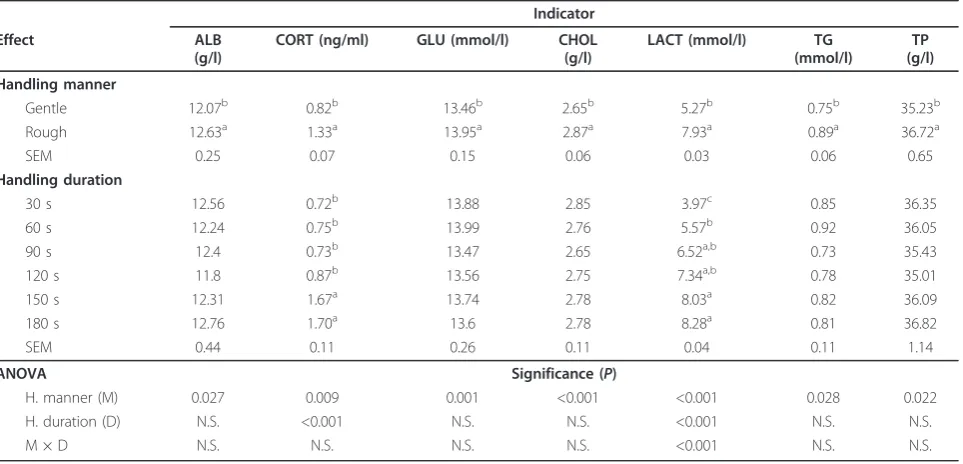
The results of biochemical examinations of the two groups of broilers handled and sampled in two different manners (gentle or rough) for 30, 60, 90, 120, 150 and 180 seconds are given in Table 1.
duration was found in the case of lactate concentration (Table 1). As can be seen from this table, concentrations of plasma lactate increased with prolonged handling duration. Pre-sampling handling for 90, 120, 150, and 180 s resulted in a pronounced elevation of lactate con-centration in comparison with 30 s handling (P < 0.001 in all cases respectively) regardless of handling manner. In addition, handling for 150 s and 180 s induced a sig-nificant increase in lactate level when compared with 60 s handling (P = 0.013, P = 0.012 respectively). As is shown in the table of interactions (Table 2), significant elevations in lactate concentration were found in broi-lers sampled in rough manner for 90, 120, 150, and 180
s when compared with gentle manner (P = 0.009,P = 0.001, P = 0.003,P = 0.003 respectively). Moreover, handling for 60, 90, 120, 150, and 180 s carried out in a rough manner induced a significantly higher lactate con-centration than handling for 30 s (P = 0.001,P< 0.001, P< 0.001, P< 0.001,P < 0.001 respectively). No signifi-cant differences were found in albumin, glucose, choles-terol, triglycerides, and total protein levels among groups of broilers handled and sampled for various time periods in our study.
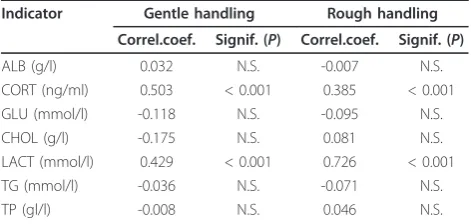
Spearman rank correlation coefficients between length of handling (s) and monitored biochemical indices in broilers handled in a gentle and rough manner are pre-sented in Table 3. The results indicate that length of pre-sampling handling (s) was significantly and posi-tively correlated with the corticosterone plasma concen-tration (P < 0.001) and lactate level (P < 0.001) in broilers handled in both a gentle and rough manner.
Discussion
Evaluating welfare and stress that is assumed to corre-late with the overall health status of an animal is diffi-cult (particularly in birds), because sampling techniques used to obtain physiological parameters are also invasive and stressful in themselves [8,19]. Therefore, more stu-dies on the pattern of detailed quantification of the pre-sampling stress response, particularly in poultry, are desirable. For this reason, this study focused on the tem-poral pattern of changes in selected biochemical stress
Table 1 Selected biochemical indices of broilers (n = 144) handled in two different manners (gentle or rough) during blood sampling for varying time periods within the interval 30-180 s
Indicator
Effect ALB
(g/l)
CORT (ng/ml) GLU (mmol/l) CHOL
(g/l)
LACT (mmol/l) TG
(mmol/l)
TP (g/l)
Handling manner
Gentle 12.07b 0.82b 13.46b 2.65b 5.27b 0.75b 35.23b
Rough 12.63a 1.33a 13.95a 2.87a 7.93a 0.89a 36.72a
SEM 0.25 0.07 0.15 0.06 0.03 0.06 0.65
Handling duration
30 s 12.56 0.72b 13.88 2.85 3.97c 0.85 36.35
60 s 12.24 0.75b 13.99 2.76 5.57b 0.92 36.05
90 s 12.4 0.73b 13.47 2.65 6.52a,b 0.73 35.43
120 s 11.8 0.87b 13.56 2.75 7.34a,b 0.78 35.01
150 s 12.31 1.67a 13.74 2.78 8.03a 0.82 36.09
180 s 12.76 1.70a 13.6 2.78 8.28a 0.81 36.82
SEM 0.44 0.11 0.26 0.11 0.04 0.11 1.14
ANOVA Significance (P)
H. manner (M) 0.027 0.009 0.001 <0.001 <0.001 0.028 0.022
H. duration (D) N.S. <0.001 N.S. N.S. <0.001 N.S. N.S.
M × D N.S. N.S. N.S. N.S. <0.001 N.S. N.S.
ALB = albumin, CORT = corticosterone, GLU = glucose, CHOL = cholesterol, LACT = lactate, TG = triglycerides, TP = total protein Means within the same effect and column lacking a common letter of superscript (a, b, c
) differ significantly (P< 0.05).
Table 2 Handling manner by handling duration
interaction for lactate concentration of broilers (n = 144, means ± SEM).
Handling duration Lactate (mmol/l)
Gentle manner Rough manner
30 s 4.18 ± 0.32b, x 3.76 ± 0.19c, x
60 s 4.96 ± 0.35a, b, x 6.19 ± 0.22b, x
90 s 4.91 ± 0.28a, b, y 7.99 ± 0.76a, b, x
120 s 5.33 ± 0.31a, b, y 9.35 ± 0.83a, b, x
150 s 6.20 ± 0.48a, y 9.86 ± 0.63a, b, x
180 s 6.04 ± 0.52a, b, y 10.5 ± 0.81a, x
Means within the same handling manner and column lacking a common letter of superscript (a, b, c
) differ significantly (P< 0.05).
indices in broilers following pre-sampling handling car-ried out in two different manners. The results of our study clearly showed that pre-sampling handling of broi-lers (i.e. catching, carrying, restraint, and collecting of blood itself) that was carried out in a rough manner had a much more pronounced impact on changes in the level of all biochemical parameters monitored in our experiment than pre-sampling handling carried out in a gentle manner. We found a highly significant increase in plasma concentrations of corticosterone, glucose, choles-terol, and lactate in broilers following rough pre-sam-pling handling in comparison with broilers handled and sampled in a gentle manner. First and foremost, the plasma level of corticosterone, which is traditionally used for assessment of physiological stress in birds [10,11,14] showed a marked elevation (from 0.82 to 1.33 ng/ml). This indicates a considerably higher stress load in roughly handled broilers in comparison with gently handled birds. In addition, rough handling also resulted in significantly elevated plasma levels of albumin, trigly-cerides and total protein in broilers when compared with gentle pre-sampling handling. Since an interaction between handling manner and handling duration was found in the case of lactate concentration only, we can conclude that the observed changes in the other bio-chemical indices were consistent across all time periods of pre-sampling handling monitored in our experiment. These results are in agreement with Knowles and Broom [23], who reported markedly lower and less pro-longed adrenocortical responses of laying hens that were carried in an upright position and gently handled for 90 s than in birds that were handled and carried in the inverted position in a rough manner. Kannan [24] also suggests that handling stress can be reduced in broilers by the use of upright handling. In contrast, Duncan [25], who found elevated corticosterone in broilers in response to manual catching and restraint, mentioned that the stressor effects of such contact were so
pronounced that inversion of the birds, or deliberate rough treatment, had no additional effect. He concluded that “it is handlingper sewhich is stressful and not the rough manner in which it is carried out”. Kettlewell and Mitchell [16] also have identified manual catching and handling as one of the most potent sources of stress and trauma in poultry.
The importance of collecting blood samples very quickly after capture when assessing baseline corticos-terone concentrations has been emphasized by various authors, although predominantly in wild birds [9,19,21]. Research has shown that capture, handling and the blood sampling procedure itself can greatly influence corticosterone concentration in animals [7,13,14]. In our experiment, the most marked effect of the length of pre-sampling handling was expressed in a marked increase in corticosterone and lactate levels. The results of our analyses (as judged by corticosterone level) indicate that pre-sampling handling not exceeding 120 seconds, can be considered as a procedure that does not significantly affect baseline (unstressed) levels of biochemical indices in broilers. It also may be considered that corticosterone needs a minimum time of 120 s to show a significantly elevated concentrations due to pre-sampling handling in broilers. However, pre-sampling handling lasting for 150 seconds and more induced a considerable elevation in corticosterone concentration in broilers. The levels of corticosterone in birds exposed to handling for 150-180 s were more than two-fold those seen in broilers that were captured and sampled within 30-90 s. This indi-cates a pronounced stress response of birds following a sampling procedure of a length equal to or exceeding 150 seconds. The strong positive correlation between corticosterone level and duration of pre-sampling hand-ling (Table 3) found in our study also supports this con-clusion. In contrast, Voslarova et al. [7] reported that samples taken within 3 min of capture were likely to reflect unstressed concentrations of corticosterone in broilers. The results of Romero and Reed [9] indicate a high degree of confidence for the five avian species monitored in the study that samples collected in less than 2 min reflect unstressed (baseline) concentrations. Chloupek et al. [21] conclude that blood samples should be collected within 1.5 min to ensure that the levels of biochemical stress indices in common pheasants are not affected by stress induced by pre-sampling handling. But it is evident that pheasants, which are primarily wild animals, may show a markedly different stress response than domestic poultry, which has already been observed [26,27]. The results of our study showed lactate plasma concentrations to also increase markedly in response to the capture and handling process in broilers. This eleva-tion was even more rapid than the corticosterone increase - as early as 60 seconds after capture. The
Table 3 Spearman rank correlation coefficients between length of pre-sampling handling (s) and monitored biochemical indices in broilers handled in a gentle (n = 72) or rough manner (n = 72).
Indicator Gentle handling Rough handling
Correl.coef. Signif. (P) Correl.coef. Signif. (P)
ALB (g/l) 0.032 N.S. -0.007 N.S.
CORT (ng/ml) 0.503 < 0.001 0.385 < 0.001
GLU (mmol/l) -0.118 N.S. -0.095 N.S.
CHOL (g/l) -0.175 N.S. 0.081 N.S.
LACT (mmol/l) 0.429 < 0.001 0.726 < 0.001
TG (mmol/l) -0.036 N.S. -0.071 N.S.
TP (gl/l) -0.008 N.S. 0.046 N.S.
lactate concentration was significantly higher than in broilers sampled within 30 s and rose further with a prolonged period of handling (from 3.97 to 8.28 mmol/l at 180 s). This rapid elevation in lactate level may be attributed to a considerable struggling activity of broilers during catching and the pre-sampling handling process. Similarly as with corticosterone concentrations, a strong positive correlation was found between plasma lactate and the duration of pre-sampling handling in our study (Table 3). These findings are in agreement with Beda-nova et al. [12], who describe a very early onset of plasma lactate elevation in response to short-term stress in broilers, and also with Chloupek et al. [21], who found a significant positive correlation between lactate concentration and duration of pre-sampling handling in common pheasants. Similarly, Ali et al. [28], who stu-died the influence of pre-slaughter stress (in connection with handling and shackling process) in poultry, found increasing lactate levels with increasing struggling activ-ity of broilers. In contrast, Voslarova et al. [7] reported a significant increase in lactate plasma concentrations only in broilers handled and sampled for more than 3 min.
It is well known that stress stimulates the body to release glucose and other energetic metabolites into the blood stream in physiologic preparation for the“fight or flight” response. When monitoring the stress effect of pre-sampling handling in our study, the acute mobilisa-tion of energy sources (glucose, total protein, albumin, triglycerides, cholesterol) was expected as a result of the stress load on the broilers during the pre-sampling handling process. This did not, however, occur during the monitored time period, which may be attributed to the onset of the stress response for these biochemical indices occurring after a period longer than 180 sec-onds. Similarly, Voslarova et al. [7] also reported no changes in glucose and cholesterol levels within 6 min of pre-sampling handling in broilers. In contrast, Beda-nova et al. [12] describe a significant elevation in the glucose level after 60 seconds of pre-slaughter handling in broilers. Chloupek et al. [21] found a significant increase in the glucose level in response to 3 min of pre-sampling handling in pheasants, but no changes in the cholesterol level within 6 min of handling. Balcombe et al. [15] describe an early (within 2 min) elevation of plasma glucose and total protein in rats in response to handling and sampling. Concentrations of albumin, glu-cose, cholesterol, triglycerides, and total protein found in our study did not show any correlation pattern in connection with duration of pre-sampling handling in broilers, which also may support a latter than 180 s onset of stress response in these biochemical indices.
Conclusions
In conclusion, the results presented indicate that pre-sampling procedures may be a considerably stressful event for broilers, particularly when carried out with a lack of care and exceeding 120 seconds. This indicates that blood samples from broilers should be collected within 2 min of capture in order to ensure that the plasma levels of corticosterone and lactate in particular are not influenced by the stress effects of handling, or immobilization stress, inevitable when blood samples are taken.
Acknowledgements
This study was conducted within the Research Project No MSM6215712402 (Veterinary Aspects of Food Safety and Quality) funded by the Ministry of Education, Youth and Sports (Czech Republic).
Author details
1Department of Veterinary Public Health and Toxicology, Faculty of
Veterinary Hygiene and Ecology, University of Veterinary and Pharmaceutical Science Brno 612 42 Brno, Czech Republic.2Department of Nutrition, Livestock Breeding and Animal Hygiene, Faculty of Veterinary Hygiene and Ecology, University of Veterinary and Pharmaceutical Sciences in Brno, 612 42 Brno, Czech Republic.
Authors’contributions
PCh designed and coordinated the study and was involved in collecting the blood, drafting the manuscript and revising it critically. IB carried out the statistical analysis and wrote the manuscript. JCh contributed to conception and design and collected the blood samples. VV contributed to the design and planning, made substantial contributions in revising the manuscript critically and gave final approval of the version to be published. All authors read and approved the final manuscript.
Competing interests
The authors declare that they have no competing interests.
Received: 9 November 2010 Accepted: 13 May 2011 Published: 13 May 2011
References
1. Odendaal JSJ:Veterinary ethology and animal welfare.Rev Sci Technol Int Epiz1994,13:261-275.
2. Beaumont C, Lebihan-Duval E, Mignon-Grasteau S, Leterrier C:The European experience in poultry welfare - A decade ahead.Poultry Sci
2010,89:825-831.
3. Erhard M, Damme K:German poultry forming between animal welfare and global market.Berl Munch Tierarztl Wochenschr2009,122:230-234. 4. Beuving G, Vonder GMA:Daily rhytm of corticosterone in laying hens and
the influence of egg laying.J Reprod Fert1977,51:169-173.
5. Fraser D:Understanding animal welfare.Acta Vet Scand2008,50(Suppl 1): S1.
6. Post J, Rebel JM, ter Huurne AAHM:Physiological effects of elevated plasma corticosterone concentrations in broiler chickens. An alternative means by which to assess the physiological effects of stress.Poultry Sci
2003,82:1313-1318.
7. Voslarova E, Chloupek P, Bedanova I, Suchy P, Pistekova V, Vecerek V:The effect of pre-sampling handling time on blood plasma biochemical parameters of broilers.Dtsch Tierarztl Wschr2008,115:62-65.
8. Maria GA, Escos J, Alados CL:Complexity of behavioural sequences and their relation to stress conditions in chickens (Gallus gallus domesticus): a non-invasive technique to evaluate animal welfare.Appl Anim Behav Sci
2004,86:93-104.
10. Romero LM, Ramenovsky M, Wingfield JC:Season and migration alters the corticosterone response to capture and handling in an arctic migrant, the White-crowned Sparrow (Zonotrichia leucophrys gambelii).Comp Biochem Physiol1997,116C:171-177.
11. Romero LM, Romero RC:Corticosterone response in wild birds: the importance of rapid initial sampling.Condor2002,104:129-135. 12. Bedanova I, Voslarova E, Chloupek P, Pistekova V, Suchy P, Blahova J,
Dobsikova R, Vecerek V:Stress in broilers resulting from shackling.Poultry Sci2007,86:1065-1069.
13. Le Maho Y, Karmann H, Briot D, Handrich Y:Stress in birds due to routine handling and technique to avoid it.Am J Physiol Regul Integr Comp Physiol
1992,263:R775-R781.
14. Mormede P, Andanson S, Auperin B, Beerda B, Guemene D, Malmkvist J, Manteca X, Manteuffel G, Prunet P, van Reenen CG, Richard S, Veissier I:
Exploration of the hypothalamic-pituitary-adrenal function as a tool to evaluate animal welfare.Physiol Behav2007,92:317-339.
15. Balcombe JP, Barnard ND, Sandusky Ch:Laboratory routines cause animal stress.Contemp Top Lab Anim Sci2004,43:42-51.
16. Kettlewell PJ, Mitchell MA:Catching, handling and loading of poutry for road transportation.Worlds Poultry Sci J1994,50:54-56.
17. Nijdam E, Delezie E, Lambooij E, Nabuurs MJA, Decuypere E, Stegeman JA:
Comparison of bruises and mortality, stress parameters, and meat quality in manually and mechanically caught broilers.Poultry Sci2005,
84:467-474.
18. Zhang L, Yue HY, Zhang HJ, Xu L, Wu SG, Yan HJ, Gong YS, Qi GH:
Transport stress in broilers: I. Blood metabolism, glycolytic potential, and meat quality.Poultry Sci2009,88:2033-2041.
19. Romero LM:Physiological stress in ecology: lessons from biomedical research.Trends Ecol Evol2004,19:249-255.
20. Angelier F, Tonra ChM, Holberton RL, Marra PP:How to capture wild passerine species to study baseline corticosterone levels.J Ornithol2010,
151:415-422.
21. Chloupek P, Voslarova E, Suchy P, Bedanova I, Pistekova V, Vitula F, Chloupek J, Vecerek V:Influence of pre-sampling handling duration on selected biochemical indices in the common pheasant (Phasianus colchicus).Acta Vet Brno2009,78:23-28.
22. Jones RB:The nature of handling immediately prior to test affects tonic immobility fear reactions in laying hens and broilers.Appl Anim Behav Sci
1994,34:247-254.
23. Knowles TG, Broom DM:The handling and transport of broilers and spent hens.Appl Anim Behav Sci1990,28:75-91.
24. Kannan G:Influence of different handling methods and crating periods on plasma corticosterone concentrations in broilers.Brit Poultry Sci1996,
37:21-31.
25. Duncan IJH:The assessment of welfare during handling and transport of broilers.InProc 3rd European Symp. on Poultry Welfare.Edited by: Faure JM, Mills AD. World’s Poult Sci Assoc., French Branch; 1989:93-107.
26. Voslarova E, Bedanova I, Vecerek V, Pistekova V, Chloupek P, Suchy P:
Changes in haematological profile of common pheasant (Phasianus colchicus) induced by transit to pheasantry.Dtsch Tierarztl Wochenschr
2006,113:375-378.
27. Suchy P, Bedanova I, Vecerek V, Voslarova E, Pistekova V, Chloupek P, Vitula F:Effects of transport stress and floor space reduction on selected biochemical indices in common pheasant (Phasianus colchicus).Arch Geflugelkd2007,71:56-61.
28. Ali MS, Kang GH, Joo ST:Review: Influences of pre-slaugter stress on poultry meat quality.Asian-Aust J Anim Sci2008,21:912-916. doi:10.1186/1751-0147-53-31
Cite this article as:Chloupeket al.:Changes in Selected Biochemical Indices Resulting from Various Pre-sampling Handling Techniques in Broilers.Acta Veterinaria Scandinavica201153:31.
Submit your next manuscript to BioMed Central and take full advantage of:
• Convenient online submission
• Thorough peer review
• No space constraints or color figure charges
• Immediate publication on acceptance
• Inclusion in PubMed, CAS, Scopus and Google Scholar
• Research which is freely available for redistribution