1. Introduction
An engineering design problem (e.g. new airplane design, new concentrated solar power plant, dam, port, refrigerator, ship, shipyard, spacecraft, etc.) can be defined as a sort of the Multi-objective
Corresponding author
E-mail address: [email protected] DOI: 10.22105/jarie.2018.144919.1052
Initialization of a Multi-objective Evolutionary Algorithms
Knowledge Acquisition System for Renewable Energy Power
Plants
Burak Omer Saracoglu1, Miguel De Simón Martín2
1Orhantepe Mahallesi, Tekel Caddesi, Istanbul, Turkey.
2Department of Electric, Systems and Automatics Engineering, University of León, Spain.
A B S T R A C T P A P E R I N F O
The design of Renewable Energy Power Plants (REPPs) is crucial not only for the investments' performance and attractiveness measures, but also for the maximization of resource (source) usage (e.g. sun, water, and wind) and the minimization of raw materials (e.g. aluminum: Al, cadmium: Cd, iron: Fe, silicon: Si, and tellurium: Te) consumption. Hence, several appropriate and satisfactory Multi-objective Problems (MOPs) are mandatory during the REPPs' design phases. MOPs related tasks can only be managed by very well organized knowledge acquisition on all REPPs' design equations and models. The proposed MOPs need to be solved with one or more multi-objective algorithm, such as Multi-multi-objective Evolutionary Algorithms (MOEAs). In this respect, the first aim of this research study is to start gathering knowledge on the REPPs' MOPs. The second aim of this study is to gather detailed information about all MOEAs and available free software tools for their development. The main contribution of this research is the initialization of a proposed multi-objective evolutionary algorithm knowledge acquisition system for renewable energy power plants (MOEAs-KAS-F-REPPs) (research and development loopwise process: develop, train, validate, improve, test, improve, operate, and improve). As a simple representative example of this knowledge acquisition system research with two selective and elective proposed standard objectives (as test objectives) and eight selective and elective proposed standard constraints (as test constraints) are generated and applied as a standardized MOP for a virtual small hydropower plant design and investment. The maximization of energy generation (MWh) and the minimization of initial investment cost (million €) are achieved by the Multi-objective Genetic Algorithm (MOGA), the Niched Sharing Genetic Algorithm/Non-dominated Sorting Genetic Algorithm (NSGA-I), and the NSGA-II algorithms in the Scilab 6.0.0 as only three standardized MOEAs amongst all proposed standardized MOEAs on two desktop computer configurations (Windows 10 Home 1709 64 bits, Intel i5-7200 CPU @ 2.7 GHz, 8.00 GB RAM with internet connection and Windows 10 Pro, Intel(R) Core(TM) i5 CPU 650 @ 3.20 GHz, 6,00 GB RAM with internet connection). The algorithm run-times (computation time) of the current applications vary between 20.64 and 59.98 seconds.
Chronicle: Received: 19 June 2018 Revised: 27 September 2018
Accepted:11 Octobert 2018
Keywords:
Multi-objective Optimization. Multi-objective Problem. Multi-objective Evolutionary Algorithm.
Scilab.
Renewable Energy.
Journal of Applied Research on Industrial
Engineering
Optimization Problem (MOP). According to [67], a MOP can be defined as “a vector of decision variables which satisfies constraints and optimizes a vector function whose elements represent the objective functions. These functions form a mathematical description of performance criteria which are usually in conflict with each other. Hence, the term “optimize” means finding such a solution which would give the values of all the objective functions acceptable to the decision maker”. Some synonymous or similar terms, such as multi-criteria optimization problem, multi-performance optimization problem or vector optimization problem are also used instead of the multi-objective optimization problem [22]. Although almost any design problem is a MOP by its nature, they can be modeled as either a Single Objective Optimization Problem (SOP) or a MOP.
Some design models can cover a few objectives and some others can include some other objectives. Hence, SOPs and MOPs are almost equally important from a research perspective and they must be studied as deep as it can be researched in a timely manner. The definition of both problems is presented in Fig. 1.
Fig. 1. Definition of SOP and MOP [22].
The MOPs can be solved by several proposed methods in the literature. These methods are grouped under the “non-preference methods”, where the decision maker is not needed, the “a priori methods”, where the decision maker expresses his or her preferences before optimization (e.g. ε-Constraint, Weighted Sum), the “a posteriori methods”, where the decision maker makes choices amongst Pareto Optimal solutions (i.e. classical algorithms such as hypervolume, normal boundary intersection, ADBASE, normal constraint method, Benson’s algorithm, directed search domain; evolutionary algorithms such as vector evaluated genetic algorithm: VEGA and Non‐dominated Sorting Genetic Algorithm: NSGA-II), the “interactive methods”, where the decision maker guides the process in an interactive way (e.g. Zionts-Wallenius Method, Step Method: STEM, Synchronous NIMBUS Method, Pareto Navigator Method, Geoffrion-Dyer-Feinberg Method: GDF, Interactive Surrogate Worth Trade-Off Method: ISWT, Sequential Proxy Optimization Technique: SPOT, and Pareto Race) [41, 42]. The Multi-objective Evolutionary Algorithms (MOEAs) are a class of the Genetic Algorithms set. The MOEAs have simply two main groups (Non-based and based) [5]. Moreover, the Pareto-based methods include two main groups (Non-Elitist and Elitist) [5]. There are many MOEAs algorithms in the literature, such as the Lexicographic method, the aggregating functions, the population-based methods under the non-Pareto-based MOEAs, the Multi-objective Genetic Algorithm (MOGA), the Non-Dominated Sorting Genetic Algorithm (NSGA), the Niched-Pareto Genetic Algorithm (NPGA) under the non-elitist Pareto-based MOEAs; the Pareto Archived Evolution Strategy (PAES), the Strength Pareto Evolutionary Algorithm (SPEA), the Strength Pareto Evolutionary
SOP MOP
“Minimizing (or maximizing) f(x) subject to gi(x) ≤ 0, i = {1, … , m}, and hi(x) = 0, j = {1, … , p}x ∈ Ω.
A solution minimizes (or maximizes) the scalar f(x) where x is a n-dimensional decision variable vector x = {x1, … , xn}
from some universe Ω.”
“minimizing (or maximizing) F(x) = (f1(x), … , fk(x)) subject
to gi(x) ≤ 0, i = {1, … , m} , and hi(x) = 0 , j = {1, … , p}x ∈ Ω.
A MOP solution minimizes (or maximizes) the components of a vector F(x) where x is a n-dimensional decision variable vector x = {x1, … , xn} from some universe Ω. It is noted that gi(x) ≤ 0 and hi(x) = 0 represent constraints that must be
fulfilled while minimizing (or maximizing) F(x) and Ω
Algorithm 2 (SPEA2), the Nondominated Sorting Genetic Algorithm II (NSGA-II), the ε-dominance NSGA-II, the Adaptive Range Multi-objective Genetic Algorithm (ARMOGA), the ε-dominance ARMOGA (εμ ARMOGA) under the elitist Pareto-based MOEAs; the Multi-objective Messy Genetic Algorithm (MOMGA), the Pareto Envelope-based Selection Algorithm (PESA), the micro-genetic algorithm for multi-objective optimization, the Multi-objective Struggle GA (MOSGA), the Orthogonal Multi-objective Evolutionary Algorithm (OMOEA), the General Multi-objective Evolutionary Algorithm (GENMOP); the Efficient Global Optimization for Multi-objective Problems (EGOMOP), the Hierarchical Asynchronous Parallel Multi-objective Evolutionary Algorithm (HAPMOEA), the Gradient Enhanced Multi-objective Genetic Algorithm (GEMOGA), the Nondominated Sorting Evolutionary Algorithm+ (NSEA+9) (see [4, 5, 22, 23, 46]).
This study aims to start finding detailed information about all MOEAs and their available free tools/software in the literature. Besides, their complete comparisons on MOPs are in this research scope. The main goal of this research, development, demonstration, and deployment (RD3) effort is to develop a very easy and useful multi-objective evolutionary algorithms knowledge acquisition system for renewable energy power plants (MOEAs-KAS-F-REPPs) in the next fifty years with integration and embedding into the original Anatolian honeybees’ investment decision support system and the Global Grid Prediction Systems (G2PS), the Global Grid Electricity Demand Prediction System (G2EDPS), and the Global Grid Peak Power Prediction System (G2P3S) (see [84-89]).
As a simple application example of this research study, only one MOP has been studied with three Multi-objective Evolutionary Algorithms (MOEAs) according to basic parallel or series operating or running of multiple MOEAs principles in the proposed MOEAs-KAS-F-REPPs: the Multi-objective Genetic Algorithm (MOGA) (1st Generation MOEA) [20], the Niched Sharing Genetic Algorithm/Non-dominated Sorting Genetic Algorithm (NSGA-I) (1st Generation MOEA) [100], and the Niched Sharing Genetic Algorithm Version II (NSGA-II) (2nd Generation MOEA) [27].
This paper has four sections. Section 2 presents the review of the literature. Section 3 presents not only the proposed knowledge acquisition and gathering system but also the preliminaries and experiments. Finally, the Section 4 presents the concluding issues and planned following research studies.
2. Literature Review
search activity was performed in the order of the title, abstract, and full text. This order helped to focus on the appropriate publications.
The application of the Single Objective Optimization Algorithms (SOAs) and the Multi-objective Optimization Algorithms (MOAs) were widely applied in many fields (especially in engineering and financial fields) since the 1970s. The early applications were in the 1970s. The MOPs were mainly solved with classical methods based on the differential calculations in the 1970s. Seo [93] presented one of the first studies that showed a brief survey of the multi-objective optimization techniques for the environmental assessment of the water resource systems in Japan. Blankenship and Fink [34] suggested that a power system control problem was actually a MOP (objective functions of production cost, environmental impact, and system operating security).
Further studies in the same direction were conducted in the 1980s. The MOPs were still mainly solved with the classical methods based on the differential calculations in the 1980s. Yokoyama et al. [113], Chetty and Subramanian [18], and Yang and Chen [110] were focused on the energy management and the power dispatch optimization. Takama and Umeda [103], Rao [75], Acharya et al. [2], Krasławski [56], and García and Prett [36] presented some manufacturing processes optimization research studies. Ramlogan and Goulter [67], Ramologan [73], and Mitchell and Bingham [63] researched on the resources optimization and planning. Shimizu and Hirata [96] presented applications in the electronics. The bio-inspired algorithms, such as the genetic algorithms, were raised fast in the 1990s, because of their simplicity in comparison with the classical methods and their efficiency and capacity to include new constraints. Hence, the bio-inspired algorithms were mainly preferred to solve the MOPs in the 1990s, in contrast with the classical methods based on the differential calculations in 1970s and 1980s. The bio-inspired algorithms were also favored by the development of faster and economic computational resources in the 1990s. Ishibuchi and Murata [48, 49, 64, 65] developed a multi-objective genetic algorithm (with and without local search) and applied it to solve the flow shop scheduling problem. Tamaki et al. [102] conducted a deep review on the multi-objective optimization by the genetic algorithms. Klemes et.al. [55], Chiang and Jean-Jumeau [19], Gorenstin et al. [37], Hsiao et al. [45] presented some optimal planning and expansion applications of the power systems. Azapagic and Clift [8], Adisa [9] researched on the life cycle assessment optimization.
path design problem. Ratono et al. [74] used a Fuzzy-Multi-objective Genetic Algorithm (Fuzzy-MOGA) approach for the enterprise resource planning system selection criteria optimization (Scilab 5.4.1). Campos-Ciro et al. [17] presented a MOP related to an open shop scheduling problem based on a real mechanical workshop made of m machines that process n jobs. It dealt with different resource constraints related to tools allocation and multi-skills staff assignment. Wood [107] presented an interesting study on the optimization problems of the non-financial key performance indicators (KPIs), a mixed metrics such as earnings before interest tax depreciation and amortization (EBITDA), net present value (NPV), expected monetary value (EMV), capital investment (CAPEX), debt capitalization ratio for the gas and oil assets portfolio strategic decision makers with the simplex (linear) and the evolutionary (non-linear) (genetic) algorithms by the visual basic application (VBA) macros for the Microsoft excel workbooks.
employing the fruit fly optimization algorithm. Ming et al. [62] solved an HRES design problem (solar, wind, battery, and diesel generator) with three maximization and minimization objectives (i.e. system reliability/renewable ability, system cost, and fuel emission) by employing the MOEA/D using Localized Penalty-Based Boundary Intersection (LPBI) method. Qu et al. [72] solved a Dynamic Economic Emission Dispatch (DEED) problem considering electric vehicles and wind power with two minimization objectives (i.e. total fuel cost, total pollution emission) by employing the MOEA/D algorithm. Shi et al. [95] optimized a grid-connected HRES problem with two minimization objectives (i.e. total system cost, and fuel emissions) by employing the PICEA-ng. Biswas et al. [14] optimized the wind farm layouts with two maximization objectives (i.e. output power and wind farm efficiency). Biswas et al. [15] solved an economic-environmental dispatch problem of thermal, wind, solar and small-hydro power combination with two minimization objectives (i.e. cost and emission) by employing two different algorithms (MOEA based on decomposition using superiority of feasible solutions MOEA/D-SF, summation based multi-objective differential evolution using superiority of feasible solutions SMODE-SF). Li et al. [59] solved a solar and wind energy integration into the Combined Cooling, Heating, and Power (CCHP) system design problem with three minimization objectives (i.e. annual total cost, carbon dioxide emission, and loss of energy supply probability) by employing the Preference-Inspired Coevolutionary Algorithm (PICEA-g). Prina et al. [71] applied the EPLANopt model in the energy system of South Tyrol with three minimization objectives (i.e. total annual costs, CO2 emissions per person, and 100−%RES [%]). Xu et al. [109] solved a Hybrid Energy Storage System (HESS) problem (wind power, energy storage, and local user) with two maximization and minimization objectives (i.e. annual profit and wind curtailment rate) to determine two decision variables (numbers of batteries and super capacitors) by employing the NSGA-II algorithm. They concluded their study with the optimal solution selection with the VIKOR (VlseKriterijumska Optimizacija I Kompromisno Resenje) technique. Yazdi and Moridi [112] optimized the design of cascade hydropower reservoirs with three maximization and minimization objectives (i.e. total amount of produced energy, system reliability, and squared deviation of release from demands) by employing the Non-Dominated Sorting Differential Evolution (NSDE) algorithm. Yuan et al. [114] optimized a standalone HRES design problem with two minimization objectives (i.e. cost of the system in the life cycle and Loss of Power Supply Probability (LPSP) + Energy Excess Percentage (EXC)) by employing the Improved Gravitational Search Algorithm (GSA).
Accordingly, there were many captivating and crucial studies with brilliant ideas in the single objective optimization and multi-objective optimization literature, however, none of the previous publications in the literature proposed a multi-objective evolutionary algorithm knowledge acquisition system for renewable energy power plants (MOEAs-KAS-F-REPPs). Hence, this research study and its first paper are unique with its proposed MOEAs-KAS-F-REPPs.
3. Knowledge Acquisition System Initialization with Preliminaries and Experiments
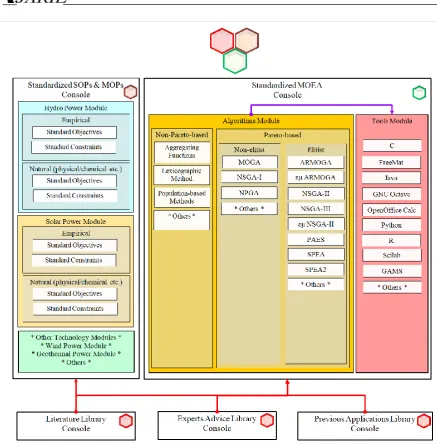
RD3 effort aims to overcome these major difficulties in the hydro and solar power industry at first and then all other renewable power industries by some unique MOEAs programming libraries (e.g. MOGA, NPGA, PAES, and εμ ARMOGA), some unique platforms (e.g. Scilab, Scilab Cloud, Python, and GNU Octave), and many standardized SOPs and MOPs. Hence, a multi-objective evolutionary algorithms knowledge acquisition system for renewable energy power plants (MOEAs-KAS-F-REPPs) and its RD3 is recommended and presented in this study (Fig. 2).
The proposed knowledge acquisition system has five consoles. These consoles are the standardized SOPs & MOPs console, the standardized MOEA console, the literature library console, the expert advice library console and the previous application library console. The library consoles (literature, expert advice, previous applications) collect and store all data and information. Then they feed two processing and storing consoles (standardized SOPs & MOPs, standardized MOEA). In these consoles, the standardization process is performed at first. Then the standardized SOPs & MOPs and also the standardized MOEA are stored in separate sectors and servers. When a new renewable energy power plant problem (e.g. a new solar power plant design, a new small hydropower plant design, a rehabilitation, replacement, and renewal of an operational solar power plant) is asked or requested at any time, the call is answered by the standardized SOPs & MOPs console and an SOP and/or MOP is offered to the users. Concurrently, the call or recall is also answered by the standardized MOEA console and algorithms with the tools are offered to the users. All of these activities may be done automatically or semi-automatically.
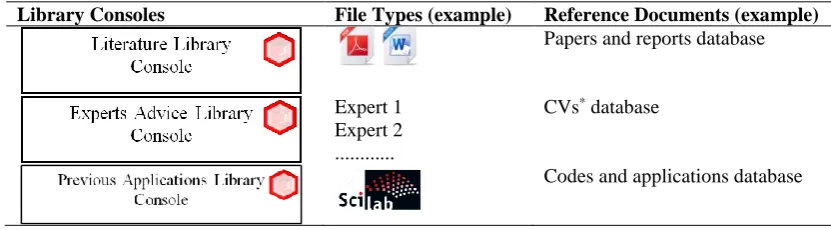
In the library consoles (literature library console, experts advice library console, and previous application library console) there are several stored files in several different formats. They may be collected automatically, semi-automatically, or manually (non-automatic) in a regular periodical timely or instantaneous manner. The structure and examples of these library consoles are presented in Table 1.
Table 1. Structure of library consoles in the proposed MOEAs-KAS-F-REPPs (literature library console, expert advice library console, and previous application library console) (*CV: curriculum vitae).
Library Consoles File Types (example) Reference Documents (example)
Papers and reports database
Expert 1 Expert 2 ...
CVs* database
Fig 2. Multi-objective evolutionary algorithms knowledge acquisition system for renewable energy power plants (MOEAs-KAS-F-REPPs).
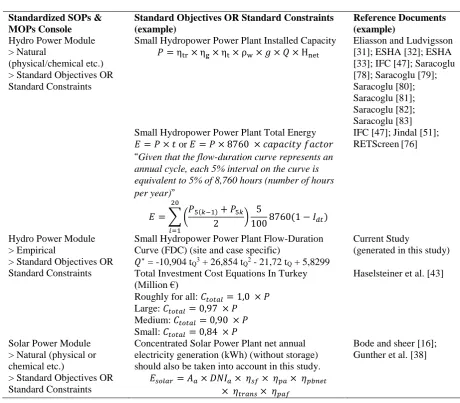
Table 2. Structure and examples of the standardized SOPs & MOPs console in the proposed MOEAs-KAS-F-REPPs (see also Abbreviations).
The standardized MOEA console consists of two modules: Algorithms and Tools. In the algorithms module, all Non-Pareto-based and Pareto-based MOEAs will be presented in a detailed manner with their own reference documents. Moreover, the Pareto-based MOEAs will be grouped under Non-elitist and Elitist sets. The tools module will present all free tools in this research field. All of the important definitions and notations (e.g. feasible region, objective region, continuous multi-objective optimization problem, discrete multi-objective optimization problem, Pareto optimal set, and Pareto front) related to the MOEA will be presented very clearly in the manuals of the standardized MOEA console. For instance:
MOPs may be solved by aggregating multiple objectives into a single objective or by Pareto set approximation [119].
MOPs may be all minimization objective (1), all maximization objective (2) or minimization of some and maximization others (3).
A candidate solution which is better than all other candidates for each objective is said to dominate other candidates [13].
A set of best solutions is identified in which the members are superior among all the candidate solutions when all the objectives are taken into account. This solution set is called Pareto Optimal Front. None of Standardized SOPs &
MOPs Console
Standard Objectives OR Standard Constraints (example)
Reference Documents (example)
Hydro Power Module > Natural
(physical/chemical etc.) > Standard Objectives OR Standard Constraints
Small Hydropower Power Plant Installed Capacity
𝑃 = ηtr× ηg× ηt× ρw× 𝑔 × 𝑄 × Hnet
Eliasson and Ludvigsson [31]; ESHA [32]; ESHA [33]; IFC [47]; Saracoglu [78]; Saracoglu [79]; Saracoglu [80]; Saracoglu [81]; Saracoglu [82]; Saracoglu [83] Small Hydropower Power Plant Total Energy
𝐸 = 𝑃 × 𝑡 or 𝐸 = 𝑃 × 8760 × 𝑐𝑎𝑝𝑎𝑐𝑖𝑡𝑦 𝑓𝑎𝑐𝑡𝑜𝑟
“Given that the flow-duration curve represents an annual cycle, each 5% interval on the curve is equivalent to 5% of 8,760 hours (number of hours per year)”
𝐸 = ∑ (𝑃5(𝑘−1)+ 𝑃5𝑘
2 )
5
1008760(1 − 𝐼𝑑𝑡) 20
𝑖=1
IFC [47]; Jindal [51]; RETScreen[76]
Hydro Power Module > Empirical
> Standard Objectives OR Standard Constraints
Small Hydropower Power Plant Flow-Duration Curve (FDC) (site and case specific)
𝑄∗ = -10,904 tQ3 + 26,854 tQ2 - 21,72 tQ + 5,8299
Current Study
(generated in this study) Total Investment Cost Equations In Turkey
(Million €)
Roughly for all: 𝐶𝑡𝑜𝑡𝑎𝑙= 1,0 × 𝑃
Large: 𝐶𝑡𝑜𝑡𝑎𝑙= 0,97 × 𝑃
Medium: 𝐶𝑡𝑜𝑡𝑎𝑙= 0,90 × 𝑃
Small: 𝐶𝑡𝑜𝑡𝑎𝑙= 0,84 × 𝑃
Haselsteiner et al. [43]
Solar Power Module > Natural (physical or chemical etc.)
> Standard Objectives OR Standard Constraints
Concentrated Solar Power Plant net annual electricity generation (kWh) (without storage) should also be taken into account in this study.
𝐸𝑠𝑜𝑙𝑎𝑟= 𝐴𝑎× 𝐷𝑁𝐼𝑎× 𝜂𝑠𝑓× 𝜂𝑝𝑎× 𝜂𝑝𝑏𝑛𝑒𝑡 × 𝜂𝑡𝑟𝑎𝑛𝑠× 𝜂𝑝𝑎𝑓
the solutions included in the POF are better than the other solutions in the same POF for all the objectives being optimized. So, all of them are equally acceptable [13].
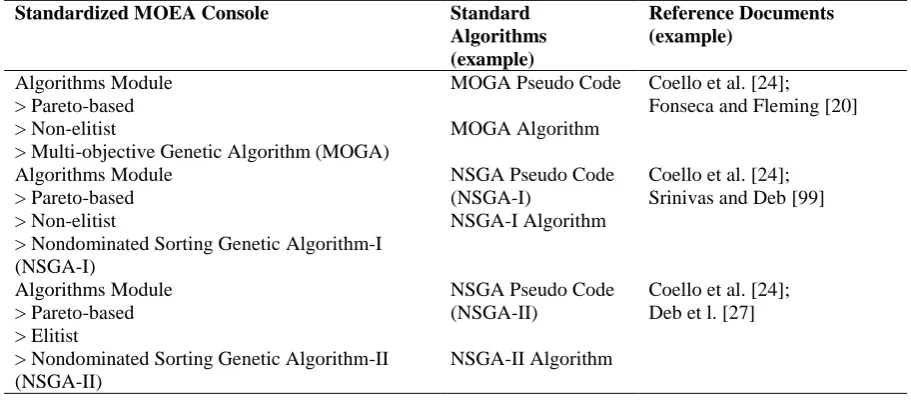
These standardized MOEAs are presented according to their classifications in the literature. The core idea of the standardized MOEAs console is presented in Table 5.
Table 3. The core idea of the standardized MOEAs console in the proposed MOEAs-KAS-F-REPPs (see also electronic supplementary materials).
The MOEA aims to find not one solution of a MOP, but the Pareto optimal set in a robust and simple way [5]. Some of the crucial issues related to the application of MOEAs are presented as follows: computationally expensive, flexible, low data dependency, poor scalability, and own ad-hoc encodings require specialized crossover and mutation operators associated to them [5].
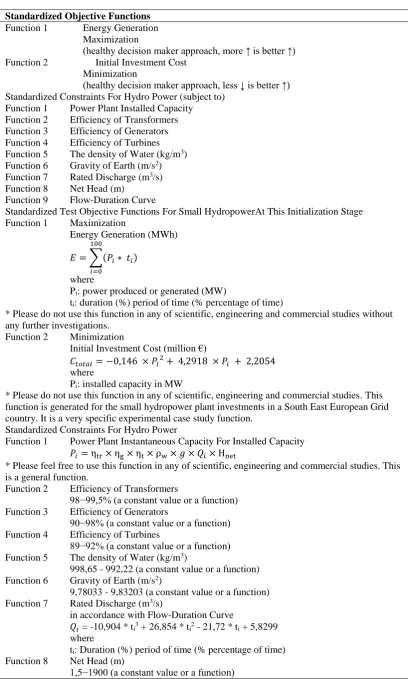
A simple representative example of the application of this proposed MOEAs-KAS-F-REPPs is presented in the following paragraphs. It is assumed that there is a real-World Small Hydropower Plant Design and Investment (SHP-DI) problem with the proposed system (MOEAs-KAS-F-REPPs). Hence, it is entitled as Virtual SHP-DI. The presentation of how system aims to work, and when the data and information of the Virtual SHP-DI are given in the system is as follows (see Table 4).
The MOGA, the NSGA-I, and the NSGA-II algorithms (solvers optim_moga, optim_nsga, and optim nsga2) on Scilab 5.5.2 are used in this study. The Scilab is also used by some researchers for optimization, where there can be different unknowns (small<20, medium<50, and large>100); type (binary, integer, and real); objective functions (linear, quadratic, based on min or max, and nonlinear); inequality or equality constrained (linear, quadratic, and nonlinear) or unconstrained models; convex or non-convex optimization MOPs (see Baudin and Steer [11]; Baudin and Couvert [12]; Margonari [61]; Deb [69]; Deb [70]). As a result, the Scilab is an excellent and compelling tool for the kickoff of this RD3 effort. The Pareto set and the Pareto front of the MOGA, the NSGA-I, and the NSGA-II algorithms on the Scilab 6.0.0 and the commented script for the Scilab 6.0.0 are presented as follows (see Fig. 3 and electronic supplementary materials).
Standardized MOEA Console Standard
Algorithms (example)
Reference Documents (example)
Algorithms Module > Pareto-based > Non-elitist
> Multi-objective Genetic Algorithm (MOGA)
MOGA Pseudo Code Coello et al. [24]; Fonseca and Fleming [20] MOGA Algorithm
Algorithms Module > Pareto-based > Non-elitist
> Nondominated Sorting Genetic Algorithm-I (NSGA-I)
NSGA Pseudo Code (NSGA-I)
Coello et al. [24]; Srinivas and Deb [99] NSGA-I Algorithm
Algorithms Module > Pareto-based > Elitist
> Nondominated Sorting Genetic Algorithm-II (NSGA-II)
NSGA Pseudo Code (NSGA-II)
Table 4. Standardized MOP (test MOP at the initialization stage of the proposed MOEAs-KAS-F-REPPs).
Standardized Objective Functions
Function 1 Energy Generation Maximization
(healthy decision maker approach, more ↑ is better ↑) Function 2 Initial Investment Cost
Minimization
(healthy decision maker approach, less ↓ is better ↑) Standardized Constraints For Hydro Power (subject to)
Function 1 Power Plant Installed Capacity Function 2 Efficiency of Transformers Function 3 Efficiency of Generators Function 4 Efficiency of Turbines Function 5 The density of Water (kg/m3) Function 6 Gravity of Earth (m/s2) Function 7 Rated Discharge (m3/s) Function 8 Net Head (m)
Function 9 Flow-Duration Curve
Standardized Test Objective Functions For Small HydropowerAt This Initialization Stage Function 1 Maximization
Energy Generation (MWh)
𝐸 = ∑(𝑃𝑖∗ 𝑡𝑖) 100
𝑖=0
where
Pi: power produced or generated (MW)
ti: duration (%) period of time (% percentage of time)
* Please do not use this function in any of scientific, engineering and commercial studies without any further investigations.
Function 2 Minimization
Initial Investment Cost (million €)
𝐶𝑡𝑜𝑡𝑎𝑙= −0,146 × 𝑃𝑖2+ 4,2918 × 𝑃𝑖 + 2,2054
where
Pi: installed capacity in MW
* Please do not use this function in any of scientific, engineering and commercial studies. This function is generated for the small hydropower plant investments in a South East European Grid country. It is a very specific experimental case study function.
Standardized Constraints For Hydro Power
Function 1 Power Plant Instantaneous Capacity For Installed Capacity
𝑃𝑖= ηtr× ηg× ηt× ρw× 𝑔 × 𝑄𝑖× Hnet
* Please feel free to use this function in any of scientific, engineering and commercial studies. This is a general function.
Function 2 Efficiency of Transformers
98−99,5% (a constant value or a function) Function 3 Efficiency of Generators
90−98% (a constant value or a function) Function 4 Efficiency of Turbines
89−92% (a constant value or a function) Function 5 The density of Water (kg/m3)
998,65 - 992,22 (a constant value or a function) Function 6 Gravity of Earth (m/s2)
9,78033 - 9,83203 (a constant value or a function) Function 7 Rated Discharge (m3/s)
in accordance with Flow-Duration Curve
𝑄𝑖 = -10,904 * ti3 + 26,854 * ti2 - 21,72 * ti + 5,8299
where
ti: Duration (%) period of time (% percentage of time) Function 8 Net Head (m)
The genetic algorithms have been introduced in the Scilab thanks to a work by Yann Collette (http://ycollette.free.fr) and allow a high-level programming model for the optimization solvers by some macros. This way, to represent an optimization problem in the Scilab, a cost function (or a multi-objective non-linear cost function) to minimize with or without bound constraints must be introduced first (usually programmed as f). The Macros in the Scilab (optim_“algorithm name”) automatically work with a coding of the parameter set (they do not work with the parameters themselves), search from a population of points (which must be initialized), use the payoff information from the objective function (they do not use derivatives or other auxiliary functions), and use the probabilistic transition rules, not the deterministic rules. Moreover, it automatically includes three main GA operators: Reproduction, crossover, and mutation, which can be easily tuned by the parameters functions (“ga_params”). Actually, the parameters module in the Scilab provides the “init_param” function, which returns a new, empty, set of parameters, and the “add_param” function that allows setting individually named parameters, which can be configured with key-value pairs.
The initialization function in the Scilab returns a population as a list made of “pop_size” individuals. If the “init_ga_default” function is used, then a population by performing a randomized discretization of the domain defined by the bounds as minimum and maximum arrays is computed. The MOGA implemented algorithm in the “optim_moga” function from the Scilab is based on Fonseca and Fleming [35], while the NSGA algorithm in “optim_nsga” solver is based on [100], and the NSGA-II algorithm implemented in “optim_nsga2” solver is based on Deb et al. [53].
Fig. 3. Pareto set & Pareto front of MOGA, NSGA-I, and NSGA-II algorithms on Scilab 6.0.0 (Windows 10 Home 1709 64bits, Intel i5-7200 CPU @2.7 GHz, 8.00 GB RAM).
The readers should be aware of the computational cost of these kinds of studies. They may be ranged from milliseconds to weeks (e.g. “1 simulation ≈ 1 ms → 1000 simulations = 1 second” and “1 simulation ≈ 1 hour → 1000 simulations ≈ 42 days” [41].
Table 5. Runtime (computation time) results for computing the algorithms.
4. Conclusion and Future Work
The major contribution of this research paper was its ability to present a new proposed multi-objective evolutionary algorithms knowledge acquisition system for renewable energy power plants (MOEAs-KAS-F-REPPs) and its RD3 initialization. This new MOEAs-KAS-F-REPPs system will also possibly be evolved into a new multiobjective artificial intelligence system in future. The multi-objective evolutionary algorithms were started to be collected and grouped according to their general classifications in the literature during this research study (e.g. Non-Pareto-based or Pareto-based and Non-Elitist or Elitist). This classification study was a crucial research by itself so that it should be organized and presented in a meticulous manner. All single and multi-objective optimization algorithms in the literature will be tried to be collected and grouped in the following studies. The MOPs functions for the proposed MOEAs-KAS-F-REPPs were started to be generated, collected, and grouped according to their common properties during this research study. For instance, in this paper, two functions in the small hydropower plant designs were generated or collected during this study. All MOPs functions in the literature will be tried to be collected in the following studies. The free tools and software for the proposed MOEAs-KAS-F-REPPs were started to be collected in the literature during this research study. For instance, the information about Python (https://www.python.org/), R (https://www.r-project.org/), and Scilab (https://www.scilab.org/) had been collected and archived during this study. The new proposed system (MOEAs-KAS-F-REPPs) was aimd to integrate all free tools and software under a unique platform that will be researched in a detailed manner. This system will allow the developers and contributors of all free tools and software to be scientifically honored. The RD3 studies and publications of this new proposed MOEAs-KAS-F-REPPs shall be tried to be developed like Open Source Initiative (https://opensource.org/) and Free Software Foundation (https://www.fsf.org/) approaches. All free tools and software in the literature will be tried to be collected and archived in the following studies.
In future, newly proposed system integration for all multi-objective evolutionary algorithms will be researched and the related help manuals of this new system will be prepared in a detailed manner. Moreover, all functions relevant to renewable energy power plants will be researched, generated, collected, grouped, and presented in this new system. Special and specific research studies will be
Computers Hardware Configuration MOGA
Algorithm Runtime (seconds)
NSGA-I Algorithm Runtime (seconds)
NSGA-II Algorithm Runtime (seconds)
1st PC Windows 10 Home 1709 64bits,
Intel i5-7200 CPU @2.7 GHz, 8.00 GB RAM
46.47 41.82 20.64
2nd PC Windows 10 Pro, Intel(R)
Core(TM) i5 CPU 650 @ 3.20 GHz, 6,00 GB RAM with internet connection
50.32 59.98 28.52
conducted for a generation, collection, verification, validation, and quality assessment of these MOPs functions in the next years. In addition to these research improvements, all performance measures in the literature for comparison of single and multi-objective optimization algorithms will be found, collected, adapted, and used in new proposed MOEAs-KAS-F-REPPs in the future publications (e.g. algorithm runtime in seconds in this study). Finally, Multi-Criteria Decision Making (MCDM), Multiple–Criteria Decision Analysis (MCDA), Multiple Criteria Decision Aiding (MCDA) methods (e.g. Analytic Hierarchy Process (AHP), Consistency-Driven Pairwise Comparisons (CDPC), and Decision Expert for Education (DEXi)) will be integrated to complete the new proposed MOEAs-KAS-F-REPPs to accomplish and handle the selection of the best alternative REPPs designs and investments (e.g. Ohunakin and Saracoglu [66]; Saracoglu [90, 91, 92]). It is believed that this new proposed MOEAs-KAS-F-REPPs will make it easier to use or apply multi-objective optimization algorithms in REPPs' designs and investments in every design and investment stage in daily engineering life (e.g. Ohunakin and Saracoglu [66]; Saracoglu [90, 91, 92]). Hence, the maximization of source usage (e.g. sun, wind, and water) and the minimization of resource consumption (e.g. raw materials) can be achieved all over the world in this century. It is also thought that similar systems can be developed in other engineering and industry fields too (e.g. Saracoglu [77]).
Abbreviations
𝑃: Power Plant Installed Capacity (MW). ηtr: Efficiency of transformer (98−99,5%). ηg: Efficiency of generator (90−98%). ηt: efficiency of turbine.
ρw: Density of water (kg/m3). g: Gravity (m/s2) approx: 9.81 m/s2. Q: Rated discharge (m3/s).
Hnet: Net head (m) (1.5−1900: Technical and technological limits in practice). E: Generated total energy (MWh).
t: Period of time (h).
Capacity factor (%) (typically 50 % to 60 %). 𝐼𝑑𝑡: Annual downtime losses (%).
𝑄∗: Small Hydropower Power Plant Flow-Duration Curve (FDC) (site and case specific). tQ: Period of time (% percentage of time).
𝐶𝑡𝑜𝑡𝑎𝑙: Total Investment Cost Equations For Turkey (Million €).
𝐸𝑠𝑜𝑙𝑎𝑟: Net annual solar electricity generation (kWh). Aa: Aperture area of solar field (m2).
DNIa: Annual direct normal irradiation (kWh/m2/y).
ηsf: solar field efficiency (%) (incl. collector (geometric (incident angle modifier, blocking & shading, intercept, cosine effect), optical), convection, radiation).
ηpa: Efficiency due to parasitic (%). ηpbnet: Net power block efficiency (%).
ηtrans: Heat to power system transfer system efficiency (%).
ηpaf: Plant availability factor (%).
References
[1] Abbass, H. A., Sarker, R., & Newton, C. (2001). PDE: a Pareto-frontier differential evolution approach for multi-objective optimization problems. Proceedings of the 2001 congress on evolutionary computation.
(pp. 971-978). IEEE.
[3] Anagnostopoulos, J. S., & Papantonis, D. E. (2007). Optimal sizing of a run-of-river small hydropower plant. Energy conversion and management, 48(10), 2663-2670.
[4] Andersson, J. (2000). A survey of multi-objective optimization in engineering design (Technical Report: LiTH-IKP-R-1097). Department of Mechanical Engineering, Linktjping University. Sweden.
[5] Arias-Montano, A., Coello, C. A. C., & Mezura-Montes, E. (2012). Multiobjective evolutionary algorithms in aeronautical and aerospace engineering. IEEE transactions on evolutionary computation, 16(5), 662-694.
[6] Asadi, E., & Sadjadi, S. (2017). Optimization methods applied to renewable and sustainable energy: A review. Uncertain supply chain management, 5(1), 1-26.
[7] Ashby, M. F. (2000). Multi-objective optimization in material design and selection. Acta materialia, 48(1), 359-369.
[8] Azapagic, A., & Clift, R. (1999). Life cycle assessment and multi-objective optimisation. Journal of cleaner production, 7(2), 135-143.
[9] Adisa, A. (1999). Life cycle assessment and its application to process selection, design and optimization. Chemical engineering journal, 79, 1-21.
[10] Banos, R., Manzano-Agugliaro, F., Montoya, F. G., Gil, C., Alcayde, A., & Gómez, J. (2011). Optimization methods applied to renewable and sustainable energy: A review. Renewable and sustainable energy reviews, 15(4), 1753-1766.
[11] Baudin, M., & Steer, S. (2009, September). Optimization with scilab, present and future. IEEE international workshop onopen-source software for scientific computation (OSSC) (pp. 99-106). IEEE. [12] Baudin, M., Couvert, V., & Steer, S. (2010). Optimization in scilab. Scilab consortium, INRIA
Paris-Rocquencourt.
[13] Beiranvand, V., Mobasher-Kashani, M., & Bakar, A. A. (2014). Multi-objective PSO algorithm for mining numerical association rules without a priori discretization. Expert systems with applications, 41(9), 4259-4273.
[14] Biswas, P. P., Suganthan, P. N., & Amaratunga, G. A. (2018). Decomposition based multi-objective evolutionary algorithm for windfarm layout optimization. Renewable energy, 115, 326-337.
[15] Biswas, P. P., Suganthan, P. N., Qu, B. Y., & Amaratunga, G. A. (2018). Multiobjective economic-environmental power dispatch with stochastic wind-solar-small hydro power. Energy, 150, 1039-1057. [16] Bode, C. C., & Sheer, T. J. (2010). A techno-economic feasibility study on the use of distributed
concentrating solar power generation in Johannesburg. Journal of energy in southern africa, 21(2), 2-11. [17] Ciro, G. C., Dugardin, F., Yalaoui, F., & Kelly, R. (2016). A NSGA-II and NSGA-III comparison for solving an open shop scheduling problem with resource constraints. IFAC-PapersOnLine, 49(12), 1272-1277.
[18] Chetty, K. M., & Subramanian, D. K. (1988). Rural energy consumption patterns with multiple objectives. International journal of energy research, 12(3), 561-567.
[19] Chiang, H. D., & Jean-Jumeau, R. (1990). Optimal network reconfigurations in distribution systems. I. A new formulation and a solution methodology. IEEE transactions on power delivery, 5(4), 1902-1909. [20] Fonesca, C. M., & Fleming, P. J. (1993, July). Genetic algorithms for multi-objective optimization:
formulation, discussion and generalization. Proceedings of the fifth international conference on genetic algorithms. (pp. 415-423). San Mateo, CA, Morgan Kaufmann.
[21] Coello, C. C. (1999, July). An updated survey of evolutionary multi-objective optimization techniques: State of the art and future trends. Proceedings of the congress on evolutionary computation (Vol. 1, pp. 3-13). Piscataway, NJ: IEEE Press.
[22] Coello, C. A. C., Van Veldhuizen, D. A., & Lamont, G. B. (2002). Evolutionary algorithms for solving multi-objective problems. New York: Kluwer Academic.
[23] Coello Coello, C. A. (1996). An empirical study of evolutionary techniques for multiobjective optimization in engineering design (Doctoral desertion). Available from ACM Digital Library.
[24] Coello, C. A. C., Lamont, G. B., & Van Veldhuizen, D. A. (2007). Evolutionary algorithms for solving multi-objective problems (Vol. 5). New York: Springer.
[25] Coello Coello, C. A., & Lechuga, M. S. MOPSO: a proposal for multiple objective particle swarm optimization. Proceedings of the 2002 congress on evolutionary computation CEC'02 (pp. 1051-1056). [26] de Simón-Martín, M., Alonso-Tristán, C., Díez-Mediavilla, M., de Francisco-Iribarren, M.A.,
Santamaría-Sánchez, R. (2012). Application to optimize the geometry of a parallel kinematics sun tracker.
International conference on renewable energies and power quality (ICREPQ’12). Santiago de Compostela. Spain.
[28] Deb K., Pratap A., Agarwal S., and Meyarivan T. A Fast and Elitist Multiobjective Genetic Algorithm: NSGA–II. IEEE Transactions on Evolutionary Computation, 6(2):182–197, April 2002.
[29] Demirkaya, G., Besarati, S., Padilla, R. V., Archibold, A. R., Goswami, D. Y., Rahman, M. M., & Stefanakos, E. L. (2012). Multi-objective optimization of a combined power and cooling cycle for low-grade and midlow-grade heat sources. Journal of energy resources technology, 134(3), 032002.
[30] Dovgan, E., Javorski, M., Tušar, T., Gams, M., & Filipič, B. (2014). Discovering driving strategies with a multiobjective optimization algorithm. Applied soft computing, 16, 50-62.
[31] Eliasson, J., & Ludvigsson, G. (2000, November). Load factor of hydropower plants and its importance in planning and design. 11th international seminar on hydro power plants, hydros future in changing markets.
Vienna, Austria: University of Technology.
[32] European Small Hydropower Association (ESHA). (2004). Guide on how to develop a small hydropower plant. Retrieved from
https://energiatalgud.ee/img_auth.php/a/ab/Guide_on_How_to_Develop_a_Small_Hydropower_Plant.pdf [33] European Small Hydropower Association (ESHA). (2005). Environmental integration of small
hydropower plants. Retrieved from
http://www.bmghidroconsultores.cl/pdf/documentos/Environmental%20Integration%20of%20Small%20 Hydropower%20Plants.pdf
[34] Blankenship, G. L., & Fink, L. H. (1978, October). Statistical characterizations of power system stability and security. Proceedings of second lawrence Symposiom. System and decision science.
[35] Fonesca, C. M., & Fleming, P. J. (1993, July). Genetic algorithms for multi-objective optimization: formulation, discussion and generalization. Proceedings of the fifth international conference on genetic algorithms, forrest (pp. 415-423). San Mateo, CA, Morgan Kaufmann.
[36] Garcia, C. E., & Prett, D. M. (1986). Advances in industrial model-predictive control. Retrieved from https://drum.lib.umd.edu/handle/1903/4475
[37] Gorenstin, B. G., Campodonico, N. M., Costa, J. P., & Pereira, M. V. F. (1993). Power system expansion planning under uncertainty. IEEE transactions on power systems, 8(1), 129-136.
[38] Günther, M., Joemann, M., & Csambor, S. (2011). Advanced CSP teaching materials. Parabolic trough technology deutsches zentrum fuer luft-und raumfahrt ev mena teaching materials implementation workshop.
[39] Hamdy, M., Palonen, M., & Hasan, A. (2012, September). Implementation of pareto-archive NSGA-II algorithms to a nearly-zero-energy building optimisation problem. Proceedings of the building simulation and optimization conference. Loughborough.
[40] He, Y., & Agarwal, R. K. (2014). Shape optimization of NREL S809 airfoil for wind turbine blades using a multi-objective genetic algorithm. 32nd AIAA applied aerodynamics conference (p. 2845). [41] Miettinen, K. (2013). Nonlinear multi-objective optimization. International series in operations research
& management science (VOL. 12).Springer US.
[42] Miettinen, K. (2001, March). Some methods for nonlinear multi-objective optimization. International conference on evolutionary multi-criterion optimization (pp. 1-20). Springer, Berlin, Heidelberg. [43] Haselsteiner, R., Heimerl, S., Arch, A., Kohler, B., Recla, R., Bilmez, C., & Mesci, Ü. (2009). Evaluation
of small and medium hydropower in Turkey in consideration of economical aspects. Wasserkraftnutzung im zeichen des klimawandels, (39), 335-358.
[44] Hormozi, M.A., Jahromi, M.B., Nasiri, G. (2016). Optimal network reconfiguration and distributed generation placement in distribution system using a hybrid algorithm. International journal of energy and power engineering, 5(5), 163-170.
[45] Hsiao, Y. T., Chiang, H. D., Liu, C. C., & Chen, Y. L. (1994). A computer package for optimal multi-objective VAR planning in large scale power systems. IEEE transactions on power systems, 9(2), 668-676. [46] Iqbal, M., Azam, M., Naeem, M., Khwaja, A. S., & Anpalagan, A. (2014). Optimization classification,
algorithms and tools for renewable energy: A review. Renewable and sustainable energy reviews, 39, 640-654.
[47] International Finance Corporation (IFC) (2015). Hydroelectric power a guide for developers and investors. Retrieved from
https://www.ifc.org/wps/wcm/connect/06b2df8047420bb4a4f7ec57143498e5/Hydropower_Report.pdf? MOD=AJPERES
[48] Ishibuchi, H., & Murata, T. (1996). Multi-objective genetic local search algorithm. Proceedings of the IEEE conference on evolutionary computation (pp .119-124). IEEE
[49] Ishibuchi, H., & Murata, T. (1998). A multi-objective genetic local search algorithm and its application to flowshop scheduling. IEEE transactions on systems, man, and cybernetics, part C (applications and reviews), 28(3), 392-403.
[51] Jindal, A. K. (2010). Small hydropower: Technology and Indian perspectives. Retrieved from http://www.aprekh.org/files/RREST_AlokJindal.pdf
[52] Kacem, I., Hammadi, S., & Borne, P. (2002). Pareto-optimality approach for flexible job-shop scheduling problems: hybridization of evolutionary algorithms and fuzzy logic. Mathematics and computers in simulation, 60(3-5), 245-276.
[53] Deb, K., Agrawal, S., Pratap, A., & Meyarivan, T. (2000, September). A fast elitist non-dominated sorting genetic algorithm for multi-objective optimization: NSGA-II. International conference on parallel problem solving from nature (pp. 849-858). Springer, Berlin, Heidelberg.
[54] Kamjoo, A., Maheri, A., Dizqah, A. M., & Putrus, G. A. (2016). Multi-objective design under uncertainties of hybrid renewable energy system using NSGA-II and chance constrained programming. International journal of electrical power & energy systems, 74, 187-194.
[55] Klemeš, J., Dhole, V. R., Raissi, K., Perry, S. J., & Puigjaner, L. (1997). Targeting and design methodology for reduction of fuel, power and CO2 on total sites. Applied thermal engineering, 17(8-10), 993-1003. [56] Krasławski, A. (1989). Review of applications of various types of uncertainty in chemical
engineering. Chemical engineering and processing: Process intensification, 26(3), 185-191.
[57] Li, F. F., & Qiu, J. (2015). Multi-objective reservoir optimization balancing energy generation and firm power. Energies, 8(7), 6962-6976.
[58] Li, H., & Zhang, Q. (2009). Multi-objective optimization problems with complicated Pareto sets, MOEA/D and NSGA-II. IEEE Transactions on evolutionary computation, 13(2), 284-302.
[59] Li, G., Wang, R., Zhang, T., & Ming, M. (2018). Multi-objective optimal design of renewable energy integrated CCHP system using PICEA-g. Energies, 11(4), 743.
[60] Mansouri, V., Khosravanian, R., Wood, D. A., & Aadnoy, B. S. (2015). 3-D well path design using a multi objective genetic algorithm. Journal of natural gas science and engineering, 27, 219-235.
[61] Margonari, M. (2011). A multi-objective optimization with open source software
.
Retrieved from http://www.openeering.com/sites/default/files/Multiobjective_Optimization_OpenSource.pdf[62] Ming, M., Wang, R., Zha, Y., & Zhang, T. (2017). Multi-objective optimization of hybrid renewable energy system using an enhanced multi-objective evolutionary algorithm. Energies, 10(5), 674.
[63] Mitchell, K. H., & Bingham, M. (1986). Maximizing the benefits of Canadian forces equipment overhaul programs using multi objective optimization. INFOR: Information systems and operational research, 24(4), 252-264.
[64] Murata, T., & Ishibuchi, H. (1995, November). MOGA: multi-objective genetic algorithms. . IEEE International Conference onevolutionary computation (Vol. 1, p. 289). IEEE.
[65] Murata, T., Ishibuchi, H., & Tanaka, H. (1996). Multi-objective genetic algorithm and its applications to flowshop scheduling. Computers & industrial engineering, 30(4), 957-968.
[66] Ohunakin, O. S., & Saracoglu, B. O. (2018). A comparative study of selected multi-criteria decision-making methodologies for location selection of very large concentrated solar power plants in Nigeria. African journal of science, technology, innovation and development, 10(5), 551-567.
[67] Ramlogan, R. N., & Goulter, I. C. (1989). Mixed integer model for resource allocation in project management. Engineering optimization, 15(2), 97-111.
[68] Osyczka, A. (1985). Multicriteria optimization for engineering design. Design optimization (pp. 193- 227). [69] Deb, K. (2005). Multi-objective optimization. Search methodologies (pp. 273-316). Springer, Boston, MA. [70] Deb, K. (2014). Multi-objective optimization. Search methodologies (pp. 403-449). Springer, Boston, MA. [71] Prina, M. G., Cozzini, M., Garegnani, G., Manzolini, G., Moser, D., Oberegger, U. F., ... & Sparber, W.
(2018). Multi-objective optimization algorithm coupled to EnergyPLAN software: The EPLANopt model. Energy, 149, 213-221.
[72] Qu, B., Qiao, B., Zhu, Y., Liang, J., & Wang, L. (2017). Dynamic power dispatch considering electric vehicles and wind power using decomposition based multi-objective evolutionary algorithm. Energies, 10(12), 1991.
[73] Ramlogan, R. N. (1987). A mixed integer model for resource allocation in construction management
(Master Thesis, University of Manitoba). Retrieved from
https://mspace.lib.umanitoba.ca/bitstream/handle/1993/16567/Ramlogan_A_Mixed.pdf?sequence=1 [74] Ratono, J., Seminar, K. B., Arkeman, Y., & Suroso, A. I. (2015). ERP selection using fuzzy-MOGA
approach: A food enterprise case study. TELKOMNIKA (Telecommunication computing electronics and control), 13(3), 1105-1112.
[75] Rao, S. S. (1987). Multi‐objective optimization of fuzzy structural systems. International journal for numerical methods in engineering, 24(6), 1157-1171.
[77] Saracoglu, B. O. (2009). A new generic method for large investment analysis in industry and an application in shipyard - port investment (Doctoral Thesis, Institute of Science And Technology, Istanbul Technical University, Istanbul).
[78] Saracoglu, B. O. (2015a). An experimental research study on the solution of a private small hydropower plant investments selection problem by ELECTRE III/IV, Shannon’s Entropy, and Saaty’s subjective criteria weighting. Advances in Decision Sciences.
[79] Saracoglu, B. O. (2015b). An AHP application in the investment selection problem of small hydropower plants in Turkey. International Journal of the Analytic Hierarchy Process, 7(2).
[80] Saracoglu, B. O. (2015c). A comparative study of Ahp, Electre Iii & Electre IV by equal objective & Shannon’s entropy objective & Saaty’s subjective criteria weighting in A private small hydropower plants investments selection problem. International journal of the analytic hierarchy process, 7(3).
[81] Saracoglu, B. O. (2015d). An experimental research of small hydropower plant investments selection in Turkey by Carrot2, DEXi, DEXiTree. Journal of investment and management, 4(1), 47-60.
[82] Saracoglu, B. O. (2016a). A PROMETHEE I, II and GAIA-based approach by Saaty's subjective criteria weighting for small hydropower plant investments in Turkey. International journal of renewable energy technology, 7(2), 163-183.
[83] Saracoglu, B. O. (2016b). A qualitative multi-attribute model for the selection of the private hydropower plant investments in Turkey: By foundation of the search results clustering engine (Carrot2), hydropower plant clustering, DEXi and DEXiTree. Journal of industrial engineering and management, 9(1), 152-178. [84] Saracoglu, B. O. (2017). Location selection factors of small hydropower plant investments powered by SAW, grey WPM and fuzzy DEMATEL based on human natural language perception. International journal of renewable energy technology, 8(1), 1-23.
[85] Saracoglu, B. O. (2017). An experimental fuzzy inference system for the third core module of the first console on the global grid peak power prediction system & its forecasting accuracy measures' comparisons with the first and the second core modules. Journal of energy systems, 1(2), 75-101.
[86] Saracoglu, B. O. (2017). Comparative study on experimental type 1 & interval & general type 2 Mamdani FIS for G 2 P 3 S. Global journal of research in engineering.
[87] Saracoglu, B. O. (2017). Comparative study on experimental 2 to 9 triangular fuzzy membership function partitioned type 1 Mamdanis FIS for G2EDPS. Global journal of research in engineering.
[88] Saracoglu, B. O. (2017). G 2 EDPS's first module & its first extension modules. American journal of applied scientific research, 3(4), 33-48.
[89] Saracoglu, B. O. (2017). Long term electricity demand & peak power load forecasting variables identification & selection. International journal of systems engineering, 6(2), 18-28.
[90] Saracoglu, B. O. Solar star projects SAM version 2017.9. 5 PVwats version 5 model case study & validation. International journal of energy applications and technologies, 5(1), 13-28.
[91] Saracoglu, B. O. Comparative experimental FWA & FOWA aggregated VLCSPPs' LUR estimation for GIS based VEED. International journal of engineering technologies, 4(2), 70-79.
[92] Saracoglu, B. O. (2018). Analytic network process vs. Benjamin Franklin’s rule to select private small hydropower plants investments. MedCrave Group LLC.
[93] SEO, F. (1977). Environmental assessment with multi-objective optimization in the region. Studies in regional science, 7, 95-111.
[94] Shi, Z., Wang, R., & Zhang, T. (2015). Multi-objective optimal design of hybrid renewable energy systems using preference-inspired coevolutionary approach. Solar energy, 118, 96-106.
[95] Shi, Z., Wang, R., Zhang, X., Zhang, Y., & Zhang, T. (2017). Optimal design of grid-connected hybrid renewable energy systems using multi-objective evolutionary algorithm. Scientia Iranica.
[96] Shimizu, K. I. Y. O. T. A. K. A., & Hirata, T. O. S. H. I. A. K. I. (1986). Optimal design using min-max criteria for two-dimensional recursive digital filters. IEEE transactions on circuits and systems, 33(5), 491-501.
[97] Shukla, A., & Singh, S. N. (2016). Multi-objective unit commitment with renewable energy using hybrid approach. IET renewable power generation, 10(3), 327-338.
[98] Sierra, M. R., & Coello, C. A. C. (2005, March). Improving PSO-based multi-objective optimization using crowding, mutation and∈-dominance. International conference on evolutionary multi-criterion optimization (pp. 505-519). Springer, Berlin, Heidelberg.
[99] Srinivas, N., & Deb K. (1993). Multi-objective optimization using nondominated sorting in genetic algorithms. Technical report. Department of Mechanical Engineering, Indian Institute of Technology, Kanput, India.
[100] Srinivas, N., & Deb, K. (1994). Muilti-objective optimization using nondominated sorting in genetic algorithms. Evolutionary computation, 2(3), 221-248.
[102] Tamaki, H., Kita, H., & Kobayashi, S. (1996, May). Multi-objective optimization by genetic algorithms: A review. Proceedings of IEEE international conference on evolutionary computation (pp. 517-522). IEEE.
[103] Takama, N., & Umeda, T. (1981). Multi-level, multi-objective optimization in process engineering. Chemical engineering science, 36(1), 129-136.
[104] Tripathi, P. K., Bandyopadhyay, S., & Pal, S. K. (2007). Multi-objective particle swarm optimization with time variant inertia and acceleration coefficients. Information sciences, 177(22), 5033-5049.
[105] Vazhayil, J. P., & Balasubramanian, R. (2014). Optimization of India’s electricity generation portfolio using intelligent Pareto-search genetic algorithm. International journal of electrical power & energy systems, 55, 13-20.
[106] Wang, R., Zhang, F., & Zhang, T. (2015, August). Multi-objective optimal design of hybrid renewable energy systems using evolutionary algorithms. 11th international conference on natural computation (ICNC), 2015 (pp. 1196-1200). IEEE.
[107] Wood, D. A. (2016). Asset portfolio multi-objective optimization tools provide insight to value, risk and strategy for gas and oil decision makers. Journal of natural gas science and engineering, 33, 196-216. [108] Hu, X., & Eberhart, R. (2002). Multi-objective optimization using dynamic neighborhood particle swarm
optimization. Proceedings of the 2002 congress onevolutionary computation, CEC'02 (pp. 1677-1681). IEEE.
[109] Xu, F., Liu, J., Lin, S., Dai, Q., & Li, C. (2018). A multi-objective optimization model of hybrid energy storage system for non-grid-connected wind power: A case study in China. Energy, 163, 585-603. [110] Yang, H. T., & Chen, S. L. (1989). Incorporating a multi-criteria decision procedure into the combined
dynamic programming/production simulation algorithm for generation expansion planning. IEEE transactions on power systems, 4(1), 165-175.
[111] Yao, W., Zhao, J., Wen, F., Dong, Z., Xue, Y., Xu, Y., & Meng, K. (2014). A multi-objective collaborative planning strategy for integrated power distribution and electric vehicle charging systems. IEEE transactions on power systems, 29(4), 1811-1821.
[112] Yazdi, J., & Moridi, A. (2018). Multi-objective differential evolution for design of cascade hydropower reservoir systems. Water resources management, 32(14), 4779-4791.
[113] Yokoyama, R., Bae, S. H., Morita, T., & Sasaki, H. (1988). Multi-objective optimal generation dispatch based on probability security criteria. IEEE transactions on power systems, 3(1), 317-324.
[114] Yuan, X., Huang, B., Xu, J., Liu, H., & Yao, Q. (2018). Application of demand response strategy in optimal configuration of a standalone wind-solar-battery system. Preprints 2018, 2018040303 (doi: 10.20944/preprints201804.0303.v1).
[115] Zhang, W., & Liu, Y. (2008). Multi-objective reactive power and voltage control based on fuzzy optimization strategy and fuzzy adaptive particle swarm. International journal of electrical power & energy systems, 30(9), 525-532.
[116] Zhao, B., Zhang, X., Li, P., Wang, K., Xue, M., & Wang, C. (2014). Optimal sizing, operating strategy and operational experience of a stand-alone microgrid on Dongfushan Island. Applied energy, 113, 1656-1666.
[117] Zhao, J., & Yuan, X. (2016). Multi-objective optimization of stand-alone hybrid PV-wind-diesel-battery system using improved fruit fly optimization algorithm. Soft computing, 20(7), 2841-2853.
[118] Zhai, R., Peng, P., Yang, Y., & Zhao, M. (2014). Optimization study of integration strategies in solar aided coal-fired power generation system. Renewable energy, 68, 80-86.