International Journal of Educational Methodology
Volume 4, Issue 1, 1 - 18.
ISSN: 2469-9632 http://www.ijem.com/
The Effect of Learning Cycle Models on Achievement of Students: A
Meta-Analysis Study
Hakan Sarac*
Ministry of Education,TURKEY
Received: October 21, 2017 ▪ Revised: December12, 2017 ▪ Accepted: February 11, 2018
Abstract: In the study, a meta-analysis was conducted to determine the effect of the use of the learning cycle model on the achievements of the students. Doctorate and master theses, made between 2007 and 2016, were searched using the keywords in Turkish and English. As a result of the screening, a total of 123 dissertations, which used learning cycle models to increase the achievement of students, were included in the analysis. As a result of this study, it is confirmed that the effect of learning cycle models on students’ achievement is positive and the determined effect size was found out as 1.164 (% 95 CI, SE = .071) according to random effects model.. In the study, moderator analysis was made according to the learning cycle models, type of the dissertations, disciplines, and education levels of students. The analyses showed that among the learning cycle models, the highest effect size was determined in the 4E Model (2.659), among the dissertations the highest effect size was in master thesis (ES = 1.231), among the disciplines the highest effect size was in the other lessons (ES = 1.637) and among the educational levels the highest effect size was in the high school students (ES = 1.237).
Keywords: Academic achievement, constructivist approach, learning cycle model, meta-analysis.
To cite this article: Sarac, H. (2018). The effect of learning cycle models on achievement of students: A meta-analysis study.
International Journal of Educational Methodology, 4(1), 1-18. https://doi.org/10.12973/ijem.4.1.1
Introduction
Ministry of National Education (MoNE) has put into practice a teaching plan which is the foreground of the constructivist approach as a result of the increase in the importance given to individual differences in education since 2004-2005 education period (Tonbuloglu, 2014). The constructivist learning approach is based on the idea that instead of transferring knowledge directly to individuals, it should be structured by associating it with prior knowledge that individuals possess (Akpinar, & Ergin, 2005). The constructivist approach generally answers the following these questions; "How does information from the outside get in our minds?", "How does this information work in our minds and cost us ourselves?", and "What changes do we have in our minds when new information contradicts our previous knowledge?" (Baker, & Piburn, 1997).
The implementation of the constructivist approach in the educational process is through learning cycle models (Ozmen, 2004). In researches conducted in science education, it is emphasized that learning cycle models are effective models in terms of knowing knowledge of learners, understanding the content of learned information and applying scientific processes. (Wilder, & Shuttleworth, 2004). The learning cycle is a flexible model. Accordingly, the form of learning stages can be changed, but the order can not be changed and none of the stages can be skipped. The stages of the learning cycle model allow students to discuss and test new situations that allow them to test their preliminary knowledge (Renner, Abraham, & Birnie, 1998).
The learning cycle model initially started out as a 3-stage model of discovery, terminology recognition and concept implementation, and then expressed as a 4E learning cycle model in the form of engage, exploration, explanation and
extension (Bybee, 2003). In the following years, the 5E has been developed as a learning cycle model by adding an additional evaluation stage by science education researchers (Boddy, Watson, & Aubusson, 2003; Bybee, 2003). Eisenkraft (2003), who is studying learning cycle models later, has re-interpreted the 5E learning cycle model as a 7E learning cycle model. Eisenkraft, in addition to the 5E model; first add the "elicit" stage and finally the "extend" stage. The stages of the 5E learning cycle model are based on Bybee (2003), engage, explore, explain, elaborate and evaluate.
*Correspondence:
Hakan Sarac, Ministry of Education, Physics teacher, Istanbul, Turkey.
SARAC / The Effect of Learning Cycle Models on Achievement of Students
The stages of the 7E learning cycle model are based on Eisenkraft (2003), preliminary information is in the form of,
elicit, engage, exploration, explanation, elaboration, evaluation and extend.
The teaching materials prepared according to the learning cycle models in the literature; the effects of the students on the learning outcomes (Coruhlu, & Cepni, 2016; Kucuk, & Calik, 2015; Meseci, & Karamustafaoglu, 2015;Turgut, Colak, & Sala, 2016; Sarac, 2015), the contribution to the teaching material development process (Balim, Turkoguz, Aydin, & Evrekli, 2012; Kanli, 2009; Sadoglu, & Akdeniz, 2015), the effect on the interest, skills and attitudes of the lesson (Demir, & Maskan, 2012; Sasmaz Oren, & Tezcan, 2009; Temel, Ozgur, & Yilmaz, 2012), opinions about learning cycle models of the teacher, the candicate teachers and students (Bilgin, Ay, & Coskun, 2013; Demir, & Maskan, 2014), and the literature search (Keles, 2010; Ozmen, 2004; Turkmen, 2006) were studied. In addition, it is available content analysis studies on "Constructivist approach 7E learning cycle model: Content analysis study" (Sarac, & Kunt, 2016), and "Written resources regarding 5e model in science education" (Ergin, 2012).
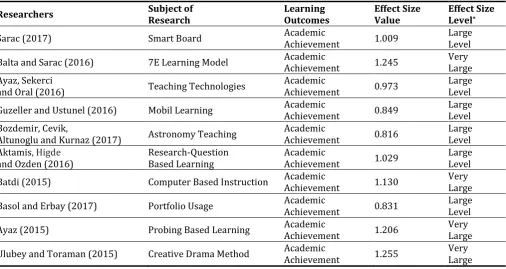
In the literature, a number of studies have been conducted on academic achievement in the learning outcomes using meta-analysis within the scope of national education researches (Aktamis, Higde, & Ozden, 2016; Ayaz, 2015; Ayaz, Sekerci, & Oral, 2016; Balta, & Sarac, 2016; Basol, & Erbay, 2017; Batdi, 2015; Bozdemir, Cevik, Altunoglu, & Kurnaz, 2017; Guzeller, & Ustunel, 2016; Sarac, 2017; Ulubey, & Toraman, 2015). It is also available about on learning cycle models "Factors effecting academic achievement of students in Turkey" (Sarier, 2015) in the form of meta-analysis. The results obtained from these studies are shown in Table 1 in general.
Table 1. Meta-analysis studies in the area of educational researches
Researchers Subject of Research Learning Outcomes Effect Size Value Effect Size Level*
Sarac (2017) Smart Board Academic Achievement 1.009 Large Level
Balta and Sarac (2016) 7E Learning Model Academic Achievement 1.245 Very Large Ayaz, Sekerci
and Oral (2016) Teaching Technologies Academic Achievement 0.973 Large Level Guzeller and Ustunel (2016) Mobil Learning Academic Achievement 0.849 Large Level Bozdemir, Cevik,
Altunoglu and Kurnaz (2017) Astronomy Teaching Academic Achievement 0.816 Large Level Aktamis, Higde
and Ozden (2016) Research-Question Based Learning Academic Achievement 1.029 Large Level Batdi (2015) Computer Based Instruction Academic Achievement 1.130 Very Large
Basol and Erbay (2017) Portfolio Usage Academic Achievement 0.831 Large Level
Ayaz (2015) Probing Based Learning Academic Achievement 1.206 Very Large
Ulubey and Toraman (2015) Creative Drama Method Academic Achievement 1.255 Very Large * According to Thalheimer and Cook (2002) classification
In the literature, there has been no meta-analysis study on the effect of learning cycle models on academic achievement of students. Therefore, it is thought this study will contribute to the literature.
The purpose of the study, a meta-analysis was conducted to determine the effect of the use of the learning cycle model on the achievements of the students. Accordingly, the question “What is the effect of learning cycle models on students’ achievement?” is tried to be answered. The sub-problems identified for this meta-analysis study is as follows.
Is there any effect of learning cycle models on the achievement of students?
Does the effect of learning cycle models on students’ achievement vary according to the type of the learning cycle models?
Does the effect of learning cycle models on students’ achievement vary according to the type of the dissertations?
Does the effect of learning cycle models on students’ achievement vary according to the type of the disciplines?
International Journal of Educational Methodology Method
Research Model
In the study, meta-analysis was used to determine the effectiveness of constructivist approach to learning cycle models in the educational process. Meta-analysis is the calculation of the effect of the independent variable on the dependent variable by comparing, quantifying and combining the quantitative data obtained from the experimental-quasi-experimental studies using statistical methods (Cohen, Manion, & Marrison, 2007).
There are two types of meta-analysis; group comparison and correlation. In this study, meta-analysis of transaction effectiveness, which is one of group comparison analysis methods, is used. Transaction effectiveness meta-analysis is a comparison of effect size values obtained by converting data belonging to independent studies used in multiple studies into a common measurement system (Sahin, 2005).
Collection of Data
The studies included in the study consist of doctorate and master theses with the necessary quantitative data on the published statistical evaluation made using the learning cycle models in the national education process between 2007 and 2016. Dissertations are not allowed to be achievemented by the researcher have not been included in the research. The screening of dissertations conducted in the national was conducted between 1 April 2017 and 1 July 2017 from the National Thesis Center website in Turkish and English. During the screening, the theses including the words "Learning cycle model", "3-stage Model", "4E Model", "5E Model" and "7E Model" in the names and keywords of the dissertations were taken in Turkish and English.
A total of 187 dissertations were found after the screening. When the identified dissertations are appropriately reviewed for the purpose of research, 123 national dissertations have been included in the search according to the required criteria in the national. In the study, the effect size value of 123 different students (Appendix-1), totaling 54 from the doctorate thesis and 69 from the master thesis were calculated for the academic achievements of the students.
Inclusion Criteria for Research
1. The study to be done between 2007 and 2016, in Turkey
2. The study has been carried out in the national territory and the achievement permits have 3. The study should be published in the national doctorate thesis and master thesis
4. Use of experimental or quasi-experimental methods in study
5. Using materials prepared according to learning cycle models for experimental groups and using traditional methods for control groups.
6. Examination of the academic achievements of the students in the study 7. Presenting the statistical data necessary to calculate the effect size in the study
Coding of Data
The appropriate coding form for the purpose of the study was developed by the researcher in order to examine the inclusion of the studies found in the research into the meta-analysis method and its suitability, to compare the studies, and to determine the statistical information used in the research. The features of the form are as follows; The quantitative data of the study and the study data are given in the order of the name of the study, the type of study, the learning cycle used in the study, the goal of the learning outcomes, the discipline of the study, the year the study was published, the duration of the study, the level of education of the participants, obtained statistical information etc... Filling in the coding form created for the purposes of meta-analysis is very important for coding reliability. In the area of studies determined for this, at least two experts must be examined and the coding forms must be filled in (Acikel, 2009). In the study, the coding forms of the studies were filled by two experts who completed the doctorate in the area of educational sciences. After coding, the forms of both experts were evaluated mutually. As a result of the evaluation, the credibility of the codes was calculated to be 95% according to the security level formula developed by Miles and Huberman (2002). According to the reliability level formula, results of 70% or more are sufficient for reliability (Yildirim, & Simsek, 2011). According to this, it can be said that the coding made for the studies determined for the purpose of the research is reliable.
Dependent and Independent Variables
SARAC / The Effect of Learning Cycle Models on Achievement of Students
Analysis of Data
In the meta-analysis study, the results of the investigations should be statistically combined. First, which statistical model of using should be decided? For this, Q statistics developed by Hedges and Olkin (1985) are used. According to the Q statistics, there are two models; Fixed Effect Model (FEM) and Random Effect Model (REM). In FEM, there is one actual effect size for each run. REM is a model that estimates the average of the magnitude of the effects of studies participating in the study (Borenstein, Hedges, Higgins, & Rothstein, 2013).
In the meta-analysis study, which statistical model is used, it is checked whether the effect sizes are homogeneous. If the p value of the homogeneity test Q is greater than .05, then the random effect model (REM) is used if the distribution is homogeneous and the fixed effect model (FEM) is below .05 (Ellis, 2010).
The effect sizes of the studies determined in the meta-analysis method are calculated as Cohen's d suggested by Thalheimer and Cook (2002) and Hedges' g proposed by Hedges and Olkin (1985). Hedges' g calculation is used in this study. Classification is used when the magnitudes of effect sizes calculated in the meta-analysis method are interpreted. When the scale of the effect size values obtained in the research is in a wide scale, the level classifications specified by Thalheimer and Cook (2002) are used. According to this, if the effect size value is less than 0.15, it is insignificant, between 0.15 and 0.40 is at a small level, between 0.41 and 0.75 is at medium level, between 0.76 and 1.10 is at large level, between 1.11 and 1.45 is at very large level, if it is bigger than 1.45, it is excellent.
Positive effect size values indicate that the assessed performance dimension is in favor of the experimental group, and a negative effect outcome indicates that the assessed performance dimension is in favor of the control group (Wolf, 1988).
The Orwin method and the funnel graph method are used to determine the publication bias of the studies identified in the meta-analysis method. In the Orwin method, the number of runs with a mean effect size of zero is calculated to reduce the value of the general effect size to zero (Lipsey, & Wilson, 2001). Funnel Plot can also be used to get an idea of broadcast bias. The funnel graph is constructed to show the magnitude of the effect of each work participating in the X-axis survey, and the sample size, variance, or standard error on the Y-X-axis. If the studies participating in the survey according to the graph show a symmetrical distribution according to the general effect size, it is decided that the study is reliable, that is, the publication bias does not exist (Ustun, & Eryilmaz, 2014).
Finally, in the meta-analysis study, various sub-groups were determined in which the effectiveness of the cycle learning models in the educational process could change. These groups are; learning cycle model types, dissertations types, disciplines, and the education levels of the students. Analyses of the identified subgroups were made and the results were reported.
Findings
In this study, the effect size values obtained from 123 dissertations were calculated. 54 effect sizes were obtained from doctoral theses and 69 from master's theses. There are 4688 students in the experimental groups and 4614 students in the control groups in the meta-analysis study. When the researhes are divided into subgroups; Seven on the 3E model, three on the 4E model, ninty-seven on the 5E model, and sixteen on the 7E model; 56 in science, 19 in physics, 19 in chemistry, 12 in biology, 8 in mathematics, 5 in social sciences and 4 in other lessons; 8 in primary schools, 42 in secondary schools, 61 in high schools and 12 in universities. Table 2 shows that the effect sizes of the 123 studies are detected homogeneous.
Table 2. Findings of academic achievement effect sizes of researches
Model N ES df (Q) Error Std. Z p I2
% 95 confidence intervals Lower
Limit Upper Limit
FEM 123 0.998 122 1166.214 .022 44.402 .000 89.539 .954 1.042
REM 123 1.164 .071 16.441 .000 1.025 1.303
International Journal of Educational Methodology
Figure-1 Forest chart of the academic achievements’ effect size values
In the graph, the position of the black squares with respect to the mid-vertical line shows the effect size value of the search, and the lines on both sides of the squares indicate the upper and lower limits of the 95% confidence interval. The size of the squares reflects the value of the investigations they belong to within the overall effect size. The figure with the lowest quadrangle shows the magnitude of the overall effect according to the random effects model of the study.
S tudy name model tez dersler öðrenme düz S tatistics for each study Hedges's g and 95% CI
Hedges's S tandar d Lower Upper
g er r or V ar iance lim it lim it Z-V alue p-V alue
F.Toprak-1 3,000 Y L K ÝM ÜNÝ V 1,559 0,309 0,095 0,954 2,164 5,049 0,000 G.Altýboz-1 3,000 DR B ÝY ÜNÝ V 0,856 0,357 0,127 0,156 1,556 2,398 0,016 C.Demir-1 3,000 DR FÝ Z LÝ S -0,413 0,276 0,076 -0,955 0,129 -1,494 0,135 Ö. S aygýn-1 3,000 DR B ÝY LÝ S 1,497 0,220 0,048 1,066 1,927 6,816 0,000 Y . Haruroðlu-1 3,000 DR B ÝY ÜNÝ V 1,796 0,379 0,143 1,054 2,538 4,744 0,000 E . Ünver-1 3,000 Y L F.BÝ L ORT 2,912 0,245 0,060 2,433 3,392 11,906 0,000 I. Özalp-1 4,000 Y L F.BÝ L ORT 2,231 0,457 0,209 1,335 3,128 4,878 0,000 B . Meþeci-1 4,000 Y L F.BÝ L ORT 0,600 0,291 0,085 0,030 1,170 2,064 0,039 U. K anlý-1 7,000 DR FÝ Z ÜNÝ V 0,353 0,222 0,049 -0,083 0,788 1,586 0,113 O. A vcýoðlu-1 7,000 Y L FÝ Z ÜNÝ V 2,201 0,317 0,100 1,580 2,822 6,946 0,000 Y . B ülbül-1 7,000 Y L B ÝY LÝ S 2,312 0,316 0,100 1,693 2,931 7,321 0,000 S . Demirezen-1 7,000 DR FÝ Z LÝ S 0,619 0,265 0,070 0,099 1,139 2,333 0,020 S .Ç. Toroslu-1 7,000 DR FÝ Z LÝ S 0,643 0,209 0,044 0,233 1,052 3,073 0,002 H. B ulut-1 7,000 Y L B ÝY LÝ S 0,788 0,194 0,038 0,408 1,169 4,060 0,000 F. Gürbüz-1 7,000 DR F.BÝ L ORT 3,953 0,510 0,260 2,954 4,952 7,755 0,000 N. K unduz-1 7,000 Y L K ÝM LÝ S 0,582 0,215 0,046 0,162 1,003 2,713 0,007 S .Y. Damar-1 7,000 DR FÝ Z LÝ S 2,494 0,262 0,068 1,982 3,007 9,533 0,000 E . Y enice-1 7,000 Y L F.BÝ L ORT 1,971 0,302 0,091 1,379 2,564 6,522 0,000 G. Gök-1 7,000 DR F.BÝ L ORT 0,438 0,156 0,024 0,132 0,743 2,810 0,005 S . Çekilmez-1 7,000 Y L FÝ Z LÝ S 1,108 0,260 0,068 0,599 1,618 4,266 0,000 A .M. Meydan-1 7,000 Y L F.BÝ L ORT 0,310 0,382 0,146 -0,440 1,059 0,810 0,418 E . Öztaþ-1 7,000 Y L F.BÝ L ORT 0,354 0,348 0,121 -0,328 1,036 1,017 0,309 H. S araç-1 7,000 DR F.BÝ L ORT 0,563 0,296 0,087 -0,017 1,143 1,904 0,057 A . P abuçcu-1 5,000 DR K ÝM LÝ S 1,561 0,201 0,040 1,167 1,955 7,766 0,000 E . A ydoðmuþ-1 5,000 Y L FÝ Z LÝ S 1,352 0,263 0,069 0,838 1,867 5,150 0,000 Þ .K. Deren-1 5,000 Y L F.BÝ L ORT 2,246 0,420 0,176 1,423 3,068 5,349 0,000 F. Ekici-1 5,000 Y L K ÝM LÝ S 0,497 0,312 0,097 -0,114 1,109 1,593 0,111 T. Özsevgeç-1 5,000 DR F.BÝ L ORT 1,860 0,289 0,083 1,294 2,426 6,442 0,000 S .N. Taþkoyan-1 5,000 Y L F.BÝ L ORT 1,850 0,392 0,154 1,082 2,619 4,718 0,000 D. K aynar-1 5,000 Y L F.BÝ L ORT 0,938 0,166 0,028 0,613 1,263 5,653 0,000 E . S evinç-1 5,000 Y L K ÝM ÜNÝ V 0,890 0,373 0,139 0,158 1,622 2,383 0,017 E . Ziyafet-1 5,000 Y L F.BÝ L ORT 1,824 0,352 0,124 1,135 2,514 5,184 0,000 V . K eskin-1 5,000 Y L FÝ Z LÝ S -0,164 0,326 0,107 -0,804 0,476 -0,502 0,616 E . Y ýldýz-1 5,000 DR F.BÝ L ORT -0,903 0,287 0,083 -1,466 -0,339 -3,141 0,002 N. Hýrça-1 5,000 DR FÝ Z LÝ S 1,104 0,297 0,088 0,522 1,687 3,717 0,000 M. Okur-1 4,000 Y L F.BÝ L ORT 5,342 0,673 0,453 4,023 6,661 7,939 0,000 Ö. A ltýnay-1 5,000 Y L F.BÝ L ORT 1,843 0,259 0,067 1,335 2,350 7,121 0,000 A . K olomuç-1 5,000 DR K ÝM LÝ S 1,462 0,263 0,069 0,946 1,978 5,557 0,000 E . Ceylan-1 5,000 DR K ÝM LÝ S 0,410 0,184 0,034 0,049 0,771 2,228 0,026 H.H. Türker-1 5,000 Y L F.BÝ L ORT 1,242 0,154 0,024 0,940 1,543 8,064 0,000 Ö. Haras-1 5,000 Y L B ÝY LÝ S -0,435 0,339 0,115 -1,100 0,229 -1,283 0,199 P .U. Keleþ-1 5,000 DR F.BÝ L ORT 0,568 0,272 0,074 0,036 1,101 2,092 0,036 S . Tiryaki-1 5,000 Y L F.BÝ L ORT 1,089 0,265 0,070 0,570 1,609 4,110 0,000 G. P arim-1 5,000 DR F.BÝ L ORT 0,756 0,305 0,093 0,158 1,354 2,476 0,013 K . A ndaç-1 5,000 Y L F.BÝ L ORT 0,810 0,235 0,055 0,349 1,271 3,446 0,001 E . Y alçýn-1 5,000 Y L F.BÝ L ORT 1,241 0,259 0,067 0,734 1,747 4,797 0,000 S . A çýþlý-1 5,000 DR FÝ Z ÜNÝ V 2,304 0,283 0,080 1,749 2,859 8,134 0,000 N.Z. Yörük-1 5,000 DR K ÝM LÝ S 0,069 0,249 0,062 -0,419 0,557 0,277 0,782 N. A ydýn-1 5,000 DR F.BÝ L ORT -0,003 0,115 0,013 -0,228 0,223 -0,023 0,982 S . E rcan-1 5,000 Y L B ÝY LÝ S 1,094 0,300 0,090 0,506 1,681 3,646 0,000 O. E rcan-1 5,000 DR K ÝM ÜNÝ V 0,531 0,221 0,049 0,097 0,965 2,398 0,016 Ý . E rsoy-1 5,000 Y L F.BÝ L ORT 0,874 0,325 0,106 0,237 1,511 2,689 0,007 E . Önder-1 5,000 Y L F.BÝ L ORT 0,905 0,311 0,097 0,294 1,515 2,905 0,004 S . E rdoðdu-1 5,000 Y L FÝ Z LÝ S 1,801 0,299 0,089 1,215 2,386 6,025 0,000 O. B ektaþ-1 5,000 DR K ÝM LÝ S 0,831 0,195 0,038 0,449 1,213 4,266 0,000 H. Coþkun-1 5,000 Y L F.BÝ L Ý LK 0,778 0,163 0,027 0,458 1,098 4,766 0,000 Z. Abdüsselam-1 5,000 Y L F.BÝ L Ý LK 0,069 0,255 0,065 -0,431 0,569 0,271 0,787 S . Uslu-1 5,000 Y L F.BÝ L ORT 2,659 0,358 0,128 1,957 3,360 7,427 0,000 Þ . Gül-1 5,000 DR B ÝY LÝ S 1,982 0,315 0,099 1,364 2,601 6,285 0,000 Z. Küçük-1 5,000 Y L F.BÝ L ORT 0,905 0,305 0,093 0,308 1,503 2,970 0,003 M. A ktaþ-1 5,000 DR B ÝY LÝ S 2,282 0,324 0,105 1,647 2,917 7,044 0,000 H. P eþman-1 5,000 DR FÝ Z LÝ S -0,095 0,143 0,021 -0,376 0,186 -0,663 0,507 A .Ç. Dindar-1 5,000 DR K ÝM LÝ S 1,082 0,240 0,058 0,611 1,553 4,500 0,000 S . B urkaz-1 5,000 Y L F.BÝ L ORT 0,790 0,290 0,084 0,222 1,358 2,728 0,006 N. A ydemir-1 5,000 DR K ÝM LÝ S 1,355 0,211 0,045 0,941 1,769 6,415 0,000 O. K enan-1 5,000 DR F.BÝ L ORT 0,808 0,228 0,052 0,362 1,254 3,548 0,000 E .B. Bahadýr-1 5,000 Y L F.BÝ L ORT 1,890 0,350 0,123 1,203 2,577 5,392 0,000 N. Ültay-1 5,000 DR K ÝM ÜNÝ V 0,869 0,257 0,066 0,366 1,372 3,384 0,001 Y . Y urt-1 5,000 Y L F.BÝ L ORT 3,690 0,290 0,084 3,122 4,258 12,726 0,000 C. B ýyýklý-1 5,000 DR F.BÝ L Ý LK 2,841 0,364 0,132 2,128 3,554 7,814 0,000 Ö. Özbayrak-1 5,000 DR K ÝM LÝ S 1,489 0,289 0,083 0,922 2,055 5,154 0,000 N. Öztürk-1 5,000 DR F.BÝ L ORT 1,525 0,350 0,123 0,838 2,212 4,351 0,000 S . S unar-1 5,000 DR K ÝM LÝ S 0,871 0,170 0,029 0,537 1,205 5,114 0,000 T.Þ. Çoruhlu-1 5,000 DR F.BÝ L ORT 1,014 0,248 0,062 0,528 1,500 4,087 0,000 D. A kgündüz-1 5,000 DR F.BÝ L ORT 0,752 0,291 0,085 0,181 1,322 2,580 0,010 R.S. Koç-1 5,000 DR F.BÝ L ORT 0,000 0,276 0,076 -0,541 0,541 0,000 1,000 E . B al-1 5,000 Y L FÝ Z ÜNÝ V 1,456 0,287 0,083 0,892 2,019 5,064 0,000 Ö. Çolak-1 5,000 Y L F.BÝ L ORT 0,492 0,319 0,102 -0,133 1,117 1,544 0,123 E . E zberci-1 5,000 Y L F.BÝ L ORT 0,161 0,271 0,074 -0,370 0,693 0,596 0,552 H.Ö. Arslan-1 5,000 DR B ÝY LÝ S 0,085 0,132 0,017 -0,174 0,344 0,643 0,520 E . Çavuþ-1 5,000 Y L F.BÝ L ORT 0,660 0,278 0,077 0,115 1,205 2,372 0,018 M. Öztürk-1 5,000 Y L F.BÝ L ORT 0,390 0,183 0,034 0,031 0,749 2,128 0,033 S .T. Altan-1 5,000 Y L F.BÝ L Ý LK 1,227 0,248 0,061 0,741 1,713 4,949 0,000 E . Özçelik-1 5,000 Y L FÝ Z LÝ S 0,605 0,325 0,106 -0,032 1,242 1,860 0,063 B . Ý stanbuloðlu-1 5,000 Y L F.BÝ L ORT 0,795 0,275 0,075 0,256 1,333 2,893 0,004 F. Kara-1 5,000 DR F.BÝ L Ý LK 1,571 0,340 0,116 0,904 2,237 4,618 0,000 M. S ertkaya-1 5,000 Y L FÝ Z LÝ S 1,186 0,360 0,129 0,481 1,890 3,298 0,001 E . K ürkçü-1 5,000 Y L B ÝY LÝ S 3,837 0,457 0,209 2,942 4,733 8,400 0,000 H. Can-1 5,000 Y L F.BÝ L ORT 1,304 0,324 0,105 0,670 1,938 4,029 0,000 E . Zengin-1 5,000 Y L F.BÝ L ORT 0,637 0,297 0,088 0,054 1,220 2,142 0,032 R. Öz-1 5,000 Y L F.BÝ L ORT 1,495 0,294 0,086 0,919 2,071 5,087 0,000 N. E rtuðrul-1 5,000 Y L F.BÝ L ORT 1,659 0,258 0,067 1,154 2,165 6,434 0,000 S .E. Nas-1 5,000 Y L F.BÝ L ORT 1,010 0,305 0,093 0,412 1,608 3,309 0,001 H.S. Tortop-1 5,000 DR FÝ Z LÝ S 0,970 0,293 0,086 0,395 1,545 3,307 0,001 T.E. Özaydýn-1 5,000 DR F.BÝ L ORT 0,829 0,251 0,063 0,337 1,321 3,303 0,001 B . Uzun-1 5,000 DR F.BÝ L ORT 0,998 0,302 0,091 0,407 1,589 3,309 0,001 Ý .A. Akpýnar-1 5,000 DR K ÝM LÝ S 0,603 0,242 0,058 0,129 1,077 2,494 0,013 F.A. Yalçýn-1 5,000 DR K ÝM LÝ S 0,720 0,218 0,048 0,293 1,148 3,300 0,001 F. Karslý-1 5,000 DR K ÝM ÜNÝ V 0,987 0,298 0,089 0,402 1,572 3,308 0,001 Ö. Ceylan-1 5,000 Y L F.BÝ L ORT 0,935 0,283 0,080 0,381 1,490 3,306 0,001 A . Tekbýyýk-1 5,000 DR FÝ Z LÝ S 1,703 0,181 0,033 1,349 2,057 9,430 0,000 M. A kpýnar-1 5,000 DR FÝ Z LÝ S 1,132 0,144 0,021 0,850 1,415 7,853 0,000 M. Masattaþ-1 5,000 Y L F.BÝ L ORT 2,361 0,163 0,027 2,041 2,681 14,468 0,000 C. K oçak-1 5,000 DR K ÝM LÝ S 1,132 0,126 0,016 0,885 1,379 8,968 0,000 H. A rtun-1 5,000 Y L B ÝY ÜNÝ V 0,760 0,245 0,060 0,280 1,240 3,102 0,002 S Sarýkaya-1 3,000 Y L F.BÝ L ORT 1,697 0,328 0,107 1,054 2,339 5,177 0,000 S . Çetinaya-1 7,000 Y L MAT ORT 0,069 0,320 0,102 -0,557 0,695 0,216 0,829 Ç. Öztürk-1 5,000 DR S OS LÝ S E 2,316 0,334 0,111 1,661 2,970 6,935 0,000 E .T. Baþer-1 5,000 Y L MAT ORT 2,048 0,353 0,124 1,357 2,739 5,809 0,000 B . Hiçcan-1 5,000 Y L MAT ORT 2,025 0,351 0,123 1,336 2,713 5,765 0,000 O. K öksal-1 5,000 Y L DÐR ORT 1,414 0,312 0,098 0,802 2,026 4,529 0,000 S . P ulat-1 5,000 Y L MAT ORT 1,301 0,291 0,085 0,731 1,871 4,473 0,000 H.K. Güler-1 5,000 Y L MAT ORT 0,142 0,235 0,055 -0,318 0,603 0,606 0,545 A .F. Sakallý-1 5,000 Y L MAT LÝ S 0,654 0,225 0,051 0,213 1,094 2,910 0,004 A . K artal-1 5,000 Y L S OS Ý LK 0,629 0,356 0,127 -0,069 1,328 1,767 0,077 S .I. Mercan-1 5,000 DR S OS LÝ S 1,800 0,278 0,077 1,256 2,344 6,486 0,000 Þ . Þ ahin-1 5,000 Y L DÐR LÝ S 0,937 0,205 0,042 0,535 1,339 4,566 0,000 M. Gök-1 5,000 DR DÐR ORT 3,239 0,390 0,152 2,474 4,005 8,298 0,000 Ý . Ý lter-1 5,000 DR S OS Ý LK 0,929 0,264 0,070 0,410 1,447 3,511 0,000 A . Þ ahiner-1 5,000 Y L MAT ORT 0,578 0,258 0,067 0,072 1,085 2,238 0,025 A . Y ýldýz-1 5,000 Y L MAT ORT 0,857 0,324 0,105 0,221 1,493 2,642 0,008 M. A kbulut-1 5,000 Y L S OS Ý LK 1,151 0,278 0,077 0,606 1,696 4,136 0,000 B . B ayram-1 5,000 DR DÐR ORT 1,094 0,338 0,114 0,431 1,757 3,235 0,001 1,164 0,071 0,005 1,025 1,303 16,441 0,000
-4,00 -2,00 0,00 2,00 4,00 Favour s A Favour s B
Meta Analysis
Evalu
ation
SARAC / The Effect of Learning Cycle Models on Achievement of Students
When the effect sizes of the researches are examined; the smallest effect size value is -0.916 (Yildiz, 2008) and the highest effect size value is 5.450 (Okur, 2009). The 123 effect size values of the study have 117 positive effect and six have negative effect.
One of the issues that should be considered in meta-analysis study is publication bias. It was determined that the required number of runs with effect sizes 0 (zero) was 8892 to reduce the value of effect size 1.164 obtained as a result of the analysis by Orwin method to 0 (zero) effect size value. This is a very high number and shows that the publication bias is low. In addition to this, it can be interpreted as Funnel Plot in Fig-2.
Figure-2 Funnel graph of the researches included in the study
In case of publication bias in the funnel graph, the effect sizes will be asymmetrically. In the case of no publication bias, they show a symmetrical distribution. As seen in Figure-2, the funnel obtained from the researches show an almost symmetrical structure. Accordingly, it can be said that there is no publication bias in the study.
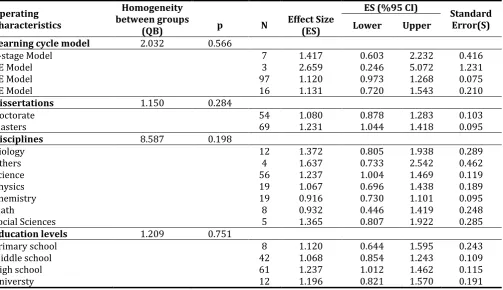
The effect sizes obtained in the meta-analysis are divided into subgroups according to various classifications. The results of the analysis are shown in Table 3.
Table 3. Statistical analyzes according to classified subgroups
Operating Characteristics
Homogeneity between groups
(QB) p N Effect Size (ES)
ES (%95 CI) Standard Error(S) Lower Upper
Learning cycle model 2.032 0.566
3-stage Model 7 1.417 0.603 2.232 0.416
4E Model 3 2.659 0.246 5.072 1.231
5E Model 97 1.120 0.973 1.268 0.075
7E Model 16 1.131 0.720 1.543 0.210
Dissertations 1.150 0.284
Doctorate 54 1.080 0.878 1.283 0.103
Masters 69 1.231 1.044 1.418 0.095
Disciplines 8.587 0.198
Biology 12 1.372 0.805 1.938 0.289
Others 4 1.637 0.733 2.542 0.462
Science 56 1.237 1.004 1.469 0.119
Physics 19 1.067 0.696 1.438 0.189
Chemistry 19 0.916 0.730 1.101 0.095
Math 8 0.932 0.446 1.419 0.248
Social Sciences 5 1.365 0.807 1.922 0.285
Education levels 1.209 0.751
Primary school 8 1.120 0.644 1.595 0.243
Middle school 42 1.068 0.854 1.243 0.109
High school 61 1.237 1.012 1.462 0.115
Universty 12 1.196 0.821 1.570 0.191
p<.05
-6 -5 -4 -3 -2 -1 0 1 2 3 4 5 6
0,0
0,2
0,4
0,6
0,8
S
tan
da
rd
E
rr
or
Hedges's g
International Journal of Educational Methodology In the subgroup analyzes made; there was no statistically significant difference in the type of learning cycle models used (QB = 2.032, p> .05), the type of dissertations (QB = 1.150, p> .05), the type of disciplines (QB = 8.587, p> .05), and the type of education levels of the students (QB = 1.209, p> .05). In other words, among the academic achievement effect sizes of the students, there is no statistically significant difference between the type of learning cycle model, the type of dissertations, the type of of disciplines, and the the type of education levels of the students.
Discussion, Conclusions and Recommendations
In the study, the dissertations on the effect of the use of learning cycle models in the educational process on students' academic achievement were combined with meta-analysis. According to the REM in the study, a positive result of 1.164 was reached in favor of experimental groups on a very large level. This result is in agreement with the results obtained from the meta-analyzes carried out within the scope of educational researches in the literature (Aktamis, Higde, & Ozden, 2016; Ayaz, 2015; Ayaz, Sekerci, & Oral, 2016; Balta, & Sarac, 2016; Basol, & Erbay, 2017; Batdi, 2015; Bozdemir, Cevik, Altunoglu, & Kurnaz, 2017; Guzeller, & Ustunel, 2016; Sarac, 2017; Ulubey, & Toraman, 2015).
When the results of the meta-analysis obtained from the research are examined according to the learning cycle models used in the study; it has been found out that there is no statistically significant difference between the effects of the academic achievement in the students and the type of learning cycle models used in the educational process (Q = 2.032 and p = 0.566). When the studies examined were evaluated according to the model of the learning cycle model, the highest effect size value was found to be excellent in the 4E Model (ES = 2.659). In addition, it has been found out that the studied studies are very large with 7E Model effect size value (ES = 1.131), 3-stage Model effect size value (ES = 1.417) and 5E Model effect size value (ES = 1.120).
When the results of the meta-analysis obtained from the research are examined according to the dissertations used in the study; it has been found out that there is no statistically significant difference between the effects of the academic achievement in the students and the type of dissertations used in the educational process (Q = 1.150 and p = 0.284). When the researches examined were evaluated according to the dissertations, the highest effect size value was found to be very large in the master theses (ES = 1,231). In the literature, it is seen that the highest effect size value of the dissertations type within the scope of the education researches is in the master thesis research with 1.307 in the study performed by Balta and Sarac (2016). According to this result, the result obtained according to the dissertations types in the meta-analysis study performed by Balta and Sarac (2016) and the academic achievement effect of the students using the learning cycle models in the study period in the research are similar according to the master thesis. In addition, within the scope of the researches, the highest effect size value in the dissertations type was 0.919 in the study of Sarac (2017), 1.598 in the study of Ayaz (2015), 1.247 in the study of Ayaz, Sekercici and Oral (2016) and 1.213 in the study of Ulubey and Toraman (2015) were found to be in doctoral theses. According to the meta-analysis studies performed by Sarac (2017), Ayaz (2015), Ayaz, Sekerci and Oral (2016) and Ulubey and Toraman (2015), results obtained according to the type of dissertations and learning cycle models the effect of using academic achievement on students' achievement according to the dissertation does not overlap.
When the results of the meta-analysis obtained from the research are examined according to the disciplines used in the study; it has been found out that there is no statistically significant difference between the effects of the academic achievement in the students and the type of disciplines used in the educational process (Q = 8.587 and p = 0.198). It is seen that the highest effect size value in the science studies is excellent in the Biology (ES = 1.372), in the Social science (ES = 1.365) and in the other lessons (ES = 1.637). In the literature, it is seen that Sarac (2017) in the scope of educational researches has the highest effect size value in the disciplines with 1,324 in the other lessons. Ayaz, Sekerci and Oral (2016), Batdi (2015) and Ulubey and Toraman (2015) were found to be in the Social sciences. In this case, meta-analysis studies of Sarac (2017), Ayaz, Sekerci and Oral (2016), Batdi (2015) and Ulubey and Toraman (2015) and the results obtained by the area of discipline and the use of learning cycle models the result obtained according to the disciplines of the academic achievement effect in the students is partially similar. In addition, Ayaz (2015) and Balta and Sarac (2016) found that the highest effect size values in the disciplines were in Chemistry lessons with 1.432 and 2.066. In this case, the results obtained by disciplines in the meta-analysis of Ayaz (2015) and Balta and Sarac (2016) and the results of the use of learning cycle models in the study in academic research do not overlap according to the disciplines of academic achievements.
SARAC / The Effect of Learning Cycle Models on Achievement of Students
highest effect size was 1,727 in primary school students according to the learning level of studying groups. It is seen that the highest impact size value in the studies of Batdi (2015) and Ulubey and Toraman (2015) is in the middle school students according to the education levels of studying groups. In this case, the results obtained by education levels in the meta-analysis of of Ayaz (2015), Batdi (2015) and Ulubey and Toraman (2015) and the result of the use of learning cycle models in the study in academic research does not overlap according to the education levels of academic achievements.
When we look at the results of the research in general; it has been determined that the use of learning cycle models in the educational process has a very large effect on students' academic achievements. There is no statistically significant difference between the learning cycle model used in the educational process and the academic achievement effect of the learning cycle models, the disciplines, the dissertations, and the education levels of the study groups.
In this meta-analysis study, the use of learning cycle models in the educational process was examined academic achievements on students, and the remaining effects were excluded from the scope of the study. After that, researchers who will work on these topics will be able to use learning cycle models in the educational process; gender and anxiety on factors such as the effect on different topics can perform meta-analysis studies. Moreover, it has been revealed that this meta-analysis gives more effective results on the courses of Biology and Social sciences. A comprehensive study of the causes of these outcomes can be made. The research was conducted in all disciplines. A similar study can be applied specifically at Science, Social sciences and Mathematics. In addition, meta-analysis studies can be done in different categories for the effects of learning cycle models on learning outcomes.
References
Acikel, C. (2009). Meta analiz ve kanita dayali analizin tiptaki yeri [Meta-analysis in medicine and evidence-based analysis]. Clinical Psychopharmology, 19 (2), 164- 172.
Akpınar, E., & Ergin, Ö. (2005). Role of science teachers in constructivist theory. Primary Education-Online, 4(2), 55-64. Aktamis, H., Higde, E., & Ozden, B. (2016). Effects of the inquiry-based learning method on students' achievement,
science process skills and attitudes towards science: A meta-analysis study. Journal of Turkish Science Education (TUSED), 13(4), 248-261.
Ayaz, M. F., Sekerci, H., & Oral, B. (2016). The Effect of Using of Instructional Technology to Elementary School Students' Academic Achievement: A Meta-Analysis Study. Journal of the Faculty of Education, 17(1), 35-54.
Ayaz, M. F. (2015). Impact of probabilistic learning approach on students' academic achievement in science class: A meta-analysis study. Turkish Studies-International Periodical for the Languages, Literature and History of Turkish or Turkic, 10(3), 139-160.
Balim, A.G., Turkoguz, S., Aydin, G., & Evrekli, E. (2012). Fen ve teknoloji dersinin “madde ve isi” konularinda yapilandirmaci yaklasimin 7E modeline dayali etkinlik planlari [Activity plans based on the 7E model of the constructivist approach to science and technology in "matter and heat"]. Bartin University Journal of Education Faculty,1(1), 129-139.
Balta, N., & Sarac, H. (2016). The effect of 7E learning cycle on learning in science teaching: A meta-analysis study. European Journal of Educational Research, 5(2), 61-72.
Baker, D. R., & Piburn, M. D. (1997). Constructing science in middle and secondary school classrooms. Copyright by Allynand Bacon, USA.
Basol, G., & Erbay, S. (2017). Portfolyo Kullaniminin Akademik Basariya Etkisi: Bir Meta Analiz Calismasi [The effect of portfolio use on academic achievement: A meta-analysis]. Hacettepe University Education Faculty Journal, 32(2), 396-412.
Batdi, V. (2015). Kavram haritasi teknigi ile geleneksel ogrenme yonteminin kullanilmasinin ogrencilerin basarilari, bilgilerinin kaliciligi ve tutumlarina etkisi: Bir meta-analiz calismasi [The achievements of the students using the conceptual map technique and the traditional learning method, its effect on the persistence and attitudes of the knowledge: A meta-analysis study]. Dumlupinar University Social Sciences Journal, 42(2), 93-102.
Bilgin, I., Ay, Y., & Coskun, H. (2013).5E ogrenme modelinin ilkogretim 4.Sinif ogrencilerinin madde konusundaki basarilarina etkisinin ve model hakkinda ogrenci goruslerinin incelenmesi [Examination of the effect of the 5E learning model on the achievement of the elementary 4th grade students on the topic of the matter and student
opinions about the model]. Kastamonu Journal of Education, 21 (4), 1449-1470.
Boddy, N., Watson, K., & Aubusson, P. (2003). A trial of the five es: A referant model for constructivist teaching and learning. Research in Science Education, 33, 27-42.
International Journal of Educational Methodology Bozdemir, H., Cevik, E. E., Altunoglu, B. D., & Kurnaz, M. A. (2017). Astronomi Konularinin Ogretiminde Kullanilan Farkli
Yontemlerin Akademik Basariya Etkisi: Bir Meta Analiz Calismasi [The effect of different methods used in teaching astronomy subjects to academic achievement: A meta analysis study]. Journal of Field Education Research, 3(1), 12-24.
Bybee, R.W. (2003). Achieving scientific literacy: From purposes to practices. Portsmouth, UK: Heinemann. Cohen, J., Manion, L., & Morrison, K. (2007). Research methods in education (Sixth Edition). New York: Routledge. Coruhlu, T. S., & Cepni, S. (2016). Zenginlestirilmis 5E Modelinin Ogrenci Kavramsal Degisimi Uzerine Etkisi: Astronomi
Ornegi [The influence of enriched 5e model on student conceptual change: An example of astronomy]. Kastamonu Journal of Education, 24(4), 1785-1802.
Demir, C., & Maskan, A. K. (2012). Web Destekli Ogrenme Halkasi Yaklasiminin Lise 11. Sinif Ogrencilerinin Fizik Dersi Oz-Yeterlik Inanclarina Etkisi [Impact of web based learning cycle approach on physics lesson self-efficacy beliefs of high school 11th grade students]. Dicle University Journal of Ziya Gokalp Education Faculty, (18), 17-30.
Demir, C., & Maskan, A. K. (2014). Web Destekli Ogrenme Halkasi Yaklasimi Uygulamalarina Iliskin Ogrenci Gorusleri [Student opinions on web based learning cycle approaches]. Journal of Computer and Education Research, 2(3), 136-150.
Eisenkraft, A. (2003). Expanding the 5e model.The Science Teacher, 70(6), 56-59.
Ellis, P. D. (2010). The essential guide to effect sizes: Statistical power, meta-analysis, and the interpretation of research results. Cambridge: Cambridge University Press.
Ergin, I. (2012). Fen Egitiminde 5E Modeli Ile Ilgili Yazili Kaynaklar Dizini [Written resources regarding 5e model in science education]. Journal of Research in Education and Teaching, 1(1), 45-53.
Guzeller, C. O.,& Ustunel, F. (2016). Effects of mobile learning on academic achievement: A meta analysis study. Adiyaman University Journal of Social Sciences Institute, 1(2), 528-560.
Hedges, L.V.,& Olkin, I. (1985). Statistical methods for meta-analysis. New York: Academic Press.
Kanli, U. (2009). Yapilandirmaci kuramin isiginda ogrenme halkasinin kokleri ve evrimi: Ornek bir etkinlik [The roots and evolution of the learning cycle in the light of constructivist theory: An example activity]. Educatin and Science,
34 (151), 44-64.
Keles, Y. (2010). Fen eğitiminde ogrenme döngüsü modelleri [Learning cycle models in science education]. Mersin University Faculty of Education Journal, 6(1), 41-51.
Kucuk, Z., & Calik, M. (2015). Effect of enriched 5Es model on 7th grade students’ conceptual change levels: A case of
‘electric current’ subject. Adiyaman University Journal of Educational Sciences, 5(1), 1-28 Lipsey, M., & Wilson, D. (2001). Practical meta-analysis. Beverly Hills, CA: Sage Publications.
Meseci, B., & Karamustafaoglu, S. (2015). Maddenin Tanecikli YapisiUnitesine Yonelik 4E Modeli Destekli Etkinliklerin Akademik Basariya Etkisi [The effect of academic achievement of 4e model supported activities for matter's granular construction unit]. Karaelmas Journal of Education Science, 3(1), 1-12.
Miles, M. B., & Huberman, A. M. (2002). The qualitative researcher’s companion. California: Sage Publications.
Okur, M. (2009).Kavramsal degisimi saglayan farkli metotlarin karsilastirilmasi: Sesin yayilmasi konusu ornegi
[Comparison of different methods providing conceptual change: Example of sound propagation]. Master Thesis, KATU Institute of Science and Technology, Trabzon.
Ozmen, H. (2004). Fen ogretiminde ogrenme teorileri ve teknoloji destekli yapilandirmaciogrenme [Learning theories and technology-assisted constructivist learning in science teaching].TheTurkish Online Journal of Educational Technology, 3(1), 100-111.
Renner, J.W., Abraham, R.M., & Birnie, H.H. (1998).The necessity of eachphase of the learning cycle in teaching high school.Journal of Research in Science Teaching, 28, 437–454.
Sarac, H. (2017). The effect of smart board usage in Turkish education system on students’ learning outcomes: A meta analysis study, TURKISH STUDIES -International Periodical for the Languages, Literature and History of Turkish or Turkic, 12(4), 445-470.
Sarac, H. (2015). Coklu ortam Destekli 7E Modeline Gore Tasarlanan Uygulamalarin 5. Sinif Fen Bilimleri Dersi “Maddenin Degisimi” Unitesinde Ogrencilerin Ogrenme Urunlerine Etkisi [The impact of students on learning products at the "matter’s change" unit of the 5th grade science course of applications designed by multimedia supported 7e
SARAC / The Effect of Learning Cycle Models on Achievement of Students
Sarac, H., & Kunt, H. (2016). Yapilandirmaci Yaklasim 7E Ogrenme Halkasi Modeli Ile Ilgili Yapilan Arastirmalar: Icerik Analizi Calismasi [Constructivist approach 7e research patterns related to learning cycle model: Content analysis study]. Electronic Turkish Studies, 11(9), 701-724.
Sarier, Y. (2015). Turkiye’de ogrencilerin akademik basarisini etkileyen faktorler: Bir meta-analiz calismasi [Factors affecting the academic achievement of students in Turkey: A meta-analysis study]. Hacettepe University Journal of Education, 1-19.
Sadoglu, G. P., & Akdeniz, A. R. (2015).7E Ogrenme Modeline Yonelik Tasarlanan Materyallerin Lise Ogrencilerinin Modern Fizik Basarilarina Etkisi [7E the effect of designed materials for learning model on modern physics achievement of high school students]. Journal of Computer and Education Research, 3(5), 96-129.
Sahin, M. C. (2005). Internet tabanli uzaktan egitimin etkililigi: Bir meta-analiz calismasi[The effectiveness of Internet-based distance education: A meta-analysis study].Unpublished Master thesis, Cukurova University, Institute of Social Sciences, Adana.
Sasmaz Oren, F., & Tezcan, R. (2009). The effectiveness of the learning cycle aproach on learners’ attitude toward science in 7th grade science classes of elemantary school. Elemantary Educational Online, 8(1), 103- 118.
Temel, S., Ozgur, S. D., & Yilmaz, A. (2012).The effect of learning cycle model on preservice chemistry teachers’ understanding of oxidation reduction topic and thinking skills. Necatibey Faculty of Education Electronic Journal of Science and Mathematics Education, 6(1), 287-300.
Thalheimer, W., & Cook, S. (2002).How to calculate effect sizes from published research articles: A simplified methodology. Tonbuloglu, B. (2014). Mustafa Sati Bey’in Gorusleri Dogrultusunda Yapilandirmacilik Anlayisina Farkli Bir Bakis Acisi
[Mustafa Sati's view of constructivism in a different perspective]. Turkish Studies - International Periodical For The Languages, Literature and History of Turkish or Turkic, 9(8), 841-852.
Turgut, U., Colak, A., & Salar, R. (2016). The effect of 7e model on conceptual achievement of students in the unit of electromagnetism. European Journal of Physics Education, 7(3), 1-37.
Turkmen, H. (2006). Ogrenme dongusu yaklasimiyla ilkogretimde fen nasil ogretilmelidir? [How should science be taught in elementary school with the learning cycle approach?]. Elementary Education Online, 5(2), 1-15
Ulubey, O., & Toraman, C. (2015). The effect of creative drama on students' academic achievement: A meta-analysis study. Mustafa Kemal University Social SciencesInstitute Journal, 12(32), 195-220.
Ustun, U., & Eryilmaz, A. (2014). Etkili arastirma sentezleri yapabilmek icin bir arastirma yontemi: Meta-analiz [A research method for effective research synthesis: Meta-analysis]. Education and Science, 1-32.
Wilder, M., & Shuttleworth, P. (2004). Cell inquiry: A 5E learning cycle lesson. Science Activities, 41(1), 25–31.
Wolf, F. M. (1988). Meta-analysis quantitative methods for research synthesis (Third edition). California: Sage Publications.
Yildirim, A., & Simsek, H. (2011).Sosyal bilimlerde nitel arastirma yontemleri [Qualitative research methods in the social sciences]. Ankara: Seckin Yayinevi.
Yildiz, E. (2008). 5E modelinin kullanildigi kavramsal degisime dayaliogretimde ust bilisin etkileri: 7. sinif kuvvet ve hareket unitesine yonelik bir uygulama [The effects of metacognition in conceptual change based teaching used in 5E model: An application for 7th grade force and movement unit]. Unpublished PhD thesis. DEU Institute of
International Journal of Educational Methodology Appendix-1. The dissertations included in the Meta analysis study
Abdusselam, Z. (2013). Animasyon Destekli Cizgi Filmlerin Fen Ogretimine Etkisi: 6. Sinif Kuvveti Kesfedelim Konusu Ornegi [The effect of animation assisted cartoons on science teaching: Example of 6th grade force exploration].
Unpublished Master thesis, KATU, Institute of Educational Sciences, Trabzon.
Acisli, S. (2010).Fizik laboratuvar uygulamalarinda 5E ogrenme modeline uygun olarak gelistirilen materyallerin ogrenci kazanimlarina etkisinin incelenmesi [Investigation of the effect of materials developed according to 5e learning model on student achievements in physics laboratory applications]. Unpublished PhD thesis, Institute of Sciences, Ataturk Universitesi, Erzurum.
Aggul-Yalcin, F. (2010).Ortaogretim ve Yuksekogretim Duzeyinde Asit-Baz Konusunun Ogretimi Icin Yapilandirmaci Yaklasima Uygun Aktif Ogrenme Etkinliklerinin Hazirlanmasi, Uygulanmasi ve Degerlendirilmesi [Constructivist approach for teaching acid-base education at secondary and higher education level preparation, application and evaluation of active learning activities].Unpublished PhD thesis. Ataturk Universitesi, Institute of Sciences, Erzurum.
Akbulut, M. (2015). Sosyal Bilgiler Ogretiminde 5e Modeli Kullaniminin Ders Basarisina ve Derse Karsi Tutumuna Etkisi
[The effect of using 5e models in the teaching of social sciences]. Unpublished Master thesis, 19 Mayis Universitesi, Institute of Educational Sciences, Samsun.
Akgunduz, D. (2013). Fen egitiminde harmanlanmisogrenme ve sosyal medya destekli ogrenmenin ogrencilerin basari, motivasyon, tutum ve kendi kendine ogrenme becerilerine etkisi [Impact of blended learning and social media supported learning in science education on students' achievement, motivation, attitude and self-learning skills]. Unpublished PhD thesis. Marmara Universitesi, Institute of Educational Sciences, Istanbul.
Akpinar, I. A. (2010). Kimyada cozeltiler konusunun ogretimi icin yapilandirmaci yaklasima uygun aktif ogrenme etkinliklerinin gelistirilerek uygulanmasi ve degerlendirilmesi [Constructive approach for the teaching of solving in chemistry, development and application of appropriate active learning activities]. Unpublished PhD thesis, Ataturk Universitesi, Erzurum.
Akpinar, M. (2012).Baglam Temelli Yaklasimla Yapilan Fizik Egitiminde Kavramsal Degisim Metinlerinin Ogrenci Erisisine Etkisi [The effect of conceptual change texts on student achievement to physics education made with context based approach]. Unpublished PhD thesis, Gazi Universitesi, Institute of Educational Sciences, Ankara.
Aktas, M. (2013).5E ogrenme modeli ve isbirlikli ogrenme yonteminin biyoloji dersi tutumuna etkisi [Effect of 5e learning model and cooperative learning method on biology course attitude]. Unpublished PhD thesis, Gazi Universitesi, Institute of Educational Sciences, Ankara.
Altan, S. T. (2015). Arastirmaya DayaliOgrenme Yontemiyle Ilkokul Ogrencilerinde Basari ve Bilimsel Surec Becerilerinin Gelistirilmesi [Achievement in primary school students with research based learning method and development of scientific process skills]. Unpublished Master thesis, Marmara Universitesi, Institute of Educational Sciences, Istanbul.
Altinay, O. (2009). 5E modeline dayaliogretim yonteminin ogrencilerin genetikle ilgili DNA, gen ve kromozom kavramlariniogrenmelerine etkisi [The effect of teaching method based on 5e model to learn students' genetic related DNA, gene and chromosome concepts].Unpublished Master thesis, Balikesir Universitesi, Institute of Sciences, Balikesir.
Andac, K. (2007). Gozden gecirme stratejisi ile desteklenmis yapilandirmaciogrenme yaklasiminin 5E modelinin ogrencilerin basinc konusundaki erisilerine, bilgilerinin kaliciligina ve tutumlarina etkisi [Impact of 5e model of constructivist learning approach supported by oversight strategy on students' achievement to pressure, persistence and attitudes of information]. Unpublished Master thesis. Dicle Universitesi, Diyarbakir.
Arslan, H. O. (2014). The effect of 5e learning cycle instruction on 10th grade students’ understanding of cell division and reproduction concepts. Unpublished PhD thesis, Middle East Technical University, Ankara.
Artun, H. (2009). Difuzyon ve osmoz kavramlarina yonelik 5E modeline uygun ogretim materyalinin gelistirilmesi ve degerlendirilmesi [Development and evaluation of teaching material in accordance with 5e model for diffusion and osmosis concepts].Unpublished Master thesis, KATU, Institute of Educational Sciences, Trabzon.
Atilboz, N. G. (2007). Ogrenme halkasi modelinin biyoloji ogretmen adaylarinin difuzyon ve osmoz konulariniogrenmeleri, biyoloji ogretimine yonelik ozyeterlik inanclari ve tutumlariuzerine etkileri [Learning cycle model learns diffusing and osmosis issues of biology teacher candidates, effects on self-efficacy beliefs and attitudes towards biology teaching]. Unpublished PhD thesis, Gazi Universitesi, Institute of Educational Sciences, Ankara.
Avcioglu, O. (2008). Lise 2 Fizik dersinde Newton yasalari konusunda 7E modelinin basariya etkisinin arastirilmasi
SARAC / The Effect of Learning Cycle Models on Achievement of Students
Aydemir, N. (2012). 5E Ogrenme Modelinin Lise Ogrencilerinin Cozunurluk Dengesi Konusunu Anlamasina Etkisi [The effect of the 5e learning model on the meaning of the resolution balance of high school students]. Unpublished PhD thesis, Institute of Sciences, ODTU, Ankara.
Aydin, N. (2010). The effect of constructivist approach in chemistry education on students' higher order cognitive skills. Unpublished PhD thesis, Hacettepe University Institute of Sciences, Ankara.
Aydogmus, E. (2008). Lise 2 fizik dersi is-enerji konusunun ogretiminde 5E modelinin ogrenci basarisina etkisi [Effect of the 5e model on student achievement in the teaching of the work-energy topic of the high school 2 physics course]. Unpublished Master thesis, Selcuk Universitesi, Institute of Sciences, Konya.
Bal, E. (2012). 5E modeli Merkezli Laboratuvar Yaklasiminin Fizik Laboratuvari Dersinde Fen Bilgisi Ogretmen Adaylarinin Tutum ve Basarilarina Etkisi [The impact of science teacher candidates' attitudes and achievements in the physics laboratory lesson of 5e model centered laboratory approach]. Unpublished Master thesis, Kastamonu Universitesi, Institute of Sciences, Kastamonu.
Bayram, B. (2015). 5E Modelinin 6. Sinif Dil Bilgisi Ogretiminde Basariya, Akademik Motivasyona ve Kaliciliga Etkisi [The impact of 5e model on achievement, academic motivation and retention in teaching language at 6th grade].
Unpublished PhD thesis. Ataturk Universitesi, Institute of Sciences, Erzurum.
Bektas, O. (2011). The effect of 5e learning cycle model on tenth grade students’ understanding in the particulate nature of matter, epistemological beliefs and views of nature of science. Unpublished Ph. D. Thesis, Middle East Technical University, Ankara.
Biyikli, C. (2013). 5E ogrenme modeline gore duzenlenmis egitim durumlarinin bilimsel surec becerileri, ogrenme duzeyi ve tutuma etkisi [Educational situations organized according to the 5e learning model include scientific process skills, learning level]. Unpublished PhD thesis, Hacettepe Universitesi, Institute of Social Sciences, Ankara.
Bulbul, Y. (2010). Effects of 7e learning cycle model accompanied with computer animations on understanding of diffusion and osmosis concepts. Unpublished Doctoral Dissertation, Middle East Technical University, Ankara.
Bulut, H. (2012). Sexual reproduction and meiosis 7e model investigating the impact of achievement. Unpublished Master thesis. Ataturk Universitesi. Institute of Sciences, Erzurum.
Burkaz, S. (2012). Fen ve Teknoloji Ogretiminde Uc Boyutlu Modellerin YapilandirmaciOgrenme Ortaminda Kullanimi
[Use of three dimensional models in science and technology teaching in constructivist learning environment]. Unpublished Master thesis, RTEU, Institute of Sciences, Rize.
Can, H. (2016). Yasam temelli isi ve sicaklik konusu ogretiminin sekizinci sinif ogrencilerinin kavramsal anlamalarina etkisi [The effect of life-based heat and temperature on the conceptual meaning of eighth grade students]. Unpublished Master thesis, Balikesir Universitesi, Institute of Sciences, Balikesir.
Ceylan, E. (2008). Effects of 5e learning cycle model on understanding of state of matter and solubility concepts. Unpublished PhD thesis, Middle East Technical University, Ankara.
Ceylan, O. (2015). Fen Ogretiminde Kavram Karikaturu Kullaniminin 7. Sinif Ogrencilerinin Akademik Basarilarina ve Bilissel Yapilarina Etkisinin Incelenmesi [The use of concept caricature in science teaching by the effect of 7th grade
students on academic achievement and cognitive structures]. Unpublished Master thesis, Sakarya Universitesi, Sakarya.
Cavus, E. (2015). Fen ve teknoloji dersinde fen gunlugu kullaniminin ilkogretim ogrencilerinin bilisustu farkindalik ve akademik basarisina etkisi [The use of science diary in science and technology lessons impacts on the supernatural awareness and academic achievement of primary school students]. Master's thesis, Adiyaman Universitesi, Adiyaman.
Cekilmez, S. (2014).The effect of 7e model on achievement and attitude of the students ducycle the instruction of electric chapter at physics course of second level of high school. Master thesis, Necmettin Erbakan University, Konya.
Cetinkaya, S. (2016).7E Ogrenme Halkasi Modelinin Carpanlar ve Katlar Konusunun Ogretiminde Akademik Basariya ve Ogrenmenin Kaliciligina Etkisi [The effect of 7e learning cycle model on academic achievement and retention of learning in teaching multipliers and coefficients]. Unpublished Master thesis, Kastamonu Universitesi, Institute of Sciences, Kastamonu.
Colak, O. (2014). Sorgulayici-Arastirmaya Dayali Fen Ogretimi Yonteminin Fen Okuryazarligi ve Bazi Alt-BoyutlariUzerine Etkisi [The impact of inquiry-research based science teaching methods on science literacy and some sub-dimensions]. Unpublished Master thesis, Trakya Universitesi, Institute of Sciences, Edirne.
International Journal of Educational Methodology
of the elementary 4th grade students in substance recognition unit]. Unpublished Master thesis. Mustafa Kemal Universitesi, Institute of Social Sciences, Hatay.
Coruhlu, T. S. (2013). Gunes Sistemi ve Otesi Uzay Bilmecesi” unitesinde zenginlestirilmis 5E ogretim modeline gore gelistirilen rehber materyallerin etkililiginin belirlenmesi [Determining the effectiveness of guide materials developed according to the enriched 5e teaching model in the "Solar system and beyond space cognitive unit"]. Unpublished PhD thesis, KATU, Institute of Educational Sciences, Trabzon.
Damar, S. Y. (2013). The effect of the instruction based on the epistemologically and metacognitively improved 7e learning cycle on tenth grade students’ achievement and epistemological understandings in physics. Doctoral dissertation, Middle East Technical University, Ankara.
Demir, C. (2010). Web Destekli Ogrenme Halkasi Yaklasimi’nin Lise 3. Sinif Ogrencilerinin Fizik (Yeryuzunde Hareket Konusu) Basarilari ve Oz-yeterlik Algilarina Etkisi [Impact of web based learning cycle approach on physics (movement on earth) achievements and self-efficacy perceptions of high school grade 3rd students]. Unpublished
Doctorate Thesis, Dicle University, Institute of Science, Diyarbakir.
Demirezen, S. (2010).The effect of 7E model to students achievement, development of scientific process skills, conceptual achievement and retention levels in electrical circuits subject. Doctoral dissertation, Gazi University, Ankara.
Deren, S. (2008).Ilkogretim 8.sinif genetik unitesinin 5E modeline gore tasarlanan multimedya destekli ogretimin ogrencilerin erisi ve tutumlarina etkisi [The effect of multimedia-assisted instruction designed according to 5e model of primary 8th grade genetic unit on students' attitudes and attitudes]. Unpublished Master thesis, Mugla Universitesi, Institute of Social Sciences, Mugla.
Dindar, A.C. (2012). The effect of 5E learning cycle model on eleventh grade students’ conceptual understanding of acids and bases concepts and motivation to learn chemistry. Unpublished dissertation, Middle East Technical University, Ankara.
Ekici, F. (2007).Yapilandirmaci Yaklasima Uygun 5E Ogrenme Dongusune Gore Hazirlanan Ders Materyalinin Lise 3. sinif Ogrencilerinin Yukseltgenme-Indirgenme Tepkimeleri ve Elektrokimya Konulari Anlamalarina Etkisi [Constructivist approach the effects of course material on the oxidation-reduction responses and electrochemical issues of high school grade 3rd students prepared according to the suitable 5e learning cycle]. Unpublished Master thesis, Gazi
Universitesi, Institute of Educational Sciences, Ankara.
Ercan, O. (2014). Effect of 5E learning cycle and V diagram use in general chemistry laboratories on science teacher candidates’ attitudes, anxiety and achievement. Unpublished PhD thesis, Gazi Universitesi, Institute of Educational Sciences, Ankara.
Ercan, S. (2009).Yapilandirmaciogrenme yaklasimi 5E ogretim modelinin madde donguleri konusunun ogretilmesine etkisi [The constructivist learning approach is influenced by the teaching of the 5e cycle teaching model to the topic of matter]. Unpublished Master thesis, Gazi Universitesi, Institute of Educational Sciences, Ankara.
Erdogdu, S. (2011). Elektrik konularinin 5E Modeli'ne goreogretiminin ogrencilerin akademik basarilarina ve tutumlarina etkisi [The effect of teaching electrical subjects according to 5e Model on students' academic achievements and attitudes]. Doctoral dissertation, Selcuk Universitesi Institute of Educational Sciences, Konya.
Er Nas, S. (2008). Isinin yayilma yollari konusunda 5E modelinin derinlesme asamasina yonelik olarak gelistirilen materyallerin etkililiginin degerlendirilmesi [Assessing the effectiveness of materials developed for the depth of 5e model in terms of heat spreading paths]. Unpublished Master thesis, Institute of Sciences, KTU, Trabzon.
Ersoy, I. (2011). Elektrik-manyetizma konusunun islenisinde, 5E modelinin derinlesme asamasina yonelik gelistirilen materyallerin ogrenci basarisina etkisinin degerlendirilmesi [Assessment of the effect of material developed for the depth of the 5e model on students' achievement in the course of electricity-magnetism]. Doctoral dissertation, Selcuk Universitesi, Institute of Educational Sciences, Konya.
Ertugrul, N. (2015). Fen Bilimleri Ogretiminde Ortak Bilgi Yapilandirma Modelinin Ogrenme Urunlerine Etkisi[The influence of common knowledge construction model on learning products in science teaching].Unpublished Master thesis, Kirikkale Universitesi, Institute of Sciences, Kirikkale.
Ezberci, E. (2014). Ust kavramsal Faaliyetleri Aktif Hale Getirici Etkinliklerle Desteklenmis 5E Ogrenme Dongusu Modelinin 7. Sinif Ogrencilerinin Ay’in Evreleri Konusundaki Kavramsal Anlamalarina Etkisi[Influence on the conceptual meanings of the 7th grade students of the 5e learning cycle model supported by upper conceptual
activities active motivation events]. Unpublished Master thesis, Gazi Universitesi, Institute of Educational Sciences, Ankara.
Gok, G. (2014). The effect of 7e learning cycle instruction on 6th grade students ‘conceptual understanding of human body
SARAC / The Effect of Learning Cycle Models on Achievement of Students
Gok, M. (2012).Muzik Egitiminde 5E Modelinin Akademik Basari, Tutum ve Kaliciliga Etkisi [The effect of 5e model in music education on academic achievement, attitude and retention]. Unpublished PhD thesis, Gazi Universitesi, Institute of Educational Sciences, Ankara.
Gul, S. (2011).5E modeline dayali olarak hazirlanan ders yaziliminin ogrencilerin basarilarina, tutumlarina ve kavram yanilgilarinin giderilmesine etkisi [Effect of course software based on 5e model on students' achievements, attitudes and elimination of conceptual misconceptions]. Unpublished PhD thesis, Ataturk Universitesi, Institute of Educational Sciences, Erzurum.
Guler, H. K. (2010).Karikatur kullanilarak yapilan ogretimin ilkogretim 6. Sinif ogrencilerinin matematik dersi dogal sayilar alt ogrenme alanindaki akademik basarilarina ve matematik dersine karsi tutumlarina etkisi [Effects of caricature teaching on the academic achievements of mathematics lesson of natural numbers and attitudes towards mathematics lesson of elementary school 6th grade students]. Unpublished Master thesis, Gazi
Universitesi, Institute of Educational Sciences, Ankara.
Gunduz Bahadir, E. B. (2012). Animasyon teknigi ve 5E ogrenme modelinin 8. Sinif “yasamimizdaki elektrik” unitesinin islenmesinde akademik basari, tutum ve elestirel dusunebilme yeteneklerine etkisinin arastirilmasi [Investigation of the effects of animation technique and 5e learning model on academic achievement, attitude and critical thinking ability in the processing of 8th grade "electricity in our life" unit]. Unpublished Master thesis, Ataturk Universitesi,
Erzurum.
Gurbuz, F. (2012).The effect of 7E learning model on academic achievements and retention of students in the unit of “electricity in our life” 6th grade science and technology course. Doctoral dissertation, Ataturk University, Erzurum. Haras, O. (2009). Ureme unitesinin 5E modeline gore ogretiminin ogrencilerin kavramsal anlama ve tutumlariuzerine
etkisi [Effect of reproductive unit according to 5e model on students' conceptual understanding and attitudes]. Doctoral dissertation, DEU, Institute of Educational Sciences, Izmir.
Harurluoglu, Y. (2011). Ogrenme halkasi modelinin fen bilgisi ogretmen adaylarinin tohum-meyve-cicek konularindaki basarilarina ve hatirlama duzeylerine etkisi [The effect of the learning-cycle model on the achievement and recall levels of science-fiction teacher candidates on seed-fruit-flower topics]. Unpublished PhD thesis, Ataturk Universitesi, Institute of Sciences, Erzurum.
Hirca, N. (2008). 5E modeline gore “is, guc ve enerji” unitesiyle Ilgili gelistirilen materyallerin kavramsal degisime etkisinin incelenmesi [Examining the conceptual change effect of the developed materials related to "work, power and energy" unit according to 5e model]. Unpublished PhD thesis, Ataturk Universitesi, Institute of Sciences, Erzurum.
Hiccan, B. (2008). 5E Ogrenme dongusu modeline dayaliogretim etkinliklerinin ilkogretim 7. Sinif ogrencilerinin matematik dersi birinci dereceden bir bilinmeyenli denklemler konusundaki akademik basarilarina etkisi [5e Effect of teaching activities based on learning cycle model on the academic achievements of first grade 7th grade
students on the basis of mathematics lesson first degree unknowns]. Unpublished Master thesis, Gazi Universitesi, Institute of Educational Sciences, Ankara.
Ilter, I. (2013). Sosyal bilgiler ogretiminde 5E ogrenme dongusu modelinin ogrenci basarisina, bilimsel sorgulayici-arastirma becerilerine, akademik motivasyona ve ogrenme surecine etkileri [The effects of the 5e learning cycle model on student achievement, scientific inquiry-research skills, academic motivation and learning process in social studies teaching]. Unpublished PhD thesis, Ataturk Universitesi, Institute of Educational Sciences, Erzurum. Istanbuloglu, B. (2014). Bilgisayar Destekli 5E Ogrenme Halkasi Modelinin Ogrenci BasarisiUzerine Etkisi [The impact of
computer aided 5e learning cycle model on student achievement]. Unpublished Master thesis, Kirikkale Universitesi, Institute of Sciences, Kirikkale.
Kanli, U. (2007). 7E modeli merkezli laboratuvar yaklasimi ile dogrulama laboratuvar yaklasimlarinin ogrencilerin bilimsel surec becerilerinin gelisimine ve kavramsal basarilarina etkisi [The impact of validation laboratory approaches on the development and conceptual achievement of students' scientific process skills with 7e model-based laboratory approach]. Unpublished Dissertation for Philosophy of Science, Gazi University, Institute of Educational Sciences, Ankara.
Kara, F. (2016).5. Sinif “Maddenin Degisimi” Unitesinde Kullanilan Baglam Temelli Ogrenmenin Ogrencilerin Bilgilerini Gunluk Yasamla Iliskilendirme Duzeyleri, Akademik Basarilari ve Fene Yonelik Tutumlarina Etkisi [Impact of context based learning used in the 5th grade "change of matter" unit on the attitudes of the students to the levels of
attachment to daily life, academic achievement and attitudes]. Unpublished PhD thesis, 19 Mayis Universitesi, Institute of Educational Sciences, Samsun.