Importance of hand-grip strength as an indicator for
predicting the results of competitions of young judokas
Águeda Gutiérrez Sánchez
1ABCDE
, Andrea Soria Domínguez
1ABCDE
,
José Antonio Pérez Turpin
2BCDE
, Juan Manuel Cortell Tormo
2CD
,
Concepción Suárez Llorca
2D
1
Facultad de Ciencias de la Educación y del Deporte, University of Vigo, Vigo, Spain
2University of Alicante, Alicante, Spain
Source of support: Departmental sources
Received: 23 May 2011; Accepted: 29 July 2011; Published online: 17 August 2011
Abstract
Background
The optimum hand-grip strength during a judo match has become an important element for judo athletes. The aim of this study was to determine whether hand-grip strength is a relevant indicator of predicting the results of competitions of young judokas.Material/Methods:
One hundred two judokas (71 male and 31 female) aged between 15 and 19 years participants of the Junior Championship of Galicia 2008 (Spain) took part in this study. The handgrip strength was measured by digital dy-namometer in both hands. All subjects complete questionnaire with information about their weight class, results in competition, gender and lateral dominance hand.Results:
Male show statistically significant differences in favor higher weight classes. However, the differences in the female divisions were not statistically significant. Differences in handgrip strength among the different podium placements achieved was statistically different in female (p=0.001) but not in male (p=0.198)Conclusions:
The results indicated that grip strength is not an extremely relevant factor to take into account for the specific prep-aration of a competitor since the only relationship found between both parameters was in the female category.Key words: hand dynamometry • Judo • performance • grip • strength
Author’s address: José Antonio Pérez-Turpin, Center of Olympic Estudies University of Alicante, Alicante, Spain; e-mail: [email protected]
B
ackgroundA multitude of scientific evidence exists about the impor-tance of grip strength for some sports [1,2]. Disciplines such as climbing, sailing, motocross, wrestling, and – of course – judo among others, require in some form or an-other a good grip to provide security in an-other actions [3,4]. For a grip to be considered good, correct techni-cal execution and a optimum level of strength are nec-essary in order to be able to maintain the action for the required amount of time [5,6].
The studies for each athletic discipline that pertain to this parameter are varied, but it should be noted that
the analysis of hand-grip strength using hand dynamom-eters is most frequent within the scope of climbing [1]. Thus we find that the grip strength level demonstrated by athletes dedicated to climbing is 483N [3], a figure very similar (481N) to that reached by tennis players in a study conducted by Fleming and McGregor [7]. In a study by España-Romero et al. [8], a remarkable dif-ference was shown between the grip strength of women and men that practice the sport of climbing, the males achieving 490N yet the females only 294N. In the field of motorcycling, Gobbi et al. [2] found strength values at 528N and a study from Barrionnuevo et al, [4] found those dedicated to nautical sports to be especially gift-ed with a grip strength at 615N. Therefore, it was askgift-ed
and Study Aim:
Authors’ Contribution: A Study Design
B Data Collection
C Statistical Analysis
D Manuscript Preparation
E Funds Collection
whether or not judokas would have strength levels sim-ilar to the other athletes studied.
The revision of the scientific literature published in rela-tion to this discipline showed that the vast majority per-tained the realm of athletic performance, especially in the application of strength (referred to also as force) [9–12]; to technique [5,6,12–17] and to both motor and cognitive capacities in terms of success in competition [18], but very few dealt with the effect of the athletes’ grip on their tech-nique, their strength, and even the precisely required force. However, it is considered to be an important indicator in competition, due to the need to hold their own against the will of their attacker by means of their grip. [19].
Judo is a martial art that has spawned from the hand of Japan’s master Jigoro Kano. He based the art mainly in the philosophical principals of Seiryoku-Zeny and those of others, which can be roughly translated as the maxi-mum efficiency in the used of strength or the use of the smallest possible force in order to obtain the maximum result, hence the literal translation as the “gentle way,” JU = gentle, DO = way [20]. From these words one can think of the practice of judo is not necessarily aimed at the possession of high levels of physical strength. However, within the context of the sport, judo is a martial art in which two individuals compete in hand to hand combat, using a grip that incorporates complex technical and tac-tical actions to leverage the power of the opponent, all of which requires a great deal of both physical and psycho-logical skill in each combat. This definition reflects the importance that grip, as a technical skill, has within the development of this activity, given that it constitutes the first step in the competition. The following research ques-tions can then be raised from our study: To what extent it is grip strength important to success in competitions? What levels of grip strength are judokas able to obtain?
The aim of this study was to determine whether hand-grip strength is a relevant indicator of predicting the re-sults of competitions of young judokas.
M
aterialandM
ethodsSubjects
One hundred two judokas (71 male and 31 female) aged between 15 and 19 years participants of the Junior Championship of Galicia 2008 (Spain) took part in this study. All subjects were healthy, and none of them was tak-ing any medications at the time of the study. They did not experience any pain or disability in their upper extremities.
All subjects and parents were thoroughly informed of the purposes and content of the study, and written informed
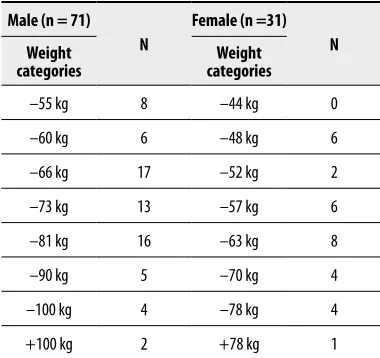
consent was obtained from the parents, subjects and coaches before participation. The research was undertak-en in compliance with the Helsinki Declaration. Juniors’ competition experience was similar (7 to 8 years). The subjects were divided by gender and into weight cate-gories (Table 1).
They were selected by following criteria:
• Having federal license to the Galician Federation of Judo and Associated Sports from the period of 2007–2008.
• Being born in 1989, 1990, 1991, or 1992, which are the birth years included in the junior category (un-der 20 years of age) at the time of the study. • Participate in the Junior Championship of Galicia
held in Ferrol on February 2, 2008.
Procedures
The maximal hand-grip strength of both hands was mea-sured with a hand dynamometer (GRIP-D TKK 5401, Takei Scientific Instruments CO). The subjects were standing comfortably with the shoulder adducted. The dynamometer, which had been previously adjusted to the size of their hand, was held freely without support; it was not touching the subject’s trunk. The position of the hand remained constant, with a downward di-rection. The palm did not flex on the wrist joint. The subjects were required to exert maximal strength on the dynamometer (maximal voluntary contraction) for 5 seconds. All subjects performed 3 trials, and the best performance was used in both hands.
Basic demographic data and information about the athletes’ gender, individual’s year of birth, competi-tion weight categories, the result obtained in the com-petition and lateral dominance of the competitor were
Male (n = 71) N
Female (n =31) N Weight
categories categoriesWeight
–55 kg 8 –44 kg 0
–60 kg 6 –48 kg 6
–66 kg 17 –52 kg 2
–73 kg 13 –57 kg 6
–81 kg 16 –63 kg 8
–90 kg 5 –70 kg 4
–100 kg 4 –78 kg 4
+100 kg 2 +78 kg 1
Table 1. Number of subjects (n=102) in different weight categories.
Hand-grip strength – the ability to exert force while grasping an apparatus with one hand [25].
Non-sport confrontation – defensive fight or destructive struggle, as individual cases hand-to-hand fight [26] – also i.e. street fighting [27].
collected. Hand dominance was determined by asking the subject which hand was used to hold a pencil and to throw a ball [21]. The measurement of weight was tak-en in cooperation with the committee of judges (weigh-ing commission). Sport achievements was determined as the dependent variable, where 0 represents not obtain-ing a medal, 1 corresponds to winnobtain-ing the gold medal, 2 with silver, and 3 with bronze.
Statistical analysis
All values were reported as mean ±SD. Gender, weight categories, handgrip strength, lateral dominance and sport achievements were assessed via a general linear model with repeated-measures analysis of variance (ANOVA) to compare han-dgrip strength and gender, sport achieve-ments. Additionally, a Levene test for homogeneity of variances was completed on each dependent variable dur-ing the ANOVA, and, in each case, homogeneity of vari-ance was found. When the data were not normally dis-tributed, the Friedman ANOVA followed by the Wilcoxon signed-rank test was used. When a significant F ratio was achieved, post hoc comparisons were completed using a Tukey HSD least significant difference. For all tests, the significance level was set at p<0.05. The analyses were done using SPSS 15.0 (SPSS Inc. Chicago, IL).
r
esultsAs seen in Table 1, of the 102 subjects analyzed, many more participants pertained to the middle weight class than to either the light or the heavy weight classes. En the case of the males, 17% of the individuals, that is to say nearly a quarter of all of the male participants, be-longed to the –66 kg category. In the female category, the most relevant data is the low participation at the regional level since there are three weight categories in which less than 4 judokas participate.
Junior category (under 20 y) were judokas born be-tween 1989 and 1992. The age distribution is so that the greatest representation is among the youngest in the category with 33.33%, followed by those born in 1991 – a total of 32 competitors – totally 31.37% of the participation. The remaining was distributed very closely among the veterans of 1989 with 15.69%, and those born in 1990 representing 19.61% of the total.
The percentage of right-handed participants (N=102) in the competition was notably higher than that of left-handed competitors. The 75% of athletes were right-handed, 20% left-handed and just 5% ambidextrous. Dominant hand show more hand-grip strength than non-dominant (439±90.56 Newton (N), 421±90.56 N; p=0.000 respectively) – Figures 1 and 2.
Both, males and females, show more handgrip strength in dominant than non-dominant hand (481±69.43 N vs. 464±67.38 N; p=0.000 and 343±52.38 N vs.
323±51.46 N; p=0.000 respectively). In handgrip strength in both hands by gender, male show more handgrip strength than female (472.63±64.94 N and 333.16±50.81 N; p=0.000 respectively).
Figure 3 shows the grip strength according to compe-tition placement achieved and lateral dominance. The latter are prevalent in all of the medal ranking, however
% 15
10
5
0
200 300
6.86 7.84
4.9 3.92
2.94 1.96 1.96
6.86 6.86
9.810.78 13.73
400
Newtons500 600 700
Figure 1. Percentage of grip strength of dominant hand. All subjects (N=102).
% 15
10
5
0 200
1.96 1.96
4.9
3.92 2.94
0.98 0.98
9.8 9.8
7.84 7.84 14.71
10.78
5.88
300 400
Newtons500 600 700 7.84
Figure 2. Percentage of grip strength of non-dominant hand. All subjects (N=102).
Newtons
600
500
400
300
200
100
0
Right Left Ambidextrous
39
15 12 10 7 8 4
3 2
2 No Medal Bronze Silver Gold Number of peopole
Figure 3. Hand-grip strength (in Newton) by lateral dominance and sport achievements.
the percentage of left-handed participants who receive bronze stands out from those obtained by other medals.
Figures 4 and 5 shows the level of strength according to gender and weight class. Male show statistically signif-icant differences (p<0.05) in favor higher weight class-es (–55 kg, 403.68±42.68 N vs. –81 kg, 491.78±57.72 N; –90 kg, 522.6±45.25 N; –100 kg, 536.5±71.85 N;
+100 kg, 574.25±58.33 N). However, the differences in the female divisions were not statistically significant.
Table 2 shows handgrip strength for each gender divi-sion according to the sport achievements.
Differences in hand-grip strength among the different sport results achieved was statistically different in fe-male (p=0.001) but not in fe-male (p=0.198). Concretely, Sport achievements Gender N Min. (N) Max. (N) _x (N) SD P
Gold
Female 7 333 460 385.57 50.60
0.031
Male 8 366.5 594.5 469.06 77.66
Total 15 333 594.5 430.1 77.28
Silver
Female 6 318.5 455 351.67 51.95
0.001
Male 8 409 644 518.19 80.45
Total 14 318.50 644 446.82 108.80
Bronze
Female 10 261 363 309.35 32.84
0.000
Male 13 351.5 606 474 61.66
Total 23 261 606 402.41 97.36
No medal
Female 8 273 346 303.19 26.07
0.000
Male 42 313 581 464.21 58.92
Total 50 273 581 438.45 80.98
Table 2. Hand-grip strength and sport achievements by gender.
(N) – Newton.
Mean 95% CI P
Gold
No medal 82.38 25.65 139.12 0.003
Bronze 76.22 22.19 130.25 0.003
Silver 33.91 –27.09 94.89 0.439
Silver No medal 48.48 –10.73 107.68 0.138
Bronze 42.32 –14.29 98.93 0.197
Bronze No medal 6.16 –45.84 58.16 0.988
Table 3. Hand-grip strength (Newton) and sport achievements in female (N=31).
CI – Confidence Interval.
Newtons
600
500
400
300
200
100
0
-55 kg -60 kg
8 6
5 4 2
17 13 16 Number of people
-66 kg Dominant Non-dominant
-73 kg -81 kg -90 kg -100 kg+100 kg
Figure 4. Male handgrip strength (N) by weight categories.
Newtons
600
500
400
300
200
100
0
-48 kg -52 kg
6 6 8
4 4
1
2
-57 kg -63 kg -70 kg -78 kg +78 kg Number of people
Dominant Non-dominant
Figure 5. Female handgrip strength (N) by weight categories.
in female competitors, these differences were found when comparing gold with bronze and not won med-al (Table 3).
d
icussionIn interpreting the findings related to grip strength of a judoka and its possible influence on performance, the consulted bibliographic documents showed that the av-erage obtained grip strength in both male and female divisions was very similar to those presented by other authors in the scope of judo [9,10] and outside of it [2– 4,7,8]. The observed average strength recorded for fe-males is very similar to that presented by Little [24] in a similar study. Regarding the level of strength observed in males, it was confirmed that it is higher than that of women. This data coincides with research articles of the same nature both within the field of judo [9–11,22] and in other athletic disciplines [8,23].
Some research discards the notion that predominance to the left side is not beneficial in itself. This is based namely on the fact that by being a minority left-hand-ed athletes of various athletic disciplines must adapt to playing with or competing against a right-handed oppo-nent. Left-handed athletes therefore often tend to sur-prise their rivals [24].
Even when the highest percentage of competitors are right-handed – both in competition and in the medal-ling positions – a noteworthy relationship can be made about the left-handed judokas that receive bronze med-als from those that obtained other medmed-als in our study. Corroboration with research by Sterkowicz et al. [16], shows that those who hate a left side dominance have a significantly improved chance of winning medals.
As for the higher levels of strength recorded in the dom-inant hand, the data are consistent with that which has been established by Franchini et al. [10], but disagrees with that presented by Carballeira and Iglesias [11].
The results show that participants pertaining to heavier weight classes presented greater levels of strength than did those of the lighter weight classes. It can therefore be stated that significant differences exist for strength according to the weight class in which one competes.
The relationship between grip strength and performance for the male division showed no significant differences. It can thus be stated that such a relationship did not exist. This is unlike in the data obtained in the study of Dri et al. [18], in which the medal placement achieved meant a better performance in all motor tests performed when compared to non-medalists. However, in the results of our study in the female division, these differences did exist between the level of grip strength and the position achieved in the competition. This aspect was confirmed by comparing the strength of the female competitors that obtained gold and silver medals with those that achieved bronze medals or did not win a medal at all. This allowed us to see the relationship between performance and grip strength among females, as was observed in the afore-mentioned study [18]. Although the differences in mo-tor skills among the female judokas with more and less success were not as pronounced as in the males, it can be concluded that the most successful judokas, in gener-al, have better cognitive skills, coordination, and greater strength than those with less success competitively, an aspect similar to our study. The results lead to repeating the importance of both gripping in competition [19], and the application of strength [9–12,25].
c
onclusionsThe results show that there is no basis to consider indica-tor hand-grip strength as the information, on which ba-sis it is possible to predict the results in the judo compe-tition. However, it has been proved that female concede male at statistically significant levels of grip strength, which may be relevant in cases of non-sport confronta-tion when the woman is forced to defence an attack of the man (the aggressor).
1. España-Romero V, Ortega FB, García-Artero E et al: Performance, anthropometric and muscle strength characteristics in Spanish elite rock climb-ers. Selección, 2006; 15(4): 176–83 [in Spanish, English abstract]
2. Gobbi AW, Francisco RA, Tuy B, Kvitne RS: Physiological characteristics of top level off-road motorcyclists. Br J Sports Med, 2005; 39(12): 927–31
3. Grant S, Hynes V, Whitaker A, Aitchison T: Anthropometric, strength, endurance and flexibil-ity characteristics of elite and recreational climb-ers. J Sport Sci, 1996; 14(4): 301–9
4. Barrionuevo JM, Fructuoso D, Hernández E, Martínez I: Maximal strength and endurance hand grip in Tornado sailor. Apunts: Medicina de l’Esport, 2007; 42(156): 161–68 [in Spanish, English abstract]
5. Adam M: Effectiveness of techniques performed by outstanding judo competitors. Research Yearbook, 2007; 2(13): 216–20
6. Franchini E, Sterkowicz S, Meira CM et al: Technical variation in a sample of high judo players. Percept Motor Skill, 2008; 106(3): 859–69
7. Fleming JC, McGregor AH: Forearm Muscle Profiles in Tennis Players. Isokinet Exerc Sci, 2005; 13(2): 147–51
8. España-Romero V, Artero EG, Ortega FB et al: Physiology of sport climbing. Rev Int Med Cienc Act Fís Deporte, 9(35): 264–98 [in Spanish, English abstract]
9. Thomas S, Cox MH, Legal YM: Physiological pro-files of the Canadian national judo team. J Sport Sci, 1989; 14(3): 142–47
10. Franchini E, Yuri M, Matheus L, Brito DE, Peduti MA: Composiçao corporal, somatotipo e força iso-métrica em atletas da seleçao brasileira universitária de judô. Ámbito Medicina Desportiva, 1996; (8): 21–29 [In Portuguese, English abstract] 11. Carballeira E, Iglesias E: Acute effects of the
judo fight: multiparametric analysis. Motricidad. European Journal of Human Movement, 2007; 19: 117–44 [in Spanish, English abstract]
r
eferences:
12. Leyk D, Gorges W, Ridder D et al: Hand grip strength of young men, women and highly trained female athletes. Eur J Appl Physiol, 2007; 99(4): 415–21
13. Ao Y, Kajiyama H, Takeuchi Y et al: The statistical structure of special techniques among the throw-ing techniques of judo. Japanese Journal of Physical Education, 1988; 4(32): 241–48
14. Sterkowicz S, Franchini E: Techniques used by ju-doists during the World and Olympic tournaments 1995–1999. Human Movement, 2000; 2(2): 24–33 15. Franchini E, Sterkowicz S: Tactics and techniques
in high level judo competition (1995–2001): con-siderations about weight category and gender. Revista Mackenzie de Educaçao e Esporte, 2003; 2(2): 125–38 [In Portuguese, English abstract] 16. Sterkowicz S, Lech G, Blecharz J: Effects of
later-ality on the technical/tactical behavior in view of the results of judo fights. Arch Budo, 2010; 6(4): 173–77
17. Carratalá V, García J, Fernándes L, López A: Effective ways of struggles applied by teenage female judoka during Spanish Judo Cadets Championship. Arch Budo, 2010; 6(1): 39–44.
18. Drid P, Bala G, Obadov S: The differences in mo-tor and cognitive abilities between the more and less successful 12–14 years old judokas. Arch Budo, 2010; 6(2): 95–100
19. Adams N, Ferrie E: Agarres: técnicas maestras de judo. Barcelona: Paidotribo. 1991 [in Spanish] 20. Uzawa T: Pedagogía del judo. Valladolid: Miñón;
1981 [in Spanish]
21. Ager CL, Olivett BL, Johnson CL: Grasp and pinch strength in children 5 to 12 years old. Am J Occup Ther, 1984; 38: 107–13
22. Little NG: Physical performance attributes of ju-nior and seju-nior women, juvenile, juju-nior and seju-nior men judokas. J Sports Med Phys Fitness, 1991; 31: 512–20
23. Giles LV, Rhodes EC, Taunton JE: The physiology of rock climbing. Sports Med, 2006; 36(6): 529–45 24. Zurita F, Fernández R, Rojas FJ, Cepero M: Manual
laterality and geographic variables, anthropometri-cal and functional spinal. Rev Int Med Cienc Act Fís Deporte, 2010; 10(39): 439–57 [in Spanish, English abstract]
25. Franchini E, Miarka B, Matheus L, Del Vecchio FB: Endurance in judogi grip strength tests: compari-son between elite and non-elite judo players Arch Budo 2011; 7(1): 1–4
26. Kalina RM: Teoria sportów walki. COS. Warszawa, 2000 [in Polish]
27. Pérez-Gutiérrez M, Gutiérrez-García C, Escobar-Molina R. Terminological recommendations for im-proving the visibility of scientific literature on mar-tial arts and combat sports. Arch Budo, 2011