Efficient Garbage Management System for
Smart Cities
K.Nagalingeswari1, Krishna Prasad Satamraju2,
Project student Department of E.C.E, Vasireddy Venkatadri Institute of Technology, Nambur, AP, India Asst.professor,Department of E.C.E, Vasireddy Venkatadri Institute of Technology, Nambur, AP, India
Abstract-- Even though we have different waste management services, they prove to be inefficient because of the lack of standard operating methods both collection-wise and logistics-wise. We present a novel method for waste collection management system. This system uses Internet of Things architecture. To ensure a robust, seamless system, we continuously monitor the dust bins and check the status of the amount of garbage filling up in the bins and when it reaches threshold level, alert will be triggered. Based on the alert, the optimized route will be calculated and sent to the garbage collection centre. The system is built using LolinNodeMCUIoT board, and Ultrasonic sensor module. With integrated route optimization, the system is made fuel efficient and effective resource management can be achieved. The compact design makes the system more reliable and accurate.
Keywords— GPS, Internet of things (IoT), Lolin NodeMCU, Waste Management.
1. INTRODUCTION
Waste management is all the activities and actions required to manage waste from its inception to its final disposal [1]. This includes collection, transportation, treatment and disposal of waste together with monitoring and regulation. Waste collection methods vary widely among different countries and regions. Domestic waste collection services are often provided by local government authorities.
Curb side collection is the most common method of disposal in most countries, in which waste is collected at regular intervals by specialized trucks. Waste collected is then transported to an appropriate disposal area. Now days, cities with developing economies experience exhausted waste collection services, in adequately manage dandun controlled dump site sand the problems are worsening [2]. Waste collection method in such countries is an on-going challenge and many struggle due to weak institutions and rapid urbanization. At present, the volume of generation of municipal solid waste (MSW) is increasing very highly with the increase of population, economic uprising, industrial development, change in consumption habit and life style of urban population. It became a great
challenge to manage MSW to the authorities in charge for waste management. Due to the lack of proper management solution, a considerable amount of 85% of the total MSW management budget is exhausted on waste collection and transportation. As a result, the improvement of the solid waste management system is much needed in recent time which requires a well-organized and proper way to monitor the status of solid waste bin in real time whereas confirming green environment and viable advance of the society.
Smart cities have been identified as a promising potential application domain for the Internet of Things, with a wide range of possible services that can benefit city administration
and citizens alike. One service that can be provided in a smart city is smart waste management. Public trash cans detract from the surrounding environment when they are full for long period soft time. On the other hand, it can be an expensive operation to send garbage truck to every trash can in the city; if cans are empty, the journey accomplishes nothing. Cities develop rough algorithms for minimizing cost of various municipal services such as collecting trash, but Internet of Things sensors can improve the services by notifying relevant public works officials when particular trash cans are full.
The so-called “intelligent bins” represent the more commonly acknowledged, example of feasible waste-related project in the context of Smart Cities. Nevertheless, smart waste management should be intended as well-beyond the simple installation sensors on bins, and it should
field of circular economy, the future directions envisaged for Smart Cities should be targeted towards industrial symbiosis, by development and implementation of tools for regenerative systems and symbiotic business links.
II.LITERATURE SURVEY
Multi-National Companies like Enevo, Compo logy, Big belly, Ecube Labs and Citibrain are working in this area globally. The technologies developed so far are still under prototyping. At International level, some of Municipal corporations in various countries are implementing at pilot scale for collection, operation and maintenance of solid waste management using IOT.
In [3], a system of integration of Radio Frequency Identification (RFID) and communication technologies for solid waste bin and truck monitoring system. RFID, GPS, GPRS and GIS along with camera technologies have been integrated and developed the bin and truck intelligent monitoring system. The experimental results showed that the performance of the developed system was stable and satisfied the monitoring system with high practicability and validity.
In [4], a new architecture is proposed with the aim to improve the on-site handling and transfer optimization in the waste management process. Architecture in this system is based on sensor nodes and makes use of Data Transfer Nodes (DTN) in order to provide to a remote server the retrieved data measurements from the garbage bins filling. A remote monitoring solution has been implemented, providing user the possibility to interact with the system by using a web browser. Several activities with the aim to provide a Decision Support System (DSS) able to find solutions for resources organization problems linked to solid waste management have been started. authors described a system to monitor the air pollution levels at the different geographic locations. So that proper measures can be taken to prevent the environmental damage due to air pollution. The proposed pollution monitoring system consists of a Mobile Data-Acquisition (DAQ) unit and database unit. The Mobile data- Acquisition DAQ unit integrates a single-chip micro controller, air pollution sensors array (CO sensor),(SO2 sensor),(NO2 sensor), a Global System for Mobile Communications Modem (GSM-Modem), and a Global Positioning System Module (GPS-Module). The Mobile-DAQ unit gathers air pollutants levels and packs them in a frame with the GPS physical location and time. The frame is subsequently uploaded to the GSM-Modem and transmitted to the database via the public mobile network for the research analysis purpose.
Carbon Dioxide and Carbon Monoxide using semiconductor gas sensors and also measures
humidity, temperature, pressure etc. The data from the sensors are processed by using Raspberry Pi2 and sensor values are uploaded to the internet using IoT technology. This system will send alert message to relevant authorities and peoples when concentrations of harm full gases reaches permissible levels using GSM Modem/internet SMS gateway. This system has given access to everyone who wish to know the concentration of gases emitted from landfill site or industrial area by sending a request message to the system.
The proposed system uses Internet of Things as the medium to establish communication between garbage bin sites and collection centre. The complete system is well designed and meets the industrial and international waste management standards.
Fig1.Overall System Block Diagram
Shows Fig1 the system block diagram of smart waste management. By applying Internet of Things to waste management, the efficiency of the system can be improved to a greater extent. The solution we developed comprises of three modules.
(1) Bin Monitoring Module
(2) Internet and Communication Module
(3) Optimization Module (Software)
Specially designed bins equipped with GPS module and a microcontroller interfaced with Wi-Fi modules are placed at various locations in the city. An ultrasonic sensor is used to find the status of the bin filled. The GPS module will give the location of the dust bin. The microcontroller will read the bin filled status from the UV sensor. This information is processed and then framed in a suitable format for posting this data into the cloud along with its latitude and longitude values.
receive a notification. Then an optimized route is calculated from the garbage college office to the notified bin in such a way that more numbers of bins are collected in that route. In this way, time and fuel can be saved.
III. PROPOSED DESIGN MENTHODOLOGY
The proposed system uses the hybrid methodology, a combination of Water fall model and agile model, is used for the development of the project and is shown in Fig 3.3.
Automation of solid waste collection and disposal is an important application of Internet of Things. This technology finds applications in the following areas.
Monitoring Solid Waste generation: Smart dustbins will help to monitor rate of waste generation, status of quantity waste in dustbins in various places in City. Public and Municipal corporations authorities, contractor can accessible through IOT Technology.
Collection And Transportation Of Waste: Solid waste generation data from city interfaced with software of transportation problem to
identify optimum routes throughout day and night depending rate of generation. This information will helpful to Municipal Engineers, contracts and track drive to minimize cost of transportation and reduce environmental quality deterioration around dust bins.
Fig2. Design Methodology
Monitoring performance of Landfill sites:
The performance of landfill site will be measured in terms of C02, CH4, temperature,
humidity, etc using IOT Technology. The data will help to Engineers in to order improve process of solid waste conversion and to avoid environmental hazards due to gases and air pollutants. This data can
be used to design appropriate land disposal sites for disposal waste in future
The proposed technology mainly to To prevent spreading of diseases due
improve collection and disposal of solid waste
To monitoring solid waste generation, collection and disposal using IOT
To monitoring and controlling process in Landfill sites using IOT
To reduce cost operation and maintenance of solid waste management.
To develop Eco-friendly Solid waste management Program.
B.HARDWARE 1) Lolin Nodemcu
Fig3.shows Lolin Node MCU pin configuration. It includes firmware Node MCU is an open-source IoT platform. It includes firmware which runs on the ESP8266 Wi-Fi SoC from Espressif and hardware which is based on the ESP-12 module. The term Node MCU by default refers to the firmware rather than the development kit. The firmware uses Lua scripting language which is built on the Espressif Non-OS SDK for 8266. It uses many open source projects, such as lua-cjson, and spiffs.
2) Esp8266 Arduino Core
As Arduino.cc began developing new MCU boards based on non-AVR processors like the ARM/SAM MCU and used in the Arduino Due, they needed to modify the Arduino IDE so that it would be relatively easy to change the IDE to support alternate tool chains to allow Arduino C/C++ to be compiled down to these new processors. They did this with the introduction of the Board Manager and the SAM Core. A "core" is the collection of software components required by the Board Manager and the Arduino IDE to compile an Arduino C/C++ source file down to the target MCU's machine language. Some creative ESP8266 enthusiasts have developed an Arduino core for the ESP8266 WiFiSoC that is available at the GitHub
C. SOFTWARE
The following software has been used in the design of the project.
1) Arduino IDE
Arduino Software (IDE) - contains a text editor for writing code, a message area, a text console, a toolbar with buttons for common functions and a series of menus. It connects to the Arduino and Genuino hardware to upload programs and communicate with them.
2) Writing Sketches
Programs written using Arduino Software (IDE) are called sketches. These sketches are written in the text editor and are saved with the file extension in to. The editor has features for cutting/pasting and for searching/replacing text. The message area gives feedback while saving and exporting and also displays errors. The console displays text output by the Arduino Software (IDE), including complete error messages and other information. The bottom right hand corner of the window displays the configured board and serial port. The toolbar buttons allow you to verify and upload programs, create, open, and save sketches, and open the serial monitor.
Get the latest version from the download page. You can choose between the Installer (.exe) and the Zip packages. We suggest you use the first one that installs directly everything you need to use the Arduino Software (IDE), including the drivers. With the Zip package you need to install the drivers manually. When the download finishes, proceed with the installation and please allow the driver installation process.
IV.RESULTS
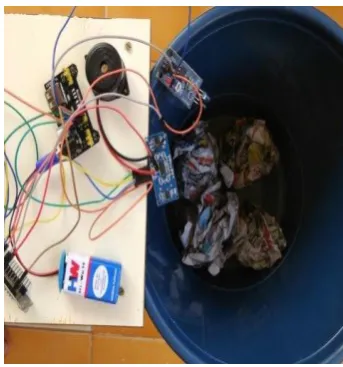
The experimental set up of the Smart Waste Management system is shown in Figure 4
Fig4.Smart Waste Collection Bin
Normal bin is used for the prototype purpose. We made a temporary arrangement of the module on a plank and integrated suitably the module to the bin. The ultrasonic sensors are placed on top of the bin. A buzzer is set to indicate the threshold level. We have to continuously monitor the dust bins and check the status of the amount of garbage filling up in the bins. When the threshold point (say 80 or 90% filled) is reached, it has to trigger an alert to the central management office, indicating that it is time for the garbage collection at that bin point. You have to take utmost care in this step to avoid false alarms i.e., reading a wrong status. These false alarms can be triggered because of uneven filling of the bin. A buzzer is beeped in such case.
Figure 5.Bin Level at ThingSpeak.com
Allowing Thing Speak users to analyze and visualize uploaded data using Matlab without requiring the purchase of a Matlab license from Math works. Thing Speak has a close relationship with Math works, Inc. In fact, all of the Thing Speak documentation is incorporated into the Math works' Matlab documentation site and even enabling registered Math works user accounts as valid login credentials on the Thing Speak website. The terms of service and privacy policy of ThingSpeak.com are between the agreeing user and Math works, Inc.
We have created a channel in Thing Speak server to post our data of the bin fill level in percentage. We have to carefully calibrate the level of the bin with respect to sensor to avoid any further problems of wrong triggering. The status of the bin fill is shown in Fig 5
We then use Matlab for simulating the Dijkstra’s shortest path finding algorithm. We demonstrated the algorithm using some set of predefined nodes.
V.CONCLUSION
In this paper, we proposed a working proof of concept for a smart waste management that can sense trash level and notify necessary city workers over the cloud. Ultrasonic distance readings are a reasonably reliable way to gather this data, though they are inconsistent when faced with complex surfaces. With our cost and power analyses, we also determine that this system can be made much cheaper and more power efficient. System cost can be reduced from that of our prototype implementation. Sleep modes can also be implemented, reducing power consumption of the system. In solid waste management system, collection of solid waste is the most important process for total disposal costs. In order to decrease total solid waste disposal costs. It is necessary to performed route optimization on current solid waste collection paths. We have used shortest path routing algorithm to calculate the distance from the central garbage collection office to the bin, in such a way that the collection vehicle covers more number of bins in that route. This optimization of collection route is helpful in effective utilization of fuel and thereby provides economic collection management. By using this method the collection of waste in the city becomes more easier. It helps in reducing air pollution, traffic flow, man power, time and money. Further this system can be expanded and implemented over a large scale to provide more reliable and efficient smart waste collection and management system for smart cities.
REFERENCES
1. Glossary of Environment Statistics: Series F, No. 67 / Department for Economic and
2. Social Information and Policy Analysis, United
Nations. New York: UN, 1997.
3. United Nations Environmental Program me (2013). “Guide lines for National Waste Management Strategies Moving from Challenges to Opportunities." 4. D. C. Wyld, “Taking out the trash (and the recyclables): RFID and the handling of municipal solid waste,” International Journal Of software Engineering & Applications (IJSEA), vol. 1, no. 1, pp. 1–13, 2010. 5. Longhi, S., Marzioni, D., Alidori, E., BuÒ, G. D.,
Prist, M. Grisostomi, M., and Pirro,(2012) M. “Solid waste management architecture using wireless sensor network technology”, in New Technologies, Mobility and Security (NTMS), 5th International Conference on (PP. 1-5), IEEE, 2012.
6. Al Mamun, M. A., Hannan, M. A., and Hussain,(2014) A. “A Novel prototype and Simulation Model for Real Time Solid Waste Bin Monitoring System”, Jurnal Kejuruteraan, 26 . pp. 15-19. ISSN 0128-0198. 7. Catania, V., and Ventura, D. “An approach for
monitoring and smart planning of urban solid waste management using smart M3 platform”, in Open Innovations Association FRUCT, Proceedings of 15th Conference of IEEE (PP. 24-31), 2014.
8. Glouche, Y., Sinha A., and Couderc, P. “A Smart Waste Management with Self- Describing Complex Objects”, International Journal on Advances in Intelligent Systems, 8 (1 &2), 2015.
9. KirtiPille, RaziyaManiyar, Nutan Bade and J.M.Bakliwal (2016) “SOLID WASTE MANAGEMENT SYSTEM”, National Conference on “Internet of Things: Towards a Smart Future” & “Recent Trends in Electronics & Communication” (IOTTSF-2016), in Association with Novateur Publication 17th -18th, Feb. 2016.
10. M. Faccio, A. Persona, and G. Zanin,(2011) “Waste collection multi-objective model with real time traceability data” Waste Management, vol. 31, no. 12, pp. 2391-2405.
11. Md. Shafiqul Islam, Maher Arebey, M.A. Hannan, HasanBasri (2012), ZigBee Based Waste Bin Monitoring System , 2012 International Conference on Innovation, Management and Technology Research (ICIMTR2012), Malacca, Malaysia,21-22 May, 2012. 12. Mihajlovic Z, Milosavljevic V, Maodus N, Rajs V,
Slankamenac M, Zivanov M (2012)System for monitoring concentration of NO2 and CO gasses on landfill sites. In: Proceedings of the 35th international convention MIPRO, Opatija, Croatia, pp 183–186, 21– 25 May 2012.
13. M. F. Omari et.al (2016) Implementation of Spatial smart waste management system in Malaysia presented in 8th IGRSM International Conference and Exhibition on Remote Sensing and GIS (IGRM-2016),IO
14. P conf. series: Earth and Environmental Science 37(2016).
15. Hassan et.al (2016) Smart solid waste Monitoring and Collection system, published in International Journal of Advanced Research in computer science and software Engineering, vol 6, Issue 10, October 2016. 16. Kanchan Mahajan,“Waste Bin Monitoring System
Using Integrated Technologies”, International Journal of Innovative Research in Science, Engineering and Technology, Issue 3, Issue 7 , July 2014.
17. M. Al-Maaded, N. K.Madi, RamazanKahraman, A.Hodzic, N. G. Ozerkan , An Overview of Solid Waste Management and Plastic Recycling in Qatar, Springer Journal of Polymers and the Environment, March 2012, Volume 20, Issue 1, pp 186-194. 18. Islam, M.S. Arebey, M. ; Hannan, M.A. ; Basri,
H,”Overview for solid waste bin monitoring and collection system” Innovation Management and Technology Research (ICIMTR), 2012 International Conference , Malacca, 258 – 262.
City”, International Journal of Scientific & Engineering Research, Volume 6, Issue 9,September-2015.
20. Manjula S, Ajay Kumar Reddy P, Lakshmipathy M, Bhaskar Reddy K (2013) Mobile data acquisition for air pollution monitoring using embedded system. IJERT.