American Journal of Nursing Science
2013; 2(3): 33-39Published online July 20, 2013 (http://www.sciencepublishinggroup.com/j/ajns) doi: 10.11648/j.ajns.20130203.13
Developing smoking cessation program for older
Canadian people: an application of Precede-Proceed
model
Khaldoun M. Aldiabat
1, *, Carole-Lynne Le Navenec
21
School of Nursing, University of Northern British Columbia, 3333 University Way,Prince George, BC, V2N 4Z9, Canada
2
Faculty of Nursing, University of Calgary, 2500 University Drive N.W, Calgary, AB, T2N 1N4, Canada
Email address:
[email protected](K. M. Aldiabat), [email protected](C. L. L. Navenec)
To cite this article:
Khaldoun M. Aldiabat, Carole-Lynne Le Navenec. Developing Smoking Cessation Program for Older Canadian People: An Application of Precede-Proceed Model. American Journal of Nursing Science Vol. 2, No. 3, 2013, pp. 33-39.
doi: 10.11648/j.ajns.20130203.13
Abstract:
Precede-Proceed model is a flexible and appropriate to develop a smoking cessation/prevention program. The
main purpose of this paper is to develop a preliminary hypothetical health promotion program that is focused onsmoking cessation / prevention for older Canadian people who smoke and live in nursing homes to improve their quality of life. It is hoped that advanced-practice gerontology nurses in a range of health settings will be able to gain insights from this paper to help older Canadian people who smoke to quit tobacco consistently and effectively. However, because this model assumes that health behavior is a complex and multidimensional process, the advanced- practice gerontology nurses who will staff this kind of practice will be guided by this framework to use their educational and practical knowledge regarding health promotion and smoking cessation/prevention programs, critical thinking, communication skills, and decision-making abilities.Keywords:
Smoking Cessation, Smoking Prevention, Older People, Health Promotion, Gerontology Nurse,
Advanced Practice Nurse, Precede-Proceed1. Introduction
The prevalence and the negative influences of cigarettes smoking on the health of older people are well reported in the literature (British Columbia Ministry of Health, 2005, Edwards & Mawani, 2006, Health Canada, 2002). The prevalence of cigarettes smoking among North American older people (65 and older) was 12% (Kaplan, Newsom, & McFarland, 2002). Whereas the overall smoking prevalence among Unites States older population was 10.2 % (Doolan & Froelicher, 2008), the smoking rate among older Canadians was 9% (Public Health Agency of Canada, 2009). The highest smoking rate among North American older people has been found among Aboriginal Canadians aged 65 and older. According to Statistics Canada (2007), smoking rates among those older population were as the following: 22% among first nations, 22% among Métis, 36% among Inuit. Although there is no new smoking prevalence reports of older Canadians could be found, the
above are convincing statistics that the smoking rate among older Canadian people, especially Aboriginals is still high.
many medications commonly prescribed
people to make them over or less effective (Watt , Carosella, Podgorski, & Ossip-Klein, 2004,
2002).
Having discussed briefly the smoking related morbidity and mortality rates among let us turn now to discuss what are the health smoking cessation among those populations
the belief that it is too late for older people who smoke to quit, Husten et al. (1997) reported that
has a major and immediate benefits for smokers of all ages, and these benefits accrue to those who already have smoking- related diseases, as well as to those
Smoking cessation at any age reduces the overall risk of death” (pp. 175-176). Therefore, the smoking
programs for older people aims not only to decrease the mortality and morbidity rates caused by smoking, but also to improve the quality of life for those
Mawani, 2006, La Croix & Omenn, 1992
No studies or smoking cessation programs designed for older Canadian people who smoke at nursing homes could be found in the literature. Thus, the main purpose of this paper is to develop a preliminary hypothetical health promotion program that is focused on smoking cessation / prevention for older Canadian people who smoke
in nursing homes to improve their quality of life hoped that advanced-practice gerontology nurse
of health settings will be able to gain insights from this paper to help older Canadian people
tobacco consistently and effectively.
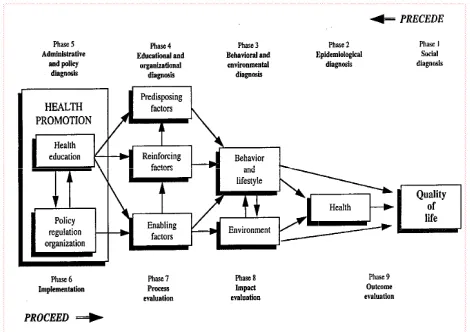
This program will be built on insights gleamed from the literature on health promotion, and organized in terms of the phases incorporated in the PRECEDE
model (see figure 1) (Green & Kreuter , 2005).
Figure 1. Generic representation of the PRECEED
Health Promotion, Planning and Evaluation (Green & Kreuter, 2005). Retrieved from www.google.ca
2. Precede-Proceed Model
In this section, the discussion will address the following three questions: (1) what is the PRECEDE
many medications commonly prescribed to the older to make them over or less effective (Watt , Klein, 2004, Health Canada,
smoking prevalence and rates among older people, what are the health benefits of among those populations? In contrast to the belief that it is too late for older people who smoke to reported that “quitting smoking immediate benefits for smokers of all ages, and these benefits accrue to those who already have related diseases, as well as to those who do not. Smoking cessation at any age reduces the overall risk of Therefore, the smoking cessation not only to decrease the mortality and morbidity rates caused by smoking, but also to improve the quality of life for those people (Edwards &
, 1992).
rograms designed for Canadian people who smoke at nursing homes could main purpose of this paper is to develop a preliminary hypothetical health smoking cessation / who smoke and live in nursing homes to improve their quality of life. It is gerontology nurses in a range of health settings will be able to gain insights from this who smoke to quit
insights gleamed from the promotion, and organized in terms of the phases incorporated in the PRECEDE-PROCEED
, 2005).
the PRECEED-PROCEED Model for (Green & Kreuter, 2005).
discussion will address the following three questions: (1) what is the PRECEDE-PROCEED
model? (2) Why has this model been considered as a possible to use for the development of a smoking cessation/ prevention program for older
and live in nursing homes? And, (3) how will this model be applicable for developing a health promotion program at the organizational (e.g., nursing homes and long facilities) level?
2.1. Firs Question: What Is The Model?
The Precede-Proceed model is a multi
framework developed by Lawerence Green and Marshal Kreuter over 40 years ago. It is used to assess health related behaviors and environments that affect health and quality of life needs, and to design, implement and
promotion programs that improve quality of life for those who need these programs (Green & Kreuter, 1991). In other words, it provides a comprehensive map for applying theories in evidence-based practice to plan and implement the most appropriate strategies that may solve health problems and improve quality of
1997).
Precede stands for Predisposing, Reinforcing, and Enabling Constructs in Educational Diagnosis and Evaluation. This part of the model serves as a diagnostic planning process that assists in developing health promotion programs, because it assumes that educational diagnosis must be identified before an intervention, just as the formulation of nursing diagnoses should precede nursing planning and intervention (Gielen & McDonald, 1997;Green & Kreuter, 1991). In 1991, the original authors added Proceed, which stands
Organizational Constructs in Educational and Environmental Development. This second part guides the implementation and evaluation of the programs designed using Proceed to develop an untraditional health promotion program that combined health education and the co (Green & Kreuter, 2005).
The Precede-Proceed consists of nine phases (
1, Precede-Proceed model) based on the premise “that health behaviors are complex, multidimensional, and influenced by a variety of factors” (Gielen & McDonald, 1997, p.360). Proceed involves five phases (phase one to phase five) whereas Proceed
six to phase nine). In the next two paragraphs, provide a brief description about each phase based on t work of Gielen and McDonald (1997) and Green and Kreuter (1991). A more detailed description and application of these phases will be discussed in the application section.
Consideration is given during phase one to determining the social problems or the quality of life needs of a given population. The task of phase two is to identify the health determinants of these problems and needs noted in
In phase three, attention is given to identify the behavioral and environmental determinants of the health problems. model? (2) Why has this model been considered as a possible to use for the development of a smoking cessation/ older Canadian people who smoke ? And, (3) how will this model be applicable for developing a health promotion program at e.g., nursing homes and long-term
: What Is The PRECEDE-PROCEED
model is a multi-theoretical based framework developed by Lawerence Green and Marshal Kreuter over 40 years ago. It is used to assess health related behaviors and environments that affect health and quality of life needs, and to design, implement and evaluate health promotion programs that improve quality of life for those who need these programs (Green & Kreuter, 1991). In other words, it provides a comprehensive map for applying based practice to plan and implement priate strategies that may solve health problems and improve quality of life (Gielen & McDonald,
stands for Predisposing, Reinforcing, and Enabling Constructs in Educational Diagnosis and Evaluation. This part of the model serves as a diagnostic planning process that assists in developing health promotion programs, because it assumes that educational diagnosis must be identified before an intervention, just as the formulation of nursing diagnoses should precede nursing planning and intervention (Gielen & McDonald, 1997;Green & Kreuter, 1991). In 1991, the original authors , which stands for Policy, Regulatory, and Organizational Constructs in Educational and Environmental Development. This second part guides the evaluation of the programs designed to develop an untraditional health promotion ombined health education and the contexts
consists of nine phases (see Figure ) based on the premise “that health behaviors are complex, multidimensional, and influenced by a variety of factors” (Gielen & McDonald, involves five phases (phase one to consists of four phases (phase six to phase nine). In the next two paragraphs, we will provide a brief description about each phase based on the work of Gielen and McDonald (1997) and Green and Kreuter (1991). A more detailed description and application of these phases will be discussed in the
Consideration is given during phase one to determining the social problems or the quality of life needs of a given population. The task of phase two is to identify the health determinants of these problems and needs noted in faze one.
American Journal of Nursing Science 2013; 2(3): 33-39 35
Predisposing factors (including information, attitudes, beliefs, values, and perception about the desired behavior change), enabling factors (including the contextual factors that facilitate or hinder the desired behavioral and environmental changes), and reinforcing factors (rewards and evaluation of others that may encourage or discourage continuing the desired behavior change) are identified during phase four. Phase five, the last phase in PRECEDE, pertains to the assessment of organizational policy, administrative facilitations, intervention alignment, and limitations that discourage implementation of the health promotion program.
In phase six, the interventions that were identified in phase five are ready now for implementation. Phases seven, eight, and nine entail process, impact, and outcome evaluation respectively. These evaluation techniques have been designed to assess certain tasks during the health promotion program. For example, process evaluation assesses if the program has been implemented according to planned protocol. Impact evaluation determines the effect of the intervention on the change in the behavioral and environmental factors. The final one is the outcome evaluation, which is designed to evaluate the major effects of the interventions on the health and quality of life of the target population.
Having addressed the first question (i.e., what is the PRECEDE-PROCEED model?), let us now turn to answer the second one (Why has this model been considered as a possible to use for the development of a smoking cessation/ prevention program for older Canadian people who smoke and live in nursing homes?).
2.2. Second Question: Why Has This Model Been Considered As A Possible To Use For The Development Of A Smoking Cessation/ Prevention Program For Older Canadian People Who Smoke And Live In Nursing Homes?
The Precede-Proceed model has been chosen to develop this program for two major reasons. First, this model provides clear steps to plan health promotion programs for actual or potential health problems and through the three levels of prevention (primary, secondary, and tertiary) (Green & Kreuter, 2005). For example, the Canadian Lung Association (CLA) has developed a national lung health framework to improve quality of life for those who have actual or potential respiratory health problem (CLA, 2008). Analysis of this framework shows clearly that it was developed based on the Precede-Proceed model because it starts from quality of life and social diagnosis and returns back to include the determinants of respiratory health status. Hence, maintenance of any health behavior change such as smoking among older Canadian people who smoke can be achieved by giving the same attention to both treatment and prevention.
Second, this model (precede-proceed) was built on numerous health and behavior theories such as health belief
model, health promotion model, and social learning theory (Green & Kreuter, 1991). Gielen and McDonald (1997) contended that the success and wide use of this model for developing health promotion programs is related to its strong theoretical base. Hence, it is expected that use of this successful theoretically-based model to develop a smoking cessation/prevention program for older Canadian people who smoke has many advantages. For example, using Precede-Proceed model not only contributes to the success of that program, but also convinces decision makers, stakeholders, fund supporters, and other partners regarding the benefits of building the health promotion program.
In summary, the above two factors provide strong indications for choosing the Precede-Proceed model to develop a smoking cessation/prevention program. However, because this model assumes that health behavior is a complex and multidimensional process, the advanced-practice gerontology nurse will also need multidimensional skills and knowledge from different sources to use this model for evidence-based health promotion practice (Green & Kreuter, 2005). Hence, the advanced- practice gerontology nurses who will staff this kind of practice must use their educational and practical knowledge regarding health promotion and smoking cessation/prevention programs, critical thinking, communication skills, and decision-making abilities. Some specific examples of these skills and abilities will be discussed next.
2.3. Third Question: How Will This Model Be Applicable for Developing a Health Promotion Program at the Organizational (e.g., Nursing Homes and Long-Term Facilities) Level?
The advanced-practice gerontology nurses and other program partners have a responsibility to determine the mission, vision, objectives, and action plan of the health promotion program. The following hypothetical material pertains to the formulation of the following: mission statement, vision, hypothesis, goal, objectives, and action plan of a smoking cessation/prevention health promotion program, which will be designed by nurses for older Canadian people who smoke in nursing homes.
2.3.1. The Vision
“Safe and healthy nursing home environment”
2.3.2. The Mission
“To enhance health and quality of life for all persons in the nursing home through developing a smoking cessation and prevention program to be delivered by advanced-practice gerontology nurses for older Canadian people who smoke”.
2.3.3. Hypothesis:
and morbidity rates related to smoking will be decreased , the environment of nursing home settings will become safer and healthier, the health and quality of life of other employees and people who do not smoke will be protected from second-hand smoke, and the productivity of the organization will be increased by reducing other risk factors that can be caused by smoking”.
2.3.4. Goal
“To cease and prevent smoking among older Canadian people who smoke and live in nursing homes”.
2.3.5. Objectives
The following are only examples of the salient objectives
2.3.5.1. (A) Outcome Objective
“Within five years of initiating the program, self reporting by older Canadian people who smoke and live in nursing home settings will indicate that 50% have completely quit smoking, 25% think they will quit smoking next year, 25% no longer smoke inside their rooms but in designed smoking rooms inside the nursing home, 100% of those who have never smoked still continue as non-smokers, and only 1 % of those who have quit smoking relapsed”.
2.3.5.2. (b) Process objective
“To prepare one small, private, equipped room inside the nursing home setting to be used as a clinic in which the advanced- practice gerontology nurses and related specialists provide counseling and other treatments that are culturally meaningful to the clients being served”.
3. The Action Plan for the Health
Promotion Program
In this section, we will discuss the action plan for this hypothetical smoking cessation and prevention program that is based on the nine phases of the PRECEDE-PROCEED model (Green & Kreuter, 2005; Gielen & McDonald, 1997). Insights for this action plan have been partially derived from the National Lung Health Framework for Canada (CLA, 2008).
3.1. Phase 1: Social Diagnosis: Assessing Quality of Life Concerns
During this phase, it is expected that advanced-practice gerontology nurses determine the perception of older Canadian people who smoke regarding their own needs or quality of life through multiple information-gathering activities. Example of these activities include knowledge about the social needs of older Canadian people who smoke from their perspective, and how various contextual factors in nursing home may influence their health and quality of life. In addition, these needs have been collected through different data collection methods. For example,
advanced-practice gerontology nurses assess the social needs by reviewing the literature, conducting individual sessions and/or focus groups, or through individual interviews, questionnaires and surveys, organizational files, social indicators, and organizational forums. Hence, to identify specific social diagnosis needs, advanced-practice gerontology nurses need to involve the older Canadians people in the nursing home who smoke, as well as other staff and people in nursing home because the issue of second-hand smoke and related concerns.
3.2. Phase 2: Epidemiological Diagnosis
Following the identification of the social needs of older Canadians people who smoke, as well as other staff and people in the nursing home, the second phase is concerned with assessing and identifying the epidemiological details of the smoking among older Canadians people who smoke in the nursing home and characteristics of those who are at risk related to smoking. For epidemiological diagnosis, advanced-practice gerontology nurses use surveys, data from the department records, and critical reviews of the literature for information regarding mortality and morbidity data as well as risk factors identified in the literature that assessed factors contributing to smoking among older Canadians people who smoke and live in the nursing home. Hence, knowing the epidemiological factors helps nurses to better address the health problem through strategies to control them.
3.3. Phase 3: Behavioral and Environmental Diagnosis
The aim of this phase is to determine the behavioral and environmental correlates of smoking among older Canadians people in the nursing home. Behavioral correlates are behaviors or lifestyles that contribute to their smoking pattern, whereas environmental correlates are social and physical factors that encourage those older persons to smoke. The delineation of these factors should first be accomplished with a thorough review of the literature related to the behavioral and environmental factors that contribute to smoking among older Canadians people in the nursing home. Literature review will help advanced practice gerontology nurses to identify health and environmental factors that contribute to the social needs through using a reductionist approach (i.e., from very general to specific factors). To illustrate, the advanced-practice gerontology nurses think about all behavioral and health factors that may influence smoking among older Canadians people who smoke in the nursing home in general, then choose the most factors that fit the situation.
American Journal of Nursing Science 2013; 2(3): 33-39 37
to older Canadian people who smoke to stop smoking within this nursing home setting?
The advanced practice gerontology nurse may be able to use the results of a study to determine what are the salient health behavioral and environmental factors that contributed to smoking among those people (e.g., relocation stress, nursing home and organizational conditions, social support, addiction...etc.) (Raphael, 2004).
Once the environmental and behavioral factors are delineated and discussed between the advanced-practice gerontology nurse and other program members (e.g., other health care providers, managers), it is helpful to prioritize them in terms of importance (more important/ less important) and changeability (more susceptible to change / less susceptible to change) (Green & Kreuter, 1991, p. 140). Objectives of smoking cessation / prevention programs must be formulated during this phase to achieve the outcomes of behavioral and environmental factors. Examples of these objectives were mentioned before (outcome and process objectives).
3.4. Phase 4: Educational and Organizational Diagnosis: Factors Affecting Health Related Behavior and Environment
This phase necessitates that the advanced practice gerontology nurse and other program team members identify predisposing, reinforcing, and enabling factors that increase the likelihood that behavioral and environmental changes will occur. In other words, predisposing, reinforcing, enabling factors that may affect smoking cessation/prevention program must be known before moving ahead in the program.
3.4.1 (a) The advanced-practice nurses and gerontology nurses assess the predisposing factors such as: knowledge, attitudes, beliefs, personal preferences, existing skills, and self-efficacy of older Canadians people in the nursing home who smoke as well as other staff nurses who are affected by their smoking. For example, advanced-practice gerontology nurses can use results from the literature to gain greater knowledge about the role of these factors in smoking. In addition, nurses also can ask the older Canadians people in the nursing home who smoke some focused questions to determine predisposing factors such as: Do you think you could stop smoking on your own? How would you describe your knowledge, skills, and self-confidence to quit smoking? Please tell me about your attitudes and beliefs about smoking and smoking cessation. 3.4.2 (b) Reinforcing factors refer to those factors that reward or reinforce smoking cessation/prevention. For example, the contextual factors in nursing homes settings in Canada (e.g., organizational, social, psychological, economical, and cultural factors) may act as reinforcing factors.
3.4.3 (c) Enabling factors guide the advanced-practice gerontology nurse to assess the motivation of older Canadians people in the nursing home who smoke, to
engage themselves in smoking cessation and prevention programs. In addition, nurses assess the environmental enabling factors that may encourage or discourage smoking cessation/ prevention such as: (1) accessibility and availability of resources for smoking cessation, (2) availability of cigarettes both inside and/or geographically close to the nursing home, (3)“No Smoking” signs, and (4) the nature of laws and policies regarding smoking and smoking cessation issued by Canadian government, agencies, and the nursing home.
3.5. Phase 5: Administrative and Policy Diagnosis: From Precede to Proceed
The fifth phase aims to identify the policies, resources, and circumstances within the nursing home settings that may facilitate or hinder increased smoking cessation/ prevention programs. During this phase, advanced-practice gerontology nurses assess the availability of human and material resources and make plans to Proceed with the program. For example, nurses will likely wish to assess the time (date) frame for accomplishment of each objective using a Gantt chart; types and numbers of personnel (e.g., behavioral and addiction nurse specialist; smoking cessation consultant nurses; and related support staff ) needed to carry out the program; material resources and supplies (e.g., educational materials; booklets and pamphlets; printers; lecture room; data show projector; counseling clinic; medical and pharmacological supplies such as Nicotine/ Cotinine urine test kit; nicotine gum or patches ); and the organization budget.
The salient barriers for implementing the smoking cessation/prevention program must be identified during this phase. Examples of such barriers include: commitment, attitudes, program familiarity of those who will implement the program, complexity of the program, and adequate space for conducting the program. Moreover, policies, regulations, and organization in Canadian nursing homes must be examined for fitness with the health promotion program plan.
Upon completion of this fifth phase, the advanced-practice gerontology nurse and other team members involved with the health promotion program can turn their attention to implement the second part of the model, which is referred to as PROCEED and consists of four phases: six, seven, eight, and nine.
3.6. Phase 6: Implementation
3.6.1 (a) Smoking cessation counseling: This type of intervention represents intervention at an individual level. In this case, the advanced practice gerontology nurses assess the readiness of change among older Canadian people who smoke in the nursing home using Prochaska and DiClemente’s (1983) Stages of Change Model. This model, which was developed by Prochaska and DiClemente over three decades, has become an influential theoretical model within the addiction behavior field. This model represents a motivational readiness continuum of changes toward healthy or unhealthy behaviors, and consists of six stages: pre-contemplation, contemplation, preparation, action, maintenance, and relapse (DiClemente, 2003; Prochaska & DiClement, 1983).
Depending on the client’s current stage of change, the nurse and client are able to decide which the most appropriate intervention for smoking cessation is. For example, they may select one or more of the following interventions: pharmacological (e.g., nicotine gum or patches), behavioral (e.g., group therapy), health education to increase client’s level of knowledge, and social support.
3.6.2 (b) The preventive intervention: Advanced-practice gerontology nurses may provide health education using appropriate communication skills that foster teaching-learning for the other people and employees who do not smoke, or for those who already quit about smoking risks and cessation benefits. Examples of teaching-learning strategies that these nurses may use are: lectures, pamphlets, flayers, and intra-organizational e-mail networks or social media.
Having discussed the implementation phase of this hypothetical health promotion program, let us now turn to discuss the evaluation phases (7, 8, and 9).
3.7. Process, Impact, and Outcome Evaluation (Phases 7, 8, and 9)
These final three phases of the PRECEDE-PROCEED model deal with process, impact, and outcome evaluation of the plan and intervention that were developed in earlier phases. First, a process evaluation should be conducted during the implementation of the smoking cessation/intervention program to ensure that the program was implemented according to plan. Second, an impact evaluation must be conducted to evaluate changes in predisposing, reinforcing, and enabling factors as well as changes in behavioral and environmental factors. Third, outcome evaluation measures the effect of the smoking cessation/ prevention program on health and quality of life for older Canadian people who smoke.
Advanced-practice gerontology nurses have a broad range of choices of evaluation models to evaluate the impact, process, and outcome of a smoking cessation/prevention program that is designed by advanced-practice gerontology nurses in Canadian nursing homes. One of the commonly used evaluation models is
“The logic Model for Planning Evaluation” (see McLaughlin & Jordan, 1999).
4. Conclusion
The goal of building an evidence-based smoking cessation/prevention program for older Canadian people who smoke and live in nursing home by the advanced-practice gerontology nurses is commendable at both individual and organizational levels. First, this program is expected to help older Canadian people who smoke to quit, improve their health by decreasing the risk of diseases and mortality rates caused by smoking. Hence, this smoking cessation/prevention program will likely create a healthy nursing home environment that protects others from exposure to the hazards of second-hand smoke, and thereby facilitate disease prevention and enhance quality of life. Second, the implementation of a smoking prevention program will enhance maintenance for older Canadian people have quit smoking, and encourage those who have never smoked (e.g., other people and employees) to continue as free of smoke and negative smoking, this prevention program will likely provide up-to-date knowledge for these populations in regard to: the major risks of smoking; effective smoking cessation protocols; and the salient benefits of cessation. Subsequently, these nurses may use this knowledge to treat and prevent smoking among older Canadian people who smoke.
References
[1] British Columbia Ministry of Health. (2005). Healthy aging through healthy living: Towards a comprehensive policy and planning framework for Seniors in B.C. Retrieved May
1st, 2011 from
http://www.health.gov.bc.ca/library/publications/year/2005/ healthy_aging.pdf
[2] Canadian Lung Association. (2008). the national lung health framework. Retrieved Feb.12, 2009, from http://www.lung.ca/about-propos/framework-cadre_e.php.
[3] Carosella, A. M., Ossip-Klein, D. J.,Watt, C. A., & Podgorski, C. (2002). Smoking history, knowledge, and attitudes among older residents of a long-term care facility. Nicotine & Tobacco Research, 4, 161–169.
[4] DiClemente, C. (2003). Addiction and change: How addictions develop and addicted people recover. New York: Guilford Press.
[5] Doolan, D. M., & Froelicher, E. S. (2006). Efficacy of smoking cessation intervention among special populations: Review of the literature from 2000 to 2005. Nursing Research, 55, S29–S37.
American Journal of Nursing Science 2013; 2(3): 33-39 39
http://www.phac-aspc.gc.ca/seniors- aines/altformats/pdf/publications/public/healthy-sante/vision/vision-eng.pdf
[7] Gielen, A.C., & McDonald, E.M. (1997). The PRECEDE-PROCEED planning model. In: K., Glanz, F.M, Lewis, & B.K. Rimmer (Eds.), Health Behavior and Education (2nd Ed.) (pp. 359-383). San Francisco, CA: Jossey-Bass Publishers.
[8] Green, L.W., & Kreuter, M. W. (2005). Health program planning: An educational and ecological approach (4th Ed.). New York: McGraw-Hill.
[9] Green, L.W., & Kreuter, M. W. (1991). Health promotion planning: An educational And environmental approach (2nd Ed.). Mountain View, CA: Mayfield Publishers.
[10] Health Canada. (2002). Healthy aging – tobacco use and smoking cessation among seniors.
[11] Husten, C. G., Shelton, D. M., Chrismon, J. H., Lin, T. -C. W., Mowery, P., & Powerll, F. A. (1997). Cigarette smoking and smoking cessation among older adults: United States, 1965–94. Tobacco Control, 6, 175–180.
[12] Kaplan, M. S., Newsom, J. T., & McFarland, B. H. (2002). Older adults’ contact with health practitioners: Is there an association with smoking practices? Journal of Gerontology. Biological Sciences & Medical Sciences, 57(6), M343– M346.
[13] La Croix, A. & Omenn, G. (1992). Older adults and smoking. Clinics in Geriatric Medicine, 8(1), 69-87.
[14] McLaughlin, J. A., & Jordan, G. B. (1999). Logic models: A tool for telling your program’s performance story. Evaluation and Program Planning, 22, 65–72.
[15] Prochaska , J., & Diclemente, C. (1983). Stages and processes of self-change of smoking: towards an integrated model of change. Journal of Consulting Clinical Psychology, 51, 390-395.
[16] Public Health Agency of Canada. (2009). [Analyses were performed using Health Canada's DAIS edition of anonymized microdata from the Canadian Tobacco Use Monitoring 2009, prepared by Health Canada].
[17] Raphael, D. (2004). Introduction to the social determinants of health. In D., Raphael (Ed.), Social determinants of health: Canadian perspectives (pp. 1-18). Toronto: Canadian Scholar’s Press Inc.
[18] Statistics Canada. (2007). A portrait of seniors in Canada, 2006. (Ottawa: Statistics Canada). Retrieved May 1st, 2011 from http://www.statcan.gc.ca/pub/89-519-x/89-519-x2006001-eng.pdf
[19] U.S. Department of Health and Human Services. (2004). The health consequences of smoking: A report of the
surgeon general. Retrieved from,
http://www.ncbi.nlm.nih.gov/books/NBK44695/