61
Computer-Mediated Communication Competencies of Teachers and
Their Accessibility to Virtual Learning Platform
Kompetensi Komunikai Bermediasikan-Komputer dalam Kalangan Guru dan Aksesibiliti Mereka dalam Pelantar Pemb.elajaran Maya
Oh Siew Pei
Email: [email protected]
Abstract
In the new global economy, teachers’ computer-mediated communication (CMC) competence and accessibility to virtual learning platform has been the subject of many studies related to virtual learning especially in developing nation. This present study will contribute to a deeper understanding of the relationship between teachers’ CMC competencies and accessibility to Frog virtual learning platform (VLE). This study was conducted in the form of a survey, with 351 sets of data being gathered from 34 secondary schools in Klang district. The results obtained from SPSS analysis revealed that there is a significant positive correlation between teachers’ CMC competencies and accessibility to Frog VLE. The results indicated that participants possess a medium level of CMC competencies towards using the Frog VLE and the accessibility to Frog VLE for a typical teacher is about once a month for several purposes in various places. It is unfortunate that the study only focusses on Malaysia and specifically on Frog VLE. There is abundant room for further progress in determining the causal relationship between the variables in the future study in other regions. Despite its limitations, the study certainly adds to our understanding of the level and the relationship between teachers’ CMC competencies and accessibility to Frog VLE, a virtual learning platform.
Keywords: Teachers, computer-mediated communication (CMC) competence, accessibility, virtual learning platform
INTRODUCTION
62 In Malaysia, a detailed education Blueprint was introduced by the Ministry of Education Malaysia (MOE) to raise the international education standards with an aim to preparing better Malaysian students for the competitiveness of the 21st century (Ghani, 2013). The Blueprint also offers a vision of the education system that Malaysia’s students both needs and deserves.
In accordance with the government’s vision of leveraging technology to upgrade the quality of learning among Malaysia learners, Ministry of Education Malaysia (MOE) had initiated a project known as 1BestariNet. Under the project, 10000 schools will be equipped with an integrated solution allowing teaching, learning, collaboration and administrative functions to take place through the Internet-based Virtual Learning Environment (Frog VLE) and a high-speed connectivity (New Straits Times, 2014). According to Siti Faizzatul Aqmal et al. (2014), the introduction of Frog VLE helps 21st century learners to learn best in this new era, to become successful in their education and life as well as improve the quality of schools in Malaysia as a whole. Hiong & Umbit (2015) stated that 1BestariNet project not simply served as a noteworthy impetus for Internet penetration in Malaysia, however, increases national income of the country as well.
Despite the expansion of virtual learning platform in Malaysian schools, the body of empirical research investigating the accessibility for such platform for teaching and learning purposes is still relatively small. The use of virtual learning platform in teaching and learning in schools particularly secondary schools remains an emerging field of study. Much uncertainty still exists about the relationship between accessibility to Frog VLE (virtual learning platform) and teacher’s computer-mediated communication (CMC) competencies. Hence, the interest of this study is to find out the level of accessibility towards using the Frog VLE and the level of teacher’s computer-mediated communication (CMC) competencies as well as the relationship between these variables among the 34 secondary schools in Klang district. The major research questions the study seeks to explore were as follows:
1) What is the level of accessibility towards using virtual learning platform? 2) What is the level of teachers’ CMC competencies towards using virtual learning
platform?
3) Is there a significant relationship between teachers’ CMC competencies and level of accessibility towards using virtual learning platform?
LITERATURE REVIEW
63 every school. However, according to a study conducted by the Ministry in 2010 found that ICT usage was relatively limited with approximately 80% of teachers spend less than one hour a week using ICT and only a third of students perceive their teachers to be using ICT regularly (Ministry of Education, 2012, p. 6-20). In spite of enormous government effort to equip the school with modern ICT facilities, the concern is to what extent it is being used in its major domains as strategic policies, availability of resources and access, efficiency and capacity of ICT use in pedagogy, monitoring and evaluation of teachers and students in Malaysian schools (Hoque, Razak, & Zohora, 2012).
Accessibility to virtual learning platform
Barriers related to the accessibility of new technologies for teachers are widespread and differ from country to country (Bingimals, 2009). In European schools, Korte & Hüsing (2006) found that infrastructure barriers such as broadband internet access are one of the barriers to the access and use of ICT and internet. In Malaysia context, it is stated in the Malaysia Education blueprint 2013-2025 that equipping all 10,000 national schools with 4G Internet access and a virtual learning platform that can be used by teachers, students, and parents through the 1BestariNet programme. One of the measures taken by the Ministry is to increase the number of ICT devices until the student- to device ratio reaches 10:1 in order to ensure students have access to the ICT (Ministry of Education, 2012, p. 6-20).
However, according to the 2013 Auditor-General’s report, Series 3, the level of VLE usage by teachers, students and parents was very low which is in the range of 0.01% to 4.69% (Ministry of Finance, 2014). This indicates that there appears to be an unexplained gap between the amounts of money spends on ICT in education and the anticipated return of Frog VLE usage. Many researchers had been researching on factors that prevent usage of ICT in teaching and learning. Bingimals (2009) indicated that teachers had a strong desire to integrate ICT into education but there are many barriers that they encountered. Barriers such as lack of competencies, lack of access to resources, lack of time, lack of technical support and lack of training are among the most prominent one (Bingimals, 2009; Buabeng-Andoh, 2012; Sohawon, Panday, & Baxou, 2015).
64 According to Becta (2004), besides non-availability of the hardware and software or other ICT materials within the school that caused inaccessibility of ICT resources, limited personal access may contribute to the access barrier. Limited personal access, either at home or at school, will result in a teacher being unable to spend time investigating the available resources and becoming not confident in using the ICT. Therefore, it is the interest of this study to find out the teacher’s accessibility of Frog VLE in Klang district secondary schools. To identify the places teachers access Frog VLE such as at homes, at school computer lab, school library, classroom and other places. Besides, related activities including teachers access Frog VLE either for administrative work, teaching and learning, communicate with students, teachers, and student’s parents will be investigate as well.
Teacher computer-mediated communication (CMC) competencies toward using virtual learning platform
With the advancement of ICT and the growing interest in using the Internet for education, a variety of new ICT tools had been introduced and presents teachers with new opportunities for computer-mediated communication (CMC). Both Pynoo et al. (2011) and Khine, Afari, & Ali (2019) vividly described that in this view of the acceleration pace of technological advancement, teachers need to be constantly adapted to the latest educational technology and be prepared in terms of ICT competencies, skills and knowledge to be able to implement ICT efficiently and effectively into the classroom. Wu, Gao, & Zhang (2014) stated that CMC not just facilitates both individual-to-group and individual-to-individual communication through networks but created new opportunities for teachers to interact personally, socially and professionally with other fellow teachers as well. CMC allow teachers to be in steady communication with other educators anytime anywhere without interrupt the classroom activities (Koszalka, 2001).
One of the most promising approach is the CMC construct defined by Spitzberg (2006) as, “any human symbolic text-based interaction conducted or facilitated through digitally-based technologies” (p. 630). The relational component model of CMC competence measure by Spitzberg (2006) is generally accepted as a more comprehensive model of CMC competence than those models that include only the cognitive and behavioural components (Jablin & Putnam, 2001). The three personal components, namely, motivation, knowledge and skills have been studied empirically and discussed theoretically (Jablin & Putnam, 2001; Spitzberg & Cupach, 1984; Spitzberg, 2000, 2006, 2011).
65 (2006), CMC competence has a significant relationship with end user’s experience and use and researcher argued that it might be correlated with the level of accessibility towards using the Frog VLE in this study. It appears to be sensible to predict that more competent CMC users probably will have higher level of accessibility towards using the Frog VLE than less competent users. In addition, Spitzberg (2006) documented that the measure of CMC competence might be useful in helping schools to diagnose their needs at the early stage of ICT implementation and it turns out to be significantly vital to understand the factors that improve user’s abilities to use the technology as the technology expand. Thus, it is critical to investigate the level of teachers’ computer-mediated communication competencies in this era of technology advancement where education emphasized more on blended learning with the increasing proliferation and prioritization of virtual learning environment.
METHODOLOGY
In this study, a survey was employed to collect data. The instrument designed in this study contained three sections, namely, (a) teachers’ demographic characteristics; (b) Accessibility to virtual learning platform and (c) Teacher computer-mediated communication competencies by Spitzberg (2006). Section A contains 3 items on respondent’s demographic background (age, gender, experiences with computer) and was collected in the form of nominal data. Section B contains 10 items on accessibility of Frog VLE for several places and several purposes. Section C contains 13 items to measure teacher computer-mediated communication competencies. All items were rated on the numerical rating scale, ranging from ‘0’ which is anchored with the words ‘not agree at all’ to ‘10’ which is anchored with the words ‘highest agreement’.
Data management and analysis were performed using Statistical Package for Social Science (SPSS) program. The descriptive statistics were used in summing the data included frequency percentage, mean and standard deviations. Pearson’s correlation coefficients were used to identify the relationship between teachers’ CMC competencies and level of accessibility of Frog VLE as appropriate.
66
RESULTS
Level of accessibility towards using virtual learning platform
Respondents were asked to rate their level of accessibility to Frog VLE at potential places such as at home, at school computer lab, at school library, at classroom and other places including cafes, friends and many more. Besides that, respondents were also asked to rate their level of accessibility to Frog VLE for the purposes of administrative work, teaching and learning, communicate with students, teachers and student’s parents. Frog VLE access of teachers in Klang district was represented by a mean score on a 5-point scale ranging from 1 (Daily) to 5 (Never) (Table 1).
Table 1: Distribution of Percentage, Frequency, and Mean Score on Frog VLE Accessibility in Several Places
Scale Percent (N) Mean SD
Daily Up to 2 to 3 times a
week Once a week Once a month Neve r
In your home 4.3
(15) 14.0 (49) 19.4 (68) 43.9 (154) 18.5 (65)
3.58 1.073
At school computer lab 3.7 (13) 11.1 (39) 16.2 (57) 42.7 (150) 26.2 (92)
3.77 1.073
At school library .60 (2) 1.1 (4) 2.0 (7) 16.8 (59) 79.5 (279)
4.74 0.61
At classroom 0
(0) 4.0 (14) 8.8 (31) 19.7 (69) 67.5 (237)
4.51 0.817
Other (cafes, friends, etc.) 0.3 (1) 2.0 (7) 3.4 (12) 17.1 (60) 77.2 (271)
4.69 0.661
Overall Access Level 4.26 0.598
As Table 1 illustrates, “In your home” was the respondents most frequent place of Frog VLE access with 81.5% (n = 286) of them having access to it either once a month (43.9%; n=154), weekly (19.4%; n=68), up to 2 to 3 times a week (14.0%; n=49) or daily (4.3%; n=15). School computer lab came second with 73.8% (n=259) of the respondents having access to Frog VLE either once a month (42.7%; n=150), weekly (16.2%; n=57), up to 2 to 3 times a week (11.1%; n=39) or daily (3.7%; n=13).
67 home and school. 17.1% (n=60) of them having access to it once a month; 3.4% (n=12) access to it weekly; 2.0% (n=7) access to it up to two to three times a week; and 0.3% (n=1) access to daily. These places included Internet cafes, friends and many more.
Finally, school library was the least favourable places where respondents having access to Frog VLE with 20.5% (n=72) of the respondents having access to Frog VLE either once a month (16.8%; n=59), weekly (2.0%; n=7), up to 2 to 3 times a week (1.1%; n=4) or daily (0.6%; n=2). The mean score on the Frog VLE Accessibility scale in various places was 4.26 (SD = 0.598), which indicates that a typical teacher had access to Frog VLE almost once a month in various places.
Table 2: Distribution of Percentage, Frequency, and Mean Score on Frog VLE Accessibility for Several Purposes
Scale Percent (N) Mean SD
Daily Up to 2 to 3 times a week Once a week Once a mont h Neve r Administrative work 6.6 (23) 9.7 (34) 7.1 (25) 30.2 (106) 46.4 (163)
4.00 1.232
Teaching and learning 3.4 (12) 15.1 (53) 21.4 (75) 39.3 (138) 20.8 (73)
3.59 1.081
Communicate with students 4.8 (17) 9.4 (33) 11.1 (39) 36.2 (127) 38.5 (135)
3.94 1.144
Communicate with teachers 3.7 (13) 5.4 (19) 7.7 (27) 30.8 (108) 52.4 (184)
4.23 1.050
Communicate with student’s parents 1.4 (5) 1.1 (4) 2.6 (9) 8.8 (31) 86.0 (302)
4.77 0.685
Overall Access Level 4.11 0.839
68 Next, access Frog VLE to do administrative work was the third highly use functions for respondents with 53.6% (n = 188) of them having access to it either once a month (30.2%; n=106), weekly (7.1%; n=25), up to 2 to 3 times a week (9.7%; n=34) or daily (6.6%; n=23). To access Frog VLE to communicate with teachers yields only 47.6% (n=167) where they having access to it either once a month (30.8%; n=108), weekly (7.7%; n=27), up to 2 to 3 times a week (5.4%; n=19) or daily (3.7%; n=13).
Finally, to access Frog VLE to communicate with student’s parents was the least favourable purposes of all with 14% (n=49) of the respondents having access to Frog VLE either once a month (8.8%; n=31), weekly (2.6%; n=9), up to 2 to 3 times a week (1.1%; n=4) or daily (1.4%; n=5). The mean score on the Frog VLE Accessibility scale for several purposes was 4.11 (SD = 0.839), which indicates that a typical teacher had access to Frog VLE almost once a month for several purposes.
Level of teachers’ CMC competencies
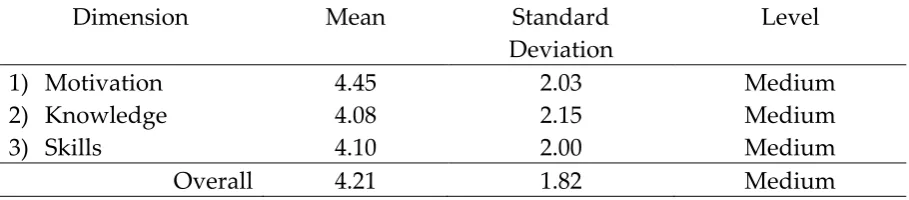
Teacher CMC competencies is measured by three dimensions which are (i) Motivation; (ii) Knowledge; and (iii) Skills. The overall mean and standard deviation of teacher CMC competencies together with the means and standard deviations for each of the teacher CMC competencies dimensions were computed using SPSS. The means in the range of 0.00 to 3.33 interpreted as low level, 3.34 to 6.67 interpreted as medium level and 6.68 to 10.00 interpreted as high level of competencies. Table 3 presents the results of the analysis.
Table 3: Mean, Standard Deviation and the Level of Teachers CMC Competencies toward Using Frog VLE (N=351)
Dimension Mean Standard
Deviation
Level
1) Motivation 4.45 2.03 Medium
2) Knowledge 4.08 2.15 Medium
3) Skills 4.10 2.00 Medium
Overall 4.21 1.82 Medium
69 respondents rated themselves as demonstrating medium level of CMC competencies for all the three teacher CMC competencies dimensions in Klang district secondary schools.
Relationship between teachers’ CMC competencies and level of Accessibility
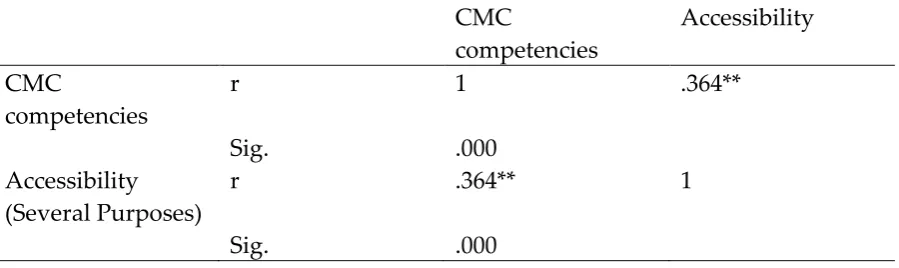
Pearson’s correlation coefficients were used to assess relationships between the level of teachers’ computer-mediated communication competencies and the level of accessibility to Frog VLE. Table 4 and Table 5 presented the correlations results between these variables.
Table 4: Summary of the Pearson’s correlation coefficients for several places
CMC
competencies
Accessibility
CMC
competencies
r 1 .329**
Sig. .000
Accessibility (Several Places)
r .329** 1
Sig. .000
** Correlation is significant at the 0.01 level (2-tailed)
By referring to Table 4 and Table 5, there is a statistically significant positive correlation (r=.329, p<.01; r=.364, p<.01) between teachers’ computer-mediated communication competencies and level of accessibility to Frog VLE for several places and several purposes respectively.
Table 5: Summary of the Pearson’s correlation coefficients for several purposes
CMC
competencies
Accessibility
CMC
competencies
r 1 .364**
Sig. .000
Accessibility (Several Purposes)
r .364** 1
Sig. .000
70
DISCUSSION
The obtained results indicate that teachers prefer to access Frog VLE at home and computer lab as compare to access Frog VLE in the classroom. This probably due to insufficient network connectivity in the classroom, a finding that other studies have also reported (Khine et al., 2019; Obaydullah & Rahim, 2019; Singhavi & Basargekar, 2019). A similar finding was reported by Ibieta, Hinostroza, Labbé, & Claro (2017). Results of their research indicate that the accessibility of ICT outside the classroom is more than inside the classroom. Evidence shows that teachers preferentially access Frog VLE for teaching and learning purpose. Followed by access Frog VLE to communicate with the students and lastly to use Frog VLE for administrative tasks. These results are similar to those reported in other research work (Frailon et al. 2014; Suárez-Rodríguez, Almerich, Orellana, & Díaz-García, 2018) where use of ICT for teaching and learning purposes is more frequent than for communicative use. The findings of this study indicated that a typical teacher had access to Frog VLE almost once a month for several purposes at several places. This is consistent with the level of teacher’s CMC competencies obtained in this study where they are still lacking of knowledge and skills to access the virtual learning platform, which prevents them from integrating Frog VLE into their daily classroom practice. If the teachers’ does not have adequate knowledge and skills, if they are not competent enough, they will be less motivated towards using Frog VLE in the classroom.
In the present study, the descriptive analysis of dataindicated that teachers in Klang district, Selangor secondary schools showed medium level of CMC competencies (M=4.21, S.D.=1.82) towards using Frog VLE. All three dimensions for teacher CMC competencies (motivation, knowledge, and skills) have mean that are interpreted as medium level which falls in line with other studies (Kandasamy & Parilah, 2013; Mahmud & Ismail, 2010).
71 In addition, a significant relationship is observed for accessibility to Frog VLE with teacher CMC competencies, which falls in line with other studies (Inan and Lowther 2010; Liu et al. 2017; Ritzhaupt et al. 2012). In other words, the correlation findings revealed that there was significant positive correlation between teachers’ level of accessibility to Frog VLE and their CMC competencies levels. The implication of this is that when teachers holds higher level of computer-mediated communication competencies, they are more likely to contribute effectively to the accessibility of virtual learning platform for teaching and learning purposes. As demonstrated by Suárez-Rodríguez, Almerich, Orellana & Díaz-García (2018), there are significant relationship between teachers’ technological competencies and the use of ICT either for personal or professional use in class
SUMMARY
This study concluded that there is a significant positive correlation between teachers’ CMC competencies and accessibility to Frog VLE. The results indicated that participants possess a medium level of CMC competencies towards using the Frog VLE and the accessibility to Frog VLE for a typical teacher is about once a month for several purposes in various places. It shows that the level of accessibility to Frog VLE is still very low. Hence, it is hoped that through this study, the findings could shed light on the new antecedents of teachers’ accessibility towards using the Frog VLE from the perspective of individual factors such as teachers’ CMC competence.
REFERENCES
Bakic-Tomic, L., Dvorski, J., & Kirinic, A. (2015). Elements of teacher communication competence: An examination of skills and knowledge to communicate.
International Journal of Research in Education and Science, 1(2), 157–166.
Bingimals, K. A. (2009). Barriers to the successful integration of ICT in teaching and learning environments: A review of the literature. Eurasia Journal of
Mathematics, Science & Technology Education, 5(3), 235–245.
British Educational Communications and Technology Agency (Becta). (2004). A review of the research literature on barriers to the uptake of ICT by teachers. Retrieved from
http://dera.ioe.ac.uk/1603/1/becta_2004_barrierstouptake_litrev.pdf
Buabeng-Andoh, C. (2012). Factors influencing teachers’ adoption and integration of information and communication technology into teaching: A review of the literature. International Journal of Education and Development Using Information and Communication Technology, 8(1), 136.
Ghani, M. F. A. (2013). Educational management in Malaysia. Retrieved from
72 /ent:$002f$002fSD_ILS$002f0$002fSD_ILS:676084/ada?qu=educational+manag ement+in+malaysia
Fraillon, J., Ainley, J., Schulz, W., Friedman, T., & Gebhardt, E. (2014). Preparing for life in a digital age: The IEA international computer and information literacy study international report. Cham: Springer
Hiong, S. N., & Umbit, A. F. (2015). A pilot study on factors affecting the use of frog virtual learning environment. 12, 1–17.
Hoque, K. E., Razak, A. Z. A., & Zohora, M. F. (2012). ICT utilization among school teachers and principals in Malaysia. International Journal of Academic Research in Progressive Education and Development, 1(4), 17–34.
Ibieta, A., Hinostroza, J. E., Labbé, C., & Claro, M. (2017). The role of the Internet in teachers’ professional practice: Activities and factors associated with teacher use of ICT inside and outside the classroom. Technology, Pedagogy and
Education, 26(4), 425–438. https://doi.org/10.1080/1475939X.2017.1296489 Inan, F. A., & Lowther, D. L. (2010). Factors affecting technology integration in K-12 classrooms: A path model. Educational Technology Research and Development, 58(2),
137–154.
Jablin, F. M., & Putnam, L. L. (2001). The new handbook of organizational communication: Advances in theory, research, and methods. Thousand Oaks, CA: SAGE
Publications.
Kandasamy, M., & Shah, H. M. P. (2013). Knowledge, attitude and use of ICT among ESL teachers. Proceedings of the Global Summit on Education. GSE Journal of Education 2013.
Khine, M. S., Afari, E., & Ali, N. (2019). Investigating Technological Pedagogical Content Knowledge Competencies among Trainee Teachers in the Context of ICT Course. Alberta Journal of Educational Research, 65(1), 22–36.
Korte, W. B., & Hüsing, T. (2006). Benchmarking access and use of ICT in European schools 2006: Results from Head Teacher and A Classroom Teacher Surveys in 27 European countries. Empirica, 1, 1-7.
Koszalka, T. A. (2001). Effect of computer-mediated communications on teachers’ attitudes toward using web resources in the classroom. Journal of Instructional Psychology, 28(2), 95.
Liu, F., Ritzhaupt, A. D., Dawson, K., & Barron, A. E. (2017). Explaining technology integration in K-12 classrooms: A multilevel path analysis model. Educational Technology Research and Development, 65(4), 795–813.
Mahmud, R., & Ismail, M. A. (2010). Impact of training and experience in using ICT on in-service teachers’ basic ICT literacy. Malaysian Journal of Educational Technology, 10(2), 5–10.
Ministry of Education. (2012). Malaysia Education blueprint 2013-2025 (Preschool to Post-Secondary Education). Putrajaya. Malaysia: Ministry of Education. Ministry of Finance. (2014). Maklum balas ke atas Laporan Ketua Audit Negara Siri 3
73 Mohamad Mohsin, S. F. A., Hassan, R., & Ariff, A. F. (2014). Amalgamation of Dale’s
Cone of Experience, Bloom’s Taxonomyand 21st Century Skills Through Virtual Learning Environment. Journal of ContempporaryManagement Sciences, 4(1), 88–99.
New Straits Times. (2014). DPM: Plans to meet our future needs. Retrieved from http://www.frogasia.com/v3/dpm-plan-education-to-meet-our-future-needs/. Obaydullah, A. K. M., & Rahim, A. (2019). Use of ICT for Primary science Teaching
and Learning at the Primary Schools in Bangladesh. International Journal of Advance Reserach and Innnovative Ideas in Education(IJARIIE), 5(1), 642–651. Pynoo, B., Devolder, P., Tondeur, J., van Braak, J., Duyck, W., & Duyck, P. (2011).
Predicting secondary school teachers’ acceptance and use of a digital learning environment: A cross-sectional study. Computers in Human Behavior, 27(1), 568–575. https://doi.org/10.1016/j.chb.2010.10.005
Ritzhaupt, A. D., Dawson, K., & Cavanaugh, C. (2012). An investigation of factors influencing
student use of technology in K-12 classrooms using path analysis. Journal of Educational Computing Research, 46(3), 229–254.
Robertson, S. L. (2005). Re‐imagining and rescripting the future of education: Global knowledge economy discourses and the challenge to education systems. Comparative Education, 41(2), 151–170.
https://doi.org/10.1080/03050060500150922
Suárez-Rodríguez, J., Almerich, G., Orellana, N., & Díaz-García, I. (2018). A basic model of integration of ICT by teachers: Competence and use. Educational Technology Research and Development, 66(5), 1165-1187.
Siti Faizzatul Aqmal, M. M., Razali, H., & Ahmad Fadzil, A. (2014). Amalgamation of Dale’s Cone of Experience, Bloom’s Taxonomyand 21st Century Skills
Through Virtual Learning Environment. Journal of ContempporaryManagement Sciences, 4(1), 88–99.
Sohawon, M. S., Panday, Y. D., & Baxou, A. K. (2015). Reviewing the management procedures from a down-up approach to integrate ICT in schools to enhance work: A case study at a model school in Mauritius. International Journal of Educational Policy Research and Review, 2(8), 103–112.
Spitzberg, B. H. (2000). A model of intercultural communication competence. Intercultural Communication: A Reader, 9, 379–391.
Spitzberg, B. H. (2006). Preliminary development of a model and measure of
computer-mediated communication (CMC) competence. Journal of Computer-Mediated Communication, 11(2), 629–666.
https://doi.org/10.1111/j.1083-6101.2006.00030.x
Spitzberg, B. H. (2011). The interactive media package for assessment of
74 Spitzberg, B. H., & Cupach, W. R. (1984). Interpersonal communication competence.
Beverly Hills, CA: Sage.
Suárez-Rodríguez, J., Almerich, G., Orellana, N., & Díaz-García, I. (2018). A basic model of integration of ICT by teachers: Competence and use. Educational Technology Research and Development, 66(5), 1165–1187.
https://doi.org/10.1007/s11423-018-9591-0