A WEB-BASED COLLABORATIVE SYSTEM FRAMEWORK FOR
GREEN BUILDING CERTIFICATION
Jack C.P. Cheng1, Vignesh Venkataraman
*Corresponding E-mail :
2
Department of Civil and Environmental Engineering, The Hong Kong University of Science and Technology, Hong Kong
Received 7 June 2013; Revised 21 October 2013; Accepted 6 November 2013
Abstract
The built environment is moving towards sustainable development and the number of green buildings increased worldwide in recent years. Green buildings are environmentally, socially and economically desirable; however the certification of green buildings is often expensive and labor-intensive. The document preparation and review process for green building certification is iterative in nature and requires the collaboration of many project participants, certification organizations and third party engineering consultants. This paper aims at developing a system framework that can assist the green building certification process. Different certification standards have been studied and their scope and credit calculation were compared to understand the requirements of the system framework. Based on the study, the required features were designed as follows, (1) role-based access control, (2) document manager and related document discovery, (3) workflow manager, (4) credit manager, and (5) knowledge manager. The features of the system provide a collaborative environment and reduce repetitive works commonly occurring in manual processes. The features of the system framework are discussed and illustrated considering the Hong Kong BEAM Plus standard. This paper also describes how the system framework enhances collaboration in the certification process.
Keywords: Collaborative system, Document management, Green building certification, Hong Kong Building Environmental Assessment Method (HK-BEAM), Information Retrieval
1.0 Introduction
What is a green building? The term ‘green building’ has various definitions. The United States Environmental Protection Agency (U.S. EPA) defines green buildings as “the practice of increasing the efficiency with which buildings and their sites use energy, water and materials, and reducing building impacts on human health and the environment, through better siting, design, construction, operation, maintenance, and removal- the complete building life cycle”[1].American Society for Testing and Materials (ASTM) defines a green building as, “a building that provides the specified building performance requirements while minimizing disturbance to and improving the functioning of local, regional, and global ecosystems both during and after its construction and specified service life,” and a building that “optimizes efficiencies in resource management and operational performance, and minimizes risks to human health and the environment”[2].The International Council for Research and Innovation in Building and Construction (CIB) defines ‘sustainable construction’ as “a holistic process aiming to restore and maintain harmony between the natural and built environments, and create settlements that affirm human dignity and encourage economic equity”[3]. Regardless of these various perceptions, green buildings have been growing rapidly worldwide. As of 2011, for example, there were over 10,000 green buildings certified by the LEED (Leadership in Energy and Environmental Design) standard in the United States alone.
the potential increase in cost to construct and operate green buildings has often put developers and tenants on halt while going green. In fact, green buildings may cost more upfront, but save from lower operating costs over building lifetime. According to Katsand Capital (2009), a minimal upfront investment of about two percent of construction costs typically yields life cycle savings of over ten times the initial investment [5].Rating systems and labeling programs are crucial to promote green buildings. However, promotion of green buildings is hindered due to insufficient fiscal incentive, lack of information about eco-label green materials and green building practices, and limited collaboration among the building team and stakeholders.
This project aims to develop a web-based collaborative system framework that can facilitate the green building assessment process, which is labor intensive and multi-participant in nature. This paper is organized as follows: Section 2 reviews different green building assessment standards. Section 3 discusses the developed system framework, its functionalities and potential benefits. Section 4 presents an example scenario considering the Hong Kong green building standard, namely BEAM Plus. Section 5 concludes by outlining the need, benefits and future work.
2.0 Research Background
2.1 Web-based Collaboration Systems
The rapid development of Internet has allowed construction organizations to utilize web-based technologies for improved inter-organizational communication and workflow. A web-web-based system uses a centralized information integration approach through a shared web server or a central database behind the web server [6]. The Architecture, Engineering and Construction (AEC) industry has utilized web-based systems for Project Management, Supply Chain Management, Knowledge Management and Engineering Design purposes. For example, Nitithamyong and Skibniewski (2004) summarized the different commercially available web-based Project Management systems and their factors of success and failure in the construction industry [7]. Chen and Tien (2007) developed a prototype system, namely ROCCAD, for real-time online collaborative CAD drawings [8]. Zhang and El- Diraby (2011) present a web-based communication system for coordinating information and knowledge flow in the AEC industry [9]. Cheng et al (2010) prototyped a service oriented web-based system for supply chain collaboration and monitoring [10]. There are plenty of examples and literature that support the use of web-based technologies for communication, collaboration and knowledge transfer in the AEC industry. Since the green building certification process requires frequent communication among participants, information storage, retrieval, transfer and reuse, web-based collaborative concepts are used for developing the system framework.
2.2 Information Systems for Green Building Certification
2.3 System Requirements for Green Building Certification
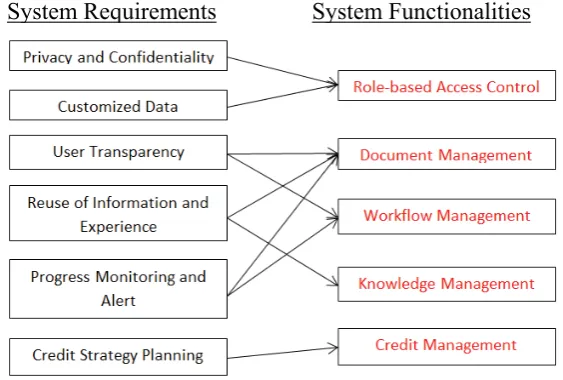
The certification process is labor intensive and requires efficient collaboration. Li et al. identified that coordination between project participants was found to be a critical factor in determining green building project success [11]. Credit calculation is an integral part of the certification process with the total credit score to earn the desired grade level. Since different certification standards have different scoring procedures, a credit manager to manage all the scoring is a mandatory requirement for a green building certification system framework. Document creation, review and submission are the key activities in the certification process and should be supported in a green building certification system. In addition, different project participants need to work together with collective responsibilities for successful execution. Managing individual roles and responsibilities could be very challenging especially with a big project team and when executing multiple projects at the same time. Therefore, security and confidentiality are also required when performing and managing green building certification. After studying various green building certification standards and their processes, the requirements of a web-based green building certification collaborative system have been summarized. Figure 1 illustrates these system requirements and how they can be fulfilled in various system functionalities. To satisfy these requirements, our proposed system framework includes the functionality of role-based access control for supporting security and confidentiality, document management for managing heavy documentation, workflow management for managing individual responsibilities and tracking responsible collaborators to execute project activities, credit management for planning and strategizing final grade, and document tagging for easy identification for retrieval of documents. The system also requires knowledge management functionality to document best practices and project knowledge for efficient execution of future projects. Based on the nature of the certification process, the required functionalities of the system will be discussed in detail in Section 4.
Figure 1: System Requirements and Suggested Functionalities for a Web-based Collaborative Green Building Certification System
3.0 Green Building Certification Standards
3.1 Worldwide Green Building Certification Standards
Green building certification standards provide the guidelines to measure, improve, certify, benchmark, and label whole-life environmental sustainability and the performance of buildings. It is one of the driving factors that promote sustainability in developed and developing nations.
Different countries developed their own certification standards for getting their buildings certified. Certification standards that are widely used and have a great global impact have been studied and compared. The selected standards in this study were (1) LEED from North America- the most widely used green building assessment standard in the world serving the North America and Asia, (2) BREEAM (BRE Environmental Assessment Method) from the United Kingdom- the oldest assessment standard in the world serving the United Kingdom and other parts of Europe, (3) Green Star from Australia- a prominent assessment standard in Oceania and the African regions, and (4) BEAM Plus from Hong Kong- a recently developed assessment standard in the fastest developing infrastructure regions of Hong Kong and mainland China. Apart from these, green building certification standards developed in countries like Japan, Singapore, Taiwan and Germany are also evolving fast and getting popular rapidly. Evolving from new constructions scheme, LEED, BREEAM and Green Star currently have different rating systems for new constructions, existing buildings, schools, industrial buildings, healthcare, courts, prisons, commercial interiors, cores and shells, and so on [12]. LEED, BREEAM, GreenStar, BEAM Plus were studied to understand the credit distribution, coverage and calculations with respective to their latest versions to better design a system framework compatible with different green building certification standards.
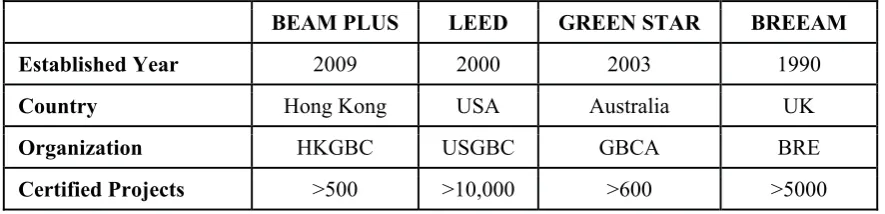
Table 1 shows the background of the different certification standards selected in this study. Their place of origin, year of establishment, controlling organization, and total number of projects certified are tabulated in Table 1 for reference. As shown in Table 1, although LEED was introduced after the BREEAM, LEED has the most certified projects thus indicating its popularity.
Table 1:Background of Different Green Building Certification Standards
BEAM PLUS LEED GREEN STAR BREEAM
Established Year 2009 2000 2003 1990
Country Hong Kong USA Australia UK
Organization HKGBC USGBC GBCA BRE
Certified Projects >500 >10,000 >600 >5000
3.2 Comparison of Scope among Standards
Credits in each green building certification standard are divided into many categories for a comprehensive assessment of different types of projects. Categories from different standards include Site Aspects, Material Aspects, Energy Use, Water Use, Indoor Environmental Quality, Transport, Waste, Pollution and Innovation. Each category constitutes different numbers of credits, and the total number varies with different standards. The difference in the standards is the result of considering the local parameters such as building types, climate, and building codes. Table 2 compares the credit distributions in BEAM Plus (New Buildings 2009 and Existing Buildings 2009), LEED (New Construction 2009 and Existing Building 2009), Green Star (Office 2008 and Residential 2009), and BREEAM (Office 2008 and Residential 2008).As shown in Table 2, BEAM Plus and LEED have very similar categories whereas Green Star and BREEAM have nearly the same categories.
3.3 Comparison of Credit Calculation Method among Standards
The ratio of the total weighted points earned to the total available points determines the final grade awarded for Green Star. In addition to following Green Star’s procedure, BEAM Plus and BREEAM have additional criteria in specific categories for determining the final grade award. The additional requirements of BEAM Plus will be discussed in the later sections. Table 3 shows the criteria for earning the different grades available in BEAM Plus, LEED, Green Star and BREEAM, respectively. For example, a total of 75 points will earn the highest grade in Green Star whereas it takes 80 points in LEED to earn the highest grades. Table 4 illustrates the different weightings assigned to each individual category.
Table 2:Comparison of Scope among Different Green Building Certification Standards
Category BEAM PLUS LEED GREEN STAR BREEAM
New Building Existing Building New Construction Existing
Building Office Residential Office
Residenti al Site/Land Use &
Ecology 25 19 27 26 8 11 10 10
Materials&
Resources 23 13 15 10 25 31 12 12
Energy 44 40 38 35 29 26 30 30
Water 10 9 11 14 12 12 9 9
IEQ/Health &
Well being 35 33 17 15 27 20 10 10
Management - - - - 12 18 22 22
Transport - - - - 11 14 9 9
Pollution/ Emission
- - -
-19 19 13 13
Waste - - - 7 7
Innovation 6 6 6 6 5 5 10 10
Regional Priority
-
-4 4 - - -
-Table 3:Grade Award Requirements among Different Standards[12]
BEAM Plus (max. 127)
LEED (max. 110)
Green Star (max. 190)
BREEAM (max. 122)
Outstanding/ Platinum/ 6 Star
75% (Platinum) 80 Points (Platinum)
75 Points (6 Star) 85%
(Outstanding) Exceptional/
Gold/ 5 Star
65% (Gold) 60-79 Points
(Gold)
60-74 Points (5 Star) 70% (Exceptional) Very Good/
Silver/ 4 Star
55% (Silver) 50-59 Points (Silver)
45-59 Points (4 Star) 55% (Very Good) Good/ Certified/
Bronze
40% (Bronze) 40-49 Points (Certified)
- 45% (Good)
Pass - - - 30% (Pass)
Source: Vignesh Venkataraman 2012
Table 4:Comparison of Category Weightage among Different Standards
Category BEAM PLUS LEED GREEN STAR BREEAM
Site Aspects 25% - -
-Land Use and Ecology - - 7% 10%
Materials& Resources 25% - 10% 12.5%
Energy 35% - 25% 19%
Water 12% - 15% 6%
IEQ/Health & Well being 20% - 20% 15%
Management - - 8% 12%
Transport - - 10% 8%
Pollution/ Emission - - 5% 10%
Waste 12% - 15% 6%
Innovation (Additional) - - - 10%
3.4 Summary
As green building certification standards are fast evolving, multiple certifications for a building are becoming a common practice. To facilitate multiple certifications in our system we studied popular green building standards to understand their scope and requirements. The LEED, BREEAM, GreenStar and BEAM Plus standards were considered for comparison. The credit categorizations, credit calculation methods and final grade award criteria were studied and compared. Many green building certification standards consider weightage to each of their credit categories for determining the final grade award. Although the differences in these standards are justifiable, it creates complication for stakeholders, including property investors, who purchase buildings in different countries and apply for certification [13]. Due to the complex nature of credits and calculation methodology among different standards, a web system assisting the certification process should be developed for improving the overall efficiency and catering multiple needs in the assessment process. Such a system can also facilitate multi-participant information sharing and collaboration which are crucial for green building certification processes.
4.0 The Proposed Web-based Collaborative System Framework for Green
Building Certification
Figure 2: The Conceptual Web-based Collaborative System Framework
4.1 Role-based Access Control
Various types of supporting documents need to be prepared, reviewed and submitted during the green building certification process. The supporting documents can be grouped into the following types.
x Templates and forms, which are generally application forms and cover letters, available from their respective websites,
x Architectural drawings, including building plans, building elevations, and floor plans,
x Engineering drawings, including technical details and sectional views of building components,
x Photos, which provide visual proof for showing installed components such as equipment and car parks,
x Analysis/calculation reports, in the aspect of energy consumption, cost budget, and other areas,
x Materials procurement bills, which provide proof for showing purchased sustainable materials/equipment,
x Utility bills (for certification of existing buildings only), which consists of electricity and water bills, and
x Compliance certification letters, which are letters from suppliers stating the quality and sustainability of the equipment and products.
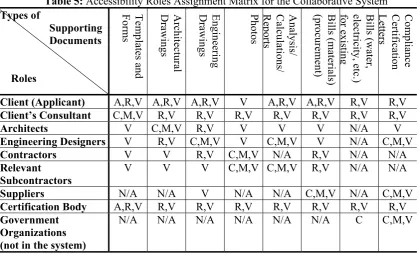
open to various project participants and adopts a role-based access control. Six types of accessibility can be assigned to each role for each type of supporting document – (1) Authorize, (2) Create, (3) Modify, (4) Review, (5) View, and (6) Not Accessible. Table 5 shows the accessibility of different roles on different types of supporting documents in our proposed system framework. The client has the highest authority in this hierarchy followed by the green building consultant. The other participants are responsible for creating, modifying and reviewing specific documents whenever necessary. For example, architects can create and modify architectural drawings, can review engineering drawings, but cannot access utility bills like electricity and water bills. This feature of the system framework supports the security and confidentiality of the users.
Table 5:Accessibility Roles Assignment Matrix for the Collaborative System
Types of
Supporting Documents
Roles
Templates and
Forms Drawings Architectural Drawings Engineering Photos Re Calculations/ Analysis/
p
orts
Bills (materials)
(procurement) electricity, et Bills (water,
c.)
for existin
g
Compliance
Certification
Letters
Client (Applicant) A,R,V A,R,V A,R,V V A,R,V A,R,V R,V R,V
Client’s Consultant C,M,V R,V R,V R,V R,V R,V R,V R,V
Architects V C,M,V R,V V V V N/A V
Engineering Designers V R,V C,M,V V C,M,V V N/A C,M,V
Contractors V V R,V C,M,V N/A R,V N/A N/A
Relevant Subcontractors
V V V C,M,V C,M,V R,V N/A N/A
Suppliers N/A N/A V N/A N/A C,M,V N/A C,M,V
Certification Body A,R,V R,V R,V R,V R,V R,V R,V R,V
Government Organizations (not in the system)
N/A N/A N/A N/A N/A N/A C C,M,V
4.2 Document Management
Document management is one of the primitive features of the certification process. Certification process involves submitting huge amount of documents and some credits require submission of multiple documents for credit award. It requires a proper organization of the documents. The document manager can support uploading and retrieval of supporting documents corresponding to their credit category, and help to monitor the status of the documents. Based on the recent status of the documents, users can communicate in requesting and committing different actions to a document thus enhancing information transparency and inter-organizational collaboration.
4.2.1 Related Document Discovery
A well-managed document repository can support the reuse of information and experience. Various participants in different projects will lead to a massive amount of documents. Managing such huge amount of documents for sorting and retrieval will be painstaking. Relatedness analysis is a useful technique to arrange large quantity of unorganized documents into organized groups for easy identification and retrieval.
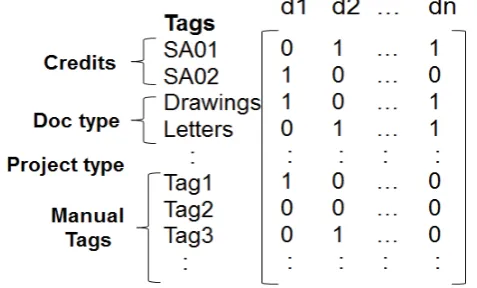
some manual tags like keywords. A feature matrix can be created for relatedness analysis, as shown in Figure 3. A value of 1 is assigned if a tag belongs to a document and a value of 0 is assigned otherwise [12]. For example, as illustrated in Figure 2, the document d1 is a drawing submitted for the credit SA02.
Figure 3: Matrix Representation of Document Tagging
When documents are represented as term column vectors, the similarity of two documents corresponds to the correlation between the vectors, which can be calculated as the cosine of the angle between the vectors, namely cosine similarity. Cosine similarity is one of the most popular similarity measure applied to text documents, such as in numerous information retrieval applications and clustering. The cosine similarity between documents d1 and d2 can be calculated as
SIM(d1, d2) = 1.2 12
Let us consider the above Equation.1, where 1and2are the column vectors over a set d= [d1, d2]. Each row represents a term vector with its tag, which is either 0 or 1, where 0 and 1 represent the presence and absence of the tag, respectively. As a result, the cosine similarity is non-negative and bounded between [0, 1]. Since the absence of a tag is valued as 0, the similarity of two documents without any similar tags will be 0. For two documents with all tags identical, the cosine similarity value is 1. In other cases, the similarity values range from 0.1 to 0.9.
4.3 Workflow Management
The collaborative nature of the certification process demands people from different organizations working together. The system provides a platform for organized workflow by assigning individual responsibilities to project team members and provide an easy way to track people concerning specific responsibility. For example, if a specific project work task has not been completed or requires modifications, the system can assist the user by identifying the responsible person and communicate to complete the required changes. Users can also keep track of their work progress and manage their workflow coherently. Furthermore, preparation and submission time for the documents related to the affected work task can be changed accordingly. The change will be announced to the corresponding project participants according the role-based accessibility matrix as mentioned in Section 4.2.
4.4 Credit Management
calculation and grade planning can be cumbersome if a team handles different certification standards or applies for multiple certifications. The proposed system framework features a credit dashboard that can handle the credit calculations and plan the final grade. This allows users to have a better approach towards their targeted grade. Grade planning and reviewing can be done more easily with the credit dashboard.
4.5 Knowledge Management and Best Practices
Green building certification process is complex and relatively new to many people in the construction industry. Inexperience and lack of proper documentation have led to inefficient practices and make the certification process complex and time consuming. As the industry is project-based and similar challenges can be met in the future, documenting best practices will create a knowledge database that will help project participants to follow efficient practices and save time in future projects.
4.6 Collaboration Supported by the System
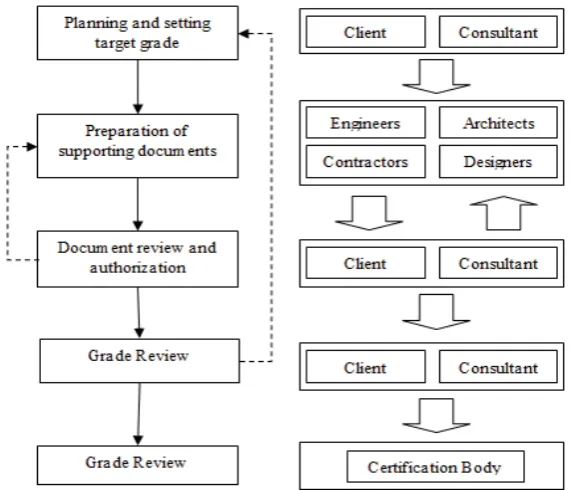
The iterative and collaborative preparation processes for green building certification are supported in our proposed system framework, as shown in Figure 4. In the figure, the left side describes the iterations that appear in the certification preparation process while the corresponding right side identifies the respective participants/roles involved. As shown in Table 5, the roles supported in our systems include the client, the green building consultant, architects, engineering designers, contractors, subcontractors, and suppliers, each having different access rights in the system. After the client and the consultant agree on and set the target grade, the responsible team members prepare the required supporting documents for earning credits. Once the prepared documents have been uploaded, they are reviewed, modified, and authorized for final submission. If there are any necessary changes, the system helps to identify the respective participants and allows them to communicate, thus enhancing collaboration. If the target grade is not achieved, as summarized in the credit dashboard, the team can review their project plan again and the process is repeated [14].
5.0 Example Scenario
In the last two decades, the construction industry in the Asian region has grown dramatically, and is poised to continue such growth [15]. The demands have led to new emerging concepts of engineering design and facilities management. For example, the Hong Kong government has been taking an active part in driving green building initiatives [16].The growing economy and government initiatives to go green saw a huge rise in the number of green buildings and certifications. In 1996, the green building certification standard HK-BEAM (Hong Kong Building Environmental Assessment Method) was established by the Hong Kong Green Building Council in Hong Kong. The standard was renamed to BEAM Plus in 2009. As of 2011, the BEAM standard has certified over 500 projects in Hong Kong, Beijing, Shanghai and Shenzhen. On a per capita basis, BEAM has assessed more buildings than any other similar scheme in use worldwide [14]. The BEAM standard was developed carefully and shares similarity in scope with the LEED standard and credit calculation with the BREEAM standard. It had a broad coverage and increasing demand.
We exploited this potential and developed a web-based collaborative system for facilitating the Hong Kong BEAMPlus certification process and for illustrative purpose. The functions of the system are explained and illustrated in the following sections. The document manager will illustrate the management of documents required for certification and people responsible for specific project works. The related document discovery illustrates the system functionality of knowledge management by successfully retrieving and reusing information. The credit dashboard will assist project participants for efficient grade planning and credit management. Confidentiality will also be supported through role based access to these functionalities
5.1 System Configuration
The system was built for document storage and management that serves as a repository of information and documents for data storage, retrieval and submission. The system consists of a database and server support. The scripting languages used for creating the web interface are PHP and HTML. Open source software was used in the system design and implementation. The open source tools used in this system are
x Apache- The Apache HTTP Server project for developing and maintaining an open-source HTTP server for modern operating systems including UNIX and Windows.
x MySQL- The world’s most widely used open source relational database management system that runs as a server providing multi-user access to a number of databases.
x PHP- Hypertext Preprocessor is a general-purpose server-side scripting language originally designed for web development for producing dynamic web pages.
x HTML (Hyper-Text Markup Language) is the main markup language for displaying web pages and other information that can be displayed in a web browser
5.2 Hong Kong BEAM Plus Certification Process
5.3 Document Manager for BEAM Plus
The system requires users to log in at the homepage. With a successful login, users can view, upload, revise, and authorize the supporting documents, based on the role-based accessibility granted to the users. The supporting documents are grouped according to the corresponding BEAM sections. On the document summary page, as shown in Figure 6, users can monitor the latest status (e.g. “submitted”, “reviewed”, “requested”, “approved”) of each supporting document under each section. The last modified date and user of each document are also displayed for transparency. On the summary page, users cannot see documents that are not accessible (“N/A”) for the users. Documents that are requested for submission are displayed in red. With such transparent and personalized document management in our system, document collection, preparation and review can be facilitated to save time for BEAM certification.
Figure 5: The Certification Process for the Hong Kong BEAM Standard
5.3.1 Related Document Discovery for BEAM Plus
To find related documents, 182 documents were collected in total and arranged in order of their categories. Collected documents comprise of photos, building drawings, bills, reports, etc. Each document was analyzed and provided with multiple tags. Every document should contain tags of the document’s credit category, type of document and document information. Project information should be added if dealing with multiple projects. Manual tags can also be provided for better identification of the document. Manual tags can vary depending on the type and content of the document and does not follow any standard protocol. After the inclusion of all tags in the documents, the feature matrix was created with the documents on one side and the tags on the other side. A value of 1 is assigned if a tag belongs to a document and a value of 0 is assigned otherwise. As an example, Table 6 lists three documents chosen for illustration.
Table 6: Illustrative Documents Used for Similarity Calculation
Doc. No Title Tag1 Tag2 Tag3
1 Car Parking Drawings SA2 Drawing Car Park
2 Demolition Waste Reduction Report MA10 Report Waste 3 Construction Waste Reduction Report MA11 Report Waste
Case1: Consider document 1 and document 2 for relatedness analysis. As shown in Table 6, document 1 has the tagsSA2, Drawing and Car park whereas document 2 has the tags MA10, Report and Waste. Using Equation 1 presented in Section 4.2.1, the cosine similarity value is given as
SIM(d1, d2) = 0 33= 0
Case2: Consider document 2 and document 3 for relatedness analysis. As shown in Table 6, document 2 and document 3 share the Report and Waste tags. Using Equation 1, the cosine similarity is given as
SIM(d2, d3) = 2
33= 0.67
Document 1 is a drawing of car parking facilities for the building. It is required for obtaining Credit SA 2 (2-3 credits) in the Site Aspects category. Documents 2 and 3 are demolition and construction waste reduction reports. These documents are required for obtaining credits MA 10 (2credits) and MA 11 (2 credits) in the Materials Aspects category. As shown in the results, document 1 and document 2 have totally different natures and different credit obligations, and therefore have the lowest (zero) similarity value. On the contrary, documents 2 and 3 have similar natures and belong to similar categories but different credit obligations, and therefore have 67 percent similarity. The above results indicate the potential of the similarity analysis algorithm in the searching, sorting, organization and submission of huge amount of documents, particularly across multiple projects. Document submission is the core in this certification process, and the proposed algorithm will be a desirable addition
5.4 Credit Dashboard for BEAM Plus
final assessment grade. A minimum number of credits in the Innovation category are also needed for obtaining Silver Grade, Gold Grade, and Platinum Grade.
Figure 8 shows the credit dashboard on our system that summarizes the credits obtained and reports the assessment grade achieved at the moment. In the example, the overall score is 70.5%, which is higher than the overall percentage requirement for the Gold grade. However, the percentage for the category Energy Use is only 59.5%, which is lower than the EU percentage requirement for the Gold Grade. Therefore, the assessment grade achieved at the moment is only Silver. Using this dashboard, clients can observe the latest fulfillment situation of each assessment criterion and probably strategically put additional efforts on specific BEAM sections or categories to achieve a higher BEAM Assessment Grade.
Table 7: BEAM Assessment Grade Award Criteria
Grade Overall SA EU IEQ IA
Platinum 3 credits (Excellent)
Gold 2 credits (Very Good)
Silver 50% 1 credit (Good)
Bronze - (Above
Average)
Figure 8:Credit Dashboard in the Demonstrative System
6.0 Conclusions and Future Work
also successfully proposed an algorithm for discovering similar documents thus eliminating information overload and enhancing information retrieval. Therefore, the proposed system framework could reduce document review iterations, save time, cut cost and increase work efficiency. The system framework can serve as a repository for project information and provide users universal access to the information over the web. The proposed system framework was also illustrated and validated using the Hong Kong BEAM green building standard. The results of this study demonstrated that a web-based collaborative environment can assist the existing manual green building certification process by increasing project team collaboration and organizing project related information more efficiently.
In the future, additional functions would be added to the system for increased efficiency. Forum discussions would be introduced for useful information exchange, and the algorithm for computing document similarity would be improved for more accurate results. Report generators and document suggestions for different credits will make the system automated. The compatibility of the proposed system framework can be extended to certification standards like LEED, Green Star and BREEAM, thus making multiple certifications for buildings effortless.
References
[1] U.S. Environmental Protection Agency (EPA). Available:
http://www.epa.gov/greenbuilding/pubs/about.htm
[2] American Society for Testing and Materials (ASTM). "E2114-08 Standard Terminology for Sustainability Relative to the Performance of Buildings".
[3] International Council for Research and Innovation in Building and Construction (CIB). Agenda 21 for Sustainable Construction in Developing Countries.
[4] G. K. C. Ding, "Sustainable construction—The role of environmental assessment tools," Journal of Environmental Management, vol. 86, pp. 451-464, 2008.
[5] G. Kats and E. Capital, Green building costs and financial benefits: Massachusetts Technology Collaborative Westborough, MA, 2003.
[6] B. Becerik, "A review on past, present and future of web based project management & collaboration tools and their adoption by the US AEC industry," International Journal of IT in Architecture Engineering and Construction, vol. 2, pp. 233-248, 2004.
[7] P. Nitithamyong and M. J. Skibniewski, "Web-based construction project management systems: how to make them successful?," Automation in construction, vol. 13, pp. 491-506, 2004.
[8] H.-M. Chen and H.-C. Tien, "Application of peer-to-peer network for real-time online collaborative computer-aided design," Journal of Computing in Civil Engineering, vol. 21, pp. 112-121, 2007. [9] J. Zhang and T. El-Diraby, "Social Semantic Approach to Support Communication in AEC," Journal
of Computing in Civil Engineering, vol. 26, pp. 90-104, 2011.
[10] J. C. Cheng, K. H. Law, H. Bjornsson, A. Jones, and R. Sriram, "A service oriented framework for construction supply chain integration," Automation in construction, vol. 19, pp. 245-260, 2010.
[11] Y. Y. Li, P.-H. Chen, D. A. S. Chew, C. C. Teo, and R. G. Ding, "Critical project management factors of AEC firms for delivering green building projects in Singapore," Journal of construction Engineering and Management, vol. 137, pp. 1153-1163, 2011.
[12] Venkataraman, "Development of a Mobile Platform For Green Building Certification," Masters Thesis, Department of Civil and Environmental Engineering, Hong Kong University of Science and Technology, Hong Kong, 2012.
[13] R. C. Retzlaff, "Green building assessment systems: a framework and comparison for planners," Journal of the American Planning Association, vol. 74, pp. 505-519, 2008.
[14] J. Cheng and V. Venkataraman, "Collaborative System for HK-BEAM Green Building Certification," Cooperative Design, Visualization, and Engineering, pp. 211-218, 2012.
[15] J. Raftery, B. Pasadilla, Y. Chiang, E. C. Hui, and B.-S. Tang, "Globalization and construction industry development: implications of recent developments in the construction sector in Asia," Construction Management & Economics, vol. 16, pp. 729-737, 1998.
![Table 3: Grade Award Requirements among Different Standards[12]](https://thumb-us.123doks.com/thumbv2/123dok_us/8449040.1704344/5.595.86.529.202.456/table-grade-award-requirements-among-different-standards.webp)