Modeling and Optimization of Hybrid HIR Drying Variables
for Processing of Parboiled Paddy
Using Response Surface Methodology
Taghinezhad, Ebrahim*
+Moghan College of Agriculture and Natural Resources, University of Mohaghegh Ardabili, Ardabil, I.R. IRAN
Rasooli Sharabiani, Vali; Kaveh, Mohammad
Faculty of Agriculture and Resources, University of Mohaghegh Ardabili, Ardabil,I.R. IRAN
ABSTRACT: The effects of hot air temperature (40, 50 and 60 oC) and Radiation Intensity (RI) (0.21, 0.31 and 0.41 w/cm2) on the response variables (drying time, Head Parboiled Rice Yield (HPRY), color value and hardness)) of parboiled rice were investigated. The drying was performed using hybrid hot air–infrared drying. The optimization of drying variables and the relationship between response variables and the influence factors were analysed using response surface methodology (RSM). Based on RSM results, the best mathematical model for prediction of HPRY, hardness and color value and drying time of samples was linear(R2= 0.96), quadratic(R2= 0.99), linear(R2= 0.93) and linear(R2= 0.99) equation, respectively. The HPRY (62.13- 68.13%) and hardness (130.27- 247.3 N) increased with increasing drying temperature and RI, while the color value (19.77- 18.03) and drying time (59.72- 34.41 min) decreased. The optimized parameters of drying were obtained 55 oC drying temperature and 0.41 w/ cm2 RI.
KEYWORDSHybrid drying; Parboiling; Quality; Rice; RSM.
INTRODUCTION
Rice (Oryza sativa) is one of the most important main foods for more than half of the world’s population [1]. The total production of milled rice in 2015 up to 2016 was estimated to be 471 million tons, of which 79% was produced in Asia [2]. So, rice is the most widely consumed in Asia. Many varieties of rice are cultivated in Iran. However, Fajr variety is the most popular rice for export and consumption in Iran while it has low milling efficiency [3]. To solve this problem, the parboiling process has been applied to betterment its milling quality.
Parboiling is a hydrothermal treatment of paddy before milling that paddy has been partially boiled in the husk. So, the parboiling process includes three basic steps: soaking, steaming and drying [4].
Each dryer has advantages and disadvantages. The hot air dryer is a common and easy method for drying of food materials [5]. Numerous researchers have investigated the hot air drying on the specification of fruits and vegetables, such as mint leaves [6], garlic slices [7],banana [8], almond [9], Whole Lemons [10], grape seeds [11] and
*To whom correspondence should be addressed.
+E-mail:[email protected]
252 Research Article onion slices [12]. However, some limitations of the hot
air drying is longer drying time and low energy efficiency [5, 6]. While Infrared Radiation (IR) dryer ensures rapid and efficient distribution of heat in the material, as a result, these method advantages are high heat efficiency and low drying time [13, 14]. The application of hybrid drying of IR and hot air provides a synergistic effect, so it is considered to be more efficient than IR or hot air heating alone [13, 14]. This drying method had been extensively used for drying of different products including of dog-rose [15], Apple slices [16], paddy [17], mulberry [18], Pineapple [19], dill [20] kiwifruit [21] and green pepper [22], So the drying of hybrid is one of the research topics in the drying field of food science. There is little published literature on Hybrid hot air- InfraRed (HIR) drying. So, in this research had been applied newer technologies including of hybrid HIR drying for a parboiled paddy of Iranian variety (Fajr).
Optimization techniques are often applied to obtain the best conditions for the drying of products. RSM has been used to optimize the process and it has been widely applied for different processes of drying in the food industry by many researchers [23-27]. RSM is a useful method for modeling between response variables and independent factors. This method is preferred because of the simplicity and high efficiency.
To our knowledge, no researchers have reported the modeling and optimization of hybrid HIR drying variables for parboiled paddy using RSM. The objectives of this work were to measure the influence of drying conditions on drying time and some quality properties of parboiled rice. Also, RSM was applied to optimize the main parameters of hybrid HIR drying for parboiled paddy. The research was performed to find the best mathematical model for the prediction of some quality attributes and drying time based on drying variables. Our results will provide a proper condition for drying of parboiled paddy and design of related equipment.
EXPERIMENHTAL SECTION
Samples
Paddy samples (Fajr variety) were purchased from Rice Research Center of Āmol, Mazandaran, Iran. The latitude of Āmol is 36.471546, and the longitude is 52.355087. Āmol, is cities place category with the GPS coordinates of 36° 28' 17.5656'' N and 52° 21' 18.3132''
E. The samples were separately saved in plastic bags at 5 ± 1oC refrigerators. In this state, the moisture content
and amylose value of samples were 11 ± 1%, wet basis (w.b.) and 22.9%, respectively. The moisture content of paddy samples was measured using an oven at 130°C for 24 h in triplicate [28].
Parboiling process
The parboiling process involves the three stages: soaking, steaming and drying.
1) Soaking: Paddy was soaked in deionized water using an electronically controlled water bath (DK-8A, China). For soaking, 200 g of paddy samples were added to 1000 ml of deionized water, for water to rice ratio of 5 : 1 [29]. The samples were soaked at the temperature of 65±0.5 oC for 180 min, with stirring at 10-minute
intervals. Researches had reported that parboiled paddy (Fajr variety) will have the best quality at a soaking temperature of 65oC and steaming time of 4 min [3].
2) Steaming: the samples were drained and left to cool to ambient temperature for 2 h after soaking [1]. The sample (1 kg) was steamed using an instrument that was manufactured by another research [1]. The samples (1 kg) were put on top of a pot including about water 10 L (96 ± 0.5 °C) by means of metal mesh. The paddy was steamed for 10 min at 96 °C [29].
3) Drying: After steaming, the paddy samples were transferred to an experimental hybrid HIR dryer. This Dryer system was including of 10 parts as follows: (1) centrifugal blower driven by a 1.5-HP motor, (2) electrical heater, (3) Duct and air tunnel, (4) inverter and thermostat, (5) infrared lamp (500 W × 3), (6) HIR chamber, (7) precision balance, (8) computer, (9) thermometer and (10) chassis (Fig. 1). Experiments were carried out at three levels of RI (0.21, 0.31 and 0.41 W/cm2), three air temperatures (40, 50 and 60°C),
and airflow velocity of 1 m/s. In order to determine the RI, the distance between the emitter and the sample was changed. distance between IR lamp and samples was 30, 20 and 10 cm for 0.21, 0.31 and 0.41 W/cm2, respectively.
Fig. 1: Schematic diagram of laboratory scale HIR dryer:(1) electrical heater, (2) infrared lamp (500 w × 3), (3) HIR chamber, (4) Duct and air tunnel, (5) centrifugal blower driven by a 1.5-HP motor, (6) inverter and thermostat
(7) precision balance, (8) computer, (9) thermometer and (10) chassis.
balance (AND, model EK600i, Japan, ± 0.01 g) at regular intervals during drying (every 5 min). During drying, the mean value of ambient temperature and relative humidities were 28 ± 2 °C and 25 ± 3%, respectively. Measuring of the temperature, velocity and humidity of samples were performed using a thermometer (Lutron, Taiwan), anemometer (Anemometer, Lutron-YK, Taiwan) and humidity meter (Testo 650, 05366501, German), respectively.
Head parboiled Rice Yield (HPRY)
After drying, the samples were husked by an instrument of Satake rubber roll huller (THU-35 A, Satake Ltd, Japan). Then, it was polished using a polisher of abrasive type (Grain Testing Mill, TM, Satake Ltd, Japan) for 90 s [30]. Whole and broken grains were separated using a laboratory rice grader instrument (FQS-13X20, Sensewealth, China). HPRY was computed as a weight percentage ratio of the whole kernel to paddy [31].
Color value
The color value of samples was measured by a color meter (CX0738, Reston Company, USA). The value of a* and b* are the values of red/green and yellow/blue coordinates, respectively. Measurements were performed at ten replications. The color value of samples was calculated by equation (1) [32, 33]:
2 2Color value a * b* (1)
Hardness
Hardness evaluation of parboiled rice was performed with a material testing machine (H50 K-S, Hounsfield, England). The parboiled rice was put on a flat plate and pressed using a flat probe of 12 mm diameter and a 500 N load cell fixed parallel to the base, at a cross-head speed of 1 mm/min. Each treatment was performed at six replications and the force average was used for reporting [34].
Experimental Design and Statistical Analysis
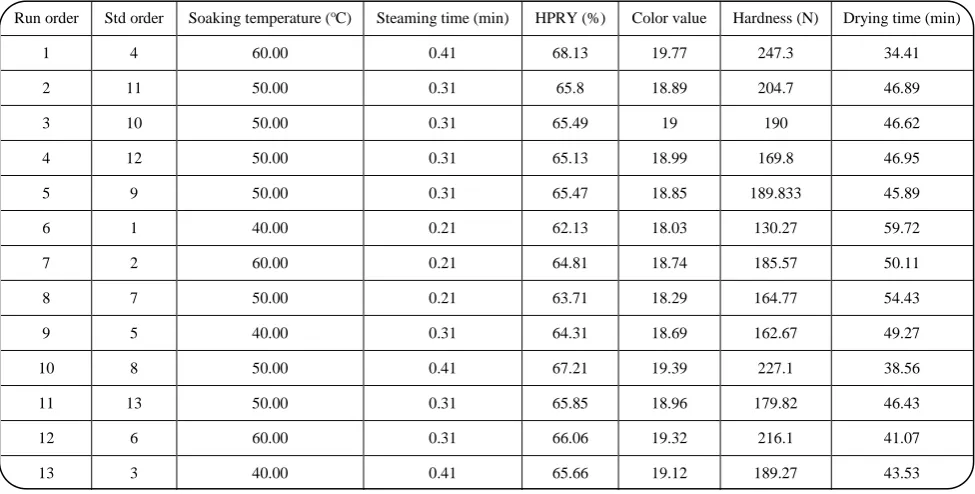
The effect of independent variables (factors) was investigated on response variables using RSM. The Central Composite Design (CCD) experimental data was employed for model fitting. It could find the best polynomial equation. The data were analyzed by Design Expert versions 7.0.0 (2007, Stat-Ease company, USA). The design included 17 experiments and was adopted by five replications of the center point as shown in Table 1. Mathematical models between the independent variables (drying temperature (oC),
RI (w/cm2)) and dependent variables (HPRY, hardness
and color value and drying time), for parboiled rice were appraised by means of multiple linear regression analysis [35] of the following equation:
n n 2
0 i 1 i i i 1 ii i
Y a
a x
a x (2)n n 1
ij i j
i 1 j i 1a x x e
Where a0, ai, aii, aij are regression constant
coefficients, xi and xj are the independent variables. Also,
254 Research Article Table 1: The experimental data based central composite design.
Run order Std order Soaking temperature (oC) Steaming time (min) HPRY (%) Color value Hardness (N) Drying time (min)
1 4 60.00 0.41 68.13 19.77 247.3 34.41
2 11 50.00 0.31 65.8 18.89 204.7 46.89
3 10 50.00 0.31 65.49 19 190 46.62
4 12 50.00 0.31 65.13 18.99 169.8 46.95
5 9 50.00 0.31 65.47 18.85 189.833 45.89
6 1 40.00 0.21 62.13 18.03 130.27 59.72
7 2 60.00 0.21 64.81 18.74 185.57 50.11
8 7 50.00 0.21 63.71 18.29 164.77 54.43
9 5 40.00 0.31 64.31 18.69 162.67 49.27
10 8 50.00 0.41 67.21 19.39 227.1 38.56
11 13 50.00 0.31 65.85 18.96 179.82 46.43
12 6 60.00 0.31 66.06 19.32 216.1 41.07
13 3 40.00 0.41 65.66 19.12 189.27 43.53
HPRY = Head parboiled rice yield. Triplicate runs were carried out at all design points and average recorded. The experimental runs were randomized.
a number of independent variables and the random error term, respectively.
The relationships between the responses were evaluated by means of adjusted R2, predicted R2, correlation
coefficients of determination (R2) and Prediction Error Sum of Squares (PRESS) [36]. A good model will have a large predicted R2 and a low PRESS. The data
were subjected to analysis of variance (ANOVA). The significant terms in the model were found by ANOVA for each response. The significance was analyzed with a confidence level above 95% (P < 0.05). The numeral and graphical optimization techniques of the Design-Expert software were used simultaneously to optimize the multiple responses at a time. The desired goals for each variable and response were chosen. All of the independent variables were within the determined range, while the responses were either maximized or minimized.
RESULTS AND DISCUSSION
Experimental Design and Model Development
The regression equations for the response variables and P value, R2, Adj R2 and Pred R2 values are given in Table 2. R2 value should be at least 0.8 for good fit of a regression model [37]. R2 of all models ranged between
0.86 and 0.97. All models were significant (p<0.01) and
there was no significant lack of fit in any of the response variables, validating the treatment [36]. Also, the high R2values revealed that the regression model fits the data well. Thus, the models could be used to predict the amount of HPRY (%), color value, hardness (N), drying time (min).
HPRY
One of the most important quality parameters that was studied with respect to the economic value of parboiled rice was the HPRY. As shown in Table 1, HPRY values were between 62.13-68.13%. The highest and lowest HPRY were obtained for the samples that had been dried at treatment 60 oC - 0.41 w/cm2 and 40 oC -
0.21 w/cm2, respectively. These findings are similar
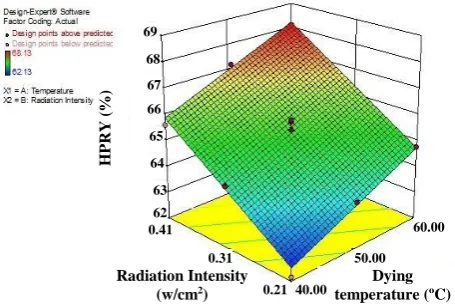
to results reported by other researchers [38]. They reported the values of HPRY in the range of 60-80% for parboiled rice (KDML 105 paddy). As shown in Table 2, the drying temperature and RI have a positive significant influence (p<0.01) on the extent of parboiled rice HPRY. Fig. 2 is the response surface plots (three-dimensional (3-D) that shows the interaction effect of drying temperature and RI on the HPRY (%).
According to Fig. 2, increasing drying temperature (from 40 oC to 60 oC) and RI (from 0.21 to 0.41 w/cm2)
Table 2: Anova table and regression equation of response variable.
Response variable Equation p value R2 value Adj R2 Pred R2
HPRY (%) 54.27 + 0.115 × A + 17.25 × B < 0.0001 0.96 0.96 0.94
Color value 16.48 - 0.0377× A + 11.20 × B - 7.086×10⁻⁴× A2 - 9.41× B2 < 0.0001 0.99 0.98 0.98
Hardness (N) -44.53 + 2.78 × A + 305.1 × B < 0.0001 0.93 0.91 0.91
Drying time 46.45 - 4.49× A - 7.96 × B < 0.0001 0.99 0.98 0.98
A: Drying temperature (oC); B: Radiation intensity (w/cm2)
Fig. 2: Effect of radiation intensity and drying temperature on head parboiled rice yield (HPRY).
may likely be related to significantly higher temperatures [39]. Reports related to the effect of the drying conditions on the HPRY have also been presented by other researchers [40]. They reported that the HPRY of long-grain SP 1 parboiled rice was relatively high when drying temperature increased. Also, the best model for the prediction of HPRY was the linear model (R2 = 96% and adjusted R2 = 96%). Similar observations were reported by other researchers [1, 41]. Therefore, it seems established that increasing the drying temperature and RI at the range we investigated may lead to an increase in the Degree of Starch Gelatinization (DSG). Because high temperature and radiation is caused to penetrate the heat radiation into the rice grain kernel and led to greater DSG [40]. In other word, suitable conditions of drying lead to gelatinization and stronger structure by diffusing into the inter-granular space of starch thus facilitating the milling process which increased the HPRY of parboiled rice [42]. So, the increase of HPRY could also be related to facilitating the separation of the gelatinized kernels from the husk following the drying. As a result, the milling becomes the easier following this separation of the husk from the kernel [43].
Color value
The sample color value is one of the quality indicators. That it is related to the value of the market [44]. The effect of drying conditions on the color value of parboiled rice was shown in Table 1. According to Table 1, the variable of drying temperature (A), IR (B) and the quadratic terms of A2 and B2 were found to be significant (P< 0.01)
on the response. The effect of A and B were positive on the response, while A2 and B2 had a negative influence
on the color value. The highest and lowest color values were related to drying conditions of 60 °C – 0.41 w/cm2
and 40 °C – 0.21 w/cm2, respectively. As shown,
in Table 2, the drying temperature and RI had significant (p<0.01) effects on the color values of parboiled rice. Increasing color value may be due to higher diffusion of the red pigment from bran and hull into endosperm during drying [45].
The quadratic model was the most appropriate model to describe the relationship between the drying conditions and color values. The R2 was 99%, the adjusted R2 was found to be 98% and all p-value
coefficients were significant (p<0.01). The influence of the drying temperature and the RI and their product on the color value are shown in Fig. 3. The color value of parboiled rice varied between 18.03-19.77.
Similar results have been presented with the investigation of the effect of the parboiling conditions on the color value by other researchers [4, 38, 46]. Decreasing of color value at the high temperatures or RI can be related to the increasing of browning rate during drying [47]. Also, many researchers evaluated the color of parboiled rice [3, 48], finally, color changes during parboiling resulted from the value of reducing sugar and amino acid amount due to their role in the development of non-enzymatic browning (Maillard reactions) [45]. Also, the drying conditions can be able to influence the color intensity.
69
68
67 66
65
64
63 62 0.41
50.00 60.00
Dying temperature (ºC)
40.00
Radiation Intensity (w/cm2)
0.31
0.21
HPR
Y
(
256 Research Article Hardness
Fig. 4 shows the effect of the drying temperature, RI and their product on the hardness of parboiled paddy. A linear relationship was suggested between independent and response variables (Hardness) (R2= 0.93, Adj. R2 = 0.91, Pred. R2= 0.91 (Table 2)). The hardness values of parboiled rice increased with increasing drying variables. The increase in hardness was severe at higher drying temperatures and RI. Increasing the drying temperature from 40 to 60oC and of the RI from 0.21 to 0.41 w/cm2
caused an increase in hardness from 130.27 to 247.3 N (Table 1). Therefore, dried parboiled paddy from 40oC-
0.21 w/cm2 showed lower hardness whereas treatment
60oC- 0.41 w/cm2 showed the highest. This may be
associated with the degradation of the structural of protein and starch by proteases and amylases, respectively or, in other words, the hardness of parboiled paddy had been related to amylopectin and amylose [45]. Similar observations were made by other researchers [41]. They reported that hardness of the parboiled rice increased with an increase in drying temperature where a higher degree of gelatinization occurred. So, the most likely explanation for increasing of hardness during drying is that more grains are gelatinized, leading to increased fracture resistance. Because, starch gelatinization can be caused to interact with protein oryzenin, as a result, its influence on the rice stickiness [45].
Drying time
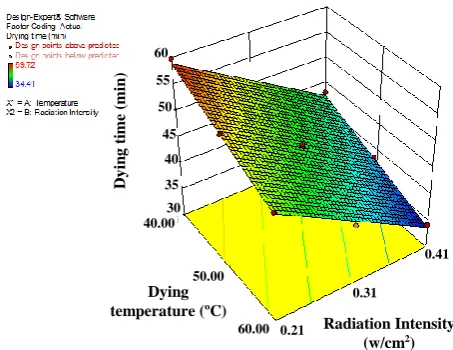
The relationship between the drying variables and drying time of parboiled rice is shown in Fig. 5. The drying time of samples increased quadratically with decreasing of both drying temperature and RI (R2=0.99, see Table (2)). As is revealed in Table 1, the drying time of parboiled rice ranged from 59.72 to 34.41 min. The lowest drying time was obtained for the samples that had been dried at a temperature of 60 oC and RI of 0.41 w/cm2.
The value of drying time decreases linearly with an increase in drying temperature and RI. These conditions lead to an increasing amount of water evaporation from the grains as a result, a higher heat transfer flux to the samples. So, increasing temperature and radiation decreases the drying time. These results are in agreement with the results of other researches [41,49, 50, 51]. In addition, the increase in the RI or air temperature is caused to increase the product surface temperature and moisture loss. So, it led to faster drying [49, 52].
Fig. 3: Effect of radiation intensity, drying temperature and their reciprocal interaction on color value of parboiled rice
Fig. 4: Effect of radiation intensity and drying temperature on the hardness of parboiled rice.
Fig. 5: Effect of radiation intensity and drying temperature on drying time of paddy.
20 19.5 19 18.5 18 0.41 50.00 60.00 Dying temperature (ºC) 40.00 Radiation Intensity (w/cm2)
0.31 0.21 C o lo r v a lu e 260 225 190 155 120 0.41 50.00 60.00 Dying temperature (ºC) 40.00 Radiation Intensity (w/cm2)
0.31 0.21 Ha rd n ess (N ) 0.41 0.31
0.21 Radiation Intensity
(w/cm2) 50.00 60.00 40.00 Dying temperature (ºC) 60 D y in g t ime ( mi n
) 55
50
45
40
Optimization
The optimal values of the independent variables selected for the response variables were obtained by solving the regression equation (Table (3)) using the Design-Expert software. The hybrid HIR drying variables can be optimized if the HPRY reached to their maximum values, color value and drying time reached to their minimum values and hardness values must be in the range of 130.27 to 247.3 N. The desirability values of the minimum and maximum were configured as 0 and 1, respectively. The optimum operating condition is determined based on the obtained maximum desirability function [1]. The optimal condition for HIR drying was estimated as drying temperature = 55 oC, RI= 0.41 w/cm2 with the
desirability of 77%. The predicted HPRY, color value, hardness and drying time under the above conditions were 67.68%, 19.57, 233.68 N and 36.21 min. To verify the prediction of the model, the optimal condition was applied to three independent replicates. The results of this work have shown that response surface methodology could be used to optimize the Drying time and quality properties of parboiled rice.
CONCLUSIONS
In this study, the effect of drying temperature and RI on drying of parboiled paddy samples was studied in hybrid HIR drying. The quality parameters and drying time were significantly (p<0.01) influenced in various combinations of drying temperature and RI. The value of HPRY, color value, hardness and drying time for parboiled rice during drying were obtained in the range of 62.13 to 68.13%, 18.03 to 19.77, 130.27 to 247.30 N and 34.41 to 59.72 min, respectively. The obtained results indicated that the amount of HPRY and hardness increased by increasing drying temperature and RI, while the amount of color value and drying time decreased. The RSM was applied to predict the drying time and quality properties of parboiled rice. Also, it can be able to optimize the drying conditions. The quadratic model was the most appropriate model to describe the relationship between the drying conditions and HPRY, color values hardness and drying time of parboiled rice was linear (R2= 0.96), quadratic (R2= 0.99), linear (R2= 0.93) and linear (R2= 0.99) equation, respectively. The best drying conditions were the drying temperature of 55 oC and RI of 0.41 w/cm2. The results offered
this study can be applied for the selection of the proper dryer for parboiled paddy drying and designing of related equipment.
Acknowledgment
We acknowledge the financial support of the University of Mohaghegh Ardabili from this research project.
Received : Feb. 4, 2018 ; Accepted : Jun. 18, 2018
REFERENCES
[1] Taghinezhad E., Brenner T., Mathematical Modeling of Starch Gelatinization and Some Quality Properties of Parboiled Rice Based on Parboiling Indicators Using RSM, J Food Process Eng., 40(3): e12483 (2017). [2] FAO., “Paddy Rice, Production Quantity, Annual
Statistics”, 2015, Commodities and Trade Division, FAO of the UN, Rome, (2016).
http://faostat.fao.org/site/567/default.aspx#ancor
[3] Taghinezhad E., Khoshtaghaza M.H., Minaei S., Latifi A., Effect of Soaking Temperature and Steaming Time on the Quality of Parboiled Iranian Paddy Rice, Int. J. Food Eng., 11(4): 547-556 (2015).
[4] Taghinezhad E., Khoshtaghaza M.H., Minaei S., Suzuki T., Brenner T., Relationship Between Degree of Starch Gelatinization and Quality Attributes of Parboiled Rice During Steaming, Rice Science, 23(6): 339-344 (2016).
[5] Orikasa T., Koide S., Okamoto S., Imaizumi T., Muramatsu Y., Takeda J., Shiina T., Tagawa A.,
Impacts of Hot Air and Vacuum Drying on the Quality Attributes of Kiwifruit Slices, J. Food Eng., 125: 51-58 (2014).
[6] Therdthai N., Zhou W., Characterization of Microwave Vacuum Drying and Hot Air Drying of Mint Leaves (Mentha cordifolia Opiz ex Fresen), J. Food Eng., 91(3): 482-489 (2009).
[7] Abano E.E., Ma H., Qu W. ,Teye E., Modeling Pre-Treatments Effect on Drying Kinetics of Garlic (Allium sativum L.) Slices in a Convective Hot Air Dryer, Afr. J. Food Sci., 5(7): 425 - 435 (2011). [8] Seyedabadi E., Khojastehpour M., Abbaspour-Fard M.H.,
258 Research Article [9] Kaveh M., Jahanbakhshi A., Abbaspour‐Gilandeh Y,
Taghinezhad E., Moghimi MBF., The effect of ultrasound pre‐treatment on quality, drying, and thermodynamic attributes of almond kernel under convective dryer using ANNs and ANFIS network, J Food Process Eng., 41: e12868 (2018).
[10] Torki Harchegan M., Sadeghi, M., Ghanbarian D., Moheb A. Dehydration Characteristics of Whole Lemons in a Convective Hot Air Dryer, Iran. J. Chem. Chem. Eng. (IJCCE), 35(3): 65-73 (2016). [11] Azzouz S., Hermassi I., Chouikh R., Guizani A.,
Belghith A., The Convective Drying of Grape Seeds: Effect of Shrinkage on Heat and Mass Transfer, J. Food Process Eng., 41(1): e12614 (2018).
[12] Sufer O., Sezer S., Demir H., Thin Layer Mathematical Modeling of Convective, Vacuum and Microwave Drying of Intact and Brined Onion Slices, J. Food Process Preserv., 41(6): e13239 (2017). [13] Wu B., Ma H., Qu W., Wang B., Zhang X., Wang P.,
Wang J., Atungulu G.G., Pan Z., Catalytic Infrared and Hot Air Dehydration of Carrot Slices, J. Food Process Eng., 37(2): 111-121 (2014).
[14] Nejadi J., Nikbakht A.M., Numerical Simulation of Corn Drying in a Hybrid Fluidized Bed-Infrared Dryer, J. Food Process Eng., 40(2): e12373 (2017). [15] Motevali A., Koloor R.T, A Comparison between
Pollutants and Greenhouse Gas Emissions from Operation of Different Dryers Based on Energy Consumption of Power Plants, J. Clean Prod, 154: 445-461 (2017). [16] El-Mesery H.S., Mwithiga G., Performance of a
Convective, Infrared and Combined Infrared- Convective Heated Conveyor-Belt Dryer, J. Food Sci. Technol., 52(5): 2721-2730 (2015).
[17] Zare D., Naderi H., Ranjbaran M., Energy and Quality Attributes of Combined Hot-Air/Infrared Drying of Paddy, Drying Technol., 33(5): 570-582 (2015). [18] Adabi E.M., Motevali A., Nikbakht A.M.,
Khoshtaghaza M.H., Investigation of Some Pretreatments on Energy and Specific Energy Consumption Drying of Black Mulberry, Chem. Ind. Chem. Eng. Q., 19(1): 89-105 (2013)
[19] Ponkham K., Meeso N., Soponronnarit S., Siriamornpun S., Modeling of Combined Far-Infrared Radiation and Air Drying of a Ring Shaped-Pineapple With/Without Shrinkage, Food Bioprod Proces, 90: 155-164 (2012).
[20] Naidu M.M., Vedhashree M., Satapathy P., Khanum H., Ramsamy R., Hebbar H.U., Effect of Drying Methods on the Quality Characteristics of Dill (Anethumgraveolens) Greens, Food Chem., 192: 849-856 (2016).
[21] Ozdemir M.B., Aktas M., Sevik S., Khanlari A.,
Modeling of a Convective-Infrared Kiwifruit Drying Process, Int. J. Hydrog Energy, 42(28): 18005- 18013 (2017).
[22] Łechtanska J.M., Szadzinska J., Kowalski S.J.,
Microwave- and Infrared-Assisted Convective Drying of Green Pepper: Quality and Energy Considerations, Chem. Eng. Proces, 98: 155–164 (2015).
[23] Muzaffar K., Dinkarrao B.V., Kumar P., Yildiz F.,
Optimization of Spray Drying Conditions for Production of Quality Pomegranate Juice Powder, Cogent Food & Agri, 2(1): 1127583 (2016). [24] Moghaddam A.D., Pero M., Askari G.R.,
Optimizing Spray Drying Conditions of Sour Cherry Juice Based on Physicochemical Properties, Using Response Surface Methodology (RSM), J. Food Sci. Technol., 54(1): 174-184 (2017).
[25] Tengse D.D., Priya B., Kumar P.A.R., Optimization for Encapsulation of Green Tea (Camellia sinensis L.) Extract by Spray Drying Technology, Food Measure, 11(1): 85-92 (2017).
[26] Yolmeh M., Jafari S.M., Applications of Response Surface Methodology in the Food Industry Processes, Food Bioproces Technol., 10(3): 413-433 (2017). [27] Amiri Chayjan R., Kaveh M., Nesa Dibagar N.,
Nejad M.Z., Optimization of Pistachio Nut Drying in a Fluidized Bed Dryer with Microwave Pretreatment Applying Response Surface Methodology., Chem. Product Proces Model, 12(3): 0048 (2017).
[28] AOAC., “Official Methods of Analysis”, 16th ed., Arlington, VA, USA: Association of Official Analytical Chemists (1995).
[29] Islam M.R., Roy P., Shimizu N., Kimura T., Effect of Processing Conditions on Physical Properties of Parboiled Rice, Food Sci. Technol. Res., 8(2): 106-112 (2002).
[31] Nasirahmadi A., Emadi B., Abbaspour-Fard M.H., Aghagolzade H., Influence of Moisture Content, Variety and Parboiling on Milling Quality of Rice Grains, Rice Science, 21(2): 116-122 (2014). [32] Lamberts L., Bie E.D., Vandeputte G.E., Veraverbeke W.S.,
Derycke V., Man W.D., Delcour J.A., Effect of Milling on Colour and Nutritional Properties of Rice, Food Chem., 100(4): 1496-1503 (2007).
[33] Taghinezhad E., Sharabiani V.R., Prediction of Starch Gelatinization Degree and Some Quality Properties of Parboiled Rice (Shiroudi Cultivar)
During Steaming of Parboiling Process, Food Science
& Technology, 15(77): 183-192 (2018) (In Farsi). [34] Miah M.A.K., Haque A., Douglass M.P., Clarke B.,
Parboiling of Rice. Part II: Effect of Hot Soaking Time on the Degree of Starch Gelatinization, Int. J. Food Sci. Tech., 37(5): 539-545 (2002).
[35] Khuri A.I., Cornell J.A., “Response Surfaces”, Marcel Dekker, New York, NY. (1987).
[36] Myers R.H., Montgomery D.C., Christine M.A.C., “Response Surface Methodology: Process and Product Optimization Using Designed Experiments”, 4th ed., John Wiley & Sons, Inc., Canada (2016).
[37] Danbaba N., Nkama I., Badau M.H., Ukwungwu M.N., Maji A.T., Abo M.E., Hauwawu H., Fati K.I., Oko A.O., Optimization of Rice Parboiling Process for Optimum Head Rice Yield: a Response Surface Methodology (RSM) Approach, Int. J. Agri. and Forest, 4(3): 154-165 (2014).
[38] Sareepuang K., Siriamornpun S., Wiset L., Meeso N.,
Effect of Soaking Temperature on Physical, Chemical and Cooking Properties of Parboiled Fragrant Rice, World J. Agri. Sci., 4(4): 409-415 (2008).
[39] Singh N., Paul P., Virdi A.S., Kaur P., Mahajan G.,
Influence of Early and Delayed Transplantation of Paddy on Physicochemical, Pasting, Cooking, Textural, and Protein Characteristics of Milled Rice, Cereal Chem, 91(4): 389-397 (2014).
[40] Tirawanichakul S., Bualuang O., Tirawanichakul Y.,
Study of Drying Kinetics and Qualities of Two Parboiled Rice Varieties: Hot Air Convection and Infrared Irradiation, Songklanakarin, J. Sci. Technol, 34(5): 557-568 (2012).
[41] Bualuang O., Tirawanichakul Y., Tirawanichakul S.,
Comparative Study between Hot Air and Infrared Drying of Parboiled Rice: Kinetics and Qualities Aspects, J. Food Process Preserv., 37(6): 1119-1132 (2013).
[42] Islam M.R., Shimizu N., Kimura T., Energy Requirement in Parboiling and Its Relationship to some Important Quality Indicators, J. Food Eng., 63(4): 433-439 (2004).
[43] Ayamdoo A.J., Demuyakor B., Dogbe W., Owusu R., Ofosu M.A., Effect of Varying Parboiling Conditions on Physical Qualities of Jasmine 85 and Nerica 14 Rice Varieties, American J Food Technol, 8(1): 31-42 (2013).
[44] Parnsakhorn S., Noomhorm A., Changes in Physicochemical Properties of Parboiled Brown Rice During Heat Treatment, Agri. Eng. Int: The CIGR E-journal, Manuscript FP 08 009. Vol. X (2008). [45] Pal P., Singh N., Kaur P., Kaur A., Virdi A.S., Parmar N., Comparison of Composition, Protein, Pasting, and Phenolic Compounds of Brown Rice and Germinated Brown Rice from Different Cultivars, Cereal Chem., 93(6): 584-592 (2016).
[46] Miah M.A.K., Haque A., Douglass M.P., Clarke B.,
Parboiling of Rice. Part I: Effect of Hot Soaking Time on Quality of Milled Rice, Int. J. Food Sci. Tech., 37(5): 527-537 (2002).
[47] Kaveh M., Abbaspour-Gilandeh Y., Amiri Chayjan R.M., Taghinezhad E., Mohammadigol R., Mass Transfer, Physical, and Mechanical Characteristics of Terebinth Fruit (Pistacia atlantica L.) Under Convective Infrared Microwave Drying, Heat Mass Transf., 54 (7): 1879–1899 (2018).
[48] Lv B., Li B., Chen S., Chen J., Zhu B., Comparison of Color Techniques to Measure the Color of Parboiled Rice, J. Cereal Sci., 50(2): 262-265 (2009).
[49] Onwude D.I., Hashim N., Abdan K., Janius R., Chen G.,
Investigating the Influence of Novel Drying Methods on Sweet Potato (Ipomoea batatas L.): Kinetics, Energy Consumption, Color, and Microstructure, J. Food Process Eng., 41(4):e12686 (2018). [50] Taghinezhad E., Rasooli Sharabiani V.,The Effect
of Combination Dryer of Hot Air-Infrared and Microwave on Some Quality Properties of Parboiled Rice, Innovative Food Technologies, 5(1): 25-38 (2017).
260 Research Article [52] Salarikia A., Ashtiani S.H.M., Golzarian M.R.,