
Modeling of Reversible Chain Transfer Catalyzed
Polymerization by Moment Equations Method
Safajou-Jahankhanemlou, Majid; Salami-Kalajahi, Mehdi*+
Department of Polymer Engineering, Sahand University of Technology, P.O. Box 51335-1996, Tabriz, I.R. IRAN
ABSTRACT: A moment equations method was performed to study the Reversible chain Transfer Catalyzed Polymerization (RTCP) of styrene in 80°C. To do this, a kinetic scheme containing conventional free radical polymerization reactions and equilibrium reactions of RTCP was assumed. After obtaining mass balance equations, three moment equations were defined for free and dormant radicals and dead chains. Monomer conversion, catalyst and cocatalyst concentrations, molecular weights and polydispersity index profiles were achieved for two different systems and compared with the simulation results of Goto et al. and also with the experimental results of this work. These systems have had different reaction rate constants for equilibrium reactions of RTCP. The results showed the pseudo-linear increase of conversion and molecular weight versus time while a small PDI values were obtained for system 1 while the final PDI value of system 2 was high. Calculating average error of results compared to experimental and simulation results of Goto et al. showed a good agreement of modeling results with others and confirm the accuracy of results obtained in this work.
KEY WORDS:Reversible chain Transfer Catalyzed Polymerization (RTCP), Moment equations method, Modeling, Kinetics.
INTRODUCTION
Controlled living Radical Polymerizations (CRP) have achieved growing attention as powerful methods for synthesizing well-defined and low-polydispersity (PDI) structures [1]. Beside typical reactions of radicals such as propagation and termination reactions, CRP techniques are based on equilibrium between propagating radicals and different dormant species. With this regards, according to the nature of the main equilibrium reaction in CRP techniques, these methods are categorized to four main groups comprising Dissociation-Combination (DC) [2], Atom Transfer (AT) [3], Degenerative chain Transfer (DT) [4], and Reversible chain Transfer (RT) [5] mechanism.
The main examples of the above-mentioned mechanisms are Stable Free Radical Polymerization (SFRP) [6-7], Atom Transfer Radical Polymerizations (ATRP) [8-9], Reversible Addition-fragmentation chain Transfer (RAFT) radical polymerization [10,11] and Reversible chain Transfer Catalyzed Polymerization (RTCP) [12-13]. Among these methods, many researches have been done on SFRP, ATRP, and RAFT methods but there are few studies on RTCP technique [12-16] which is the newer one in CRP methods. In RTCP method, similar to iodide-mediated polymerization based on a degenerative chain transfer, polymerization system includes monomer,
* To whom correspondence should be addressed. +E-mail: [email protected]
an alkyl iodide and a conventional radical initiator. Also, due to low exchange frequency of degenerative chain transfer reactions, an iodide-based catalyst (AI) is added [17,18]. In the presence of AI catalyst, another reversible reaction mechanism occurs which is called the Reversible chain Transfer (RT).
Mathematical modeling of polymerization processes provides a deeper comprehension into the mechanism of reactions. Combining theoretical knowledge and mathematical modeling enables to predict resultant polymers' properties acquired from polymerization systems. For this, some modeling techniques have been used to model different polymerization systems such as population balances [19], Monte Carlo simulation method [20-21], moment equations method [22-23] and etc.
Although some studies have been done on the modeling and simulation of polymerization kinetics of RTCP technique [24,25], there is no report on the modeling of its mechanism using moment equations method. So, in this work RTCP of styrene in 80°C with dibenzoyl peroxide (BPO) as the initiator was modeled using moment equations method for the first time. The modeling results were compared to the simulation results obtained from the reference [24] and also with the experimental results of this work.
EXPERIMENTAL SECTION Materials
Styrene (Aldrich, 99%) was passed through a basic aluminum column to remove inhibitor before use. Phenylethyl iodide (Tetrahedron, 99%), germanium (IV) iodide (Aldrich, > 99%), benzoyl peroxide (Sigma-Aldrich, > 98%), and ethanol (Merck, 99%) were used as received.
2.2. Characterization
Average molecular weights and molecular weight distributions were measured by Gel Permeation Chromatography (GPC) technique. It was conducted on an Agilent 1100 series equipped with a Refractive Index (RI) detector at 30 °C. Three PL gel 10 m bead-size columns (300 × 7.5 mm) in series (104,103,500 Å) were used. All columns were calibrated with narrow polydispersity polystyrene (PS) standards (Polymer Laboratory) with molar mass ranging 650-189300 g/mol. THF was used as the eluent at a flow rate of 1 mL/min. Also, conversion was determined by gravimetry.
RTCP polymerization of styrene
A typical procedure is as follows: BPO (0.223 g, 0.92 mmol, 2×10⁻² mol/L), GeI
4 (0.133 gr, 0.23 mmol,
5×10⁻³ mol/L), phenylethyl iodide (system 1: 0.854 g,
3.68 mmol, 8×10⁻² mol/L; system 2: 0.108 g, 0.46 mmol,
1×10⁻² mol/L) and styrene (46 mL, 0.4 mol, 8.73 mol/L)
were transferred into three-neck-round-bottomed flask and mixed for 30 min. The flask was equipped with condenser, a nitrogen gas inlet and septum. The content of the flask was purged for approximately 20 min with nitrogen to eliminate oxygen. Afterward, the aliquots of homogeneous solution were transferred to glass vials under N2 atmosphere and the vials were sealed with
rubber plug. Reaction samples completely sank in water bath at 80 °C. Samples (vials) were taken at preset times, and then were quenched in an ice water bath and precipitated into cold ethanol to prevent further polymerization. The product was then transferred to a vacuum oven to remove monomer at room temperature before characterization. Monomer conversion was determined using gravimetry method.
THEORITICSL SECTION RTCP Mechanism
The main reactions as the mechanism of the RTCP of styrene initiated by BPO at 80 °C which are introduced by Vana et al. [24] are listed below:
Primary radical formation:
d
fk *
BPO→2R (1)
Initiation:
i k
* *
1
R +M→P (2)
i k
* *
2
PhE +M→P (3)
Propagation:
p k
* *
n n 1
P +M→P+ (4)
Termination:
t k * *
n m n m
P +P →P+ (5)
Pre-equilibrium degenerative chain transfer: ex
ex k
* *
n n
k
P +PhE I− →P − +I PhE
Degenerative chain transfer: ex
ex k
* *
n m n m
k
P +P − I →P − +I P
← (7)
Pre-equilibrium reversible chain transfer:
da
a k
* *
k
PhE +AI→PhE I A− +
← (8)
Reversible chain transfer:
da a k * * n n k
P +AI→P − +I A
← (9)
Cross termination:
t,cross k * *
n n
P +A →P (10)
In these reactions, phenylethyl iodide is the alkyl iodide compound and AI stands for iodide-based catalyst which is GeI4 in this study. The other compounds which
are included in mechanism are well-known from conventional free radical polymerization.
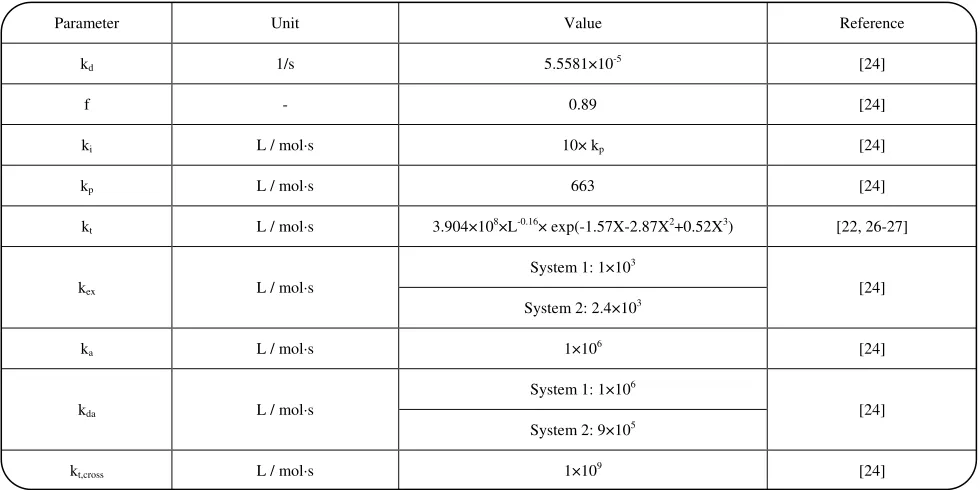
In this study, two systems were used to compare the moment modeling with simulation results from ref. [24]. The kinetics parameters which are mentioned in RTCP reactions for these two systems are shown in Table 1.
Mass Balance Equations
In batch process, mass balance equations for the reaction components are as follow:
d d[BPO] k [BPO]
dt = − (11)
*
*
d i
d[R ] 2fk [BPO] k [R ][M]
dt = − (12)
* * *
i p n 1 n
d[M] k [M]([R ] [PhE ]) k [M] [P ] dt
∞
=
= − + − (13)
*
1 * *
i
d[P ]
k [M]([R ] [PhE ])
dt = + − (14)
* * *
p 1 t 1 n 1 n ex 1
k [M][P ] k [P ] ∞ P k [P ][PhE I]
=
− − − +
* *
ex 1 ex 1 n 1 n
k [PhE ][P I] k [P ] ∞ [P I]
=
− − − +
* *
ex 1 n 1 n a 1
k [P I] ∞ [P ] k [P I][A ]
=
− + − −
* * *
da 1 tcross 1
k [P ][AI] k− [P ][A ]
*
* *
i ex n 1 n
*
ex n 1 n
* *
a da
d[PhE ] k [PhE ][M] k [PhE I] [P ] dt
k [PhE ] [P I]
k [PhE I][A ] k [PhE ][AI]
∞ = ∞ = = − + − − − + − − (15) * n *
p n 1
* * *
p n t n m 1 m
* *
ex n ex n
* *
ex n m 1 m ex n m 1 m
* * * *
a n da n tcross n
d[P ]
k [P ][M]
dt
k [P ][M] k [P ] [P ]
k [P ][PhE I] k [P I][PhE ]
k [P ] [P I] k [P I] [P ]
k [P I][A ] k [P ][AI] k [P ][A ]
− ∞ = ∞ ∞ = = = − − − − + − − − + − + − − − (16) n 1
n * * * *
t i 1 i n i tcross n
d[P ] 1k [P ][P ] k [P ][A ]
dt 2
−
− =
= + (17)
*
ex n 1 n
*
ex n 1 n
* *
a da
d[PhE I] k [PhE I] [P ] dt
k [PhE ] [P I]
k [PHE I][A ] k [PhE ][AI]
∞ = ∞ = − = − − + − − − + (18) n * ex n * *
ex n ex n m 1 m
* *
ex n m 1 m a n *
da n
d[P I]
k [P ][PhE I] dt
k [PhE ][P I] k [P I] [P ]
k [P ] [P I] k [P I][A ]
k [P ][AI]
∞ = ∞ = − = − − − − − + − − − + (19) * *
a n 1 n
* * * *
da n 1 n tcross n 1 n
d[A ] k [A ]([PhE I] [P I])
dt
k [AI]([PhE ] [P ]) k [A ] [P ]
∞ = ∞ ∞ = = = − − + − + + − (20) * a * *
n da n
n 1 n 1
d[AI] k [A ]([PhE I] dt
[P I]) k [AI]([PhE ] [P ])
∞ ∞
= =
= − +
− − +
(21)
These equations can be directly solved; however, to reduce the amount of calculations and also to obtain number- and weight-average molecular weight, and polydispersity index, moment equations are used herein.
Model Development
Table 1: Kinetic parameters for RTCP of styrene at 80 °C with GeI4 as iodide-based catalysts.
Parameter Unit Value Reference
kd 1/s 5.5581×10⁻⁵ [24]
f - 0.89 [24]
ki L / mol·s 10× kp [24]
kp L / mol·s 663 [24]
kt L / mol·s 3.904×10⁸×L-0.16× exp(-1.57X-2.87X2+0.52X3) [22, 26-27]
kex L / mol·s
System 1: 1×10³
[24] System 2: 2.4×10³
ka L / mol·s 1×10⁶ [24]
kda L / mol·s
System 1: 1×10⁶
[24] System 2: 9×10⁵
kt,cross L / mol·s 1×10⁹ [24]
L: Number-averaged chain length, X: Conversion
For propagating radicals, dormant chains and dead polymer chains, nth moment equations are defined by:
n *
n i
i 1
i [P ] , n 0 2 ∞
=
λ = = − (22)
n
n i
i 1
i [P I] , n 0 2
∞
=
γ = − = − (23)
n
n i
i 2
i [P ] , n 0 2 ∞
=
µ = = − (24)
The zeroth, the first, and the second moment equations
were used to calculate number- and weight-average molecular weight and polydispersity index. If polymer molecular weight, at each moment of the reaction, stems from growing, dormant and dead chains, equations related to number- and weight-average molecular weight and polydispersity index are given by:
1 1 1
0 0 0
n
M λ γ µ
λ γ µ
+ +
=
+ + (25)
2 2 2
1 1 1
w
M λ γ µ
λ γ µ + + = + + (26) w n M PDI M
= (27)
To calculate Eqs. (25) to (27), one needs to numerically compute moment equations used. Rearranging the above equations, the following equations can be derived for the zeroth, the first, and the
second moment equations of growing, dormant and dead chains:
* * 2
0
0
* *
0 0 0
* 0 0 [ ]([ ] [ ]) [ ] [ ] [ ] [ ] [ ] = + − − − + + − − i t
ex ex a
da tcross d
k M R PhE k
dt
k PhE I k PhE k A
k AI k A
λ λ λ γ γ λ λ (28) * * 1 0 *
0 1 1 1
*
0 1 1 0 1
* 1 1 [ ]([ ] [ ]) [ ] [ ] [ ] [ ] [ ] [ ] = + + − − − + − + + − − i p
t ex ex
ex ex a
da tcross d
k M R PhE k M
dt
k k PhE I k PhE
k k k A
k AI k A
λ λ λ λ λ γ γ λ γ λ γ λ λ (29) * * 2
0 1 0 2
*
2 2
*
0 2 2 0 2
*
2 2
[ ]([ ] [ ])
[ ]( 2 )
[ ] [ ] [ ] [ ] [ ] = + + + − − − + − + + − − i p t ex ex
ex ex a
da tcross d
k M R PhE
dt
k M k
k PhE I k PhE
k k k A
k A I k A
* 0
0 0
*
0 0
[
]
[
]
[ ]
[
]
=
−
−
−
+
ex ex
a da
d
k
PhE
I
k
PhE
dt
k A
k
AI
γ
λ
γ
γ
λ
(31)
* 1
1 1
*
1 0 0 1 1 1
[ ] [ ]
[ ] [ ]
= − − −
+ − +
ex ex
ex ex a da
d
k PhE I k PhE
dt
k k k A k A I
γ
λ
γ
γ λ
γ λ
γ
λ
(32)
* 2
2 2
*
2 0 0 2 2 2
[ ] [ ]
[ ] [ ]
= − − −
+ − +
ex ex
ex ex a da
d
k PhE I k PhE
dt
k k k A k A I
γ
λ
γ
γ λ
γ λ
γ
λ
(33)
* 2
0
0 0
1 [ ]
2
tcross t
d
k A k
dt
µ
λ λ
= + (34)
* 1
1 0 1
[ ]
tcross t
d
k A k
dt
µ
λ
λ λ
= + (35)
* 2
2
2 0 2 1
[ ] ( )
tcross t
d
k A k
dt
µ
λ
λ λ
λ
= + + (36)
All moments set to be zero at time zero for solving these equations except moments which were set to be equal to the initial concentration of phenylethyl iodide. Following the derivation of mass balance equations, the set of ODE's can be solved by a commercial ODE solver (ode23tb, ode23s, or ode15s in MATLAB R2010b).
RESULTS AND DISCUSSION
In RTCP systems, AI operates as a deactivator of the propagating macroradical to reduce the propagation rate. Reversibly, the produced A* reactivates the dormant
species by activating Polymer-I macromolecules. The uniform growth of macroradicals caused by frequent cycles of reversible chain transfer reactions enables a more precise control over the chain length distribution.
Figs. 1 and 2 show the modeling and experimental results obtained in this work and the simulation results from ref. [24] for system 1 and 2 respectively. The results conclude conversion, number- and weight-average molecular weights, PDI, and the concentration profiles of AI and PhE-I for system 1 and conversion, Mn, and PDI
profiles for system 2. As it is expected from a living/controlled system, monomer conversion increases linear with time up to monomer conversion of about 0.7 in both systems. The Mn increases with monomer
conversion, while it gradually slows down in its increase,
due to the accumulation of new chains resulting from BPO initiation. This effect is especially pronounced with slowly propagating monomers, such as styrene, for which high amounts of radicals are necessary to propel the polymerization. In system 1, the PDI reaches about 1.2 from an early stage of polymerization. Although this value is lower than a value for free radical polymerization, but for an ideal system it can be lowered. However, the initiator of the living process, PhE–I, which predetermines the number of living chains, is consumed during the early stages of the polymerization, which is a prerequisite for obtaining narrow molecular weight distributions. The level of cross-termination is rather significant for this system, too, as the concentration of the deactivator AI after 10 h is about one-fourth of its initial concentration at time zero. The PDI values in system 2 are higher than system 1. This phenomenon could be ascribed to the higher value of kda in this system which
results an increase in the concentration of A* and
subsequently increase in cross termination probability. Also, comparing the results of this work with the simulation results of Goto et al. shows that the molecular weight obtained here is a little higher that their results. It can be attributed to the gel effect which is assumed here but not in ref. [24]. Also, results show good fitting with the results of ref. [24] except the concentration of AI, although the final concentration values are the same.
Finally, the accuracy of modeling results presented here was examined for systems 1 and 2 separately. To this end, the average error of the all results which are depicted in Fig. 1 or 2 was calculated by Eq. (37).
n
1
Moment modeling result - Goto simulation result dError =
n (37)
Where n is the number of data. According to Eq. (37), the average errors of 7 % and 6 % were obtained for systems 1 and 2 respectively. The higher error value of system 1 is due to the deviation of AI concentration profile from Goto’s results. Also, the difference between the termination rate constants is another reason for increasing average error values. However, a fine correlation between the modeling results of this work and the simulation results from ref. [24] is achieved.
CONCLUSIONS
Fig. 1: Comparing the modeling kinetics and experimental results of this work with the simulation results obtained from [24] for system 1.
0 0.2 0.4 0.6 0.8 1
Monomer conversion
0 0.2 0.4 0.6 0.8 1
Monomer conversion
0 0.2 0.4 0.6 0.8 1
Monomer conversion
0 0.2 0.4 0.6 0.8 1
Monomer conversion
0 0.2 0.4 0.6 0.8 1
Monomer conversion
0 40000 80000 120000 160000 200000
Time (s)
8000
6000
4000
2000
0
M
n
(
g
.m
o
l
-1 )
10000
8000
6000
4000
2000
0
M
w
(
g
.m
o
l
-1)
0.005
0.004
0.003
0.002
0.001
CA
l
(
m
o
l.
L
-1)
0.08
0.06
0.04
0.02
0
CP
h
E
-l
l
(
m
o
l.
L
-1)
1.7
1.6
1.5
1.4
1.3
1.2
1.1
P
D
I
1
0.8
0.6
0.4
0.2
0
M
o
n
o
m
er
c
o
n
v
er
si
o
Fig. 2: Comparing the modeling kinetics and experimental results of this work with the simulation results obtained from [24] for system 2.
equations method and the effect of main reaction rate constants of RTCP was achieved. Subsequently, the validity of the modeling procedure was confirmed by employing simulation results of Goto et al. and experimental results obtained in this work. The fast exchange frequency of iodine resulted a narrow distribution and faster PDI decrement in RTCP systems. Increasing the kda value caused an increase the
concentration of A* and the probability of cross
termination reaction which resulted in higher PDI values. Comparing the modeling results with the simulation results of Goto’s research work showed the good agreement between them. The average error of the system 1 and 2 were obtained 7 % and 6 % respectively
Received : Sept. 3, 2012 ; Accepted : Sept. 13, 2013
REFERENCES
[1] Roghani-Mamaqani H., Haddadi-Asl V., Salami-Kalajahi M., In situ Controlled Radical Polymerization: A Review on Synthesis of Well-defined Nanocomposites, Polymer Reviews, 52, p. 142 (2012).
[2] Sciannamea V., Jérôme R., Detrembleur C., In-Situ Nitroxide-Mediated Radical Polymerization (NMP) Processes: Their Understanding and Optimization, Chemical Reviews, 108, p. 1104 (2008).
[3] Roghani-Mamaqani H., Haddadi-Asl V., Najafi M., Salami-Kalajahi M., Preparation of Tailor-Made Polystyrene Nanocomposite with Mixed Clay-Anchored and Free Chains via Atom Transfer Radical Polymerization, AIChE Journal, 57, p. 1873 (2011).
[4] Salami-Kalajahi M., Haddadi-Asl V., Behboodi-Sadabad F., Rahimi-Razin S., Roghani-Mamaqani H., Effect of Silica Nanoparticle Loading and Surface Modification on the Kinetics of RAFT Polymerization, Journal of Polymer Engineering, 32, p. 13 (2012).
[5] Goto A., Tsujii Y., Fukuda T., Reversible Chain Transfer Catalyzed Polymerization (RTCP): A New Class of Living Radical Polymerization, Polymer, 49, p. 5177 (2008).
[6] Cunningham M.F., Controlled/Living Radical Polymerization in Aqueous Dispersed Systems, Progress in Polymer Science, 33, p. 365 (2008). 0 40000 80000 120000 160000 200000
Time (s)
1
0.8
0.6
0.4
0.2
0
M
o
n
o
m
er
c
o
n
v
er
si
o
n
0 0.2 0.4 0.6 0.8 1
Monomer conversion
25000
20000
15000
10000
5000
0
M
n
(
g
.m
o
l
-1 )
0 0.2 0.4 0.6 0.8 1
Monomer conversion
1.8
1.6
1.4
1.2
P
D
[7] Simms R. W., Hoidas M. D., Cunningham M. F., Nitroxide-Mediated Styrene Surfactant-Free Emulsion Polymerization, Macromolecules, 41, P. 1076 (2008).
[8] Roghani-Mamaqani H., Haddadi-Asl V., Najafi M., Salami-Kalajahi M., Synthesis and Characterization of Clay Dispersed Polystyrene Nanocomposite via Atom Transfer Radical Polymerization, Polymer Composites, 31, P. 1829 (2010).
[9] Roghani-Mamaqani H., Haddadi-Asl V., Najafi M., Salami-Kalajahi M., Preparation of Nanoclay-Dispersed Polystyrene Nanofibers via Atom Transfer Radical Polymerization and Electrospinning, Journal of Applied Polymer Science, 120, P. 1431 (2011).
[10] Rahimi-Razin S., Haddadi-Asl V., Salami-Kalajahi M., Behboodi-Sadabad F., Roghani-Mamaqani H., Matrix-Grafted Multiwalled Carbon Nanotubes/Poly(methyl methacrylate) Nanocomposites Synthesized by In Situ RAFT Polymerization: A Kinetic Study, International Journal of Chemical Kinetics, 44, P. 555 (2012). [11] Salami-Kalajahi M., Haddadi-Asl V., Rahimi-Razin S.,
Behboodi-Sadabad F., Najafi M., Roghani-Mamaqani H., A Study on the Properties of PMMA/Silica Nanocomposites Prepared via RAFT Polymerization, Journal of Polymer Research, 19, Art. No. 9793 (2012).
[12] Goto A., Hirai N., Wakada T., Nagasawa K., Tsujii Y., Fukuda T., Living Radical Polymerization with Nitrogen Catalyst: Reversible Chain Transfer Catalyzed Polymerization with N-Iodosuccinimide, Macromolecules, 41, P. 6261 (2008).
[13] Goto A., Hirai N., Nagasawa K., Tsujii Y., Fukuda T., Kaji H., Phenols and Carbon Compounds as Efficient Organic Catalysts for Reversible Chain Transfer Catalyzed Living Radical Polymerization (RTCP), Macromolecules, 43, p. 7971 (2010).
[14] Yorizane M., Nagasuga T., Kitayama Y., Tanaka A., Minami H., Goto A., Fukuda T., Okubo M., Reversible Chain Transfer Catalyzed Polymerization (RTCP) of Methyl Methacrylate with Nitrogen Catalyst in an Aqueous Microsuspension System, Macromolecules, 43, P. 8703 (2010).
[15] Wolpers A., Ackermann L., Vana P., H-Phosphonic Acid Derivatives as Catalysts for Reversible Chain Transfer Catalyzed Polymerization (RTCP) at Ambient and High Pressure, Macromolecular Chemistry and Physics, 212, P. 259 (2011).
[16] Kuroda T., Tanaka A., Taniyama T., Minami H., Goto A., Fukuda T., Okubo M., Iodine Transfer Dispersion Polymerization (Dispersion ITP) with CHI3 and Reversible Chain Transfer Catalyzed
Dispersion Polymerization (Dispersion RTCP) with GeI4 of Styrene in Supercritical Carbon Dioxide,
Polymer, 53, p. 1212 (2012).
[17] Kim J., Nomura A., Fukuda T., Goto A., Tsujii Y., Use of Alcohol as Initiator for Reversible Chain Transfer Catalyzed Polymerization, Macromolecular Reaction Engineering, 4, P. 272 (2010).
[18] Goto A., Hirai N., Tsujii Y., Fukuda T., Reversible Chain Transfer Catalyzed Polymerizations (RTCPs) of Styrene and Methyl Methacrylate with Phosphorus Catalysts, Macromolecular Symposia, 261, P. 18 (2008).
[19] Jalili K., Abbasi F., Nasiri M., Copolymerization of Styrene and Methyl Methacrylate. Part I: Experimental Kinetics and Mathematical Modeling, Polymer, 52, p. 4362 (2011).
[20] Salami-Kalajahi M., Najafi M., Haddadi-Asl V., Application of Monte Carlo Simulation Method to Polymerization Kinetics over Ziegler-Natta Catalysts, International Journal of Chemical Kinetics, 41, P. 45 (2009).
[21] Mahjub A., Salami-Kalajahi M., Haddadi-Asl V., Roghani-Mamaqani H., Monte Carlo Simulation of Photo-initiated Bulk Polymerization of Furfuryl Methacrylate, Iranian Polymer Journal, 20, P. 205 (2011). [22] Salami-Kalajahi M., Haddadi-Asl V., Ganjeh-Anzabi P.,
Najafi M., Dithioester-mediated RAFT Polymerization: A Kinetic Study by Mathematical Modelling, Iranian Polymer Journal, 20, P. 459 (2011).
[24] Vana P., Goto A., Kinetic Simulations of Reversible Chain Transfer Catalyzed Polymerization (RTCP): Guidelines to Optimum Molecular Weight Control, Macromolecular Theory and Simulations, 19, P. 24 (2010).
[25] Mahjub A., Mohammadi H., Salami-Kalajahi M., Torabi Angaji M., Simulation of Reversible Chain Transfer Catalyzed Polymerization (RTCP): Effect of Different Iodide Based Catalysts, Journal of Polymer Research, 19, Art. No. 9740 (2012). [26] Najafi M., Roghani-Mamaqani H., Salami-Kalajahi M.,
Haddadi-Asl V., A Comprehensive Monte Carlo Simulation of Styrene Atom Transfer Radical Polymerization, Chinese Journal of Polymer Science, 28, P. 483 (2010).
![Fig. 1: Comparing the modeling kinetics and experimental results of this work with the simulation results obtained from [24] for system 1](https://thumb-us.123doks.com/thumbv2/123dok_us/8449844.1704616/6.595.67.523.81.679/comparing-modeling-kinetics-experimental-results-simulation-results-obtained.webp)
![Fig. 2: Comparing the modeling kinetics and experimental results of this work with the simulation results obtained from [24] for system 2](https://thumb-us.123doks.com/thumbv2/123dok_us/8449844.1704616/7.595.70.277.82.684/comparing-modeling-kinetics-experimental-results-simulation-results-obtained.webp)
