Corresponding Author E-mail:[email protected] 181 | Page
http://www.ijabbr.com
Available online at
International journal of Advanced Biological and Biomedical Research
Volume 2, Issue 1, 2014: 181-191
Genetic Dissection of Some Important Agronomic Traits in Rice Using Line ×
Tester Method
Zeinab Montazeri1*, Nadali Babaeian Jelodar2, Nadali Bagheri3
1
MSc student, Sari Agricultural Science and Natural Resources University, Sari, Iran 2,3
Professor and Associate Professor, Sari Agricultural Science and Natural Resources University, Sari, Iran.
Abstract
A study was conducted on genetics of some important agronomic traits (number of productive tillers per hill, plant height (cm), panicle length (cm), number of spikelets per panicle and 100-grain weight) in rice during 2012-13. Two lines were crossed with five testers in line × tester fashion to produce 10 F1 hybrids.
Analysis of variance revealed significant differences among genotypes and crosses. Variances of SCA were higher than the GCA variances for number of productive tillers per hill, panicle length (cm) and 100-grain weight (gr) which indicated predominance of non-additive gene action in the inheritance of these traits. P35 tester produced the lowest height among testers, highest number of productive tillers and
number of spikelets per panicle among parents and its hybrids produced highest number of productive tillers, highest panicle length (cm), highest number of spikelets per panicle (Tarom-Jelodar × P35) and
lowest height (Danesh × P35) among hybrids. Also this variety was found to be good general combiner
for height (cm) and panicle length (cm). Crosses namely Tarom-Jelodar × Sange-Tarom, Danesh × Jahesh and Danesh × P35 had useful and significant heterosis for all traits. These crosses were identified as
promising genotypes for increasing of rice yield in future improvement programs. Thus hybrid varieties have positive potential for rice breeding.
Key words: Rice, Line × Tester, Combining Ability, Heterosis, Yield. 1. Introduction
182 | Page
one of the powerful tools available to estimate the combining ability effects and aids in selecting the desirable parents and crosses for the exploitation of heterosis. Line × tester technique (Kempthorne et al. 1957) is useful in deciding the relative ability of female and male lines to produce desirable hybrid combinations. It also provides information on genetic components and enables the breeders to choose appropriate breeding methods for hybrid variety or cultivar development programs (Mirarab and Ahmadikhah 2010). Farshadfar et al (2013) estimated combining ability effects for agro-morphological characters of rapeseed (Brassica napus L.) using line×tester mating design. Among the 7 female lines, RGS003 revealed maximum GCA effects for seed yield, thousand kernel weight, seed per pod and number of branches. Among the testers, Option500 was desirable as it manifested higher estimates of GCA effects for seed yield and thousand kernel weight.Also they reported three cross-combiners Magent × Opera, Elect × Option500 and Shiralee × Opera were found to be the best specific crosses for seed yield. Presence of heterosis and SCA effects for some important agronomic traits in rice are reported by Roy & Mandal (2001). Singh & Kumar (2004) also identified suitable parents through line x tester analysis in rice. Roh et al. (1989) reported that non-additive gene effects preponderated in the genetic control of plant height. In contrast, Kaushik and Sharma (1988) reported preponderance of additive gene effects in control of plant height and panicle length. Sardana and Borthankur (1987) reported the important role of both GCA and SCA for heading date, plant height and panicle length. Marilia et al. (2001) stated that specific combining ability (SCA) effects of hybrids alone had limited power for parental selection in breeding programmes, and must be used in combination with other parameters such as hybrid means and GCA of the respective parents. The hybrid combinations with high mean performance, desirable SCA estimates and involving at least one of the parents with high GCA would likely to enhance the concentration of favorable alleles (Gnanasekaran et al. 2006; Kenga et al. 2004; Manivannan et al. 2001; Thirumeni et al. 2000). In the present study 2 lines × 5 testers mating design along with 7 rice genotypes and 10 F1s were used to determine the heterosis, combining ability as well as
the gene action on some important agronomic traits.
2. Materials and Methods
2.1 Plant materials
The experimental materials consist of seven rice genotypes, two genotypes (Tarom-Jelodar and Danesh) were used as females (designated as lines) and five genotypes (Sange-Tarom, Jahesh, Moosa-Tarom, Basmati 370 and P351) designated as testers were used as males. These parents were crossed to produce 10
F1 hybrids according to line × tester mating design (Kempthorne, 1957). This study was conducted in
2012-2013 years at Research Field of Sari Agricultural Sciences and Natural Resources University. Single seedlings of each entry were transplanted at 20 × 20 cm spacing in 3 × 5 m2 plots in a RCBD (randomized complete block design) with three replications. In this study five traits includes productive tiller number per hill, plant height (cm), panicle length (cm), number of spikelets per panicle and 100-grain weight were evaluated based on standard evaluation rice system (Scshu, 1988).
2.2 Statistical analysis
Data were recorded on nine randomly selected plants from parents and F1s plant samples. Heterosis was
estimated from mean values according to Fehr (1987) and t-test was performed. Combining ability analysis was done using line x tester method (Kempthorne, 1957). The variances for general combining ability and specific combining ability were tested against their respective error variances derived from ANOVA reduced to mean level. Significance test for GCA and SCA effects were performed using t-test. Midparent heterosis
183 | Page
(Ht) and high-parent heterosis (Htb) or heterobeltiosis were determined as outlined by Falconar and Mackay (1996). Also significance test for heterosis values were performed using t-test (Wynne et al., 1970).
3. Results and discussion 3.1 Means of the estimated traits
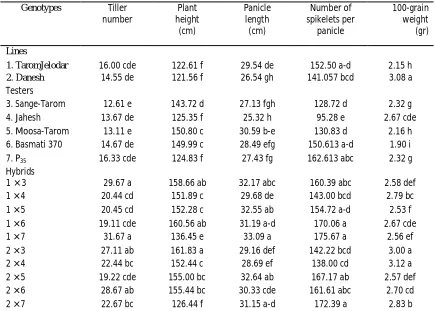
Mean of lines, testers and their hybrids (Table 1) indicated worth of genetic variability for the improvement of number of productive tillers per hill, plant height (cm), panicle length (cm), number of spikelets per panicle and 100-grain weight (gr) traits, which are important in hybrid rice yield. Mean of traits classified using Duncan's multiple range test (p = 0.05). P35 variety produced the lowest height
among testers, highest number of productive tillers and number of spikelets per panicle among parents and its hybrids produced highest number of productive tillers, highest panicle length (cm), highest number of spikelets per panicle (Tarom-Jelodar × P35), and lowest height (Danesh × P35) among hybrids.
Danesh line and its hybrid (Danesh × Jahesh) produced lowest height and highest 100-grain weight (gr), respectively. Also the longest panicle length among parents was given by Moosa-Tarom that was similar to the results reported by Bagheri and Babaeian (2010). Significant differences among various traits have been observed earlier reports (Surek and Korkut, 2002; Swati and Ramesh, 2004). The results showed that different genetic systems involved in controlling traits, which emphasized on important of study of these traits. More productive tillers/plant, increased panicle length and 100-grain weight are desirable traits of these hybrids helping for increasing rice yield.
3.2 Analysis of variance (ANOVA)
184 | Page
3.3 Combining ability analysis
3.3.1 General combining ability
The results of GCA of parents is shown in Table 4. For plant height negative GCA was desirable. As seen P35 tester had lowest significant negative GCA. Hence this parent is better general combiners for height
and the use of it in breeding programs causes dwarf and resistance to lodging. Also for number of spikelets per panicle positive GCA was desirable that was given by P35. Therefore this pollinator was
found to be good general combiner for these two traits. In panicle length (cm) Moosa-tarom tester had highest significant positive GCA.
3.3.2 Specific combining ability
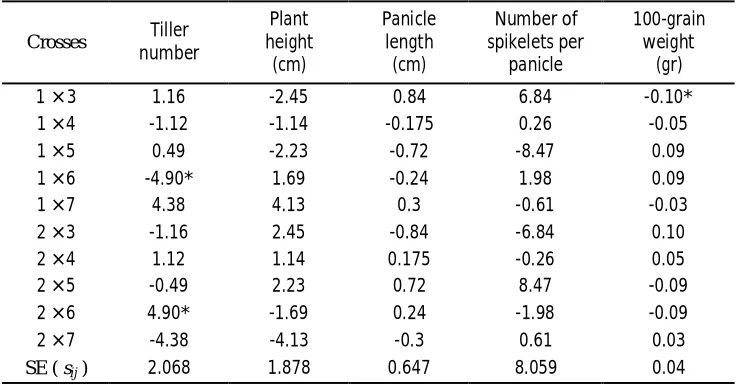
None of the lines or pollinators was found to be good specific combiner for all the characters studied (Table 5). Only for number of productive tillers per hill, Danesh × Basmati 370 had significant positive SCA. Therefore this hybrid was is better specific combiners for this trait.
3.4 Evaluation of heterosis
Heterosis values of hybrids were estimated based on mid-parent (MP) and better parent (BP)
performance, which are shown in Table 6. The degree of heterosis varied from cross to cross and from character to character. The data on estimates of heterosis (Ht) and heterobeltiosis (Htb) revealed that midparent heterosis for number of productive tillers per hill ranged 24.62 to 107.41 percent and that of high-parent heterosis was 19.44 to 95.43 percent (Table 6). Six hybrids present significantly positive heterosis as well as heterobeltiosis. Out of these six hybrids viz. Tarom-jelodar × Sange-tarom (Ht = 107.41, Htb = 85.43), Tarom-jelodar × P35 (Ht = 95.92, Htb = 93.94), Danesh × Sange-tarom (Ht = 99.63,
Htb = 86.32), Danesh × Jahesh (Ht = 59.03, Htb = 54.23), Danesh × Basmati 370 (Ht = 96.23, Htb = 95.43) and Danesh × P35 (Ht = 46.82, Htb = 38.82) were important based on high significant heterosis of
both types.Over-dominant type of gene action was suggested for them. Three hybrids (Tarom-jelodar × Jahesh, Tarom-jelodar × Moosa-tarom and Danesh × Moosa-tarom) showed significant and positive mid-parent heterosis but non-significant positive heterobeltiosis manifesting partial dominant type of gene action, while Tarom-jelodar × Basmati 370 indicated non-significant heterosis and heterobeltiosis displaying additive type of gene action. These results are in agreement with earlier findings (Vanaja and Babu, 2004; Verma et al., 2002). Negative heterosis for plant height is desirable for breeding short statured hybrids and varieties. None of the hybrids manifested significantly negative mid-parent and high-parent heterosis for plant height. The extent of heterosis over mid-high-parent was 2.63 to 23.48 percent and that of better parent was 0.98 to 21.61 percent. Danesh × P35 had the lowest degree of heterosis for height
(Ht = 2.63) but it was non-significant. For panicle length (cm), all hybrids except Tarom-jelodar × Jahesh were important based on highly significant heterosis of both types (Ht = 7.5 to 16.08, Htb = 5.59 to 13.40). Over-dominant type of gene action was suggested for them. Tarom-Jelodar × Jahesh showed significant and positive mid-parent heterosis but non-significant heterobeltiosis manifesting partial dominant type of gene action. For spikelets per panicle only Danesh × Moosa-tarom (Ht = 22.97, Htr = 18.51) had significantly positive heterosis and heterobeltiosis manifesting over dominance type of gene action. Also three hybrids (Tarom-jelodar × Sange-tarom, Danesh × Jahesh and Danesh × P35) had
185 | Page
can be regarded as promising based on both types of heterosis for the improvement of number of spikelets per panicle.
5. Conclusion
Ultimate aim of rice breeding is to gain the heterotics yield associated with other heterotic characters. Yield is the complex character of all other yield contributing characters such as height, number of productive tillers, 100-grain weight and etc. Decreased height, Increased tiller number and high grain weight can be effective for improving yield. In this study crosses namely Tarom-Jelodar × Sange-Tarom, Danesh × Jahesh and Danesh × P35 had heterotic effects for all traits. These hybrids are recommended as
desirable crosses for improving of related-yield traits in rice. Thus hybrid genotypes can be used for producing of promising rice varieties in the future.
References
Annadurai A, Nadarajan, N (2001). Combining ability for yield component and physiological traits in hybrid rice. Madras Agric. J., 88: 300-303.
Bagheri NA, Babaeian-Jelodar NA (2010). Heterosis and Combining Ability Analysis for Yield and Related-Yield Traits in Hybrid Rice. International Journal of Biology. Vol. 2, No. 2.
Eidi Kohnaki M, Kiani GH and Nematzadeh GH (2013). Relationship between Morphological Traits in Rice Restorer Lines at F3 Generation using Multivariate Analysis. International journal of Advanced Biological and Biomedical Research (IJABBR), Volume 1, Issue 6, 572-577.
Falconar DS, Mackay TFC (1996). Introduction to Quantitative Genetics. Chapman and Hall. London, U.K.
FAO (Food and Agriculture Organization of the United Nations). 2004. The State of Food
and Agriculture 2003–2004. Agricultural Biotechnology: Meeting the Needs of the Poor? (1 June 2005; www.fao.org/docrep/).
Farshadfar E, Kazemi Z and Yaghotipoor A (2013). Estimation of combining ability and gene action for agro-morphological characters of rapeseed (Brassica napus L.) using line×tester mating design. International journal of Advanced Biological and Biomedical Research (IJABBR), Volume 1, Issue 7, 711-717.
Fehr WR (1987). Heterosis In: Principles of cultivar development: Theory and Techniques (Vol. 1). Macmillan Publishing Company. New York, pp: 115.
Gnanasekaran M, Vivekanandan P, Muthuramu S (2006). Combining ability and heterosis for yield and grain quality in two line rice (Oryza sativa L.) hybrids. The Indian Journal of Genetics and Plant Breeding. 66(1), 6-9.
Kaushik RP, Sharma MK (1988). Gene action and combining ability for yield and its component characters in rice under cold stress condition. Oryza. 25(1): 1-9.
186 | Page
Kempthorne O (1957). An introduction to genetic statistics. John Wiley and Sons, Inc., New York. pp. 453-471.
Mackill DJ, Lei XM (1997). Genetic Variation for Traits Related to Temperate Adaptation of Rice Cultivars. Crop Sci 37, 1340-1346.
Manivannan N, Ganesan J 2001. Line x tester analysis over environment in sesame. Ind. J. Agric. Res, 35(4), 225-258.
Marilia CF, Servio TC, Vatter OR, Clibas V, Siu TM (2001). Combining ability for nodulation in common bean (Phaseolus vulgaris L.) genotypes from Andean and Middle American gene pools. Euphytica American gene pools 118: 265-270.
Mirarab M, Ahmadikhah A (2010). Study on genetics of some important phonological traits in rice using line × tester analysis. Annals of Biological Research, 1 (4):119-125. Nematzade Gh A, Valizade A (2002). Hybrid rice improvement. Mazandaran Universiti prining office. 202 pages.
Paterson AH, Freeling M, Sasaki T (2005). Grains of knowledge:genomics of model cereals. Genome Research 15, 1643-1650.
Ramalingam J, Nadarajan N, Vanniyarajan C, Rangasamy P (1997). Combining ability studies involving cms lines in rice. Oryza, 34, P. 4-7.
Rissi RD, Hallauer AR, De RR (1991). Evaluation of four testers for evaluating maize lines in a hybrid development program. Revista Brasllelia de Genetica, 14: 467-481.
Roh SE, Plee YM, Guh JO (1989). 12th Asian-Pacific weed science society conference. Los Bonas, Philippines. 261–265.
Roy B, Mandal AB (2001). Combining ability of some quantitative traits in rice. Ind. J.Genet., 61(2): 162-164.
Sardana S, Borthankur DN (1987). Combining ability for yield in rice, Oryza, 24(1), 14-18..
Scshu DV (1988). Standard evaluation system for rice. The International Rice Testing Program. The International Rice Research Institute. Los Banos. Philippines. pp. 1-54. Singh NK, Kumar A ( 2004). Combining ability analysis to identify suitable parents for heterotic rice hybrid breeding. IRRN, 29(1): 21-22.
Surek H, Korkut KZ (2002). Heterosis for yield and its components under temperate conditions. Proc. Euro Rice-2001 Symp. Krasnodar, Russia, Sep. 3-8 p: 1-10.
Swati PG, Ramesh BR (2004). The nature and divergence in relation to yield traits in rice germplasm. Annals. Agric. Res., 25(4): 598-602.
Thirumeni S, Subramanian M, Paramasivam K (2000). Combining ability and gene action in rice. Trop. Agric. Res. 12: 375-385
187 | Page
Verma OP, Shanthi U S, Srivastava HK (2002). Heterosis and inbreeding depression for yield and certain physiological traits in hybrids involving diverse ecosystem of rice (Oryza sativa L.). J. Genet. Breed, 56 (3): 267-278.
Wayne SC, Dilday RH (2003). Rice: Origin, History, (Wiley Series in Crop Science, John Wiley & Sons, Inc.). 324 p.
188 | Page
Table 1. Means of the estimated traits for seven parents and 10 F1 hybrids in rice
In each column, any two means having a common letter are not significantly different at p = 0.05 based on Duncan,s Multiple Range Test.
100-grain weight (gr) Number of spikelets per panicle Panicle length (cm) Plant height (cm) Tiller number Genotypes Lines 2.15 h 152.50 a-d 29.54 de 122.61 f 16.00 cde 1. TaromJelodar 3.08 a 141.057 bcd 26.54 gh 121.56 f 14.55 de 2. Danesh Testers 2.32 g 128.72 d 27.13 fgh 143.72 d 12.61 e 3. Sange-Tarom 2.67 cde 95.28 e 25.32 h 125.35 f 13.67 de 4. Jahesh 2.16 h 130.83 d 30.59 b-e 150.80 c 13.11 e 5. Moosa-Tarom 1.90 i 150.613 a-d 28.49 efg 149.99 c 14.67 de 6. Basmati 370
2.32 g 162.613 abc 27.43 fg 124.83 f 16.33 cde 7. P35
Hybrids 2.58 def 160.39 abc 32.17 abc 158.66 ab 29.67 a 1 × 3
2.79 bc 143.00 bcd 29.68 de 151.89 c 20.44 cd 1 × 4
2.53 f 154.72 a-d 32.55 ab 152.28 c 20.45 cd
1 × 5
2.67 cde 170.06 a
31.19 a-d 160.56 ab
19.11 cde 1 × 6
2.56 ef 175.67 a
33.09 a 136.45 e
31.67 a 1 × 7
3.00 a 142.22 bcd
29.16 def 161.83 a
27.11 ab 2 × 3
3.12 a 138.00 cd
28.69 ef 152.44 c
22.44 bc 2 × 4
2.57 def 167.17 ab
32.64 ab 155.00 bc
19.22 cde 2 × 5
2.70 cd 161.61 abc
30.33 cde 155.44 bc
28.67 ab 2 × 6
2.83 b 172.39 a
31.15 a-d 126.44 f
189 | Page
Table 2. Analysis of variance for combining ability effects of different traits in rice MS df Sources of variation 100-grain weight (gr) Number of spikelets per panicle Panicle length (cm) Plant height (cm) Tiller number 0.02* 94.85 ns 0.19 ns 14.72 ns 20.74 ns 2 Replication 0.34** 1206.63** 15.67** 634.62** 112.41** 16 Genotypes 0.45** 1472.23** 10.71** 537.82** 5.89 ns 6 Parents (p) 1.63** 5525.15** 121.07** 3559.93** 1168.09** 1
P vs C
0.12** 549.72* 7.27** 374.12** 66.13** 9 Crosses (c) 0.36** 151.06 ns 13.53** 22.56 ns 0.45 ns 1 Lines 0.135** 1014.91** 10.88** 787.79** 79.63** 4 Testers 0.045** 184.19 ns 2.09 ns 48.35** 69.05** 4
L × T
0.005 194.85 1.255 10.58 12.84 32 Error 0.003 ns 16.87 ns 0.24 ns 15.04 ns -0.13 ns 6
σ2gca
0.013* -3.55 ns 0.28 ns 12.59 ns 18.74 ns 9
σ2sca
0.23 -4.75 0.86 1.19 -0.007 σ2gca / σ2sca
2.73 9.32 3.76 2.26 17.79 CV (%)
* and **; Significant at p = 0.05 and p = 0.01 levels, based on an F-test, respectively. ns: non-significant.
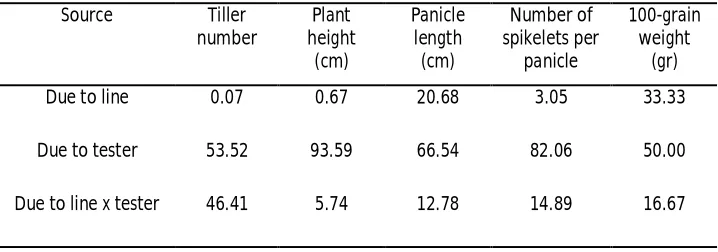
Table 3. Proportional contribution of lines, testers and their interactions to total variance in rice
100-grain weight (gr) Number of spikelets per panicle Panicle length (cm) Plant height (cm) Tiller number Source 33.33 3.05 20.68 0.67 0.07 Due to line
50.00 82.06 66.54 93.59 53.52 Due to tester
16.67 14.89
12.78 5.74
46.41 Due to line x tester
190 | Page
Table 4. General combining ability ( gi ) effects for traits in rice parents
* and ** General combining ability estimate significantly different from zero at p = 0.05 and 0.01, respectively, based on an T-Test.
Table 5. Specific combining ability ( sij ) effects for traits in rice crosses.
* and ** Specific combining ability estimate significantly different from zero at p = 0.05 and 0.01, respectively, based on an T-Test.
100-grain weight (gr) Number of spikelets per panicle Panicle length (cm) Plant height (cm) Tiller number Genotypes Lines -0.11 2.24 0.67 0.87 0.12 1. Tarom-Jelodar 0.11 -2.24 -0.67 -0.87 -0.12 2. Danesh 0.018 3.6 0.29 0.839 0.92 SE ( gi)
Testers 0.05 -7.22 -0.4 9.15** 4.24 3. Sange-Tarom 0.22 -18.02* -1.88* 1.07 -2.70 4. Jahesh -0.18 2.42 1.53* 2.54 -4.31* 5. Moosa-Tarom -0.05 7.31 -0.31 6.90** -0.26 6. Basmati 370
-0.04 15.51* 1.06 -19.66** 3.02 7. P35
0.029 5.69
0.457 1.328
1.46 SE ( gi)
100-grain weight (gr) Number of spikelets per panicle Panicle length (cm) Plant height (cm) Tiller number Crosses -0.10* 6.84 0.84 -2.45 1.16 1 × 3
-0.05 0.26
-0.175 -1.14
-1.12 1 × 4
0.09 -8.47
-0.72 -2.23
0.49 1 × 5
0.09 1.98
-0.24 1.69
-4.90* 1 × 6
-0.03 -0.61
0.3 4.13
4.38 1 × 7
0.10 -6.84
-0.84 2.45
-1.16 2 × 3
0.05 -0.26
0.175 1.14
1.12 2 × 4
-0.09 8.47
0.72 2.23
-0.49 2 × 5
-0.09 -1.98
0.24 -1.69
4.90* 2 × 6
0.03 0.61
-0.3 -4.13
-4.38 2 × 7
0.04 8.059
0.647 1.878
191 | Page
Table 6. Heterosis (Ht) and Heterobetiosis (Htb) estimates (%) in rice crosses.
* and **; Significant at p = 0.05 and p = 0.01 levels, based on an t-test, respectively.ns: non-significant. Crosses
Tiller number Plant
height (cm)
Panicle length (cm)
Number of spikelets per
panicle
100-grain weight (gr)
Ht Htb Ht Htb Ht Htb Ht Htb Ht Htb
1 × 3 107.41** 85.43** 19.14** 10.39** 13.53** 8.90** 14.07* 5.17 ns 15.44** 11.21**
1 × 4 37.78* 27.75 ns 22.51** 21.17** 8.20** 0.47 ns 15.42 ns -6.23 ns 15.77** 4.49*
1 × 5 40.50* 27.81 ns 11.39** 0.98 ns 8.27** 6.41* 9.21 ns 1.46 ns 17.40** 17.13**
1 × 6 24.62 ns 19.44 ns 17.8** 7.05** 7.50* 5.59* 12.21 ns 11.51 ns 31.85** 24.19**
1 × 7 95.92** 93.94** 10.29** 9.31** 16.08** 12.02** 11.5 ns 8.03 ns 14.54** 10.34**
2 × 3 99.63** 86.32** 22.01** 12.6** 8.66** 7.48* 5.43 ns 0.82 ns 11.11** -2.60 ns
2 × 4 59.03** 54.23** 23.48** 21.61** 10.64** 8.10* 16.78* -2.17 ns 8.52** 1.30 ns
2 × 5 38.97* 32.1 ns 13.82** 2.78 ns 14.27** 6.70* 22.97** 18.51* -1.91 ns -16.56**
2 × 6 96.23** 95.43** 14.48** 3.63* 10.23** 6.46* 10.82 ns 7.3 ns 8.43** -12.34**