Experimental Parameters of Fine Particle Plasmas Explicitly
Expressed by Dimensionless Characteristic Parameters
Hiroo TOTSUJI
Graduate School of Natural Science and Technology and Faculty of Engineering, Okayama University, Okayama 700-8530, Japan
(Received 15 May 2008/Accepted 21 June 2008)
Experimental parameters of fine particle plasmas, densities and temperatures of components and the fine par-ticle size, are explicitly expressed in terms of dimensionless characteristic parameters, such as Coulomb coupling and strength of screening, and typical examples are given. Though characteristic parameters are readily obtained from experimental parameters, the reverse is not trivial and it is shown that the charge neutrality condition limits the characteristic parameters realized by fine particle plasmas within the domain (a/λ)2/(Γ/A)≥3. Here,aand
λare the mean distance between fine particles and the screening length, respectively, Γ =(Qe)2/ak
BTp is the Coulomb coupling of fine particles, andA=(neTe+niTi)/npTpis the ratio of the ideal gas pressures of ambient plasma (of ions and electrons) and fine particles.
c
2008 The Japan Society of Plasma Science and Nuclear Fusion Research
Keywords: fine particle (dusty) plasma, dimensionless characteristic parameter, Yukawa one-component plasma (OCP) model, Coulomb coupling
DOI: 10.1585/pfr.3.046
1. Introduction
Fine particle plasmas are mixtures of fine particles (particulates) and ambient plasma of ions and electrons. Fine particle plasmas provide us with a stage for various interesting phenomena especially in the domain of strong coupling such as formation of the Coulomb crystal and other structures. Statistical properties of fine particle plas-mas are characterized by a set of several dimensionless characteristic parameters which properly describe the sys-tem. In order to observe some phenomenon expected to occur at some specific combination of characteristic pa-rameters, it is necessary to interpret the combination into a set of experimental parameters which realizes the state with designated combination.
When characteristic parameters at a state of fine par-ticle plasmas are obtained in experiment, one may want to modify their values by changing experimental parameters such as the size of fine particles and densities and temper-atures of components. Since most of experimental param-eters are related to not a single characteristic parameter in the set, it is not trivial to adjust experimental parameters appropriately. Characteristic parameters are readily calcu-lated from experimental parameters by definitions but the reverse needs at least some manipulation and numerical so-lution of equations. We here give the reverse relations ex-plicitly in a simple form including numerical results to fa-cilitate theoretical and experimental investigations of fine particle plasmas.
In order to make a correspondence between theoret-ical and experimental parameters, it is necessary to char-author’s e-mail: [email protected]
acterize statistical-mechanical properties of the system by dimensionless parameters. The simplest model of fine particle plasmas is the Yukawa one-component plasma (Yukawa OCP) model [1–4]. This has a sound basis in the domain of weak coupling and we expect the characteriza-tion of the system by its parameters to work at least as a reference frame also in the domain of strong coupling as follows.
There exist some aspects of fine particle plasmas which are not described by the Yukawa OCP model. One is the anisotropy of interaction between particles induced by the effect of gravity on particles. In experiments on the ground, fine particles are kept afloat in the domain of sheath by the electric field. The ion flow in the sheath then leads to anisotropic interactions between particles includ-ing (nonreciprocal) attractive part, through the dielectric response [5] or the focusing of ions due to deflections of their orbits by particles [6, 7], as observed in the formation of strings of particles along the ion flow. In the directions perpendicular to the flow, on the other hand, the measure-ments of the force between colliding particles have shown that the interaction is expressed by the Yukawa potential to a good accuracy at least within a few times the screen-ing length [8–10]. The dispersion of oscillations in ordered monolayers of particles can also be fitted to those calcu-lated by the Yukawa interaction [11].
In describing fine particle plasmas, we assume that they can be characterized by parameters for isotropic sys-tems in the first approximation. This may be realized in mi-crogravity experiments [12]. Under this condition, we need not to levitate particles by the sheath electric field which
c
2008 The Japan Society of Plasma
causes unidirectional near- or supersonic ion drift. We may also have approximately isotropic system balancing the gravity by, for example, the temperature gradient [13]. Since ions are not drifting in these cases, we expect the screening is mainly provided by ions. After the system is characterized by parameters for isotropic systems and the correspondence to experimental parameters is known, we can take the effects of anisotropy into account.
Apart from the anisotropy, there have also been some arguments that the (isotropic) precipitation of ions onto particles and other mechanisms lead to an additional at-tractive interaction between them [14]. These effects are expected to appear when some conditions are satisfied and the magnitude of the attraction can become larger than the Yukawa repulsion in the long range domain where the lat-ter is strongly screened. There seem, however, to be no di-rect experimental observations hitherto. It is also possible to evaluate these effects once the correspondence within the Yukawa OCP characterization is known.
Since the magnitude of the charge on fine parti-cles is typically 103 to 104 times the elementary charge, the screening around fine particles may not be properly described by the linear Debye-H¨uckel expression. The screening may also be modified by the collisions of ions forming screening cloud with neutral atoms and other ef-fects, depending on the neutral atom density. In the domain less than a few times the screening length, however, the potential is approximately described by the Yukawa poten-tial [8–10, 15] and the characterization within the Yukawa OCP model may work as a reference frame in considering these effects.
We give a description of fine particle plasmas within the Yukawa OCP model in Sec. 2 and relate characteristic parameters explicitly to experimental parameters in Sec. 3. Some examples and the discussion on the effect of ion-neutral collisions are given in Sec. 4. Concluding remarks are given in Sec. 5.
2. Characteristicc Parameters of Fine
Particlec Plasmas in Yukawa OCP
Modelc
We consider fine particle plasmas composed of fine particles (particulates) and ambient plasmas of ions and electrons. For simplicity, we assume fine particles are spheres of radiusrpand ions are of single species and with the positive chargee. We denote the density, the tempera-ture, and the charge of fine particles by (np, Tp, −Qe), as-suming that their charge is negative. For ions and electrons, we denote the density and the temperature by (ni, Ti) and (ne, Te), respectively. Since it is believed thatTe >Ti(∼
Tp) in most experiments, we assign different values for the temperatures of the components. We thus have eight pa-rameters for charged components of the system, namely, (rp, np, Tp, Q, ni, Ti, ne, Te).
We characterize fine particle plasmas by the param-eters of the Yukawa OCP model or the one-component Yukawa system embedded in polarizable and neutralizing background plasma of ions and electrons [1–4]. In this model, the potential around a point particle with the charge
−Qeis given by the Yukawa potential
−Qe
r exp(−r/λ), (1)
whereλis the screening length given by 1
λ =
4πnie2
kBTi
+4πnee2
kBTe 1/2
. (2)
In experiments on Earth, the ion flow gives the anisotropy of interaction between fine particles which is neglected in the above model. There exist, however, many aspects of fine particle plasmas within the isotropic interaction and we assume that our system can be regarded as isotropic at least in the first approximation. In recent experiments under microgravity, we may expect much reduced ion flow and anisotropy.
In the Yukawa OCP model, the statistical properties of fine particles are characterized by the strength of the Coulomb coupling
Γ= (Qe)2
akBTp =
4πnp 3
1/3 (Qe)2
kBTp
(3) and the strength of the screening
ξ= aλ. (4)
Hereais the mean distance between fine particles defined by
a=
3 4πnp
1/3
. (5)
When the particle have a spherical core of radius rp and the charge−Qeis uniformly distributed on the surface, the potential atr>rpis modified into the form [16, 17]
(−Qe) 1+rp/λ
exp[−(r−rp)/λ]
r
= (−Qe˜ )
r exp(−r/λ) for r>rp, (6)
where ˜
Q=Qexp( ˜rp)
1+r˜p
(7) and
˜
rp=
rp
λ. (8)
This potential field is equivalent to that of a point parti-cle with the renormalized charge −Qe˜ . The interaction between fine particles is given by the Deryagin-Landau-Verwey-Overbeek (DLVO) potential which is still of the Yukawa type
(−Qe˜ )2
r exp(−r/λ) for r>2rp, (9)
3. Experimental Parameters in Terms
of Characteristic Parametersc
We now consider the correspondence between the characteristic parameters of fine particle plasmas and ex-perimental parameters of densities and temperatures within the characterization by the Yukawa OCP model parame-ters. As the latter, we have eight parameters and we need eight conditions to determine them.
3.1
Conditions
We first assume that the charge neutrality condition is satisfied:
ni=ne+Qnp. (10)
When characteristic parameters (Γ, ξ) are specified, we have two conditions:
4πnp 3
1/3 (Qe)2
kBTp =Γ
(11)
and
3 4πnp
1/3
(4πe2)1/2
ni
kBTi +
ne
kBTe 1/2
=ξ. (12)
The charge on a fine particle −Qe is determined by the balance between the fluxes of ions and electrons onto the surface. When we writeQin the form
Q=fQ
kBTe
e2/r p
(13) introducingfQ, the condition is given by
ne
kBTe
me 1/2
exp
− fQ
1+r˜p
−ni
kBTi
mi 1/2
1+ fQ 1+r˜p
Te
Ti
=0 (14)
in the orbital-motion-limited (OML) theory [18]. Here the effect of reduction of the electron density [19] is reflected through (10). We take into account that the surface poten-tial of the fine particles is given by
(−Qe˜ )
r exp(−r/λ)
r=rp
= (−Qe˜ )
rp
exp(−rp/λ) = (−Qe)
rp(1+r˜p).
(15) We discuss the applicability of the OML theory when ex-amples of experimental parameters are given.
Since we have imposed four conditions, (10), (11), (12), and (14) for eight experimental parameters, we are left with four degrees of freedom. As these four, we take the radiusrp,
Γ0= (Qe)2
rpkBTp
, (16)
A=neTe+niTi npTp ,
(17) and the ratio of the ion and fine particle temperatures
τip=
Ti
Tp
. (18)
The value ofAis the ratio of the ideal gas pressure of am-bient plasma (ions and electrons) to that of fine particles. It is to be noted that
η=
Γ Γ0
3 =rp
a 3
=4π 3 npr
3
p (19)
is the packing fraction of fine particles, which we denote byη, and
˜
rp= ΓΓ 0ξ.
(20) In principle, the ratio τip is determined by other pa-rameters through the energy relaxation processes which in-clude neutral atoms. In most experiments, however,τip∼1 is implicitly assumed without detailed analysis of the lat-ter processes or temperature measurements. In this paper we treat this ratio as an externally determined parameter expecting to be around unity, instead of giving other con-ditions to determineτip.
3.2
Solutions
We first note that, from (10), (11), (12), (14), (19), (17), and (18), np, ni/(A/τip), ne/(A/τip), Ti/(A/τip) =
τipTp/(A/τip), and Te/(A/τip) are explicitly expressed in terms ofrp,Γ/A,ξ,Γ/Γ0, and fQ(see Appendix) as
np= 3 4πr3
p Γ Γ0 3 , (21)
ni/(A/τip)
np
= f 2 Q Γ0/A
× [1+(Γ0/A)/fQ]2
[f2
Q/(Γ0/A)][1+(Γ0/A)/fQ]+(1/3)ξ2(Γ0/Γ)+fQ
, (22)
ne/(A/τip)
np =
fQ2
[1+(Γ0/A)/fQ] [(1/3)ξ2(Γ
0/Γ)+fQ] × [(1/3)ξ2/(Γ/A)−1]
[f2
Q/(Γ0/A)][1+(Γ0/A)/fQ]+(1/3)ξ2(Γ0/Γ)+fQ
, (23)
Ti (A/τip) =τip
Tp (A/τip) = f
2 Q Γ0/A
1+(Γ0/A)/fQ (1/3)ξ2(Γ
0/Γ)+fQ 2 e2 rp , (24) and Te (A/τip)
=
1+(Γ0/A)/fQ (1/3)ξ2(Γ
0/Γ)+fQ
e2
rp
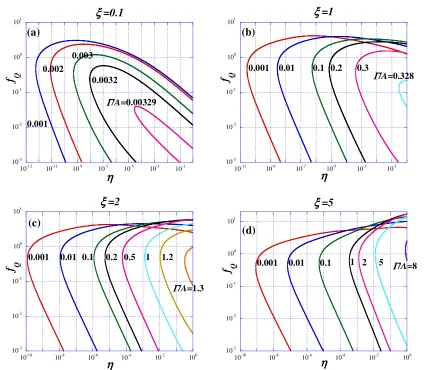
Fig. 1 Values offQas function of packing fractionη=(Γ/Γ0)3for some values ofξandΓ/A. (a)ξ=0.1 and 0.001≤Γ/A≤0.00329,
(b)ξ=1 and 0.001≤Γ/A≤0.328, (c)ξ=2 and 0.001≤Γ/A≤1.3, and (d)ξ=5 and 0.001≤Γ/A≤8.
We here point out that, sincene≥0, we have to satisfy the condition (1/3)ξ2/(Γ/A)≥1 or
ξ2=a
λ
2 ≥3
Γ
A
. (26)
This comes from the condition of charge neutrality [19] but has not been explicitly shown in terms of characteristic pa-rameters. Thus the lower limit of realizableξis determined byΓ. Since the value ofAis usually many orders of magni-tude larger than unity, this lower bound forξis not effective in most cases even in the domain of strong coupling where
A Γ 1. In the case of very strong coupling where Γ/A∼1 [20–22], however, this bound does limit the space of characteristic parameters of Yukawa OCP realized by fine particle plasmas.
Substituting (22), (23), (24), (25), and (20) into the equation for fQor (14), we can determine the value of fQ. We note that, since (14) includes only the ratiosne/niand
Te/Ti which are independent ofrp orA/τip, the value of
fQ is determined self-consistently when the set of values (Γ/A, ξ, Γ/Γ0) is specified. Let us now introducen0 and
E0 =kBT0defined respectively by
n0≡ 3 4πr3
p
(27)
and
E0=kBT0≡
e2
rp
. (28)
We also defineAby
A= A
τip.
(29)
Then the values of (fQ, np/n0, (ni/n0)/A, (ne/n0)/A, (Ti/T0)/A=τip(Tp/T0)/A, (Te/T0)A) are determined by the set of values (Γ/A, ξ, Γ/Γ0)irrespective of the values
of(rp, A/τip):
Γ
A, ξ,
Γ Γ0
determines
fQ,
np
n0
, ni
An0
, ne
An0
, Ti
AT0 =τip
Tp
AT0
, Te
AT0
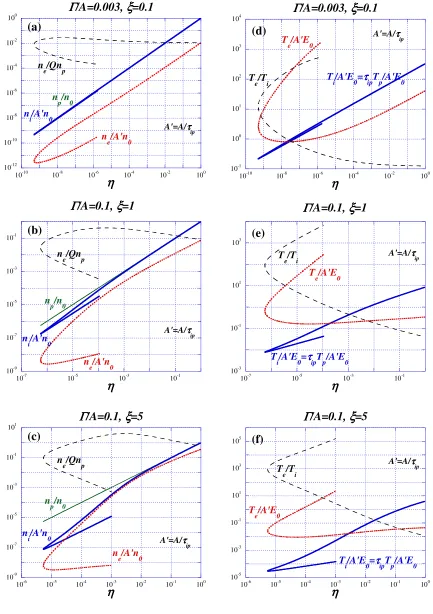
Fig. 2 (a-c) Values of (ni/n0)/A(thick solid line), (ne/n0)/A(dotted line),np/n0(thin solid line) andne/Qnp(broken line). (d-f) Values of (Ti/T0)/A(=τip(Tp/T0)/A,solid line), (Te/T0)/A(dotted line), andTe/Ti(broken line).
4. Examples
We may assume that the experiment is done in inert gases. The results are not restricted within the usual range
un-Fig. 3 Values ofni[cm−3] andne[cm−3] in the case of (a-c)Te=3 eV and (d-f)Ti=300 K.
specified as far as possible in order to include the cases whereTp andTiseem to be not equal against the natural expectationτip=1.
Whenrpis measured inµm, we have forn0andE0
n0=2.39×10¹¹ 1 (rp[µm])3
cm−3 (31)
and
E0=1.44×10⁻³ 1
rp[µm]
eV. (32)
4.1
Determination of
f
Qcombina-Fig. 4 Values ofTi[eV] andTe[eV] in the case of (a-c)Te=3 eV and (d-f)Ti=300 K.
tions of parameters and, whenni, ne, Ti, Te, and ˜rp are specified as is in its usual application, we have only one solution for (14) if it exists.
Substituting the values of fQ into (22), (23), (24), and (25), values of (ni/n0)/A, (ne/n0)/A, (Ti/T0)/A =
τip(Tp/T0)/A, and (Te/T0)/Aare obtained for given val-ues of (Γ/A, ξ, Γ/Γ0). Examples of (ni/n0)/A and (ne/n0)/Aare shown in Fig. 2 (a) together withnp/n0and
ne/Qnp. In some cases,ne/niandne/Qnpare significantly smaller than unity indicating that, in these cases, the over-all charge neutrality is maintained mostly by ions and neg-atively charged particulates.
Fig. 5 Values ofAandQin the case of (a-c)Te=3 eV and (d-f)Ti=300 K.
is limited when we impose some condition on this ratio corresponding to realistic situations in experiments.
In these and following examples, we include the cases with a wide range of densities and temperatures. They may be helpful to explore the possibility to extend usual limit of characteristic parameters of fine particle plasmas.
4.2
Determination of
r
p,
A, and
τ
ipUp to this point, we have not specified the particulate radiusrp,A, andτipwhich determine the actual (not nor-malized) values of densities and temperatures. For selected radius of fine particlesrp, we can determine the value of
We here show two sets of examples of values cor-responding to typical values of temperatures, one with
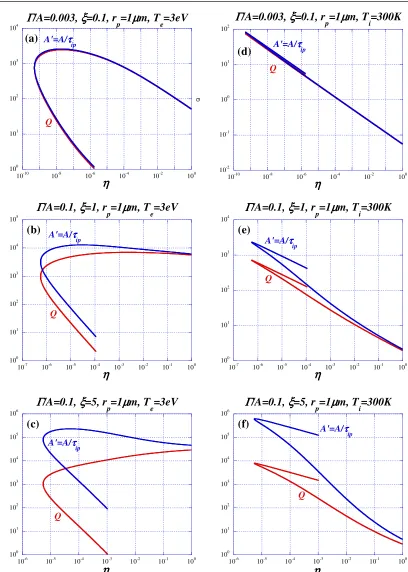
Te = 3 eV and another with Ti = 300 K, both for the case ofrp =1µm. Resultant values of densities, temper-atures,A =A/τip, andQfor these two sets are shown in Figs. 3 (a-c), Figs. 4 (a-c), and Figs. 5 (a-c) and Figs. 3 (d-f), Figs. 4 (d-(d-f), and Figs. 5 (d-(d-f), respectively.
We observe that, in the case of (Γ/A =0.1, ξ = 1), both conditions on the temperatures are satisfied whenη∼ 5.9×10⁻⁷ andΓ/Γ
0 = η1/3 ∼ 8.4×10⁻³. In this case,
A ∼2.3×10³τ
ip, fQ ∼0.34, Q∼ 7.0×10²,np ∼1.4× 105cm−3,n
i ∼ 1.0×108cm−3, andne ∼ 1.9×106cm−3. Realized combination of characteristic parameters isξ∼1, Γ ∼ 2.3×10²τ
ip, and Γ0 ∼ 2.7×10⁴τip. We observe that these results include experimental parameters which are often realized in dusty plasma experiments.
The above values are for the case of rp = 1µm. As for therp-dependence, it should be noted that, when (Γ/A, ξ,Γ/Γ0) and the temperatures are given,A/τip∝rp,
np∝r−p3,ni,ne∝rp−2, andΓ/τip,Γ0/τip∝rp.
4.3
Applicability of OML theory
It has been argued [23] that the expression of the OML theory is modified by the effect of ion-neutral collisions when the ion-neutral collision mean free path is smaller than the screening lengthλ. Forλ, we have
λ
rp = Γ0/Γ
ξ =
1
η1/3ξ. (33) On the other hand, at the pressurepn, the number density of neutral atoms (of inert gases)nnis given by
nn=2.41×10¹⁴pn[Pa] 300
Tn[K]
cm−3. (34) Here the pressure is measured in Pa and the neutral gas temperature Tn is measured in K. Since the ion-neutral collision cross sectionσin is∼ 10−14cm2, the ion-neutral collision mean free path is estimated as 1/σinnn ∼ 5 × 10³(p
n[Pa])−1µm whenTn∼300 K. The ratioλ/(1/σinnn) is given by
λ
1/σinnn ∼
rp[µm]pn[Pa] 5×10³η1/3ξ
300[K]
Tn .
(35) We may expect the simple OML theory is applicable as a first approximation when this ratio is much smaller than unity. Rewriting the above ratio into
λ
1/σinnn ∼
rp[µm] 1
pn[Pa] 50
10−6
η
1/3 1
ξ
300[K]
Tn , (36) we see that the above condition may be satisfied in rela-tively high density experiments with appreciable screening (ξ > 1) where, for example,ηξ3/(r
p[µm])3 >10−6 in the neutral gas of relatively low pressure pn < 50 Pa at the room temperatureTn ∼300 K. Our results with the sim-ple OML theory are thus applicable in a wide domain of parameters.
In the case of low density experiments with weak screening or with high neutral gas pressures where the ratio (36) is comparable with or larger than unity, we may need to take into account the effect of ion-neutral collisions in (14). In the case of high densities, the effect of existence of other fine particles may also need consideration. In this paper, we limit ourselves within the simple OML theory leaving such cases to separate analyses.
5. Conclusion
Experimental parameters (the size of fine particles and densities and temperatures of fine particles, ions, and elec-trons) and the charge of a fine particle are explicitly ex-pressed by characteristic parameters of fine particle plas-mas modeled by the Yukawa system of finite-size particles embedded in the ambient plasma. Typical examples of the set of experimental parameters are given and the applica-bility of adopted charging theory is confirmed in the cases of fine particles of relatively high density in neutral gases of relatively low pressure. It is also shown for the first time that the charge neutrality condition limits the domain of fine particle plasmas such thatξ2/(Γ/A) ≥ 3 in terms of characteristic parameters. Though definitions of charac-teristic parameters are simple, the determination of exper-imental parameters in targeting a specific combination of characteristic parameters is not trivial. These results may be useful to design experiments in order to observe phe-nomena expected to occur at some specific values of the characteristic parameters [20–22].
Acknowledgments
This work has been supported in part by the Grant-in-Aid for Scientific Research (C) No.19540521 of the Japan Society for the Promotion of Science (JSPS).
Appendix
Let us define normalized temperatures by
Ti= kBTi e2/r
p,
Tp= kBTp e2/r
p,
and Te= kBTe e2/r
p.
(A1)
Then
Q=fQTe, (A2)
Γ0= (fQTe)2
Tp
, (A3)
and the charge neutrality condition (10) is written as
ne
np =
ni
np −
fQTe. (A4)
Eliminatingneby (A4), we rewrite the definition ofξ, (12), into the form
ni
np
1
Ti +
1
Te
=1 3ξ
2Γ0
Also eliminatingnefrom (17) and using (A3), we have
A+Γ0 fQ =
ni
np
Te Tp
1+T
i
Te
. (A6)
From (A5) and (A6), we have
Te= 1
τip
A−1+Γ0/fQ (1/3)ξ2(Γ
0/Γ)+fQ.
(A7) Values ofTpandTiare then given respectively by
Tp=(fQT
e)2 Γ0 =
f2 Q Γ0
1
τ2 ip
A−1+Γ0/fQ (1/3)ξ2(Γ
0/Γ)+fQ 2
(A8)
and
Ti=τipTp=
fQ2
Γ0 1
τip
A−1+Γ0/fQ (1/3)ξ2(Γ
0/Γ)+fQ 2
. (A9)
Since we usually haveA1, we rewriteA−1 intoA. From these results for temperatures, (A4), and (A5), densities are given as (22) and (23).
[1] For example, M.O. Robbins, K. Kremer and G.S. Grest, J. Chem. Phys.88, 3286 (1988) and References therein. [2] S. Hamaguchi and R.T. Farouki, J. Chem. Phys.101, 9876
(1994).
[3] Y. Rosenfeld, Phys. Rev. E49, 4425 (1994).
[4] H. Totsuji, C. Totsuji, T. Ogawa and K. Tsuruta, Phys. Rev. E71, 045401(R)(2005); H. Totsuji, T. Ogawa, C. Totsuji and K. Tsuruta, Phys. Rev. E72, 036406 (2005).
[5] M. Nambu, S.V. Vladimirov and P.K. Shukla, Phys. Lett. A 230, 40 (1995).
[6] F. Melandso and J. Goree, Phys. Rev. E52, 5312 (1995).
[7] G. Lapenta, Phys. Rev. E66, 026409 (2002).
[8] U. Konopka, L. Ratke and H.M. Thomas, Phys. Rev. Lett. 79, 1269 (1997).
[9] U. Konopka, G.E. Morfill and L. Ratke, Phys. Rev. Lett. 84, 891 (2000).
[10] R. Kompaneets, U. Konopka, A. Ivlev, V. Tsytovich and G. Morfill, Phys. Plasmas14, 052108 (2007).
[11] For example, S. Zhadanov, S. Nunomura, D. Samsonov and G. Morfill, Phys. Rev. E68, 035401(R)(2003).
[12] For example, V.E. Fortov, A.V. Ivlev, S.A. Khrapak, A.G. Khrapak and G.E. Morfill, Phys. Reports421, 1 (2005). [13] O. Arp, D. Block, A. Piel and A. Melzer, Phys. Rev. Lett.
93, 165004 (2004).
[14] For example, V.N. Tsytovich, Y.K. Khodatev and R. Bingham, Commun. Plasma Phys. Control. Fusion,17, 249 (1996).
[15] J.E. Daugherty, R.K. Porteous, M.D. Kilgore and D.B. Graves, J. Appl. Phys.72, 3934 (1992).
[16] B. Deryagin and L. Landau, Acta Phys.-chim. USSR14, 633 (1941).
[17] E.J.W. Verwey and J. Th. G. Overbeek,Theory of the Sta-bility of Lyophobic Colloids(Elsevier, New York, 1948). [18] For example, J.E. Allen, Phys. Scripta45, 497 (1992); J.
Goree, Plasma Sources Sci. Tech.3, 400 (1994).
[19] O. Havnes C.K. Goertz, G.E. Morfill, E. Grun and W. Ip, J. Geophys. Res.92, 2281 (1987).
[20] H. Totsuji, J. Phys. A: Math. Gen.39, 4565 (2006). [21] H. Totsuji,Non-Neutral Plasma Physics VI, Workshop on
Non-Neutral Plasmas 2006, eds. M. Drewsen, U. Uggerhøj and H. Knudsen, AIP Conference Proceedings 862, (Amer-ican Institute of Physics, New York, 2006) p.248.
[22] H. Totsuji, Phys. Plasmas15, 072111 (2008).
![Fig. 3Values of ni [cm−3] and ne [cm−3] in the case of (a-c) Te = 3 eV and (d-f) Ti = 300 K.](https://thumb-us.123doks.com/thumbv2/123dok_us/8445684.1703130/6.595.90.497.65.608/fig-values-ni-cm-ne-case-te-ti.webp)
![Fig. 4Values of Ti [eV] and Te [eV] in the case of (a-c) Te = 3 eV and (d-f) Ti = 300 K.](https://thumb-us.123doks.com/thumbv2/123dok_us/8445684.1703130/7.595.90.500.66.621/fig-values-ti-ev-te-case-te-ti.webp)