Solving the DNA Fragment Assembly Problem with a
Parallel Discrete Firefly Algorithm implemented on GPU
Pablo Javier Vidal1and Ana Carolina Olivera1
Centro de Investigaciones y Transferencia Golfo San Jorge CONICET - Universidad Nacional de la Patagonia Austral
Ruta N◦3, 9011, Caleta Olivia, Argentina.
{pjvidal,acolivera}@conicet.gov.ar
Abstract. The Deoxyribonucleic Acid Fragment Assembly Problem (DNA-FAP) consists in reconstructing a DNA chain from a set of fragments taken randomly. This problem represents an important step in the genome project. Several authors are proposed different approaches to solve the DNA-FAP. In particular, nature-inspired algorithms have been used for its resolution. Even they were obtaining good results; its computational time associated is high. The bio-inspired algorithms are iterative search processes that can explore and exploit efficiently the solution space. Firefly Algorithm is one of the recent evolutionary computing models which is inspired by the flashing light behaviour of fireflies. Recently, the Graphics Processing Units (GPUs) technology are emerge as a novel environment for a parallel implementation and execution of bio-inspired algorithms. Therefore, the use of GPU-based parallel computing it is possible as a complementary tool to speed-up the search. In this work, we design and implement a Discrete Firefly Algorithm (DFA) on a GPU architecture in order to speed-up the search process for solving the DNA Fragment Assembly Problem. Through several experiments, the efficiency of the algorithm and the quality of the results are demonstrated with the potential to applied for longer sequences or sequences of unknown length as well.
Keywords:DNA Fragment Assembly Problem, Graphic Processing Units, Paral-lelism, Firefly Algorithm.
1.
Introduction
The Deoxyribonucleic Acid Fragment Assembly Problem (DNA-FAP) consists of: ob-taining the correct sequence of the DNA by finding the permutation of fragments that best represents the original DNA chain, given a set of large number (hundreds or even thousands) of DNA fragments with errors. The DNA-FAP is the primary goal in any genome project and the remaining phases strongly depend on the accuracy of the re-sults at this stage. The DNA-FAP is therefore a combinatorial optimization problem that is NP-Hard [29]. Over the past decade, a lot of tools have been invented to automate DNA sequencing. Among these tools, PHRAP [10], TIGR assembler [34], STROLL [3], CAP3 [11], Celera assembler [22] and EULER [29] may be cited. Each one automates fragment assembly using a variety of algorithms, the most widely used being those based on greedy techniques.
proven to outperform the greedy techniques in small instances of the problem. However, the quest for new, more accurate and faster techniques still continues. One of the main problems is scaling up these methods to the size of real organisms.
The Firefly Algorithms (FAs), which were developed by Yang [36,37], are recent bio-inspired algorithms that have achieved outstanding results in various domains [6,18,40]. The FA is a population-based approach based on the flashing patterns and behaviour of fireflies [37]. FAs have some significant advantages over other metaheuristics, such as Genetic Algorithms(GAs) and Particle Swarm Optimizers (PSOs) [9]. A couple of its distinctive advantages are: the automatic subgrouping and its ability to deal with multi-modal problems [37]. Fireflies can randomly subdivide into sub-groups and each group can potentially swarm around a local optimum. All optimal solutions (obviously includ-ing the global optimum) can be obtained simultaneously if the number of fireflies is much higher than the number of subgroups [36,37]. In a few years, a lot of research around FA has been done with excellent results in many different fields, such as Power Energy Sys-tems [2,6], Mobile Networks [1] and Permutations Combinatorial Problems [18,32,38]. If we consider large instances of the problem, the evaluation of a DNA-FAP solution can easily require more than several tens of seconds. It may be necessary to perform several hundred of thousands of evaluations in each iteration process since metaheuristics use a population of solutions. So, the computational time can be in the order of hundreds of days. In this context, the Graphics Processing Units (GPUs) is recognized as powerful way of achieving high-performance on long running scientific applications [23]. Nevertheless, parallel Firefly Algorithm represents a new developing research area and, to the best of our knowledge, very little research has been urdertaken with FA on GPU [27,12,35]. Based in our previous work [35], we propose a Parallel Discrete Firefly Algorithm running en-tirely on GPU (GPU-DFA) for solving the DNA fragment assembly problem. The idea in GPU-DFA design is to create a simple but powerful enough algorithm to adapt itself to the GPU environment. Here we present the characteristics for the main processes of the GPU-DFA. Also, we demonstrate that the proposed optimization technique is quite amenable for massive parallelism in order to obtain significant efficiency and substantial gain times. In order to evaluate our approach, sixteen popular benchmarks have been used [19]. We employ these benchmarks for making a comparison between our method and some of the best methods published. The contributions of the paper can be summarized as follows:
– We define the structure of a parallel DFA to be executed mainly in a GPU and deter-mine the time-consuming operations spent by the GPU-DFA.
– A deep analysis of the behaviour of Discrete Firefly Algorithm design for GPU to solve the DNA assembly problem was carry out.
– We incorporate an exploitation operator in our canonical proposal addressed for this problem, a local search strategy, in order to carry out a fine-tuning of solutions.
2.
The DNA Fragment Assembly Problem
DNA-FAP is one of the fundamental problems in computational molecular biology [29]. This problem involves the combination of partial information from known fragments in order to find a consistent and complete DNA chain. Hence, large DNA strands need to be broken into small fragments for sequencing in a process called shotgun sequencing [30], but this process does not keep either the ordering of the fragments or the portion about where the particular fragment came from. This leads to the DNA fragment assembly prob-lem [14] where these short sequences have to then be reassembled in the right order by using the overlapping portions as landmarks. Most fragment assembly algorithms consist of the following steps:
– Overlap: Finding the potentially overlapping portions of fragments. – Layout: Finding the order of the fragments based on similarity scores. – Consensus: Deriving the DNA sequence from the layout.
The overlap problem consists of finding the best match between the suffix of one read and the prefix of another one. The common practice is to filter out pairs of fragments that do not share a significantly long common substring.
Constructing the layout is the hardest step in fragment assembly [20]. The difficulty is encountered when deciding whether two fragments really overlap, i.e., that their differ-ences are caused by sequencing errors or they actually come from two different copies of a repeat. Repeat fragments represent the major challenge for the whole genome shotgun sequencing and make the layout problem very difficult.
In order to evaluate a solution for DNA-FAP, the following function can be defined: for a possible order oflfragments (a permutation)i= [0, ..., a, a+ 1, ..., l]the Equation 1 shows the value of the sequenceifor DNA-FAP.
f(i) =
l−1 X
a=0
wa,a+1 (1)
wherewa,a+1is the pairwise overlap strength of fragmentsaanda+ 1[26].
The final consensus step of fragment assembly amounts to correcting errors in the sequence of reads. To measure the quality of a consensus, we can look at the coverage distribution. Coverage at a base position is defined as the number of fragments at that position. It is a measure of the redundancy of the fragment data, and it denotes the num-ber of fragments, on average, where a given nucleotide in the target DNA is expected to appear. It is computed as the number of bases read from fragments over the target DNA’s length [14]. If no sequencing error is detected at the overlap phase, the process simply finds the longest suffix of one string that matches exactly the prefix of another one. How-ever, when sequencing errors exist, the process searches for the best match but a small percentage of errors still remain (1% to 3%). The only information available during the assembly process is the sequence of bases; therefore, the ordering of the fragments must rely primarily on fragment similarity and on how much they overlap.
The coverage is then computed as the number of bases read from fragments over the length of the target DNA:
Coverage= Pl
i=1length of the fragmenti
target sequence length , (2)
wherelstands for the number of fragments. Thus, the higher the coverage and the smaller the number of gaps, the better the results. A partial coverage is achieved when it is not possible assemble a given set of fragments into a single contig. More precisely, acontig in biology is defined as a layout consisting of contiguous overlapping fragments. Overlap-ping between adjacent fragments must be greater than or equal to a predefined threshold (i.e., cut-off parameter).
The assembly of DNA fragments into a consensus sequence corresponding to the parent sequence constitutes the DNA-FAP, which is NP-hard [29].
3.
Firefly Algorithm
The Firefly Algorithm (FA) is a recent bio-inspired metaheuristic developed by Yang [36]. It is inspired by mimicking the flashing and attraction behaviour of fireflies. In the scheme of Yang the fireflies have the following characteristics:
1. All fireflies are unisexual, so that one firefly is attracted to other fireflies regardless of their sex.
2. Attractiveness is proportional to their brightness. Hence, for any two flashing fireflies, the less bright one will move towards the brighter one (see Fig. 1(a)). The attractive-ness decrease as their distance increases. So, the attractiveattractive-ness has the same value of brightness when the distance between two fireflies is 0. If no one is brighter than a particular firefly, it moves randomly as shown in Fig. 1(b).
3. The brightness of a firefly is affected or determined by the landscape of the objective function.
A canonical FA works with two basic concepts: the variation of light intensity I
(brightness), and the firefly attractivenessβbetween two fireflies [36]. In the simplest case for maximum optimization problems, the brightnessIof a firefly is its fitness. In addition, light intensity decreases with the distance from its source, and light is also absorbed in the media, so we should allow the attractiveness to vary with the degree of absorption. For a given medium with a fixed light absorption coefficientγ, the light intensityIvaries with the distancer(see Equation 3). As a firefly’s attractivenessβ is proportional to the light intensity seen by adjacent fireflies, we can now define the attractivenessβof a firefly by Equation 4.
Ij(rij) =I0e−γrij (3) βj(rij) =β0e−γr
2
ij (4)
(a) (b)
Fig. 1.Firefly movement considering their attractiveness: (a)jmoves toi, the brightest firefly close to it; (b)jhas more brightness than the most attractive fireflyi, sojmoves randomly.
seen in the eyes of the beholders and judged by other fireflies [36]. With respect to the light absorption coefficient γ, if γ → 0 the attractiveness of a fireflyi matches with its brightness (fitness), i.e., the brightness of a firefly will not decrease when viewed by another one. In the case ofγ → ∞, this means that the attractiveness value of a firefly is close to zero when viewed by another firefly in the sense that fireflies fly randomly. So,γdetermines the speed of convergence and how the FA behaves and the parameterβ
controls the attractiveness. Parametric studies suggest thatβ0 = 1can be used for most applications [39]. The distance between two fireflies iandj which are located at two different locations, can be expressed as a Euclidean distance, as follows:
rij=ki−jk= v u u t
k=n X
k=1
(ik−jk)2 (5)
wherendenotes the dimensionality of the problem. Taking into account the parameters liker,βandI, FA can define the kind of movement a fireflyican make with respect to a fireflyj. A pseudocode explanation of canonical FA can be seen in Algorithm 1. First, in populationPall the fireflies are initialized (line 1). Initialize the light intensity of each fireflyiwith its fitness (line 2). Next, theγparameter is defined (line 3). Then, while the stop condition is not reached (line 4), for each fireflyi, FA tries to find the brightest firefly
jneari(line 5 to 13). FA comparesIiandIj, ifIj > Iithen fireflyiwill move toward
fireflyj(line 8). The movement of a fireflyiis attracted to another more attractive firefly
jis determined by
i=i+β0e−γr
2
ij(j−i) +αi (6)
intensity is updated (line 11). The fireflies are ranked and the current best is found (line 14). When the iterative process ends, FA returns the results obtained (line 16).
Algorithm 1Canonical Firefly Algorithm.
1: Initialize a populationP of fireflies(i= 1,2,3, ..., n) 2: Initialize light intensity of each fireflyi,Ii=f(i)
3: Define light absorption coefficientγ
4: whileno stopping condition is satisfieddo 5: fori= 1 :nall firefliesdo
6: forj= 1 :n, withi6=jdo 7: ifIj> Iithen
8: Move fireflyitowardsj
9: end if
10: Attractiveness varies with distancerviae−γr2
11: Evaluate new solutions and update light intensity
12: end for 13: end for
14: Rank the fireflies and find the current best
15: end while
16: return Inform results
As can be seen from Algorithm 1 where it has an inherentO(n2×t)complexity, where tis the number of iterations of thewhile, since every fireflyimust evaluate Equation 4n
times, for every other fireflyj. This complexity is not easy to reduce.
3.1. Discrete Firefly Algorithm
Discrete FA (DFA) is a variation of canonical FA used for combinatorial problems with success for diverse problems [6,13,25,32]. In the Section 5, the discrete firefly algorithm approach is described in the context of its GPU approximation.
4.
Graphic Processing Units
The model for GPU computing uses a CPU and GPU together in a heterogeneous co-processing computing model, the CPU is considered as the host and the GPU is used as the device coprocessor. The sequential part of the application runs on the CPU and the computationally-intensive part is accelerated by the GPU. GPUs may contain several hundred simple processors. The set of processors are usually considered as a Single In-struction Multiple Data (SIMD) computer. A GPU is used by means of akernelthat is a function callable from the host and executed on the device by each thread. Compute Unified Device Architecture (CUDA) [4] is an extension of the C programming language and was created by nVidia. CUDA is a C language environment that provides services to programmers and developers ranging from common GPU operations in the CUDA library to traditional C memory management semantics in the CUDA run-time.
threads on the GPU. The batch of threads can be organized as a grid of thread blocks. A thread block is a batch of threads that can cooperate together by efficiently sharing data through diverse levels of memory and synchronizing their execution to coordinate memory accesses.
5.
GPU Discrete Firefly Algorithm
The goal of this section is to present our algorithmic proposal, which has been called GPU-DFA. Our primary concern when designing DFA accelerated by GPU is to establish an efficient model that runs the main processes of DFA entirely on GPU. The objectives are: (1) to minimize the data transfers between the CPU and the GPU, thus avoiding com-munication bottlenecks; (2) we will also aim to support n-dimensional optimization prob-lems using the firefly model interaction with the chance that our algorithm can support large numbers of fireflies due to optimized data-structures. The CUDA software model is employed so as to exploit maximum parallel execution and high arithmetic intensity of GPUs [24].
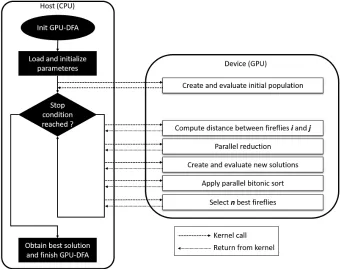
The flowchart of the GPU-DFA model is presented in Fig. 2. The major resource-consuming part is computed by the GPU and the rest is handled by the CPU. Adapting this kind of bio-inspired algorithm is not a straightforward task because hierarchical memory management on GPU has to be handled. Memory transfers from CPU to GPU are slow and these copying operations have to be minimized. Our proposal starts with the initialization of the FA parameters. All parameters are transferred to the GPU main memory. Then, GPU-DFA creates and evaluates in each thread a firefly solution fromP in each thread. Next, we use a group of kernels that execute several tasks until the stop condition has been reached: compute distance between fireflies, parallel reduction, evaluate new solutions, apply parallel sort and select best fireflies. The division in multiple kernels is due to the heterogeneity of the tasks and the complexity thereof.
Algorithm 2 shows the organization of the different processes for the GPU-DFA. The following sections explain each procedure one by one in detail.
Algorithm 2GPU Firefly Algorithm. 1: Define light absorption coefficientγ
2: Allocate problem inputs on GPU memory
3: Copy problem inputs on GPU memory
4: Allocate solution structure population on GPU memory
5: Initialize a populationP ofnfireflies
6: foreachf iref ly(i) ofPinparallel do 7: initializeSolution(i);
8: evaluateSolution(i);
9: end for
10: whilenon stop conditiondo
11: temp=∅
12: foreach pairiandjfromPinparallel do 13: A=computeDifferences(i,j);
14: rij=computeDistance(i,j,A);
15: βij=computeAttractiveness(rij,i,j);
16: end for
17: apply reduction function
18: for allj∈Pinparallel do
19: ifjis attracted to other fireflyithen 20: k=random(2, A)
21: temp.add(move2−opt(j, k))
22: else
23: temp.add(moveRandom(j))
24: end if 25: end for
26: P= Take bestnfireflies in temp
27: end while
5.1. Parallel initialization
First of all, problem information and additional structures associated with the operation must be copied on GPU. It is important to notice that data inputs are read-only structures and never change during the whole execution of GPU-DFA. Therefore, the copy is only performed once during the whole execution.
Since GPUs require parallel massive computations with predictable memory accesses, it is necessary to allocate a structure for storing all the solutions.
In our GPU-DFA approach, the initialization and evaluation of each solution will be achieved one-by-one. Each fireflyiis created randomly (line 7) by permutation of DNA fragments. Next (line 8), the fireflyiis evaluated and its fitness (Brightness) is calculated. Hence, GPU-DFA computes them through parallel threads. A set of consecutive threads can access successive memory spaces. In this way we try to follow recommendations and patterns for memory coalescence [15] (lines 6-9).
5.2. Computing distances, Attractiveness and Reduction Operation
For each evolution step, GPU-DFA computesrij,β, andIin parallel between each pair
of firefliesiandj. When evaluating each combination, it is necessary to run a parallel reduction kernel in order to define whether solutionj performs a random movement or moves closer to a brighter solution (lines 12-15).
GPU-DFA uses an auxiliary structure located in the shared memory for storing the partial values computed by each thread. The algorithm launches nblock of threads to evaluate the values stored in the shared memory (line 16).
In continuous optimization problem, distance between two fireflies is simply calcu-lated using Euclidian distance. For the DNA-FAP the distance between two fireflies,rij
is defined by Equation 7 (line 14). In this equation,Ais the number of different edges between firefliesiandjthrough the number of consecutive differences in the array posi-tions (line 13). The parameterlindicates the size of problem (number of fragments). In Equation 7,rij∈[0,10]and it will be used in attractiveness calculation (line 15) [13].
rij =A
l ×10 (7)
In order to clarifyA, considerer the Figure 3. It shows the part of firefliesiandjwith differences in the order of DNA fragments. The value ofA is five, the different edges between them are(2,4),(4,5),(7,1),(10,3)and(3,6).
The attractiveness is calculated exactly as Canonical FA. The light intensityI of a fireflyiis define as the fitness value of the firefly.
5.3. Parallel Modifications
Once each fireflyjhas a defined movement, GPU-DFA creates and evaluatesn×mnew solutions (by disturbing each one with a specific operator or randomly and saves them intemp (lines 17-24).m is number of new fireflies created considering each firefly j
order 8 9 10 11 12 13 14 15 16 17
i . . . 2 4 5 7 1 10 3 6 . . .
j . . . 2 5 7 4 1 10 6 3 . . .
Fig. 3.Fragment of firefliesiandj,Ais calculated for two firefliesiandjas the number of different edges between them.
DNA-FAP. The movement is appliedktimes (line 21), wherekis a number selected ran-domly between 2 and parameterA(line 20). Otherwise, random movement is generated by applying a 2-opt operator without any restrictions (line 23).
5.4. Bitonic Sort
The firefly scheme needs to sort thetempaccording to its fitness by using parallel Bitonic Sort [28] to get thenbest fireflies to replace onP. Bitonic sort has primarily been used by previous GPU sorting algorithms even though the classic complexity is ofn(logn)2. This method needs a total number of comparison/exchange operations ofO(nlogn). The hidden constant in the asymptotic is smaller than in other parallel sorting methods. It can be implemented in a highly parallel manner on modern architectures, even without any scatter operations, that is, without random access writes, which would involve passing a sequential execution mode within the GPU. Next, selectnsolutions in parallel to replace the populationP(line 26).
5.5. Random Number Generation
The performance of a nature-inspired algorithm largely depends on the quality of its ran-dom number generator across the entire evolution. We used a Mersenne Twister ranran-dom generator approach [31] for this study. At the beginning of the execution, GPU-DFA set a global seed that is passed and it is used to set up one local seed per thread. Finally, this local seed is invoked continuously by each thread for subsequent random number generation. This approach has been successfully tested in other work [35].
5.6. Solution Encoding
In order to make an efficient mapping between a thread and a particular solution, we use a discrete vector representation. This codification uses an alphabetΣ = {1, . . . , l}
wherel is the total number of fragments to be sorted. Then, a solution is a permutation of fragments of DNA. In this representation, each variable takes its value over the finite alphabetΣ.
5.7. GPU-DFA exploitation: Local Search
In addition to improve the model of canonical GPU-DFA, we incorporate other proposal with a Local Search defined as 3-opt movement. This process is performed after line 26 in Algorithm 2 for all the fireflies inP. The 3-opt analysis involves deleting 3 connections (or edges) in a DNA sequence, reconnecting the sequence in all other possible ways, and then evaluating each reconnection method to find the optimum one. This process is then repeated for a different set of 3 edges at random.
6.
Experimental settings
In this section we present our experimental set-up. First, we show the features of the selected DNA-FAP instances. Next, the methodology and the parameter settings used in the tests are summarised.
6.1. Instances
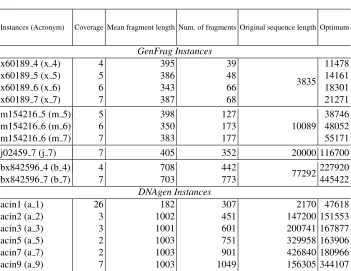
We carried out several experiments with different instances of DNA-FAP benchmark data sets, which were described in [19].
Table 1.Information of datasets
Instances (Acronym) Coverage Mean fragment length Num. of fragments Original sequence length Optimum
GenFrag Instances
x60189 4 (x 4) 4 395 39
3835 11478
x60189 5 (x 5) 5 386 48 14161
x60189 6 (x 6) 6 343 66 18301
x60189 7 (x 7) 7 387 68 21271
m154216 5 (m 5) 5 398 127
10089 38746
m154216 6 (m 6) 6 350 173 48052
m154216 6 (m 7) 7 383 177 55171
j02459 7 (j 7) 7 405 352 20000 116700
bx842596 4 (b 4) 4 708 442
77292227920
bx842596 7 (b 7) 7 703 773 445422
DNAgen Instances
acin1 (a 1) 26 182 307 2170 47618
acin2 (a 2) 3 1002 451 147200 151553
acin3 (a 3) 3 1001 601 200741 167877
acin5 (a 5) 2 1003 751 329958 163906
acin7 (a 7) 2 1003 901 426840 180966
acin9 (a 9) 7 1003 1049 156305 344107
the instances information with their names, coverage, sizes (mean fragment lengthand number of fragmentsper instance), original sequence length and the optimum, respec-tively. The instances are ordered by group and number of fragments. A more detailed description of these benchmarks can be found in [19]. In order to test the GPU-DFA we usen = 32(number of fireflies) andm = 16(number of new solutions generated) as parameter settings. These values were obtained from a previous study presented in [35].
6.2. Experimentation
In order to analyse both the behaviour and performance of our approach, we need to clarify some parameter definitions and mechanisms.
In order to make a meaningful comparison between both the DFA implementations -CPU and GPU-, we have chosen a stop condition so that we can guarantee a similar exploration of the search space for all the instance problem sizes. The stop condition for both algorithms is defined in one million of evaluations.
We perform 30 independent runs to evaluate the instances. We have marked a result in dark grey when it is the best and in light grey when it is the second best result.
The experiments were performed using the host with a CPU AMD FX(tm)-8320 Eight-Core Processor, with a total physical memory of 16GB. The operating system is Ubuntu Precise 12.04. In the case of the GPU, we have an NVIDIA GeForce GTX 780Ti with 3GB of DRAM on the device and we used the CUDA version 6.0.
7.
Results and Analysis
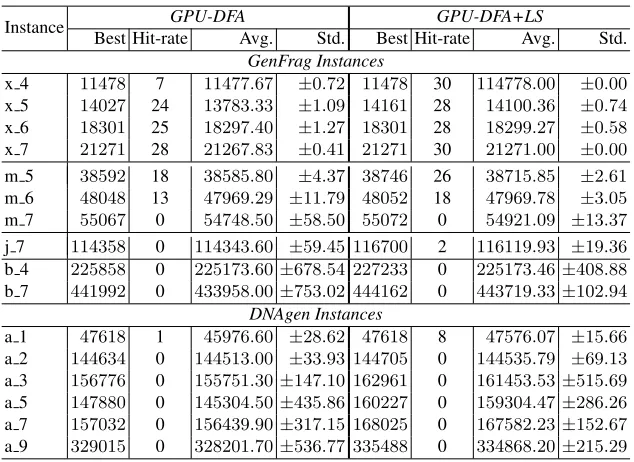
This section presents the experimental results obtained with the GPU-DFA approach and GPU-DFA with Local Search (GPU-DFA+LS). We measured the quality of the solution by considering the fitness value achieved as well as the number of contigs obtained solv-ing different DNA-FAP instances. Next, the time performance of DFA and GPU-DFA+LS was analysed and compared with respect to the CPU-DFA algorithm. Finally, an analysis for each GPU-DFA kernel time execution was provided.
7.1. Numerical Analysis
Table 2.GPU-DFA results for DNA-FAP instances.
Instance GPU-DFA GPU-DFA+LS
Best Hit-rate Avg. Std. Best Hit-rate Avg. Std.
GenFrag Instances
x 4 11478 7 11477.67 ±0.72 11478 30 114778.00 ±0.00
x 5 14027 24 13783.33 ±1.09 14161 28 14100.36 ±0.74
x 6 18301 25 18297.40 ±1.27 18301 28 18299.27 ±0.58
x 7 21271 28 21267.83 ±0.41 21271 30 21271.00 ±0.00
m 5 38592 18 38585.80 ±4.37 38746 26 38715.85 ±2.61
m 6 48048 13 47969.29 ±11.79 48052 18 47969.78 ±3.05
m 7 55067 0 54748.50 ±58.50 55072 0 54921.09 ±13.37
j 7 114358 0 114343.60 ±59.45 116700 2 116119.93 ±19.36
b 4 225858 0 225173.60±678.54 227233 0 225173.46±408.88
b 7 441992 0 433958.00±753.02 444162 0 443719.33±102.94 DNAgen Instances
a 1 47618 1 45976.60 ±28.62 47618 8 47576.07 ±15.66
a 2 144634 0 144513.00 ±33.93 144705 0 144535.79 ±69.13
a 3 156776 0 155751.30±147.10 162961 0 161453.53±515.69
a 5 147880 0 145304.50±435.86 160227 0 159304.47±286.26
a 7 157032 0 156439.90±317.15 168025 0 167582.23±152.67
a 9 329015 0 328201.70±536.77 335488 0 334868.20±215.29
The best solutions obtained by GPU-DFA are competitive and close to the optimum. The results indicate that GPU-DFA is capable of exploring the search space in an effective way showing promising behaviour.
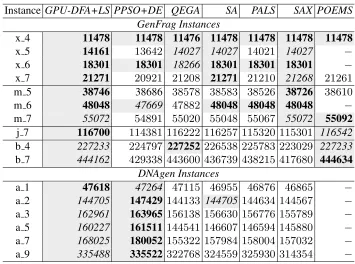
Table 3 summarizes the results obtained by the GPU-DFA+LS and others DNA-FAP assembler algorithms [7,16,17,21]. Values in bold with gray background indicate that an algorithm reaches the optimal solution for the instance and values initalicwith gray background show values with the second best solution found.
From Table 3, we observe that the algorithms with a more intelligent behaviour ben-efits the search process, obtaining in general competitive results for all the instances. For small and medium benchmarks, the efficiency of all the algorithms is roughly comparable. Our approach obtain the optimum or stay very near being secondly.
Table 3 indicates that for larger instances, the behaviour is similar, obtaining values very near to the optimum as is the case of DNAgen instances where only the PPSO+DE overcome GPU-DFA+LS results. In the case of GenFrag instances, GPU-DFA+LS was superior to the other algorithms. In general, the second best solution is obtained by the GPU-DFA+LS in large instances. The simulation results demonstrate that the proposed GPU-DFA+LS optimizes the overlap score for the 16 benchmark instances tested.
7.2. Comparison of the contigs
Table 3.Results for the 16 benchmark datasets along with GPU-DFA results for the addit.
Instance
GPU-DFA+LS PPSO+DE QEGA
SA
PALS
SAX POEMS
GenFrag Instances
x 4
11478
11478
11476
11478
11478
11478
11478
x 5
14161
13642
14027
14027
14021
14027
−
x 6
18301
18301
18266
18301
18301
18301
−
x 7
21271
20921 21208
21271
21210
21268
21261
m 5
38746
38686
38578 38583 38526
38726
38610
m 6
48048
47669
47882
48048
48048
48048
−
m 7
55072
54891 55020 55048 55067
55072
55092
j 7
116700
114381 116222 116257 115320 115301
116542
b 4
227233
224797
227252
226538 225783 223029
227233
b 7
444162
429338 443600 436739 438215 417680
444634
DNAgen Instances
a 1
47618
47264
47115 46955 46876 46865
−
a 2
144705
147429
144133
144705
144634 144567
−
a 3
162961
163965
156138 156630 156776 155789
−
a 5
160227
161511
144541 146607 146594 145880
−
a 7
168025
180052
155322 157984 158004 157032
−
a 9
335488
335522
322768 324559 325930 314354
−
colony (ABC) [8], Queen Bee Evolution Based on Genetic Algorithm (QEGA) [16], Simulated Annealing (SA) [7], Problem Aware Local Search (PALS), and Genetic Al-gorithm [7].
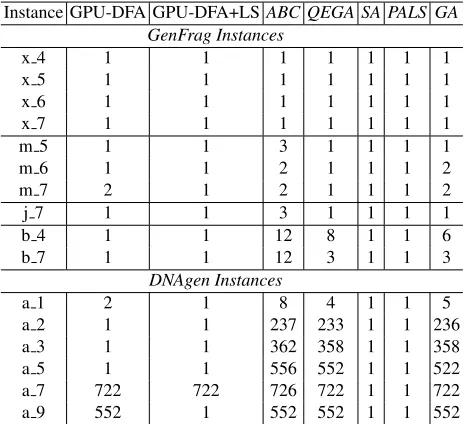
For GenFrag instances, GPU-DFA obtains an optimal layout of the DNA sequence. In the case of the largest DNAgen instances, GPU-DFA cannot find the best layout. How-ever, PALS, SA and GPU-DFA return similar fitness values. So, we can infer that canon-ical GPU-DFA needs a better exploitation operation to find the best contigs. In fact, the results obtained by the GPU-DFA+LS prove this point. The results of our proposals are competitive with respect to other approaches presented in the literature. Nevertheless, in the case of GPU-DFA, for instances m 7, a 1, a 7 and a 9 as the contig value did not improve the results obtained by PALS and SA. The GPU-DFA+LS enhances the contig value obtained in m 7, a 1 and a 9.
From Table 4 we can conclude that the use of an intelligent search method for search space exploitation obtains better results (a lower number of contigs) than a random seed-ing or other bio-inspired techniques.
Table 4.Best final number of contig for our assembler (using the best configuration) and for other specialized systems.
Instance GPU-DFA GPU-DFA+LSABC QEGA SA PALS GA
GenFrag Instances
x 4 1 1 1 1 1 1 1
x 5 1 1 1 1 1 1 1
x 6 1 1 1 1 1 1 1
x 7 1 1 1 1 1 1 1
m 5 1 1 3 1 1 1 1
m 6 1 1 2 1 1 1 2
m 7 2 1 2 1 1 1 2
j 7 1 1 3 1 1 1 1
b 4 1 1 12 8 1 1 6
b 7 1 1 12 3 1 1 3
DNAgen Instances
a 1 2 1 8 4 1 1 5
a 2 1 1 237 233 1 1 236
a 3 1 1 362 358 1 1 358
a 5 1 1 556 552 1 1 522
a 7 722 722 726 722 1 1 722
a 9 552 1 552 552 1 1 552
7.3. Execution Time Analysis
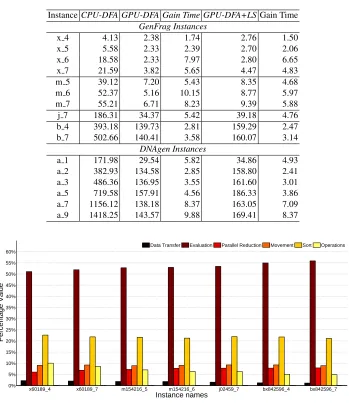
Table 5 provides the average time consumed in seconds for the CPU and GPU implemen-tation of DFA. The table shows the acronym of each instance in the first column. Column two and three indicate the average time for the CPU-DFA and GPU-DFA models. Finally, column four provides the gain time computed.
Concerning the amount of gain time obtained, we have computed this metric by di-viding the average time of the CPU-DFA over the average time for the GPU-DFA. As an initial observation, we can say that the gain time is above the value 1.00 indicating that the CPU always spent more execution time than the GPU.
Table 5 illustrates that while the number of fragments increased, the GPU-DFA times did not rise significantly, in contrast with the times of the CPU-DFA version.
Table 5 indicates that the GPU-DFA algorithm obtained lower times in all the in-stances. The gain time for the GPU-DFA ranges from 1.73×to 9.88×. We can observe that the largest value differences exist in medium/large instances. For the case of the in-tegration of a Local Search to the GPU model, we can see that runtimes are increased but not significantly. The results of execution tiems are better (less) than those obtained by the implementation in CPU. With respect to the gains of times obtained, they do not surpass the canonical model GPU-DFA.
Table 5.Mean time (in seconds) to find the best fitness obtained for each implementation in all instances.
InstanceCPU-DFA GPU-DFA Gain Time GPU-DFA+LSGain Time
GenFrag Instances
x 4 4.13 2.38 1.74 2.76 1.50
x 5 5.58 2.33 2.39 2.70 2.06
x 6 18.58 2.33 7.97 2.80 6.65
x 7 21.59 3.82 5.65 4.47 4.83
m 5 39.12 7.20 5.43 8.35 4.68
m 6 52.37 5.16 10.15 8.77 5.97
m 7 55.21 6.71 8.23 9.39 5.88
j 7 186.31 34.37 5.42 39.18 4.76
b 4 393.18 139.73 2.81 159.29 2.47
b 7 502.66 140.41 3.58 160.07 3.14
DNAgen Instances
a 1 171.98 29.54 5.82 34.86 4.93
a 2 382.93 134.58 2.85 158.80 2.41
a 3 486.36 136.95 3.55 161.60 3.01
a 5 719.58 157.91 4.56 186.33 3.86
a 7 1156.12 138.18 8.37 163.05 7.09
a 9 1418.25 143.57 9.88 169.41 8.37
x60189_4 x60189_7 m154216_5 m154216_6 j02459_7 bx842596_4 bx842596_7 0%
5% 10% 15% 20% 25% 30% 35% 40% 45% 50% 55% 60%
Instance names
Percentage Value
Data Transfer Evaluation Parallel Reduction Movement Sort Operations
Fig. 4. Average percentage of six time-consuming operations spent by the GPU-DFA model for six DNA-FAP instances.
be-x60189_4 x60189_7 m154216_5 m154216_6 j02459_7 bx842596_4 bx842596_7 0%
5% 10% 15% 20% 25% 30% 35% 40% 45% 50% 55% 60%
Instance names
Percentage Value
Data Transfer Evaluation Parallel Reduction Movement Sort Operations LS
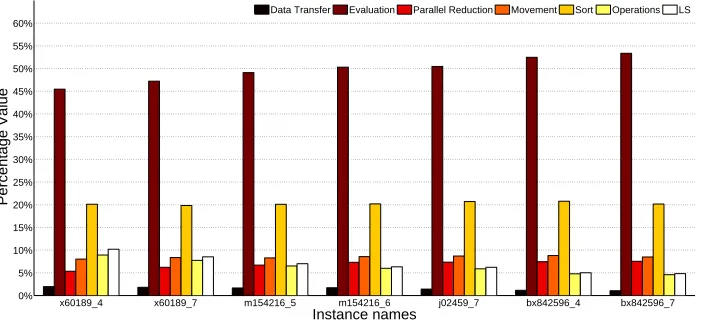
Fig. 5. Average percentage of seven time-consuming operations spent by the GPU-DFA+LS model for six DNA-FAP instances.
tween CPU and GPU, evaluation, reduction, sort, generation of movement, and other mi-nor operations (such as computing distance between two fireflies and replacing solutions between tempandP). Fig. 2 presents the GPU-DFA operations that are analysed. In addition, Fig. 5 shows the time used by the local search procedure in GPU.
A first observation that can be made on Fig. 4 is about the data transfers between the CPU and the GPU. The time associated with the transfers is less than 3% and is kept for all instance sizes. Indeed, from the first instance (x60189 4), the time corresponds to 2.60% and it reaches 1.47% for the last instance (bx842596 7). The time dedicated to the data transfers in the iteration-level parallel model is not significant in comparison with the rest of the processes. Another observation concerns the time spent by the sort and the evaluation of the solutions which represents most of the total running time. The evaluation process time grows accordingly with the instance size (more than 50% time is busy with this process).
Also, in Fig. 4 we can appreciate the time-consuming sort process. The time consumed by the sort process ranged between 23% and 21% of the total running time. In this sense, we can see that as time sorting decreases, the evaluation process grows. These values can be explained by taking into account that, as the number of fireflies increases, the number of iterations decreases. So, the evaluation process needs more time to work with each solution (since the number of elements to be analysed grows). With fewer iterations the evaluation process consumes almost 55% of the running time in the largest instance. Moreover, we observe that the parallel reduction time grows by a smaller proportion when instances become larger (ranging between 8% and 9%).
that even when wasting time in the data transfer operations and the sort function, the algorithm is still fast and effective. The case of the data transmission performed by the algorithmic model is less time consuming. In regard to the other GPU-DFA processes, we can see that those related with the main FA model have very similar time cost during GPU occupation. This indicates that this model can distribute tasks in different kernels and no single task slows down the system more than others (with the exception of the evaluation process which for all instances demands the longest time).
As final remarks regarding our approach, these results demonstrate that GPU-DFA obtains satisfactory results. We have confidence in the algorithmic performance since we have not yet introduced any specific function or operator related to DNA-FAP in particu-lar.
8.
Conclusions and Future Work
In this paper, we have proposed a Discrete Firefly Algorithm implemented on GPU to assemble DNA fragments in order to reconstruct a genome sequence. The algorithm was executed on a GPU platform designed for massive parallel arithmetic computing. The new algorithm is inspired by the successful experience gathered by the FA in different fields. We performed the tests over a group of well-known DNA-FAP benchmarks and compared it with others assemblers. Promising results were obtained considering not only the optimal values, but also the number of contigs generated by GPU-DFA.
From the analysis of all the results we can observe that the GPU-DFA can achieve the optimum or is very close to it but cannot find the best layout for largest DNAgen in-stances. So, we propose a GPU-DFA enhancement approach (GPU-DFA+LS) in order to exploit the neighbourhood of these solutions. The preliminary results of our experiments are very promising in regard to the effectiveness of the method that we have developed. In-deed, GPU-DFA+LS can be considered a satisfactory assembler, in view of its high accu-racy and real time efficiency for DNA assembler sequence problems. The GPU-DFA+LS seems to be a favourable optimization tool in part due to the effect of the attractiveness function and its search model.
In general, both approaches provide a good balance of exploitation and exploration. The implementation on a parallel platform allows the optimal values to reached in a short time, which is interesting, with the idea of applying this algorithm for big database of genomes. Moreover, we have found that the GPU-DFA model provides a robust parallel model that allows instances of different sizes to be solved without great degradation in the quality of the solutions and time execution.
Considering comparison with others assemblers, it is clear that we need to explore the possibility of an intelligent initialization of the fireflies in future work in order to generate quality initial solutions.
Acknowledgments.Authors thank to Agencia Nacional de Promoci´on Cient´ıfica y Tecnol´ogica for grant PICT 2014-0430 and grant PIP 2015-2017 from Consejo Nacional de Investigaciones Cient´ıficas y T´ecnicas (CONICET). Authors are thankful to Universidad Nacional de la Patagonia Austral (UNPA). In the same way, the work of Pablo Javier Vidal and Ana Carolina Olivera has been partially funded by the PI-UNPA 29/B209.
References
1. Bojic, I., Podobnik, V., Ljubi, I., Jezic, G., Kusek, M.: A self-optimizing mobile network: Auto-tuning the network with firefly-synchronized agents. INFORM SCIENCES 182(1), pp. 77–92 (2012)
2. Chandrasekaran, K., Simon, S.P.: Network and reliability constrained unit commitment prob-lem using binary real coded firefly algorithm. INT J ELEC POWER 43(1), pp. 921–932 (2012) 3. Chen, T., Skiena, S.S.: A case study in genome-level fragment assembly. Bioinformatics 16
(2000)
4. Corporation, N.: NVIDIA CUDA C Programming Best Practices Guide. Tech. rep. (2009) 5. Engle, M.L., Burks, C.: Artificially generated data sets for testing DNA sequence assembly
algorithms. Genomics 16(1), pp. 286–288 (1993)
6. Farhoodnea, M., Mohamed, A., Shareef, H., Zayandehroodi, H.: Optimum placement of active power conditioners by a dynamic discrete firefly algorithm to mitigate the negative power qual-ity effects of renewable energy-based generators. International Journal of Electrical Power & Energy Systems 61, pp. 305–317 (2014)
7. Firoz, J.S., Rahman, M.S., Saha, T.K.: Bee algorithms for solving dna fragment assembly prob-lem with noisy and noiseless data. In: Proceedings of the 14th Annual Conference on Genetic and Evolutionary Computation. pp. 201–208. ACM, New York (2012)
8. Firoz, J.S., Rahman, M.S., Saha, T.K.: Bee algorithms for solving dna fragment assembly prob-lem with noisy and noiseless data. In: Proceedings of the 14th Annual Conference on Genetic and Evolutionary Computation. pp. pp. 201–208. ACM, New York (2012)
9. Fister, I., Jr., I.F., Yang, X.S., Brest, J.: A comprehensive review of firefly algorithms. CoRR abs/1312.6609 (2013)
10. Green, P.: Phrap, version 1.090518, http://phrap.org (2009)
11. Huang, X., Madan, A.: CAP3: A DNA sequence assembly program. Genome research 9(9), pp. 868–877 (1999)
12. Husselmann, A., Hawick, K.: Parallel parametric optimisation with firefly algorithms on graph-ical processing units. In: Hamid (ed.) 2012 World Congress in Computer Science, Computer Engineering, and Applied Computing (2012)
13. Jati, G.K., Manurung, R., Suyanto: Discrete firefly algorithm for traveling salesman problem: A new movement scheme. In: Yang, X.S., Cui, Z., Xiao, R., Gandomi, A.H., Karamanoglu, M. (eds.) Swarm Intelligence and Bio-Inspired Computation, pp. 295–312. Elsevier, Oxford (2013)
14. Jones, N.C., Preface, P.A.P.: An Introduction to Bioinformatics Algorithms. Massachusetts In-stitute of Technology (2004)
15. Kirk, D.B., Hwu, W.m.W.: Programming Massively Parallel Processors: A Hands-on Ap-proach. Morgan Kaufmann Publishers Inc., San Francisco, CA, USA, 1st edn. (2010) 16. Knuth, D.E.: The Art of Computer Programming, Volume 3: (2Nd Ed.) Sorting and Searching.
17. Kubalik, J., Buryan, P., Wagner, L.: Solving the dna fragment assembly problem efficiently using iterative optimization with evolved hypermutations. In: Proceedings of the 12th annual conference on Genetic and evolutionary computation. pp. 213–214. ACM (2010)
18. Maher, B., et al.: A firefly-inspired method for protein structure prediction in lattice models. Biomhc 4(1), pp. 56–75 (2014)
19. Mall´en-Fullerton, G.M., Hughes, J.A., Houghten, S., Fern´andez-Anaya, G.: Benchmark datasets for the DNA fragment assembly problem. International Journal of Bio-Inspired Com-putation 5(6), pp. 384–394 (2013)
20. Minetti, G., Alba, E.: Metaheuristic assemblers of DNA strands: Noiseless and noisy cases. In: Proceedings of the IEEE Congress on Evolutionary Computation, CEC2010, Barcelona, Spain, 18-23 July 2010. pp. 1–8 (2010)
21. Minetti, G., Leguizam´on, G., Alba, E.: Sax: a new and efficient assembler for solving dna fragment assembly problem. In: 2012 Argentine Symposium on Artificial Intelligence (2012) 22. Myers, E.W., Sutton, G.G., Delcher, A.L., Dew, I.M., Fasulo, D.P., Flanigan, M.J., Kravitz,
S.A., Mobarry, C.M., Reinert, K.H., Remington, K.A., et al.: A whole-genome assembly of drosophila. Science 287(5461), pp. 2196–2204 (2000)
23. Navarro, C.A., Hitschfeld-Kahler, N., Mateu, L.: A survey on parallel computing and its appli-cations in data-parallel problems using gpu architectures. Communiappli-cations in Computational Physics 15(2), pp. 285–329 (06 2015)
24. NVIDIA Corporation: NVIDIA CUDA C Programming Guide (June 2011)
25. Osaba, E., Yang, X.S., Diaz, F., Onieva, E., Masegosa, A.D., Perallos, A.: A discrete firefly algorithm to solve a rich vehicle routing problem modelling a newspaper distribution system with recycling policy. Soft Computing pp. 1–14 (2016)
26. Parsons, R., Forrest, S., Burks, C.: Genetic algorithms, operators, and DNA fragment assembly. Machine Learning 21(1-2), pp. 11–33 (1995)
27. de Paula, L., et al.: Parallelization of a modified firefly algorithm using GPU for variable selec-tion in a multivariate calibraselec-tion problem. Internaselec-tional Journal of Natural Computing Research (IJNCR) 4(1), pp. 31–42 (2014)
28. Peters, H., Schulz-Hildebrandt, O., Luttenberger, N.: Fast in-place sorting with CUDA based on bitonic sort. LNCS, vol. 6067, pp. 403–410. Springer (2009)
29. Pevzner, P.: Computational Molecular Biology: An Algorithmic Approach. MIT Press (2000) 30. Pop, M.: Shotgun sequence assembly. Advances in Computers 60, pp. 193–248 (2004) 31. Saito, M., Matsumoto, M.: Variants of mersenne twister suitable for graphic processors. ACM
Trans. Math. Softw. 39(2), pp. 12:1–12:20 (Feb 2013)
32. Sayadi, M.K., Hafezalkotob, A., Naini, S.G.J.: Firefly-inspired algorithm for discrete optimiza-tion problems: An applicaoptimiza-tion to manufacturing cell formaoptimiza-tion. Journal of Manufacturing Sys-tems 32(1), pp. 78–84 (2013)
33. Shah, R., Narayanan, P., Kothapalli, K.: Gpu-accelerated genetic algorithms. In: Workshop on Parallel Architectures for Bio-ispired Algorithms in conunction with Parallel Architectures and Compilation Techniques (PACT Workshop). pp. 27–34 (2010)
34. Sutton, G.G., White, O., Adams, M.D., Kerlavage, A.R.: Tigr assembler: A new tool for as-sembling large shotgun sequencing projects. Genome Science and Technology 1(1), pp. 9–19 (1995)
35. Vidal, P., Olivera, A.C.: A parallel discrete firefly algorithm on gpu for permutation combinato-rial optimization problems. In: Hernndez, G., Barrios Hern´andez, C.J., D´ıaz, G., Garc´ıa Garino, C., Nesmachnow, S., P´erez-Acle, T., Storti, M., V´azquez, M. (eds.) High Performance Comput-ing, Communications in Computer and Information Science, vol. 485, pp. 191–205. Springer Berlin Heidelberg (2014)
36. Yang, X.S.: Nature-Inspired Metaheuristic Algorithms. Luniver Press (2008)
38. Yang, X.S., He, X.: Firefly algorithm: Recent advances and applications. Int. J. Swarm Intelli-gence 1, pp. 36–50 (2013)
39. Yang, X.S., He, X.: Firefly algorithm: Recent advances and applications. CoRR abs/1308.3898 (2013)
40. Yang, X.S., Hosseini, S.S.S., Gandomi, A.H.: Firefly algorithm for solving non-convex eco-nomic dispatch problems with valve loading effect. Applied Soft Computing 12(3), pp. 1180– 1186 (2012)
Pablo Javier Vidal, received his degree in Computing Engineering, in 2008 from Uni-versidad Nacional de la Patagonia Austral; the degree fo Dr. in Software Engineering and Artificial Intelligence, in 2106, from Universidad de M´alaga. He is currently an as-sistant professor at the Universidad de la Patagonia Austral-Unidad Acad´emica Caleta Olivia. Currently has a postdoctoral scholarship from Consejo Nacional de Investiga-ciones Cient´ıficas y T´ecnicas. He has experience in software engineering with emphasis on automation and Graphic Processing Units research. His main research topics are par-allel and distributed computing, evolutionary algorithms and metaheuristics, numerical modelling. ORCID: 0000-0001-6502-8010
Ana Carolina Oliverais an Assistant Researcher at National Council of Scientific and Technological Researches from the Ministerio de Ciencia y Tecnologa de la Naci´on Ar-gentine. Dr. in Computer Science from Universidad Nacional del Sur, in Bah´ıa Blanca, Argentina. She is Adjunct Professor at the Department of Exact and Natural Sciences of Universidad Nacional de la Patagonia Austral. She participates and directs in several national and international projects. Her research focuses on bio-inspired algorithms. She has published several book chapters and articles in indexed journals and proceedings of refereed international conferences. ORCID: 0000-0001-7825-1959