ments, as the final system is tested against user requirements. It is thus highly de-sirable to be able to automate transition from requirements to acceptance tests. In this paper we present a model-driven approach to this issue, where detailed use case models are transformed into test cases. Importantly, our approach facilitates syn-chronising functional test cases with other types of tests (non-functional, domain logic, user interface) and introducing test data. This leads to a unified approach where requirements models of various kind drive the acceptance testing process. This process is parallel to the development process which also involves automatic transformations from requirements models to software development artefacts (mod-els and code). To show validity of the approach we present a case study which uses a new tool called ReDSeT, that transforms requirements formulated in the Require-ments Specification Language (RSL) into tests in a newly proposed Test Specifica-tion Language (TSL).
Keywords:acceptance testing, test generation, use cases, metamodel, model trans-formation.
1.
Introduction and related work
Acceptance testing is the ultimate step in every software development effort [15]. Accep-tance tests are part of the overall testing process [16], and are usually performed with high involvement of the customers who compare the final system’s operations with the original contract between stakeholders and developers. This contract should be clear to both sides, so that the stakeholders can formulate their real needs and the developers can produce software compliant with these needs.
One of the most popular notations to specify functional requirements are use cases, introduced initially by Jacobson [12]. Use cases are represented through scenarios that define interactions between external actors and the system-to-be-built that lead to specific goals of certain value to the actors [5]. Use case scenarios can be specified using differ-ent notations, of which model-based ones have significant value [21]. Precise notations consisting of models with runtime semantics can be processed automatically to produce other software artifacts, including code [22].
modelling notation, like interaction models (see work by Guti´errez et al. [11] and by Turner et al. [32]). Other proposed mechanisms involve analysis of use case contracts (pre- and post-conditions) to create more complex testing scenarios that consider changes of the system state (see work by Nebut et al. [17]). However, this approach works on a more formal level and uses sequence diagrams to denote scenarios. To understand such diagrams, a significant level of technical knowledge of UML is needed, which makes it arguably hard to inspect by the end-users.
An interesting approach was proposed by El-Attar and Miller [9]. It involves gener-ating acceptance test scripts from textual use case scenarios combined with domain and robustness (class) models. The generated scripts contain test scenarios, description of the input and the expected results. In another, similar approach, Som´e and Cheng create test cases through generating state machines [28]. State machines are also used by Jiang and Ding [13]. Their approach goes a step further by proposing to express use case scenarios using a formalised grammar with uniform subject-verb-object sentences.
Test cases based on use cases concentrate on verifying the functional requirements. Still, also other important aspects need to be assured: meeting the business rules, UI look-and-feel and various quality issues (performance, reliability etc.). These kinds of require-ments should be verified by executing corresponding tests. A quite broad domain of test generation approaches is GUI-based, as surveyed by Banerjee et al. [1]. In the context of our work, an interesting approach was presented by Bertolini and Mota [3] who link GUI-based testing with use cases. Of other relevant approaches, we can mention work by Bizerra et al. [4] who introduce a method for generating tests from formally speci-fied business rules associated with domain models and by Dyrkom and Wathne [8] who propose a method to automate test generation from non-functional requirements.
Most of the above mechanisms use model transformations forming the area of Model-Based Testing (MBT), which is an evolving technique for generating suites of test cases from software models of various kind [6, 20]. It should be noted that although different types of tests are generated from requirement models describing the same software sys-tem, usually they are not related. To verify different aspects of the system we need to use different methods which do not have direct interrelations. This paper aims at improv-ing this situation. It focuses on automatic generation of different but interrelated types of tests. These tests are integrated through functional test cases obtained from model-based use case scenarios using an automated tool. The resulting test specification is expressed with a metamodel-based language called the Test Specification Language (TSL). In this language, every functional test case can integrate various other types of tests.
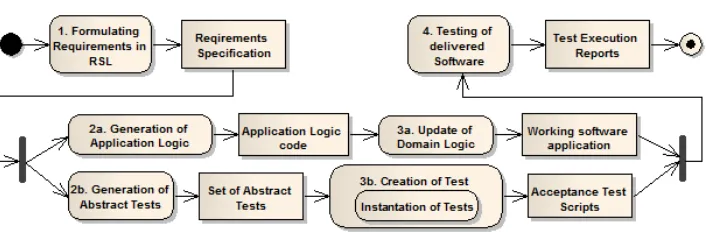
Such integrated test sets are generated on the basis of tightly interrelated requirements models that describe many aspects of the developed software system, which makes this idea MBT-compliant. The main idea of test automation is based on creating requirements specifications with a modelling language called the Requirements Specification Language (RSL) [14, 25]. Models in this language are used as input to the process illustrated in Figure 1 (see step 1).
The figure depicts two parallel model transformation paths that lead to acceptance testing of a delivered software application:
2a); having the application logic, domain logic code is updated manually according to given domain rules (step 3a);
– acceptance test script production – abstract tests are automatically generated on the basis of use cases and other related requirements (step 2b); test scenarios are then manually composed of instances of abstract tests (step 3b).
This process can be performed repeatedly according to incremental delivery of re-quirements. RSL provides means to denote use case scenarios very precisely thus signif-icantly facilitating the generative steps of the two parallel processes. Additional informa-tion contained in scenario sentences (noinforma-tions from the domain vocabulary) and other re-lated requirements allow for generating other types of tests. All the tests generated on the basis of RSL-based requirements form a complete and coherent test suite for acceptance testing. The generation steps are performed using a tool called ReDSeT (Requirements-Driven Software Testing) written as a plug for the RSL tooling environment called ReD-SeeDS (Requirements-Driven Software Development System) [24, 27].
This paper is a significant extension of our previous work [30], presented at the 5th International Workshop on Automating Test Case Design (FedCSIS). It introduces the TSL metamodel and related model transformation rules that allow for generating TSL models from RSL models. Moreover, it presents the process of obtaining the final test scripts from the generated abstract test cases and discusses a cases study performed to validate the approach.
2.
Detailed requirements expressed in RSL
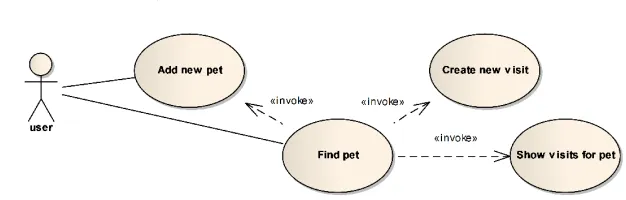
Fig. 2.Example use case model for the ‘Find pet’ use case
Fig. 3.Example scenarios for the ‘Find pet’ use case
for ordinary people who do not have technical expertise. The language has a precise spec-ification of its syntax [14] and semantics [22] with methods of its use explained e.g. by Nowakowski et al. [19].
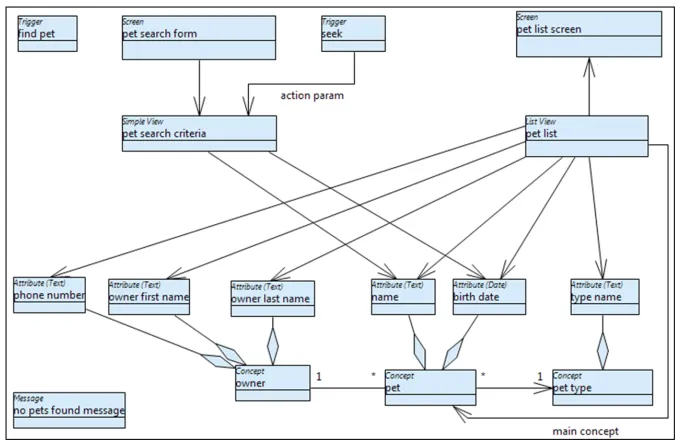
To illustrate RSL we present a fragment of a requirements model for the Pet Clinic sys-tem, adapted from the book by ´Smiałek and Nowakowski [25]. Figures 2, 3 and 4 contain an elementary use case model with four use cases, scenarios for one of the use cases and an associated domain model. As we can notice in Figure 3, scenarios basically consist of numbered sentences in a simple ‘SVO(O)’ grammar, where sentences are sequences con-taining a Subject, a Verb and one or two Objects. These sentences are constructed using links to notions stored in the domain vocabulary presented in Figure 4.
Fig. 4.Example domain model for the ‘Find pet’ use case
All the requirements in RSL can have relationships. To depict relations between use cases, a special invoke relationship is used (see Figure 2). This relationship has precise execution semantics. Each such relationship has to be associated with specific sentences in scenarios of the invoking use case that refer to the invoked use case. We can notice such sentences in the scenarios in Figure 3. These sentences have ‘call’ semantics and they mean that the respective invoked use case starts execution at this point. More details about semantics of invocations can be found in works by Nowakowski et al. [19] and
´Smiałek et al. [26].
RSL offers much more capabilities than in the presented example. For instance, it allows for constructing tree-like package structures and introducing simple free-text re-quirements to describe business rules or quality (non-functional) aspects. Its formal spec-ification [14] is based on a metamodel consisting of over 200 metaclasses. Detailed dis-cussion of the metamodel and on developing transformations from RSL to UML and code can be found in the already mentioned book by ´Smiałek and Nowakowski [25]. Instead, the following sections contains an overview of the testing language whose metamodel is derived from that of RSL. Next, we will present a transformation from RSL to this new testing language.
3.
Test Specification Language
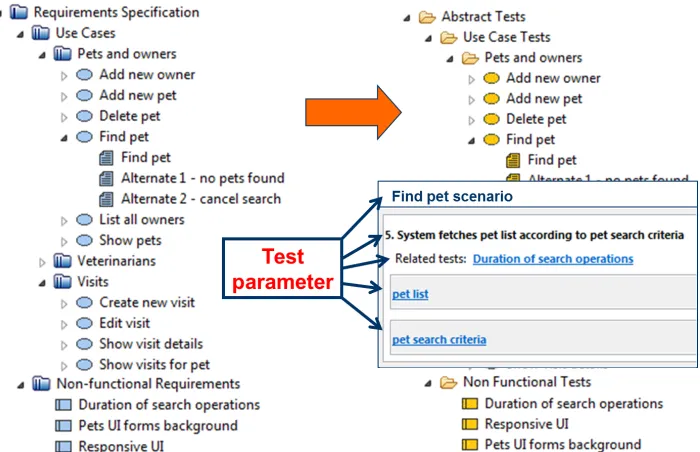
Fig. 5.Test specification derived from a requirements specification
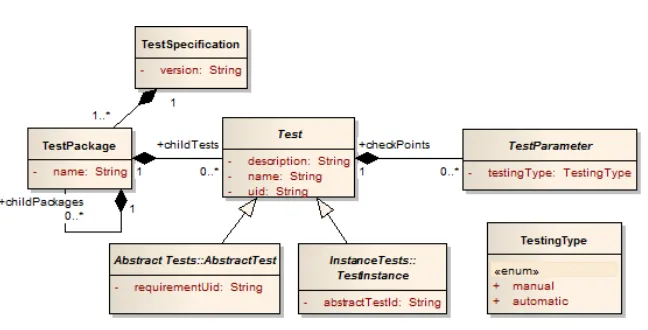
The main idea of TSL is to provide notation for reusable tests, that are understandable for non technical people (end-users, clients, stakeholders, etc.) and precise enough to allow for verifying the software system in detail. All tests are grouped in a tree structure, named the Test Specification (see Figure 5 - right). This structure is an implementation of the metamodel shown in Figure 6. EachTestcontained in theTestSpecificationthrough aTestPackage, represents a procedure for verification of a single software requirement. Such a verification is performed by processing through all the check points defined inside a test. Types of check points should be dedicated to each type of test as specialisations of
TestParameters. The general attribute of this metaclass (testingType) determines whether the specific check point will be executed automatically or manually. Each specialisation of
TestParametershould also include an attribute determining the check point result value, adequate for the test type.
The basic structure of a TSL test specification consists of two packages: Abstract Tests and Concrete Tests. The Abstract Tests package includes subtypes ofAbstractTest. This kind of tests are generated directly from the requirements specification and comprise mostly use case tests and notion-based tests, but can also contain tests of other types. They posses therequirementUidattribute that points to the source element in the requirements model. A use case test corresponds to a use case, and includes use case test scenarios gen-erated from RSL use case scenarios, like the ones illustrated in Figure 5. The metamodel that represents this structure is shown in Figure 7.
AUseCaseTestScenario includes an initial condition (a precondition sentence) that
Fig. 6.TSL metamodel: test specification structure
Fig. 7.TSL metamodel: use case tests
Fig. 8.TSL metamodel: use case test scenario sentences
metaclass. The check points forUseCaseTestScenarios are postconditions pointed-at by
UseCaseTestScenarioParameters.
Fig. 9.TSL metamodel: notion tests
original idea). As shown in Figure 8, sentences describing single actions are represented
bySVOSentences. This kind of sentence is described with aDomainStatement, which
forms itspredicate(the verb-object part of an SVO sentence).
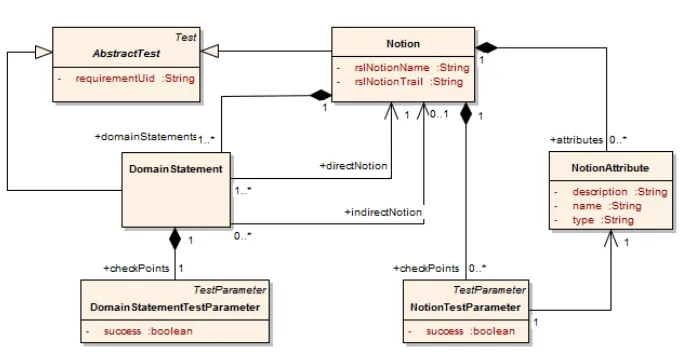
TheDomainStatement metaclass, as shown in Figure 9, is a specialisation of
Ab-stractTestand has check points represented byDomainStatementTestParameters. Each
DomainStatement is owned by someNotion that is generated on the basis of an RSL
notion.Notiontests can be verified according toNotionTestParameters that verify No-tionAttributes.
In addition to action sentences, two additional sentence types were introduced: Con-ditionSentences andControlSentences. Analogously to RSL, they are used in scenarios to express the flow of control between alternative scenarios of the same use case, as well as between scenarios of different use cases (see ´Smiałek et al. [21]).
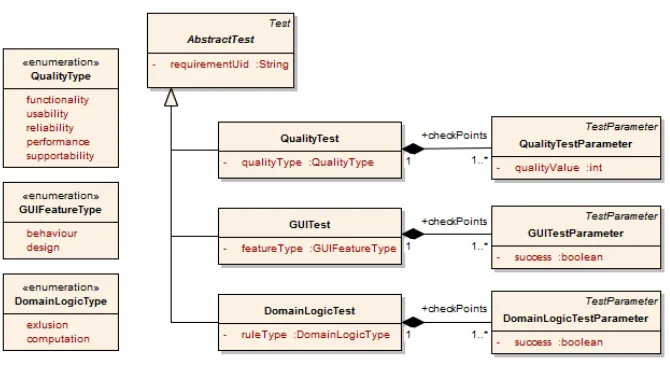
In addition to use case tests that verify behaviour of the system, tests of other types can verify the domain logic, the user interface, the non-functional aspects (performance, usability, etc,) or any other aspect of the system that is described through requirements. Figure 10 shows a taxonomy of such constructs which includesQualityTest,GUITest,
DomainLogicTest and respective specialisations of the TestParametermetaclass. This
metamodel template can be used for introducing other types of tests.
Fig. 10.TSL metamodel: tests of other types
Fig. 11.TSL metamodel: test relationships
Fig. 12.RSL to TSL transformation procedure
4.
Automatic test generation
The transformation is performed in several steps. The top-level transformation steps of the transformation procedure are presented in Figure 12. At the beginning of the transfor-mation, a newTestSpecificationstructure is created (step 1). The basicTestSpecification
structure consists of a root node named using the scheme of “Software Case Name - date” and two childTestPackages named “Abstract Tests” and “Concrete Tests”. The Abstract Tests package is constructed to reflect the source use case model structure. The Concrete Tests package is empty – Test Scenarios will be created here.
AllSVOSentences withinUseCaseTestScenarios are composed ofDomainStatements
(e.g. ‘enter pet search criteria’) which are parts of specificNotions (e.g. ‘pet search cri-teria’). For this reason, RSL notions should be processed first (step 2). For each RSL notion, a TSLNotionis created and placed in the proper package. The name, description and attached notion attributes are transferred, with theNotionTestParameters pointing at theNotionAttributes.
For all theNotions, domain statements taken from respective RSL notions are created (step 3). For each createdDomainStatementaDomainStatementParameteris also cre-ated. The phrases contained in the RSL domain statement notions, used as the direct and the indirect object are found and pointed-at by thedirectNotionand theindirectNotion attributes.
Having processed theNotions and the DomainStatements, the transformation can now process use cases(step 4). For each RSL use case, a UseCaseTest is created and placed in a properTestPackagewithin the use case test structure. The name and the de-scription are transferred accordingly. All the scenarios contained in a RSL use case are transferred into aUseCaseTestScenario. On the basis of the use case scenario’s pre- and postcondition, adequate pre- and postconditions are created asConditioninstances and attached to the respectiveUseCaseTestScenarios. In addition,
UseCaseTestScenarioPa-rameters pointing at the postconditions are attached. Sentences of the processed RSL
scenarios are transferred into appropriate instances of classes that specialise from
Use-CaseTestScenarioSentence. For everySVOSentence, the respectiveDomainStatement
is found and a relation to the correspondingDomainStatementis created. For every con-trol sentence, aTestInvocationRelationshipis created with an emptyUseCaseTestas its target.
TargetUseCaseTests of theTestInvocationRelationships are set after all the use cases are transformed intoUseCaseTests (step 5). For eachTestInvocationRelationship con-tained in aControlSentence, a correctUseCaseTestis found and set.
Fig. 13.Test scenarios composed of test cases
5.
Test instantiation
A scenario of a use case test determines conditions, steps and check points that will verify implementation for a given use case. These elements will be used to perform acceptance tests after placing them in test scenarios and assigning specific test data values. Test sce-narios are grouped into second-level packages within the general structure of a TestSpec-ification(see Figure 13). They are defined by a test engineer as a set of ordered instances of use case test scenarios, that are called “test cases”. A test case describes a single proce-dure for verifying system’s functionality. It is composed of ordered sentences describing actions, conditions and invocations of other test cases. This structure is represented by the metamodel shown in Figure 14.
To examine the result of executing a wholeTestScenario, aTestScenarioCheckPoint
is used. TheexpectedResultattribute is used to denote the success or failure of scenario execution according to some given conditions. The overall result depends on the results of individualTestCases, forming the steps of theTestScenario. EachTestCaseis exam-ined in relation to theTestCaseCheckPointthat refers to thepostconditionof the given
TestCase.
TestCases are composed ofTestCaseSentences, as illustrated in Figure 15. Actions taken by the main actor or by the system are represented bySVOSentenceInstances and contain SVOSentenceInstanceCheckPoints. Such check points represent places where execution of related actions needs to be examined. The result of checking an SVOSen-tenceInstancedepends on the states ofDomainObjects that are determined by respective
DomainObjectCheckPoints. These check points focus on the values of the
DomainOb-jectAttributes.
The metaclassesTestScenario,TestCase,SVOSentenceInstance, andDomainObject
at-Fig. 14.TSL metamodel: test scenario and test cases
Fig. 15.TSL metamodel: test case sentences and domain objects
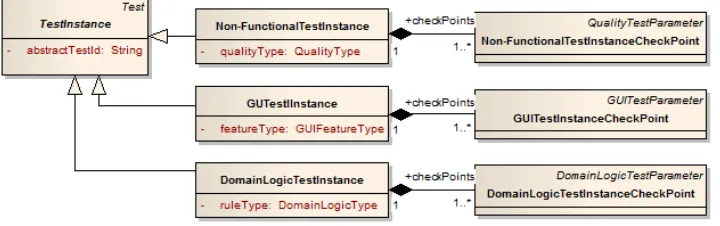
NonFunctional-Fig. 17.Test Scenario creation procedure
TestInstances,GUITestInstances andDomainLogicTestInstances, as shown in Figure
16.TestInstances of these other types are automatically created during execution of the instantiation procedure. They have their own check points, and their results affect the results of their parent tests.
Test scenarios constructed with test cases also build the context for the test data. The initial test data values are set by the test engineer as the precondition values of the test scenarios. Test data values describe basic business objects as well as GUI elements. Test data in scope of one test scenario is passed between test cases as its pre- and postcondition values. The test data values change according to the functionality and the business logic that is being tested. It can be noted that although test cases cannot be formally related to each other, within the manually created test scenarios they indirectly refer to business processes that are implemented within the system under test.
The instantiation procedure of a use case test scenario consists of adding consecutive test cases. This simple process is illustrated in Figure 17. First, we create aTestScenario, give it a nameand a description, and situate it in an instance of aTestPackage. Then, we attach to it consecutiveTestCases. The available test cases depend on compatibility of their pre- and postconditions.
For each newly addedTestCase, an automatic instantiation procedure is performed. The procedure is presented in Figure 18. At its beginning theTestCaseis assigned a con-secutive number. For a nestedTestCase, its number is segmented (e.g.:2.3.1). Thenameof the chosenUseCaseTestScenarioand thedescriptionof the correspondingUseCaseTest
are transferred into the TestCase (step 1). The same is done for the UseCaseTestSce-nario’spreconditionandpostcondition(step 2).
Having a givenTestCasecreated, appropriateSVOSentenceInstances,
ConditionSen-tenceInstances and InvokeSentenceInstances are created. All the TestCaseSentences
Fig. 18.Test Case instantiation procedure
of other types related to theDomainStatementpointed-at by the predicaterelation are transferred into adequateTestInstancespecialisations. TheseTestInstances are inserted as parts of appropriateSVOSentenceInstances (step 4). In the next step,directObjects and indirectObjects of sentence predicates are created asDomainObjects on the basis of di-rect and indidi-rectNotions of the appropriateDomainStatement(step 5). AllAbstractTests related toNotions pointed-at by the Domain statements’directNotionand indirectNo-tionrelations are transferred into adequateTestInstancespecialisation instances. These
TestInstances of other types are contained asdirectObjects orindirectObjects (step 6).
In case of condition sentences, respectiveConditionSentenceInstances are gener-ated with theirorderNumberandsentenceTextpreserved (step 7). Also, appropriate Con-trolSentenceInstances are generated with appropriateorderNumberandsentenceText(step 8). Depending on the test engineer’s decision, a nestedTestCasecan be created on the basis of theUseCaseTestrelated through aTestInvocationRelationshipto the currently processedUseCaseTest(step 9). If a use case test invocation is used, one of the invoked
UseCaseTestScenarios has to be instantiated recursively.
After creating test instances related to individual sentences, the procedure creates
TestInstances for all the AbstractTests related to the processed UseCaseTestScenario
Fig. 19.TSL as a complement for the UML Testing Profile
6.
TSL as an extension of the UML Testing Profile
TSL can be seen as a stand-alone language but it can be easily interfaced with other languages for model-based testing. Specifically, it can be used in conjunction with UML-based testing. UML is commonly used for software modelling but it lacks constructs specific to software testing. To supplement UML in the area of testing, the UML Test-ing Profile (UTP) was introduced by the OMG (Object Management Group) [33]. It uses typical UML profiling mechanisms and offers a domain-independent specification of var-ious test concepts based on the UML notation. UTP allows for creation, documentation, visualization, specification and exchange of model-based test specifications.
The UTP-based validation can be used in conjunction with TSL-based testing. Figure 19 presents a relevant scenario. Starting from requirements, a system developer delivers UML models, which are the basis for developing a given system. The same requirements are used for manual creation of UTP models. On the basis of these test models, detailed unit and integration tests can be executed [34]. However, this does not include high-level acceptance tests. Here, TSL offers an extension allowing to derive such tests directly and automatically from functional requirements.
Fig. 20.Example screens produced from requirements in RSL
7.
Case study
To validate the presented approach, we have conducted a case study. It is based on ex-tended Pet Clinic requirements briefly introduced in Figures 2, 3 and 4. Figure 20 shows example screens produced from the domain model in Figure 4. The upper screen reflects the ‘pet search form’ element with the associated ‘pet search criteria’ and attributes. Anal-ogously, the lower screen reflects the ‘pet list’ element. These two screens should be pre-sented to the user at appropriate times during use case execution (see sentences 2 and 5 in Figure 3).
To perform the case study, we have developed a tool called ReDSeT (Requirements Driven Software Testing). It is based on the Eclipse Rich Client Platform. It is closely inte-grated with the ReDSeeDS tool (www.redseeds.eu [27]) which provides advanced editors for RSL models (use cases, scenarios, notions and other requirements). The generated test specifications can be included in the same Eclipse project as the source requirements spec-ification and code. This enables integration of activities at different stages of the software development project.
The ReDSeT tool is designed as a set of integrated plug-ins, which are responsible for: automatic generation of tests, test management, use case test viewing, test scenario editing, composing sequences of test cases and test data value editing. Test viewers and test data value editors for the tests of other types can be additionally attached to the tool.
new pet’ test scenario structure in the Test Specification Browser. The wizards allowed to make decisions on including optionally invoked use cases in the test scenario. In the example test scenario, test cases ‘2.1 Create new visit - Create new visit’ and ‘3.1 Show visit details - Show visit details’ have been chosen to be instantiated as being invoked from the respective two invoking use cases. Test cases could be viewed in the Test Editor, while test values contained in test cases and included test of all types were edited in the Detailed Test View.
In order to perform acceptance tests according to test scenarios defined in the ReDSeT tool, test execution scripts were generated. These test scripts contain detailed steps for the testers in the form of structured text. Each line represents one test with its name, description, input data values and expected state of the system for the specified elements. Part of a test execution script for the ‘Create new visit for a new pet’ is presented in Figure 21 in the form of a CSV text file. The rows that represent steps in a test scenario have filled background and are shown as numbered test cases.
Each sentence in a test case is numbered with a test case number and an SVO sen-tence number. Additional tests are included below respective test case sensen-tences as shown in Figure 21. For example, sentences3 SVO 2and3.1 SVO 2have additional tests which define test data values consistent with appropriate domain elements (‘pet’ and ‘visit’) attached to these particular sentences. A Non Functional Test is attached to the step ‘Sys-tems fetches visit list for pet’ to examine performance of the search operation. In turn, a GUI test is presented below the step3 SVO 4 and is attached to the step’s direct object (‘visit list screen’) which is a UI element.
On the basis of such test execution scripts, we have verified the developed Pet Clinic software system. The results of each test step were noted in an additional column. In the cases when tests have failed, the corresponding requirement could be easily found by tracing to the appropriate requirements element. The implementation units were precisely located then by examining traces to code, as described in the work by ´Smiałek et al. [23]. During the case study, several test scenarios, like: ‘Create new visit for a new pet’, ‘Create new visit with adding an owner and a pet’ or ‘Cancel all visits to the chosen vet’ were created manually and automatically with the ReDSeT tool from the Pet Clinic requirements specification.
Fig. 21.Test execution script - attached test and SVO sentence object test
quick creation of tests that focus on intensive interaction between software systems and their users. The obtained test scenarios define high quality instructions that can be easily followed to verify the developed system from both functional and non-functional points of view. Moreover, it assures that the created tests are coherent in terms of data that needs to be provided and expected at the various check-points in the test scenarios.
The proposed idea and the ReDSeT tool offer a complete solution for creating accep-tance tests suitable for interactive systems. The basis for creating sets of test scenarios are detailed use case models with precisely specified scenarios. Requirements defined using RSL significantly facilitate automatic test generation, and TSL allows for expressing in-terrelated tests of different types in a way that should be comprehensible to the audience responsible for acceptance testing.
The automatically generated tests can be re-used in various test scenarios. Preparation of such generated tests can be done in parallel to formulation of requirements thus facil-itating various test-driven approaches. Every change in requirements can be quickly rep-resented in tests through their re-generation, retaining high level of detail of the changed requirements.
It can be noted that the proposed method consists in black box testing and is inde-pendent of the implementation technology of the system under test. Since RSL and TSL are defined using metamodels, various other models can be generated from RSL and TSL models. Also, traces from requirements to test cases can be used for automatic processing. For example, test coverage reports can be generated which also associates this approach with the problems of regression testing. Analysis of various possibilities and creation of appropriate methods and tools will be subject to further research.
Another area of further research is to use RSL, TSL and their transformations [26] as an implementation of Test Driven Development (TDD) [2] and Behaviour Driven De-velopment (BDD) [18]. These ideas assume that software deDe-velopment is driven by tests developed already at early stages of the software increments. The proposed solution seems to have high potential to facilitate such approaches by making the whole process of test creation very agile through automation of the transition from the user needs (cf. models in RSL) to the tests that drive development.
graphical user interface. It is also planned to extend the tool with the mechanisms for gen-erating test scripts in formats acceptable by test automation tools like e.g. IBM Rational Functional Tester [7] or Selenium. This would allow for even higher levels of automation in black-box testing.
References
1. Banerjee, I., Nguyen, B., Garousi, V., Memon, A.: Graphical user interface (GUI) testing: Systematic mapping and repository. Information and Software Technology 55(10), 1679–1694 (2013)
2. Beck, K.: Test Driven Development: By Example. Addison-Wesley (2002)
3. Bertolini, C., Mota, A.: A framework for GUI testing based on use case design. In: Proc. Third International Conference on Software Testing, Verification, and Validation: Workshops. pp. 252–259 (2010)
4. Bizerra Junior, E.M., Silva Silveira, D., Lencastre Pinheiro Menezes Cruz, M., Araujo Wan-derley, F.: A method for generation of tests instances of models from business rules expressed in OCL. Latin America Transactions, IEEE (Revista IEEE America Latina) 10(5), 2105–2111 (2012)
5. Cockburn, A.: Writing Effective Use Cases. Addison-Wesley (2000)
6. Dalal, S.R., et al.: Model-based testing in practice. In: Proc. 21st International Conference on Software Engineering (ICSE ’99). pp. 285–294. ACM (1999)
7. Davis, C., Chirillo, D., Gouveia, D., et al.: Software Test Engineering with IBM Rational Func-tional Tester: The Definitive Resource. IBM Press (2009)
8. Dyrkorn, K., Wathne, F.: Automated testing of non-functional requirements. In: Companion 23rd Conference on Object-Oriented Programming Systems Languages and Applications. pp. 719–720. ACM (2008)
9. El-Attar, M., Miller, J.: Developing comprehensive acceptance tests from use cases and robust-ness diagrams. Requirements Engineering 15(3), 285–306 (2010)
10. Graham, I.M.: Task scripts, use cases and scenarios in object-oriented analysis. Object-Oriented Systems 3(3), 123–142 (1996)
11. Guti´errez, J.J., Escalona, M.J., Mej´ıas, M., Torres, J.: An approach to generate test cases from use cases. In: Proc. 6th International Conference on Web Engineering. pp. 113–114. ACM (2006)
12. Jacobson, I., Christerson, M., Jonsson, P., ¨Overgaard, G.: Object-Oriented Software Engineer-ing: A Use Case Driven Approach. Addison-Wesley (1992)
13. Jiang, M., Ding, Z.: Automation of test case generation from textual use cases. In: 4th Interna-tional Conference on Interaction Sciences. pp. 102–107 (2011)
14. Kaindl, H., ´Smiałek, M., Wagner, P., et al.: Requirements specification language definition. Project Deliverable D2.4.2, ReDSeeDS Project (2009), http://www.redseeds.eu/
15. Marciniak, J.J., Shumskas, A.: Encyclopedia of Software Engineering, chap. Acceptance Test-ing. Wiley, 2 edn. (2002)
16. Myers, G.J., Sandler, C., Badgett, T.: The Art of Software Testing. Wiley Publishing, 3 edn. (2011)
17. Nebut, C., Fleurey, F., Le Traon, Y., J´ez´equel, J.M.: Automatic test generation: A use case driven approach. IEEE Transactions on Software Engineering 32, 140–155 (2006)
18. North, D.: Introducing BDD. Better Software Magazine (Mar 2006)
25. ´Smiałek, M., Nowakowski, W.: From Requirements to Java in a Snap: Model-Driven Require-ments Engineering in Practice. Springer (2015)
26. ´Smiałek, M., Nowakowski, W., Jarzebowski, N., Ambroziewicz, A.: From use cases and their relationships to code. In: Second IEEE International Workshop on Model-Driven Requirements Engineering. pp. 9–18. IEEE (2012)
27. ´Smiałek, M., Straszak, T.: Facilitating transition from requirements to code with the ReDSeeDS tool. In: 20th IEEE International Requirements Engineering Conference. pp. 321–322. IEEE (2012)
28. Som´e, S.S., Cheng, X.: An approach for supporting system-level test scenarios generation from textual use cases. In: Proc. 2008 ACM Symposium on Applied Computing. pp. 724–729. ACM (2008)
29. Steinberg, D., Budinsky, F., Paternostro, M., Merks, E.: EMF: Eclipse Modeling Framework 2.0. Addison-Wesley, 2 edn. (2009)
30. Straszak, T., ´Smiałek, M.: Automating acceptance testing with tool support. In: 2014 Federated Conference on Computer Science and Information Systems. pp. 1569–1574 (2014)
31. Team, J.: JGraLab: The Java Graph Laboratory. http://jgralab.uni-koblenz.de
32. Turner, D.A., Park, M., Kim, J., Chae, J.: An automated test code generation method for web applications using activity oriented approach. In: Proc. 23rd IEEE/ACM International Confer-ence on Automated Software Engineering. pp. 411–414 (2008)
33. UML Testing Profile (UTP) Version 1.2. Tech. Rep. formal/2013-04-03, Object Management Group (2012)
34. Zander, J., Dai, Z., Schieferdecker, I., Din, G.: From U2TP models to executable tests with TTCN-3: An approach to model driven testing. Lecture Notes in Computer Science 3502, 289– 303 (2005), TestCon’05
Tomasz Straszakis a researcher interested in software modeling, requirements engineer-ing and test engineerengineer-ing. He currently finalises his PhD work at the Warsaw University of Technology. He gained professional experience in telco and banking sectors working as a system/business analyst, software and solution architect and programmer.
as a software developer and project manager. He teaches software modelling and require-ments engineering in academia and for the major Polish companies. He published two books: on UML modelling and model-driven requirements, and over 70 articles in na-tional and internana-tional refereed journals and conference proceedings. He is a member of program committees of international conferences in the area of software engineering, and did reviews for major software engineering journals. His research interests include meta-modelling, model transformations, scenario-based requirements engineering and object-oriented development methods.