A Two-step MF Signal Acquisition Method for Wireless
Underground Sensor Networks
Wei Liang1, Yong Xie1, Xuhui Chen1, Osama Hosam2,3, and Xiaoyan Chen1 1 Department of Software Engineering, Xiamen University of Technology,
Xiamen, Fujian 361024, China
{wliang, yongxie, xhchen, yxc}@xmut.edu.cn 2
Computer Science and Engineering College, Taibah University, Yanbu, Saudi Arabia
The City for Scientific Research and Technology Applications, IRI, Alexandria, Egypt
Abstract. Signal acquisition plays a critical role on the bit error rate (BER) of a direct sequence spread spectrum (DS/SS) communication system working with low frequency. In this paper, we propose a new signal acquisition method. The acqui-sition process includes coarse matched filter (MF) location in the first stage and an accurate MF acquisition as a verification mode for the second stage. The perfor-mance metrics, including mean acquisition time (MAT) and power consumption, are accuracy. The results indicate that when the signal-to-noise ratio (SNR) keeping consistent, the MAT of the proposed method is less than the original one. When the SNR is around -5dB, the system mismatch rate is about5.6×10−4, which takes only one percent of those achieved in the original acquisition algorithms. The two-step MF acquisition method is stable except its power consumption being a little higher than the original method.
Keywords:acquisition, spread spectrum, signal processing, wireless communica-tion, underground sensor networks.
1.
Introduction
Wireless underground sensor networks (WUSNs) is currently a fairly active and promis-ing research field. It can be applied to determine locations and monitor a variety of con-ditions, such as soil properties for agricultural applications and toxic substances for envi-ronmental monitoring [16][5][30]. However, there are still a large amount of challenges when WUSNs are applied to underground environment. There are factors, such as extreme path loss, reflection/refraction, multi-path fading, reduced propagation velocity and ambi-ent noise, impact the reliability of underground communication with the electromagnetic (EM) waves [8][27].
i.e. capturing signals accurately and synchronizing them in communication chips, is criti-cal, for the entire system’s bit error rate (BER) is directly affected by the capture position. Signal acquisition plays a vital role in signal processing. It can be used to decide the ex-act division of useful data and preamble. With the development of rapid Pseudo-Noise (PN) code acquisition with matched filter (MF) in a DS/SS system, a lot of targeted meth-ods have come into use. For example, in order to solve the acquisition in DS/SS with a large frequency offset, paper [21] proposes a method dividing MFs into a series of sets to correspond to partial sequences of the PN code. Aiming at a frequency-hopping DS/SS system, parallel acquisition with MF can improve performance of MAT when involving more branches of parallelism [4]. Meanwhile, by using MF with multi-vaues coefficients, we can assure whether the acquisition is established or not within a shorter duration [29]. In addition, two methods are proposed to solve the problem of Doppler frequency shifting. The first one involves a segmented transversal matched filter (SMF) acquisition which is suitable for personal communications systems [23]. The other one gives us the improved SMFs with FFT approach. This method realizes fast acquisition in premise that Doppler shifts considered, however, larger power consumed. Lots of researches on applying sig-nal acquisition to different environments, such as asynchronous cellular networks [17], impulse radio ultra wide band systems (IR-UWB) [25], coherent optical pulse CDMA [10],LEO mobile satellite communications have been considered [15] [14].
The remainder of the paper is organized as follows. Section 2 illustrates and compares existing methods. The architecture of this system and the test platform is introduced in Section 3. Section 4 describes in detail the new signal acquisition method based on the MF acquisition method. This section introduces the two-step MF method in acquisition rules and acquisition theory, respectively. Section 5 evaluates this new signal acquisition scheme in MAT, BER and energy consumption. Section 6 makes a conclusion of this paper and discusses the directions for future work.
2.
Related Work
A variety of classical signal acquisition methods are shown in this paper, such as serial signal acquisition [22], sequential estimation [11], parallel signal acquisition [18] and MF signal acquisition [26]. In this section, we have summarized previous schemes of signal acquisition and analyzed the performance.
search acquisition method which achieve small delay performance [19]. However, parallel search occupies more resources than serial and MF schemes, which directly leads to high power consumption. The authors in [31] propose a robust MF acquisition to eliminate the cases of false alarm in signal acquisition. It significantly improves performances over the conventional matched-filter algorithm for the specific UWB channel model. A compact digital matched filter (DMF) acquisition system is proposed in [13], which achieves a mean acquisition time comparable to that of the conventional DME. However, it allows an unlimited period of integration and some advantages in terms of probabilities of de-tection and false alarm. Therefore the proposed DMF requires a short device length and still provides a fast acquisition. [20] proposes a low-power 128-tap dual-channel direct-sequence spread-spectrum (DSSS) digital matched-filter chip. It adopts a double-edge-triggered clocking scheme. The experiments show it has low power consumption and can be used for code acquisition of DSSS signals in portable systems.
Because of the MF method having a better performance than others, this paper pro-poses a two-step signal acquisition method based on the MF scheme, which can typically apply to wireless underground sensor networks (WUSN). Our aim is to provide a state-of-the-art signal acquisition method for WUSN which has been examined in terms of the accuracy of signal acquisition, BER, power conservation, and additional features.
3.
Architecture
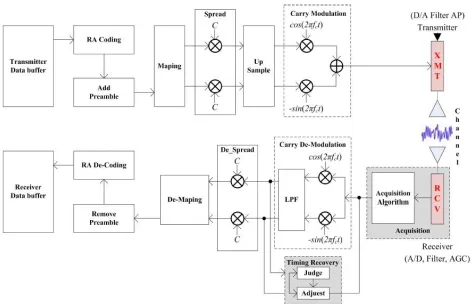
The architecture generally includes some well-known components of any wireless com-munication system, such as channel coding, interleaving, spread, carrier modulation and bandpass filter at the sender respectively. In receiver, signal acquisition, de-spread, carrier de-modulation, channel decoding, bandpass filter, low-pass filter and receiving antenna are included at the receiver. All parts are illustrated in Fig.1.
Fig. 1.The architecture of the low-frequency communication system for WUSNs
useful data. The specific method is depending on the spread scheme and the concrete applications it will be applied to. In order to increase the SNR, doing the correlative calculation before carrier de-modulation is a good choice to get the shot of the useful data, which is also named as MF signal acquisition. Therefore, signal acquisition must be put in front of the carrier de-modulation and de-spread while processing the received data. Besides, we prefer to give a new proposal based on the MF signal acquisition.
The low-frequency communication test platform is presented in Fig.2. It primarily includes a processor [1], field-program gate array (FPGA) [2], ADDA [3] and daughter boards that represent RF front ends of receiver and transceiver. The dominant part of the system is FPGA being responsible for the digital logic implementation of signal process-ing algorithms. Before the test, we download the related signal processprocess-ing algorithms of the whole architecture into the FPGA through the JTAG interface. The signal acquisition is a vital composition while processing the received data. Considering the strong ambient noise in underground channel, it is necessary to adopt the direct sequence spread signal processing method to increase the range frequency spectrum in order to make the SNR as large as possible.
Fig. 2.Hardware platform for WUSNs
4.
Two-step MF Signal Acquisition Method
4.1. Acquisition Rules
As shown in Fig.3, the received signal goes through the MF two times. In the former one, the MF is applied to the whole spread code. The output signal of the filter is proportional to the autocorrelation function (ACF). It is assumed that the ACF has zero value except in the case that the code is completely inside the filter whose value of ACF is one. Then, the outputs of the MF access the comparator. The comparator uses the threshold Th in
a way that the output shows “1” (hit), ifx(t) ≥ Th, and “0” otherwise. Here, x(t) is
the input signal. Thus we can roughly determine the capture point in the first step. Then, set this point as the right endpoint and regard the length of preamble after coding as the interval length. In the second instance, the MF is applied to this interval. Meanwhile, set a higher sampling rate at the matching filter compared to the first step. Comparators are used in both steps. However,Thchanges with the sample rate. Analysis will be shown
in the second subsection. By selecting each of the two-step sampling rates under premise of balance capture accuracy and real-time performance, we can reach an accurate capture point. If the sample rate is low, the false alarmPf u[25] is catastrophic and causes a total
miss of the correct code phase. On the contrary, the higher sample rate will increase the MAT and power consumption. Thus, a proper balance sample rate is a key for two-step.
Fig. 3.The scheme of two-step MF acquisition
4.2. Acquisition Theory and the Threshold Range Model
samples slide through the acquisition window, theKcorrelation values are buffered by the comparator. Comparator selects the maximum value and gives the synchronous position of the corresponding waveform sample.
The sequence of binary digits spread by Gold Coding is a bit streamsg(t)can be
expressed as (1):
sg(t) =c(d(t)) (1)
Here,d(t)∈ {0,1}is the original data bit andc(·)is the Gold sequence expansion. Thus we havesg(t)∈ {0,1}. Assumingsg(t)hasKdigits, the modulated transmitting
signals(t)is defined as (2):
s(t) =<{sg(t)ej2πkt/T} (2)
Here,T represents the transmitted period,k stands for the carrier frequency and<
indicates the real part of a complex number. We assume that the received signal waveform r(t)to be
r(t) =s(t)∗h(t) +N(t)
=
N−1
X
n=0
s(tn)h(t−tn) +N(t)
=
N−1
X
n=0
snh(t−nT−εn) +N(t)
(3)
Whereh(t)is the channel’s impulse response,tn =nT +εn represents then−th
time period,εnis the timing offset for then−thsymbol, andN(t)is Gaussian noise.
We assume thatεnis a random walk, i.e.,εn=ε0+ n−1
P
i=0
υi, whereε0is the initial phase,
υiis an independent random variable with mean to be 0 and variable to beσ2. Thus it is
easy to derive thatεn has mean valueε0, variancenσ2andtnhas mean valuenT +ε0 and variancenσ2, i.e.ε
n˜N(ε0, nσ2)andtn˜N(nT+ε0, nσ2).
The stability of a system is an important property that we have to consider in prac-tical implementations. In this paper, we assume the impulse response is a summation of absolute value, i.e.,
Sh=
∞
X
n=−∞
|h(n)|<∞ (4)
In this condition the outputr(t)is almost bounded. Sinces(t)≤M for someM, we have
r(t)≤M
N−1
X
n=0
|h(t−tn)|+|N(t)|<∞+|N(t)| (5)
progress. That is, there is no frequency change between transmitter and receiver. Denote the sampled signal byrs(t), thus
rs(t) =r(t) (6)
The ideal sampling time to the signal waveformr(t)begins whenr(t)just reached the receiver. However, it is difficult to achieve in practice. It is necessary to design a method of obtain signal’s starting edge before the signal arrival in receiver. Due to the unpredictable noise and phase shift, we have to choose one method to decide the first signal waveform ofr(t). Let the real sampled signals berR(t0),rR(t1),rR(t2),rR(t3),rR(t4),rR(t5),...
. We shall call itl-sample ifrR(tl) =rs(t0)representing the correct signal being sampled
at timel. As sampling of the signal is done beforer(t)arrives at the receiver,rR(tk)is
interfering noise signal whenk < land it isl-sample.
Assume the correct preamble, denoted by P = {p0, p1,· · · , pL−1}, has L digits. Then the data storage matrix, denoted byW ∈Rk×Lwithk≥L, is
W =
r0,0 r0,1 · · · r0,L−1 r1,0 r1,1 · · · r1,L−1
..
. ... . .. ... rk−1,0rk−1,1· · · rk−1,L−1
=
rR(tL−1) rR(tL−2) · · · rR(t0)
rR(tL) rR(tL−1) · · · rR(t1)
..
. ... . .. ... rR(tk+L−2)rR(tk+L−3)· · · rR(tk−1)
(7)
If the sampling isl-sample, the data in the firstl−1rows are all noise signals. To verify the position ofrs(t0), we use the cross-correlation to generatekcross-correlation
values. It is denoted byRW P betweenW andP, i.e.,
RWiP(0) =W(0)∗P(0) =
L−1
X
n=0 ri,npn
=
i−l+1
X
n=0
ri,npn+ L−1
X
n=i−l
N pn
(8)
Since N represents noise signal, we consider it has little influence on this cross-correlation, that is, the expected value ofN pnis very small, more precisely,E(|N pn|)≤
e, whereeis the zeroth order error. Thus,
RWiP(0) =
i−l+1
X
n=0
ri,npn+ (L−i)e
≈
i−l+1
X
n=0
ri,npn= i−l+1
X
k=0
rR(tk)pk
=
i−l+1
X
k=0
[
N−1
X
n=0
snh(t−nT−εn) +N(t)]pk
One may incorrectly conclude that the cross-correlation is non-decreasing with the growth of the quantity of same elements betweenW andP. In fact, all transmitted data moves one step when a time interval increases, which deduces all the pairs of correspond-ing data betweenW andP. They are different from the case in the previous time. The maximum cross-correlation takes place when the exact preambles are totally sampled by the receiver. All of the data from the transmissions keep exactly same with the preambles P. The theoretical maximum (when considering small noise) is derived as below.
ω=maxk
i=0{RWiP(0)}=
k
max
i=0 < Wi, P >≈ kPk2 (10) Here< x, y >represents the inner product on xandy,kxk2 represents Euclidian 2-norm ofx, i.e.,kxk2 = (x2
1+x22+. . .+x2n)
1
2 . However, when noise is strong, the influence of transmitted signal is substantial and the actual maximum cross-correlation will be larger than the theoretical threshold.
Since transmitting signal is interfered by noise, there exists random factors in this model, i.e., the time offsetεn and Gaussian white noiseN(t). To analyze the statistical
properties of the model, we assume the impulse response to be
h(x) =e−x (11) This function has several good properties in probability. We can obtain that the im-pulse response is an absolutely summation we expected for. The results may be different if other impulse response functions are chosen. The impulse response is
h(t−nT−εn) =e−t+nTeεn (12)
Thus the random factor moves to an exponential random variable whose logarithm is normal distribution. This random variable is log-normal distributed in probability. As we mentioned before,εn˜N(ε0,(
√
nσ)2), that is,ε
nis normally distributed with an expected
value ofε0and standard deviation of√nσ. Referring to the log-normal variableeεn, the expected value and variance are
E(eεn) =eε0+12nσ 2
V ar(eεn) =e2ε0+nσ2(enσ2−1)
(13)
We can obtain that the variance increases asnincreases. The other random factor is Gaussian noiseN(t), which is normally distributed with expected value 0 and varianceσg2
at any timet. Consequently, due to the fact that the two random factors are independent, we can combine these two random factors as follows,
σm= q
e2ε0+nσ2(enσ2−1) +σg (14) Furthermore, to verify whether the maximum of cross-correlation does represent all preambles that have been sampled, we introduce a statistical inference approach. The expected theoretical maximum value of cross-correlation iskPk2, the standard deviation isσm. In 95% confidence interval, the value of cross-correlation we calculated should be
in the interval
Ifσmis much smaller thankPk2, the lower boundkPk2−1.96σmis not far from
kPk2. In this case, if all the preambles are sampled, the lower bound can be acted as a pre-setting threshold. However, ifσmis not sufficiently smaller thankPk2or even larger than kPk2, it leads to the lower bound be nearly 0 or negative. In such situation, the lower bound has no practical significance. This lower bound is no longer an appropriate threshold, since signal can be interfered by small noise at any time. Hence, we must keep cross-correlation value beyond the lower bounds. Besides, we can get from (15) that sample rate decides the value ofkPk2. Therefore, although this two-step comparator principle is same, the threshold varies with the changes on sampling rate.
5.
The Numerical Results
We assume the length of the preamble isnbits. After spreading and sampling, the length of preamble isn×K×M. We first add the White Gaussian noise to the sending signal when simulating. Under the circumstance, the higher the defined sampling rate is, the closer location we can find to the acquisition position. If the defined sampling rate is high, the sinusoidal wave form will be more accurately. Meanwhile, the interval of the second step achieves a greater chance of covering the true capture point. However, an extremely high sampling rate leads to resource overhead and time consumption. In a low-frequency underground communications system, transmission power should be as small as possible in order to guarantee the energy supply. This results in a dilemma between accuracy of signal acquisition and resource consumption. It is necessary to balance the sampling rate and resource consumption.
Fig. 4.The relationships among threshold, mismatch rate and SNR
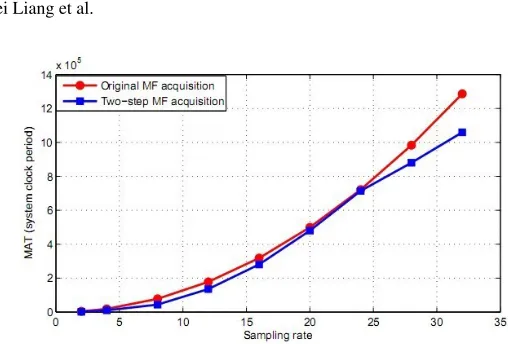
Fig. 5.The relationship among original acquisition and two-step MF acquisition in MAT
When coarse sampling rate is 16 points per period in the first step of two-step MF acquisition, we obtain better results by the new method through a large number of simu-lations. Hence, we suggest to set the maximum coarse sampling rate to be 16 points per period. The result in Fig.5 indicates that when the sampling rate is less than 16, the coarse sampling rate is the previous value in abscissa. For example, if the abscissa value is 12 in Fig.5, the new method of coarse sampling rate is 8. When the sampling rate is greater than 16, the new method of coarse sampling rate is determined as 16. Fig.5 shows that the time consumption of the two methods will go up monotonically with the increasing sampling rate, but the time consumption of the new method will be much less than the original one. According ton-th Lagrange Interpolation Polynomial, ann-th remainder term or bound for the error is presented as
R(x) =f(x)−p(x) =f
(n+1)(ξ(x))
(n+ 1)! (x−x0)(x−x1)· · ·(x−xn) (16)
wheref(x)is an ideal continuous sine function ofL2 space,p(x) is sine function which goes by Lagrange polynomial fitting after sampling, (x0, x1,· · · , xn)aren+ 1
distinct numbers andξ(x)is a number given by the Generalized Rolle’s Theorem, which satisfyingξ(x)∈(a, b). For interpolation sampling theorem,n= 1, that means, use a line connecting two sampling point, then,
R(x) = f
(2)(ξ(x))
2 (x−x0)(x−x1) (17)
We can seef(2)(ξ(x))will influence the variation ofR(x). Sincef(x)is a continuous function,f ∈ Cn, that means,f is n-order differentiability, so |f(2)| < ∞, assuming
max|f(2)|= 2c, then
also decrease and the accuracy increases. Of course, this will remain true as long as both transmitter and receiver clocks are fully synced.
Fig. 6.The relationship among original acquisition and two-step MF acquisition in Gaus-sian noise channel
Fig. 6, Fig.7 and Fig.8 are BERs of the two-step method and the original method in Gaussian noise, Rayleigh noise and impulse noise respectively. In the condition of SNR being -10 and system frequency being 1 KHz, the BER of the two-step method is lower than the original method. After the Matlab simulation, we implement the algorithm by means of hardware logic design using Verilog HDL on the FPGA.
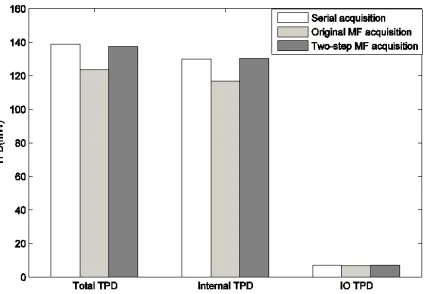
We also analyze the resource consumption by means of hardware logic design using Verilog HDL on the FPGA. We make an evaluation of the resource consumption among this new two-step MF acquisition method, the serial acquisition and original MF acqui-sition, especially the thermal power dissipation (TPD) and the logic elements (LEs) and memory bits, which is indicated in the Fig.9 and Fig.10. From the evaluation results we can conclude that the serial method occupies more resources than others, and the two-step method has a little larger power consumption than the original acquisition method.
6.
Conclusion
Fig. 7. The relationship among original acquisition and two-step MF acquisition in Rayleigh noise channel
Fig. 9.The relationship on the LEs and Memory bits among the serial method, original MF acquisition and two-step MF acquisition method
significantly lower. There is also much future work to be considered, such as: (1) Energy efficiency. More attention will be paid to the energy efficiency on our further research con-sidering high efficient algorithms. (2) The scope of applications. This paper describes the performance of the low-frequency communication system that is applied to underground wireless communication networks (UWCN). This system could also be applied to any other low frequency applications in the future to verify the performance of the acquisition proposed in this paper.
Acknowledgement.This work is supported by the National Nature Science Foundation of China (Grant61572188, 61502405), the Research Project supported by Xiamen University of Technology (YKJ15019R), Xiamen science and technology research project (3502Z20133033), the Science and technology project of the State Planning Commission (WKJ-FJ-35).
References
1. Atmega embedded processors and sigma dsp audio processors, [Online]. Available: http://www.analog.com/en/products/processors-dsp/blackfin.html
2. Cyclone v gx fpgas with 3.125 gbps provide the lowest system cost and power, [Online]. Avail-able: https://www.altera.com/products/fpga/arria-series.html
3. Differential amplifiers from analog devices are highly integrated and optimized for differential signaling applications. adda, [Online]. Available: http://www.analog.com/en/index.html 4. Chau, Y.A., Joe, S.Z.: Parallel acquisition with matched filters for frequency-hopping signals.
In: IEEE 4th International Symposium on Spread Spectrum Techniques and Applications Pro-ceedings. pp. 756–760. IEEE, Mainz, USA (1996)
5. Chaudhary, D.D., Nayse, S.P., Waghmare, L.M.: Application of wireless sensor networks for green house parameters control in precision agriculture. International Journal of Wireless Mo-bile Network 3(1), 140–149 (2011)
6. Davisson, L.D., Flikkema, P.G.: Fast single-element pn acquisition for the tdrss ma system. IEEE Transactions on Communications 36(11), 1226–1235 (1988)
7. Dicarlo, D., Weber, C.: Multiple dwell serial search: performance and application to direct sequence code acquisition. IEEE Transactions on Communications 31(5), 650–659 (2008) 8. Elleithy, A., Liu, G., Elrashidi, A.: Underground wireless sensor network communication using
electromagnetic waves resonates at 2.5 ghz. Journal of Wireless Networking and Communica-tions 2(6), 158–167 (2012)
9. Freitag, L., Stojanovic, M., Singh, S., Johnson, M.: Analysis of channel effects on direct-sequence and frequency-hopped spread-spectrum acoustic communication. IEEE Journal of Oceanic Engineering 26(4), 586–593 (2001)
10. Huang, W., Andonovic, I., Tur, M.: Code acquisition in coherent optical pulse cdma systems utilizing coherent correlation demodulation. IEEE Transactions on Communications 48(4), 611–621 (2000)
11. Jayaweera, S.K., Hakim, K.: A cooperative game theoretic solution for lifetime maximization of wsns in sequential estimation. In: 2010 5th International Conference on Information and Automation for Sustainability (ICIAFs). pp. 233–238. IEEE, Colombo (2010)
12. Jiang, X., Yin, Z., Cui, K., Yin, L., Wu, Z.: Communication performance analysis of tdrs system ma service. In: 2014 12th International Conference on Signal Processing (ICSP). pp. 1659– 1664. IEEE, Hangzhou (2014)
13. Jo, G.D., Chang, S.H., Kweon, H.Y., Kim, S.Y.: A compact matched filter for rapid code ac-quisition. vol. 50, pp. 713 – 717 (1999)
15. Kim, J.Y., Lee, J.H.: Code acquisition of a ds/cdma system with imperfect power control for leo mobile satellite communications. In: IEEE 48th Vehicular Technology Conference. pp. 1543– 1547. IEEE, Ottawa (1998)
16. Kone, C.T., Hafid, A., Boushaba, M.: Performance management of ieee 802.15.4 wireless sen-sor network for precision agriculture. IEEE Sensen-sors Journal 15(10), 5734–5747 (2015) 17. Kong, S.H., Nam, W.: A-gnss sensitivity for parallel acquisition in asynchronous cellular
net-works. IEEE Transactions on Wireless Communications 9(12), 3770–3778 (2010)
18. Li, X., Merrett, G.V., White, N.M.: Energy-efficient data acquisition for accurate signal esti-mation in wireless sensor networks. EURASIP Journal on Wireless Communications and Net-working 13(18), 1–15 (2013)
19. Lin, J., Yin, S., Li, W.: Performance of combined saw convolver/serial-search acquisition for dsss system with single-tone jamming. In: International Conference on Communication Tech-nology Proceedings. pp. 370–374. IEEE, Beijing (1996)
20. Liou, M., Chiueh, T.: A low-power digital matched filter for direct-sequence spread-spectrum signal acquisition. IEEE Journal of Solid-State Circuits 36(6), 933 – 943 (2001)
21. Madhow, U., Pursley, M.B.: Acquisition in direct-sequence spread-spectrum communication networks: An asymptotic analysis. IEEE Transactions on Information Theory 39(3), 903–912 (1993)
22. Mishali, M., Eldar, Y.C., Elron, A.J.: Xampling: Signal acquisition and processing in union of subspaces. IEEE Transactions on Signal Processing 59(10), 4719–4734 (2011)
23. Persson, B., Bolton, R.J.: A segmented matched filter for cdma code synchronization in systems with doppler frequency offset. In: IEEE Global Telecommunications Conference. pp. 648–653. IEEE, San Antonio (2001)
24. Puska, H., Sarnisaari, H., Iinatti, J., Lilj, P.: Serial search code acquisition using smart antennas with single correlator or matched filter. IEEE Transactions on Communications 56(2), 299–308 (2008)
25. Renzo, M.D., Annoni, L., Graziosi, F., Santucci, F.: A novel class of algorithms for timing acquisition of differential transmitted reference uwb receivers: Architecture, performance anal-ysis and system design. IEEE Transactions on Wireless Communications 7(6), 2368–2387 (2008)
26. Sartipi, M., Fletcher, R.: Energy-efficient data acquisition in wireless sensor networks using compressed sensing. In: Data Compression Conference. pp. 223–232. IEEE, Snowbird (2011) 27. Sun, Z., Akyildi, I.F.: Magnetic induction communications for wireless underground sensor
networks. IEEE Transactions on Antenna and Propagation 58(7), 2426–2435 (2010)
28. Tiansi, H., Yunsi, F.: Qelar: A machine-learning-based adaptive routing protocol for energy-efficient and lifetime extended underwater sensor networks. IEEE Transactions on Mobile Computing 9(6), 796–809 (2010)
29. Yamada, M., Kamio, Y., Wada, Y.: Acquisition of direct-sequence spread-spectrum signal with parallel matched filters. In: IEEE International Symposium on Personal, Indoor and Mobile Radio Communications. pp. 1260–1264. IEEE, London (2000)
30. Yang, J., Zhang, C., Li, X., Huang, Y., Fu, S., Acevado, M.F.: Integration of wireless sensor networks in environmental monitoring cyber infrastructure. Wireless Networks archive 16(4), 1091–1108 (2010)
31. Yen, N.Y., Su, S.L.: Robust matched-filter acquisition for direct-sequence ultrawideband sys-tems. IEEE Transactions on Vehicular Technology 58(8), 4419 – 4425 (2009)
Yong Xiereceived his BE in computer science and technology from Hunan University of Science and Technology, China, in 2007, and PhD in computing science from Hunan University, China, in 2013. His research interests include real-time embedded systems, intellectual property protection, field programmable gate arrays, wireless sensor networks. Dr. Xie is the corresponding author of this paper.
Xuhui Chenreceived his PHD in computing science from Xi’an Jiaotong University, China, in 2003. He is currently a Professor in department of Software Engineering, Xia-men University of Technology, China. His current research interests include steganogra-phy, real-time embedded systems and field programmable gate arrays.
Osama Hosamreceived his PHD in computer science and technology from Hunan Uni-versity of Science and Technology, China, in 2011. He is currently a assistant Profes-sor College of the Computer Science and Engineering at Taibah University, Egypt. His research interests include real-time embedded systems, intellectual property protection, field programmable gate arrays, image watermarking.
Xiaoyan Chenreceived her MS in Department of Software Engineering from the Xiamen University, China, in 2012. His current research interests include real-time embedded systems, intellectual property protection, and field programmable gate arrays.