Received: 16 Sep 2013, Revised: 23 Oct 2013, Accepted: 15 Dec 2013, Available online: 15 Jan 2014
1 Department of Nursing Education, Abhar School of Nursing, Zanjan University of Medical Sciences, Zanjan, Iran
*Corresponding Author: Nasrin Masoumi, Department of Nursing Education, Abhar School of Nursing, Zanjan University of Medical Sciences, Zanjan, Iran
Comparison of the Attitudes of Second and Fourth Year
Nursing Students towards Hospitalized Elderly
Fatemeh Shojaei1, Nasrin Masoumi1*
Introduction
Successful implementation of family planning, expansion of primary health care, improving economic and social conditions, and the emergence of new prevention, diagnosis, and treatment technologies of diseases has increased the population of people 60 years and older and these people as defined by the World Health Organization are called the elderly (1). There are 600 million elderly worldwide aged 60 years and above and this
figure will double by 2025. The current elderly population in Iran is 4 million 500 thousand people and it is expected that by the year 1400 it will reach 9 million people (2). If life continues in Iran in the current state, around the year 1410 there will be a burst of elderly population growth and between 25 to 30% of the population will be older than 50 years (3). Therefore, with the increasing number of elderly, providing skilled and experienced healthcare in many areas related to the elderly appears to be
Open Access
Original Article
Abstract
Objective:The aim of this study was to compare the attitude of second and fourth year nursing students
towards the elderly hospitalized in training hospitals of Zanjan University of Medical Sciences, Iran. With regard to the change of attitude from second year to fourth year, strategies for health promotion, better service for the hospitalized elderly, and different trainings for nursing students were offered.
Materials and Methods: This was a cross-sectional study. The subjects were selected by census and
included 57 second-year nursing students and 33 fourth-year students of Zanjan University of Medical Sciences. Data collection tool consisted of a questionnaire including two parts. The first part included questions about general and demographical characteristics, and the second part contained McLafferty’s attitude towards the elderly questionnaire.
Results: Despite the more positive attitude of the fourth year students toward caring for the elderly compared with the second year students, there was no significant difference between the two groups. Based on the findings and in examining the effects of multiple variables on the attitude of students, multiple regression model was used. The final model showed that education site (P < 0.039), gender (P < 0.052), age (P < 0.057), and experience in working with elderly (P < 0.057) (close to the significance level) can be predictors of the attitudes of students towards the elderly.
Conclusion: The results confirmed that the formal education struggled to make changes in the students’
attitude towards the elderly during their second year to fourth year. Due to the existence of a neutral attitude in the second and fourth year students and the lack of difference in attitude between the two groups, to improve and create a positive attitude towards the elderly, more educational opportunities for nursing students should be created. Professors and students, while increasing their knowledge about aging processes, should define appropriate care models for the elderly and help them along with the students.
Keywords: Attitude, Elderly, Nursing Students
Crescent Journal of Medical and Biological Sciences
Vol. 1, No. 1, Winter 2014, 13-17
necessary. Doctors and nurses play a pivotal role in providing care for the elderly. Therefore, nurses, as part of the health care system, play a crucial role in improving the quality of care for the elderly (4). McKinlay and Cowans also believe that due to the increasing number of elderly, care of the elderly will be an important part of the nurses duty (5). Results of some studies have shown that nurses, compared with other groups, have lower knowledge and more negative attitudes towards the elderly and were more anxious and expressed less confidence in connection with the elderly (6). Moreover, previous research suggested that there is much negative attitude toward the elderly among nursing students and these attitudes are based on myths and stereotypes which cause a lack of understanding of the aging process and energy of the elderly (4).
Based on researches, the features of students most effective on their attitude towards the elderly include age, gender, experience of dealing with or living with the elderly, higher education, tendency to work with the elderly, and education on aging. It was also stated that students who had initial clinical experience in nursing homes had more positive feelings towards the elderly. Numerous studies have demonstrated that as students spend more time and become older and closer to the final year of their studies their interest to work with the elderly is decreased (7). Most of the international studies had also shown more negative attitudes than positive attitudes (8).
There is no doubt that negative attitudes have potentially significant impact on the professional
competence and quality of providing care.
Furthermore, it causes the students not to choose caring for the elderly as their area of work and this eliminates the key role of nurses in elderly care (9). Thus, it seems that evaluation of nursing students' attitudes towards the hospitalized elderly can be a step in planning to train nurses who understand the needs of the elderly and can provide quality care to this vulnerable group (10). Therefore, this study aimed to compare the attitude of the second and
fourth year nursing students towards the
hospitalized elderly, and also detect the process of change of their attitude from the second year to the fourth year. Moreover, it aimed to provide valuable recommendations in the area of elderly nursing education for the teachers and administrators of nursing, and thereby, take a positive step towards the recovery of elderly patients.
Materials and Methods
This was a cross-sectional study. The study population consisted of all second and fourth year nursing students of Zanjan University of Medical Sciences and Islamic Azad University of Abhar, Iran. Census sampling was performed on the second and fourth year students in nursing schools of these two universities. Data collection tool was a questionnaire that consisted of two parts. The first part included general questions and demographic characteristics
such as age, gender, education, semester, experience working with the elderly, having an elderly in the family, having a friendly relationship with the elderly, the relation with the elderly, the elderly’s age, and willingness to work with the elderly after graduation. The second part of the questionnaire included the Nursing Attitudes toward Older Adults Questionnaire that was designed by Isabella McLafferty in 2005. This tool consisted of 30 questions on a 5-point Likert scale and the answers ranged from completely agree to completely disagree. In each question the most positive attitude will score 5 points and the answer that showed the most negative attitude would score 1 point. In 18 questions (1-5-8-10-11-12-13-15-19-21-22-23-24-26-27-28-29-30) the option of totally agree showed the most positive
attitude and in the other 12 questions
(2-3-4-6-7-9-14-16-17-18-20-25) the questions were negative and the option of totally agree scored 1 point. Each unit of the study, based on the responses to the questionnaire options, had the possibility of achieving a score between 30 (most negative attitudes) to 150 (most positive attitudes). Overall scores of 30-69.9 signified negative attitude, 70-109.9 neutral attitude, and 110-150 positive attitude. This tool, after being translated by a person fluent in English, was handed to 10 faculty members for determination of scientific validity. In addition, to determine the reliability of the tool, Cronbach's alpha was used. The data collected was analyzed by SPSS for Windows (version 19, SPSS Inc., Chicago, IL, USA).
Results
(close to the significance level) can be the predicting factors associated with students’ attitude towards the elderly.
Discussion
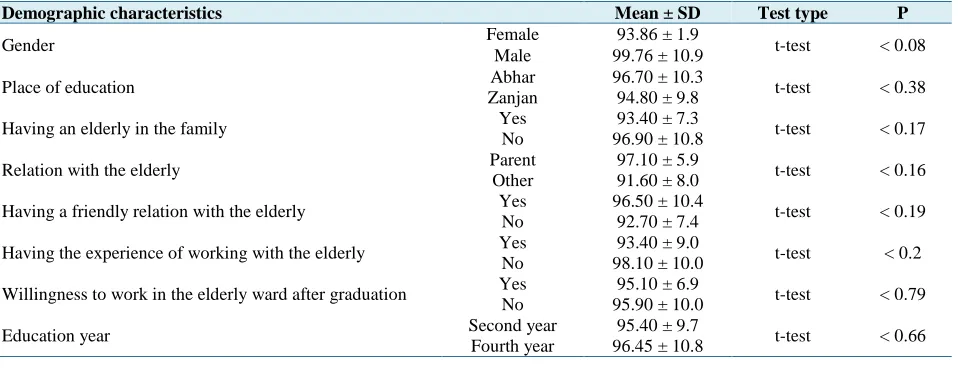
Based on the findings of this study, although the mean attitude of fourth year students was slightly higher than the second year students, this difference was not statistically significant (P < 0.66). The majority of second year students (93%) and fourth year students (84.4%) had a neutral attitude towards the elderly. In both years there was a lack of negative attitude towards the elderly.
According to the results, it appeared that taking courses on aging at the university and further experience in clinical care of elderly did not have a special effect on improving students’ attitudes towards the elderly. In addition, fourth year students, who had passed their theory and practical modules and were at the end of their practical and theoretical studies, had no significant difference regarding attitude with the second year students, who had little care experience. This may be related to the credits that have been passed at university without performance. On the other hand, a review of the nursing education program approved by the Department of Health showed that there were no particular theoretical courses in the field of aging and gaining knowledge about the aging processes and their required care in the undergraduate program. However, in terms of medical and surgical courses, it was required to emphasize on each of the geriatric concepts and special care for the elderly. Now the question is, whether teachers have the time or motivation to focus on the implications of aging, with the heavy volume of the theoretical courses and the limited training hours. There is also the question of whether care for different diseases and emphasis on geriatric care taught by professors. Surely, the answer to these questions needs further study, but the results of this study confirmed that the formal education program struggled to change the attitudes of students
towards the elderly during the second to fourth years of their studies. The results of a survey by Shahidi and Toktam Jannesari on the effects of education on students’ attitudes toward the elderly showed no difference between the attitude of chemistry students and nursing students toward the elderly (11). Furthermore, contrary to expectations, the trained students had a more negative attitude regarding elderly than the other two groups. They also questioned the role of formal education for specialists by relaying on the results of his research, and suggested that the content of nursing courses in the field of aging should be examined more carefully (11). However, some researches within and outside the country were inconsistent with the present research, in which senior students had a more positive attitude compared to the freshmen students (12-16). In the study by Sung, the difference in attitudes toward the elderly was not significant between the first and third year students; however, the mean score of third year students was higher (17). Moreover, in the study by Shen and Dongxia, freshmen students had better attitude towards the elderly compared to third year students (18).
Conclusion
Due to the existence of a neutral attitude in the second and fourth year students and the lack of difference in attitudes of the two groups, more training opportunities should be established for nursing students regarding the promotion and development of positive attitudes towards the elderly. In addition, special efforts are needed to change the attitudes of the students towards the elderly. Teachers and students, while increasing their knowledge about aging processes should define appropriate care models for the elderly and help them alongside the students. Positive attitude toward older people is obtained through interaction with professors and experts, learning about the natural changes due to aging, and direct contact with the healthy or sick elderly (19). Students’ positive
Table 1. Comparison of the mean and standard deviation of attitude of the subjects in terms of demographic
variables
Demographic characteristics Mean ± SD Test type P
Gender Female 93.86 ± 1.9 t-test < 0.08
Male 99.76 ± 10.9
Place of education Abhar 96.70 ± 10.3 t-test < 0.38
Zanjan 94.80 ± 9.8
Having an elderly in the family Yes 93.40 ± 7.3 t-test < 0.17
No 96.90 ± 10.8
Relation with the elderly Parent 97.10 ± 5.9 t-test < 0.16
Other 91.60 ± 8.0
Having a friendly relation with the elderly Yes 96.50 ± 10.4 t-test < 0.19
No 92.70 ± 7.4
Having the experience of working with the elderly Yes 93.40 ± 9.0 t-test < 0.2 No 98.10 ± 10.0
Willingness to work in the elderly ward after graduation Yes 95.10 ± 6.9 t-test < 0.79 No 95.90 ± 10.0
Education year Second year 95.40 ± 9.7 t-test < 0.66
attitudes towards older people are affected by the content of courses and curriculum. Therefore, a review of the theoretical content of nursing education and clinical training should take place in order to enable students to communicate more effectively with healthy or sick elderly during their trainings and clinical courses. The more nursing student are in connection with the elderly and work in the elderly units, the more their interest and positive attitude towards working with older adults will increase (14,20-23). Attitudes are usually obtained through social learning and processes such as observing colleagues and professors during providing care for the elderly (19). Therefore, faculty members and nurses have an advantageous position in influencing the development related to the elderly, because in addition to the expansion of knowledge in this area they can act as a positive role model in this area (24). Clinical teaching policymakers can use culture as a rich resource for improving students attitudes towards the elderly (18). On the other hand, religious orientation also influences their attitudes towards the elderly (12,25,26). Islam is the religion of most Iranian people and respecting the elderly has been advised in Islam. Allah says in the Quran Kareem: “And your Lord has decreed that you not worship except Him, and to parents, good treatment. Whether one or both of them reach old age [while] with you, say not to them [so much as], "uff," and do not repel them but speak to them a noble word. And lower to them the wing of humility out of mercy and say, "My Lord, have mercy upon them as they brought me up [when I was] small"(27). Therefore, religious doctrine and texts can be used to help change students attitudes towards the elderly.
Limitations and recommendations for future research
Given that this research was carried out in the nursing school of Zanjan University of Medical Sciences, the number of samples was small. Perhaps with a larger sample size in different universities better and different results can be achieved. Furthermore, given that only the attitudes of the second and fourth year students were compared, the results may not be generalizable to all students. This study was a cross-sectional study; thus, it is
recommended that another study using a
longitudinal approach be conducted on the attitude of students in different years of study (freshmen students to senior students). This study was conducted on nursing students and it is also recommended to perform further surveys on other medical and paramedical students (psychologists, physicians, social workers, and physiotherapists).
Ethical issues
The study was approved by the Ethics Committee of Zanjan University of Medical Sciences.
Conflict of interests
We declare that we have no conflict of interests.
Acknowledgments
We would like to thank all of our colleagues who helped us in this study.
References
1. Malek Afzali H, Baradaran Eftekhary M, Hejazi F, Khojasteh T, Tabrizi R, Faridi T. Social mobilization for health promotion in the elderly. Hakim Res J 2007; 9: 1-6. [In Persian].
2. Mohammadi Zeydie E, Khalaj M, Naghizadeh Jahromi M. Quality of life assessment elderly people that experiencing low back pain. Salmand Iran J Ageing 2007; 1: 119-24. [In Persian]. 3. Nejati V, Ashayeri H. Health Related Quality of
Life in the Elderly in Kashan. Iran J Psychiatry Clin Psychol 2008; 14: 56-61. [In Persian]. 4. Tierney AJ, Lewis SJ, Vallis J. Nurses' knowledge
and attitudes towards older patients admitted to acute orthopaedic wards. Journal of Orthopaedic Nursing 1998; 2: 67-75.
5. McKinlay A, Cowan S. Student nurses' attitudes towards working with older patients. J Adv Nurs 2003; 43: 298-309.
6. Wells Y, Foreman P, Gething L, Petralia W. Nurses' attitudes toward aging and older adults-examining attitudes and practices among health services providers in Australia. J Gerontol Nurs 2004; 30: 5-13.
7. Soderhamn O, Lindencrona C, Gustavsson SM. Attitudes toward older people among nursing students and registered nurses in Sweden. Nurse Educ Today 2001; 21: 225-9.
8. Burbank PM, Dowling-Castronovo A, Crowther MR, Capezuti EA. Improving knowledge and attitudes toward older adults through innovative educational strategies. J Prof Nurs 2006; 22: 91-7.
9. Hosseini Seresht A, Nasiri Ziba F, Kermani A, Hosseini F. Assesment of Nursing Students and Clinial Nurses' Attitude Toward Elderly Care. Iran J Nurs 2006; 19: 57-67. [In Persian].
10. Askaryzade Mahani M, Arab M,
Mohammadalizade S , Haghdoost A. Staff Nurses Knowledge of Aging Process and Their Attitude toward Elder People. Iran J Nurs 2008; 21: 19-27. [In Persian].
11. Shahidi Sh, Toktam Jannesari N. Effects of formal training on students' attitudes toward the aged.
Psychological Reaserch 2003; 7: 78-92.
[In Persian].
12. Hweidi IM, Al-Obeisat SM. Jordanian nursing students' attitudes toward the elderly. Nurse Educ Today 2006; 26: 23-30.
13. Usta YY, Demir Y, Yonder M, Yildiz A. Nursing students' attitudes toward ageism in Turkey. Arch Gerontol Geriatr 2012; 54: 90-3.
15. Wilkinson TJ, Gower S, Sainsbury R. The earlier, the better: the effect of early community contact on the attitudes of medical students to older people. Med Educ 2002; 36: 540-2.
16. Lambrinou E, Sourtzi P, Kalokerinou A, Lemonidou C. Attitudes and knowledge of the Greek nursing students towards older people. Nurse Educ Today 2009; 29: 617-22.
17. Sung Kt. Elder respect: exploration of ideals and forms in East Asia. Journal of Aging Studies 2001; 15: 13-26.
18. Shen J, Xiao LD. Factors affecting nursing students' intention to work with older people in China. Nurse Educ Today 2012; 32: 219-23. 19. Goncalves DC, Guedes J, Fonseca AM, Pinto FC,
Martin I, Byrne GJ, et al. Attitudes, knowledge, and interest: preparing university students to work in an aging world. Int Psychogeriatr 2011; 23: 315-21.
20. Fitzgerald JT, Wray LA, Halter JB, Williams BC,
Supiano MA. Relating medical students'
knowledge, attitudes, and experience to an interest in geriatric medicine. Gerontologist 2003; 43(6): 849-55.
21. Cheong SK, Wong TY, Koh GC. Attitudes towards the elderly among Singapore medical students. Ann Acad Med Singapore 2009; 38: 857-61. 22. Duque G, Gold S, Bergman H. Early clinical
exposure to geriatric medicine in second-year medical school students--the McGill experience. J Am Geriatr Soc 2003; 51: 544-8.
23. Shahidi S, Devlen J. Medical students' attitudes to and knowledge of the aged. Med Educ 1993; 27: 286-8.
24. Ferrario CG, Freeman FJ, Nellett G, Scheel J. Changing Nursing Students' Attitudes About Aging: An Argument For The Successful Aging Paradigm. Educational Gerontology 2007; 34: 51-66.
25. Levine B, Cravin R. Physiologic adaptation with aging (cardiac nursing). 15th ed. Philadelphia,
PA: Lippincott Williams & Wilkins; 2005. p. 220-6.
26. Karsheki H, Gravand H. The role of Religious Orientation on attitude toward elderly people. Proceedings of the International Congress on Culture and Religious; 2011 May 14-16; Tehran, Iran.
27. The Holy Quran Sura Al-Isra. Verse 23-24.
Citation: Shojaei F, Masoumi N. Comparison of the Attitudes of Second and Fourth Year Nursing Students