© 2019 Scholars Academic Journal of Biosciences | Published by SAS Publishers, India 220
Scholars Academic Journal of Biosciences
Abbreviated Key Title: Sch Acad J Biosci
ISSN 2347-9515 (Print) | ISSN 2321-6883 (Online) Journal homepage:http://saspublisher.com/sajb/
Structural and Functional Characterization of a Unique Hypothetical Protein
(Wp_000373624.1) Of Shigella Flexneri: A Computational Approach
Syeda Fatima Nadeem1, Faheem Uz Zaman Kamboh2*, Syeda Saleha Nadeem3, Shahbaz Tariq4
1,4MPhil Scholar, Government College University, Lahore, Pakistan 2MPhil Scholar, Forman Christan College, Lahore, Pakistan 3DPT, Gulab Devi Chest Hospital, Lahore, Pakistan
*Corresponding author: Faheem Uz Zaman Kamboh | Received: 02.05.2019 | Accepted: 10.05.2019 | Published: 19.05.2019
DOI:10.21276/sajb.2019.7.5.1
Abstract
Original Research Article
Shigella is one of the most common reason for morbidity and mortality all through the world, causing around 125 million Shigellosis per year and an expected 14,000 deaths, generally among children‟s of <5 years of age. Bacillary dysentery, a very common bowl disease is caused by Shigella flexneri. The hypothetical protein of Shigella flexneri (>WP_000373624.1) was taken and analyzed for the determination of its molecular and structural characteristics. Additionally, we attempt to forecast a worthy model of >WP_000373624.1 by utilizing in silico techniques related to protein homology and prediction of active sites to develop effective treatment against Shigella flexneri. Pyre2 software was used for the 3D structural analysis through homology modeling. The functional annotation was also performed by CDD Blast. This in silico hypothetical protein analysis can be additionally exploited in molecular drug strategy for other clinically important pathogens.
Keywords: Bacillary dysentery, Hypothetical protein, CDD Blast, Shigellosis.
Copyright @ 2019: This is an open-access article distributed under the terms of the Creative Commons Attribution license which permits unrestricted use, distribution, and reproduction in any medium for non-commercial use (NonCommercial, or CC-BY-NC) provided the original author and source are credited
I
NTRODUCTION
The innovation of the genomics field particularly subsequent generation sequencing logical strategies is being achieved by the gathering of huge quantity of gene sequencing attained from distinctive microbial strains [1-3]. In spite of the fact that about half of the total genes inside a genome are grouped in the classification of 'hypothetical', 'conserved' or 'unknown' or the 'orphans‟ genes, obliging our perception of the pathogenicity of the different types of microbes [4, 5], the genome sequence of Shigella flexneri is available in the NCBI database.
Nucleic acid predicted sequences are termed as hypothetical proteins. Human‟s proteomes is characterized by huge percentage of hypothetical proteins [6]. Various ways for the prediction of protein functions are developed by many researchers which can be achieved from the data derived from structure similarity, interaction between proteins, interactions between protein and ligand, similarity of the active sites, region of phosphorylation, gene expression etc. Though, the traditional method of the assuming function of protein lies on the similarity of the sequence using software‟s such as BLAST [7], FASTA [8]. There is no chemical existence of hypothetical protein and are
predicted through nucleic acid sequences. Furthermore, these proteins are considered to be of low identity to be recognized as annotated proteins. Hypothetical proteins are not recognized and described at chemical level, however they represents a large portion in the sequenced microbial genomes [9]. Two classes of the hypothetical protein are known to exist. Of which one class is the class of uncharacterized family whereas the additional class is the class of domains having un-known function. There is no linkage between an unknown protein and a known gene as confirmed through experimental techniques.
There are many benefits on analyzing the protein which have no known function including 3D conformational structure which makes it happens to asses new domains and subjects, protein pathways and cascades. Pharmacological targets may also be offered through these new domains.
Numerous proteins have obscure functions; though, these protein domains contribute in the metabolism of the microbes and may results in contrary effects. Occasionally the protein function may change because of transformations, for example, insertion, substitutions and deletions of amino acids [10]. The principle target of the research is to recognize a protein
Syeda Fatima Nadeem et al., Sch Acad J Biosci, May, 2019; 7(5): 220–227
© 2019 Scholars Academic Journal of Biosciences | Published by SAS Publishers, India 221 domain whose function is un-known and to predict its
classification utilizing bioinformatics softwares. This examination will end up being valuable in indulgent to the mechanism involved in bacteria; helpful to the detection of new medications and could fundamentally affect infection control and antibody advancement methodologies.
Shigella is one of the most common reason for morbidity and mortality all through the world, causing around 125 million Shigellosis per year and an expected 14,000 deaths, generally among children‟s of <5 years of age [11]. In the United States, Shigella is the 3rd most common reasons for gastroenteritis, with no less than 500,000 cases of shigellosis connected diarrheal occasions in the USA yearly. General side effects of shigellosis includes bloody diarrhea, queasiness, and tenesmus (torment in the gut), whereas complications include post-disease joint inflammation, sepsis, seizures and hemolytic-uremic disorder. The two principle courses of transmission include (i) through contaminated food, and (ii) water tainted with human waste; Shigella is effectively transmitted through human contact because of its low irresistible dose of 10±200 cells.
Shigella flexneri, intracellular pathogen, is the major cause of bowl disease “bacillary dysentery” in people [12]. The infection is described by bacterial intrusion of the duodenal cells, direct spread from one cell to other by scattering inside the epithelium of the large intestine and also the inflammation of the intestinal mucosa. The disease spread procedure fundamentally depends on the assembly of the actin at the bacterial shaft, which moves the bacteria all through the cytoplasm of the infected cell. Polar actin get together is upheld by polar articulation of the bacterial auto transporter relative IcsA, which selects the N-WASP/ARP2/3 actin gathering machinery. As motile microscopic organisms experience cell to cell interactions, they form plasma film distensions that venture into neighboring cells [13].
The experimental ways to deal with allocating the function and also of prediction of three dimensional structures of non-characterized proteins are arduous but costly as well. "In silico" characterization that consolidates the utilization of numerous databases and calculations is another option, and we utilized this methodology in this study. The in silico techniques are outlined based on trial results and writing reports proposing their effective applicability [14, 15]. In this article, the hypothetical protein of Shigella flexneri (>WP_000373624.1) was taken and analyzed for the determination of its molecular and structural properties. Additionally, we attempt to forecast a worthy model of >WP_000373624.1 by utilizing in silico techniques related to protein homology and prediction of active sites to develop effective treatment against Shigella flexneri.
M
ATERIAL AND
M
ETHODS
Sequence retrieval
The unknown proteins were looked in NCBI, protein database, by means of keywords, ''hypothetical protein,'' and then the subsequent hits were arbitrarily chosen to contemplate the close relative protein by exploiting the program „blast‟. To foresee the purpose of inquiry protein, a similar exploration was done by utilizing „NCBI blast‟ to distinguish proteins that might have auxiliary resemblance with that of the theoretical protein. Shigella flexneri was retrieved for annotation from website (http: //www.ncbi.nlm.nih. gov/) for the analysis of various properties including physiochemical properties, functional and structural properties.
Physicochemical classification of the unknown protein
The theoretical protein in crude categorization design was assessed for the physicochemical cataloging utilizing the „ProtParam‟ online software [16]. The properties figured by the software comprise the sub-atomic weight, hypothetical isoelectric point (pI), composition of amino-acids, grand average of hydropathicity (GRAVY), the coefficient of extinction, instability index and the aliphatic index. The coefficient of extinction shows the quantity of light absorbed by a certain protein at a specific wave-length. The instability catalog gives a gauge of the strength of a certain protein. Whereas the instability index of less than 40 is interpreted to be steady whereas above 40 is predicted to be unstable. The side chain amino acids possess some relative volume which is characterized through the aliphatic index. The GRAVY of a protein is ascertained as the entirety of the hydropathy estimations of the greater part of the amino acids separated by quantity of deposits in the arrangement [17].
Subcellular localization
Syeda Fatima Nadeem et al., Sch Acad J Biosci, May, 2019; 7(5): 220–227
© 2019 Scholars Academic Journal of Biosciences | Published by SAS Publishers, India 222
Fig-1: Representation of the different steps involved in annotation of hypothetical proteins
Homology modelling
The three dimensional protein structures can give exact data about in what way proteins associate and restrict in its steady structure. Without test points of interest of the three dimensional structure, homology displaying is the absolute most encouraging technique for 3D structure prediction. Different online web servers are accessible for structural demonstration of protein [20-22]. Regardless of insignificant change, one essential phase that is common to all demonstrating softwares is to predict the best-match tentatively demonstrated layout.
Virulence factor analysis
Virulent factor assumes to be a vital part in drug target prediction. It provides a portrayal about more dynamic proteins which play vital parts for pathogens survival. VICMPred software [23] and VirulentPred software [24] were utilized for the investigation of virulence. The VICMPred permits the expectation based on three diverse methodologies, i.e., designs based; designs based and composition of amino acids; designs based, amino acid sequence and dipeptide structure. For this situation, we have chosen design based approach. The software virulentPred provides a more precise prediction of virulence when contrasted with VICMPred [25].
SOSUI server
SOSUI software determines that the hypothetical protein is a cytoplasmic protein or a membrane protein and also segregates insoluble proteins from the soluble ones. This software utilizes four physio chemical characteristics, the hydropathy index, the length of every single sequence, an amphiphilic index and a record of amino acid charges. The outcomes of proteins which are forecast of trans-membrane helices for the membrane proteins, a helical turn and graph of the hydropathy plot [10, 26]
P
ROTEIN
F
UNCTION
A
NALYSIS
Proteins are divided into families and superfamily based on their function, structure and amino acid sequence by different protein classification software‟s like CATH, SCOP, CDD BLAST and so on. In view of amino acid sequence similarity, CDD-Blast database was utilized to foresee the protein function [27]. This approach was utilized using different software‟s including RPSBLAST, an altered form of PSI-BLAST, to rapidly check an arrangement of predetermined position-particular scoring matrices with a hypothetical protein.
R
ESULTS AND
D
ISCUSSION
The database was sought with the word 'Hypothetical protein', which brought about millions of records that were illustrative of numerous species. To decrease the amounts, 'Shigella flexneri' was utilized to sieve the results, and 127494 passages were appeared. From the outcomes, every unknown protein grouping with greater than 190 amino-acids were arbitrarily chosen and subjected to NCBI blastp investigation to get the preparatory information. From the outcome, the protein sequence of >WP_000373624.1 was chosen to predict its various useful and structural characteristics utilizing different computational techniques. The fasta classification of the selected protein is given underneath.
>WP_000373624.1 MULTISPECIES: hypothetical protein [Bacteria]
MDRFPRSDSIVQPRAGLQTYMAQVYGWMTVGL LLTAFVAWYAANSAAVMELLFTNRVFLIGLIIAQ LALVIVLSAMIQKLSAGVTTMLFMLYSALTGLTL SSIFIVYTAASIASTFVVTAGMFGAMSLYGYTTKR DLSGFGNMLFMALIGIVLASLVNFWLKSEALMW AVTYIGVIVFVGLTAYDTQKLKNMGEQIDTRDTS NLRKYSILGALTLYLDFINLFLMLLRIFGNRR
Syeda Fatima Nadeem et al., Sch Acad J Biosci, May, 2019; 7(5): 220–227
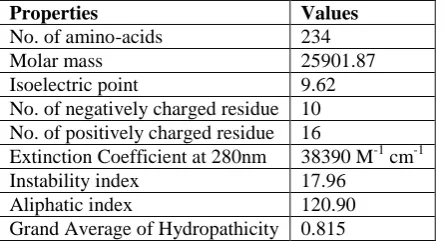
© 2019 Scholars Academic Journal of Biosciences | Published by SAS Publishers, India 223 amino acid was 234 and the molecular weight was
25901.87. Isoelectric point was 9.62. The predicted isoelectric point will be helpful as solvency is least and in an electric field movement is zero at this point. In addition proteins end up stable and conservative at isoelectric pH, thus registered isoelectric point will be beneficial for building up a buffer system for filtration by isoelectric focusing strategy. The extinction coefficient at 280nm was 38390 M-1 cm-1 figured by Expasy's Protparam. The quantitative investigation of protein to protein and protein to ligand connections could be possible by utilizing this figured extinction coefficients [28]. The instability index was observed to be 17.96 which showed that the protein is stable. The
aliphatic index is the comparative size of a protein possessed by aliphatic side chains which influence a positive aspect in rasing the thermostability of a globular protein. The AI for the HP is 120.90. The proteins with high aliphatic index may indicate steadiness in a wide temperature whereas proteins will low AI index are not thermally stable and show greater adaptability [29]. The GRAVY of hypothetical protein is -0.815. Normal range of GRAVY is from negatige 0.103 to negative 0.874. The enhanced collaboration of protein and water happens at a lower GRAVY. The GRAVY result is calculated by dividing hydropathy of aminoacids by the residues of aminoacids [30].
Table-1: Physicochemical properties of hypothetical protein Properties Values
No. of amino-acids 234
Molar mass 25901.87
Isoelectric point 9.62
No. of negatively charged residue 10 No. of positively charged residue 16
Extinction Coefficient at 280nm 38390 M-1 cm-1
Instability index 17.96
Aliphatic index 120.90
Grand Average of Hydropathicity 0.815
Determining localization of the query proteins can provide data about their cell function. This data could be used in considering mechanism of disease and drug production. It was examined by CELLO and validated by PSORTb version 3.0 [18]. The prediction of the sub-cellular localization of the HP was of cytoplasmic locale. The subcellular localization commended that the inquiry protein was restricted in the
cytoplasmic locale with a relating P-estimation of 10.0. There are a few reports showing that cytoplasmic proteins are associated with metabolic pathways and act about as pharmacological medication target [31, 32]. The outcome of PSORTb is illustrated in Table 3 which recommends the reasonableness of the hypothetical protein as drug target.
Table-2: The sub-cellular localization likelihood of the hypothetical protein of Shigella flexneri using software PSORTb
SUBCELLULAR LOCALIZATION SCORES
Cytoplasmic 10.0
Extracellular 0.00
Outer Membrane 0.00
Periplasmic 0.00
Cytoplasmic Membrane 0.00
FINAL PREDICTION
Cytoplasmic 10.0
3D structure of proteins gives essential bits of knowledge about the molecular function and in this way allows a successful outline of analyses. Homology demonstrating of the chosen hypothetical protein was performed by utilizing Phyre2 keeping in mind the end goal to get 3D structure. The model obtained is given in figure 2. Furthermore, secondary structure and protein disorder were anticipated through phyre2. It was anticipated that secondary structure hypothetical protein model dimensions includes X=38.644 Y=56.551
Syeda Fatima Nadeem et al., Sch Acad J Biosci, May, 2019; 7(5): 220–227
© 2019 Scholars Academic Journal of Biosciences | Published by SAS Publishers, India 224
Fig-2: 3D structure of Hypothetical protein
Fig-3: Transmembrane helical structure
Fig-4: Secondary structure and disorder prediction
VICMPred and VirulentPred was used to depict the virulence of the query protein >WP_000373624.1 [Shigella flexneri]. Determining the sequence of the bacterial virulent protein gives suggestions regarding the characterization and identifications of the factors involved in virulence and thus helps in discovering novel
Syeda Fatima Nadeem et al., Sch Acad J Biosci, May, 2019; 7(5): 220–227
© 2019 Scholars Academic Journal of Biosciences | Published by SAS Publishers, India 225
Table-3
SCORES OF DIFFERENT FUNCTIONAL CLASS
FUNCTION SCORES
Cellular process 0.67641024
Information Molecule -6.2709436
Metabolism 0.99949743
Virulence factors -0.66713171
The SOSUI server is used for the segregation of the membrane bound proteins and cytoplasmic proteins along with the determination of transmembrane helices, in which the accurateness of arrangement of the proteins were 99%, whereas the predicted value for trans-membrane helix was 97% [26]. The server SOSUI
is accessible on site:
http://www.tuat.ac.jp/~mitaku/sosui/. In this study the results of SOSUI server proposes that the hypothetical protein is a transmembrane protein which have seven transmembrane helices as illustrated in table 4.
Table-4: Trans-membrane Helices
NO N-TERMINAL TRANSMEMBRANE REGION C-TERMINAL TYPE LENGTH
1 23 QVYGWMTVGLLLTAFVAWYAANS 45 PRIMARY 23
2 51 LLFTNRVFLIGLIIAQLALVIVL 73 PRIMARY 23
3 83 GVTTMLFMLYSALTGLTLSSIFI 105 PRIMARY 23
4 107 YTAASIASTFVVTAGMFGAMSL 128 SECONDARY 22
5 138 SGFGNMLFMALIGIVLASLVNFW 160 PRIMARY 23
6 165 ALMWAVTYIGVIVFVGLTAYDTQ 187 PRIMARY 23
7 208 SILGALTLYLDFINLFLMLLRIF 230 SECONDARY 23
Functional analysis of the query protein was done by using CDD Blast software which demonstrated bacterial BAX inhibitor (BI)-1/ YccA-like proteins. This family contains bacterial relatives of the mammalian individuals from the BI-1 like family having low number of transmembrane proteins, which have been appeared to have an antiapoptotic impact either by empowering the anti-apoptotic property of Bcl-2 which is a well described oncogene, or by inhibition of the proapoptotic function of Bax which also belongs to Bcl-2 family. In plants, BI-1 like proteins plays important role in portection against pathogen. BI-1 has been appeared to be related with calcium levels, responsive oxygen species (ROS) generation, cytosolic fermentation, and autophagy. In other diseases, BAX inhibitor has likewise been appeared to control insulin protection, adipocyte separation and hepatic disorder [35]. Moreover, BI-1 action is essential in a large number of tumors, promoting metastasis by balancing act in flow, a procedure subordinate upon the BI-1 C-end and BI-1: actin cooperation [36]. Control of BI-1 along these lines has the potential for critical remedial advantage in an extensive range of human infections
C
ONCLUSION
The event of HP in genomes establishes a crucial issue for both the relative and functional genomics examinations. Particularly for pathogenic microorganisms, these unknown proteins deter the search for novel and more intense medication targets which lead to progression to the improvement of
scientific investigation on these living organisms and upgrade of our comprehension of their abilities to cause disease. Investigations of the function, family and structure of the hypothetical protein were done by using different software‟s and the function prediction of query protein was made. The data accumulated from this investigation would be useful in understanding the function of uncharacterized proteins exhibit in Shigella flexneri. Moreover, an in silico computational approach for functional characteristics of hypothetical proteins can encourage additional researches on these hypothetical proteins as novel putative medication target for other clinically critical pathogens.
R
EFERENCES
1. Mazandu GK, Mulder NJ. Function prediction and analysis of Mycobacterium tuberculosis hypothetical proteins. International journal of molecular sciences. 2012;13(6):7283-302.
2. Kamal MS, Nimmy SF, Parvin S. Performance evaluation comparison for detecting DNA structural break through big data analysis. Comput Syst Sci Eng. 2016;31:275-89.
3. Gupta S, Singh Y, Kumar H, Raj U, Rao A, Varadwaj PK. Identification of novel abiotic stress proteins in Triticum aestivum through functional annotation of hypothetical proteins. Interdisciplinary Sciences: Computational Life Sciences. 2018;10(1):205-20.
Syeda Fatima Nadeem et al., Sch Acad J Biosci, May, 2019; 7(5): 220–227
© 2019 Scholars Academic Journal of Biosciences | Published by SAS Publishers, India 226 detection in DNA sequences. Interdisciplinary
Sciences: Computational Life Sciences. 2017;9(4):512-27.
5. Anandakumar S, Shanmughavel P. Computational annotation for hypothetical proteins of Mycobacterium tuberculosis. J Comput Sci Syst Biol. 2008;1:050-62.
6. Lubec G, Afjehi-Sadat L, Yang J-W, John JPP. Searching for hypothetical proteins: theory and practice based upon original data and literature. Progress in neurobiology. 2005;77(1-2):90-127. 7. Pearson WR, Lipman DJ. Improved tools for
biological sequence comparison. Proceedings of the National Academy of Sciences. 1988;85(8):2444-8.
8. Altschul SF, Madden TL, Schäffer AA, Zhang J, Zhang Z, Miller W, Lipman DJ. Gapped BLAST and PSI-BLAST: a new generation of protein database search programs. Nucleic acids research. 1997 Sep 1;25(17):3389-402.
9. Galperin MY, Koonin EV. „Conserved hypothetical‟proteins: prioritization of targets for experimental study. Nucleic acids research. 2004;32(18):5452-63.
10. Varma PBS, Adimulam YB, Kodukula S. In silico functional annotation of a hypothetical protein from Staphylococcus aureus. Journal of infection and public health. 2015;8(6):526-32.
11. Bardhan P, Faruque A, Naheed A, Sack DA. Decreasing shigellosis-related deaths without Shigella spp.–specific interventions, Asia. Emerging infectious diseases. 2010;16(11):1718. 12. Agaisse H. Molecular and cellular mechanisms of
Shigella flexneri dissemination. Frontiers in cellular and infection microbiology. 2016;6:29. 13. Musher DM, Musher BL. Contagious acute
gastrointestinal infections. New England Journal of Medicine. 2004;351(23):2417-27.
14. Barh D, Tiwari S, Jain N, Ali A, Santos AR, Misra AN, Azevedo V, Kumar A. In silico subtractive genomics for target identification in human bacterial pathogens. Drug Development Research. 2011 Mar;72(2):162-77.
15. Madagi S, Patil VM, Sadegh S, Singh AK, Garwal B, Banerjee A, Talambedu U, Bhattacharjee B. Identification of membrane associated drug targets in Borrelia burgdorferi ZS7-subtractive genomics approach. Bioinformation. 2011;6(9):356. 16. Gasteiger E, Hoogland C, Gattiker A, Wilkins MR,
Appel RD, Bairoch A. Protein identification and analysis tools on the ExPASy server. InThe proteomics protocols handbook 2005 (pp. 571-607). Humana press.
17. Walker J. The proteomics protocols handbook. Totowa, NJ: Humana Press CrossRef Google Scholar. 2005.
18. Yu NY, Wagner JR, Laird MR, Melli G, Rey S, Lo R, Dao P, Sahinalp SC, Ester M, Foster LJ, Brinkman FS. PSORTb 3.0: improved protein
subcellular localization prediction with refined localization subcategories and predictive capabilities for all prokaryotes. Bioinformatics. 2010 May 13;26(13):1608-15.
19. Yu CS, Chen YC, Lu CH, Hwang JK. Prediction of protein subcellular localization. Proteins: Structure, Function, and Bioinformatics. 2006;64(3):643-51.
20. Uddin R, Rafi S. Structural and functional characterization of a unique hypothetical protein (WP_003901628. 1) of Mycobacterium tuberculosis: a computational approach. Medicinal Chemistry Research. 2017 May 1;26(5):1029-41. 21. Fiser A, Šali A. Modeller: generation and
refinement of homology-based protein structure models. InMethods in enzymology. 2003; 374:461-491. Academic Press.
22. Zhang Y. I-TASSER server for protein 3D structure prediction. BMC bioinformatics. 2008;9(1):40.
23. Saha S, Raghava G. VICMpred: an SVM-based method for the prediction of functional proteins of Gram-negative bacteria using amino acid patterns and composition. Genomics, proteomics & bioinformatics. 2006;4(1):42-7.
24. Garg A, Gupta D. VirulentPred: a SVM based prediction method for virulent proteins in bacterial pathogens. BMC bioinformatics. 2008;9(1):62. 25. Raj U, Sharma AK, Aier I, Varadwaj PK. In silico
characterization of hypothetical proteins obtained from Mycobacterium tuberculosis H37Rv. Network Modeling Analysis in Health Informatics and Bioinformatics. 2017;6(1):5.
26. Hirokawa T, Boon-Chieng S, Mitaku S. SOSUI: classification and secondary structure prediction system for membrane proteins. Bioinformatics (Oxford, England). 1998;14(4):378-9.
27. Marchler-Bauer A, Derbyshire MK, Gonzales NR, Lu S, Chitsaz F, Geer LY, Geer RC, He J, Gwadz M, Hurwitz DI, Lanczycki CJ. CDD: NCBI's conserved domain database. Nucleic acids research. 2014 Nov 20;43(D1):D222-6.
28. Gill SC, Von Hippel PH. Calculation of protein extinction coefficients from amino acid sequence
data. Analytical biochemistry.
1989;182(2):319-26.
29. Ikai A. Thermostability and aliphatic index of globular proteins. The Journal of Biochemistry. 1980;88(6):1895-8.
30. Kyte J, Doolittle RF. A simple method for displaying the hydropathic character of a protein. Journal of molecular biology. 1982;157(1):105-32. 31. Desai MC. Annual reports in medicinal chemistry:
Academic Press. 2014.
Syeda Fatima Nadeem et al., Sch Acad J Biosci, May, 2019; 7(5): 220–227
© 2019 Scholars Academic Journal of Biosciences | Published by SAS Publishers, India 227 33. Kelley LA, Mezulis S, Yates CM, Wass MN,
Sternberg MJE. The Phyre2 web portal for protein modeling, prediction and analysis. Nature Protocols. 2015;10:845.
34. Saha S, Raghava GPS. VICMpred: An SVM-based Method for the Prediction of Functional Proteins of Gram-negative Bacteria Using Amino Acid Patterns and Composition. Genomics, Proteomics & Bioinformatics. 2006;4(1):42-7.
35. Li B, Yadav R, Jeong G, Kim H-R, Chae H-J. The characteristics of Bax inhibitor-1 and its related diseases. Current molecular medicine. 2014;14(5):603-15.