O R I G I N A L A R T I C L E
Open Access
What happens when the definition of
disability changes? The case of obesity
Jennifer Bennett Shinall
Correspondence:
[email protected] Vanderbilt University Law School, 131 21st Avenue South, Nashville, Tennessee 37203, USA
Abstract
This paper examines how Congress’s 2008 expansion of who is disabled under the Americans with Disabilities Act (ADA) impacts the labor market outcomes of newly covered individuals. Focusing on obese individuals, I exploit variation in coverage of obesity before and after the 2008 expansion to identify effects of the legal change, but I find no improvement in the labor market outcomes of the obese. Although the 2008 expansion was intended to remedy the unintended consequences of the ADA and improve labor market outcomes of the disabled, these early estimates suggest that the expansion has not yet achieved Congress’s stated goals.
JEL codes:J14, J21, J78, K31
Keywords:ADA, Disability law, Obesity, Employment discrimination, Law in action
1 Introduction
When Congress first passed the Americans with Disabilities Act (ADA) on July 26, 1990, its goals were lofty: it aimed“to invoke the sweep of congressional authority…in order to address the major areas of discrimination faced day-to-day by people with disabilities”(42 U.S.C. § 12101(b)(4)). Congress expressly intended“to provide a clear and comprehensive national mandate for the elimination of discrimination against individuals with disabil-ities”throughout their lives, including in employment, and thus to improve the outcomes of the disabled in the labor market and beyond (42 U.S.C. § 12101(b)(1)). Specifically, Title I of the ADA sought to further Congress’s goals in the labor market by prohibiting discrimination against the disabled with regard to the“terms, conditions, and privileges of employment” and by requiring employers to provide“reasonable accommodation” to disabled employees who are capable of “perform[ing] the essential functions of the employment position”(42 U.S.C. §§ 12111(8), 12112(a)).
Yet empirical studies suggest that, over the past two decades, Title I of the ADA has fallen far short of Congress’s intentions. Two well-known papers by DeLeire (2000) and Acemoglu and Angrist (2001) demonstrate that, instead of improving the position of the disabled in the labor market, employment has actually declined for the disabled since Title I went into effect on July 26, 1992. Subsequent papers such as Hotchkiss (2004) and Bound and Waidmann (2002) have questioned the methodology of earlier estimates, but even after re-estimating the wage and employment outcomes of the disabled after the ADA, these papers admit that labor market outcomes for the disabled, at best, remained the same after the effective date of Title I.
Although multiple issues may have contributed to the ineffectiveness of Title I, certainly one of the greatest obstacles encountered by ADA plaintiffs was the fact that Congress’s definition of disability in the Act was anything but clear. Congress defined an ADA disabil-ity as“(A) a physical or mental impairment that substantially limits one or more of the major life activities of such individual; (B) a record of such an impairment; or (C) being regarded as having such an impairment.”(ADA 1990 §3(2)). But Congress failed to define what the terms “impairment,” “substantially limits,” “major life activities,” and “regarded as”precisely meant. Nor did Congress provide any rules of construction for the undefined terms in the ADA.
As a result, years of litigation ensued over the meaning of these terms and, more broadly, over who was disabled for the purposes of the ADA. Coverage under the ADA’s definition may have been relatively certain for individuals confined to a wheelchair, but coverage was much less certain for individuals affected by a host of other debilitating conditions, includ-ing cancer, diabetes, and heart disease. Among the conditions for which coverage was uncertain under the 1990 ADA was obesity.1The negative effects of obesity on wage and employment outcomes are well documented (Cawley 2004; Pagan and Davila 1997; Averett and Korenman 1996). Similar to the labor market penalty experienced by individuals with most other types of disabilities, the obesity penalty may consist of both a penalty related to reduced productivity, suggested by the long list of comorbidities associated with obesity, including musculoskeletal conditions (Hergenroeder et al. 2011; Alley & Chang 2007), and a penalty related to taste-based discrimination, suggested by the persistence of the negative wage and employment effects for women, but not for men, after controlling for individual characteristics (Shinall 2016; Cawley 2004).2 Still, the question with which most courts wrestled regarding obesity was whether it was a covered “impairment” under the 1990 ADA (as opposed to an uncovered physical condition). With the exception of a single federal appellate court, federal courts generally answered this question in the negative.
Fortunately for the obese (and many other individuals seeking disability status under the ADA), the legal environment improved in 2008. In response to decisions by the US Supreme Court and federal appellate courts that had severely limited coverage under the ADA, Congress passed the Americans with Disabilities Act Amendments Act (ADAAA). The ADAAA clarified many of the definitional ambiguities of the 1990 Act, including def-initions of the crucial terms“substantially limits,” “major life activities,”and“regarded as” within its provisions. Moreover, Congress provided rules of construction in the amended Act that admonished federal courts to construe the term “disability…in favor of broad coverage of individuals…to the maximum extent permitted”(42 U.S.C. § 12102(4)(A)).
In expanding the coverage of the ADA in 2008, Congress did not specifically identify obesity or any other medical condition as a covered disability.3
Nonethe-less, Congress’s broad command has led the US Equal Employment Opportunity
Commission (EEOC) to revise its official ADA guidance substantially. With respect to obesity, the prior guidance stated that obesity would only be a covered disability under the ADA in “rare circumstances,” but the current guidance now states that
“severe obesity, which has been defined as body weight more than 100 % over the norm…is clearly an impairment” (EEOC 2009). The EEOC’s definition of severe obesity roughly equates to the medical definition of morbid obesity, which is a body mass index (BMI) of 40 or more (the BMI of a normal-weight person ranges
convinced federal courts to view the claims of morbidly obese individuals seeking the ADA’s protections more favorably.
As a result of the ADAAA, obese individuals—and particularly morbidly obese indivi-duals—are positioned to see improvements in labor market outcomes now more than ever before. Because the legal treatment of obesity has shifted since the 2008 Amendments, the possibility of seeing a large and substantial improvement in nationwide employment out-comes of the heaviest individuals in the labor market seems quite plausible. Consequently, the principal focus of this paper will be to examine how morbidly obese individuals have fared in terms of employment and in terms of presence in the labor market since the passage of the ADAAA. Using 2004 through 2013 data from the Behavioral Risk Factor Surveillance System (BRFSS), I estimate the 2008 Amendments’labor market effects. In spite of the potential for the amended ADA to improve the labor market outcomes of obese individuals, I find little evidence that it has actually improved their outcomes. These estimates suggest that, so far, the ADAAA in action has not been much more effective in the labor market than its predecessor.
My investigation of how expanding the definition of disability under the ADA has impacted the heaviest individuals in the labor market will proceed as follows. Section 2 discusses the legal treatment of obese individuals under the 1990 version of the ADA, and Section 3 examines how this legal treatment has changed since the 2008 Amendments. Section 4 elaborates on my data and empirical methodology, and Section 5 presents my results. Section 6 discusses the implications of these results both for the obese and for the disabled generally, considering why the ADA in action may diverge from the ADA in print.
2 The debate surrounding the effectiveness of the 1990 ADA
In passing the original 1990 Act and the 2008 Amendments, the unambiguous intent of Congress was to improve labor market outcomes for the disabled. Yet most prior studies of the original version of the ADA indicate that it has failed to accomplish Congress’s stated intent, which immediately raises questions about why and how a law with such a clear purpose could fail to accomplish its purpose. Prior work has primarily blamed the Act’s imposition of all costs associated with employing a disabled worker on the employer. As part of the employer’s duty not to discriminate in the hiring, compensation, promotion, or firing processes, employers are required to provide “ rea-sonable accommodations” to disabled individuals unless such accommodations would
“impose an undue hardship” on the employer (42 U.S.C. § 12112). The ADA requires employers to bear the entire cost of reasonably accommodating the disabled worker; the ADA’s equal pay provision prohibits employers from taking the cost of reasonable accommodation out of a disabled worker’s paycheck. In addition, if the employer had previously refused to hire the disabled because of personal distaste for the disabled or because of the perceived distaste of customers, clients, and other employees, the employer must fully bear the costs of distaste in order to comply with the ADA.
hire, promote, or retain the disabled worker. If the employer (or the employer’s customers) harbors any animus or taste-based preferences against the disabled, such costs would also be included in a. Against this consideration, the employer will weigh the expected profits minus the expected costs of making the contrary employment deci-sion—here, not hiring, not promoting, or discharging the disabled worker. In this case, the expected profits,πn, would be generated by the alternative worker hired, promoted, or retained in the disabled worker’s place; the expected costs would include the costs of non-compliance with the ADA, including a potential lawsuit brought by the disabled worker. As long as
πd−a<πn−c; ð1Þ
the employer will decide not to hire, promote, or retain the disabled worker. From Eq. (1), it follows that as long as the expected cost of compliance is sufficiently larger than the expected cost of non-compliance, the employer will decline to take a positive employment action with respect to the disabled worker.4
In line with the above model, economists have focused on the high compliance costs the Act imposed on employers, particularly the compliance costs imposed by the reason-able accommodation provision, to explain their findings that employment of the disreason-abled declined after the ADA. DeLeire (2000), for instance, concluded that the increased costs to firms arising from the ADA’s accommodation mandate was responsible for a 7.2 percentage point decline in employment of disabled men after 1990. Acemoglu and Angrist (2001) similarly blamed accommodation costs (and costs arising from disputes over what constitutes a reasonable accommodation5) for their finding that disabled men and women worked between 1 and 4 fewer weeks per year after passage of the 1990 ADA. Yet the evidence available on the costs of reasonable accommodation casts some doubt on the argument that compliance costs are solely responsible for the ineffectiveness of the original ADA. According to a 2013 employer interview study by the Job Accommodation Network (2013), 58 % of disability accommodations cost the employer nothing. Of the 42 % of accommodations that are costly, the median employer expenditure is only $500.
Since previous authors have principally focused on compliance costs, they have paid less attention to the potential importance of non-compliance costs. Yet according to Eq. (1), relatively low non-compliance costs (when compared to employer compliance costs) could have the same negative consequences for wage and employment outcomes of the disabled population. Non-compliance costs may be low for many reasons, including (1) if a disabled worker is unlikely to sue an employer who improperly denies his/her coverage under the ADA, (2) if a defendant employer has a good chance of winning an ADA lawsuit in which the case is close or in which the employer has improperly denied coverage, and (3) if the damages available to successful ADA plaintiffs are too low to deter employers from improperly denying coverage to disabled workers.
by Clermont and Schwab (2009) demonstrated that new ADA employment case filings in federal court declined sharply between 2002 and 2007. Given their prior findings, the authors worried that potential ADA plaintiffs might be discouraged by high costs or low probability of success from filing lawsuits against employers.6
Although the low plaintiff success rate and the decline in plaintiff filing rate under the ADA were part of larger trends in all employment discrimination litigation (Clermont and Schwab 2004, 2009), the definitional ambiguity of the 1990 Act may at least partially explain these trends in the case of the ADA. Recall from Section 1 that Congress failed to define several key terms and failed to provide rules of construction in the original Act. This definitional ambiguity could have led to inconsistent decisions among federal courts, which over time could have convinced employers that they had a good chance of winning close ADA cases (and simultaneously discouraged potential ADA plaintiffs about their prospects in federal court).
Such inconsistent decisions under the original Act are apparent in the case of obesity. In Cook v. Department of Mental Health (1993), the First Circuit upheld a jury award of $100,000 to a morbidly obese job applicant, Bonnie Cook, after the Rhode Island Department of Mental Health refused to rehire her as an institutional attendant because she was morbidly obese. Cook had held this position twice previously, voluntarily leaving both times with a clean employee record, and she had always been morbidly obese. In reaching its decision, the First Circuit was persuaded that Cook could not just “simply lose weight and rid herself of any concomitant disability”; the evidence demonstrated that Cook would have to deal with a dysfunctional metabolism for the rest of her life no matter how much weight she lost. Moreover, the court placed particular importance on the fact that Cook’s obesity arose from an underlying physiological condition.
The Cook decision had the potential to revolutionize the treatment of obese worker-s—especially morbidly obese workers—under the 1990 version of the ADA. And yet, in the years following the First Circuit’s decision, Cook proved to be the exception, not the rule. Since the 1993 case, the Second, Sixth, and Eleventh Circuits have all distinguished or disagreed with Cook. In Andrews v. State of Ohio, 104 F.3d 803 (6th Cir. 1997), the Sixth Circuit refused to grant relief to Ohio State Highway Patrol officers who had been disci-plined at work after failing to meet the weight limits set by the Highway Patrol Fitness Pro-gram. The court noted that the appendix to the relevant rule in the Code of Federal Regulations, 29 C.F.R. § 1630.2(h), held that the “definition of the term‘impairment’does not include physical characteristics such as eye color, hair color, left-handedness, or height, weight or muscle tone that are within ‘normal’ range and are not the result of a physio-logical disorder.”Thus, to hold that“a mere physical characteristic, without more, equal[s] a physiological disorder,” the court concluded, “would debase [the] high purpose [of] the statutory protections available to those truly handicapped.”The Sixth Circuit distinguished its holding from the Cook case by noting that the plaintiff in Cook had presented expert testimony that her morbid obesity arose from a physiological impairment of the metabol-ism. Almost a decade later, the Sixth Circuit reaffirmed this decision in E.E.O.C. v. Watkins Motor Lines.7
The Second Circuit agreed with the Sixth Circuit that physical characteristics not arising from a physiological condition were not impairments for the purposes of the ADA. In Greenberg v. Bellsouth Telecommunications, Inc., 498 F.3d 1258 (11th Cir. 2007), the Eleventh Circuit declined to grant ADA protection to an obese worker who actually did suffer from diabetes, hypertension, hypothyroidism, and other physiological conditions because the worker failed to show that he was“unable to work in a broad class of jobs.” Furthermore, even though Cook remains good law in the First Circuit today, never again has the First Circuit found an obese individual disabled for the purposes of the ADA in a reported decision.8
Federal courts’ later treatment of obesity under the 1990 version of the ADA suggests that the Cook decision was an outlier. Given the general lack of success of obese plaintiffs bringing ADA claims subsequent to Cook, the case, at best, stands for the proposition that morbid obesity could be a covered disability under the original ADA in rare circumstances and only when it arose from an underlying physiological condition. In light of the case law that followed Cook, it seems unlikely that the decision convinced many employers to reform their treatment of all obese applicants and employees. At most, Cook might have encouraged some employers in the First Circuit to take more care in their treatment of the morbidly obese.
3 Obesity and the 2008 Americans with Disabilities Act Amendments Act As noted in Section 1, the legal environment substantially improved for obese workers, and disabled workers generally, with the passage of the ADAAA in 2008. The ADA Amend-ments were Congress’s response to four US Supreme Court cases (ADAAA § 2). The first three, nicknamed the “Sutton trilogy,” consisted of Sutton v. United Air Lines (1999), Murphy v. United Parcel Service, Inc. (1999), and Albertson’s, Inc. v. Kirkingburg (1999). Decided together on June 22, 1999, the three cases severely limited the definition of disabil-ity under the original version of the ADA by holding that an individual was not disabled if corrective measures could ameliorate the individual’s condition. The fourth case, Toyota Motor Manufacturing, Ky., Inc. v. Williams (2002), decided in 2002, even more severely limited the definition of disability under the original ADA by holding that “the central inquiry must be whether the claimant is unable to perform the variety of tasks central to most people’s daily lives, not whether the claimant is unable to perform the tasks associated with her specific job.”Thus, even if an ADA plaintiff’s impairment substantially limited her ability to do her job, she would not have been considered disabled under the ADA after Toyota unless her impairment also substantially limited her ability to function in daily life.
compliance remains to provide disabled workers with reasonable accommodations that do not result in an undue hardship. Thus, the ADAAA should not have raised the per worker cost of compliance.
Not only has coverage of disabilities generally become more certain since the 2008 Amendments—thus raising the cost of employer non-compliance—but also coverage of obesity in particular has become more certain. In addition to revising its compliance guidelines to reflect the view that severe obesity is now a covered disability under the revised Act, the EEOC has filed two ADA lawsuits involving morbidly obese plaintiffs following the passage of the ADAAA. In September 2010, the EEOC filed its first public interest suit, EEOC v. Resources for Human Development, Inc., which involved a morbidly obese woman in New Orleans. Lisa Harrison had been terminated from her job at a residential treatment facility despite an excellent performance record. Even though Harrison had already weighed over 400 lb at the time of her hiring, she weighed 527 lb at the time of her termination. The district court denied the employer’s motion for summary judgment, finding that Harrison’s“severe obesity…[wa]s clearly an impairment,” and Harrison need not prove the underlying basis of her obesity in order to gain protec-tion under the ADA. Before the case could go to trial, Harrison’s employer settled with the EEOC for $125,000.9In September 2011, The EEOC filed a second public interest suit involving a morbidly obese Houston man. The EEOC v. BAE Systems, Inc. suit arose after an employer, BAE Systems, fired a plant employee, Ronald Kratz, because of his weight. Throughout his employment, Kratz was able to perform the essential functions of his job, despite weighing approximately 450 lb at his hiring and 680 lb at his termination. Before the district court could rule on any motions, BAE Systems settled the suit with Kratz for $55,000. (Equal Employment Opportunity Commission, 2012b).
Moreover, favorable treatment of ADA claims made by morbidly obese individuals has extended beyond the two EEOC suits. In two cases filed by private, morbidly obese litigants with right-to-sue letters from the EEOC, federal district courts located in the Fifth Circuit have acknowledged that severe obesity limiting a major life activity can now be considered a disability under the expansive terms of the ADAAA.10 A Mississippi district court in Lowe v. American Eurocopter, LLC, held,“Based on the substantial expansion of the ADA by the ADAAA, defendant’s assertion that plaintiff’s weight cannot be considered a disabil-ity is misplaced.”11 Another district court in Louisiana similarly found that a plaintiff’s obesity was a disability because it substantially limited her breathing, which was a major life activity.12And a very recent case out of a federal district court in Missouri (located in the Eighth Circuit) has similarly agreed that obesity claims under the ADA will fare much better in the post-ADAAA regime. The court noted that the pre-ADAAA case law requiring “obesity [to be] related to an underlying physiological disorder or condition…[was] based on the more restrictive approach that was applied before Congress passed the Americans with Disabilities Amendments Act of 2008.”13 Further-more, the Missouri district court found the employer’s argument that obesity could qualify as a disability under the ADA only in “rare circumstances…misplaced as that language has been omitted [from the EEOC Compliance Guidelines] following the ADAAA.”14
provider, only pled the first type of ADA liability in her complaint, claiming that she was limited in a major life activity under 42 U.S.C. § 12101(1)(A). (She did not claim that her former employer regarded her as substantially limited or that she had a record of a limit-ing impairment under subparts (B) and (C).) Contrary to her claims, however, the plaintiff referred to herself in the deposition as merely “overweight”; she also testified that she exercised regularly and that she did not have any health conditions or limitations as a re-sult of her obesity. The final nail in the coffin came from the plaintiff’s deposition testi-mony that her obesity “[a]bsolutely [did] not” impact her ability to perform her former account executive position.
Beyond the reported cases and settlements, the ADAAA has evidently led to a substantial number of obese plaintiffs filing suit under the amended ADA; a 2012 estimate reported that 48 obesity-related ADA cases had already been filed since the Amendments went into effect (Gordon 2012). Although only a handful of these cases have resulted in publicly available decisions or settlements, a perceptible shift has occurred in how attorneys view obesity claims under the ADA since the 2008 Amendments. Employer defense firms across the country have published numerous articles warning employers of the regime change with regard to obesity since the Amendments.16Moreover, despite the very small number of obesity cases under the ADAAA that have been decided by district courts—and despite the fact that no federal court of appeals has weighed in on the issue—employment defense attorneys’ advice is largely the same: “Employers should assume that, post-ADAAA, obese employees are protected, and focus on providing reasonable accom-modations”(Montgomery 2012).
This perceptible shift not only in how courts view obesity-related ADA claims but also in how attorneys view obesity-related ADA claims makes obesity a ripe area for study in the post-ADAAA regime. If employers are listening to courts—or at least listening to their attorneys—they have good reason to take obesity claims under the ADA more seriously. They have good reason to believe that under the amended ADA, courts will view less favorably any improper treatment of a severely obese employee or applicant whose weight substantially limits a major life activity.
4 Empirical methodology and data
To evaluate whether this expansion in the definition of disability under the ADAAA has impacted the labor market outcomes of the obese, I take a similar empirical approach as Carpenter (2006), who previously examined a related question. This paper asks whether the 2008 ADAAA has improved labor market outcomes of the obese; Carpenter asked whether the 1990 ADA improved labor market outcomes of the obese. Specifically, Carpenter examined whether employment outcomes of the obese improved after Cook, the sole positive federal court decision under the 1990 ADA. Carpenter found that employment of the obese, but not the morbidly obese, increased after 1993 (the year of the Cook decision) by two percentage points for men and four percentage points for women nationwide.
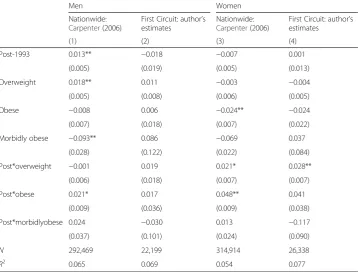
Carpenter only examined nationwide employment outcomes, not outcomes specific to the First Circuit. To determine whether employment outcomes of the morbidly obese improved in the First Circuit after Cook, Appendix Table 9 replicates Carpenter’s results, restricting his nationwide data to observations from the First Circuit only. According to these estimates, employment of the morbidly obese may have actually declined for men and women in the First Circuit after Cook (although the point esti-mates are not statistically significant). In sum, whatever was driving the increases in employment outside the First Circuit for the regularly obese in the mid-1990s, it does not appear to be the Cook decision.
Cook and the 1990 version of the ADA may not have improved employment outcomes of morbidly obese workers. Yet as discussed in Section 3, the 2008 amended version of the ADA is positioned to remedy the original Act’s prior shortcomings. Increased support from the EEOC as well as consistently positive case law in favor of covering morbidly obese workers under the ADA should encourage employers to rethink how they treat weight in the workplace. Certainly, post-ADAAA legal developments have convinced defense attorneys to rethink their advice to employers regarding weight in the workplace. If employers are in fact responding to these legal developments, then they should be more discouraged from taking adverse employment actions against workers on the basis of weight now than under the previous legal regime, and employment of the morbidly obese should increase in the post-ADAAA period.
To test whether employment of the morbidly obese actually increased after the ADAAA, I use a difference-in-differences approach, the same methodology used by Carpenter (2006):
PrðYict¼1Þ ¼XictβþOictγ1þPtγ2þ ðOictPtÞγ3þCcσ1þTtσ2
þðCcTtÞσ3þεict
ð2Þ
Here,Yist is the labor market outcome of interest for individuali, who lives in federal circuitcat timet. This analysis will investigate two principal outcomes: first, whether the individual is employed and, second, whether the individual is in the labor market (since improvement in legal protections may encourage disabled individuals to enter the labor market).18Xis a vector of individual demographic characteristics that includes age, race, ethnicity, education, and marital status, andOis a dummy variable indicating whether the individual is obese.19P is a post-2008 indicator variable, representing the post-ADAAA period.Cis a vector of circuit dummy variables for all 12 geographically defined federal circuits, and T is a set of year dummy variables. The coefficient of interest, γ3, is the double-difference estimate. That is,γ3represents the change in the employment of obese workers after the ADAAA, differencing out (1) changes in employment of the obese before the ADAAA and (2) changes in employment of the non-obese both before and after the ADAAA. Because the dependent variable is a non-continuous dummy variable (equal to 1 if the respondent is employed/in the labor market), I will estimate Eq. (2) using a linear probability model to avoid the concerns raised by Ai and Norton (2003) regarding the reliability of difference-in-differences estimates with probit estimation.
since 1984; data are collected from respondents continuously throughout the year. Although only 15 states participated in the first year of the BRFSS, most states partici-pated by 1990, and all states and territories have participartici-pated from 1994 until the most recent year of availability, 2013. Besides being the data that Carpenter used for his previous, related study of obesity and the ADA, the BRFSS has both a size and a time advantage for this particular study over the few other labor market datasets that contain weight and height information.
The BRFSS’s size advantage is that, unlike other datasets used to study obesity and the labor market (such as the National Longitudinal Survey of Youth, or NLSY), the BRFSS has contained at least 50,000 respondents every year since its inception. The large number of respondents allows this study to distinguish between the obese and the morbidly obese. Such a distinction is important given that all of the positive developments in ADA litigation have involved morbidly obese (not regularly obese) individuals. Similarly, the EEOC guidance says that even under the expanded ADAAA regime, only severe obesity (double normal body weight20), which roughly parallels the medical definition of morbid obesity (double normal BMI), is a covered disability under the amended ADA. Even though 25 to 33 % of the country is obese, only about 6.6 % of the country is morbidly obese (Sturm and Hattori 2013). Given the relatively small number of morbidly obese individuals, a large amount of observations is critical for this study.
The BRFSS’s time advantage is that it contains 5 years of post-ADAAA observations, which should allow the present study to identify any meaningful changes in the labor market outcomes of the obese—and particularly, in the labor market outcomes of the morbidly obese—since the 2008 Amendments. Other datasets that contain both labor market and BMI information on their respondents have few, if any, post-2008 observations. The Eating and Health Module, for example, ends in 2008 and so contains no post-ADAAA observations. The NLSY 1979 contains just two post-post-ADAAA observations, and even though the NLSY 1997 contains several post-ADAAA observations, the oldest respondents in that dataset are only 32.
Because the focus of the BRFSS is health status and behaviors, the survey asks respondents to self-report their weight and height,21from which I calculate their BMIs. Because pregnancy can dramatically, but temporarily, alter a person’s weight, I drop pregnant women from the sample. I also drop individuals from the sample who have BMIs greater than 100.22 Since the focus of this study is employment, I will also focus on individuals between the typical working ages of 18 and 65, inclusive. In addition to health-related questions, the BRFSS asks respondents about their demographic charac-teristics and labor market status, although these questions are more limited. Among the demographic characteristics available in the BRFSS are age, gender, race, ethnicity, education, marital status, and presence of children. The BRFSS also asks respondents whether they are employed, to which they can answer that they are employed for wages, self-employed, out of work for less than 1 year, out of work for more than 1 year, a homemaker, a student, retired, or unable to work.
work for pay or profit during a given week and defines unemployed as not having a job but actively looking for one during the past 4 weeks. Second, although the self-employed would normally be counted as self-employed under the BLS definition, I drop self-employed respondents for consistency with prior disability literature, including Baldwin (2006) and Beegle and Stock (2003).
To construct my second dependent variable of interest, in the labor market, I define workers who are employed for wages, self-employed, or out of work as being in the labor market and workers who are a homemaker, a student, retired, or unable to work as being out of the labor market. Plausibly, disabled workers who may have been discouraged by lack of success in the original ADA regime may re-enter the labor market in the post-ADAAA period, hoping that their fortunes in the labor market will improve. For this reason, it is im-portant to monitor movement into (or out of) the labor market during this time period, which this second dependent variable of interest will allow me to do in the next section.
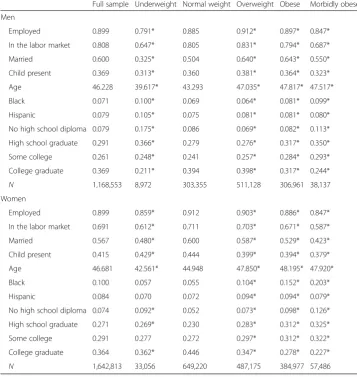
5 Results
Summary statistics for the BRFSS data are presented by BMI classification and gender in Table 1. These data, which include observations from 2004 to 2013, contain 1,168,553 observations of men and 1,642,813 observations of women ages 18 to 65 (inclusive). For men, the means of the underweight, overweight, obese, and morbidly obese are statistically different from the means of the normal weight for virtually every characteristic. The summary statistics for underweight and morbidly obese men have much in common: compared to normal-weight men, both are more likely to be a member of a minority group, less likely to be employed or in the labor market, less likely to have a child, and less likely to have graduated from college. In contrast, overweight men are actually more successful in the labor market than normal-weight men, and overweight men are also the most likely of all BMI groups to have graduated from college. Moreover, heavier men are more likely to be married than normal-weight men, and they tend to be older than normal-weight men.
For women, clear weight-based patterns in the data are apparent as BMI classification increases beyond normal weight. As a woman gets heavier and rises above the normal-weight BMI classification, she becomes increasingly less likely to be employed or in the labor market, less likely to be married, less likely to have a child, and less likely to have graduated from college. Moreover, black women, Hispanic women, and older women are relatively overrepresented in the overweight, obese, and morbidly obese groups. On the labor market, marriage, and education fronts, normal-weight women appear to be the most successful of all BMI classifications. The correlations between BMI, demo-graphic, education, and labor market outcomes seen in the BRFSS are very much in line with the correlations seen previously in the NLSY, National Health and Nutrition Examination Survey, and the Eating and Health Module.23
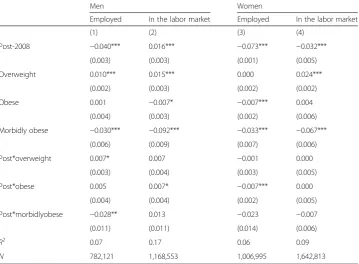
controls (detailed in Section 5) in the reported estimates.24 In all four columns of Table 2, the regression estimates include federal circuit fixed effects, year fixed effects,25 and circuit*year fixed effects.26 All standard errors are heteroscedasticity-robust and clustered by federal judicial circuit.
Turning first to the estimates for men, the coefficient of interest is thepost*morbidlyobese variable. Given the fact that all positive post-ADAAA developments (the EEOC guidance, the EEOC litigation, and the private litigation) have all involved morbidly obese (not regu-larly obese) plaintiffs, any effects of the ADAAA should be greatest for, if not limited to, the morbidly obese. The post-2008 interaction effects for the overweight and the obese are presented for comparison. In sharp contrast to Carpenter’s estimates of the original ADA’s effects, the estimates of the ADAAA’s effects are unpromising for morbidly obese workers who seek legal protection. The point estimate for the effect of the ADAAA on morbidly obese men’s employment since 2008 is negative and statistically significant, indicating that
Table 1Summary statistics for 2004–2013 BRFSS respondents in the labor market, ages 18 to 65
Full sample Underweight Normal weight Overweight Obese Morbidly obese
Men
Employed 0.899 0.791* 0.885 0.912* 0.897* 0.847*
In the labor market 0.808 0.647* 0.805 0.831* 0.794* 0.687*
Married 0.600 0.325* 0.504 0.640* 0.643* 0.550*
Child present 0.369 0.313* 0.360 0.381* 0.364* 0.323*
Age 46.228 39.617* 43.293 47.035* 47.817* 47.517*
Black 0.071 0.100* 0.069 0.064* 0.081* 0.099*
Hispanic 0.079 0.105* 0.075 0.081* 0.081* 0.080*
No high school diploma 0.079 0.175* 0.086 0.069* 0.082* 0.113*
High school graduate 0.291 0.366* 0.279 0.276* 0.317* 0.350*
Some college 0.261 0.248* 0.241 0.257* 0.284* 0.293*
College graduate 0.369 0.211* 0.394 0.398* 0.317* 0.244*
N 1,168,553 8,972 303,355 511,128 306,961 38,137
Women
Employed 0.899 0.859* 0.912 0.903* 0.886* 0.847*
In the labor market 0.691 0.612* 0.711 0.703* 0.671* 0.587*
Married 0.567 0.480* 0.600 0.587* 0.529* 0.423*
Child present 0.415 0.429* 0.444 0.399* 0.394* 0.379*
Age 46.681 42.561* 44.948 47.850* 48.195* 47.920*
Black 0.100 0.057 0.055 0.104* 0.152* 0.203*
Hispanic 0.084 0.070 0.072 0.094* 0.094* 0.079*
No high school diploma 0.074 0.092* 0.052 0.073* 0.098* 0.126*
High school graduate 0.271 0.269* 0.230 0.283* 0.312* 0.325*
Some college 0.291 0.277 0.272 0.297* 0.312* 0.322*
College graduate 0.364 0.362* 0.446 0.347* 0.278* 0.227*
N 1,642,813 33,056 649,220 487,175 384,977 57,486
employment for morbidly obese men declined by 2.8 percentage points in the post-2008 period. For the labor market regressions in column 2, the point estimate is small and positive but nowhere close to statistically significant. The results in Table 2 suggest that after the ADAAA went into effect on January 1, 2009, morbidly obese men have seen a decline in employment without an offsetting rise in labor market participation.
The estimates for the post-2008 ADAAA effect on women do not appear any more promising for morbidly obese women who seek legal protection. In columns 3 and 4 of Table 2, the point estimates of the coefficient on post*morbidlyobese are negative, although statistically insignificant, in both the employment regression and the labor market regres-sion. These results suggest that, at best, morbidly obese women have not experienced any improvement in employment outcomes since the ADAAA, nor have they been sufficiently encouraged by the more favorable legal regime to increase their labor market participation. In spite of the ADAAA’s promise—particularly for groups like the morbidly obese, who have seen quite a few favorable legal developments in the post-ADAAA period—the results in Table 2 indicate that not much has changed in terms of employment or labor market participation. If anything, outcomes have declined for the morbidly obese since most of the point estimates are negative. Nonetheless, looking back at the history of the pro-obesity developments under the ADAAA raises the question of whether 2008 is the
Table 2The effect of the ADAAA on obese individuals (post-2008 effect)
Men Women
Employed In the labor market Employed In the labor market
(1) (2) (3) (4)
Post-2008 −0.040*** 0.016*** −0.073*** −0.032***
(0.003) (0.003) (0.001) (0.005)
Overweight 0.010*** 0.015*** 0.000 0.024***
(0.002) (0.003) (0.002) (0.002)
Obese 0.001 −0.007* −0.007*** 0.004
(0.004) (0.003) (0.002) (0.006)
Morbidly obese −0.030*** −0.092*** −0.033*** −0.067***
(0.006) (0.009) (0.007) (0.006)
Post*overweight 0.007* 0.007 −0.001 0.000
(0.003) (0.004) (0.003) (0.005)
Post*obese 0.005 0.007* −0.007*** 0.000
(0.004) (0.004) (0.002) (0.005)
Post*morbidlyobese −0.028** 0.013 −0.023 −0.007
(0.011) (0.011) (0.014) (0.006)
R2 0.07 0.17 0.06 0.09
N 782,121 1,168,553 1,006,995 1,642,813
Notes: Reported estimates are effects from a linear probability model using respondents in the labor market ages 18 to 65 from the 2004–2013 BRFSS data. The dependent variable employed counts respondents who are employed for wages as employed, counts respondents who are out of work as unemployed, and drops all other respondents. The dependent labor market variable counts workers who are employed for wages, self-employed, or out of work as being in the labor market and workers who are a homemaker, a student, retired, or unable to work as being out of the labor market. Heteroscedasticity-robust standard errors clustered by federal circuit are below in parentheses. All estimates are weighted using the BRFSS sample weights. These difference-in-differences estimates are estimated for underweight, overweight, obese, and morbidly obese individuals (with normal-weight individuals as the omitted BMI category), but only the estimates for overweight, obese, and morbidly obese individuals are reported. All regressions include controls for nationwide unemployment rate (by gender), education level, age, age squared, marital status, presence of a child, black, Hispanic, and other races. Sample excludes pregnant women
appropriate year around which to test. Although the ADAAA went into effect at the be-ginning of 2009, courts did not begin hearing ADAAA cases until much later. In fact, the EEOC did not file its first obesity-related lawsuit under the ADAAA until September 2010, and its second suit came a year later in 2011. Both cases settled in 2012. Because the best publicized obesity-related developments under the ADAAA did not begin until late 2010, arguably, the status of obesity under the amended ADA might have remained uncertain to employers (and their attorneys) until then. Thus, perhaps the more appropri-ate year around which to test is 2010, not 2008, in order to see the ADAAA’s effect on labor market outcomes of the obese.27
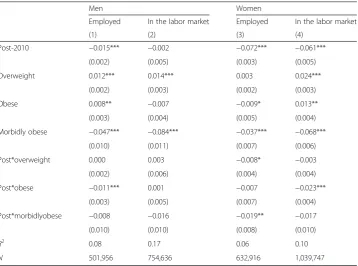
To test this hypothesis, Table 3 repeats the estimates in Table 2 using 2008 through 2013 BRFSS data and 2010 as the operative year. Even with these changes in the ana-lysis, the results in Table 3 do not look much different than the results in Table 2. With respect to the men’s results in Table 3, the point estimate of the effect of the post-2010 period on morbidly obese men’s employment is negative, although statistically insignifi-cant. The point estimate of the effect on morbidly obese men’s labor market participa-tion after 2010 is similarly negative and insignificant. Nor are the post-2010 effects of the ADAAA positive for morbidly obese women. According to column 3 of Table 3, morbidly obese women saw a 1.9 percentage point decline in employment in the
post-Table 3The effect of the ADAAA on obese individuals (post-2010 effect)
Men Women
Employed In the labor market Employed In the labor market
(1) (2) (3) (4)
Post-2010 −0.015*** −0.002 −0.072*** −0.061***
(0.002) (0.005) (0.003) (0.005)
Overweight 0.012*** 0.014*** 0.003 0.024***
(0.002) (0.003) (0.002) (0.003)
Obese 0.008** −0.007 −0.009* 0.013**
(0.003) (0.004) (0.005) (0.004)
Morbidly obese −0.047*** −0.084*** −0.037*** −0.068***
(0.010) (0.011) (0.007) (0.006)
Post*overweight 0.000 0.003 −0.008* −0.003
(0.002) (0.006) (0.004) (0.004)
Post*obese −0.011*** 0.001 −0.007 −0.023***
(0.003) (0.005) (0.007) (0.004)
Post*morbidlyobese −0.008 −0.016 −0.019** −0.017
(0.010) (0.010) (0.008) (0.010)
R2 0.08 0.17 0.06 0.10
N 501,956 754,636 632,916 1,039,747
Notes: Reported estimates are effects from a linear probability model using respondents in the labor market ages 18 to 65 from the 2008–2013 BRFSS data. The dependent variable employed counts respondents who are employed for wages as employed, counts respondents who are out of work as unemployed, and drops all other respondents. The dependent labor market variable counts workers who are employed for wages, self-employed, or out of work as being in the labor market and workers who are a homemaker, a student, retired, or unable to work as being out of the labor market. Heteroscedasticity-robust standard errors clustered by federal circuit are below in parentheses. All estimates are weighted using the BRFSS sample weights. These difference-in-differences estimates are estimated for underweight, overweight, obese, and morbidly obese individuals (with normal-weight individuals as the omitted BMI category), but only the estimates for overweight, obese, and morbidly obese individuals are reported. All regressions include controls for nationwide unemployment rate (by gender), education level, age, age squared, marital status, presence of a child, black, Hispanic, and other races. Sample excludes pregnant women
2010 period. This finding is particularly striking given that the observations from the pre-comparison period (2008, 2009, and 2010) fall largely during the Great Recession. Furthermore, morbidly obese women did not increase their labor market participation during this period. The point estimate on the post*morbidlyobese coefficient in the labor market regression (column 4) is negative, although statistically insignificant.
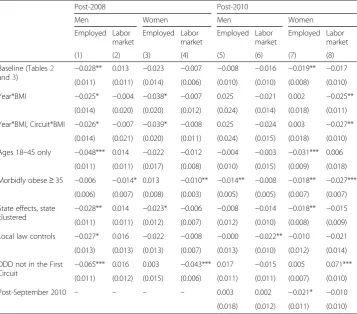
No matter the period tested—post-2008 or post-2010—the labor market outcomes of morbidly obese individuals do not appear to have improved as a result of the ADAAA and may have actually declined. Because this finding is incongruous with the positive developments in obesity-related ADA case law, additional robustness checks are warranted. Appendix Table 10 reports the results of placebo estimates of the employment and labor market participation effects of the post-2007, post-2009, and post-2011 periods on the mor-bidly obese; the point estimates are generally negative.28Table 4 reports a re-estimate of the post*morbidlyobese coefficient using eight different specifications for both the post-2008
Table 4Robustness checks: estimate of post*morbidlyobese interaction term
Post-2008 Post-2010
Men Women Men Women
Employed Labor market
Employed Labor market
Employed Labor market
Employed Labor market
(1) (2) (3) (4) (5) (6) (7) (8)
Baseline (Tables2 and3)
−0.028** 0.013 −0.023 −0.007 −0.008 −0.016 −0.019** −0.017 (0.011) (0.011) (0.014) (0.006) (0.010) (0.010) (0.008) (0.010)
Year*BMI −0.025* −0.004 −0.038* −0.007 0.025 −0.021 0.002 −0.025**
(0.014) (0.020) (0.020) (0.012) (0.024) (0.014) (0.018) (0.011)
Year*BMI, Circuit*BMI −0.026* −0.007 −0.039* −0.008 0.025 −0.024 0.003 −0.027**
(0.014) (0.021) (0.020) (0.011) (0.024) (0.015) (0.018) (0.010)
Ages 18–45 only −0.048*** 0.014 −0.022 −0.012 −0.004 −0.003 −0.031*** 0.006
(0.011) (0.011) (0.017) (0.008) (0.010) (0.015) (0.009) (0.018)
Morbidly obese≥35 −0.006 −0.014* 0.013 −0.010** −0.014** −0.008 −0.018** −0.027***
(0.006) (0.007) (0.008) (0.003) (0.005) (0.005) (0.007) (0.007)
State effects, state clustered
−0.028** 0.014 −0.023* −0.006 −0.008 −0.014 −0.018** −0.015 (0.011) (0.011) (0.012) (0.007) (0.012) (0.010) (0.008) (0.009)
Local law controls −0.027* 0.016 −0.022 −0.008 −0.000 −0.022** −0.010 −0.021
(0.013) (0.013) (0.013) (0.007) (0.013) (0.010) (0.012) (0.014)
DDD not in the First Circuit
−0.065*** 0.016 0.003 −0.043*** 0.017 −0.015 0.005 0.071*** (0.011) (0.012) (0.015) (0.006) (0.011) (0.011) (0.007) (0.010)
Post-September 2010 – – – – 0.003 0.002 −0.021* −0.010
(0.018) (0.012) (0.011) (0.010)
Notes: See Tables2and3for details on baseline specifications. Each cell reports the estimated value of thepost*morbidlyobese
coefficient for a separate regression. Theyear*BMIinteraction terms multiply year of response by BMI classification (with normal weight omitted); thecircuit*BMIinteraction terms multiply federal circuit by BMI classification (with normal weight omitted). The ages 18–45 regressions restrict the sample to respondents ages 18–45 (all other regressions consider respondents ages 18–65). The morbidly obese≥35 regressions redefine obese as a BMI of 30 (inclusive) to 35 and morbidly obese as a BMI of 35 (inclusive) or higher. State effects and state-clustered regressions substitute state fixed effects for circuit fixed effects and state-clustered standard errors for circuit-clustered standard errors. Local law control regressions add controls for jurisdictions that explicitly prohibit weight or personal appearance discrimination and interaction terms between living in such a jurisdiction and BMI classification (with normal weight omitted) using the 2004–2012 BRFSS data (post-2008 effect) or the 2009–2012 BRFSS data (post-2010 effect). The DDD regressions consider the triple-difference estimate of the ADAAA’s effect on jurisdictions outside the First Circuit. The post-September 2010 regressions consider the effects after the first EEOC lawsuit was filed on behalf of a morbidly obese individual in September 2010 (as opposed to considering the post-2010 effect)
period and the post-2010 period. Row 1 reports the baseline estimates from Tables 2 and 3 for comparison. Row 2 adds interaction terms for year of interview times BMI classification (with the normal-weight category omitted); row 3 additionally includes interaction terms for federal judicial circuit times BMI classification (with the normal-weight category omitted). Row 4 explores whether the effects of the ADAAA may be more visible for younger respondents and restricts the sample to respondents ages 18 to 45 (inclusive), which is the same age group studied by Carpenter (2006). Row 5 examines whether expanding the morbidly obese category to include individuals with a BMI of greater than or equal to 35 meaningfully changes the results.29 Row 6 substitutes state fixed effects for federal circuit fixed effects and clusters the standard errors at the state level instead of the federal circuit level. None of these robustness checks meaningfully change the results; in fact, many of the negative point estimates that were statistically insignificant in the baseline regressions become statistically significant (and more negative) in these alternative specifications.
Row 7 of Table 4 re-estimates the baseline regressions adding an indicator variable and interaction effects30for the ten jurisdictions across the USA that prohibit discrimination on the basis of weight and/or personal appearance. The ten jurisdictions are Michigan; Washington, DC; San Francisco, CA; Santa Cruz, CA; Madison, WI; Urbana, IL; Bing-hamton, NY; Howard County, MD; Harford County, MD; and Prince George’s County, MD. Obese individuals working in these jurisdictions who experience labor market dis-crimination have an alternative remedy to the ADA, which makes controlling for the availability of such laws potentially important. The only caveat to controlling for these laws is that in 2013, the BRFSS stopped identifying observations by county for privacy rea-sons. Thus, controlling for these laws requires me to cut a year off on each end of the time periods, so that the post-2008 estimate uses 2005–2012 data and the post-2010 estimate uses 2009–2012 data. Despite all these changes, the results are remarkably similar to the baseline regressions. The point estimates are of similar magnitudes, and the already negative point estimate of the post2010*morbidlyobese coefficient becomes statistically significant as a result of the additional controls and time restrictions.
post-2010 period. Given that this result is somewhat of an anomaly compared to the other estimates and is so large (7.1 percentage points), it is difficult to conclude that the increase is solely the result of EEOC enforcement of the ADAAA after 2010. At best, this result sug-gests that EEOC enforcement of the ADAAA may have encouraged some morbidly obese women outside the First Circuit to enter the labor market after 2010.
A final robustness check is presented in row 9 of Table 4 for the post-2010 estimates. Because the BRFSS data identifies the month and the year of interview, these estimates take advantage of the month data and test the effect of the post-September 2010 period (the EEOC filed its first ADAAA lawsuit on behalf a morbidly obese individual in that month) instead of the post-2010 period. The results are again substantially similar to the baseline estimates, although the estimated coefficient on the post*morbidlyobese interaction term for women's employment actually becomes more negative.
Table 5 considers whether the effects of the ADAAA have been heterogeneous on certain sub-populations and, thus, re-estimates the baseline results in Tables 2 and 3 for whites, blacks, Hispanics, individuals with low levels of education (defined as a high school diploma or less), and individuals with high levels of education (defined as at least some college). Even though minority status and socio-economic status are not legally relevant to a federal disability claim (that is, being a member of a minority group does not make it easier to prove a disability discrimination claim in court), several compelling reasons exist for considering possible heterogeneity in the ADAAA’s effects. First, as seen in the BRFSS summary statistics (Table 1) and other prior work on obesity, obesity disproportionately affects individuals who have low levels of education and who self-identify as a minority. Second, Cawley (2004) presented evidence of heterogeneity in the effect of weight on wages, finding the most negative impact for white women and the least negative impact for black men.
Table 5 reports a re-estimate of the post*morbidlyobese coefficient on these sub-populations for both the post-2008 period and the post-2010 period. The point estimates for each sub-population, like the point estimates for the combined populations, are almost
Table 5Heterogeneity of post*morbidlyobese interaction term estimates across sub-populations
Post-2008 Post-2010
Men Women Men Women
Employed Labor market
Employed Labor market
Employed Labor market
Employed Labor market
(1) (2) (3) (4) (5) (6) (7) (8)
White respondents −0.011 0.008 −0.018 −0.003 −0.034*** −0.008 −0.022** −0.019**
(0.010) (0.014) (0.011) (0.008) (0.011) (0.007) (0.008) (0.008)
Black respondents −0.023 0.016 −0.008 −0.005 0.071* −0.012 −0.039 0.002
(0.044) (0.021) (0.037) (0.013) (0.035) (0.029) (0.023) (0.022)
Hispanic respondents −0.108** 0.019 −0.032 −0.015 0.078 −0.058 0.022 0.008
(0.045) (0.034) (0.032) (0.026) (0.050) (0.045) (0.029) (0.032)
High school or less −0.052** 0.016 −0.016 0.009 0.030 −0.039** −0.021 −0.034*
(0.022) (0.011) (0.020) (0.011) (0.019) (0.015) (0.020) (0.019)
More than high school −0.003 0.013 −0.022* −0.018 −0.034** −0.007 −0.019** −0.005
(0.012) (0.016) (0.011) (0.010) (0.014) (0.011) (0.007) (0.010)
Notes: See Tables2and3for details on baseline specifications. Each cell reports the estimated value of the
entirely negative. Indeed, considering these sub-populations separately often increases the estimated magnitude of the negative coefficient on the post*morbidlyobese interaction term. Perhaps the most notable result is for whites in the post-2010 period. These estimates suggest that employment declined by 2.2 percentage points for morbidly obese white women and 3.4 percentage points for morbidly obese white men since EEOC enforcement of the ADAAA began in late 2010. Labor market participation of morbidly obese white women also decreased by 1.9 percentage points. Cawley’s (2004) results indicated that morbidly obese white women were in the most need of legal protection in the labor market, and yet, the results presented in Table 5 suggest that they may have been most harmed by the ADAAA.
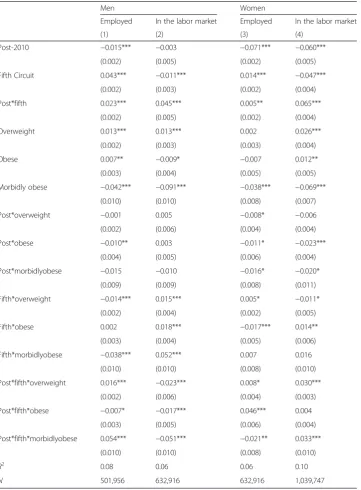
A final, alternative specification is presented in Table 6. Because morbidly obese plaintiffs have been disproportionately successful in district courts within the Fifth Circuit—both EEOC enforcement suits were filed there, and two other district courts have stated in sum-mary judgment orders that severe obesity can now be a disability under the ADAAA—it is possible that any positive effects of the ADAAA may be strongest there. The EEOC lawsuits received quite a bit of local press,32so attorney awareness of the EEOC’s position on obesity is likely to have been greater within this region than nationwide. A greater aware-ness of the EEOC’s position—and later, the EEOC’s success in convincing a federal court—that severe obesity is a disability under the ADA may have translated into plaintiffs’ lawyers seeking out or taking on more clients with an obesity claim under the ADA. A greater awareness may have also translated into more defense lawyers advising their employer clients to take greater care with their obese em-ployees and applicants. This hypothesis is tested in Table 6 with a triple-difference estimate, comparing labor market outcomes of morbidly obese men and women in-side the Fifth Circuit to the outcomes of morbidly obese men and women outin-side the Fifth Circuit, before and after the EEOC lawsuits began in late 2010.
The results in Table 6 are more positive than the prior estimates, although still somewhat mixed. After 2010, morbidly obese men’s employment rates increased by 5.4 percentage points in the Fifth Circuit compared to the rest of the country, but their labor market participation rates declined by almost an equal amount (5.1 percentage points). The data on morbidly obese women in the Fifth Circuit after 2010 demonstrate the opposite pattern: employment rates declined by 2.1 percentage points for these women after 2010 compared to women in the rest of the country, but this decline is offset by a greater increase (3.3 percentage points) in the labor force participation rate of Fifth Circuit morbidly obese women during the post-2010 period.
Table 6The effect of EEOC enforcement post-2010 in the Fifth Circuit
Men Women
Employed In the labor market Employed In the labor market
(1) (2) (3) (4)
Post-2010 −0.015*** −0.003 −0.071*** −0.060***
(0.002) (0.005) (0.002) (0.005)
Fifth Circuit 0.043*** −0.011*** 0.014*** −0.047***
(0.002) (0.003) (0.002) (0.004)
Post*fifth 0.023*** 0.045*** 0.005** 0.065***
(0.002) (0.005) (0.002) (0.004)
Overweight 0.013*** 0.013*** 0.002 0.026***
(0.002) (0.003) (0.003) (0.004)
Obese 0.007** −0.009* −0.007 0.012**
(0.003) (0.004) (0.005) (0.005)
Morbidly obese −0.042*** −0.091*** −0.038*** −0.069***
(0.010) (0.010) (0.008) (0.007)
Post*overweight −0.001 0.005 −0.008* −0.006
(0.002) (0.006) (0.004) (0.004)
Post*obese −0.010** 0.003 −0.011* −0.023***
(0.004) (0.005) (0.006) (0.004)
Post*morbidlyobese −0.015 −0.010 −0.016* −0.020*
(0.009) (0.009) (0.008) (0.011)
Fifth*overweight −0.014*** 0.015*** 0.005* −0.011*
(0.002) (0.004) (0.002) (0.005)
Fifth*obese 0.002 0.018*** −0.017*** 0.014**
(0.003) (0.004) (0.005) (0.006)
Fifth*morbidlyobese −0.038*** 0.052*** 0.007 0.016
(0.010) (0.010) (0.008) (0.010)
Post*fifth*overweight 0.016*** −0.023*** 0.008* 0.030***
(0.002) (0.006) (0.004) (0.003)
Post*fifth*obese −0.007* −0.017*** 0.046*** 0.004
(0.003) (0.005) (0.006) (0.004)
Post*fifth*morbidlyobese 0.054*** −0.051*** −0.021** 0.033***
(0.010) (0.010) (0.008) (0.010)
R2 0.08 0.06 0.06 0.10
N 501,956 632,916 632,916 1,039,747
Notes: Reported estimates are effects from a linear probability model using respondents in the labor market ages 18 to 65 from the 2008–2013 BRFSS data. The dependent variable employed counts respondents who are employed for wages as employed, counts respondents who are out of work as unemployed, and drops all other respondents. The dependent labor market variable counts workers who are employed for wages, self-employed, or out of work as being in the labor market and workers who are a homemaker, a student, retired, or unable to work as being out of the labor
market. Heteroscedasticity-robust standard errors clustered by federal circuit are below in parentheses. All estimates are weighted using the BRFSS sample weights. These difference-in-differences estimates are estimated for underweight, overweight, obese, and morbidly obese individuals (with normal-weight individuals as the omitted BMI category), but only the estimates for overweight, obese, and morbidly obese individuals are reported here. All regressions include controls for nationwide unemployment rate (by gender), education level, age, age squared, marital status, presence of a child, black, Hispanic, and other races. Sample excludes pregnant women
In sum, if the ADAAA has improved labor market outcomes for anyone, its effects have been isolated to individuals living in the area of the country that has most actively enforced the new federal disability discrimination regime. Caution should be taken in interpreting the Fifth Circuit results since the employment and labor market participation results are often offsetting.33 Still, even if employment and labor market participation results in the Fifth Circuit cancel each other out, the post-2010 Fifth Circuit results are notable because, unlike the nationwide results, they are not entirely negative. Overall, the estimates presented in this section provide a cautionary tale to policymakers, suggesting that in the absence of enforcement, new anti-discrimination laws may not help—and may even hurt—their intended beneficiaries.
6 Conclusions
By more clearly defining what it meant to be disabled under the ADA, and by explicitly overturning four previous judicial interpretations that had severely restricted what it meant to be disabled under the ADA, Congress had dual purposes in passing the 2008
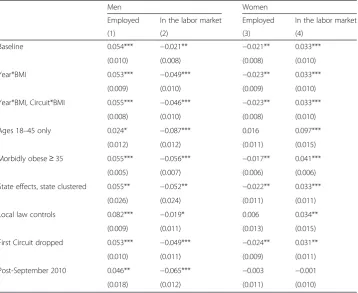
Table 7Robustness checks: estimate of post*fifth*morbidlyobese interaction term
Men Women
Employed In the labor market Employed In the labor market
(1) (2) (3) (4)
Baseline 0.054*** −0.021** −0.021** 0.033***
(0.010) (0.008) (0.008) (0.010)
Year*BMI 0.053*** −0.049*** −0.023** 0.033***
(0.009) (0.010) (0.009) (0.010)
Year*BMI, Circuit*BMI 0.055*** −0.046*** −0.023** 0.033***
(0.008) (0.010) (0.008) (0.010)
Ages 18–45 only 0.024* −0.087*** 0.016 0.097***
(0.012) (0.012) (0.011) (0.015)
Morbidly obese≥35 0.055*** −0.056*** −0.017** 0.041***
(0.005) (0.007) (0.006) (0.006)
State effects, state clustered 0.055** −0.052** −0.022** 0.033***
(0.026) (0.024) (0.011) (0.011)
Local law controls 0.082*** −0.019* 0.006 0.034**
(0.009) (0.011) (0.013) (0.015)
First Circuit dropped 0.053*** −0.049*** −0.024** 0.031**
(0.010) (0.011) (0.009) (0.011)
Post-September 2010 0.046** −0.065*** −0.003 −0.001
(0.018) (0.012) (0.011) (0.010)
Notes: See Table6for details on baseline specifications. Each cell reports the estimated value of thefifthcircuit*post*
morbidlyobesecoefficient for a separate regression. Theyear*BMIinteraction terms multiply year of response by BMI classification (with normal weight omitted); thecircuit*BMIinteraction terms multiply federal circuit by BMI classification (with normal weight omitted). The ages 18–45 regressions restrict the sample to respondents ages 18–45 (all other regressions consider respondents ages 18–65). The morbidly obese≥35 regressions redefine obese as a BMI of 30 (inclusive) to 35 and morbidly obese as a BMI of 35 (inclusive) or higher. State effects and state-clustered regressions substitute state fixed effects for circuit fixed effects and state-clustered standard errors for circuit-clustered standard errors. Local law control regressions add controls for jurisdictions that explicitly prohibit weight or personal appearance discrimination and interaction terms between living in such a jurisdiction and BMI classification (with normal weight omitted) using the 2009–2012 BRFSS data. The First Circuit regressions drop the First Circuit from the sample (since the First Circuit decided the Cook case). The post-September 2010 regressions consider the effects after the first EEOC lawsuit was filed on behalf of a morbidly obese individual in September 2010 (as opposed to considering the post-2010 effect)
Amendments to the ADA. First, Congress hoped to reduce the uncertainty over who was disabled under the ADA, and second, Congress hoped to do so by greatly expanding the coverage of the ADA “to the maximum extent permitted” (42 U.S.C. § 12102(4)(A)). According to EEOC Legal Counsel Peggy Mastroianni, the agency’s ultimate aspiration for
the ADAAA has been to create a system in which “‘employers are expeditiously
determining whether individuals have disabilities and then moving on to the heart of the matter: judging fitness based on individual abilities and qualifications, and providing accommodation where needed to do the job.’Over time, that should result in a reduction in ADA litigation”(Dorrian 2014).
Thus, the EEOC and Congress have been united in their vision for the 2008 Amendments to virtually eliminate the question of who is disabled for the purposes of the ADA. In terms of the model presented in Eq. (1), their hope has been that the Amendments would raise the costs of non-compliance for employers. Yet this paper suggests that the lofty goals of the EEOC and Congress have so far remained unattained, particularly in areas of the country that have not seen much enforcement of the expanded federal disability regime. Taking as its subject a group that has experienced a legal sea change as a result of the Amendments, this paper concludes that the morbidly obese have not seen systematic improvement in labor market outcomes since the 2008 Act. The post-ADAAA case law indicates that at least a few morbidly obese individuals have benefited from the increased protections of the ADAAA, but the data suggest that these improved labor market outcomes may not extend beyond the few morbidly obese workers who have successfully brought a lawsuit.
So why hasn’t the ADAAA worked thus far for the morbidly obese—in spite of strong support by the EEOC and favorable district court decisions? One possibility is that the law in action may not exactly match the law on paper. For instance, if enough morbidly obese workers, employers, and/or employment lawyers remain largely unaware of the legal change, then enough morbidly obese workers may not be coming forward to enforce their newfound rights under the ADAAA. In fact, some evidence exists to support this
lack-of-Table 8Heterogeneity of post*fifth*morbidlyobese interaction term estimates across
sub-populations
Men Women
Employed In the labor market Employed In the labor market
(1) (2) (3) (4)
White respondents −0.004 −0.013* −0.036*** 0.016*
(0.012) (0.007) (0.008) (0.009)
Black respondents −0.022 −0.110*** −0.068** 0.069**
(0.043) (0.029) (0.026) (0.023)
Hispanic respondents 0.181** −0.121** 0.086** 0.039
(0.059) (0.043) (0.031) (0.038)
High school or less 0.096*** −0.081*** −0.024 0.092***
(0.018) (0.013) (0.022) (0.015)
More than high school 0.019 0.011 −0.014* 0.002
(0.015) (0.012) (0.008) (0.011)
Notes: See Table6for details on baseline specifications. Each cell reports the estimated value of the
awareness hypothesis. According to EEOC Legal Counsel Mastroianni, not only do some morbidly obese individuals appear to be unaware of the 2008 Amendments but also“some courts are mistakenly citing and applying pre-ADAAA case law”(Dorrian 2014).
Even assuming that most courts, lawyers, and morbidly obese workers are aware of the positive changes brought about by the ADAAA, social and economic factors may discour-age morbidly obese workers from coming forward to enforce their rights. Because the ADAAA was passed on the brink of a recession, and unemployment rates have remained relatively high during the post-ADAAA period, morbidly obese workers may be reluctant to challenge employers out of fear of losing their jobs in a tight labor market. Or perhaps morbidly obese workers are scared that coming forward will damage their reputation among potential future employers and will make finding a new job impossible.
Whatever the explanation behind the lack of improvement in the labor market out-comes of the morbidly obese since 2008, Resources for Human Development, BAE Systems, and the other pro-obesity ADAAA decisions would not be the first legal cases that failed to stimulate meaningful, on-the-ground change. Even landmark cases such as Brown v. Board of Education have been criticized for failing to have any systematic, on-the-ground impact, in spite of their symbolic impact (Rosenberg 2008; Bell 2004). Indeed, the findings presented here are in line with recent findings from an interview-based study conducted by George et al. (2011) regarding the on-the-ground impact of another employ-ment discrimination case, Jespersen v. Harrah’s Operating Co (9th Cir. 2006).34This 2006 Ninth Circuit decision, which centered on a casino bartender in Reno challenging her former employer’s sex-based grooming standards, announced that“[i]f a grooming stand-ard imposed on either sex amounts to impermissible sex stereotyping…a plaintiff of either sex may challenge that requirement”under Title VII. The case effectively opened the door to appearance-based, sex-stereotyping claims in the Ninth Circuit.
In spite of the widespread media coverage of Jespersen—and the widespread discussion of the case among lawyers and legal academics—the authors found that Las Vegas casino workers, who stood to gain the most from the decision, were completely unaware of it. And when the authors made them aware of the favorable legal decision, the casino workers expressed unwillingness to come forward and enforce their newfound rights. Among the excuses the workers gave included fears of losing their current hard-to-get, high-paying jobs and of being blacklisted from similar, future jobs (George et al. 2011).
This study suggests that the ADAAA has not been any more effective on the ground for morbidly obese workers than Jespersen has been for Ninth Circuit casino workers. Determining whether the 2008 Amendments will ultimately be a success or a failure will require more time and more study of other disabled populations. But these early estimates suggest that the ADAAA is following the same disappointing trajectory as the 1990 version of the Act.
Endnotes 1
Throughout this paper, weight categories are defined according to body mass index
(BMI), which is calculated using the following equation: BMI¼weight lbð Þ703
height inð Þ
ð Þ2 . Using BMI,
2
Shinall (2016) suggests that, after comparing the occupational characteristics of the obese to the non-obese, the taste-based discrimination component is the dominant component of the obesity labor market penalty, particularly for women.
3
Whether an individual’s disability is covered is always determined on a case-by-case basis. Note, however, that 42 U.S.C. § 12102(2) provides a non-exhaustive list of actions that Congress considers to be major life activities.
4
In order for the employer to pass over the disabled worker, the expected cost of accom-modation must exceed the expected cost of non-compliance plus the difference in the ex-pected profits of the workers (a>c+ (πd−πnd)). The difference in expected profits of the two workers should not be very large as long as the non-disabled worker is the next best option after the disabled worker. Although this example has been stated in terms of the employer considering a positive employment action with respect to the disabled worker, the example could easily be reworked to situations in which the employer is considering taking a negative employment action against a disabled worker.
5
Terming such costs “firing costs,” Acemoglu and Angrist (2001) believed that employers avoided hiring the disabled altogether in order to avoid the additional costs associated with their employment.
6
In fact, Clermont and Schwab (2004, 2009) argued, based on the notable decline in federal court case filings, that potential ADA plaintiffs (and employment discrimination plaintiffs generally) might be discouraged by high costs and low probability of success from filing lawsuits against employers.
7
E.E.O.C. v. Watkins Motor Lines, 463 F.3d 436 (6th Cir 2006) held that“to consti-tute an ADA impairment, a person’s obesity, even morbid obesity, must be the result of a physiological condition.”
8
In fact, one district court in the First Circuit that has subsequently discussed the case concluded that “Cook is instructive, yet not dispositive, on the issue of morbid obesity as an ‘impairment.’” Nedder v. Rivier College, 908 F. Supp. 66, 75 n.8 (D.N.H. 1995). See also Katz v. City Metal Co., 87 F.3d 26, 31 (1st Cir. 1996); Mandel v. Boston Phoenix, Inc., 456 F.3d 198, 208 (1st Cir. 2006) (citing Cook only in its discussions of evidentiary burdens).
9
E.E.O.C. v. Resources for Human Development, Inc., 827 F. Supp. 2d 688, 694 (E.D. La. 2011); Equal Employment Opportunity Commission (2012a).
10
Melson v. Chetofield, 2009 WL 537457 (E.D. La. Mar. 4, 2009); Lowe v. American Eurocopter, LLC, 2010 WL 5232523 (N.D. Miss. Dec. 16, 2010).
11
2010 WL 5232523, at *8 (N.D. Miss. Dec. 16, 2010). 12
2009 WL 537457, at *3 (E.D. La. Mar. 4, 2009). 13
Whittaker v. America’s Car Mart, Inc., 2014 WL 1648816, at *2 (E.D. Mo.
April 24, 2014). 14
Whittaker v. America’s Car Mart, Inc., 2014 WL 1648816, at *2 (E.D. Mo.
April 24, 2014). 15
The Southern District of Alabama, where Powell was decided, is located within the Eleventh Circuit.
16
For examples of such articles, see Hager and Schwedler (2013) and Egan (2013). 17