R E S E A R C H
Open Access
Provably secure attribute-based encryption with
attribute revocation and grant function using
proxy re-encryption and attribute key for
updating
Takeru Naruse
1*, Masami Mohri
2†and Yoshiaki Shiraishi
3†* Correspondence: [email protected] †Equal contributors
1
Nagoya Institute of Technology, Nagoya, Japan
Full list of author information is available at the end of the article
Abstract
Ciphertext-Policy Attribute-Based Encryption (CP-ABE) is suitable for data access control on a cloud storage system. In CP-ABE, the data owner encrypts data under the access structure over attributes and a set of attributes assigned to users is embedded in user’s secret key. A user is able to decrypt if his attributes satisfy the ciphertext’s access structure. In CP-ABE, processes of user’s attribute revocation and grant are concentrated on the authority and the data owner. In this paper, we propose a ciphertext-policy attribute-based encryption scheme delegating attribute revocation processes to Cloud Server by proxy re-encryption. The proposed scheme does not require generations of new secret key when granting attributes to a user and supports any Linear Secret Sharing Schemes (LSSS) access structure. We prove that the proposed scheme is secure against attack by unauthorized users and Cloud Server.
Keywords:Cryptographic cloud storage; Ciphertext-policy attribute-based encryption; Attribute revocation and grant; Proxy re-encryption
Background
Sharing of data on a cloud storage has a risk of information leakage caused by service provider’s abuse. In order to protect data, the data owner encrypts data shared on the cloud storage so that only authorized users can decrypt.
Ciphertext-Policy Attribute-Based Encryption (CP-ABE) [1,2] is suitable for data ac-cess control in the cloud storage system. The authority manages the attributes in the system. The data owner chooses an access structure and encrypts message under the access structure. The set of attributes assigned to users is embedded in his secret key. A user is able to decrypt a ciphertext if his attributes satisfy the ciphertext’s access structure.
There are user’s attribute revocation and grant in CP-ABE. In simple processes of user’s attribute revocation, when his attributes are revoked, the data owner re-encrypts the shared data so that revoked user cannot decrypt. Then, the authority redistributes new secret keys so that other users can decrypt. In simple processes of user’s attribute grant, the authority generates a new secret key. These simple processes are concen-trated on the data owner and the authority.
Some attribute revocable CP-ABE schemes have been proposed [3-5]. Yu et al. [3] proposed a scheme combining CP-ABE with proxy re-encryption. The authority can delegate re-encryption and secret key update to proxy servers. However, this scheme has a limitation in access policy because it can only express “AND” policy. Hur et al. [4] proposed a scheme using key encryption keys (KEKs). A service provider distributes KEKs to each user. The service provider re-encrypts a ciphertext by an attribute group key. Then, he encrypts attribute group key by using KEKs so that authorized user can de-crypt. As the number of system users has increases, the number of KEKs also increases and management becomes complicated. Liang et al. [5] proposed a scheme using user in-formation (UI). UI is generated by Revocation Tree and Revocation List. An authorized user can decrypt ciphertexts by using secret key and UI. In this scheme, users whose attri-butes are revoked lose the access rights to all shared data by attribute revocation processes. Moreover, in these schemes [3-5], the authority needs to generate a new key when granting attribute to users.
In this paper, we propose a CP-ABE scheme delegating attribute revocation processes to Cloud Server by proxy re-encryption and meets the following requirements.
1) Support any Linear Secret Sharing Schemes (LSSS) access structure.In existing schemes, there are following three expression methods of the access structure: tree, vector and matrix.
The schemes using tree (for example the schemes of [1,4]) are not given the security proof under the standard model because they use hash functions for encryption. The schemes using vector whose elements are combined by AND condition are given the security proof under the standard model (for example the scheme of [3]) but they cannot perform flexible access control because only“AND”can be used for decryption conditions.
By using matrix, for example a LSSS matrix, it is possible to use“AND”and“OR” for decryption conditions, that is, it is possible to perform a fine-grained access control and give the security proof under the standard model [2,5]. However, the revocation function is not shown in [2], and the scheme of [5] can revoke the only specified users but cannot revoke the only specified attributes.
2) Revoke the only specified attribute (attribute level user revocation).In the scheme of [5], users whose attributes are revoked lose the access rights to all shared data. To perform a fine-grained access control of shared data, it is desirable to revoke the only specified attributes. The schemes of [3,4] meet this requirement.
3) Does not require the generation of new secret key when granting attribute to user.In the way that the authority generates a new secret key and sends the key to a user every time it grants attributes to a user, the calculation amount of the authority is large in the case attributes are frequently granted. To avoid focusing the process of user’s attribute grant in the authority, we enable cloud servers to update user’s secret key. As far as we know, there is no scheme that meets this requirement.
Methods
Preliminaries
Bilinear Maps
LetG1,G2be two cyclic groups of prime orderp. LetPbe a generator ofG1. A bilinear map is a mape:G1×G1→G2with the following properties:
1) Bilinearity: for allP,Q∈G1anda,b∈Zp, we havee(aP,bQ)→e(P,Q)ab.
2) Non-degeneracy:e(P,P)≠1.
3) Computability: There is an efficient algorithm tocomputee(P,Q) for allP,Q∈G1.
Linear Secret Sharing Scheme (LSSS)
Definition 1 (Linear Secret Sharing Schemes (LSSS) [2,6]) A secret-sharing scheme
Πover a set of partiesPis called linear (overZp) if
1) The shares for each party form a vector overZp.
2) There exists a matrix anMwithlrows andncolumns called the share-generating matrix forΠ. For alli= 1,…,l, tei’th row ofMwe let the functionρdefined the party labeling rowiasρ(i). When we consider the column vectorv= (s,r2,…,rn), where
s∈Zpis the secret to be shared, andr2,…,rn∈Zpare randomly chosen, thenMvis the vector of l shares of the secretsaccording toΠ. The share (Mv)ibelongs to partyρ(i).
Suppose thatΠis an LSSS for the access structureA. Let S∈Abe any authorized set, and let I⊂{1, 2,…,l}. Then, there exist constants {ωi∈Zp}i∈Isuch that, if {λi} are valid
shares of any secretsaccording toΠ, thenX
i∈I
ωiλi¼s. Futhermore, there these constants
{ωi} can be found in time polynomial in the size of the share-generating matrixM[6].
Decisional Parallel Bilinear Diffie-Hellman Exponent Assumption
Choose a group G1of prime order p according to the security parameter. Let a,s,
b1,…,bq∈Zpbe chosen at random and P∈G1be a generator of G1. If an adversary is given→y¼
P;sP;aP;…;aqP; ;aqþ2P;…;a2qP
∀1≤j≤qs⋅bjP; a=bj
P;…; aq=b j
P; ; aqþ2=b j
P;…; a2q=b j
P
∀1≤j;k≤q;k≠ja⋅s⋅bk=bjP;…;aq⋅s⋅bk=bjP
it must remain hard to distinguishe Pð ;PÞaqþ1∈G2 from a random element inR∈G2. An algorithm Athat outputsz∈{0, 1} has advantageϵin solving decisionalq-parallel BDHE inG1if
Pr A →y;T ¼e gð ;gÞaqþ1s
¼0
h i
−Pr A →y;T ¼R
¼0
h i
≥ j
System Model and Definition
Model
There are four entities in the proposed scheme as follows. User:The user downloads the shared data from Cloud Server.
Data owner:The data owner encrypts the shared data then uploads to Cloud Server. Authority:The authority manages attributes in the system and publishes the parame-ters used for encryption. It generates a secret key that user’s attributes are embedded and PRE keys used for re-encryption and updating secret key. The authority is trusted party.
Cloud Server: Cloud Server stores shared data. It re-encrypts encrypted shared data and update secret key by using PRE keys received from the authority. Similar to previous schemes [3,4], we assume Cloud Server to be curious-but-honest. That is, it will honestly execute the tasks assigned by legitimate parties in the system. However, it would like to learn information of encrypted shared data as much as possible.
Algorithm Definition
Our proposed scheme is composed of 8 algorithms: Auth.Setup, DO.Enc, Auth.Ext, U.Dec, Auth.ReKeyGen, C.ReEnc, C.ReKey, C.AddAtt.
Auth.Setup: The setup algorithm takes as input the security parameter and attribute universe description. It outputs the public parameters PK, master secret keyMSK and the keys for granting an attributeJ.
DO.Enc:The Encryption algorithm takes as input the public parametersPK, an LSSS access structureA, and a messageℳ. It outputs a ciphertextCT.
Auth.Ext: The key extraction algorithm takes as input the master keyMK, and a set of attributesS. It outputs a secret keySKandtID.
U.Dec:The decryption algorithm takes as input a secret keySKfor a setSand a ci-phertext CT for an access structure A. If the set of attributes S satisfies the access structureA, it outputs a messageℳ.
Auth.ReKeyGen: The re-encryption key generation algorithm takes as input the mas-ter keyMKand a set of attributesγfor update. It outputs the redefined master keyMK0, the redefined public parametersPK0, and the PRE (Proxy Re-Encryption) keysrk.
C.ReEnc: The re-encryption algorithm takes as input an attribute y for update, the ciphertext component Diand a PRE key listRKLy. It outputs the re-encryption
cipher-text componentD0i.
C.ReKey: The key regeneration algorithm takes as input an attribute w for update, the secret key componentKwand the PRE key listRKLw. It outputs the updated secret
key componentK0w.
C.GrantAtt: The attribute grant algorithm takes as input an attribute v, the key for granting an attributeJv,tID and the PRE key listRKLv. It outputs secret key component Kvand redefines the key for granting an attributeJ
0
v.
Security Definition
Attack Model 1 In this model, we assume an attack by unauthorized users. Security in this model is defined with the following game.
-Init.The adversaryAsubmits the challenge access structureAto the challengerC. -Setup.The challenger C runs setup algorithm and gives the public parametersPKto the adversaryA.
-Phase1.The adversary can issue following query.
Ext query: The adversaryAsubmits a set of attributesSwhereSdoes not satisfy the access structureAto the challenger. The challengerCgives secret key correspondingS. Add query: The adversaryAsubmits a set of attributesS0whereS∪S0does not
satisfy the challenge access structureA. The challengerCgives the secret key componentKxcorresponding toS0.
-Challenge.The adversaryAsubmits two equal length messagesM0,M1. The challenger flips a random coinb, and encryptsMbunderA. The challenger gives
ciphertextCTto the adversaryA. -Phase2.Phase1 is repeated.
-Guess.The adversaryAoutputs his guessb0ofb.
The advantage of an adversaryAin this game is defined as Pr b0 ¼b
h i
−1 2.
Definition 2 A ciphertext-policy attribute-based encryption scheme is secure if all polynomial time adversaries have at most a negligible advantage in the above game.
Attack Model 2 In this model, we assume an attack by Cloud Server. Security in this model is defined with the following game.
-Init.The adversaryAsubmits the challenge access structureAand version number ver* to the challengerC.
-Setup.The challengerCruns setup algorithm and gives the public parametersPKand PRE key and the keys for granting an attributeJto the adversaryA.
-Phase1.The adversary can issue following query.
Kxquery: The adversaryAsubmits a set of attributeS. The challengerCgives
secret key componentKxcorresponding toSto the adversaryA.
-Challenge.The adversaryAsubmits two equal length messagesM0,M1. The challenger flips a random coinb, and encryptsMbunderA. The challenger gives
ciphertextCTto the adversaryA. -Phase2.Phase1 is repeated.
-Guess.The adversaryAoutputs his guessb0ofb.
Definition 3 A ciphertext-policy attribute-based encryption scheme is secure if all polynomial time adversaries have at most a negligible advantage in the above game.
Our Scheme
Overview
shown in [3] to the proposed scheme. In the proposed scheme, the attribute key is included in the ciphertext and secret key to delegate attribute revocation processes to Cloud Server. The attribute key is master key components corresponding to each attribute in the system. When user’s attributes are revoked, the authority re-defines the attribute keys, and generates PRE keys for updating the attribute keys. Cloud Server re-encrypts ciphertext and updates secret key by updating attribute key by using PRE key. Each attribute is associated with version number for updating attri-bute key.
Cloud Server keeps user list UL, re-encryption key list RKL and the key for granting an attribute to secret key J. UL records user’s ID, user’s attribute informa-tion, secret key components, tID. tID is a random number that randomize each
secret key to prevent users’collusion attack. tID should “bind” components of one
user's key together so that they cannot be combined with another user's key com-ponents[2]. RKL records update history of attribute (version number) and PRE keys.
When granting attributes to users, Cloud Server generates user’s secret key com-ponents correspond to granting attribute from tID and J, and sends secret key
com-ponent to the user. The user joins secret key comcom-ponent to own secret key. Thus, it is possible to grant attributes to users without generation of new secret key by the authority.
Algorithm
Auth.Setup(U) The setup algorithm takes as input the number of system attributes
U. It first chooses a group G1 of prime order p, a generator P∈G1. It then chooses random group elements Q1,…,QU∈G1 that are associated with the U attributes in the system. In addition, it chooses two randomα,a∈Zp, and randomAtt1,…,AttU∈Zpas
the attribute key.
The public parameters are
PK :¼ <P;e Pð ;PÞα;aP;Q1;…;QU;T1¼Att1P;…;TU>
The master key isMK: = <α,Att1,…,AttU>.
The keys for granting an attribute areJ: = < {x,Jx= 1/Attx}1≤x≤U>.
DO.Enc(PK, (M,ρ),ℳ) The Encryption algorithm takes as input the public parame-ters PK, an LSSS access structure (M,ρ), and a message ℳ. The functionρ associates
rows ofM to attributes. LetMbe anl×nmatrix. It first chooses a random vector →v¼
s;y2;…;yn
ð Þ∈Zp. Fori= 1 tol, it computesλi:¼→v ⋅Mi. It then chooses randomr1,…,
rl∈Zpand outputs the ciphertext
CT :¼ <C;C0;ðC1;D1Þ;…;ðCl;DlÞ>¼
<Ke Pð ;PÞαs;sP; λ1ð ÞaP −r1Qρð Þ1;r1Tρð Þ1
;…; λlð ÞaP −rlQρð Þl;rlTρð Þl
>
with (M,ρ).
Auth.Ext (MK,S) The key extraction algorithm takes as input the master key MK, and a set of attributesS. It first chooses a randomtID∈Zp. It then outputstID and the
SK :¼<K;L;∀x∈S Kx>¼
<αPþtIDð Þ;aP tIDP;∀x∈S tðID=AttxÞQx> :
U.Dec (SK,CT) The decryption algorithm takes as input a secret keySKfor a set S and a ciphertextCTfor access structure (M,ρ). Suppose thatSsatisfies the access struc-ture and let Ibe defined as I= {i:ρ(i)∈S}. Then, let {ωi∈Zp}i∈Ibe as set of consistants
such that if {λi} are valid shares of the secretsaccording toM, then
X
i∈Iωiλi¼s.
The decryption algorithm first computes
e C0
;K
Y
i∈I e Cð i;LÞe Di;Kρð Þi
ωi ¼
e Pð ;PÞαse Pð ;PÞastID Y
i∈I e Pð ;PÞ taλiωi
¼ e Pð ;PÞαs:
It can then decrypt the messageℳ=C/e(P,P)αs.
Auth.ReKeyGen(MK,γ) The re-encryption key generation algorithm takes as input the master keyMKand a set of attributes γfor update. For eachx∈γ, it chooses
ran-dom Att0x∈Zp as the new attribute key, and computes T0x:¼Att
0
xP, rkx→x0 :¼Att 0 x
Attx. It
then replaces eachAttxof the master key component with Att0x, and eachTx of public
parameter with T0x. It outputs the redefined the master keyMK', the redefined public parametersPK', and the PRE keysrk:= {x,rkx}x∈γ.
C.ReEnc(y(=ρ(i)),Di,RKLy)The re-encryption algorithm takes as input an attributey
(=ρ(i)) for update, the ciphertext componentDiand a PRE key listRKLy. It first checks
version of attribute y. Ify has the latest version, it outputs ⊥and exit. LetAttyð Þn be
defined as an attribute key of the latest version of attributey. It computes rky↔yð Þn :¼r
ky↔y0⋅rky0↔y00⋅⋅⋅rkyðn−1Þ↔yð Þn ¼Attyð Þn=Atty. Then, it outputs the re-encrypted ciphertext
componentD0i:¼rky↔yð Þn⋅Di¼ Attyð Þn=Atty
⋅riAttyP¼riAttyð ÞnP.
C.ReKey (w,Kw,ID,RKLw) The key regeneration algorithm takes as input an attri-bute wfor update, the secret key component Kw and the PRE key listRKLw. It first
checks version of attributew. Ifwhas the latest version, it outputs⊥and exit. LetA
ttwð Þn be defined as the attribute key for the latest version of attributew. It computes
rkw↔wð Þn :¼rkw↔w0⋅rkw0↔w00⋅⋅⋅rkwðn−1Þ↔wð Þn ¼Attwð Þn=Attw. It then outputs the updated secret key componentK0w:¼rk−w1↔wð Þ⋅n Kw¼ðAttw=Attwð ÞnÞ⋅ðtID=AttwÞQw¼ðtID=Attwð ÞnÞ
Qw.
C.GrantAtt (v,Jv,tID,RKLv) The attribute grant algorithm takes as input an
attri-bute v, the key for granting an attribute Jv, tID and the PRE key list RKLv. It first
checks version of attribute v. LetAttvð Þn be defined as the attribute key for the latest
version of attributev. It first computesrkv↔vð Þn :¼rkv↔v0⋅rkv0↔v00⋅⋅⋅rkvðn−1Þ↔vð Þn ¼Attvð Þn=A
ttv. It then outputs secret key component for Kv:¼tID⋅rk−v↔1vð Þ⋅n Jv¼ tID⋅ðAttv=Attvð ÞnÞ⋅
1=Attv
ð ÞQv¼ðtID=Attvð ÞnÞQvand redefines the key for granting an attributeJ
0
v:¼rk−v↔1vð Þn⋅
Jv¼ð1=Attvð ÞnÞQv.
Security Proof
We prove that unauthorized users and Cloud Server cannot decrypt ciphertextCTthat was encrypted by using the proposed scheme.
Security Proof in the Attack Model 1
Theorem 1Suppose the decisionalq-parallelBDHE assumption holds and a challenge matrix of size is l* ×n* where l* ×n*≤q, our scheme is IND-CPA secure in the attack model 1.
Proof Suppose we have adversary A with non-negligible advantage ϵ against our scheme in the attack model 1. Moreover, suppose it chooses a challenge matrixM* where both dimensions are at mostq. We show how to build a simulator,B, that plays the decisional
q-parallelBDHE problem.
Init. The simulator takes in a q-parallelBDHE challenge →y;T. The adversary gives the simulatorBthe challenge access structure (M*,ρ*), whereM* hasn* columns.
Setup.The simulatorBgenerates the public parameterPKas follows. The simulator
B chooses random α0∈Zp and implicitly sets α=α0+aq+ 1 by letting e Pð ;PÞα¼e aP;aqP
ð Þe Pð ;PÞα0. It outputs public parameterQ1,…,QUas follows.
1. For eachxfor 1≤x≤Ubegin by choosing a random valuezx
2. LetXdenote the set of indicesi, such thatρ*(i) =x. 3. The simulatorBcomputes
Qx¼zxPþ X
i∈X a2Mi;1=bi
Pþ a2M
i;2=bi
Pþ⋅⋅⋅þ an M
i;n=bi
P
n o
Note that ifX=∅ then we have Qx¼gzx. Also note that the parameters are
distrib-uted randomly due to gzx. The simulatorBrandomly chooses attribute keyst
x∈Zpfor
1 ≤x≤Uand computes public parameters Τx=txP. It gives the adversaryAthe public
parametersPK:= (P,e(P,P)α,aP,Q1,…,QU,T1,…,TU).
Phase1.The adversaryAissues following queries:
Ext query: The adversaryAsubmits a set of attributesSwhereSdoes not satisfy the access structure M* to the challenger. The simulator first chooses a random r∈Zp.
Then it finds a vectorw→¼ðw1;…;wnÞ∈Zpn such thatw1=−1 and for alliwhereρ(i)∈ S' we have thatw→⋅Mi ¼0. The simulatorBbegins by implicitly definingtIDas
rþw1aqþw2aq−1þ⋯þwnaq−n
þ1
It performs this by setting L¼rPþXi¼
2;…;nwiðaqþ1−iPÞ =tIDP. The simulator can
computeKas
α0PþarPþ X i¼2;…;n
wiaqþ2−iP
The simulatorBcomputesKx∀x∈Sas follows.
Case 1. If there is noisuch thatρ*(i) =x, it computesKx= (1/tx)⋅zxL.
Case 2. If there isisuch thatρ*(i) =x.
1) LetXbe the set of allisuch thatρ*(i) =x. 2) It computesKxas
zxLþ X
i∈X X
j¼1;…;n
Mi;j½ aj=bi
rPþ X
k¼1;…;n k≠j
wk aqþ1þj−k=bi
P
3) It calculatesKx¼ð1=txÞK
0
x.
It gives the adversaryAsecret keySK:= (K,L,∀x∈S Kx).
Add query :The adversary Asubmits a set of attributesS0whereS∪S0does not sat-isfy the challenge access structureM*.The simulatorBcomputesKx∀x∈S0as follows.
Case1. If there is noisuch thatρ*(i) =x, it computesKx= (1/tx)⋅zxL.
Case2. If there isisuch thatρ*(i) =x.
1) LetXbe the set of allisuch thatρ*(i) =x. 2) It computesK0xas
zxLþ X
i∈X X
j¼1;…;n
Mi;j½ aj=bi
rPþ X
k¼1;…;n k≠j
wk aqþ1þj−k=bi
P
3) It calculatesKx¼ð1=txÞK
0
x.
It gives the adversaryAthe secret key componentf gKx ∀x∈S0.
v
→¼ s;saþy0
2;sa2þy 0
3;…;san−1þy 0
n
∈Zn
p . In addition, it choose random values
r0 1;…;r
0
l∈Zp.
Fori= 1,…,n*, we defineRias the set of allk≠isuch thatρ*(i) =ρ*(k). The challenge
ciphertext components are then generated as
Di¼−r0iTρð Þi−sbiTρð Þi
Ci¼hr
0
i
ρð Þi þ
X
j¼2;…;n M
i;jy
0
jð ÞaP
( )
−zρð Þiðbi⋅sÞPþ f X
k∈Ri X
j¼1;…;n M
k;jaj⋅s⋅ðbi=bkÞPg
It gives the adversaryAthe challenge ciphertextCT¼C;C0;ðC1;D1Þ;…;ðCl;DlÞ. Phase2.Phase 1 is repeated.
Guess. The adversary A will eventually output a guessb0. of b. The simulator then
outputs 0 to guess thatT ¼e Pð ;PÞaqþ1sifb0. =b; otherwise, it outputs 1 to indicate that it believesTis a random group elementR∈G2.
WhenTis a tuple the simulatorBgives a perfect simulation so we have that
Pr¼hB→y;T ¼e Pð ;PÞaqþ1s¼0i¼1 2þ:
When T is a random group element the messageℳbis completely hidden from the
adversary and we have Pr¼ B →y;T ¼R
¼0
h i
¼1
2. Therefore, the simulator B can
play the decisionalq-parallelBDHE game with non-negligible advantage.
Security Proof in the Attack Model 2
Theorem 2 Suppose Waters’s scheme [2] is IND-CPA secure, our scheme is also IND-CPA secure in the attack model 2.
Proof Suppose we have adversary A with non-negligible advantage ϵ against our scheme in the attack model 2. Moreover, suppose it chooses a challenge matrix M* where both dimensions are at mostq. We prove there is an simulator B which has ad-vantage at least ϵagainst Waters’s scheme simulator (Given input, it responds accord-ing to algorithms of the Waters’s scheme).
Init. The adversaryAsubmits the challenge access structure (M*,ρ*) where M* has
n* columns and version number ver* to the simulator B. The simulatorB submits the challenge access structure (M*,ρ*) to the Waters’s scheme simulator.
Setup.The simulatorBreceives public parametersPK':= (P,e(P,P)α,aP,Q1,…,QU) from the Waters’s scheme simulator. It randomly chooses attribute keys tx∈Zp for 1 ≤x≤U
and computes public parameters Τx=txP. It computes the key for granting an
attri-bute J:= {(1/t1)Q1,…, (1/tU)QU}. Then, the simulatorBcomputes PRE keys and public
parameters Tx for each version as follows. For x (1≤x≤U), for 1≤k≤ver*−1, the
simulator Brandomly chooses PRE keys rkxð Þk→xðkþ1Þ∈Zp and computes public
parame-ters Txðkþ1Þ¼rkxð Þk↔xðkþ1ÞTxð Þk . (k+ 1) and (k) denote the version number of PRE keys
and public parameter. The simulator B gives the adversary A the public parameter
PK:= (P,e(P,P)α,aP,Q1,…,QU,T1,…,TU), the key for granting an attribute J and all
PRE keys.
Kxquery: The adversary Asubmits a set of attributesSfor version k, 1≤k≤ver*−
1. we denote Vxð Þk ¼
Yk
i¼2
rkxði−1Þ↔xð Þi . The simulator B randomly chooses tID∈Zp and
computes ∀x∈S Kx¼ðtID=tx⋅Vxð ÞkÞQx. It gives the adversaryA the secret key
compo-nents {Kx}∀x∈S.
Challenge. The adversary A submits two equal length messages ℳ0, ℳ1, then the simulatorBsubmits them to the Waters’s simulator. The Waters’s simulator flips a ran-dom coin b∈{0, 1} and computes ciphertest CT0:= (C,C0, (C1,D1),…, (Cl,Dl))←Enc
(PK, (M*,ρ*),ℳb). The simulator B receives the ciphertext CT', then it computes
CT :¼ C;C0; C1;Vρð Þ1ðverÞD1
;…; Cl;Vρð ÞlðverÞDl
from the ciphertext CT0. It
gives the adversaryAthe cipertextCT. Phase2.Phase 1 is repeated.
Guess.The adversaryAoutputs will eventually output a guessb0ofb. The simulator
Boutputsb0as its guess.
The simulation above shows there is a simulator B that has advantage at least ϵ ageinst Waters’s scheme simulator if there is an adversary A that has advantage ϵ against our scheme.
Result and discussion
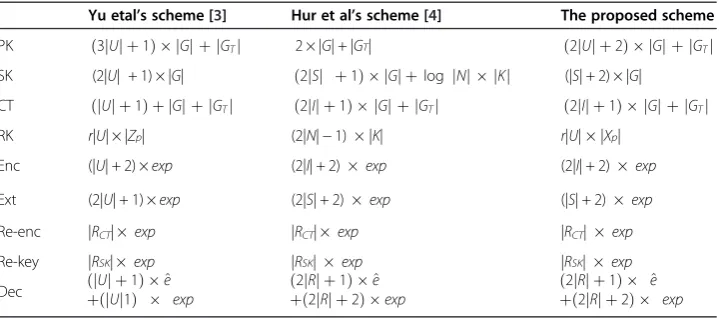
In Table 1, we give two comparisons of the proposed scheme with the schemes of [3,4] that can revoke the only specified attributes. The first comparison is in terms of the size of the public key (PK), the secret key (SK), the ciphertext (CT), and the re-encryption key (RK). The second comparison is in terms of the computation amount of encryption (Enc), secret key generation (Ext), re-encryption (Re-enc), decryption (Dec), and secret key update (Re-key). As to the size of the public key, the scheme of [4] has the smallest one, followed by the proposed scheme. As for the size of the secret key,
Table 1 Key Size, Ciphertext Size and Computation Amount
Yu etal’s scheme [3] Hur et al’s scheme [4] The proposed scheme
PK ð3j j þU 1Þ j j þ jG GTj 2 × |G| + |GT| ð2j j þU 2Þ j j þ jG GTj
SK (2|U| + 1) × |G| ð2j j þS 1Þ j j þG log j j jN Kj (|S| + 2) × |G|
CT ðj j þU 1Þ þj j þ jG GTj ð2j j þI 1Þ j j þ jG GTj ð2j j þI 1Þ j j þ jG GTj
RK r|U| × |Zp| (2|N|−1) × |K| r|U| × |Xp|
Enc (|U| + 2) ×exp (2|I| + 2) × exp (2|I| + 2) × exp
Ext (2|U| + 1) ×exp (2|S| + 2) × exp (|S| + 2) × exp
Re-enc |RCT| × exp |RCT| × exp |RCT| ×exp
Re-key |RSK| × exp |RSK| ×exp |RSK| × exp
Dec ðþj j þUðj jU11Þ Þ ^eexp ðþ2ðj j þR2j j þR 1Þ 2Þ e^exp þð2ðj j þR2j j þR 1Þ 2Þ ^eexp
Exp:ex ponentiation inG,ê: bilinear pairing, |U|: the number of attributes defined in the system, |S|: the number of attributes in user’s key,
|R| the number of user’s attributes satisfying an acces structure, r: the number of times the attribute revocation event occurs, |RSK|: the number of updated attributes (secret key),
the proposed scheme has the smallest one. Both the proposed scheme and the scheme of [4] have equally the smallest size ciphertexts. As to the size of the re-encryption key, if there are users more than the number of attributes, both the proposed scheme and the scheme of [3] have the equally smallest one.
As for the computation amount of encryption and decryption, the proposed scheme and the scheme of [4] have the equally smallest. As to the computation amount of se-cret key generation, the proposed scheme has the smallest. Finally, as to the computa-tion amount of re-encrypcomputa-tion and secret key update, all schemes have the same.
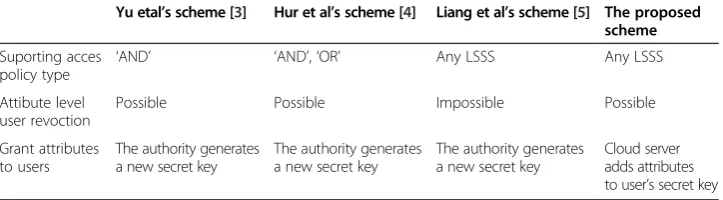
The differences, in terms of the requirements in Section I, between the proposed scheme and the schemes of [3-5] are summarized as shown in Table 2.
Conclusion
This paper proposed a ciphertext-policy attribute-based encryption scheme delegating attribute revocation processes to Cloud Server by proxy re-encryption. Cloud Server re-encrypts a ciphertext and updates a secret key by updating attribute key with PRE key for updating the attribute keys.
The proposed scheme meets three requirements as follows; First, the proposed scheme supports any LSSS access structure. Second, the authority can only revoke specified attribute by updating attribute key included in ciphertext corresponding to his attributes which are revoked. Finally, when granting attributes to a user, generation of a new secret key becomes unnecessary because Cloud Server generates secret key com-ponents corresponding to granting attributes.
The proposed scheme is secure against attack by unauthorized users and Cloud Server. Our future direction is to implement the proposed scheme and confirm its feasibility.
Competing interests
The authors declare that they have no competing interests.
Authors’contributions
TN designed the study and drafted the manuscript. MM and YS conceived of the study, participated in the design and drafting the article and revising it critically for intellectual content. They reviewed and approved the final, submitted version. All authors read and approved the manuscript.
Authors’Information
TN received B.E. degree from Nagoya Institute of Technology, Japan, in 2013. He is a graduate student of the institute. His current research interests include information security, cryptography. He received DICOMO2013 symposium Paper Awards and Presentation Awards in 2013. He is a member of IPSJ.
MM received B.E. and M.E. degrees from Ehime University, Japan, in 1993 and 1995 respectively. She received Ph.D degree in Engineering from the University of Tokushima, Japan in 2002. From 1995 to 1998 she was an assistant professor at the Department of Management and Information Science, Kagawa junior college, Japan. From 1998 to 2002 she was a research associate of the Department of Information Science and Intelligent Systems, the University of Tokushima, Japan. From 2003 to 2008 she was a lecturer of the same department. Since 2008, she has been an
Table 2 Comparison of Schemes
Yu etal’s scheme [3] Hur et al’s scheme [4] Liang et al’s scheme [5] The proposed scheme
Suporting acces policy type
‘AND’ ‘AND’,‘OR’ Any LSSS Any LSSS
Attibute level user revoction
Possible Possible Impossible Possible
Grant attributes to users
The authority generates a new secret key
The authority generates a new secret key
The authority generates a new secret key
associate professor at the Information and Multimedia Center, Gifu University, Japan. Her research interests are in coding theory, information security and cryptography. She is a member of IEEE and a senior member of IEICE. YS received B.E. and M.E. degrees from Ehime University, Japan, and Ph.D degree from the University of Tokushima, Japan, in 1995, 1997, and 2000, respectively. From 2002 to 2006 he was a lecturer at the Department of Informatics, Kinki University, Japan. From 2006 to 2013 he was an associate professor at the Department of Computer Science and Engineering, Nagoya Institute of Technology, Japan. Since 2013, he has been an associate professor at the Department of Electrical and Electronic Engineering, Kobe University, Japan. His current research interests include information security, cryptography, computer network, and knowledge sharing and creation support. He received the SCIS 20th Anniversary Award and the SCIS Paper Award from ISEC group of IEICE in 2003 and 2006, respectively. He is a member of IEEE, ACM and a senior member of IEICE, IPSJ.
Author details
1Nagoya Institute of Technology, Nagoya, Japan.2Gifu University, Gifu, Japan.3Kobe University, Kobe, Japan.
Received: 30 October 2013 Accepted: 6 March 2015
References
1. Bethencourt J, Sahai A, Waters B (2007) Ciphertext-policy attribute-based encryption. In: Paper presented at the 2007 IEEE Symposium on Security and Privacy, Oakland., 20–23 May 2007
2. Waters B (2011) Ciphertext-policy attribute-based encryption: an expressive, efficient, and provably secure realization. In: Paper presented at the 14th International Conference on Practice and Theory in Public Key Cryptography, Taormina., 6–9 March 2011
3. Yu S, Wang C, Ren K, Lou W (2010) Attribute based data sharing with attribute revocation. In: Paper presented at the 5th ACM Symposium on Information. Computer and Communications Security, Beijing, 13 April 2010 4. Hur J, Nor D.K (2011) Attribute-based access control with efficient revocation in data outsourcing systems.
doi:10.1109/TPDS.2010.203.
5. Liang X, Lu R, Lin X, Shen X (2011) Ciphertext policy attribute based encryption with efficient revocation. http://bbcr.uwaterloo.ca/~x27liang/papers/abe%20with%20revocation.pdf.
6. Beimei A (1996) Secure schemes for secret sharing and key distribution. Dissertation, Israel Institute of Technology.
Submit your manuscript to a
journal and benefi t from:
7 Convenient online submission
7 Rigorous peer review
7 Immediate publication on acceptance
7 Open access: articles freely available online
7 High visibility within the fi eld
7 Retaining the copyright to your article