International Journal of Emerging Technology and Advanced Engineering
Website: www.ijetae.com (ISSN 2250-2459, ISO 9001:2008 Certified Journal, Volume 6, Issue 11, November 2016)
105
An Efficient Secure & Scalable Mobile Application using Key
Policy based Elliptic Curve Cryptography Algorithm in Cloud
Sadaf Hussaini
1, Prof. Amit Saxena
21M.E (CSE), Scholar, Truba Institute of Engineering & IT 2SAssociate Professor & Head, CSE
Abstract—Here in this tabloid an innovative and Upgraded algorithm for Security in Mobile Application in Clouds is implemented using Key Policy based Elliptic Curve Cryptography Algorithm. The Wished-for Methodology implemented here is centered on the Concept of Secrete Data Sharing over Mobile Clouds. The Methodology implemented here is centered on the Concept of Providing User Revocation by the Public Verifier using a Group Signature and then applying Elliptic Curve based Key Generation for the Secure Sharing of Data concluded Public Clouds. The Methodology implemented here provides resourceful Manager Reversal with Key Policy based Authentication and provides better Auditing Time and Communication Cost as equated to the Surviving Methodology implemented for Data Sharing.
Keywords—Mobile Clouds, Elliptic Curve Cryptography, Key Policy, Attribute based Encryption.
I. INTRODUCTION
Clouds data storage services bring many difficult propose problems, significantly payable to the failure of substantial control. These confronts have considerable manipulate arranged the facts security and concerts of cloud methods. Cloud computing considered as the expectations IT design, and still guarantees to make available unrestricted and expandable storage space store and other computing stores as a overhaul to haze consumers in a very gainful technique [1]. Now a day‘s cloud computing is a reasonably extended knowledge to accumulate data from more than one user. Lots of data of huge quantity are uploaded in the digital environment which involved lots of storage space & computing stores. The cloud is analogical to the internet the cloud computing is based on cloud illustrations utilized in the before time stage to be an illustration of telephone networks and subsequently to represent internet. Efficient pursuit on scrambled facts is also an important anxiety in clouds. The cloud user should not know the query but should be gifted to arrival the records that satisfy the query. This is accomplished by revenue of searchable encryption [2], [3]. The keywords are sent to the haze encrypted and the cloud come backs the consequence without knowing the actual keyword for the search.
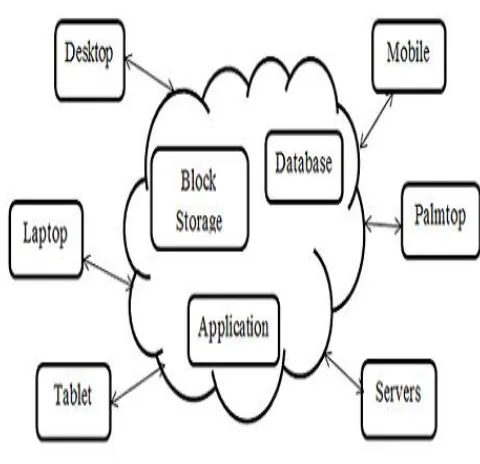
[image:1.612.331.571.305.537.2]The delinquent now is that the facts proceedings ought have keywords allied through them to aid the exploration. The exact archives are returned only when searched with the exact keywords.
Figure 1: Cloud Data Stowing
International Journal of Emerging Technology and Advanced Engineering
Website: www.ijetae.com (ISSN 2250-2459, ISO 9001:2008 Certified Journal, Volume 6, Issue 11, November 2016)
106
The proposed [4] protocol has been recognized on viability accepted mobile and cloud proposals to show real-world standards which determine the usefulness of the manner. Much of the data accumulated in clouds is highly susceptible such as medical records and social networks data. Even haze stowing is spare mutable how the shelter trials and secrecy are reachable for the subcontracted data converts a serious uneasiness. On the further hand, the consumer should authenticate it before starting any deal and alternatively, it must be make sure that the cloud does not modify with the data that is outsourced. Cloud user confidentiality is also want therefore that the cloud user or other users do not recognize the appearances of the consumer. To right of entry a make safe data transaction in the haze the suitable cryptographic method is operated. The data titleholder essential encrypt the organizer and formerly accumulate the file in the haze server. If a third persondownloads the file consumers may analysis the
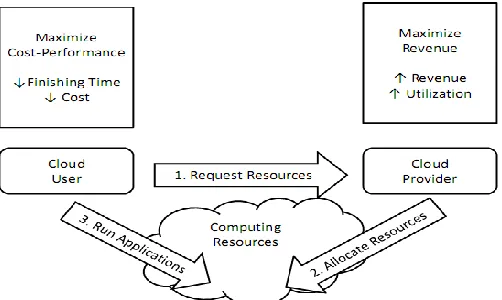
[image:2.612.50.291.439.616.2]documentation if the consumer had the key which is utilized to decrypt the encrypted heading. Occasionally this might be a malfunction owed to the knowledge development and the hackers. The cloud can embrace the client answerable aimed at the facts it outsources and similarly the cloud is itself answerable for the services it make available. The asset of the purchaser who accumulates the data is also demonstrated.
Figure 2: Basic Cloud Computing Model
II. THEORETICAL BACKGROUND
Now a day‘s cloud computing is an expanded knowledge to accumulate data from more than one user. Cloud computing is an atmosphere that allows consumers to accumulate the data storage.
Remote backup scheme is the sophisticated idea which decreases the expenditure for applying more memory in an association. It facilitates activities and government organization diminishes their economic operating cost of data management. They can documentation their data backups somewhat to third party cloud storage contributors to a certain extent than sustain data centers on their individual. Various explanations may be imagined to switch encrypted data with a haze provider in a protected way, such thereby the cloud provider is not openly entrusted with key objects but naive methods frequently demonstrate difficult to level. For instance, the main problem of a proposal centered on the exploit of a communal vital management scheme such as RSA [5].
Deputation re-encryption is a cryptographic scheme expanded to envoi the decryption accurate since one festivity (the delegator) to alternative (the envoi). In a proxy re-encryption (PRE) method, the delegator allocates a crucial to a commission to re-encrypt all e-mails scrambled thru his own communal vital such therby the re-encrypted ciphertexts canister be decrypted with the delegatee‘s sequestered key. The delegation is a semi-trusted entity i.e. it is trusted to complete only the ciphertext re-encryption without identifying the private keys of the delegator and the delegatee, and lacking having exact to practice to the plaintext. To resolve this difficulty, an unusual solution
could be that the delegator decides a different key pair for
[image:2.612.328.579.462.612.2]each delegatee, which is also improbable.
Figure 3: Cloud Tradition Scenario over on cloud environment.
III. LITERATURE SURVEY
International Journal of Emerging Technology and Advanced Engineering
Website: www.ijetae.com (ISSN 2250-2459, ISO 9001:2008 Certified Journal, Volume 6, Issue 11, November 2016)
107
The means obligates stayed modified so that a facts holder and a trusted authority co-operate in the keygeneration and encryption processes such that
computationally-intensive cryptographic operations and requests are minimized for the facts owner; this is of importance to a population of mobile users that must conserve their consumption of battery and usage of wireless communication. In particular, the user is not required to perform costly pairing operations; instead, they are delegated to the executive and haze provider. Similarly, the supervisor multiplies the decryption vital, not the facts possessor, and it assists with key distribution on behalf of the owner. Additionally, an amalgam decorum is proposed that optionally allows message encryption based on a group key, allowing the user membership to be further refined for highly sensitive data.
Additionally, it allows re-encryption to occur, and thus revocation to become efficient without necessitating existing common remedies and their limitations; an example is the expiration of attributes specified in the attribute-based policy that show the ways to regular key keep informed as spell lapses. The suggested decorum is analogous in inclusive concert to the inventive cipher
text-policy attribute-based-encryption clue, whereas
significantly lessening the computational and traffic encumbrance on the mobile statistics possessor in a structure anywhere facts updates and encryption activities are frequent and dominant. Thus, the proposal [4] is useful for securing portable haze multiplying with very large user populations.
Alternative correlated slog advises the merger of ABE through commission re-encryption, consenting fine-grained entree governor of assets whereas offloading re-encryption activity to the haze provider [9]. It has numerous differences to the scheme that will be proposed. The facts holder is elaborate in spawning a vital aimed at individually
new manager that intersections or verdures the
classification, relatively than offloading this task; it is not individual an unaffordable cost for a itinerant handler, but also unusable allocated to the handler‘s suppleness. Auxiliary renovation is that a clandestine key must be redeveloped and re-distributed for separately user, in sluggish approach, when user revocation occurs relatively than allocating consumers to elevation a communal cluster key, which reduces the communication cost and results in higher efficiency. Furthermore, the re-encryption occurs due to attribute re-definition and the scheme is based on KP-ABE (Key-Policy Attribute-Based Encryption) and not CP-ABE, where the ciphertext is associated with a policy.
In this tabloid author has proposed a new method Hierarchical Identity-Based Encryption (HIBE) and CP-ABE, using hierarchical domain masters to allocate user keys; this is finished at the expenditure of improved storage space constraints for key substance held by clients and a greater amount of dealing out when generating ciphertext. A technique of reliable data allotment has been suggested that utilizes a enlightened elliptic camber encryption pattern [10]. On the new hand, it trusts upon a essayist uploading encrypted data to the haze and then allocating credentials to the haze to achieve re-encryption and also to the reader on each data precise to procedure challenge; this is clearly impractical when applied to resource-constrained devices and networks.
In this paper author has [11] consuming Secure Hash algorithm for authentication purpose SHA is the one of more than a few cryptographic hash functions, most frequently exploited to confirm that a heading has been unaffected. Here they are using the Paillier cryptosystem is a probabilistic asymmetric algorithm for public key cryptography. Withdrawn consumers cannot contact data consequent to they have been revoked. The suggested method is flexible to replay attacks. An author whose attributes and explanations have been repealed cannot carve posterior decayed information. The protocol sustains several speak and carves on the data stockpiled in the haze server. These charges are similar to the subsisting federal approaches and the exclusive procedures are more often than not done by the cloud user. According to this proposing algorithm a cloud consumer can produce a file and accumulate it strongly in the haze. This method consists of utilize of the two etiquettes ABE besides ABS. The cloud confirms the legitimacy of the buyer without identifying the user‘s characteristics before storing data on cloud server. The method also has the further characteristic of precise to use control in which only legitimate consumers are able to decrypt the accumulated information. The cloud manipulator organizes not recognize the features of the purchaser who stores information, but only confirm the user‘s documentations. Key sharing is through in a distributed method and also conceals the attributes and exact to use procedure of a client. One drawback is that the cloud recognizes the access rule for each confirmation accumulated in the haze. This method avoids replay attacks and maintains conception, alteration, and reading data accumulated in the haze server.
International Journal of Emerging Technology and Advanced Engineering
Website: www.ijetae.com (ISSN 2250-2459, ISO 9001:2008 Certified Journal, Volume 6, Issue 11, November 2016)
108
Here they inductee the novel cryptosystem for all right grained distribution of encrypted data that we identifyKey-Policy Aspect Based Encryption (KPABE). In
cryptosystem, ciphertexts are tagged with sets of characteristics and private keys are correlated with exact to use compositions that control which ciphertexts a consumer is proficient to decrypt. Fine-grained exact to use control methods make easy compromise differential exact to use rights to a set of consumers and permit elasticity in identifying the right of entry rights of individual consumers. Numerous methods are known for executing fine grained right of entry control. Secret-sharing schemes (SSS) are utilized to partition a furtive mid a numeral of bashes.
In this paper author Matthew Pirretti and Brent Waters [13] introduce a new protected information management design based on promising attribute-based encryption (ABE) primitives moreover they suggest cryptographic optimizations in Secure Aspect Based Systems. Various performance analyses of ABE scheme and illustration applications show the capability to diminish cryptographic costs by as much as 98% over earlier suggested method creations. During this, shows that the attribute scheme is a proficient explanation for strongly administration evidence in big data, loosely-coupled method, distributed schemes. Decryption decrypts a ciphertext encrypted by the Encryption. This procedure starts with the decrypting party confirming that they obligate the entailed attributes. The parties performing arts of decryption will then utilize their attributes towards decrypt the ciphertext to facilitate obtain the AES and HMAC key.
John Bethencourt, Amit Sahai, Brent Waters [14] here
author initiates Ciphertext-Policy Attribute-Based
Encryption. They employ a desired attendant to accumulate the statistics and arbitrate admittance rheostat. Various distributed methods a client ought to only be proficient to exact to practice data if a consumer groups an assured established of badges or aspects. At extant, the merely way for put into effect such policies are to make use of a reliable waitron to accumulate the data and mediate entree rheostat. On the further hand, if any server storing the data is collaborated then the confidentiality of the data will be cooperated. Besides, they make available an accomplishment of our method and give presentation dimensions. The most important confront in this contour of effort is to get a novel schemes with well-designed shapes of appearance that manufacture more than a random arrangement of procedures.
In this tabloid author S. Marium proposed a new algorithm of Extensible authentication protocol (EAP) during three ways handshaking method with RSA algorithm. Here they proposed distinctiveness constructed monogram for hierarchical strategy. They also afford a validation protocol for haze calculating (APCC) [15]. APCC is more person of little consequence and well-organized as evaluated to SSL authentication protocol. In this, Challenge–handshake authentication protocol (CHAP) is castoff for authentication persistence. When create demand for any data or slightly package on the haze. The Provision earner authenticator (SPA) sends the first request for client uniqueness. The phases are as follows:
1)Initially when cloud user entreaty for somewhat amenity
to haze deal earner SPA send a CHAP call/challenge to the haze user.
2)The user sends CHAP call/challenge which is computed
by expending a hash function to SPA.
3)SPA confirms the test value with its individual estimated
value. Unknown they are equivalent then SPA sends CHAP success message to the haze user.
Accomplishment of this EAP-CHAP in cloud computing provides confirmation of the cloud user. It makes available safety measures besides spoofing characteristics stealing, data tempering hazard and DoS attack. The data is being moved between cloud user and fog earners. To afford
protection, disproportionate key encryption (RSA)
procedure is castoff.
International Journal of Emerging Technology and Advanced Engineering
Website: www.ijetae.com (ISSN 2250-2459, ISO 9001:2008 Certified Journal, Volume 6, Issue 11, November 2016)
109
Due to wide-spread protection and performance analysis give you an idea about that the wished-for process is extremely proficient and flexible adjacent to replay attacks. User revocation and exact to use control policies extremely adds to preserve missing from exploitation of cloud services and contribute to knowledge concerns. The threats that canister be defeat are data failure, lacking confidence of APIs, Denial of Service, exploitation of cloud services, shared technology concerns. When data failure or altered form of the element in a file happens it canister be improved using file recovery choices.Markulf Kohlweiss, Ueli Maurer, Cristina Onete, Bjorn Tackmann, Daniele Venturi [17-25] have been presented Anonymity-preserving Public-Key Encryption: A Constructive Approach where public-key cryptosystems with enhanced security properties have stayed wished-for to examine structures with inadequacies for preserving receiver secrecy when using public-key encryption (PKE). They use the constructive cryptography approach by Maurer and Renner and understand cryptographic methods as creations of a definite best store (e.g. a secret unspecified channel) from given valid stores (e.g. a transmit channel). Here they characterize suitable secret announcement stores and demonstrate that a very usual store can be created by expending a PKE method which accomplish three properties that become visible in cryptographic text. Experimental outcomes do not only sustain the confidence in subsisting methods and manufactures; they also demonstrate that the simpler and more competent inadequately strong methods canister be developed securely.
IV. PROPOSED METHODOLOGY
Create a Haze Recreation Environment with ‗N‘ number of Cloudlets and Brokers and Data Centres and Virtual Machines.
The Anticipated Methodology implemented here works on the Following Phases:
1. Create a Haze Recreation Environment.
2. Users of the Clouds need to register on the cloud if they
want to access or Share Data over Clouds.
3. As soon as the registration is done a group Signature is
allotted to the respective User, separately of the Users desires to be Verifier by the Public Verifier.
4. When Public Verifier verifies Users of the Group, and
by exhausting Group Signature Users can Share Data over Cloud.
The anticipated methodology works on the following four phases:
1. Setup
2. Key Generation 3. Encryption 4. Decryption
SETUP PHASE & KEY GENERATION
During the setup of the anticipated methodology the parameters of the cloud desires to be initialize such as users, brokers and data centres as well as the physical characteristics of the cloud also desires to be setup.
Since Elliptic Curve Cryptography is used here for the generation of public and private keys, hence the basis elliptic curve equation of the form:
Here sender and receiver need to select a private random point on the elliptic curve and a common base point G. From the generated private and Base point public key is generated using,
Where, ‗x‘ is the private key and G is the common base point and ‗y‘ is the public key.
ENCRYPTION
For the encryption of the message with a keyword ‗K‘ using public key that can be derived from string ‗str‘. For every string that contains a keyword and data and time known as ‗str‘. First of all generate a public key for the known bit string and applying identity based encryption to obtain ciphertext ‗C‘.
DECRYPTION
The receiver for the decryption of the ciphertext ‗C‘ uses his private key to generate original message m‘.
ALGORITHM
1.Setup the cloud situation with a quantity of users and
data centres and brokers having their individual physical characteristics.
2.User ‗Ui‘ when sends the data to the data centre will
generate a keyword and create a string ‘str‘.
3.User ‗Ui‘ using his public key encrypt the data and send
to the storage repository in the form of tupple (keyword, cipher text).
4.User ‗Ui‘ also allots a unique id and password for the
receiver for the access of the data.
5.Te receiver needs to authenticate first for the data to
International Journal of Emerging Technology and Advanced Engineering
Website: www.ijetae.com (ISSN 2250-2459, ISO 9001:2008 Certified Journal, Volume 6, Issue 11, November 2016)
110
6. After authentication receiver ‗R‘ sends query in form of
keyword to the central authority where on the foundation of attribute the queries are fetched with the match keyword.
7. Receiver accesses the data in encrypted form and
performs decryption using private key.
8.
Receiver also verifies the message is valid or not usingMessage Authentication Code.
FLOWCHART
Add Receiver
(Att, Enc)
Access Permission
[image:6.612.43.278.234.448.2]Decrypt Data
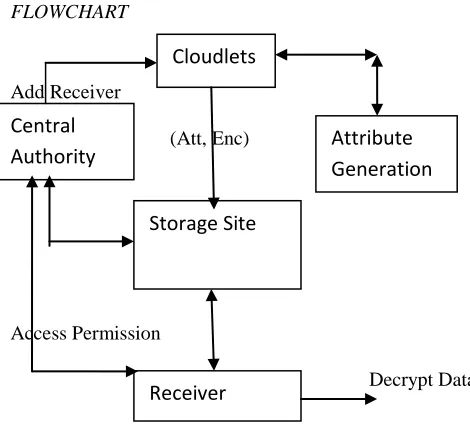
Figure 4 Flow Chart of the methodology
The figure shown above is the flow chart of the Planned Technique, it contains a number of users central authority known as broker and receiver or data centre. First of all users can generate data and also generates attribute for the generated data from user and send to the storage panel. The user also adds receiver for authentication. The receiver then access data using attribute and decrypt the data using ECIES.
The elliptic curve integrated encryption system (ECIES) is the standard elliptic curve based encryption algorithm. It is a public-key encryption algorithm. It uses of domain parameters (K,E,q,h,G). It allows us to use symmetric encryption/decryption functions Ek(m) and Dk(c) by our choice which is easy to encrypt long messages. It uses elliptic curve encryption technique to choose the asymmetric public and private keys that is Y and X. The elliptic curve‘s equation is
E: y2 = x3 + ax + b
Step 1- Client has the data called message M and public key Y of reader and chooses a random number K from range R(1….. q-1) where q is a prime number.
Step 2- Client computes U <- [K]G , where G is a common base point, K is selected random number.
Step 3- Client computes T <- [K]Y, where Y is a public key of reader, K is selected random number.
Step 4- Client computes keys k1 and k2 by applying key derivation function. (k1ǀǀ k2) <- KD (T ,l ), where T is the value computed in step 3 and l is the length of T.
Step 5- Client Encrypt the message by xor based encryption technique by using k1(step 4) as a key.
Ciphertext C<- E k1 (M)
Where E is encryption function k1 is key and M is message or data.
Step 6- Client computes a message authentication code r
r <- MAC k2 (C)
Where MAC is a hash function, k2 is key (step 4) and C is a cipher text (step 5)
Step 7- Client sends (U, C, r) and identity of message to the central data base (TTP).
If Receiver wants to access any data then it first have to authenticate itself to TTP by its prefix password, if password does match TTP allows reader to access the client‘s encrypted data then receiver can access the data.
Step 1- Receiver receives client‘s data (U, C ,r) and apply his private key X to decrypt the data. it computes
T <- [X]U
Here U is received MAC and X is a private key of receiver.
Step 2-Compute (k1ǀǀk2) <- KD(T ,l )
Here KD is key derivation function, T computed in step 1 and l is length of T.
Step 3- Receiver decrypt the cipher text and compute original message M
M <- DK k1 (C)
Here C is received cipher text DK is xor based decryption and k1 is key computed in step 2.
Step 4- Receiver computes MAC r‘
r‘ <- MAC k2 (C)
Cloudlets
Attribute
Generation
Central
Authority
Storage Site
International Journal of Emerging Technology and Advanced Engineering
Website: www.ijetae.com (ISSN 2250-2459, ISO 9001:2008 Certified Journal, Volume 6, Issue 11, November 2016)
111
Here MAC is hash function k2 is key computed in step 2. and C is received cipher text.Step 5- Compare received r to computed r‘
If r = r‘
Then message M is correct, the receiver accept the message, otherwise discard it.
V. RESULT ANALYSIS
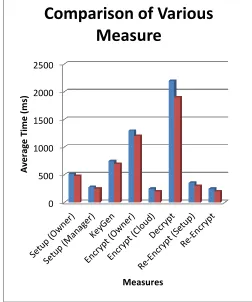
[image:7.612.323.576.157.311.2]The Table shown below is the analysis and comparison of Average Time on various procedures such as at the time of Setup and Key Generation and Encryption, Decryption. The Planned Technique implemented here provides less Average Time in Comparison with the Existing Methodology.
Table 1. Analysis of Average Time
Average Time (ms)
Measures Piotr et. al’s
Work
Sadaf et. al’s Work
Setup (Owner) 520 480
Setup (Manager) 280 250
KeyGen 750 700
Encrypt (Owner) 1300 1200
Encrypt (Cloud) 250 200
Decrypt 2200 1900
Re-Encrypt (Setup) 360 300
Re-Encrypt 250 200
The Table shown below is the analysis and comparison of Communication Time on various procedures such as at the time of Setup and Key Generation and Encryption, Decryption. The Planned Technique implemented here provides less Average Time in Comparison with the Existing Methodology.
Table 2.
Analysis of Communication (ms)
Communication (ms)
Activity Piotr et. al’s
Work
Sadaf et. al’s Work
Initial Encryption,
key Setup 3.1 2.6
Decryption 2 1.5
Re-encryption 0.4 0.21
[image:7.612.43.298.342.599.2]The Figure shown below is the analysis and comparison of Average Time on various procedures such as at the time of Setup and Key Generation and Encryption, Decryption. The Planned Technique implemented here provides less Average Time in Comparison with the Existing Methodology.
Figure 5. Comparison of Average Time
0 500 1000 1500 2000 2500
A
ve
rag
e
Ti
m
e
(
m
s)
Measures
[image:7.612.322.574.400.702.2]International Journal of Emerging Technology and Advanced Engineering
Website: www.ijetae.com (ISSN 2250-2459, ISO 9001:2008 Certified Journal, Volume 6, Issue 11, November 2016)
[image:8.612.51.301.215.464.2]112
The Figure shown below is the analysis and comparison of Communication Time on various procedures such as at the time of Setup and Key Generation and Encryption, Decryption. The Planned Technique implemented here provides less Average Time in Comparison with the Existing Methodology.Figure 6. Comparison of Communication (ms)
VI. CONCLUSION
At the present time, cloud computing became a big computing standard for data storage on cloud server. Number of cloud users and cloud providers grow rapidly. As the number of cloud providers increases select a trusted service became tedious because various fake user may try to know the encryption and decryption key. The checking method is essential to resolve the cloud integrity issues to satisfy user‘s privacy concerns. The Planned Technique implemented here provides efficient Communication Cost and Time as well as can be implemented for large number
of users for Data Sharing.
REFERENCES
[1] M. Armbrust, A. Fox, R. Griffith, A. D. Joseph, R. H. Katz, A. Konwinski, G. Lee, D. A. Patterson, A. Rabkin, I. Stoica, and M. Zaharia, ―Above the clouds: A berkeley view of cloud computing,‖ University of California, Berkeley, Tech. Rep. USB-EECS-2009-28, Feb 2009.
[2] J. Li, Q. Wang, C. Wang, N. Cao, K. Ren, and W. Lou, ―Fuzzy Keyword Search Over Encrypted Data in Cloud Computing,‖ Proc. IEEE INFOCOM, pp. 441-445, 2010.
[3] S. Kamara and K. Lauter, ―Cryptographic Cloud Storage,‖ Proc.14th Int‘l Conf. Financial Cryptography and Data Security, pp. 136-149, 2010.
[4] Piotr K. Tysowski and M. Anwarul Hasan, ―Hybrid Attribute- and Re-Encryption-Based Key Management for Secure and Scalable Mobile Applications in Clouds‖ IEEE 2013.
[5] R. L. Rivest, A. Shamir, and L. Adleman, ―A method for obtaining digital signatures and public-key cryptosystems,‖ Commun. ACM, vol. 26, no. 1, pp. 96–99, Jan. 1983
[6] M. Armbrust, A. Fox, R. Griffith, A. D. Joseph, R. Katz, A.
Konwinski, G. Lee, D. Patterson, A. Rabkin, I. Stoica, and M. Zaharia, ―A view of cloud computing,‖ Commun. ACM, vol. 53, pp. 50–58, Apr. 2010.
[7] B. Hore, S. Mehrotra, M. Canim, and M. Kantarcioglu, ―Secure
multidimensional range queries over outsourced data,‖ The VLDB Journal, vol. 21, no. 3, pp. 333–358, 2012.
[8] Tim Mather, Subra Kumaraswamy, Shahed Latif Cloud Security and Privacy: An Enterprise perspective of Risks and Compliance, O'Reilly Media, Inc., 2009.
[9] S. Yu, C. Wang, K. Ren, and W. Lou, ―Achieving secure, scalable, and fine-grained data access control in cloud computing,‖ in Proceedings of the 29th conference on Information communications, ser. INFOCOM‘10. Piscataway, NJ, USA: IEEE Press, 2010, pp. 534–542.
[10] G. Zhao, C. Rong, J. Li, F. Zhang, and Y. Tang, ―Trusted data sharing over untrusted cloud storage providers,‖ in Proceedings of the 2010 IEEE Second International Conference on Cloud Computing Technology and Science, ser. CLOUDCOM ‘10. Washington, DC, USA: IEEE Computer Society, 2010, pp. 97–103. [11] M. Suriyapriya, A. Joicy, ―Attribute Based Encryption with Privacy
Preserving In Clouds‖ International Journal on Recent and Innovation Trends in Computing and Communication Volume: 2 Issue: 2 February 2014.
[12] V. Goyal, O. Pandey, A. Sahai, and B. Waters, ―Attribute-Based
Encryption for Fine-Grained Access Control of Encrypted Data,‖ Proc ACM Conf. Computer and Comm. Security, pp. 89-98, 2006.
[13] W. Wang, Z. Li, R. Owens, and B. Bhargava, ―Secure and Efficient
Access to Outsourced Data,‖ Proc. ACM Cloud Computing Security Workshop (CCSW), 2009
[14] J. Bethencourt, A. Sahai, and B. Waters, ―Ciphertext-Policy
Attribute-Based Encryption,‖ Proc. IEEE Symp. Security and Privacy May 2006.
[15] S. Marium, Q. Nazir, A. Ahmed, S. Ahthasham and Aamir M. Mirza, ―Implementation of EAP with RSA for Enhancing The Security of Cloud Computing‖, International Journal of Basic and Applied Science, vol 1, no. 3, pp. 177-183, 2012.
[16] Keerthi B, V Rajesh kannan, ―Implementation of Attribute Hiding Strategy and Key Revocation in Cloud Environment‖ IJISET-International Journal of Innovative Science, Engineering & Technology, Vol. 1 Issue 2, April 2014.
[17] Markulf Kohlweiss, Ueli Maurer, Cristina Onete, Björn Tackmann, Daniele Venturi, ―Anonymity-Preserving Public-Key Encryption: A Constructive Approach‖ 13th International Symposium, PETS 2013, Bloomington, IN, USA, July 10-12, 2013.
0 0.51 1.52 2.53 3.5
Co
m
m
u
n
ic
ation
Ti
m
e
(
m
s)
Activity
International Journal of Emerging Technology and Advanced Engineering
Website: www.ijetae.com (ISSN 2250-2459, ISO 9001:2008 Certified Journal, Volume 6, Issue 11, November 2016)
113
[18] Hur, Junbeom. "Improving security and efficiency in attribute-baseddata sharing", IEEE Transactions On Knowledge And Data Engineering, Vol. 25, No. 10, pp. 2271 – 2282, October 2013. [19] Yu, Shucheng, Cong Wang, Kui Ren, and Wenjing Lou. "Attribute
based data sharing with attribute revocation." In Proceedings of the 5th ACM Symposium on Information, Computer and Communications Security, pp. 261-270. ACM, 2010.
[20] A. Sahai and B. Waters, ―Fuzzy Identity-Based Encryption,‖ Proceedings International Conference on Theory and Applications of Cryptographic Techniques (Eurocrypt ‘05), pp. 457-473, 2005. [21] V. Goyal, O. Pandey, A. Sahai, and B. Waters,
―Attribute-BasedEncryption for Fine-Grained Access Control of Encrypted Data,‖Proceedings of ACM Conference on Computer and Communication Security, pp. 89-98, 2006.
[22] J. Bethencourt, A. Sahai, and B. Waters, ―Ciphertext-PolicyAttribute Based Encryption,‖ Proceedings IEEE Symposium Security andPrivacy, pp. 321-334, 2007.
[23] R. Ostrovsky, A. Sahai, and B. Waters, ―Attribute-Based Encryptionwith Non-Monotonic Access Structures,‖ Proceedings ACM Conference Computer and Comm. Security, pp. 195-203, 2007.
[24] Alfin Abraham, Vinodh Ewards, Harlay Maria Mathew ―A Survey on Optimistic Fair Digital Signature Exchange Protocols‖, International Journal on Computer Science and Engineering (IJCSE), ISSN: 0975-3397, Vol. 3, No. 2, pp. 821 – 825, Feb 2011.