R E S E A R C H
Open Access
A pilot study of the duration of GP
consultations in Ireland
Tom Pierse
1, Luke Barry
1, Liam Glynn
2, Diarmuid Quinlan
3, Andrew Murphy
4and Ciaran O
’
Neill
5*Abstract
Background:General practitioner (GP)-led primary care is the linchpin of health care in Ireland. Reflecting
international trends, there are increasing concerns about the sustainability of the current Irish GP service due to an increasing workload. Objective data on the duration of GP consultations are currently not available in Ireland. The objective of this pilot study is to demonstrate how the duration of consultations can be collected, using readily available administrative data.
Methods:Software was developed to extract the duration of GP consultations using the opening and closing of electronic patient records associated with a GP consultation. GP practices (N= 3) comprising 15 GPs were recruited from a university-affiliated research network. A retrospective analysis of GP consultations with patients with diabetes for the 9 years between 2010 and 2018 was used to assess the feasibility of using this system to measure the duration of consultations.
Results:The average duration of a consultation was 14.1 min for the 9 years spanning 2010 to 2018. Patients had an average time between consultations of 99 days.
Conclusions:This pilot study confirms that an administrative data set can be utilised at negligible cost to monitor GP practice consultation workload over time. Our preliminary pilot data show that GP consultation durations among participating practices were longer than the 5–11.7 min reported in the UK and show an increase over the period. Clearly, a larger number of practices and patients are required to substantiate this finding.
Keywords:GP, Consultation duration, Consultation time, GP workload, Primary care
Background
Population growth, policy measures that have widened access, and population ageing with increasing multi-morbidity have contributed to an increase in demand
for GP services in Ireland [1]. This has coincided with
an increase in emigration among newly trained GPs, an increase in part time working by many existing
GPs [2] and many GPs nearing retirement age [3]. In
the absence of increased training and recruitment, these trends will place increasing pressure on those who remain to deliver an increasingly complicated
and administratively demanding service [4].
The duration of GP consultations varies widely across Europe; in the UK, the average consultation duration has been variously reported at 5 to 11.7 min
whereas in Sweden the average duration is 22 min [5,
6]. Trends in consultation duration are available for a
small number of countries; these indicate stable or
slowly increasing consultation durations [5].
Cur-rently, the only estimates of GP consultation
dura-tions in Ireland are based on GP recall [2]. In a
survey of 462 randomly selected GPs, respondents stated the number of face-to-face consultations that
they would complete in a single clinical session [2].
The majority of GPs (64%) reported seeing 15 pa-tients per session, which suggests 12 min per consult-ation if a 3-h session is assumed [2].
Consultation durations have been shown to be re-lated to the characteristics of the patient, the practice,
the practitioner, and the consultation [7–9].
Import-ant patient characteristics related to increased con-sultation length include the degree of multi-morbidity and to a lesser extent patient age [7, 9–11]. Practice
© The Author(s). 2019Open AccessThis article is distributed under the terms of the Creative Commons Attribution 4.0 International License (http://creativecommons.org/licenses/by/4.0/), which permits unrestricted use, distribution, and reproduction in any medium, provided you give appropriate credit to the original author(s) and the source, provide a link to the Creative Commons license, and indicate if changes were made. The Creative Commons Public Domain Dedication waiver (http://creativecommons.org/publicdomain/zero/1.0/) applies to the data made available in this article, unless otherwise stated.
* Correspondence:[email protected]
characteristics related to the duration of consultations
include the practice workload [11]. Practitioner
char-acteristics associated with the duration of consulta-tions include gender and experience. Orton and
Pereira [12], for example, found that female GPs have
consultations that are longer than their male counter-parts and that doctors registered more than 10 years have shorter consultations than those registered less than 10 years.
While there is a paucity of high-quality evidence on the effects of changing the duration of consultations on outcomes, there are indications of improved quality of care associated with longer consultation durations [5,13,
14]. Increased consultation durations are associated with
increased patient enablement, more accurate diagnosis
of psychological problems [14], more preventative care
[15], and reduced hospital admissions for some
condi-tions [5]. Increased consultation durations have also
been shown to be related to reduced GP stress and burnout [5,10].
There is sparse evidence around the relationship be-tween the length of GP consultations and patient
satis-faction [13, 16]. There is also little evidence on the
extent to which consultation durations are affected by the relationship between the GP and the patient. One study found that patients that were new to a practice had significantly longer consultations [9].
What is abundantly clear is that there is a paucity of evidence based on the use of reliable data collected at scale on the duration of consultations in Ireland. Lacking such evidence, it is challenging to identify if, and why these have changed over time, or what effect this may have had on patient outcomes and satisfac-tion. The aim of this study was to demonstrate, as a proof of principle, how consultation duration data could be readily extracted from software used rou-tinely by Irish GPs. We then outline multiple poten-tial applications of this data source for health service improvement, planning, and research in Ireland. As
defined by Eldridge et al. [17], this is a pilot study
intended to support the conduct of a later and much larger study.
Methods
Practice selection and data extraction
GP practices using the Socrates practice management software were recruited from a university-affiliated re-search network. Information was sent to practices invit-ing them to participate in this study, outlininvit-ing the study aims and how to participate. Participating practices were asked to ensure all practitioners consistently opened and closed patient records before and after each consultation over a 2-week period in 2018. Participating practices also undertook a software upgrade to enable extraction of
study data. As this was a pilot study, it was decided to collect data from three practices. The data from the GP practice software was extracted and anonymised by the Irish College of General Practitioners (ICGP). All data collected was completely anonymised to the researchers.
GP information technology
In Ireland, there are four GP practice management soft-ware packages accredited by the Irish College of General
Practitioners [18]. The Socrates GP software package is
one of these and used by 17.3% of GPs in the West of
Ireland [19]. The Socrates system captures information
entered during a consultation, including test results, re-ferrals, and diagnoses. The duration of consultations is captured by recording the time the patient record is opened at the start of a consultation and closed at the conclusion. This offers a platform through which the
duration of consultations may be identified and
captured.
Data capture in the GP practice
The software to capture the duration of consultations was developed as part of an unrelated diabetes study. The software harvested duration of consultation data solely for those patients with diabetes. The duration of a
consultation was only included when the patients’ file
was accessed for a clinical consultation with a GP; pa-tient files opened for administrative purposes are identi-fiable in the database and were excluded from the analysis. The duration of a consultation was linked to the patient’s data using a unique identifier. The software rounded the duration of consultations to the nearest mi-nute. Data were captured from January 2010 (2 prac-tices) and November 2010 (1 practice) to January 2019 (all practices).
Data validation
The accuracy of the duration of consultation data
de-pends upon the patient’s record being opened at the
Statistical comparison of durations
A log-linear model was used to compare the duration of consultations across GP practices due to right-skewed distribution of the duration variable.
Results
Data on the duration of 13,786 consultations involv-ing 577 individual patients were extracted as part of our study. Complete consultation duration data were available from January 2010 (2 practices) and Novem-ber 2010 (1 practice) to January 2019 (all practices).
The unit of observation of the data is the practice—
individual GPs are not identified. The records of con-sultations are for normal working hours, Monday to Friday.
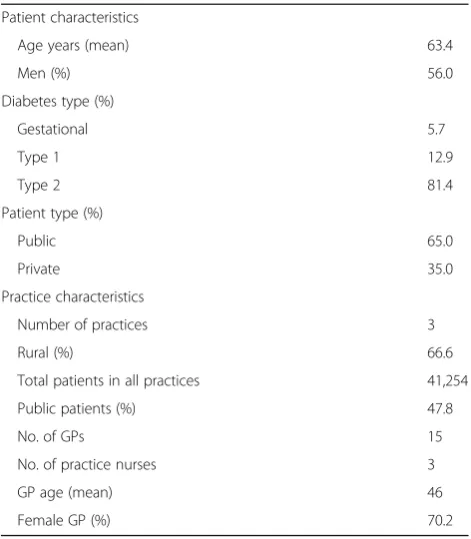
The characteristics of the participating practices and
patients are shown in Table1. While the patient
charac-teristics data is longitudinal, the mean age, gender, dia-betes type, and patient type (public or private) are broadly in line with a previous cross-sectional study of diabetes in Ireland which report both type I and type II diabetes as well as gestational diabetes [20]. Any differ-ences may be a reflection of differdiffer-ences in consultation frequency and the inclusion of different types of diabetes.
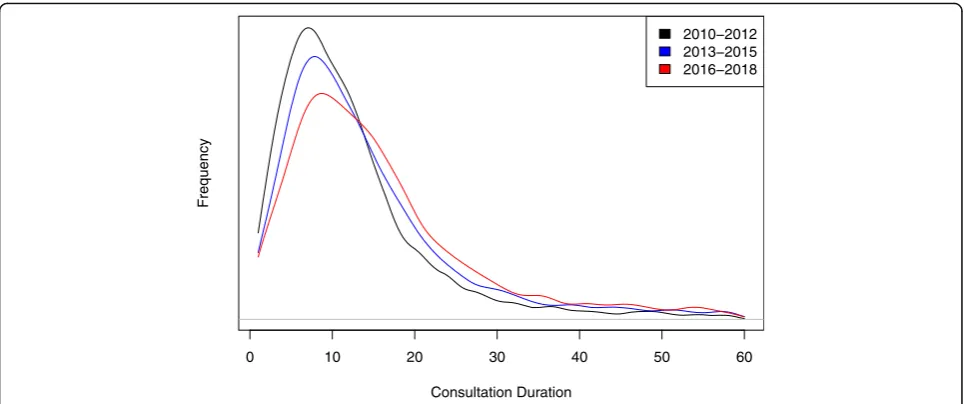
The mean consultation duration was 14.1 min (SD = 10.6), and the mean time between consultations was 99 days. To visualise the distribution of consultation durations and changes in the distribution over time,
we split the data into three time periods, shown in
Fig. 1. The distribution shifts to the right over time
indicating a trend toward longer duration of
consulta-tions. As shown in Table 2, two of the three practices
have had statistically significant increases in consult-ation durconsult-ations between the first and third time periods.
Validation exercise
The validation exercise carried out involved comparing the mean duration of consultations in the period prior to the explicit request that consultation files be closed on termination of the consultation, from 13 to 27 November 2018, with the period from 28 to 11 December 2018. There were a total of 76 and 79 consultations with people with diabetes in each of these periods re-spectively. A comparison of these two periods shows no change in the mean consultation length (14.99 min
vs 14.86 min, pvalue 0.93).
Discussion
This pilot study confirms that Irish GP consultation workload has the potential to be objectively measured over time, using an easily accessible, low-cost data source. There are potentially a wide range of uses for such data. These include monitoring trends in average durations over time to show the effects of policy inter-ventions on GP utilisation, identifying capacity con-straints across the country and the impact of these on consultation times, and assisting GPs to benchmark against each other. With a fuller set of practice records from a large nationwide sample, for all patients and not just those with diabetes, it would be possible to more fully explore these questions. This study though provides a proof of principle with respect to the feasibility of the data collection process.
The usefulness of such data in assessing the impact of policy changes, such as the introduction of univer-sal health care, is self-evident. As we have demon-strated, the data is available as a time series in what appears to be a reliable format that allows the num-ber and duration of each consultation to be mea-sured. While we have only explored the use of the system with respect to patients with diabetes, it could be easily expanded to other patient groups and used to explore the impact of initiatives here. For example, it is proposed to expand the availability of free GP
care to all those aged under 12 years in Ireland [21].
The data could also be used to estimate the cost of a GP consultation for use in health technology assess-ments and indeed bring greater granularity to this in terms of different patient types than is available in
UK sources such as the PSSRU Unit Costs [22].
Table 1Patient and practice characteristics
Patient characteristics
Age years (mean) 63.4
Men (%) 56.0
Diabetes type (%)
Gestational 5.7
Type 1 12.9
Type 2 81.4
Patient type (%)
Public 65.0
Private 35.0
Practice characteristics
Number of practices 3
Rural (%) 66.6
Total patients in all practices 41,254
Public patients (%) 47.8
No. of GPs 15
No. of practice nurses 3
GP age (mean) 46
The data would also be useful in relating the dur-ation of consultdur-ations with the frequency of
consulta-tions [5]. Policies, such as structured diabetes care,
addressing a range of issues during a single consult-ation, will require protected clinical time. Previous studies have found that GP consultation durations may be increased by 2 min for each additional
pre-senting problem [23]. It remains to be seen whether
such extended consultations will reduce the frequency of GP visits.
While only three practices were included in our study and while it was not the focus of our attention, it is in-teresting to note that despite increased demands on GP time, consultation durations increased in two out of the three practices over the period. Whether this is typical of other patient groups or other GP practices is unclear.
Limitations
The data presented in this study are from 3 GP prac-tices with 15 GPs, in a university-affiliated research network, and may not be representative of main-stream Irish GP practice. The duration of consult-ation data collected in this pilot was solely for patients with diabetes, who are not representative of all patients. This clearly limits a broader comparison of the GP duration of consultations, but the proof of concept emerges intact. Similar data could readily be
extracted for other patients, enabling comparisons. Similarly, while we extracted data using an add-on to the Socrates software package, the authors have con-firmed with the ICGP that similar arrangements could be readily implemented in other software platforms.
Future studies attempting to use this data may wish to implement further validation exercises. Information was provided to practices requesting patient files be closed directly after the end of the consultation. While this exercise showed that there was no differ-ence between the periods before and after the explicit request was made, it does not confirm that GPs are using the software in the desired manner. Therefore, there is a risk that consultation durations may be overestimated. This can only be confirmed by
com-prehensive ‘time and motion’ research.
Much of the work on consultation durations have fo-cused on the GP consultation. The practice nurse under-takes a quarter of consultation in UK general practice
[7]. We do not observe in the current data whether the
consultation is nurse or GP provided. This would be a useful addition to the software and has been collected in similar international studies [6,7].
Conclusions
In this study, we have demonstrated that it is feasible to collect the duration of consultations in Ireland, at a Fig. 1Kernel density plot of the duration of consultations for three time periods
Table 2Duration of consultation by practice for three time periods
P1:2010–2012, mean (S.D.) P2:2013–2015, mean (S.D.) P3:2016–2018, mean (S.D.) Diff P1:P3,pvalue
Practice A 17.0 (10.8) 19.5 (11.9) 19.1 (11.9) 0.01
Practice B 13.3 (10.1) 12.8 (9.6) 13.8 (9.6) 0.27
negligible cost using electronic administrative records. We outline the multiplicity of applications for such data including tracking the consultation workload of GPs over time. This is important in the context of increasing demands on GP time due to increasing population, in-creasing multi-morbidity and policy changes such as the move toward universal health care.
Abbreviations
GP:General practitioner; ICGP: Irish College of General Practitioners
Acknowledgements
This study has been supported by funding HRB RL/2013/16 for the study’s conduct and publication costs.
Authors’contributions
CON contributed to all stages of the study from conception to drafting; LB contributed to the design of the study and the acquisition and
interpretation of the data. TP contributed to the analysis and interpreted the data and the drafting of the manuscript. AM contributed to the data acquisition and drafting of the manuscript. LG and DQ contributed to the drafting of the manuscript. All authors read and approved the final manuscript.
Funding
This project was funded by a grant from the Irish Health Research Board.
Availability of data and materials
The data that support the findings of this study are available from the ICGP, but restrictions apply to the availability of these data, which were used under licence for the current study, and so are not publicly available.
Ethics approval and consent to participate
Ethical approval for this study was granted by the Irish College for General Practitioners [ICGP2016.3.02]. Practices consented to participate in the study by completing an anonymous online survey.
Competing interests
The authors declare that they have no competing interests.
Author details
1Health Economic and Policy Analysis Centre, National University of Ireland Galway, Galway, Ireland.2Graduate Entry Medical School and Health Research Institute, University of Limerick, Limerick, Ireland.3Department of General Practice, University College Cork, Cork, Ireland.4Discipline of General Practice, School of Medicine, National University of Ireland Galway, Galway, Ireland. 5Centre for Public Health, Queens University Belfast, Belfast, UK.
Received: 1 August 2019 Accepted: 22 November 2019
References
1. Glynn LG, Valderas JM, Healy P, Burke E, Newell J, Gillespie P, et al. The prevalence of multimorbidity in primary care and its effect on health care utilization and cost. Fam Pract. 2011;28(5):516–23.
2. O'Kelly M, Teljeur C, O'Kelly F, Ni Shuilleabhain A, O'Dowd T. Structure of general practice in Ireland; 2015.
3. Dept. of Health. Health service capacity review. Dublin: Department of Health; 2018.
4. HSE. Medical workforce planning: future demand for general practitioners 2015-2025. Dublin: Health Service Executive; 2015.
5. Irving G, Neves AL, Dambha-Miller H, Oishi A, Tagashira H, Verho A, et al. International variations in primary care physician consultation time: a systematic review of 67 countries. BMJ Open. 2017;7(10):e017902. 6. Hobbs FR, Bankhead C, Mukhtar T, Stevens S, Perera-Salazar R, Holt T, et al.
Clinical workload in UK primary care: a retrospective analysis of 100 million consultations in England, 2007–14. Lancet. 2016;387(10035):2323–30. 7. Stevens S, Bankhead C, Mukhtar T, Perera-Salazar R, Holt TA, Salisbury C,
et al. Patient-level and practice-level factors associated with consultation
duration: a cross-sectional analysis of over one million consultations in English primary care. BMJ Open. 2017;7(11):e018261.
8. Deveugele M, Derese A, van den Brink-Muinen A, Bensing J, De Maeseneer J. Consultation length in general practice: cross sectional study in six European countries. Bmj. 2002;325(7362):472.
9. Britt HC, Valenti L, Miller GC. Determinants of consultation length in Australian general practice. Med J Aust. 2005;183(2):68–71.
10. Mercer SW, Fitzpatrick B, Gourlay G, Vojt G, McConnachie A, Watt GC. More time for complex consultations in a high-deprivation practice is associated with increased patient enablement. Br J Gen Pract. 2007;57(545):960–6. 11. PetekŠter M,Švab I,Živčec KG. Factors related to consultation time:
experience in Slovenia. Scand J Prim Health Care. 2008;26(1):29–34. 12. Orton PK, Pereira GD. Factors influencing consultation length in general/
family practice. Fam Pract. 2016;33(5):529–34.
13. Wilson AD, Childs S, Gonçalves-Bradley DC, Irving GJ. Interventions to increase or decrease the length of primary care physicians’consultation. Cochrane Database Syst Rev. 2016;(8):CD003540.https://doi.org/10.1002/ 14651858.CD003540.pub3.
14. Hutton C, Gunn J. Do longer consultations improve the management of psychological problems in general practice? A systematic literature review. BMC Health Serv Res. 2007;7(1):71.
15. Wilson A, Childs S. The relationship between consultation length, process and outcomes in general practice: a systematic review. Br J Gen Pract. 2002; 52(485):1012–20.
16. Elmore N, Burt J, Abel G, Maratos FA, Montague J, Campbell J, et al. Investigating the relationship between consultation length and patient experience: a cross-sectional study in primary care. Br J Gen Pract. 2016; 66(653):e896–903.
17. Eldridge SM, Lancaster GA, Campbell MJ, Thabane L, Hopewell S, Coleman CL, et al. Defining feasibility and pilot studies in preparation for randomised controlled trials: development of a conceptual framework. PloS One. 2016; 11(3):e0150205.
18. ICGP. Software Companies 2019 [15–07-19]. Available from:https://www. icgp.ie/go/in_the_practice/information_technology/software_companies. 19. Kavanagh KE, O'Brien N, Glynn LG, Vellinga A, Murphy AW. WestREN: a
description of an Irish academic general practice research network. BMC Fam Pract. 2010;11(1):74.
20. Murphy K, McHugh S, Moran J. Diabetes in General Practice Audit Report. Cork: Diabetes in General Practice and UCC; 2010.
21. IMO. Statement: IMO reaches€210m deal with Govt for GP services 2019 [15–07-19]. Available from: https://www.imo.ie/news-media/news-press-releases/2019/statement-imo-reaches-210/index.xml.
22. Curtis L, Burns A. Unit costs of health and social care 2018. Kent: Personal Social Services Research Unit; 2018.
23. Salisbury C, Procter S, Stewart K, Bowen L, Purdy S, Ridd M, et al. The content of general practice consultations: cross-sectional study based on video recordings. Br J Gen Pract. 2013;63(616):e751–e9.
Publisher’s Note