JSARD
Journal of
School
Administration
Research and
Development
ISSN: 2470-850X
The Journal of School Administration Research and Development
J
SARD
JSARD Editorial Board Members
Editor-in-Chief,
James Mullooly, Ph.D., California State University, Fresno
Senior Editor,
M. Anne Visser, Ph.D., University of California, Davis
Senior Editor,
Joshua Kunnath, Ed.D., Principal Research Center, Inc.
Managing Editor
, Brandon Palmer, Ed.D., Principal Research Center, Inc.
Associate Editor,
Randy Schultz, Ed.D., California State University, Bakersfield
The Journal of School Administration Research and Development
J
SARD
Welcome to the Principal Research Center’s second issue of the peer-reviewed Journal of School
Administration Research and Development (JSARD), an open access, online and print publication.
The purpose of the JSARD is to support the mission of the Principal Research Center Inc., which
ad-vocates for the highest quality 21
stcentury education of children through the improvement of
selec-tion and development of school leaders in our naselec-tion’s schools. By publishing high-quality research
and commentaries on school leadership topics, we hope to connect educational stakeholders from
universities, governing agencies, school districts, and other educational organizations interested in
improving education for children in the United States. Our second issue includes articles from
re-searchers and practitioners on topics including school leadership development, sustaining arts
pro-grams in schools, instructional coaching, and beginning teacher development.
The publication of this journal represents a collaboration between researchers and practitioners
currently working in universities, education organizations, and school districts who are actively
pursuing the improvement of leadership selection and development in education. We want to
thank everyone who supported our journal launch in 2016 and we are looking forward to our
sec-ond year publishing the JSARD in Summer and Winter 2017.
Sincerely,
Brandon Palmer
The Journal of School Administration Research and Development
J
SARD
Table of Contents
Q and A Dialogue: Principal Development
5
Troy Mooney, Life Schools, Dallas, TX
Herbert O’Neil, Life Schools, Dallas, TX
The Acclimation of New Assistant Principals
9
Hykeem M. Craft, Sam Houston State University Rene Malveaux, Sam Houston State University Sonja A. Lopez, Sam Houston State University Julie P. Combs, Sam Houston State University
School Leader Relationships: The Need for Explicit Training on Rapport,
19
Trust, and CommunicationKara Lasater, University of Arkansas
Sustaining Arts Programs in Public Education
27
David Dunstan, University of Southern California
Instructional Coaching Implementation: Considerations for K-12 Administrators
37
Kelly Gomez Johnson, University of Nebraska at Omaha
Beginning Teachers' Experiential Learning in the Era of Common Core: A Case Study
41
Loy Dakwa, Northeastern University
T
he ever-changing demands placed on school princi-pals has necessitated the development of formal pro-grams for improving the capacity of both existing school principals and those in the pipeline (i.e., assis-tant principals, vice-principals, and other aspiring school leaders). While there are several well known development programs such as LEAD at Denver Pub-lic Schools and Broward County PubPub-lic Schools in Florida, other school districts and educational institu-tions in other locales throughout the country have programs that have began to emerge. In Dallas, Tex-as, Troy Mooney, Chief Academic Officer of Life Schools and Herbert O’Neil, Chief Talent Officer of Life Schools have developed a preparation guide and development program to meet the demanding needs of 21st century school leaders.Both Troy Mooney and Herbert O’Neil have worked in education in numerous capacities for a number of years. Troy Mooney has served in educa-tion for 23 years. He has been a teacher, site adminis-trator, and assistant superintendent in public educa-tion. Herbert O’Neil has been in education for 13 years and has served as a principal at the elementary, junior high, and high school levels and currently serves as a district administrator.
The following conversation with Troy Mooney and Herbert O’Neil chronicles the genesis of Primer and how it contributes to the development of school lead-ers and aspiring school leadlead-ers within their organiza-tion.
Q1: What support and development does your dis-trict offer school administrators to prepare for the principalship?
HO: We have created a two-tiered leadership prepara-tion program that we have branded Primer Lead. The introductory level of the program is the Life Leaders
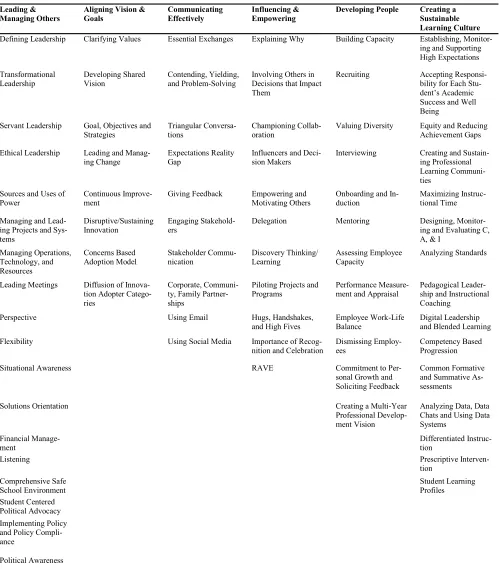
Academy (monthly meetings) and the second year pro-gram is called Leadership Fellows (quarterly meetings). The content for both programs is derived from our competency list displayed in Table 1. We have dedi-cated instructors who plan the Life Leaders and Leader-ship Fellows content lesson plan prior to each meeting. We also integrate developmental content from the
Primer competencies from these programs in our assis-tant principal and principal meetings as well. The as-sistant principal and principal meetings contain a mix of operational and development content so that we continue to prepare our current and next generation of leaders.
The Life Leaders program meets monthly and in-cludes developing presentation, collaboration, and leading meeting skills of participants. This program is designed not just to prepare participants for the prin-cipalship but rather to be leaders in their current jobs as well. Many of our Life Leaders participants have gone on to Assistant Principal and Principal roles, but others have shifted into curriculum or other central office positions.
The Leadership Fellows program includes coaching and mentoring for participants from current princi-pals and other district leaders. The meetings are once a quarter and the attendees work on actual real-world projects (not simulations) for the organization. They plan and execute events, address problematic areas, and produce procedure documents. They role-play interviewing and other leadership activities. Our on-going support beyond these two different cohort groups include the following:
An annual kickoff meeting for all participants and existing district leadership.
Videos, podcasts, and other documents to support participant development.
with
Troy Mooney, Chief Academic Officer and
Leading & Managing Others
Aligning Vision & Goals
Communicating Effectively
Influencing & Empowering
Developing People Creating a Sustainable Learning Culture
Defining Leadership Clarifying Values Essential Exchanges Explaining Why Building Capacity Establishing, Monitor-ing and SupportMonitor-ing High Expectations Transformational
Leadership Developing Shared Vision Contending, Yielding, and Problem-Solving Involving Others in Decisions that Impact Them
Recruiting Accepting Responsi-bility for Each Stu-dent’s Academic Success and Well Being
Servant Leadership Goal, Objectives and
Strategies Triangular Conversa-tions Championing Collab-oration Valuing Diversity Equity and Reducing Achievement Gaps Ethical Leadership Leading and
Manag-ing Change
Expectations Reality Gap
Influencers and Deci-sion Makers
Interviewing Creating and Sustain-ing Professional Learning Communi-ties
Sources and Uses of
Power Continuous Improve-ment Giving Feedback Empowering and Motivating Others Onboarding and In-duction Maximizing Instruc-tional Time Managing and
Lead-ing Projects and Sys-tems
Disruptive/Sustaining Innovation
Engaging Stakehold-ers
Delegation Mentoring Designing, Monitor-ing and EvaluatMonitor-ing C, A, & I
Managing Operations, Technology, and Resources
Concerns Based Adoption Model
Stakeholder Commu-nication
Discovery Thinking/ Learning
Assessing Employee Capacity
Analyzing Standards Leading Meetings Diffusion of
Innova-tion Adopter Catego-ries
Corporate, Communi-ty, Family Partner-ships
Piloting Projects and Programs
Performance Measure-ment and Appraisal
Pedagogical Leader-ship and Instructional Coaching
Perspective Using Email Hugs, Handshakes, and High Fives
Employee Work-Life Balance
Digital Leadership and Blended Learning Flexibility Using Social Media Importance of
Recog-nition and Celebration
Dismissing Employ-ees
Competency Based Progression Situational Awareness RAVE Commitment to
Per-sonal Growth and Soliciting Feedback
Common Formative and Summative As-sessments Solutions Orientation Creating a Multi-Year
Professional Develop-ment Vision
Analyzing Data, Data Chats and Using Data Systems
Financial Manage-ment
Differentiated Instruc-tion
Listening Prescriptive Interven-tion
Comprehensive Safe
School Environment Student Learning Profiles Student Centered
Political Advocacy Implementing Policy
and Policy Compli-ance
Political Awareness
Table 1
A Facebook group and social media groups to con-tinue ongoing leadership discussions and devel-opment.
Coaching development training for the actual coaches who will be working with our Leadership Fellows participants. This has given us an avenue to develop and refine the leadership coaching skills of our existing principals and central office leadership.
Q2: How did the idea for Primer come about?
TM: The original idea for Primer came about when I was an Assistant Superintendent in Waller ISD in 2010 and was talking with our high school principal, Brian Merrell, about the fact that there should be a practical guide for new principals. I began writing the Primer Entry Guide as a passion project in 2012 and I complet-ed it, with help from Herbert O’Neil, in April of 2016. During the same time as I was creating the entry guide we were developing our leadership preparation program and we ultimately decided to brand every-thing we were doing to support and develop leaders under the Primer brand.
The critical piece of the Primer program was our research and development of the competencies for the program. We reviewed existing standards at the state and national level, met with leaders of existing pro-grams, reviewed national research and borrowed from our own experiences. These competencies are the framework for all of our books, articles, podcasts,
YouTube videos and other Primer items.
Q3: What do you believe are the most important takeaways from Primer that a new principal could benefit from?
HO: The most important takeaway is to begin inten-tionally developing leaders at your district or at least your campus. A new principal should consider the
Primer Entry Guide for New Principals as an affordable (.99 cents) and essential resource. The basic theme of the guide is about first building relationships before beginning any “tearing down of fences.” There is much more useful information in the guide but I have found that many new principals fail when they begin with trying to implement their own ideas (even if they are good) without first making the necessary connec-tions with their staff.
As far as the existing list of Primer competencies some of them mean more to me personally but they are almost all derived from existing National stand-ards or research.
Q4: The role of the principal has greatly evolved over the last several decades. How do you think the role will continue to change and what development and support will be needed to meet those changes to the role of the principal?
TM: The role has changed but many districts still do not meet what I think are basic requirements for prin-cipal support including:
Regular principal meetings.
Supervisors only responsible for approximately 10 principals.
Expectation that supervisors respond quickly to principal questions/inquiries/concerns.
Inclusion of development items instead of only operational items at principal meetings.
While much of the principal experience is universal, each district has some specific behaviors that they re-quire of principals. Have those been articulated? Has there been any thought and planning on how to pre-pare current and future principals for those district specific responsibilities and competencies? Principals need training on how to collaborate effectively. This begins with “involving people in decisions that im-pact them.” Principals also need to train their own leadership teams on how to collaborate effectively. Additionally, principals need to strengthen their in-structional leadership capabilities but their first priori-ty is to ensure their campus is operationally function-ing at a high level. If the principal is the most knowl-edgeable person about curriculum and instruction at their campus then they may have hired poorly.
Q5: What advice would you give a new superinten-dent who wanted to ensure those school administra-tors coming up through the ranks are prepared for the principalship?
TM & HO:
Commit to developing leaders at all levels throughout the organization. Develop a leader-ship preparation program that is focusing on de-veloping leaders rather than only just preparing principals. Good organizations need leaders all throughout the system and a campus full devel-oped teacher leaders will be of great benefit to any principal. The district leadership preparation pro-gram cannot be an afterthought. Planning is re-quired for the selection of participants, competen-cies, content, and measurement of outcomes of a leadership program.
as-signed into cohorts, have authentic job embedded experiences, complete meaningful work, and be exposed to mentoring and coaching throughout the process.
Existing principals should be involved in the pro-gram both for content development and for men-toring/coaching and to ensure the program is rel-evant.
Conclusion
The preparation of school site administrators is par-amount for school leaders to meet the rigorous de-mands of leading their school sites. Today’s educa-tional leaders have unprecedented challenges in en-suring teachers are delivering high-quality common core teaching to prepare students for the 21st century
and beyond. School leaders such as Troy Mooney and Herbert O’Neil are building capacity in their school leaders through Primer Lead, a comprehensive leader-ship program centered on developing core competen-cies. As the principalship continues to evolve in com-plexity, programs such as Primer Lead may serve as an exemplary program to develop school leaders in these demanding and evolving times.
▪▪▪
If you would like to know more about Primer it can be purchased for Kindle at www.Amazon.com https:// www.amazon.com/Primer-Entry-Plan-New-Principals
-ebook/dp/B01EYY8XQK/ref=sr_1_fkmr0_1? ie=UTF8&qid=1480957767&sr=8-1
-fkmr0&keywords=Principal+entry+guide+primer
▪▪▪
If you are interested in participating in a future Q and A Dialogue article featured in the Journal of School Ad-ministration Research and Development, please email [email protected] and include a brief letter of interest with the following information: name, title, organiza-tion, and area of expertise.
The Acclimation of New
Assistant Principals
Hykeem M. Craft
Sam Houston State University
Julie P. Combs
Sam Houston State University
Rene Malveaux
Sam Houston State University
Sonja A. Lopez
Sam Houston State University
ABSTRACT: Although the assistant principal position has been the career path for aspiring principals, some researchers have claimed the position lacks adequacy as a training position. With limited research available, the purpose of this study was to explore the induction and acclimation experiences of newly assigned assis-tant principals. Following a phenomenological re-search approach, interviews were conducted with six public school assistant principals. New assistant prin-cipals prepared for their positions by seeking prior leadership opportunities and asking questions, but they noted a lack of confidence in making decisions. These new assistant principals, recognizing the im-portance of professional relationships, worked to build trust with students and teachers. Implications for school district leaders, preparation programs, and aspiring candidates are provided.
Keywords: assistant principals, vice-principals, social-ization, induction
have been conducted about the assistant principal (e.g., Petrides, Jimes, & Karaglani, 2014; Williams, 2012), much of the literature occurred before 1999 (see Oleszewski, Shoho, & Barnett, 2012). Updated infor-mation is needed about the challenges and barriers of newly assigned assistant principals, which can assist current administrators and educators in preparation programs by providing timely and relevant support to these new leaders. As such, the purpose of this study is to explore the induction and acclimation experienc-es of newly assigned assistant principals.
Review of Literature
The common duties of assistant principals have changed little over the last four decades (e.g., Haus-man, Nebeker, McCreary, & Donaldson, 2002; Oleszewski et al., 2012; Reed & Himmler, 1985; Scog-gins & Bishop, 1993). Reed and Himmler (1985) re-viewed the literature on assistant principals from 1926 to 1985 and concluded that although studies have been abundant, the “nature of the work has escaped clear conceptualization” (p. 60). Many of these studies addressed similar research questions focused on an analysis of duties using questionnaires (Reed & Himmler, 1985). Almost a decade later, Scoggins and Bishop (1993) reviewed 26 studies conducted from 1973 to 1992 to identify the most common roles of as-sistant principals, which were found to be “discipline, attendance, student activities, staff support and evalu-ation, building supervision, guidance, co-curricular activities, athletics, community agencies, master schedules” (p. 42). Further, the duties of the assistant principal were determined primarily by the principal (Scoggins & Bishop, 1993). Similarly, Reed and Himmler (1985) concluded the secondary assistant principal was “charged with establishing and main-taining organizational stability” (p. 82), which includ-ed developing the master schinclud-edule (before the use of
personal computers), planning the calendar of after-school activities, and supervising students. In a more recent synthesis of literature about the assistant princi-pal, Oleszewski et al. (2012) affirmed that most of these previously cited duties remain relevant today, with the most cited roles as “student management, instructional leadership, and personnel manage-ment” (p. 274). Interestingly, the significance of in-structional leadership tasks was not evident until the 2000s (Oleszewski et al., 2012).
Student discipline remains the primary duty of U.S. assistant principals (Hausman et al., 2002; Reed & Himmler, 1985; Scoggins & Bishop, 1993). Hausman et al. (2002) observed most of the duties of the assis-tant principal were centered “around management of people, particularly students” (p. 152), requiring assis-tant principals to have effective human relations skills. Focused on effective student management, Williams (2012) consulted with experts to create a set of skills and dispositions for secondary assistant principals. She concluded the qualities of effective disciplinarians were honesty, visibility, ethical behavior, fairness, and good communication skills. One of the most com-monly cited traits of successful assistant principals was the ability to build and maintain positive relation-ships, and Williams (2012) noted that building rela-tionships was often linked to building a positive school climate.
Many scholars have indicated the role of the assis-tant principal is problematic and undefined
(Armstrong, 2012; Petrides et al., 2014). In spite of the “ad hoc task assignments that traditionally accompa-ny the assistant principal role” (Petrides et al., 2014, p. 176), assistant principals participating in Hausman et al.’s (2002) study were positive about their positions. Balancing work and life was a major concern, and as-sistant principals who worked 55 hours or more a week reported the lowest levels of balance (Hausman et al., 2002). New assistant principals participating in Armstrong’s (2014) study described “responsibilities and workloads as physically and emotionally stress-ful,” especially when they “did not have the time, technical skills and the procedural knowledge re-quired to complete everyday managerial and discipli-nary tasks” (p. 30). Although some assistant princi-pals wanted to spend more time with instructional tasks (Glanz, 1994; Hausman et al., 2002), their duties as crisis managers outranked “attending to the proac-tive goals of curriculum planning, instructional super-vision, resource allocation, and professional develop-ment” (Hausman et al., 2002, p. 152). Armstrong (2012) concluded from a study of 15 new assistant principals the role “remains an underutilized, frag-mented, reactive managerial role” (p. 421), and the
position should be reconfigured (Armstrong, 2012; Oleszewski et al., 2012).
Preparation for the Position
The lack of preparation of assistant principals for their positions has been well documented for some years (Hartzell, Williams, & Nelson, 1995; Hausman et al., 2002). Twenty years ago, Hartzell et al. (1995) con-cluded new assistant principals did not have the nec-essary knowledge and skills for their positions and were unaware of the realities of the position and its challenges. One common theme in the literature con-cerning preparation of assistant principals is the inad-equacy of formal preparation programs focused on the role (Armstrong, 2010; Oleszewski et al., 2012). Almost all courses in preparation programs focus on the principal position, with a “disconnect between the relevance of formal training” and the needs of assis-tant principals (Hausman et al., 2002, p. 152). Assis-tant principals prepared for their roles on the job through trial and error and with reinforcement from their principals (Mertz, 2006). Further, principals were key in the learning process because they as-signed the responsibilities and were in a position to give meaningful feedback (Mertz, 2006). Combined with the lack of pre-service training, Oleszewski et al. (2012) noted few of the professional development op-portunities available were specific to the needs of as-sistant principals.
aspects of building leadership” (Searby et al., 2015, p. 29).
Many researchers have recommended additional professional development and training for assistant principals (Hausman et al., 2002; Oleszewski et al., 2012; Petrides et al., 2014), particularly with the preva-lence of “inappropriate professional certification pro-grams” (Armstrong, 2010, p. 709). Noting a specific concern with handling conflict with teachers, Petrides et al. (2014) recommended “increased support to aid them in establishing ongoing constructive conversa-tions with teachers” and ways to establish “non-intrusive processes for impacting teacher practice” (p. 188). Oleszewski et al. (2012) called for more studies about the professional development needs of assistant principals.
Conceptual Framework
Theories related to the socialization of assistant principals serve as the conceptual framework of this qualitative study. Career socialization is the process of learning the norms and expectations of a given po-sition. Greenfield (1985) described the socialization process of assistant principals as being informal, ran-dom, and varied––a process that differs from that of the principal roles (Armstrong, 2012). Assistant prin-cipal training is often on-the-job and informal, ran-dom in occurrence, and varied in required accultura-tion time. In one of the later stages of the socializaaccultura-tion process, one’s identity changes from that of a teacher to that of an administrator (Greenfield, 1985). Instead of focusing on the stages of socialization, Marshall (1985) focused on the tasks that help the assistant principal assume the new role identity. According to Marshall (1985), initially, the person makes a decision to leave teaching and then learns about the selection process. Next, the new assistant principal experiences the change from teacher to administrator, sometimes described as a culture shock. To adapt to the new role, the assistant principal finds resources and social supports.
Scholars have noted concerns with the socialization process for new assistant principals, referring to the transition as a “trajectory of conflict, resistance, and accommodation” (Armstrong, 2012, p. 418). In a study about the socialization process of 15 new assis-tant principals, Armstrong (2012) concluded the tran-sition from teacher to administrator is a “complex pas-sage” involving “personal and professional chang-es” (p. 404) that “destabilize[s] novice VPs cognitively, emotionally, and socially” (p. 418) for which they are unprepared. In a different study, Armstrong (2010) described that new assistant principals were without
support at the induction stages and recommended school districts to work together with universities to improve the transition process.
Method
This qualitative study employed the techniques of phenomenological research methods (Moustakas, 1994). According to Van Manen (1990), a phenomeno-logical design is appropriate to understand the es-sence of lived experiences of participants. For phe-nomenological research, Creswell (2013) recommend-ed 3 to 10 participants. Six participants were recruitrecommend-ed for the study using snowball sampling techniques, as we used professional contacts to locate participants who served as assistant principals in public schools for at least one year and no more than three years. A diverse group of participants took part in this study. Four of the participants identified as White and two as Black. Three participants were male, whereas both Black assistant principals were female. All of the participants served fewer than three years in the assistant principal role. Three assistant principals worked at campuses serving students in Grades 6-8, and three worked at campuses serving students in Grades 9-12. Two had been promoted to assistant principal from a teaching assignment on the same campus, and four were placed in a new setting for their first assistant principal assignment.
After consent was given, participants were inter-viewed in face-to-face settings. The interviews were audio-recorded and transcribed for analysis. Inter-view questions were developed after a reInter-view of the literature and piloted with two assistant principals. The pilot interview results allowed for improvements to data collection. Additional demographic data were collected using questionnaires.
In the transcription analysis, a combination of first-cycle and second-first-cycle coding techniques was em-ployed (Saldaña, 2013). Initially, applied attribute coding was used for each transcript using the demo-graphic data. Next, first-cycle coding consisting of structural codes was used to organize the large
amounts of information gathered from the interviews. Using the structural codes, we searched each tran-script, applying a combined descriptive and in-vivo coding. After several rounds of first-cycle coding, clusters of meanings and thematic coding in second-cycle coding were identified.
Results
pre-sent the findings in three structural categories: prepa-ration for the position, challenges of the new assistant principals, and relationships. Themes within each cat-egory are described in the following sections. To en-sure anonymity, the six participants were assigned the pseudonyms Amy, Bill, Carl, Dalene, Edgar, and Feli-cia. Summaries are provided in Tables 1, 2, and 3.
Preparation for the Position
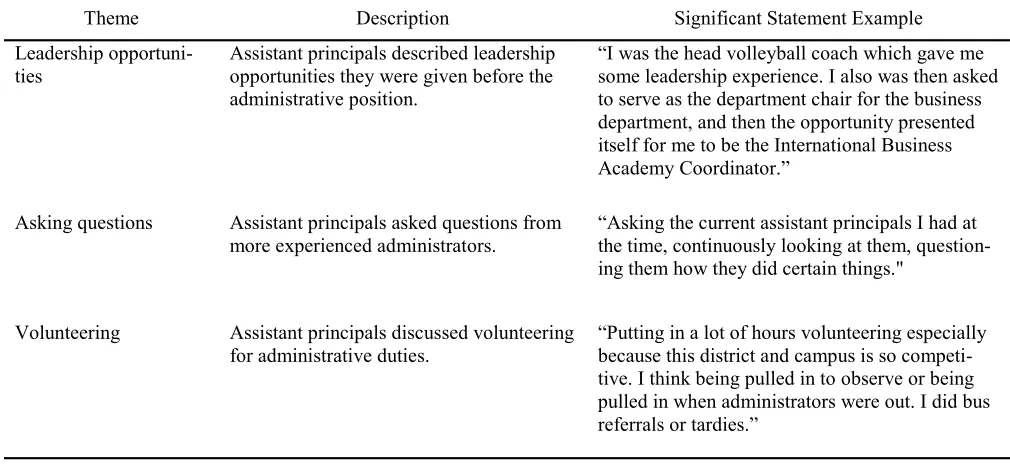
The assistant principals discussed their preparation for the position as a new administrator and the im-portance of learning about the role. Dalene stated, “You really have to let it be known you are interested, and you have to put in the time to learn.” The assis-tant principals in this study all dedicated many hours to transition to the role of administrator. The three themes used to summarize the new assistant princi-pals’ preparation for the position were (a) leadership opportunities, (b) asking questions, and (c) volunteer-ing. Descriptions of each theme are provided in Table 1.
One theme that developed was leadership opportuni-ties, which were the opportunities that assistant prin-cipals were afforded before attaining their first admin-istrative position. Amy explained, “I was actually prepared for it [assistant principal position]. And by that I mean I was given the opportunity to serve in
multiple roles in my previous district.” Felicia also described leadership opportunities as a teacher: “I was a team leader.” She added being part of “the flight team” allowed her opportunities to fill in “when administrators were out.”
Another common theme to describe the prepara-tion for the assistant principal posiprepara-tion was asking questions. All of the assistant principals mentioned the importance of asking questions. Carl shared, “Talking to my dad [an administrator], talking to my uncle [an administrator], and getting some feedback from my high school principal” helped him prepare for the po-sition. Edgar stated, “Don’t be afraid to ask ques-tions.” The assistant principals shared a spirit of hu-mility and were willing to ask questions to gain a bet-ter understanding of the position.
A common theme of volunteering was also present among the assistant principals. Many of the partici-pants mentioned the various aspects of the position and the importance of requesting additional duties as a teacher to be better prepared for the role of adminis-trator. Dalene explained, “You have to take on differ-ent responsibilities, saying give me Red Ribbon Week or give me this and let me be in charge.” Also, Carl added, “It’s like anything, you can tell somebody about it, but until you get your feet wet and do it yourself, you just don’t know.”
Table 1
Summary of Themes of New Assistant Principals’ Preparation
Theme Description Significant Statement Example Leadership
opportuni-ties Assistant principals described leadership opportunities they were given before the administrative position.
“I was the head volleyball coach which gave me some leadership experience. I also was then asked to serve as the department chair for the business department, and then the opportunity presented itself for me to be the International Business Academy Coordinator.”
Asking questions Assistant principals asked questions from
more experienced administrators.
“Asking the current assistant principals I had at the time, continuously looking at them, question-ing them how they did certain thquestion-ings."
Volunteering Assistant principals discussed volunteering
for administrative duties.
Challenges of New Assistant Principals
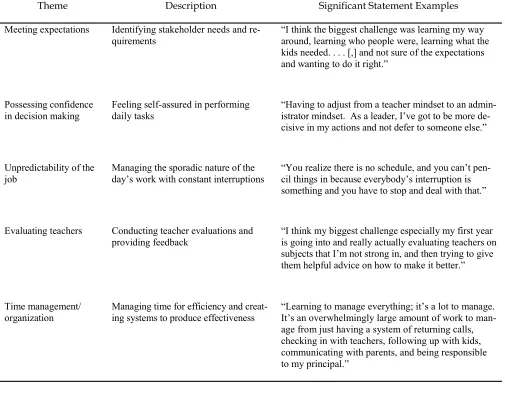
Each assistant principal articulated numerous chal-lenges faced during their beginning years in the ad-ministrative position. Transitioning into a leadership role of teachers and managing all of the unexpected and unplanned crises were difficulties repeatedly mentioned by the participants. For example, Amy ex-plained her biggest transition was “not being in con-trol of the day.” Taking on a role where the landscape of the position changed daily was another challenge expressed by the assistant principals. The five themes used to summarize the challenges faced by the new assistant principals were (a) meeting expectations, (b) possessing confidence in decision making, (c) unpre-dictability of the job, (d) evaluating teachers, and (e) time management/organization. Descriptions of each theme are provided in Table 2.
One theme that developed was the assistant princi-pals’ challenge of meeting expectations. Identifying the needs of the various campus stakeholders and ful-filling the requirements of the multitude of duties and responsibilities were often mentioned. Amy recount-ed the difficulty in being a new administrator at an unfamiliar campus and the challenges of meeting ex-pectations:
I didn’t know what I was walking into; I didn’t know any of the people on the campus. I didn’t know much about the dynamics of the students, the faculty, or the staff on the campus. The biggest challenge was learning my way around, learning who people were, and learning what the kids need-ed.
Carl, also new to his middle school campus, is in his first year as an assistant principal and remembered his concerns about meeting expectations of his new peer
Table 2
Summary of Themes of Challenges of New Assistant Principals
Theme Description Significant Statement Examples
Meeting expectations Identifying stakeholder needs and
re-quirements “I think the biggest challenge was learning my way around, learning who people were, learning what the kids needed. . . . [,] and not sure of the expectations and wanting to do it right.”
Possessing confidence
in decision making Feeling self-assured in performing daily tasks “Having to adjust from a teacher mindset to an admin-istrator mindset. As a leader, I’ve got to be more de-cisive in my actions and not defer to someone else.”
Unpredictability of the
job Managing the sporadic nature of the day’s work with constant interruptions “You realize there is no schedule, and you can’t pen-cil things in because everybody’s interruption is something and you have to stop and deal with that.”
Evaluating teachers Conducting teacher evaluations and
providing feedback “I think my biggest challenge especially my first year is going into and really actually evaluating teachers on subjects that I’m not strong in, and then trying to give them helpful advice on how to make it better.”
Time management/
organization Managing time for efficiency and creat-ing systems to produce effectiveness “Learning to manage everything; it’s a lot to manage. It’s an overwhelmingly large amount of work to man-age from just having a system of returning calls, checking in with teachers, following up with kids, communicating with parents, and being responsible to my principal.”
group: “Everything was brand new. I knew nothing at all and did not know what to expect.”
Another emerging theme was possessing confidence in decision making. The assistant principals struggled with feeling self-assured in their new roles and in making administrative decisions. Bill reflected, “I re-member when I first started that fear of ‘oh, what if I do things wrong?’” His hopes for the first year were to “not screw up.” In addition to dealing with learning the expectations required of her, Amy expressed con-cerns about her abilities. She was worried about “not knowing . . . or having enough confidence in myself that I had all the tools to do that [lead a school].” A common theme of unpredictability of the job was also present among the new campus administrators. Many of the participants mentioned some aspect of the ever-changing daily routine of the assistant princi-pal’s role and how a well-planned day could easily be thwarted by an unexpected event. Carl realized, “I’m not in control anymore. I don’t have my little bubble anymore.” Edgar further noted the irregularity of the position as a challenge:
This job is unbelievably unpredictable. So, to set a schedule out for yourself for a week, or even a day, like today, I’m going to do this, and you do it natu-rally as organized people do, but [you] never do[;] . . . never does it work out like you want it to. Also, the less experienced assistant principals struggled in their first year to conduct classroom ob-servations and provide valuable feedback to their teachers. The theme of evaluating teachers emerged from the interviews. Carl described “the need for time with your group of assistant principals in the district and talk about how something [observations] would be scored” to aid with conducting teacher ob-servations.
Last, the theme of time management/organization was a commonality among the assistant principals. Find-ing a way to complete all the tasks in a timely, effi-cient manner, especially with the aforementioned un-predictability of the job, was also a challenge. Bill commented on the challenge of time management: Knowing how much time I needed to put into
dif-ferent aspects of walk-throughs, investigations, discussing situations with students, and giving time to teachers, making sure everyone is doing what they are supposed to and really trying to get all of your reports and everything done on time. Felicia concurred she was challenged with “learning to manage everything. . . . It was a lot to learn to man-age, so getting organized and getting a system was the
biggest challenge.”
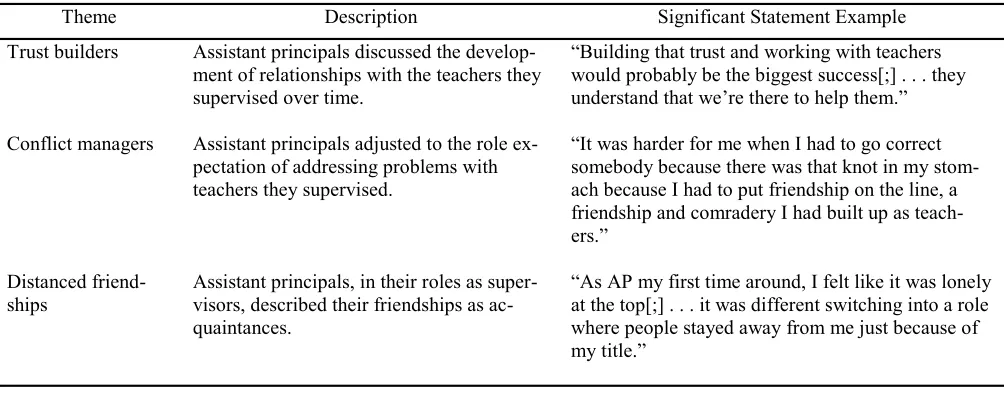
Relationships of the New Assistant Principals The assistant principals described their relation-ships as being in transition as they adjusted to their roles as administrators. For example, Felicia de-scribed her biggest challenge as adjusting “from a teacher mindset to an administrator mindset.” The assistant principals in this study all experienced a transition in their friendships when changing roles from teacher to assistant principal. They had few friendships, and those they had were not part of their workplace. Instead, at their jobs they focused on the professional relationships they were building with teachers. Three themes were used to summarize the relationships of these new assistant principals. These new administrators were trust builders and conflict managers with distanced friendships. A description of each theme is shown in Table 3.
As trust builders, the assistant principals discussed the strategies they used to build trust and the devel-opment of their relationships with teachers over time. Edgar described his strategy:
My goal really every day is to say hello to every one of my teachers I see in the hallway[,] . . . so if we can build them up enough to know we care about them, um, it’s easier to have that tough con-versation.
The development of trust was also noted when partic-ipants described a success story; all six assistant prin-cipals mentioned their positive relationships with teachers or students as one of their successes. Carl described his success with two teachers: “The relation-ship between us continued to strengthen.” He be-lieved the teachers were able “to do a better job in the classroom” because of their supportive relationship. Another common theme to describe the relation-ships of the new assistant principals was conflict man-agers. Five of the assistant principals talked about their challenges with addressing conflict with teach-ers. Bill described the transition from teacher to ad-ministrator:
You’re worried about stepping on people’s toes or hurting people’s feelings, and I think for me, that was the biggest change. . . . [,] and typically as a teacher, you avoid uncomfortable situations, and you can get away from them. But as a principal, those you kind of live with.
up, you have to call them on it.” His challenge was “knowing how to do that . . . in a professional way . . . to keep them motivated to work and to keep that re-spect.” Dalene concluded, “Some people took it [correction] really well; others, it crawled all over them,” and some “people just don’t want to be cor-rected.”
Another theme describing relationships was dis-tanced friendships. All of the assistant principals talked about changes in friendships at work, which they ac-cepted as part of their new roles as administrators. Both Carl and Felicia used the phrase “it’s lonely at the top” to describe their changed social positions in their schools. Bill explained that in his role as an ad-ministrator, “You don’t usually have really friends, [rather] more acquaintances,” and the “friendship part kind of gets a little tricky [when] you have to look at them and tell them they are doing something wrong.” Commenting on her exclusion from social events with teachers, Dalene explained, “I’m not invited to the social gatherings like I used to be. And it’s not be-cause the friendship isn’t there, it’s just teachers can’t vent.”
Of the assistant principals in this study, two be-came administrators in the same schools that they were teachers and four were in different schools. Alt-hough all of the assistant principals reported a change in their friendships as they transitioned from teachers to administrators, some differences were noted in these two groups. The individuals in unfamiliar set-tings seemed to experience less difficulty with friend-ships and their new role. Amy shared, “I started on a new campus, in a new district, and so my role is what
it was, and I didn’t have friends already to have to adjust.” In contrast, Dalene worked in the same school as a teacher and administrator. She explained being in the same school was “easier for me because I had relationships with the staff, and I feel like I had a lot of support.” At the same time, she noted, “It was harder for me when I had to go correct somebody be-cause there was that knot in my stomach bebe-cause I had to put friendship on the line.”
Discussion
A consistent finding in our study was new assistant principals prepared for their positions by seeking leadership opportunities, asking questions, and volun-teering—activities which have also been noted by Mertz (2006). Participants benefitted from prior lead-ership positions (e.g., department heads, team leaders, and coaches), confirming the work of other research-ers (Hausman et al., 2002; Searby et al., 2015). Also, these new assistant principals sought out informal mentorships from their peer administrators, under-standing the importance of asking questions in their new roles. As confirmed in the literature (e.g., Mertz, 2006; Oleszewski et al., 2012), even after completing master’s degrees, obtaining state certifications, and securing their first campus administrative positions, many new assistant principals in our study did not possess the confidence to make decisions in their new roles.
The many challenges that surfaced during the par-ticipants’ beginning years as assistant principals were meeting others’ expectations, handling the job unpre-dictability, evaluating teachers, and managing time.
Theme Description Significant Statement Example Trust builders Assistant principals discussed the
develop-ment of relationships with the teachers they supervised over time.
“Building that trust and working with teachers would probably be the biggest success[;] . . . they understand that we’re there to help them.”
Conflict managers Assistant principals adjusted to the role ex-pectation of addressing problems with teachers they supervised.
“It was harder for me when I had to go correct somebody because there was that knot in my stom-ach because I had to put friendship on the line, a friendship and comradery I had built up as teach-ers.”
Distanced
friend-ships Assistant principals, in their roles as super-visors, described their friendships as ac-quaintances.
“As AP my first time around, I felt like it was lonely at the top[;] . . . it was different switching into a role where people stayed away from me just because of my title.”
Table 3
Although some of the participants expressed difficulty in knowing what was expected of them by their new peers (especially at a new school), others doubted their self-efficacy in taking action. Some respondents addressed the challenges in adjusting from a teacher role with a structured, daily routine to an administra-tor role, which lacked structure and routine. Green-field (1985) and Marshall (1985), who provided early theories about the socialization process of new assis-tant principals, also noted these concerns. More re-cently, Armstrong (2015) characterized the assistant principal position as having “hectic and fragmented working environments where challenge and change are the norms” (p. 110). The assistant principals in our study attempted to cope with these challenges using time management strategies; however, we predict the nature of the position will continue to offer repeated challenges for these novice administrators
(Armstrong, 2010, 2012).
Similar to prior studies about assistant principal transition (Armstrong, 2012; Greenfield, 1985), partici-pants in this study witnessed changes in their relation-ships during their transitions. Focusing on the im-portance of building trust with teachers, parents, and students, new administrators offered positive relation-ships as a way to manage ongoing conflicts inherent in their new roles. Concurring with Hausman et al. (2002) and Williams (2012), we noted that these assis-tant principals had to build positive relationships and manage many conflicts—skills for which they were sometimes unprepared.
Implications and Recommendations
Based on the findings from the study, instructors of principal preparation programs can assist in the prep-aration and transition of new leaders. All leadership candidates need time to reflect upon and develop their relationship-building and conflict-management skills. Some participants commented that as teachers, they could avoid conflict-filled situations that were unavoidable as administrators. Specific exercises and case studies designed to help candidates assimilate and practice decision-making skills might be helpful. Aspiring candidates need a more realistic view of the roles and responsibilities of the administrator. Both preparation programs and school district men-tors can assist in the communication of accurate job descriptions, work conditions, and roles. Educators who have accepted jobs with an accurate job preview have been more likely to remain employed and expe-rience higher job satisfaction levels (Ellis, 2014).
After new assistant principals have been hired, school districts help them in understanding their roles as trust builders and conflict managers. From our study, we noted participants voiced many challenges in their transitions from teachers to administrators. School district leaders should provide a support net-work composed of experienced administrators to help new assistant principals manage the professional lone-liness they experience as new administrators. The respondents specifically requested school district lead-ers be more intentional with support, providing col-laboration opportunities and interactive, hands-on professional development. For example, Felicia shared, “They [the individual districts] need to have a system in place to support APs––a system of profes-sional development, a system of go-to people, a sys-tem of protocols and procedures that APs should fol-low.”
Amy and Edgar discussed the need for districts to have better mentoring programs to support new assis-tant principals allowing collaboration among the new administrators. Similarly, Bill and Carl discussed providing support to new assistant principals in the areas of basic policies and procedures and new infor-mation from the state, but with the hands-on ap-proach of playing. Bill recommended “more role-playing . . . [and] coaching them [new assistant princi-pals] through it. [For example,] if you do expel a kid or send them to an alternative campus . . . OK, what do you do then?” He expressed that many first-year assistant principals don’t know certain protocols. Carl concluded, “Give them the handbook; let them experi-ence it. [Trainings on] discipline and real-life scenari-os[,] . . . giving actual attendance issues and having me go through the court scenario[,] . . . teacher ap-praisals[,] and how to give proper feedback.” These needs were also noted in previous studies (Hausman et al., 2002; Oleszewski et al., 2012; Petrides et al., 2014).
being proactive in getting to know the job expecta-tions, the building, and the culture quickly. Having this knowledge could facilitate introductions with stu-dents and teachers, possibly making it easier to devel-op a rapport with them and to feel connected within the building.
Another consistent finding was being teachable and seeking advice. Many of the participants were of the opinion that if a situation arises in which a new assistant principal does not know the answer, then he or she should simply seek out advice. Some of the participants also recommended new assistant princi-pals be willing to open to try new ideas and absorb as much information as possible—being teachable. Bill advised, “Breathe[;] . . . all you can do is the best you can. Don’t be afraid to ask. . . . [and] learn to manipu-late your time.” Carl described the importance of flex-ibility, remarking, “You have to be willing to change it up. Be open, don’t be prideful, and know there are going to be some gray areas.” Dalene, Edgar, and Fe-licia discussed the relevance of seeking others who have either previously served in the assistant princi-pal role or who are currently serving in the role and have done so successfully for some time. Dalene shared, “With their [others in the profession] experi-ence, they have a different outlook. . . . As a new assis-tant principal, you may still see it [the duties of the job] as a teacher.” Edgar advised to “buddy with them [seasoned administrators]. . . . Mentor with them. . . . Really ask questions.” Felicia advised new assistant principals to “talk to people and get a differ-ent perspective, and then find your own way. Don’t be too hard on yourself.” Learning the logistics of the organization, being teachable, and seeking advice were all important actions recommended to take in the first few months on the job.
Conclusion
School leaders are instrumental in the education of students (Branch, Hanushek, & Rivkin, 2012; Coelli & Green, 2012; Grissom, Kalogrides, & Loeb, 2015). Be-cause a majority of school principals were once assis-tant principals, the position of the assisassis-tant principal is viewed as a training position. However, a need for more information about this position remains, as the literature is dated (before 1999) and scant. Our study was an attempt to add more recent information about the induction and acclimation experiences of newly assigned assistant principals. Although data satura-tion was reached for the research quessatura-tions posed, limitations were present such that we recommend future researchers include more voices of beginning administrators. As described in the research
litera-ture, the professional relationships of assistant princi-pals changed as they transitioned from teacher to ad-ministrator. Although most of the participants seemed to accept the reduced social interaction at work, they acknowledged the need to build positive relationships with teachers and students to manage the increased conflicts inherent in their positions.
References
Armstrong, D. (2010). Rites of passage: Coercion, compliance, and complicity in the socialization of new vice-principals.
Teachers College Record, 112(3), 685-722.
Armstrong, D. (2012). Connecting personal change and organiza-tional passage in the transition from teacher to vice prin-cipal. Journal of School Leadership, 22, 398–425.
Armstrong, D. (2014, April). Transition to the role of principal and
vice-principal study. Retrieved from https://education-leadership-ontario.ca
Armstrong, D. (2015). Listening to voices at the educational front-line: New administrators’ experiences of the transition
from teacher to vice-principal. Brock Education Journal, 24
(2), 109–122.
Barnett, B. G., Shoho, A. R., & Oleszewski, A. (2012). The job reali-ties of beginning and experienced assistant principals.
Leadership and Policy in Schools, 11(1), 92-128.
Battle, D. (2010). Principal attrition and mobility: Results from the 2008–
09 principal follow-up survey (NCES 2010-337). Retrieved from http://nces.ed.gov/pubs2010/2010337.pdf
Branch, G., Hanushek, E., & Rivkin, S. (2012). Estimating the effect of
leaders on public sector productivity: The case of school
princi-pals (NBER Working Paper No. 17803). Retrieved from
http://www.nber.org/papers/w17803.pdf
Coelli, M., & Green, D. (2012). Leadership effects: School principals
and student outcomes. Economics of Education Review, 31
(1), 92-109.
Creswell, J. W. (2013). Qualitative inquiry & research design: Choosing
among the five approaches. Thousand Oaks, CA: Sage. Ellis, C. L. (2014). From hiring process to retention: The relationship
among accurate job previews, position fit, teacher satisfaction, and retention (Doctoral dissertation). Retrieved from ProQuest Dissertations and Theses database. (Order No. 3581899)
Glanz, J. (1994). Redefining the roles and responsibilities of assistant
principals. Clearing House, 7(5), 283-287.
Greenfield, W. (1985). The moral socialization of school
administra-tors: Informal role learning outcomes. Educational
Admin-istration Quarterly, 21, 99-119.
Grissom, J., Kalogrides, D., & Loeb, S. (2015). Using student test
scores to measure principal performance. Educational
Evaluation and Policy Analysis, 37(1), 3-28.
Hartzell, G. N., Williams, R. C., & Nelson, K. T. (1995). New voices in
the field: The work lives of first-year assistant principals.
Hausman, C., Nebeker, A., McCreary, J., & Donaldson, G. J. (2002).
The worklife of the assistant principal. Journal of
Educa-tional Administration, 40(2), 136–157. doi: 10.1108/09578230210421105
Kwan, P. (2009). The vice-principal experience as a preparation for
the principalship. Journal of Educational Administration, 47
(2), 191-205. doi: 10.1108/09578230910941048
Leithwood, K., Louis, K. S., Anderson, S., & Wahlstrom, K. (2004).
How leadership influences student learning. New York, NY: The Wallace Foundation. Retrieved from http:// www.wallacefoundation.org
Marshall, C. (1985). Professional shock: The enculturation of the
assistant principal. Education and Urban Society, 18(1),
28-58.
Mertz, N. (2006). The organizational socialization of assistant princi-pals. Journal of School Leadership, 16, 644-675.
Moustakas, C. E. (1994). Phenomenological research methods. Thousand
Oaks, CA: Sage.
Oleszewski, A., Shoho, A., & Barnett, B. (2012). The development of
assistant principals: A literature review. Journal of
Educa-tional Administration, 50, 264–286. doi: 10.1108/09578231211223301
Petrides, L., Jimes, C., & Karaglani, A. (2014). Assistant principal
leadership development: A narrative capture study.
Jour-nal of EducatioJour-nal Administration, 52, 173-192. doi:10.1108/ JEA-01-2012-0017
Reed, D. B., & Himmler, A. H. (1985). The work of the secondary
assistant principalship: A field study. Education and Urban
Society, 18(1), 59–84.
Saldaña, J. (2013). The coding manual for qualitative researchers.
Thou-sand Oaks, CA: Sage.
Scoggins, A., & Bishop, H. L. (1993, Nov). A review of the literature
regarding the roles and responsibilities of assistant principals. Paper presented at the MidSouth Educational Research Association, New Orleans, LA.
Searby, L., Wang, C.-H., & Browne-Ferrigno, T. (2015). The profile of
the ready assistant principal. Retrieved from http:// ncpeaprofessor.org/wp-content/uploads/2015/10/ Conference-Program.pdf
Van Manen, M. (1990). Researching lived experience: Human science for
an action sensitive pedagogy. New York, NY: State Universi-ty of New York Press.Williams, S. (2012). Examination of the skills and dispositions needed for assistant principals to be effective disciplinarians: Having the "right stuff" as
assistant principal. Michigan Academician, 41, 92-112.
School Leader Relationships: The Need for
Explicit Training on Rapport, Trust, and
Communication
Kara Lasater
University of Arkansas
ABSTRACT: An important aspect of school leader-ship is relationleader-ship development, but developing meaningful relationships as a school leader is chal-lenging. School leader relationships are challenged by diverse stakeholder groups, varied contexts, and diffi-cult situations. The complex nature of school leader relationships necessitates explicit training for leaders on relational skills. The purpose of this paper is to provide professional development recommendations for school leaders regarding three aspects of relation-ships: rapport, trust, and communication. Specific ideas for school leaders regarding how to establish rapport, trust, and effective communication are cussed. Finally, the use of structured role play is dis-cussed as the recommended approach to professional development for school leader relationships.
Keywords: school leadership, relationships, rapport, trust, communication, role play, professional develop-ment
address the role of relationships in the work of school leaders. Some of the domains focus explicitly on the relational nature of the school leader role. For exam-ple, Standard 7 addresses the role of school leaders in establishing a “professional community for teachers and staff” and calls leaders to “empower and entrust teachers,” establish “trust and open communication,” and “develop and support open, productive, caring, and trusting working relationships among leaders, faculty, and staff” (NPBEA, 2015, p. 15). Similarly, Standard 8 addresses the role of school leaders in es-tablishing “meaningful engagement of families and community” and calls leaders to “create and sustain positive, collaborative, and productive relationships with families and the community for the benefit of students,” “engage in regular and open two-way com-munication with families and the community about the school, students, needs, problems, and accom-plishments,” and “build and sustain productive part-nerships with public and private sectors to promote school improvement and student learning” (p. 16). Many of the other Professional Standards for Educa-tional Leaders speak implicitly to the importance of relationship cultivation. For example, Standard 2 re-lates to the domain “ethics and professional norms” and calls leaders to “lead with interpersonal and com-munication skill” (p. 10), while Standard 10 relates to the domain “school improvement” and calls effective leaders to connect “to the district office and external partners for support in planning, implementation, monitoring, feedback, and evaluation” (p. 18).
Though relationship development in the school leader position is acknowledged in both the literature (Bryk & Schneider, 2002; Gallagher, Bagin, & Moore, 2005; Riehl, 2012; Stronge et al., 2008) and professional standards for educational leaders (NPBEA, 2015), de-veloping these relationships remains challenging.
Challenges in Relationship Development School leaders are called to develop meaningful relationships with diverse stakeholder groups
repre-R
elationships are the cornerstone of many aspects of educational leadership. According to Northouse (2015), every situation involving school leaders re-quires some degree of relational behavior. Current topics in education––such as trust, collaboration, pro-fessional learning communities, distributed leader-ship, supervision, mentoring, coaching, and family-school-community partnerships––reflect the relational nature of the school leader position. Furthermore, the increased involvement of parents and community members in educational processes requires school leaders to develop stronger relationships than ever before (Stronge, Richard, & Catano, 2008).senting varied interests, positions, cultures, needs, values, and beliefs about education (Abaya & Normore, 2010; Henry & Woody, 2013). These stake-holder groups include teachers, students, parents, community members, board members, administrators, and others. The purpose of each of these relationships also varies, as does the school leader’s role within the relationships (Odhiambo & Hii, 2012). Adding to the complexity of relationship development for school leaders are the within-group differences that exist. For example, establishing relationships with one fami-ly may require school leaders to exhibit a completefami-ly different skill set than those required to work with another family. The contexts in which these relation-ships exist also vary dramatically (e.g., rural, urban, suburban, large school, small school, etc.), and these various contexts present unique challenges for school leaders (Auerbach, 2012).
Relational efforts of school leaders are further com-plicated by many structural and psychological barri-ers (Christenson, 2004). Structural barribarri-ers are the factors that limit access between educators and other stakeholders, such as time constraints and lack of funding for outreach initiatives. Psychological barri-ers are the interpbarri-ersonal factors experienced by educa-tors, families, and community members that impede relationship development. Examples of psychological barriers include distrust, low self-efficacy, fear of con-flict, and a blaming attitude (Christenson, 2004). Principals must rely on a breadth of highly sophis-ticated relational skills and understand when and how to use these skills to develop meaningful relationships with diverse stakeholders. Unfortunately, principal preparation in this regard is often incomplete (Anast-May, Buckner, & Geer, 2011; Duncan, Range, & Scherz, 2011), and many school leaders are unpre-pared to effectively build relationships with stake-holders from diverse backgrounds (Epstein, 2011). Leadership preparation programs often stress the im-portance of relationships for principals, but they stop short of training principals on how to cultivate mean-ingful relationships with diverse groups of people (Kowalski, 2001). Failure to provide principals with explicit and extensive training on relationship devel-opment is problematic and may leave many school leaders involved in highly complex social interactions with diverse groups of people without the skills and experiences necessary to navigate these situations.
Professional Development Needs
The value of school leader relationships, as well as the highly complex nature of these relationships, sug-gests the need for explicit and extensive professional
development for school leaders on the establishment of relationships with diverse stakeholders. According to a survey of Wyoming school principals, the areas in which principals needed the most support were relat-ed to relationship-building, communication, and con-flict-resolution, yet these were the areas in which min-imal to no professional development was provided (Duncan et al., 2011). As effective school leaders are called to “develop workplace conditions for teachers and other professional staff that promote effective professional development” (NPBEA, 2015, p. 14) and “tend to their own learning and effectiveness through reflection, study, and improvement” (NPBEA, 2015, p. 15), school leaders must take the charge in seeking and implementing professional development on suc-cessful relationship-building.
The sections below contain ideas and recommenda-tions related to professional development for school leaders on relational skills. They are based largely on practices currently taught, implemented, and re-searched within other fields, such as counseling, med-icine, and communications (see Gurland & Grolnick, 2008; Heintzman, Leathers, Parrott, & Cairns, 1993; Ivey, Ivey, & Zalaquett, 2010). Though the practices were originally intended to facilitate relationships in other fields, it is believed that they apply more gener-ally to the development of all relationships. As such, these practices can assist school leaders in the devel-opment of relationships with various stakeholders. The provided recommendations center on three important aspects of relationships: rapport, trust, and communication. Though these qualities are presented individually, they should be considered concurrently, as rapport, trust, and communication are inextricably connected and interdependent. Building rapport re-quires trust and effective communication, effective communication requires rapport and trust, and trust requires effective communication and rapport. Specif-ic ideas and recommendations regarding how to es-tablish rapport, trust, and communication within the field of school leadership are provided below and are followed by a recommendation related to the delivery of professional development in these areas.
Building Rapport
bonding; and communicating effectively. The authors also provided fifty attributes of rapport from within these domains. Examples of rapport attributes in-clude admitting faults and mistakes, listening and paying attention, creating a positive environment, en-gaging in personal discussions, smiling, using humor, being accessible and responsive, showing concern, and ensuring that communication is comfortable. In addition, supervisor use of the nonverbal behaviors of smiling, touching (e.g., touching on the arm, hand-shakes, etc.), nodding affirmatively, posturing to show involvement, and maintaining eye contact have been found to increase rapport with subordinates
(Heintzman et al., 2013).
The rapport indicators presented in the literature can be directly applied to the work of school leaders. School leaders can demonstrate both professional and personal care for stakeholders by attending to their personal stories. Finding opportunities to relate with these stories deepens connections and communicates genuine care and concern. Asking about others’ inter-ests or spending a few moments to check on their well -being requires minimal effort, but it goes a long way in the establishment of rapport. Respecting the auton-omy and individual perspectives of others may also improve rapport (Gurland & Grolnick, 2008). This can be demonstrated by providing opportunities for stake-holders’ voices to be heard and allowing them to share in decision-making processes.
Further, school leaders can develop rapport by in-creasing their visibility and accessibility. Visibility refers to school leaders’ presence both within the school and the community. Visibility provides oppor-tunities for school leaders to be seen, but it also pro-vides school leaders opportunities to initiate dialogue with stakeholders. Opportunities to engage in dia-logue equate to opportunities to build rapport. Acces-sibility can also strengthen rapport. School leaders demonstrate that they are accessible to stakeholders when they encourage open communication and pro-vide opportunities for this open communication to occur. It may be beneficial for school leaders to create both formal and informal systems of accessibility. Formal systems could include town hall meetings or public forums, whereas informal systems could in-volve dissemination of contact information, timely responses to phone calls or emails, and approachabil-ity at school events.
Another way for school leaders to establish rapport is through appropriate follow-up on reported con-cerns and past conversations. For example, a parent may call to discuss a concern regarding his or her
child’s academic performance. After discussing the concern and deciding on a plan of action, it may be helpful for the school leader to follow-up with the parent. If the concern has already been addressed, then the parent knows that the school leader heard the concern and cared enough to respond. If the concern has not been addressed, then the principal has created another opportunity to problem-solve on the issue. Either way, the principal demonstrates genuine care and concern for the parent and student––ultimately building rapport and strengthening the relationship.
Establishing Trust