_____________________________________________________________________________________________________
Value Chain Analysis of Potato in Ilam District, Nepal
Keshav Prasad Shrestha
1*and Surendra Yadav
21
Socioeconomics and Agriculture Research Policy Division, Khumaltar, Lalitpur, Nepal.
2
Agriculture Research Station, Jaubari, Ilam, Nepal.
Authors’ contributions
This work was carried out in collaboration between both authors. Both authors read and approved the final manuscript.
Article Information
DOI: 10.9734/SAJSSE/2018/v2i325861 Editor(s): (1) Dr. Mehmood Ali Noor, Chinese Academy of Agricultural Sciences, Key Laboratory of Crop Physiology and Ecology, Ministry of Agriculture, Institute of Crop Science, Beijing 100081, China. Reviewers: (1) Jayath P. Kirthisinghe, University of Peradeniya, Sri Lanka. (2)Abdullah-Al-Zabir, Sylhet Agricultural University, Bangladesh. Complete Peer review History:http://prh.sdiarticle3.com/review-history/27980
Received 06 October 2018 Accepted 21 December 2018 Published 26 December 2018
ABSTRACT
The purpose of the study was to analyze the value chain of potato in the Ilam district. Potato is one of the major stable food and source of income for the majority rural farmers of the Ilam district. Using random sampling techniques, data were collected using semi-structured household survey with 165 respondents, 50 traders, input and service providers and along with 5 focus group discussion. Data were analyzed using SPSS and excel software. Results of the compound annual growth analysis showed that area, production and productivity is increasing significantly by 8.12, 2.87 and 2.79% respectively over 19 years in the country and 3.78, 2.84, and 3.55 respectively in the Ilam district. The farmers are generally growing local variety however; they also grow some improved varieties. The benefit cost ratio of local varieties is very low (0.68) whereas for improved varieties higher (1.73). Farmers do not adopt the grading and packaging which is generally done by the traders. The import of potato sharply increasing over the years which was 46,097 t worth of NPR 35.74 million in 2008/09 and reached to 249,368 t worth of NPR 531.25 million in 2016/17 which is 14.86 fold increases in value within 8 years. The value chain analysis reveals that, the margin received by the farmers is 27% of the retail price whereas traders and wholesalers deals in big quantities and extract substantial margin. The major constraints of potato production are diseases accompanied by weak availability of seed, high production cost, decreasing labor availability, and weak backward and forward linkage. Therefore, findings suggest that, government and developing agencies should support farmers organizations for the adoption of new variety,
Shrestha and Yadav; SAJSSE, 2(3): 1-13, 2018; Article no.SAJSSE.46158
involve in quality seed production, integrated management of diseases, reduce cost of production, develop agricultural marketing infrastructures to boost up the production and make market access to the farmers.
Keywords: Benefit-cost ratio; compound annual growth rate; marketing, productivity; value chain.
1. INTRODUCTION
Agriculture in Nepal is still subsistence but with the right policies and supportive investments at local, provincial and national levels, agriculture offers new opportunities to move out of poverty. Pathways out of poverty open to Nepal by means of agriculture include smallholder farming and animal husbandry, employment in the “new agriculture” of high value products and entrepreneurship.
In Nepal, agriculture and its associated industries are essential for the economic growth, reducing mass poverty and food insecurity. Using agriculture as the basis for economic growth requires a productivity revolution in smallholder farming. Given the very poor rural infrastructure and poorly placed institutions, this revolution must be different from the so called “Green Revolution”. With number of associated efforts in the past, the success is limited and the challenges are getting bigger with changing situation of liberalization and globalization.
Potato (Solanum tuberosum) is grown worldwide in more than 150 countries of the world as staple food including Nepal [1]. The survival of hundreds of millions of people in the developing countries depends on the potato today [2]. It is fourth most important crops in the world after wheat, rice and maize [3]. It is also important cash crops to address food insecurity and reduce poverty among small holders in the countries like Nepal [4]. It is important food crops for food security and fourth most important staple food after rice, maize, and wheat in Nepal [5]. In Nepal, it occupies first position in terms of productivity (14.03 t ha-1), 2nd position in total production (2,805,582 ha), and 5th position in area of production [6]. Potato is an important crop for both hills and terai of Nepal [7]. It is an important crop for food security in the high hills of Nepal contributing substantially to the livelihood of resource poor farmers in the mountains [8].
Potato cultivation occupy about 199,971 ha of land and the total production reached about of 2,805,582 t with average productivity of 14.03 t ha-1 in 2015/16 in Nepal [9]. It is grown from an
altitude of about 70 meter mean above sea level (masl) to 4500 masl in Nepal where potato is planted in different seasons and harvested accordingly in different times, almost throughout the year [10]. Mostly, the farming is subsistence type with small landholding of only 0.68 ha [11]. The cultivation of potato is popular among smallholder farmers due to its wider adaptability, high yield potential and demand. Thus, becomes major sources of food, income and employment to many rural farmers. The share of potato to Gross Domestic Product (GDP) is 2.17 and Agriculture Gross Domestic Product (AGDP) is 6.57% [12]. The per capita consumption of potato found 80.56 kg in 2013 which was 16.44 in 1961 [13].
Nepalese farmers have been cultivating potato over 200 years with its earliest record of its introduction in Nepal was in 1973. But, the crop becomes economically important only in 19th century. The National Potato Research Program (NPRP) of Nepal under Nepal Agricultural Research Council (NARC) is involved in research and developing improved cultivar of potato in Nepal. Similarly, Potato Development Program (PDP) under Department of Agriculture (DoA) is involved in dissemination and production of recommended varieties and technologies through District Agriculture Development Office (DADO) located in all districts of Nepal [14].
The main objective of this study was to analyse the value chian stituation of potato in Ilam district. Also understand the function and dynamics of the value chains; identify key players and propose possible initiatives for Agriculture Research Station (ARS), Jaubari, Ilam for the future reserch program development on potato to promote increased enterprise income and employment.
2. MATERIALS AND METHODS
2.1 Selection of the Study Area
due to its potentiality of production to marketing along with accessibility of researcher, and budget and lack of time availability of researchers. For the study, field survey and literature review were conducted along with expert consulatation, traders survey and Focus Group Discussion (FGD).
2.2 Sampling of Stakeholders and Chain Actors
For field study, the the main stakeholders such as farmers, traders (local, district, and wholeseller level), service providers, transporters were focussed for this research. A total of 165 potato producing farmers were selected randomly from the list of DADO, Ilam. Similarly, 50 traders including local, road head, district level and regional level were also selected and interviwed through semi-structured questionnaire survey. Likewise, 10 input suppliers from the Fikkal, Ilam Bazar and Birtamod were also consulted. Likewise, other actors like transporters, representative from cooperatives, and other service providers like, DADO, District
Development Committee (DDC), Non
Government Organizations (NGOs) were also selected for the expert consultations.
2.3 Interview and FGD
An in-depth interview was also held with value chain agents including input suppliers, producers, collectors/local traders, road side traders, transporters, wholesalers, processors, retailers, service providers, representatives from cooperatives etc. Identification and selection of such stakeholders were done in consultation with the officials at the district level. The interview and interaction was mainly focused on the value
chain performance, constraints and
opportunities, cost and margins, prices in different markets, trends and perspectives, and growth potentials.
In depth meeting and interacion were held with government organizations, research institutions, INGOs, and NGOs.
FGD was held with concern stakeholders specially the producers, traders, input suppliers. The major issues covered in the FGDs are: value
chain performance, constraints and
opportunities, profitability, efficiency of the value chain, prices, trends and perspectives, growth potentials etc. Similarly, it also covered the issues identified at various level of interaction.
2.4 Use of Primary Information
The primary data on area, production and
productivity of potato was used from the data reported in the Statistictical Information of
Ministry of Agriculture Development in deirrenent years such as 2013, 2014, 2015, qne 2016.
2.5 Data Analysis
The primary information was collected from the field survey through semi structured open ended questionnaire schedule. The secondary information related to the study was collected through different journal, proceeding, annual reports of NARC, NPRP, PDP, DADO, Department of Agriculture (DoA), Ministry of Agriculture and Development (MoALD) and other developing agencies. The collected information were coded, tabulated and analyzed by using Statistical Package of Social Science (SPSS)
and Micro-soft Excel for calculating cost of production, benefit cost ratio. Moreover, SWOT (Strengths, Weaknesses,
Opportunities and Threats) analysis was also carried out.
2.6 Profitability and Benefit Cost Ratio
The profitability was estimated by deducting total cost from gross return.
The gross return was calculated by multiplying the average yield of potato with the price of the potato Gross margin was calculated as:
Gross margin = Gross return – total variable cost
Where,
Gross return = Price of potato x Total potato production
Total variable cost = Sum of all variable costs
Variable cost = Cost of inputs (Seed, FYM/Compost, human labor cost, bullock labor cost, other cost such as transportation cost, loading unloading cost)
Benefit Cost analysis calculated by using following formula
2.7 Mapping the Value Chains
The proposed mapping methodology drew primarily on secondary data supplemented with field interviews with farmers, traders, and expert panel through the value chain. The value chain maps have been presented in a
format with the key stages in the value chain identified on the left of the map and associated enterprises at each stage to the right. The study differentiated between enterprises that engage in one stage of the value chain e.g. primary production, and composite enterprises that engage in more than one stage of the value chain e.g. production and processing.
2.8 SWOT Analysis
SWOT (Strength, Weakness, Opportunity, Threats) analysis is a strategic planning technique used to help a person or or
identify strengths, weaknesses, opportunities, and threats related to business competition or project planning. It is intended to specify the objectives of the business venture o
identify the internal and external factors that are favorable and unfavorable to achieving those objectives. Users of a SWOT analysis often ask and answer questions to generate meaningful information for each category to make the tool useful and identify their competitive advantage.
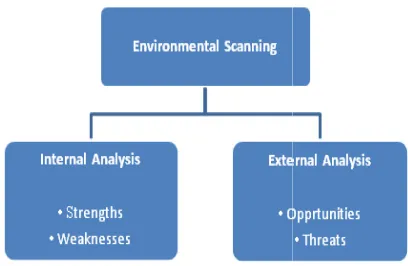
This tool provides a framework for understanding controllable internal and external factors that the interventions should address for the entire value chain (Fig. 1).
Fig. 1. Frame work of SWOT analysis
3. RESULTS AND DISCUSSION
3.1 Potato Production in Nepal
In Nepal, potato is grown in 199,971 ha and produce 2,805,582 t with the productivity of 14.03
Shrestha and Yadav; SAJSSE, 2(3): 1-13, 2018; Article no.
The proposed mapping methodology drew primarily on secondary data supplemented with field interviews with farmers, traders, and expert panel through the value chain. The value chain maps have been presented in a conventional format with the key stages in the value chain identified on the left of the map and associated enterprises at each stage to the right. The study differentiated between enterprises that engage in one stage of the value chain e.g. primary tion, and composite enterprises that engage in more than one stage of the value chain e.g. production and processing.
SWOT (Strength, Weakness, Opportunity, is a strategic planning technique used to help a person or organization identify strengths, weaknesses, opportunities, competition or It is intended to specify the objectives of the business venture or project and identify the internal and external factors that are favorable and unfavorable to achieving those objectives. Users of a SWOT analysis often ask and answer questions to generate meaningful information for each category to make the tool
and identify their competitive advantage.
This tool provides a framework for understanding controllable internal and external factors that the interventions should address for the entire value
Fig. 1. Frame work of SWOT analysis
RESULTS AND DISCUSSION
3.1 Potato Production in Nepal
In Nepal, potato is grown in 199,971 ha and produce 2,805,582 t with the productivity of 14.03
t ha-1 in 2015/16 [9]. Over the past decade high growth rate was recorded for production and the source of growth was both the extension in potato production area and productivity. The compound annual growth rate (CAGR) for the period area, production and yield during 1997/88 to 2016/17 are 8.12 (p=0.024), 2.8
and 2.8 (p=0.000) percent respectively (Table 1).
3.2 Potato Production in Ilam District
The area, production and yield of potato in Ilam are also in increasing trend. However, trend has sharply increased from the year 2008/09 [13] (Fig. 2). In year 2015/16, the area, production and productivity of potato In Ilam has found 7815 ha, 133,772 t and 17.11 t ha-1 respectively [9]. The CAGR on area, production and yield during last 3 decades (1997/88 to 2016/17) are 3.78 (p value=0.0001), 2.842 (p=0.000), and 3.546 (p=0.000) percent respectively.
3.3 Management Practice of Potato
Production
3.3.1 Variety and source of seed
Farmers are generally growing local variety of potato predominantly Bite, Jhyale, and
They are also growing some improved variety namely, Disire, Kufri Jyoti, NPI, and newly introduced Janakdev from ARS, Jaubari, Ilam. The local variety is susceptible to wart and late blight diseases hence giving low yield. But, due to lack of availability of improved variety and better taste of they are reluctant to grow local variety.
The seed is generally produced in the high altitude areas in the summer season, which sold to the grower of low altitude area in the hills for growing early-winter season crop. In low altitude areas the potato are grown only for ware purpose and farmers do not store their potato for seed purpose and therefore, every year they get seed form higher hill area. This is well established traditional seed flow system in the hills. However, with the improvement of access to road in Ilam to
terai districts, seed produced in the high hills also
marketing to the tarai districts.
3.3.2 Use of manures and fertilizers
Farmers were using both organic and inorganic manure for the cultivation of potato crop. As the potato is a well adopted income generating crop and availability of Farm Yard Manure (FYM) in
13, 2018; Article no.SAJSSE.46158
in 2015/16 [9]. Over the past decade high rate was recorded for production and the source of growth was both the extension in potato production area and productivity. The compound annual growth rate (CAGR) for the period area, production and yield during 1997/88 , 2.87 (p=0.000) percent respectively (Table 1).
3.2 Potato Production in Ilam District
The area, production and yield of potato in Ilam are also in increasing trend. However, trend has sharply increased from the year 2008/09 [13] (Fig. 2). In year 2015/16, the area, production and productivity of potato In Ilam has found 7815 respectively [9]. ea, production and yield during last 3 decades (1997/88 to 2016/17) are 3.78 (p value=0.0001), 2.842 (p=0.000), and 3.546
Management Practice of Potato
growing local variety of , and Holange. They are also growing some improved variety namely, Disire, Kufri Jyoti, NPI, and newly introduced Janakdev from ARS, Jaubari, Ilam. The local variety is susceptible to wart and late blight diseases hence giving low yield. But, due to lack of availability of improved variety and better taste of they are reluctant to grow local
The seed is generally produced in the high altitude areas in the summer season, which sold rower of low altitude area in the hills for winter season crop. In low altitude areas the potato are grown only for ware purpose and farmers do not store their potato for seed purpose and therefore, every year they get seed rea. This is well established traditional seed flow system in the hills. However, with the improvement of access to road in Ilam to districts, seed produced in the high hills also
fertilizers
their own farm, farmers generally use high doses of FYM. The average application of FYM was found 33 t with minimum of 13 and maximum of 100 t. Similarly, they were using 79, 101 and 40 kg of urea, Di-Ammonium Phosphate (DAP), and Murate of Potatsh (MoP) in an average during the seeding the potato tubers (Table 2).
3.3.3 Planting
The potato is grown in both winter and summer season crops. It is grown as summer season crop in higher altitude and as winter season at lower altitude (Table 3). Women and children are generally involved in the planting. In the high hills, flat planting is also common and they are
planting by digging small pit and maintaining spacing about 50-60 cm x 20-30 cm.
3.3.4 Disease/pest incidence and control measures
The major prevailing problems of disease and pest were reported by the farmers are: wart, late blight, scab, potato tuber moth, white grub, and red ants. Farmers were not found aware of management practices and most of them are not using pesticides. Only about two percent farmers reported they use chemicals to control the disease and pest but the initiative taken by the farmers is not sufficient.
Table 1. CGAR trend of area, production and yield of potato in Nepal over the decades
Period CAGR Area% CAGR of Production% CAGR of Yield%
1997/98-2006/07 9.302 (p=0.000) 2.861 ((p=0.000) 1.3194 (p=0.000)
2007/08-2016/17 2.336 (p=0.000) 1.493 (p=0.013) 1.006 (p=0.072)
1997/98-2016/17 8.124 (p=0.024) 2.869 (p=0.000) 2.797 (p=0.000)
Source: Researcher calculation based on MoAD data [9, 12, 15, and 16].
Fig. 2. Trend of area, production, and yield of Potato in Ilam district over the decades (Source: 9, 12, 15 and 16]
Table 2. Application of compost, urea, DAP, and MoP in study area
SN Description FYM (ton) Urea (kg) DAP (kg) MoP
1 Average 33 79 101 40
2 Minimum 13 20 20 10
3 Maximum 100 300 400 100
Source: Field Survey 2016 (N=165)
Table 3. Potato Growing Season in the Ilam district
Area August Sep Oct Nov Dec Jan Feb March April May June July
High hills
Low hills
Planting Growth Harvesting
Source: Field Survey 2016
0 20,000 40,000 60,000 80,000 100,000 120,000 140,000 160,000
A
re
a
(
h
a
),
P
ro
d
u
c
ti
o
n
(
t)
,
a
n
d
P
ro
d
u
c
ti
v
it
y
(
t/
h
a
)
Shrestha and Yadav; SAJSSE, 2(3): 1-13, 2018; Article no.SAJSSE.46158
3.3.5 Harvesting and postharvest handling
In summer season crop is harvested during the months of June-May and the winter season harvested in January-March. Generally, farmers do not hold potato after harvest. Commercial farmers fix the harvesting date and after the date has been agreed with the traders, farmers harvest the crop and traders from his side arrange grading, packaging and transportation. Semi-commercial and subsistence farmers generally harvesting on their own, and sell their produce to collector, trader or commission agents at the wholesale market. They were also found involved in retail business in haat bazar. It was found that in the case of small producer the trader generally dictate the price but the commercial producers negotiate the price just before harvest.
The productivity greatly differs from place to place and year to year. It also depends on variety. The multiplication ratio of early varieties is generally low compared to long duration variety. The overall average productivity of potato was about 6-8 t ha-1 which is below the national and district average.
In general, the farmers do not store ware potato for a prolonged duration. Postharvest handling practice is greatly lacking.
3.4 Cost of Production and Benefit Cost Analysis
The cost of production of local and improved cultivar of potato in study area is greatly differs due to their yield/productivity. The cost of local and improved cultivar has calculated NPR 35 and 14 kg-1 respectively. The net income of local
cultivar is in negative (NPR -93,428 ha-1) with benefit cost (BC) ratio of 0.69 whereas improved cultivar gives better net income of NPR 182,979 ha-1 with BC ratio of 1.73 (Table 4). The local cultivar has negative net income as well as BC ratio even though farmers are cultivating it due to the opportunity cost as they work their self and do not hire the labor for work. The taste of local cultivar is also very good and like by the people. Similarly, its storage characteristic is also better than the improved one.
3.5 Import and Export Analysis
Import of potato and seeds are increasing trends in terms of both quantity and values. The data received from the Trade Export Promotion Centre (TEPC) total quantity of ware potato as well as seed potato in year 2008/09 was 46,097 t which increased drastically to 249,368 t in 2016/17 which values was NRs. 35.74 million to 531.25 million respectively (Fig. 3). The regression analysis over 9 years of quantity import found CAGR of increasing significantly with 9.03% with p value 0.001 and in case of value of import increasing highly significantly with 15.07% having p value 0.0001.
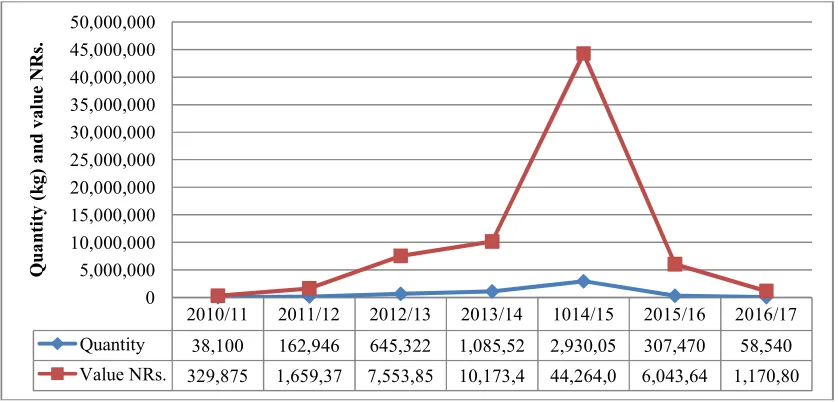
Export of potato and seeds are also being from Nepal but it is very limited amount compared to import. The data received from the TEPC reveals that it was exported 38.1 t in years 2010/11 which reached to 292 t in 2014/15 and fall down to 58.5 t in 2016/17. Similarly, its value found NRs. 329,875 in 2010/11 and 1170,800 in 2016/17 (Fig. 4). The regression analysis over 7 years of quantity export found CAGR increasing with 6.51% with p value 0.67 and in case of value import increasing with 13.48% having p value 0.39.
Table 4. Cost of production of local and improved Potato cultivation ha-1 and BC Ratio
Particulars Total cost of production per ha
Local Variety Improved
Human and bullock labor 131,750 124,350
Input cost 159,700 123,085
Land tax 645 645
Repair and maintenance 2,000 2,000
Depreciation 2,133 2,133
Total cost NPR 296,228 252,213
Total Production (kg) 8,450 18,133
Cost of Production per kg 35 14
Sale Price per kg 24 24
Gross Return NPR 202,800 435,192
Net Income NPR -93,428 182,979
Benefit Cost ratio 0.68 1.73
Fig. 3. Import of Potato quantity (tons) and Value NRs. (thousands) (Source: TEPC)
3.6 Value Chain Mapping
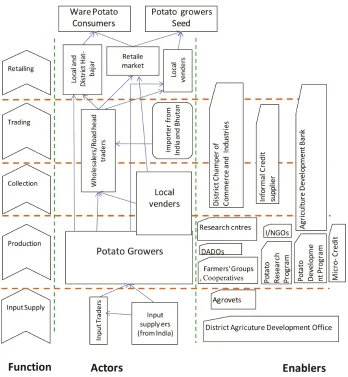
The chain map provides a graphic representation of the structure showing how products flow through the primary system as well as alternative channels. The channels are generally vertical chain of enterprises that transforms raw materials and delivers them to consumers as finished goods. The map lists functions vertically along the left-hand side with the final markets across the top. The participants or actors of the value chain are designated by boxes.
In the potato map (Fig. 5), the channels have been identified on the basis of core business
units, i.e. the supply, production and distribution involving physical product flow from supplier to the end-user. In general, the more the units are integrated, the more competitive advantage they gain and more capital-intensive they are.
3.6.1 Institutional involvement
3.6.1.1 Farmers organizations
The numbers of groups is quite impressive; however, the functioning of such groups seems to be less effective. However, these groups have better access to technical and other services and regularly visit the service providing agencies,
Fig. 4. Export of Potato quantity (t) and Value NRs. (thousands) (Source: TEPC)
2008/09 2009/10 2010/11 2011/12 2012/13 2013/14 1014/15 2015/16 2016/17
Quantity (t) 46,097 83,154 84,242 163,343 228,908 215,175 240,660 212,943 249,368
Value NRs. 000' 357,426 890,025 1,106,4 2,148,3 3,121,4 4,143,0 5,096,7 4,533,3 5,312,5
-1,000,000 2,000,000 3,000,000 4,000,000 5,000,000 6,000,000
Q
u
a
n
ti
ty
(
to
n
s)
a
n
d
V
a
lu
e
N
R
s.
0
0
0
'
2010/11 2011/12 2012/13 2013/14 1014/15 2015/16 2016/17
Quantity 38,100 162,946 645,322 1,085,52 2,930,05 307,470 58,540
Value NRs. 329,875 1,659,37 7,553,85 10,173,4 44,264,0 6,043,64 1,170,80
0 5,000,000 10,000,000 15,000,000 20,000,000 25,000,000 30,000,000 35,000,000 40,000,000 45,000,000 50,000,000
Q
u
a
n
ti
ty
(
k
g
)
a
n
d
v
a
lu
e
N
R
Shrestha and Yadav; SAJSSE, 2(3): 1-13, 2018; Article no.SAJSSE.46158
Fig. 5. Value Chain Map of Potato in Ilam district
participate in training, get new improved seed and technical support in disease, pest and nutrient management practices and so on. However, it was reported by the farmers that the groups are still weak and functioning poorly and they are more engaged in saving and credit in general. Similar tendency was observed in the case of cooperatives. There are some good examples of cooperatives functioning in the sector of saving and credit, vegetable production and marketing; however such cases are limited in numbers and coverage. Such informal groups are generally promoted by public institutions, NGOs/INGOs and other support agencies.
3.6.1.2 Traders organizations
The organizational development is relatively better compared to farmers. There are
associations operating at district level. However, there is no specialized traders’ organization working in potato. The linkages of these traders with public and private sector agencies are very poor and function in isolated environment. No institutional mechanism has been developed to establish efficient value chain of potato.
3.6.1.3 Facilitating agencies
information is very poor and in the remote areas and subsistence farmers get very little or no access even to this information.
3.6.1.4 Service providers
DADO is implementing various activities on potato promotion. Activities area focused only at the level of production. Group formation, technical advice to growers, technology demonstrations, training is the key activities implemented by the DADO.
Potato Development Program (PDP) is in Kathmandu based public agency. The objective of this public sector agency is to promote potato cultivation.
Potato Development Farm, Nigale was established to produce high quality seed of new varieties for hill conditions. It is also involved in the production of True Potato Seed (TPS). However, it is located in the Central Region with very few or no activity in the Ilam.
At the national level "Potato Research program (PRP)" has the mandate to conduct research works on potato. It has recommended several potato varieties. PRP is also involved in producing high quality pre-basic seed (PBS) through tissue culture technique which is distributed throughout the country through PDP.
3.6.2 Functionaries in the value chain
3.6.2.1 Farmers
Three types of production system have been observed: I) Subsistence production, II) Semi-commercial and III) Commercial production. Subsistence production is carried out for household consumption and produced in small quantities. The produce from the first category of farmers generally enters in a very limited quantity in the local hat-bazar (market). Commercial farmers sell most of their produce to various market intermediaries. The producers generally deal with traders and wholesalers. In most cases, farmers depend on road head traders and village level traders for price information. Some of the farmers reported that they get price and other information through the truck drivers who frequently visit the wholesale markets. But now-a-days, the situation has slightly changed due to easy access to communication technology and the commercial farmers generally have access to market information to some extent.
3.6.2.2 Village level traders
Small traders residing in the same village and commercial producers are occasionally involved in potato marketing. These traders are frequent visitors of wholesale markets and keep good relation with producers and big traders. Generally, they deal with small quantity at a time owing to their small amount of capital. To some extent, these traders are aware of price information and generally they do not take any risk of loss because only after knowing the assembly market price they make purchase in the village.
3.6.2.3 Big traders
Big traders purchase potato from commercial farmers who have scale of production and village level small traders who generally functions like collector. In the district these traders are retailers of foodstuff and other goods of basic needs. Generally, they have permanent farmers who occasionally purchase foodstuff and other requirements of daily need.
3.6.2.4 Commission agent/wholesalers
These functionaries play a vital role in marketing channels. Quite a substantial part of the marketable volumes potato goes the commission agents functioning in the wholesale markets like Birtamod. Usually, they do not take the ownership of the product but arrange for the sale on behalf of the traders, and they act only on commission and bear no risk. For this service, they charge 5% commission on the total sale value. Payments are generally made in installments. The small traders and farmers reported that delayed payment by the commission agents is one of the problems in potato trading. Grading and packing function is generally carried out by the traders who buy the stock from the farmers. The commission agents have very good trade relationship with the wholesalers and even retailers including Indian traders. They regularly exchange market information with Nepali and Indian traders on demand and prices.
3.6.2.5 Transporters
Shrestha and Yadav; SAJSSE, 2(3): 1-13, 2018; Article no.SAJSSE.46158
Table 5. Strength, weakness, opportunity and threat of potato sector in Ilam district
Helpful/Positive Factors Harmful/Negative Factors
Internal Factors Strengths
1. Research Station established in Jaubari
2. Developing road access to the rural area
3. Access to communication facilities 4. Year round production suitable
climate
5. Potentials for area and productivity growth
6. Traditional knowledge and skills of growers
7. Organic production system in the high hills
8. Traditional seed storage in the high hills
9. Many high yielding varieties are released
10. Functional traditional marketing linkage
11. Groups and cooperatives involved in market
12. Great potential of import substitution
Weakness
1. Weak adoption of improved technology
2. Worse seed quality
3. High incidence of diseases 4. Poor value addition activities 5. Farmers not fully aware of
quality seed
6. Lack of availability of improved variety
7. Poor road accessibility to reach market
8. Lack availability of inputs 9. Weak backward and forward
linkage
10. Lack of investment
External Factors Opportunity
1. Potential for increase area and productivity
2. Scope of establish potato processing industry
3. Government policy support as a high value income generating crop
4. Potentials to provide assistance in food technology and quality management 5. Scope of value added products 6. Import substitution is great opportunity 7. High hills could be developed for the
organic seed production hub
Threats
1. Serious threat of diseases like wart, late blight, and brown rot 2. Potato tuber moth is also
emerging threat
3. High cost of production in hills 4. Decreasing labor availability
Source: Field survey 2016
3.6.3 Analysis of value chain
The value chain analysis done which shows all cost, losses, margins and prices along the chain and the shares of each actor as the product moves from production to local traders, wholesale market, retail market and finally up to the consumers. As given in the Annex 1, the total farm level cost is about NPR 13.96. Of the total farm level cost, cost on labor represents the most important cost item, followed by seed, manures and fertilizers. The losses are quite substantial at the farm level about 5%. The average farm gate price during the last marketing season was NRs 24 per kg. The margin received by the producers is NPR 9.05 kg-1 which is 27% of the retail price
is about 10% at the retailers’ level. The analysis of the value chain of potato indicates that the traders and wholesalers deal in big quantities and extract substantial margin.
3.7 SWOT Analysis
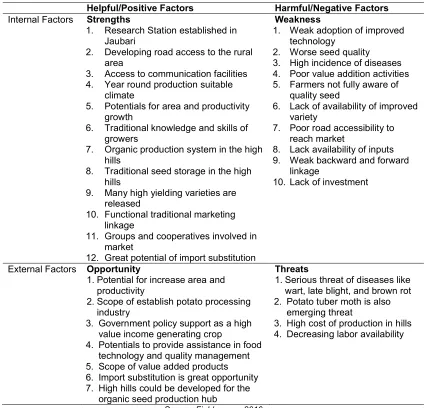
The SWOT analysis of the potato shows number of strengths and opportunities for boosting value adding interventions. The researcher and developing agencies must give emphasis while designing of interventions for addressing the weaknesses and threats for the growth of the potato sector. The following Table 5 shows the strength, weakness, opportunity and threat of potato sector in study districts as well as in the Ilam district.
4. CONCLUSION AND RECOMMENDA-TIONS
Area, production and productivity of the country as well as study district are increasing significantly. However, the majority of the farmers are growing local varieties which are diseases susceptible. The import of potato is also increasing sharply for which substitution is required. The area and productivity could be increased by introducing new improved varieties, management of diseases and pest, reduce production cost and provided training to the grower farmers.
Based on the assessment and analysis of findings, especially the constraints faced by the farmers following major recommendations have been made:
Support farmers for the adoption of new varieties released by PRP/NARC along with quality seed production in their locality so as improved variety should be available in the district.
Verification and demonstration of suitable varieties of potato should be done so as farmers could select their appropriate cultivar.
Promote integrated disease and pest management practices.
Research should be done to reduce the cost of production.
Training program should be organized on improved cultivation practices
Farmers should be encouraged to form a group and cooperative
COMPETING INTERESTS
Authors have declared that no competing interests exist.
REFERENCES
1. Sapkota M, Bajracharya M. Resource use efficiency analysis for potato in Nepal. Journal of Nepal Agricultural Research Council. 2018;4:54-59.
DOI:http://dx.doi.org/10.3126/jnarc.v4i1.19 690
2. Timsina KP, Kafle K, Sapkota S. Economics of potato (Solanum tuberosum L.) production in Taplejung districts of Nepal. Agronomy Journal of Nepal. 2011; 2:173-181.
3. Tolno E, Kobayashi H, Ichizen M, Esham M, Balde BS. Potato production and supply by smallholder farmers in Guinea: An economic analysis. Asian Journal of Agricultural Extension, Economics & Sociology. 2016;8(3):1-16.
DOI: 10.9734/AJAEES/2016/201726 4. Bajracharya M, Sapkota M. Profitability
and productivity of potato (Solanum
tuberosum) in Baglung district, Nepal.
Agriculture and Food Security. 2017;6:47. DOI: 10.1186/s40066-017-01250
5. Gairhe S, Gauchan D, Timsina KP. Adoption of improved potato varieties in Nepal. Nepal. Journal of Nepal Agricultural Research Council. 2017;3:38-44.
DOI:http://dx.doi.org/10.3126/jnarc.v3i1.17 274
6. Panta S, Luitel BP, Upadhyay KP, Chaudhary JN, Sapkota P, Pariyar K. On-station evaluation of potato clones in mid-western region of Nepal. In: Upadhyay, K.P. and Bhattarai, P. (eds). Proceedings of the National Potato Working Group held in 9-10, November, 2017. National Potato Research Program, Khumaltar, Lalitpur, Nepal; 2017.
7. Ghimire S, Pandey S, Gautam S. Study on degeneration of potato seed in the terai region of Nepal. Agrotechnology; 2016. DOI: 10.4172/2168-9881.1000149.
8. Luitel BP, Khatri BB, Lama L, Dhakal R, Khadka K, Choudhary D, Aryal S, Bonierbale M, Kadian MS. Journal of Nepal Agricultural Research Council. 2017;3:6-14.
Shrestha and Yadav; SAJSSE, 2(3): 1-13, 2018; Article no.SAJSSE.46158
9. MoAD. Statistical Information on Nepalese Agriculture. Ministry of Agriculture
Development, Nepal. Monitoring,
Evaluation and Statistical Division, Agriculture Statistics Section, Singha Durbar, Kathmandu, Nepal; 2016.
10. Sharma BP. Potato research in Nepal: Enhancing productivity and food security. In: Dhital, S.P. and Bhattarai, P. (eds). Proceedings of the national potato research workshop held in 31 March to 2 April 2014, National Potato research Programme, Khumaltar, Lalitpur, Nepal; 2014.
11. CBS. National sample census of agriculture Nepal 2011/12. Central Bureau of Statistics, Government of Nepal, National Planning Commission secretariat, Kathmandu, Nepal; 2013.
12. MoAD. Statistical Information on Nepalese Agriculture. Ministry of Agriculture
Development, Nepal. Monitoring,
Evaluation and Statistical Division,
Agriculture Statistics Section, Singha Durbar, Kathmandu, Nepal; 2015.
13. FAOSTAT. Online data; 2016.
Available:www.fao.org/faostat/en/#data/QC 14. Gairhe S, Gauchan D, Timsina KP. Adoption of improved varieties of Potato in Nepal. Journal of Nepal Agricultural Research Council. 2017;3:38-44.
DOI:http://dx.doi.org/10.3126/jnarc,v3i1.17 274
15. MoAD. Statistical Information on Nepalese Agriculture (Time series data). Ministry of Agriculture Development, Agribusiness Promotion and Statistical Division, Agri-statistical section Singha Durbar, Kathmandu, Nepal; 2013.
16. MoAD. Statistical Information on Nepalese Agriculture. Ministry of Agriculture
Development, Nepal. Monitoring,
Evaluation and Statistical Division, Agriculture Statistics Section, Singha
Annex 1. Value chain analysis of potato in Ilam District
1. Farmers Level
Item Price Kg-1 Potato
Human and bullock labor 6.86
Seed 5.29
Manure 1.10
Fertilizer 0.44
Land tax 0.04
Repair and maintenance 0.11
Depreciation 0.12
Total Farm Level cost 13.96
Losses 0.99
Margin 9.05
Farm Gate Price 24.00
2. Local Trader Level
Packaging bag 0.30
Grading and Weighing 0.20
Acquisition cost 24.00
Total assembling cost 24.50
Transportation, loading, unloading 1.00
Total local trader level cost 25.50
Losses 0.00
Margin 2.55
Assembler level price 28.05
3. Wholesaler/Commission Agent Level
Storage and communication 0.05
Acquisition cost 28.05
Total wholesaler level cost 28.10
Losses 0.00
Margin 1.41
Wholesaler commission agent level price 29.91
4. Retailers level
Rent and other cost 0.50
Packaging 0.40
Acquisition cost 29.91
Total retail level cost 30.41
Losses 1.82
Margin 3.04
Retailer level price 35.27
Source: Field Survey 2016 and calculation by researcher
© 2018 Shrestha and Yadav; This is an Open Access article distributed under the terms of the Creative Commons Attribution License (http://creativecommons.org/licenses/by/4.0), which permits unrestricted use, distribution, and reproduction in any medium, provided the original work is properly cited.
Peer-review history: