69
BLENDED LEARNING AND
TEACHING FOREIGN LANGUAGES
Blanka Frydrychová Klímová University of Hradec Králové, Czech Republic E-mail: [email protected]
Abstract
Teachers are all the time looking for different ways of increasing the quality of their teaching. At present the use of computers and new technologies has become an important aspect of foreign language learning. They have enabled the language teaching community to redefi ne some of the strategies and concepts of teaching and learning. In this climate computer-based distance learning courses have emerged. One of the supports of the distance learning is e-learning, which is widely used at the University of Hradec Králové. Sometimes e-learning is also exploited in the so-called blended learning. The talk will concentrate on the perception of the term blended learning, its possible model and contribution. In conclusion one of the representative blended courses will be introduced.
Key words: blended learning, educational quality, e-learning, language learning.
Introduction
Over the past decade the use of computers and new technologies has become an important aspect of foreign language learning. They have enabled the language teaching community to redefi ne some of the strategies and concepts of teaching and learning. This has been done in terms of enriching classroom activities, reorganizing course structures, and providing learners with more autonomous as well as more learner-centred opportunities for learning. Furthermore, teachers have been also looking for increasing the quality of their teaching with help of new and modern information technologies. In this climate computer-based distance learning courses have emerged. One of the supports of the distance learning is e-learning, which is widely used at the University of Hradec Králové. Sometimes e-learning is also exploited in the so-called blended learning.
Methodology
70 Blended learning
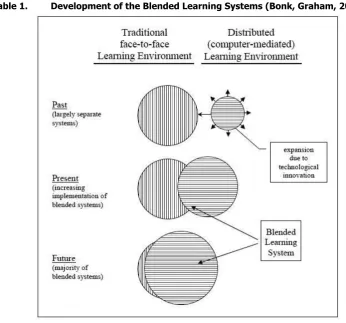
The term blended learning has become extremely fashionable nowadays, particularly in corpo-rate and higher education settings. But what, in fact, does blended learning mean? The term itself is quite diffi cult to defi ne since it is used in diverse ways by different people. Overall, the three most common meanings for blended learning are the following (see also Whitelock - Jelfs 2003): 1) the integration of traditional learning with web-based on-line approaches; 2) the combination of media and tools (e.g. textbooks) employed in e-learning environments; and 3) the combination of a number of teaching and learning approaches irrespective of the technology used (Driscoll 2002). As Bonk and Graham (2005) claim, blended learning is part of the ongoing convergence of two archetypal learning environments. On the one hand, there is the traditional face-to-face learning environment that has been around for centuries. On the other hand, there are distributed learning environments that have begun to grow and expand in exponential ways as new technologies have expanded the possibilities for distributed communication and interaction (Table 1). In this paper, following Little-john (2006), blended learning is perceived as an integration of face-to-face teaching and learning methods with on-line approaches.
Table 1. Development of the Blended Learning Systems (Bonk, Graham, 2005).
Why blend?
In the literature on blended learning, the most common reason given for its implementation is that it combines “the best of both words”. Graham et al. (2003) state three main reasons why blended learning should be chosen:
improved pedagogy; 1.
increased access/ fl exibility; 2.
71 Volume 5, 2008 Blended learning undoubtedly contributes to the development and support of more interactive
1.
strategies not only in face-to-face teaching but also in distance education. Developing activities linked to learning outcomes namely place focus on learner interaction, rather than content dis-semination. In addition, distance learning can then offer more information available for students, better and faster feedback and richer communication between a tutor and a student. Obviously, it offers more opportunities for communication (both face-to-face and on-line).
Access to learning is one of the key factors infl uencing the growth of distributed learning environ-2.
ments. Students can access materials at any time and anywhere. Furthermore, they can proceed at their own pace. Consequently, it means higher motivation and stimulation for students (ibid). The increased cost effectiveness is particularly true for the corporate systems where people are 3.
permanently busy and hardly ever can afford to attend face-to-face full-time classes. However, the blended learning enables them after fi nishing their work, family and other social commitments to start learning. Also universities are all the time looking for better quality enhancements and cost savings. For example, the blended learning is an asset for their distance learning courses or investment learning projects.
On the other hand, there are some drawbacks (Čech, Klímová, 2003) which might contradict with the above mentioned statements. The blended learning is certainly time-consuming and de-manding for creation, preparation and evaluation. At random there might also occur problems with technology.
Feasible Model of Blended Language Courses (A Hradec Králové Case)
The blended learning is particularly suitable for language learning when conventional face-to-face teaching is sometimes necessary for developing speaking communication skills. In this way it is used also at the Faculty of Informatics and Management in Hradec Králové when speaking of language teaching. Students can do, for example, writing and reading tasks on their own and in classes teachers can concentrate more on listening and speaking activities.
As Rychtářová (2003/ 2004, p. 105) has shown, for teachers at elementary and secondary schools, of the four basic communication skills the most important skill to master is speaking (94%) and listening (71%), while reading (62%) and writing (49%) are considered less important.
A complementary part of the blended learning in Hradec case is e-learning, which is being widely developed at the faculty. The Faculty of Informatics and Management (FIM) of the University of Hradec Králové has been intensely involved in the application of e-learning in teaching since 1999 (Nocar, 2004, p. 63) as its teachers continuously attempt to improve the quality of their teach-ing. E-learning namely enormously contributes towards increasing effectiveness and effi ciency of educational process. The faculty uses the WebCT e-learning system for on-line publishing of many different courses. Besides the environment where students can access study materials any time and anywhere, the WebCT offers additional valuable tools for teachers, too. Present e-learning systems, such as the WebCT, provide many enhancements to help teachers to publish their study materials and control the learning process. With a little effort every teacher can become a course creator that can easily publish his/ her life-long elaborated materials. The process of publishing materials in the on-line system (e.g. the WebCT) is fairly straightforward. It consists of several steps, which are as follows:
materials preparation; •
materials conversion into HTML format; •
materials uploading into WebCT system; •
linking page from the content module (outline of the course); •
linking tests, quizzes and assignments if necessary. •
(on-72 line teaching = On-Line VyukA), began to be used as a new quality support for full-time students as well. At present more than 90 e-courses are being fully exploited in teaching at the faculty. In English teaching more than 40 e-courses are being used. Some of them, such as Teaching Written Business English, can be taught completely on-line. However, most of them are blended as there are usually a few tutorials. At tutorials (face-to-face teaching) students usually discuss the problems they come across when doing different types of tasks or writing assignments. This is particularly suitable for the university distance students and interuniversity study, the so-called RIUS (Development of Interuniversity Study) project. Moreover, sometimes there are regular classes and e-courses are used as reference courses (i.e. students can once again read the information obtained in class and do some additional exercises to practice their knowledge) for further self-study or revision of the lecture. This is, for example, true for teaching Culture of Great Britain or History of the USA.
Blended Course on Academic Writing
One of the representative blended courses at the faculty is, for example, an optional one semester course on Academic Writing. The course is aimed at the whole process of writing and gives advice on how to write professionally. It shows the component parts of the writing process, that is: envisaging what to write, planning an outline, drafting passages, writing the whole thing, revising and rewriting it, and fi nishing it in an appropriate form, together with publishing all or parts of a text. In addition, it focuses on those features which are different in English and Czech, such as making references, quoting bibliography or using appropriate English. As for the last aspect, there are independent sec-tions on grammar structures in written English, lexical structures, and punctuation.
The course tries not only to address a lack of students’ formal writing in the English language but also to approach it in a new way. The course exposes students to blended learning. That means they meet a teacher once into two weeks to discuss and clarify the mistakes they made in their as-signments (i.e. essays), which together with a deeper self-study of the materials implemented in their on-line e-learning course, they write every second week.
In the summer semester of 2007 the course was attended by 12 students of Management and Tourism. To discover whether the integration of face-to-face teaching and learning methods with on-line approaches was successful in imparting learning, students were given the following evalu-ation form:
Please comment on the overall structure and content of the course. 1.
Did you fi nd the reference on-line course (OLIVA) motivating/ not motivating and 2.
why?
List three activities which were the most useful to you? 3.
Were there any activities you did not fi nd useful and why? 4.
What or who motivated you to attend the course (e.g. friends, credits ……)? 5.
Did you welcome the possibility to have a face-to-face course once every two weeks or 6.
would you prefer to have it every week?
Would you recommend the course to other people? 7.
Further comments? 8.
Thank you.
Generally, all respondents (12) were satisfi ed with the overall structure of the course. They stated that the information given to them during the whole course had been very useful. Moreover, they thought this subject should be compulsory in the second year of their study when preparing for their Bachelor paper.
73 Volume 5, 2008 when the system did not work.
The most useful activities according to the respondents were: writing essays, discussing common mistakes, which appeared in students’ essays, discussing the structure of a Bachelor paper, using an on-line course, or translating. Furthermore, there was no activity that students considered not worth doing. Only two students commented that there had been too many tasks in the on-line course, and that not all were useful.
As for question 5, the main motivation factor for attending and studying the course was students’ eagerness to improve their English, especially their skills of formal written English. The second motivation factor was their intention to write a Bachelor paper in English. Among further additional factors were, for example, another way of obtaining needed credits or that a friend recommended them to attend the course.
Except for two respondents, who would have liked to have the face-to-face course every week, everybody welcomed a chance to have the course once every two weeks. Overall, the responses to the given questions were very positive, and it is noteworthy that respondents indicated in their answers to question no. 7 that they thought the course would be useful for all students at the faculty.
Conclusion
The above-mentioned information demonstrates both institutional and teachers’ effort to im-prove a sustainable process towards the educational quality of teaching and learning at the faculty by applying new technologies in education. While acknowledging some problems, these seem to be outweighed by the advantages, for example, an opportunity for distance learning, which undoubtedly increases the quality for education and goes beyond traditional ways of teaching and learning, and thus extends further possibilities for learning.
As far as language teaching is concerned, modern information technologies do offer challenging ways of teaching and learning, such as easy access to study materials, the opportunity to proceed at an individual pace, and to choose the time and place of studying, and almost immediate feedback on writing with e-mail tutorial support. These benefi ts are, however, only a partial solution for learners who need to develop speaking skills. However, this problem can be solved to some extent by using telephone and video conferencing. Nevertheless, conventional face-to-face training is still neces-sary to provide the practice and feedback on performance that can really help to improve speaking skills. Therefore, blended learning can be a solution to a number of problems. As Sharma (2006) says, ‘on the one hand, technology is here to stay. On the other, the teacher will never be replaced. I believe it is crucial that the teacher remains in control as the person creating the course programme, meeting the learners, interpreting or assigning the material and honing the course. The technology should not ‘lead’.’
References
Bonk, C.J., Graham, C.R. (2005). Handbook of Blended Learning: Global Perspectives, Local Designs. San Francisco, CA: Pfeiffer Publishing.
Čech, P., Klímová, B. (2003). Kurz Teaching Written Business English (TWBE)in J. Sedláček (Ed.) Sborník příspěvků ze semináře a soutěže e-learning 2003. Hradec Králové: Gaudeamus, 23-26.
Driscoll, M. (2002, March). Blended Learning: Let’s Go beyond the Hype. Learning and Training Innovations Newsline. Retrieved Oct 5, 2005 from
http://www.ltimagazine.com/ltimagazine/article/articleDetail.jsp?id=11755.
Graham, C.R. et al. (2003). Benefits and Challenges of Blended Learning Environments.
In: M. Khosrow-Pour (Ed.), Encyclopedia of Information Science and Technology I-V. Hershey, PA: idea Group Inc.
74 Poulová, P. (2004). E-learning na FIM UHK v roce 2003 in K. Květon (Ed.) E-learning v České a Slovenské
republice, stav a perspektiva. Praha: ČVUT, 171- 179.
Rychtářová, K. (2003/ 2004). Odborný jazyk a jazyková přípravenost učitelů ZŠ a SŠ. Cizí jazyky, 3, 104-105.
Sharma, P. (2006, January). Future in the Balance. English Teaching Professional, 42, 58-59.
Whitelock, D., Jelfs, A. (2003). Editorial: Journal of Educational Media Special Issue on Blended Learning.
Journal of Educational Media, 28(2-3), 99-100.
Adviced by Pavel Čech, University of Hradec Kralove, Czech Republic
Blanka Frydrychová Klímová Lecturer of English Language at University of Hradec Králové, Faculty of Informatics and Management, Department of Applied Linguistics, Rokitanského 62, 500 03 Hradec Králové 3, Czech Republic.