Licensed under Creative Common Page 56
http://ijecm.co.uk/
ISSN 2348 0386
A MODIFIED CONSUMER DECISION MAKING MODEL FOR ONLINE
SHOPPING: A STRUCTURE EQUATION MODELLING APPROACH
Tahseen Arshi, A.
Director of Studies, FoBM, Majan University College, Oman [email protected]
Morande, S.
Lecturer, FoBM, Majan University College, Oman [email protected]
Veena Tewari, N.
Programme Manager, FoBM, Majan University College, Oman [email protected]
Abstract
The conventional consumer decision making model (CDMM) claims a rich pedigree of academic
development and has been guiding researchers and practitioners over the last forty years in
understanding consumer decision making process. Although, sizeable theorizing and empirical
research has focused on traditional consumer decision-making styles, little attention has been
paid to online consumer decision-making styles. With increased proliferation of internet into
consumer purchase domain and an onslaught of consumer online shopping, the sustainability of
CDMM has become questionable. It has sparked renewed interest of researchers and hence
there is a call to refine the CDMM to include measures that influence online shopping behaviour.
This study has developed measures that are relevant for online shopping and also argues that the
processes of information search and evaluation of alternatives are fused together in an online
shopping environment. The study uses a dominantly quantitative approach and utilizes structural
equation modelling to test the information technology measures that influence consumer decision
making. As a result, this study proposes a modified model of consumer decision making for online
shopping, which has key implications for researchers and practitioners.
Keywords: Consumer decision making, online shopping, information search, evaluation of
Licensed under Creative Common Page 57 INTRODUCTION
The consumer decision making model (CDMM) also known as Nicosia Model was initially proposed by Francesco Nicosia (1976). The first criticism of the Nicosia CDMM is that it considers all customers and all purchase situations to be the same. According to Bray(2008) CDMM assumes that all customers go through all the stages of CDM to complete the purchase process. The CDMM shows that consumer purchase is a very complex process and involves five distinct stages which includes need recognition, information search, and evaluation of alternatives, purchase decision and post purchase behavior (Bhasin, 2010). The main strength of the CDMM is its ability to guide marketers to design marketing strategies for each of the stages of the consumer decision making process. It takes into account the fact that customers spend a lot of time in information search, evaluating from the different alternatives and then finally choosing the product that would satisfy their expectations.
However, in reality the CDMM is not applicable in all situations. In many situations customers would skip some stages and engage in impulse buying. At the same time consumer experiences and characteristics may not be the same (Glassock and Fee, 2015).Various researches have concluded that there are products for which the customer do not spend time on information search and choosing from various alternatives and hence do not go through all the stages of CDM process (Milner and Rosenstreich, 2013).
In situations of online shopping, the consumer search for information and evaluation of alternatives are different. Online shopping can satisfy multiple consumer needs more effectively and efficiently as consumers can not only easily compare product features, availability, and price, but also can browse the complete product portfolio with minimal effort, minimal inconvenience in a limited time (Chen and Leteney, 2000; Grewal, Iyer, and Levy, 2002). The depth of information and variety of choices made available online by marketers and comparative analysis platforms makes the process shorter and easier and hence it is suggested that these two processes are fused together in the context of online shopping. A number of factors can be found to be influencing online shopping process. These include technology and internet landscape, availability of payment channels and payment instruments. These factors are studied in detail in this study and the measures are included in the modified consumer decision making model of online shopping.
LITERATURE REVIEW
Licensed under Creative Common Page 58 a consumption choice While different models of decision making exist in the literature, most are variations of the "grand models" (i.e. Nicosia, 1976; Engel et al., 1967; Howard and Sheth, 1969), make up the dominant framework for understanding consumer decision making. These cognitive models view individuals as "information processors" who obtain information from the environment and process, organise, and evaluate it in relation to a decision.
Past research has shown that the Internet represents a sufficiently different retail environment and a different atmosphere which can significantly influence the emotions and motivations of shoppers and thereby affect their buying behaviour (Menon & Kahn, 2002). In addition, many studies have argued that online shoppers and non-shoppers have different personal characteristics and that there is a significant difference between online shopping and offline shopping (Parsons, 2002; Vijayasarathy, 2002; Card, Chen, and Cole, 2003, Kau, Tang, and Ghose, 2003).
Most of the models of consumers buyer behaviour are similar in its outcome, varies on the basis of consumers priorities and the intensity of need and wants of a particular product. According to Prasad and Jha (2014) and Oke et al. (2016) the buyer behaviour models discuss the actual outcome of a product purchase which is judged to be better than or equal to the expected, the buyer will feel satisfied and can plan for repeat purchase or become brand loyal. Bray (2008) sums up general criticisms of the model by noting it that it’s mechanistic approach
does not apply well to varied decision-making contexts. Further, he also notes that the environmental variables, particularly technology and its mechanisms in influencing consumer decision-making, have not been clearly specified (Bray, 2008). Proliferation of internet technology and online shopping has made information search easier and faster. Reviews are playing a major role in the consumer decision making model. They provide information about products and services and also helps to boost local search engine optimization (SEO) in the process. This also facilitates consumer’s ability to evaluate between alternatives and take
Licensed under Creative Common Page 59 Measures of online shopping
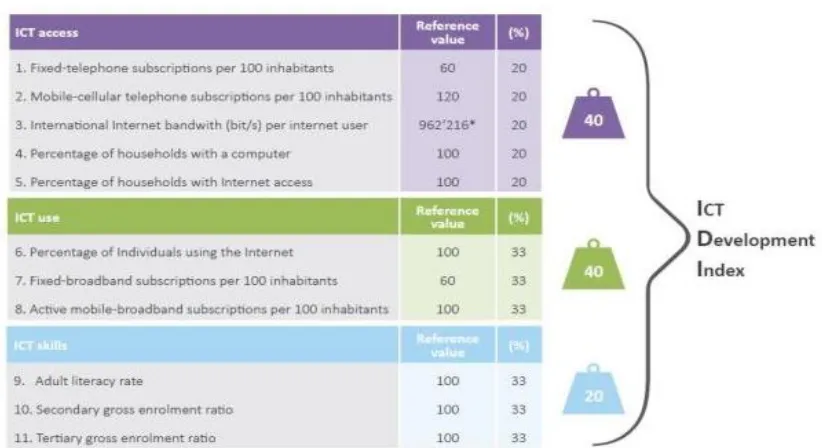
Information and communication technologies (ICT) indicators are developed by United Nations Telecommunications union in order to develop benchmarks and compare ICT performance across societies (MIS Report, 2014). Used international Internet bandwidth refers to the average traffic load of international fibre-optic cables and radio links for carrying Internet traffic. This factor is very significant as it has considerable impact on online payment instruments. According to research, ICT use indicators include percentage of individuals using the Internet who used the Internet from any location and for any purpose, irrespective of the device and network. Such access can be via a computer, mobile phone, gaming console (networked), digital TV, etc. Access can be via a fixed or mobile network connected with World Wide Web (Battu, 2016).
ICT also considers Fixed-broadband subscriptions that refers to fixed subscriptions for high-speed access to the public Internet via cable modem, DSL, fibre-to-the-home/building, other fixed-broadband subscriptions, satellite broadband and terrestrial fixed wireless broadband. This total is measured irrespective of the method of payment. It excludes subscriptions that have access to data communications (including the Internet) via mobile-cellular networks (Pham, 2014). It includes fixed WiMAX and any other fixed wireless technologies, and both residential subscriptions and subscriptions for organizations. The last parameter includes active mobile-broadband subscriptions which refers to the sum of standard mobile-broadband subscriptions and dedicated mobile-broadband subscriptions (Ajjan et al. 2014). Standard mobile-broadband subscriptions refer to active mobile-cellular subscriptions with advertised data speeds that allow access to the greater Internet via HTTP and which have been used to set up an Internet data connection using Internet Protocol (IP). Standard SMS and MMS messaging do not count as active Internet data connection, even if messages are delivered via IP. International Internet bandwidth refers to the total used capacity of international Internet bandwidth, in megabits per second (Bauer and Latzer, 2016).
Payment Channels and Payment Instruments
Licensed under Creative Common Page 60 Figure1: ICT Index
Source: http://www.itu.int/en/ITUD/Statistics/Documents/publications/misr2015/MISR2015-w5.pdf
Research Gap and Conceptual Framework
The review of literature showed that there are prominent gaps specifically the lack of consideration of information technology measures in relation to consumer decision making process. These information technology measures specifically relate to information search and information evaluation processes. Based on these research gaps, the following conceptual framework has been developed and related hypotheses were framed.
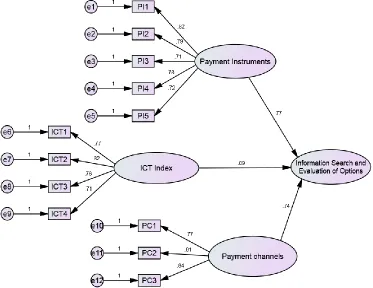
Licensed under Creative Common Page 61 As per the recommendations of Diamantopoulos and Siguaw (2006) the hypothesized relationship between the measures have been clearly shown in the conceptual framework. There are five reflective measures of payments instruments, four reflective measures of ICD index and three reflective measures of payment channels. Further, the ICT index, payment channel (PC) and payment instruments (PI) are the formative measures of information search and evaluation of alternative processes, which have been hypothesized to be a single process for online shopping. According to these prepositions, the hypotheses have been framed.
Hypotheses
H1: Consumer decision making for online shopping is influenced by ICT Index, PC and PI
particularly information search and evaluation of alternatives.
H2: Information Technology measures facilitate information search and evaluation of
alternatives and hence is a single process in an online shopping environment.
METHODOLOGY
An epistemologically positivist and realist positioning is well suited for this research. Therefore, measurement, reliability and validity assumed importance and a quantitative research strategy was chosen (Bryman and Bell, 2015). When research involves and development and testing of models, structural modeling (SEM) approach is quite robust method to test the validity of exiting models or modified models (Gaskin, 2012). Hence SEM was employed to tests the validity of the proposed modified model. At the first level, the measures of the factors for online consumer shopping was tested as reflective measures. In other words, the objective was to test whether the measures are valid. Initially, exploratory factor analysis was conducted to test the validity of measures. To substantiate the findings further, a measurement model was developed using SEM. In order to test the causal effect of these factors on modified CDM model, a structural model was developed which included the reflective measures of the proposed factors at the first level and formative measures of the CDM at the second level. Although, a dominantly quantitative strategy was employed, a subjectivist ontology was also warranted at the initial stages of the research, since the measures for modified CDM model was largely exploratory in nature. Hence, the measures had to be qualitatively validated by experts, which included academics from the field and practitioners from the industry.
Sampling
Licensed under Creative Common Page 62 survey was conducted drawing from a sample of consumers engaged in online shopping. The sampling strategy was convenience, since only those consumers were chosen who shop online. Convenience sampling has been used in prior studies on online shopping by Ramayah et al. (2008). Another group of sample involved marketing professionals, who design marketing strategies for online companies. A total of 200 respondents participated in the study which were drawn from India and Oman.
Measures
The measures of the traditional CDM model already exists in large part of the literature. However, the measures for the modified model was largely exploratory and is emerging, hence not much academic literature is available on these factors and their measures. Three main factors that have been identified for the modified CDM model are ICT index, Payment Instruments and Payment Channels.
ANALYSIS AND RESULTS
Satisfactory levels of reliability with Cronbach Alpha scores >.7 as recommended by Saunders (2010) was evident as shown in the table 1 below, indicating that the measures were internally consistent and reliable for further analysis.
Table 1: Reliability Statistics
Reliability Statistics
Cronbach's Alpha N of Items
.788 11
In order to check the validity of measures, exploratory factor analysis involving Principal Components Analysis with Promax Rotation and Kaiser Normalization was used as suggested by Kline (2011). The KMO scores shown in table 2 below was quite good (>.70)and showed that the data is fit enough to conduct factor analysis and structural equation modelling tests.
Table 2: KMO Scores
KMO and Bartlett's Test
Kaiser-Meyer-Olkin Measure of Sampling Adequacy. .783 Bartlett's Test of
Sphericity
Approx. Chi-Square 981.947
Df 66
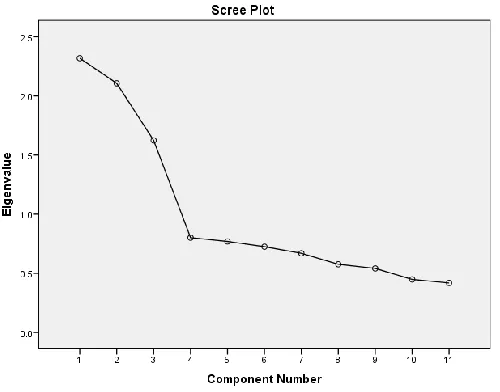
Licensed under Creative Common Page 63 The screen plot also showed that the three factor structure was appropriate. Further, the pattern matrix showed that the measures loaded onto their respective factors with satisfactory values (>.40) recommended by Tabachnik and Fidel (2007).
Figure 3: Screen Plot showing 3 valid factors
Table 3: Pattern Matrix
Pattern Matrixa
Component
1 2 3
ICT1 .733 ICT2 .810 ICT3 .732 ICT4 .899
PI1 .730
PI2 .820
PI3 .748
PI4 .892
PC1 .754
PC2 .861
PC3 .892
Licensed under Creative Common Page 64 Further, structure equational modeling approach was used (AMOS version 22). Gaskin (2012) pointed out that modelling interactions, non-linearity, correlated independents, correlated errors and error terms are all accounted for in SEM analysis and hence provides a more advanced and robust analysis of data, particularly for testing of models. In order to confirm the factorial structure of the three technology factors, a measurement model was estimated using maximum likelihood method (ML). By following ML method, both S (the sample variance-covariance matrix) and Σ (θˆ) (the sample estimated, model implied v-c), which are sample estimates of Σ
(the population variance-covariance matrix), were treated differently. While S was unrestricted, Σ (θˆ) was constrained by the specified SEM model. In this way, ML searched for the set of parameter estimates that maximizes the probability that S was drawn from Σ (θ) (the population,
model implied v-c matrix), assuming that is the best estimate of Σ (θˆ) (Stevens, 2009) The measurement model and model fit indices are shown figure 4 below.
Figure 4: Measurement Model for Measures of Online Shopping
CMINDF 1.521 GFI .987 AGFI .953 CFI.945 RMSEA .048
Licensed under Creative Common Page 65 The fit indices were as per the recommended standards indicating good model fit as suggested by Tabachnick and Fidell (2007). The complete SEM model is shown in figure 5 below.
Figure 5: Complete SEM Model showing the modified model of CDM for online shopping
CMINDF 1.467 GFI .927 AGFI .914 CFI.925 RMSEA .034
The complete SEM model showed that three information technology measures namely ICT index, PC and PI are formative measures and have a causal effect on information search and information evaluation process. The coefficient values of .77 for payment instruments, .89 for ICT index and .74 for payment channels led the researchers to accept H1 that consumer decision making for online shopping in influenced by ICT Index, PC and PI particularly information search and evaluation of alternatives. It also led to the acceptance of H2 that Information Technology measure facilitate information search and evaluation of alternatives and hence is a single process in relation to online shopping.
DISCUSSION
Licensed under Creative Common Page 66 interaction of customers with the internet and whole new generation of online shopper emerging in developing countries, the traditional CDM model is not sustainable. It needs refinement particularly in relation to information technology measures. Therefore, efforts to modify the model by researchers in an appropriate research endeavor. Many studies had highlighted the barriers of online shopping and highlighted the frustrations and hesitation of shoppers when they shop online (Karimi et al. 2015; Kohli et al. 2004). When consumers browse the online store, more for information, than for buying online, is due to the barriers such as purchase failures, security fears, service frustrations (Cho, Kang, and Cheon, 2006). These barriers can be attributed to unavailability of robust information technology infrastructure. The measure identified and develop in this study, reduces such negative outcomes and by increasing the robustness of the measures improves favourable and informed consumer decision making. Robust index secure payment channels and modern payment methods has advantages regarding the amount of product information, ease of use, speed and convenience. It also reduces the sensitive to issues of privacy and security when factors are favourable (Thom, 2000). Within given model ICT development index (IDI), directly affects information search in the consumer purchase behaviours. Considering faster lifestyle, the consumer search for information depends on the enhancement of mobile computing. While on the move – this phase of consumer decision making called ‘Information Search’ – is affected directly with respect to
Licensed under Creative Common Page 67 three factors namely availability of online infrastructure (IDI), payment channels and payments instruments are important for online shopping process and hence included in the modified CDM model in this study.
CONCLUSION
The findings of this study has implications for academics, managers and researchers. Traditional CDMM is appropriate for offline shopping environments, but needed refinement in light of changes in technology landscape and consumers involvement with technology. The contributions of this study can be realized at two levels. Firstly, at the theoretical level, the modified CDMM has been refined to include information technology measures for online shopping, which is appropriate considering the changes in the technology landscape. Secondly, the study can guide marketing and brand managers in designing branding and advertising strategies for online shoppers. The findings have specific implications for marketing communications, as information search and evaluation is closely associated with how information is transmitted and processed. In an online shopping environment, it is not just about quantity or frequency of information that reaches the consumers, but it is also about the quality of information, since consumers are also evaluating the information at the same time. Marketing communications have to evolve to include information that is not just informative but facilitates evaluation. Information technology platforms provide the opportunity to make the communication more effective through real time interaction and feedback. Further, in an online shopping environment brand managers should focus on creating brand preference, rather than brand recognition. The modified CDMM provides the opportunity to brand managers to create brand recognition and brand identify at the same time. Positive brand evaluation will then lead to brand preference. The factors and measures developed and validated through this study will ultimately effect consumer purchase decision making and marketing managers must leverage the growth in technology to develop effective marketing strategies.
Licensed under Creative Common Page 68 can be developed. Finally, technology measures would keep evolving and hence the model of online shopping will see a further transformation with time. This study has contributed by not only including information technology measures into a consumer behavioural model, but also by increasing the awareness for future research do so.
REFERENCES
Ajjan, H. Hartshorne, R. Cao, Y. and Rodriguez, M. (2014). Continuance use intention of enterprise instant messaging: a knowledge management perspective, Behaviour & Information Technology, 33 (7), 678- 692.
Anonymous (2009). Research and Markets: Trends in Online Payment Market in India, China & Malaysia. M2 Presswire.
Battu, D. (2016) Communications Networks Economy,New York: John Wiley and Sons.
Bauer, M.J. and Latzer, M. (2016). Handbook on the Economics of Internet,Boston: Edward Elgar Publishing.
Bhasin, H. (2010). Factors Affecting Consumer Buying Behavior, www.marketing91.com accessed 26th Jan 2017.
Bray, J. P. (2008). Consumer Behaviour Theory: Approaches and Models, Discussion Paper. Bournemouth: Bournemouth University.
Bryman, A. and Bell, E. (2015). Business Research Methods, Oxford: Oxford University Press.
Card, J.A. Chen, C. and Cole, S.T. (2003). Online travel products shopping: differences between shoppers and non-shoppers, Journal of Travel Research, 42, 133-139.
Chen, S. and Leteney, F. (2000). Get real! Managing the next stage of Internet retail, European Management Journal, 18(5), 519-528.
Cho, C. Kang, J. and Cheon, H. (2006). Online shopping hesitation, Cyberpsychology & Behavior, 9(3), 261-274.
Diamantopoulos, A., & Siguaw, J. A. (2006). Formative versus reflective indicators in organizational measure development: A comparison and empirical illustration, British Journal of Management, 17, 263-282.
Engel, J.F. Blackwell, R. D. and Miniard, P.W. (1995). Consumer Behavior, NY: Blackwell Press
Frambach, R.T. Roest, H.C.A. and Krishnan, T.V. (2007).The impact of consumer internet experience on channel preference and usage intentions across the different stages of the buying process, Journal of Interactive Marketing, 21 (2), 26 – 41.
Gaskin, J. (2012) 'Model fit again'. Gaskination's Statswiki, Available at: http://statswiki.kolobkreations.com, accessed 20th January 2017.
Glasssock, G. and Fee, A. (2015). The decision-making processes of self-initiated expatriates: a consumer behaviour approach, Journal of Global Mobility, 3(1), 4.
Grewal, D. Iyer, G.R. and Levy, M. (2002). Internet retailing: enablers, limiters and market consequences, Journal of Business Research, 57(7), 703-713.
Hedman, J. Tan, F.B. Holst, J. and Kjeldsen, M. (2017). Taxonomy of payments: a repertory grid analysis, The International Journal of Bank Marketing, 35(1), 75-96.
Howard J.A and Sheth J.N. (1967).Theory of Buyer Behavior, Proceedings, American Marketing Association.
Licensed under Creative Common Page 69 Karimi, S. Papamichail, K.N. and Holland, C.P. (2015). The effect of prior knowledge and decision-making style on the online purchase decision-making process: A typology of consumer shopping behaviour, Decision Support Systems, 77, 137-138.
Kau, A. K. Tang, Y.E. and Ghose, S. (2003). Typology of online shoppers. Journal of Consumer Marketing, 20(2), 139-156.
Kline, R.B. (2011). Principles and Practice of Structural Equation Modeling (3rd Ed.), New York: Guilford Press.
Kohli, R. Devraj, R. and Mahmood, M.A. (2004). Understanding Determinants of Online Consumer Satisfaction: A Decision Process Perspective, Journal of Management Information Systems, 21(1), 115-135.
Measuring the Information Society Report (2014). Geneva, Switzerland: International Telecommunication Union (ITU), p. 40. Accessed 22nd January 2017.
Menon, S. and Kahn, B. (2002). Cross-category effects of induced arousal and pleasure on the Internet shopping experience, Journal of Retailing, 78, 31-40.
Milner, T. and Rosenstreich, D. (2013). A review of consumer decision-making models and development of a new model for financial services, Journal of Financial Services Marketing, 18 (2), 106-120.
Nicosia, F.M. Robert, W (1976). Consumer Behavior toward Sociology of Consumption. Journal of Consumer Research, 5, 121-133.
Oke, A.O. Kamolshotipros, P. Popoola, O.Y. Ajagbe, M.A. and Olujobi, O.J. (2016). Consumer Behavior towards Decision Making and Loyalty to Particular Brands. International Review of Management and Marketing, 6(4).
Parsons, A.G. (2002). Non-functional motives for online shoppers: why we click, Journal of Consumer Marketing, 19(5), 380-392.
Pham, T.L. H. (2014). ICT Development Strategies, Hamburg: Anchor Academic Publishing.
Ramayah, T. Oh, S.M. and Azizah, O. (2008). Behavioral Determinants of Online Banking Adoption: Some Evidence from a Multicultural Society, Journal on Management, 2 (3), 29-37.
Ramirez, A. (2014). How Online Reviews are affecting the Consumer Decision Making Model.
Saunders, M., Lewis, P. and Thornhill, A. (2010). Research Methods for Business Students, London: Pitman Publication.
Stevens, J. (2009). SEM: A Workshop presented to College of Education, University of Oregon, available at http://pages.uoregon.edu/stevensj/workshops/sem_slides6.pdf accessed 2nd Feb 2017.
Tabachnik, B.G. and Fidell, L.S. (2007). Using Multivariate Statistics, London: Pearson International Education.
Thom, G. (2000).Online shop lags. Delivery doubt slows growth, Herald Sun. Melbourne, 24.
Vijayasarathy, L.R. (2004). Predicting consumer intentions to use on-line shopping: the case for an augmented technology acceptance model, Information & Management, 41, 747-762.
Zhang, L.Y. Shi, Y.J. and Lu, Q. (2014).Consumer's Decision-Making Behavior in Online Shopping: An Integrated Analysis, Applied Mechanics and Materials, 519-520, 422-429.
APPENDIX 1: Measures used in Research Instrument
Labels Description
ICT1 Fixed and Wireless broadband subscriptions ICT2 Mobile-cellular telephone subscriptions ICT3 Skills and digital literacy
Licensed under Creative Common Page 70 PI1 Credit card to enable the cardholder to pay a merchant for goods and
services.
PI2 Internet banking (also known as Net-banking /Online banking) is used to process the payment using bank gateway in real time.
PI3 Digital wallet helps people pay for stuff, but it will also store tickets, bus and passes and gift cards.
PI4 Debit card is another banking instrument that can be used around the globe and is accepted worldwide, including millions of retailers, ATMs, online or over the phone.
PI5 Prepaid Cards will help you pay for stuff, but it will also store concert tickets, bus and subway passes and gift cards.
PC1 Desktop/ Laptops uses special plugins to retain the credit/debit card information to be able to make online payments when required.
PC2 Smartphones (with USSD banking) / PDA (Personal Digital Assistants) Customized mobile applications (Such as Paypal) and QR codes based payment mechanism can be used to make payment