3185
Reducing Delay Of Wireless Sensor Networks
Using Energy Efficient Unequal Clustering Routing
Algorithm
Priyanka Handa, Tripatjot Singh Panag, Balwinder Singh Sohi
Abstract: The sensor nodes with limited resources are deployed in a sensor field. A large number of Senor nodes communicate with each other and exchange sensed data to form a wireless sensor network (WSN). The Quality-of-service (QoS) guarantee in WSNs is difficult and more challenging due to the fact that the resources available with sensors nodes are limited and the various applications running over these networks have different constraints in their nature and requirements. End to End transmission delay(E2ETD) is very important factor of QoS of WSN. E2ETD is time taken by a packet to travel from source to base station(BS). To achieve high QoS the delay should be minimal. In this paper energy-efficient unequal clustering routing algorithm(EEUCR) is evaluated to check its performance for E2ETD. In this protocol, the area of the network is divided into the number of rings of unequal size and each ring is further divided into a number of clusters. Rings nearer to BS have smaller area and area of rings keeps on increasing as the distance from BS increases for balanced energy consumption. Heterogeneous energy nodes are deployed in the network. E2ETD of EEUCR is computed and is compared with existing protocols. Results show that EEUCR performs better than other protocols because the ring structure facilitates to find the route to transfer the packets immediately and also BS is located at the center of sensor field.
Index Terms: Wireless sensor network, quality of service, end to end transmission delay, EEUCR
—————————— ——————————
1. INTRODUCTION
Wireless Sensor Network (WSN) is collection of several sensor nodes deployed randomly in a region. Sensor nodes sense data about events and physical phenomena, which occur in the region, and transmit them to a base station. Each sensor node has a limited communication range and battery. The battery of each sensor node while not being rechargeable or replaceable due to the application of these networks, supplies the required energy of the node[1]. Wireless sensor networks have emerged as an equally valuable and novel platform for wireless communication and other areas of applications. The potential of wireless sensor networks includes wider areas of coverage such as environmental monitoring, defense machinery and surveillance, ecology evaluation, industrial products manufacturing, home appliances, transportation, medical applications, the algorithms used in these networks should have energy efficiency. Every WSN has its own QoS requirements such as delay sensitivity, energy, network lifetime, fault tolerance, throughput, PDR, etc. The network's capability to offer superior services is measured as QoS of the network. There exist many envisioned applications in WSNs and their QoS requirements may be very different. It is unlikely that there will be a “one-size-fits-all” QoS support solution for each application. Routing techniques play major role to improve QoS of the network. These protocols are called QoS based routing protocols[2].
There may be two perspectives of QoS in WSNs:
a) Application-specific QoS: In this perspective, QoS parameters such as coverage, exposure, measurement errors,
and an optimum number of active sensors are considered. The applications impose specific requirements on the deployment of sensors, the number of active sensors, the measurement precision of sensors and so on, which are directly related to the quality of applications
b) Network QoS: In this perspective, it may be considered that how the underlying communication network can deliver the QoS-constrained sensor data while efficiently utilizing network resources. Although we cannot analyze each possible application in WSNs since most applications in each class have common requirements on the network. From the point of view of network QoS, major concern is about, how the data is delivered to the sink and corresponding requirements. Generally, there are three basic data delivery models, event-driven, query-event-driven, and continuous delivery models. Most event-driven applications in WSNs are interactive, delay intolerant (real-time), mission-critical, and non-end-to-end applications. It means that the events sensors are expected to observe are very important to the success of the application. The application needs to detect these events and accordingly takes appropriate action as quickly as possible and as reliably as possible. Most query-driven applications in WSNs are interactive, query-specific delay-tolerant, mission-critical, and non-end-to-end applications. To save energy, queries can be sent on demand. In the continuous model, sensors send their data continuously to the sink at a pre-specified rate[3].Further, during network overload, the most important traffic should still have its QoS requirements satisfied in the presence of different types of network dynamics, which may arise from node failure, wireless link failure, node mobility, and node state transition[3],[4]. In this paper, EEUCR[5] is simulated to check the QoS of the system. Simulation results show that E2ETD of WSN is reduced. The EEUCR is a ring-based unequal static clustering routing algorithm. Heterogeneous energy nodes are deployed in the circular field. BS is deployed at the center of the senor field. If the distance of cluster head to BS is less than d0 then there will be single-hop communication but if the
distance is greater than equal to d0 then there will be multi-hop
communication. The d0 is a critical distance. The value of d0
depends upon system parameters such as the height of the antenna, the carrier signal wavelength, etc. The next-hop is
————————————————
PriyankaHanda, Research scholar at IKG PTU, Jalandhar, Punjab, INDIA. Email: [email protected]
Tripatjot Singh Panag, Electronics and communication engg.,
BBSBEC, Fatehgarh Sahib, Punjab, INDIA. Email:
3186 selected on the basis of the weighted function of distance and
remaining energy the cluster heads in the lower ring. A lot of work has been done in the last few years in the field of WSNs. We reviewed some of the most relevant papers. Handa et al.[1] introduced different types of WSNs. A survey of layers of WSNs is presented and also discuss open research issues of different layers. The applications and challenges of WSNs are explained. Asif et al.[2] focuses on, the QoS satisfaction in WSNs, basics of QoS support in WSNs, and more importantly challenge, requirements of QoS at each layer. They also review the QoS protocols and categorize the QoS aware protocols and elaborate on their pros and cons. Handa et al.[5] introduced EEUCR. This is a ring-based routing algorithm. The nodes deployed in the sensor field are heterogeneous energy nodes. The area of the sensor field is divided into five rings. Radii of rings decrease as they approach BS. Nodes deployed in ring0 and ring1 are supernodes having energy two times than the nodes deployed in rings 1, 2 and 3. Heinzelman et al.[6] introduced clustering first time. This is a single-hop clustering algorithm. Adaptive clustering is used and also every node has the same probability to be elected as cluster head irrespective of remaining energy. TDMA( time division multiple access) is used for intra-cluster communication. Handa et al.[7] evaluated PDR of energy-efficient unequal clustering routing algorithm. PDR is compared with other protocols and found better. Also, lifetime of EEUCR is evaluated for different numbers of nodes and is also better in terms of first node dead. Yarinezhad et al.[9] proposed, a new routing algorithm based on a new virtual infrastructure, which consists of several nested rings. Nested rings store the latest sink position in order that the normal sensor nodes can find the latest sink position to forward their data with the least energy consumption and delay. In addition, this algorithm supports several mobile sinks in the network. Simulation results indicate that the proposed algorithm reduces energy consumption and delay, and prolongs the sensor network lifetime. Luo et al.[10] described a Two-Tier Data Dissemination (TTDD) is a routing protocol based on a virtual infrastructure for WSNs. In TTDD, source nodes are both position-aware and stationary. The source has divided the grid of the cells and proactively builds grid structure throughout the sensor filed that provides efficient data delivery to multiple mobile sinks. In TTDD when an event is generated and sink needs data, it forwards the query within a local area about cell size large to discover nearby dissemination nodes. TTDD avoids the flooding of the sink’s topological updates, the source virtual grid construction reduces the network lifetime. Yarinezhad et al.[11] designed a Virtual Grid Based (VGB) routing protocol for wireless sensor networks based on a virtual grid infrastructure. In this method, the sensor field is divided into equally sized cells. The number of cells is a function of the number of sensor nodes. The purpose of the VGB protocol is to find a series of nodes with a suitable distribution in the network. The sink position is stored and updated in these nodes; the other nodes can get the latest position of the sink with the least time and energy consumption. In this method, a node can achieve the sink position by sending a sink position request in maximum one or two steps farther. Khan et al.[12] proposed a routing protocol based on virtual infrastructure Virtual Grid-Based Dynamic Routes Adjustment (VGDRA). In this protocol, there is a mobile sink in the network, which moves around the region. The main idea of this method is based on a cellular virtual
infrastructure that contains the sensor nodes. First, the network is divided into several square regions. However, In VGDRA, since the movement of the sink is outside of the region, it causes farther nodes to consume more energy for sending their data to the sink. He et al. [13] proposed SPEED protocol, it is a heuristic routing protocol that has been designed for real-time wireless sensor networks. This protocol uses routing among paths that have constant and specified speed and it uses exponentially weighted moving average in order to evaluate the idle duration of the link. The aim of this protocol is to reduce delay. The remainder of this paper is organized as follows. Section II describes the network model of EEUCR. Section III shows the simulation results. Section IV concludes the paper and also discuss future scope.
2. NETWORK MODEL
The EEUCR[5] uses the concept of heterogeneity of nodes, unequal clustering, and multi-hop communication. The BS is deployed at the center in the area under observation. The sensor field is divided into five rings. Radii of rings are not equal, it reduces as rings approach to BS, this will help to balance the energy consumption of the sensor nodes. The following fig1 shows network architecture. This fig represents rings with different radii which results in unequal clustering.
Fig.1. Network Architecture
Fig.2 represents the flow chart of the process of EEUCR. Heterogeneous energy nodes are deployed in the network. The area of the network is divided into two zones As and An.
where, As is an area where supernodes are deployed i.e. area
of ring r0 & r1. An is an area where normal nodes are deployed
i.e area of rings r2, r3 & r4. Radii of rings can be calculated as
per equation(1) where rm is maximum radius Value of q is between 0 and 1, q and r0 are such chosen that ratio of number of nodes in As to number of nodes in An is 1:4.The
number of nodes in zone As and An are proportional to their
respective areas.
3187 Fig.2. Flowchart of EEUCR
3.
SIMULATION
RESULTS
AND
DISCUSSION
The following parameters are measured by the simulations. End to End transmission delay: End-to-end transmission delay indicates how long it took for a packet to travel from the application layer of the source to the application layer of the destination and is measured in milliseconds. End-to-End transmission delay is calculated by following equation.
𝑡 =∑ ∗ (2)
It denotes the average delay time of every successfully transmitted packet, 𝑁S is the set of successful transmission
nodes, 𝑡xdelay is the end-to-end delay of node x, and 𝑃 is the
total number of successful transmission packets, Nx are
number of packets transmitted by node x.
Table -1
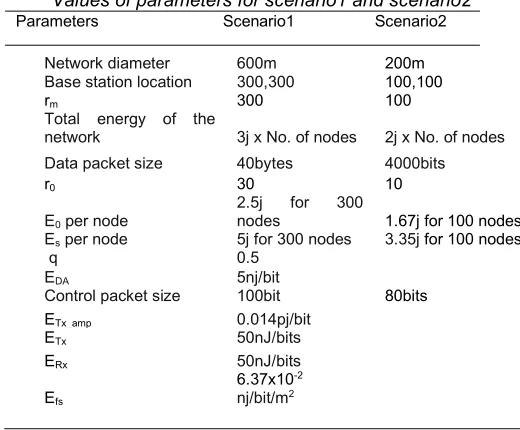
Values of parameters for scenario1 and scenario2
Parameters Scenario1 Scenario2
Network diameter 600m 200m
Base station location 300,300 100,100
rm 300 100
Total energy of the
network 3j x No. of nodes 2j x No. of nodes Data packet size 40bytes 4000bits
r0 30 10
E0 per node
2.5j for 300
nodes 1.67j for 100 nodes
Es per node 5j for 300 nodes 3.35j for 100 nodes
q 0.5
EDA 5nj/bit
Control packet size 100bit 80bits
ETx_amp 0.014pj/bit
ETx 50nJ/bits
ERx 50nJ/bits
Efs
6.37x10⁻²
nj/bit/m2
MatlabR2015b is used for simulation and executed on a computer having Intel® CoreTMi5 CPU @2.4GHz with 4GB
RAM. The table-1 shows the value of parameters used for simulation. A number of experiments have been conducted to evaluate the performance of the proposed protocol. Two different scenarios are used to evaluate E2ETD of EEUCR. The almost same set of protocols is used for comparison in two scenarios. In the Table-1 value of energy of Es and E0 is
shown for deployment of 300 nodes and 100 nodes for scenario1 and scenario2, respectively. The total energy of the network will be dependent on the total number of nodes deployed and accordingly, the energy of Es and E0 will vary. 3.1 Comparison of E2ETD of EEUCR with existing protocols for scenario1
3188
before every communication round and lastly, BS is deployed at the center of the field. The maximum delay of EEUCR is 38msec and minimum delay is 4msec. Nested ring’s performance is inferior to EEUCR but better than other protocols because it uses nested ring structure. Delay in VGB is close to the delay in nested ring routing. However, delay in VGB is more than the delay in Nested Routing because the VGB algorithm has a low number of intersection nodes and the traffic volume near these nodes is very high. VGDRA algorithm, performs better only than TTDD, because the BS moves outside of the region, the nodes farther away from the BS take a long time transferring their data to it, therefore the average delay increases. The TTDD algorithm has more delay than the others do, because, in the TTDD algorithm, data is transmitted on a cellular path to the BS. This causes a lot of traffic on the data transmission path, which leads to an increase in the average delay.
Fig. 3. Comparison for E2ETD of TTDD, VGDRA, VGB, nested ring, EEUCR for scenario1
Table-2
Values of TTDD, VGDRA, VGB, nested ring, EEUCR for delay(millisecond) for scenario1
No. of
nodes TTDD VGDRA VGB
Nested
Ring EEUCR
200 41 25 14 9 4 250 48 30 21 13 7 300 57 34 27 18 10 350 64 42 35 23 14 400 72 49 44 28 20 450 77 52 47 33 25 500 80 55 50 38 29 550 89 63 54 42 33 600 99 71 60 48 38
3.2 Comparison of E2ETD of EEUCR with existing protocols for scenario2
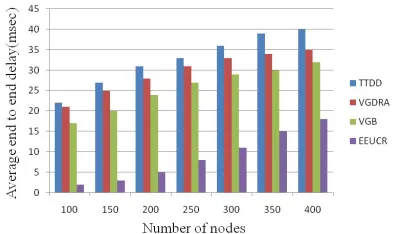
This is the small scenario, as the sensor field is of small dimensions. The routing protocols used for comparison with EEUCR[5] are TTDD[10], VGB[11], VGDRA[12]. Results of comparison of EEUCR with other protocols are shown in Fig.4 and Table-3. In this scenario also EEUCR performs better than other protocols because of reasons mentioned in scenario1.
Fig. 4. Comparison for E2ETD of TTDD, VGDRA, VGB, EEUCR for scenario2
Table -3
Values for E2ETD of TTDD, VGDRA, VGB, EEUCR delay(millisecond) for scenario2
No. of nodes TTDD VGDRA VGB EEUCR
100 22 21 17 2
150 27 25 20 3
200 31 28 24 5
250 33 31 27 8
300 36 33 29 11 350 39 34 30 15 400 40 35 32 18
4. CONCLUSION AND FUTURE SCOPE
EEUCR is an unequal static clustering routing protocol. Heterogeneous energy nodes are deployed in the sensor field. Cluster heads are selected on the basis of maximum remaining energy of the sensor nodes in the cluster. TDMA is used for intra-cluster communication. Next-hop is selected on the basis of weighted function of remaining energy and distance between the CH and next-hop. E2ETD of EEUCR is computed and compared with TTDD, VGB, VGDRA and nested ring for scenario1 and compared with TTDD, VGB, VGDRA for scenario2. The E2ETD of EEUCR is less than other protocols in both scenarios due to center position of BS, ring structure and static clustering. In future authors are planning to extend this work for mobile and multiple BSs.
REFERENCES
[1] P. Handa, B.Sohi A Survey on Various Layers of Wireless Sensor Networks, Journal of Mobile Computing, Communications & Mobile Networks, Vol 2, No 2, 2015, pp. 1-9.
[2] M. asif, S. khan, R. ahmad, M. sohail, and D. singh, (senior member, ieee), “Quality of service of routing protocols in wireless sensor networks: a review,” IEEE access, 2017.
[3] D. Chen and P. K. Varshney, “QoS Support in Wireless Sensor Network: A Survey,” Proceedings of the 2004 International Conference on Wireless Networks(ICWN2004), Las Vegas, Nevada, USA, June 2004.
3189
[5] P.Handa, T.S. Panag, B.S. Sohi, “ Energy efficient unequal clustering routing algorithm for WSNs,” IJRTE, vol. 8, issue 3, pp. 5040-5048, 2019
[6] W. Heinzelman, A. Chandrakasan and H. Balakrishnan, “Energy efficient communication protocols for wireless microsensor networks,” in: Proceedings of the 33rd Hawaiian International Conference on Systems Science, 2000.
[7] P.Handa, T.S. Panag, B.S. Sohi, “Enhancing Packet Delivery Ratio and a lifetime of Wireless Sensor Networks using Energy-Efficient Unequal Clustering Routing Algorithm”, IJITEE, Volume-8, Issue-12, October 2019(accepted)
[8] M. Liu, S. Xu, and S. Sun, “An agent-assisted QoS-based routing algorithm for wireless sensor networks,” J. Netw. Comput. Appl., 2012, vol. 35, no. 1, pp. 29-36.
[9] R. Yarinezhad, “Reducing delay and prolonging the lifetime of wireless sensor network using efficient routing protocol based on mobile sink and virtual infrastructure” Ad Hoc Networks ,2019, pp.42–55. [10] H. Luo , F. Ye , J. Cheng , S. Lu , L. Zhang , TTDD:
Two-tier data dissemination in large-scale wireless sensor networks, Wireless Netw. 2005, pp. 161–175 . [11] R. Yarinezhad , A. Sarabi , “Reducing delay and
energy consumption in wireless sensor networks by making virtual grid infrastructure and using mobile sink,” AEU –Int. J. Electron. Commun, 2018, pp.144– 152 .
[12] A .W. Khan , A .H. Abdullah , M.A . Razzaque , J.I. Bangash , “VGDRA: a virtual grid-based dynamic routes adjustment scheme for mobile sink-based wireless sensor networks,” IEEE Sensors J. , volume 15, issue 1, 2015, pp. 526–534 .